On 8 February 1793, just over two weeks after the execution of the King Louis XVI of France in the Place de la Révolution, and with a city on the verge of the Reign of Terror, the daily Journal Général de France – as if nothing were amiss – advertised a new publication entitled Concerto pour la guitarre avec accompagnement de deux violons, alto et basse by a certain Mr Vidal.Footnote 1 This work, considered the earliest guitar concerto,Footnote 2 was composed by an obscure musician of Spanish origins whose biographical details are largely unknown.
The vogue for the guitarFootnote 3 in France during the second half of the eighteenth century has been little studied. Even books on guitar history treat this period in a cursory manner, as if there were no major guitar composers and no repertory worthy of attention.Footnote 4 As we shall see, however, the guitar was popular in Paris from the late 1750s onwards, with peaks that indicate an enormous popularity among amateurs. The instrument underwent something of a transformation: it moved from five double courses to six single strings, substituted tablature for staff notation and acquired a repertory for voice and guitar which, towards the end of the century, began to encompass solo and chamber music. This process was carried out by guitarists mostly overlooked by musicology, and among them Vidal was probably one of the most prominent figures.
Most of what we know about Vidal derives from a brief entry by Anik Devriès and François Lesure in their 1979 volume Dictionnaire des éditeurs de musique français.Footnote 5 This provides information relating to Vidal's activity as a publisher, recording two addresses where he was established between 1787 and 1795 and the name of the business he ran, Les Soirées Espagnoles, but it provides no other relevant data. However, some details in this entry, as we shall see, are not altogether accurate. Vidal's first name is not known, which makes it difficult to trace him; however, many sources refer to him as ‘B. Vidal’, following François-Joseph Fétis's Biographie Universelle des Musiciens (1835–1844).Footnote 6 Fétis in turn probably drew from Ernst Ludwig Gerber's Neues Historisch-biographisches Lexikon der Tonküstler (1812–1814).Footnote 7 Although references in several later dictionaries seem to have copied Fétis, no eighteenth-century document has been found which uses this initial, and in fact Gerber – Fétis’ likely source – had compiled an earlier dictionary in 1790–1792, the Historisch-biographisches Lexikon der Tonkünstler, in which he included Vidal without any initial.Footnote 8 As regards musicological consideration of Vidal's works, in 2010 Erik Stenstadvold provided valuable information about the guitar methods Vidal compiled.Footnote 9 At that stage, only two methods were known, but since that time two further methods have surfaced. There has been no other serious study of Vidal, and the present article seeks to throw new light on this intriguing character, as well as providing – for the first time – a checklist of his works (see the Appendix).
‘LE TEMS DE MERCHI’
In the introduction to his Seconde méthode de guitare (Paris, 1813–1816) the French guitarist Antoine Gatayes made a passing reference to the most important guitarists on the Parisian scene in the second half of the eighteenth century:
C'est à peu près dans le tems de MERCHI, que de grands Professeurs ont paru. VIDAL, TRILLE-LA-BARRE, SIMON, PATOUARD, BOYER, ont encore développé le charme de la Guitare; VIDAL, par une exécution savante et hardi.Footnote 10
It was around the time of Merchi that the great masters appeared. Vidal, Trille-la-Barre [Trille Labarre], Simon, Patouard [Patouart] and Boyer further developed the charm of the guitar – Vidal, with a learned and bold execution.
‘Le tems de Merchi’, to which Gatayes refers, had begun in 1753 with the arrival in Paris of the Italian brothers Giacomo and Joseph Bernard Merchi (though Gatayes mentions only one brother, whom he praises warmly but does not identify).Footnote 11 There had been a marked decline of interest in the guitar in France after its heyday during the reign of Louis XIV (reigned 1643–1715), and the presence of the Merchi brothers in the metropolis gave a definitive impulse to this new vogue. This was especially the case from 1755 onwards, when they were granted a privilege for publishing music,Footnote 12 although it was not until 1757 that advertisements for guitar music appeared in the press.Footnote 13 This new interest in the guitar was also noted in the Encyclopédie by Denis Diderot and Jean le Rond d'Alembert, where, under the entry ‘guittare’, we read that ‘some devotees have caused the guitar to be reborn and have at the same time reawakened our taste for our vaudevilles, pastorales and brunettes, which have thereby acquired a fresh appeal’ (‘Quelques amateurs l'ont fait renaître, & ont en même tems réveillé notre goût pour nos vaudevilles, pastorales & brunettes, qui en acquerrent un nouvel agrément’).Footnote 14 Alongside the brothers Merchi, several other individuals began to pay attention to the guitar in the late 1750s and early 1760s. They included Mr Simon (member of the Académie Royale de Musique), Jean-Baptiste Dupuits des Bricettes (‘directeur & professeur de l’école publique de musique’), Pierre Lagarde (‘compositeur de la chambre de S. M.’), the anonymous Don *** (author of the earliest guitar method so far identified),Footnote 15 Louis François Joseph Patouart (‘ordinaire de la chambre du Roi’) and Michel Corrette. As we can see, several of these names were associated with the Académie Royale de Musique or the king's Musiciens de la Chambre, which indicates that the fashion for the guitar was taken up by some prominent musicians following its lull in popularity after the death of Louis XIV.
The instrument in these early years had not evolved much from the so-called baroque guitar. It had five double courses, the fifth and fourth, in standard usage, being an octave pair, and was used mainly to accompany songs.Footnote 16 The vast majority of publications were recueils or collections of pieces, most of them for voice with guitar accompaniment, containing chansons, brunettes or ariettes known at that time or recently premiered at the theatres of the city. At least fifty such recueils for guitar and voice were issued in Paris between 1757 and 1769, a number which would increase dramatically in the two following decades. Merchi, most probably Giacomo, was clearly the most prominent figure in the 1760s.Footnote 17 He began in 1757 with his Recueil de chansons, a series of collections for guitar and voice (in subsequent publications he would mostly employ the term livre instead of recueil). By 1770 he had already published twenty of these collections, and another fourteen appeared in print before the end of his career in 1780.
‘MONSIEUR VIDAL, MAÎTRE DE GUITTARE’
The first written trace of Vidal dates from 3 April 1769, when the weekly L'avant-coureur announced his Recueil de menuets pour guittare avec les Folies d'Espagne variées. This appears to have been a collection of pieces for solo guitar published by Boüin; Vidal is named on this advertisement as maître de guittare.Footnote 18 Vidal seems to have been an immigrant from Spain seeking his fortune in Paris. He probably arrived at the latest by the end of 1768 or in early 1769, in time to make contact with the publishers before the appearance of his first work. Publishing works based on les Folies d'Espagne would have called attention to his Spanish identity, since the guitar was considered in France to be a Spanish instrument. Maître clearly indicated his availability and willingness to give lessons on the guitar. In Paris in the early 1760s, only a handful of guitarists – including Merchi, Favier and Mignard – can be traced giving guitar lessons; to this small number Vidal and another important figure in the following decades, Jean François Guichard, are mentioned in 1769. Vidal also taught singing, for in March 1770 he appeared in the Journal de la Musique as maître de musique vocale, with his address given as rue des Vieux-Augustins, à l'Hôtel des Quatre Saisons, a central setting close to La Place de Victoires.Footnote 19
In order to understand the profile of the amateur enthusiast taking guitar lessons at that time, the words by Philippe Macquer in his Dictionnaire portatif des Arts et Métiers (1767) may be illuminating: ‘the guitar, instrument of fantasy, suitable for accompanying a single voice, has become fashionable in Paris, especially among the ladies’ (‘La Guitarre, instrument de fantaisie, propre à accompagner une voix seule, a pris une vogue à Paris, sur-tout parmi les Dames’).Footnote 20 Women seem to have been a significant majority of the amateurs learning to play this instrument. Guitar was among the instruments – besides the harpsichord, piano, harp and lute – considered to have ‘befitted the respectable bourgeois woman’.Footnote 21 Fashionable ladies were expected to sing, and it became common for women to take singing lessons.Footnote 22 Since the guitar and the voice were intimately related, as Macquer states, several guitar teachers began to advertise themselves – like Vidal – as ‘maître de chant’ or ‘maître de goût de chant’ as an extra way of earning a living.Footnote 23
Vidal arrived in Paris at a fortunate moment for a guitarist, for the volume of music being produced for the instrument was from 1770 increasing at a great rate. This interest may have had something to do with Marie Antoinette, who on 16 May 1770 married the future Louis XVI. She is known to have been very fond of music, playing the harpsichord, harp and probably also the guitar.Footnote 24 In November 1770 the publisher Nicolas Jolivet advertised a weekly periodical of airs avec accompagnement de guitare,Footnote 25 set by Patouart le fils.Footnote 26 This publication, La muse lyrique, was dedicated to ‘Madame la Dauphine’: that is, to Marie Antoinette. Jolivet changed the dedication from ‘Madame la Dauphine’ to ‘La Reine’ when Louis XVI ascended the throne with Marie Antoinette as queen in May 1774.Footnote 27 A weekly publication with such a royal dedicatee may have had some considerable impact on the fashion for this instrument.Footnote 28
Vidal began to work actively within the recueil genre with the publisher Boüin, who at that time operated in one of the most central streets of the city, the rue Saint-Honoré, close to Saint Roch.Footnote 29 Between 1769 and 1774 Vidal published three such collections with this publisher; by 1777 the number had risen to eight, and by around 1785 he had already produced seventeen. Boüin, seeing the potential in Vidal as early as March 1772, began to distribute his music in other major towns in France. His 2ème Recueil d'airs d'opéra-comiques with guitar accompaniment was advertised as being sold in Lyon, Toulouse, Lille and Bordeaux in addition to Paris.Footnote 30
To understand the amount of music that Vidal devoted to this genre we need to take a closer look at one of these recueils. For example, his 3ème Recueil, advertised in 1774,Footnote 31 contains eleven songs for voice and guitar, with titles such as Quand l'amour, Air de la belle fermière, Quand on est jeune garçon, Loin de toi and so forth; this was clearly a genre of music targeted at amateurs keen to sing les beautés de l'amour to their male or female muses. The size of these collections could vary considerably, but would normally consist of twenty to thirty pages containing mostly songs with guitar accompaniments, and sometimes also pieces for solo guitar, depending on the type of recueil. The title of this kind of collection, Recueil d'airs d'opéra-comiques, implies that there was a high demand among amateurs for arrangements of airs of comic operas that had been performed at the various music theatres of the city. The instrument accompanying the voice had traditionally been the harpsichord, but the harp, and especially the relatively cheap and portable guitar, increasingly entered this new trend.
Around 1774 Vidal made some connections in other French cities, notably Lyon and Nantes.Footnote 32 The most important music publisher in Lyon, Jean Antoine Castaud, published at least two of his recueils.Footnote 33 This publisher was familiar with the guitar since he had already sold the works of other guitarists, mainly Merchi.Footnote 34 In December 1774 Castaud published Vidal's Septième recueil de pièces & d'airs nouveaux with guitar and violin accompaniment ad libitum. The press advertisement promoted Vidal by stating that ‘the reputation of the composer precedes this collection’.Footnote 35 This recueil was dedicated to Mademoiselle Cornabé de Champvieux, most probably Suzanne, daughter of Daniel Cornabé, négociant et bourgeois from Lyon.Footnote 36 To judge by the dedication, Vidal had been giving her lessons. Vidal is referred here as Vidal l'aîné, maître de guittare, which seems to indicate that he was the elder of two brothers or of other individuals with the same surname.Footnote 37 Vidal l'aîné is mentioned again in 1776 in an advertisement of his 4ème Recueil, but this time it was published by Boüin in Paris and again included the mention of his profession as maître de guittare.Footnote 38 I have not found any differences in the style of the compositions where Vidal is mentioned as l'aîné and those where he is not. In fact if we compare, for example, his seventh Recueil with Castaud (Lyon, 1774) with his Soirées Espagnoles with Boüin (Paris, 1776) we find that Vidal actually reused, in the French capital, some of the pieces previously published in Lyon under the name Vidal l'aîné. The fact that no other pieces by Vidal l'aîné have been found, as well as the high number of this recueil, suggests with a high degree of certainty that there was only one Vidal composing music for guitar.Footnote 39
LES SOIRÉES ESPAGNOLES
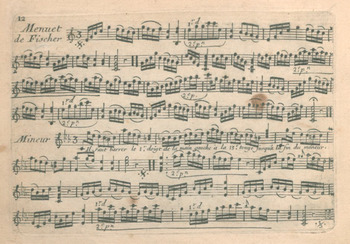
Probably the most remarkable year in the career of Vidal was 1776. The Annonces, affiches et avis divers of 28 December 1775 announced a new and important project for him, Les soirées espagnoles, a weekly periodical for guitar music published by subscription, containing one or two pieces for voice and guitar and one or two pieces for solo guitar. For this series Vidal wrote music that in some cases must have been quite challenging for amateurs with not much knowledge of the instrument. In Figure 1 we can see one of the brief pieces included in this periodical. It is a minuet in ABA form, in C major moving into C minor, a key especially difficult for guitar amateurs. This piece requires not only some dexterity playing violinistic scales, but also a prolonged use of a demanding technique known as ‘barré’ (barring), where the performer must – as Vidal indicates – ‘barrer le 1.r doigt de la main gauche à la 13.e touge jusqu’à la fin du mineur’ (hold the first finger of the left hand on the thirteenth fret until the end of the minor section).Footnote 40
Vidal, ‘Minuet de Fischer’ and ‘Mineur’, from Les Soirées Espagnoles (Paris: Boüin, 1776), 12. An amateur would be required to have a significant level of dexterity to play these passages in semiquavers. Bibliothèque Nationale de France, Y-438. Used by permission

It is not clear how long this periodical lasted, but advertisements for the years 1776, 1777 and 1782 have been found. The Almanach Musical for 1783 also has a reference to it, and this may imply that the journal continued from 1776 until 1783.Footnote 41 The Bibliothèque Nationale de France has a complete copy of the volume for the year 1776, which comprises no less than 260 pages of songs with guitar accompaniment and solo music for guitar. Les soirées espagnoles was printed by Boüin in Paris and distributed in Versailles and Bordeaux (as the title-page indicates), but it may also have had a wider dissemination. With this publication Vidal was joining the list of composers producing periodicals for guitar in those years. In fact, in 1776 at least six periodicals for guitar coexisted in Paris, which indicates the presence of an active guitar scene within the city.
In March 1776, only a couple of months after Les Soirées Espagnoles had been launched, Vidal's Nouvelle méthode de guitarre, Op. 8, dedicated to Mademoiselle Genty, was advertised.Footnote 42 This method was sold, as the advertisement states, in Paris, Versailles, Lille, Brussels and Bordeaux. The appearance of other guitar tutors also shows the great interest in the guitar in those years. In January 1777 new methods by both Merchi and Corbelin appeared, and in the ensuing years composers such as Baillon, Boutard and Guichard followed suit. The productions of recueils for guitar also increased, especially in the years 1774, 1776 and 1777. In this last year alone at least thirteen recueils were advertised in the Parisian press from composers like Corbelin, Tissier, Mademoiselle Cherbourg and Dutilly as well as Vidal. Three recueils were by him, his sixth, seventh and eighth, all of them with Boüin.
As if all this were not enough, in 1776 Vidal played at the Concert Spirituel, as noted by Les Spectacles de Paris in 1777. With no further information, Vidal is mentioned among ‘the virtuosos that have shone’ (‘les virtuoses qui ont brillé’) in a list that includes musicians such as Jarnowick, Lefebvre, Loifel, Bezozzi, Lebrun and others.Footnote 43 Vidal is known to be the only guitarist to have played in this prestigious series of public concerts since its foundation by Anne Danican Philidor in 1725.Footnote 44
In 1778 the Almanach Musical listed a publication of the previous year with the title Recueil d'airs avec accompagnement de guitare et clavecin, Op. 19. What is interesting about this work – besides the fact that it also includes pieces for clavecin (either solo or accompanying the voice) – is that the title states that the collection is available in Nantes at the home of the author (chez l'auteur) as well as from the publisher Bignon in Paris. As has been shown, Vidal had an important workload in Paris those years, and this makes difficult to imagine that he would have moved to a city as far away as Nantes. Moreover, in Almanach Musical 1777, 1778 and 1779 Vidal is referred as maître de Guitare at the same address in Paris, at the rue du Petit-Carreau, implying that he maintained a permanent residence in the capital.Footnote 45 So if he did in fact move to Nantes, it would probably have been for a very brief period only, without leaving his residence in Paris.
Vidal changed his Paris address some time between 1779 and 1782. In February 1782 he was advertised as maître de guittare at rue Neuve S. Eustache hôtel d'Anjou,Footnote 46 an address he still had in 1783.Footnote 47 Besides this change of address, little is known of him between 1778 and 1785. By examining the different catalogues of the publishers with whom he worked, however, we can infer that he was busy writing music. A Boüin catalogue of 1783 shows five more recueils than that of 1774, while the subsequent catalogue of c1783–1784 shows a significant number of new compositions: ten sonatas for solo guitar, ten duos for violin and guitar, two potpourris for guitar and violin and six new recueils.Footnote 48 This implies that Vidal, with all his professional commitments, remained in Paris during those years teaching, composing and playing in different venues.
‘UN DES PLUS CÉLÈBRES MAÎTRES DE GUITARE DE L'EUROPE’
By 1785, the Tablettes de Renommée des Musiciens, a publication listing musicians active in Paris, was referring to Vidal in these terms:
VIDAL, un des plus célèbres et les plus habiles maîtres de guitare de l'Europe, a fait une Méthode pour cet instrument, & plusieurs des Œuvres de Duo, Sonates, & Recueils d'Airs, avec des Variations d'un genre Savant & digne de l'exécution des plus grands Maîtres.Footnote 49
Vidal, one of the most famous and most skilful guitar masters in Europe, has composed a method for this instrument, and several duos, sonatas and collections of airs, with variations in a learned style worthy to be performed by the greatest masters.
In the Tablettes a selected number of names – apparently considered the most important musicians – were emphasized through the use of capital letters. Of the twenty-eight guitarists listed, only four are highlighted in this way: Baillon, l'abbé Guichard, Merchi and Vidal. An analysis of these four entries shows that among them Vidal receives the most attention and recognition. Baillon's entry focuses on his achievements as publisher of music for guitar, Merchi's on his compositions (especially his methods for guitar) and Guichard's upon his being ‘renommé pour le goût de chant et de guitare’ (renowned for his taste in singing and the guitar). As the quotation above shows, the writer gives credit to Vidal for being one of the most skilful guitarists in Europe, and praises his compositions in a ‘learned style worthy to be performed by the greatest masters’, which were probably the highest compliments that could be paid to a guitarist.
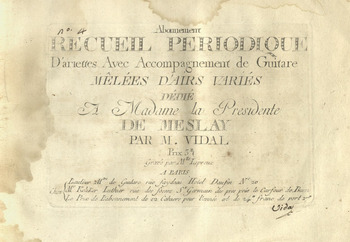
Although Vidal continued working with Boüin during these years, a new direction in his business practice can be seen in 1786. In January that year he started a new periodical with the publishers Jean Gabriel Koliker and Mademoiselle Le Beau. Entitled Recueil périodique d'ariettes and dedicated to Madame la Presidente de Meslay,Footnote 50 this periodical was issued in monthly instalments with approximately fifteen pages of music, half of which was solo music.Footnote 51 The fourth instalment, supposedly for the month of April, shows the author at a new address, rue Feydeau Hotel Daufin no. 20 (see Figure 2). Nonetheless, Vidal seems to have stayed there only a few months, since in September we find him at yet another address, rue de Richelieu, but with no number given.Footnote 52 In this central street Vidal set up his own publishing business, which from January 1787 was given the signboard name Soirées Espagnoles. One of the very first works he issued as a publisher was a Duo concertant pour clavecin ou forte-piano et violoncelle by Le Chevalier Léaumont.Footnote 53
Title-page from Recueil périodique d'ariettes avec accompagnement de Guitare No. 4 (Paris: Koliker, April 1786), which shows the new address of the author and signature at the foot of the page. Musikmuseet arkiv, Stockholm. Used by permission

By the end of 1786 Vidal appears to have decided to stop working on the Recueil Périodique with Koliker and Le Beau in order to launch his own Journal de Guitare, which was announced in these terms:
Le premier cahier de journal de Mr Vidal pour 1787 paroîtra au commencement de janvier. Ce journal sera composé de 12 cahiers pour l'année. Les ariettes, outre l'accompagnement de guittare, auront un accompag.t de violon ad libitum séparé du journal. Le prix de l'abonnement est de 24tt franc de port. On souscrit chez l'auteur, aux Soirées Espagnoles Magasin de Musique, Rue de Richelieu, entre la rue ménar et la rue neuve S.t marc, N°. 99. A Paris.Footnote 54
The first number of Mr Vidal's journal for the year 1787 will appear in early January. It will be composed of twelve parts per year. The ariettes, in addition to the guitar accompaniment, will have an ad libitum violin accompaniment separate from the journal. The subscription price is 24tt [livres tournois] with postage paid. One can take out a subscription with the author at the music shop Les Soirées Espagnoles, rue de Richelieu, between rue Ménar and rue neuve St. Marc, N°. 99. In Paris.
On 25 September 1787 Vidal received a privilege to publish this journal for ten years.Footnote 55 It is not quite clear exactly how long it lasted, but after March or April 1790 it was discontinued for more than a year and then resumed some time afterwards, as we shall see.
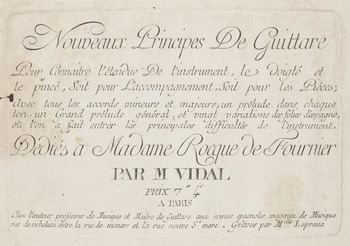
In 1787 or 1788 Vidal published his second method, entitled Nouveaux Principes de Guittare, dedicated to Mme Rocque de Fournier (see Figure 3), a simple method of twenty-one pages written for a five-course guitar with the fourth and fifth being an octave pair, where he explains in a ‘more lucid way’ the precepts of the instrument pour les commençants.Footnote 56 Vidal could have made a more complicated method, especially after seeing the complex Traité des agréments de la musique Op. 35 that Merchi had devoted to the guitar ten years before, but somehow Vidal wanted simplicity and something ‘low-priced’. While Merchi's treatise (thirty-eight pages) cost nine livres, Baillon's Nouvelle Méthode (sixty-three pages) published in 1780 cost twelve livres. Vidal's method had the exact same price as Francesco Alberti's Nouvelle Méthode (thirty pages) published in 1786Footnote 57 – seven livres and four sous – something more affordable for the mass of amateurs wanting to learn this instrument and not willing to spend too much on it. Another relevant guitar method at that time, the Nouvelle méthode pour la guitarre, Op. 7, by Barthélemy Trille Labarre (c1789), cost twelve livres for its eighty-two pages – almost four times the number of Vidal's second method (twenty-one). This shows that Vidal had by far the most expensive ratio per page among the guitarists at that time. Actually, printed music seems to have been an extremely high-priced distraction only reserved for aristocrats if we compare it with the value of other goods at that time.Footnote 58
Title-page from Nouveaux Principes de Guittare (Paris: author, c1787). Royal Academy of Music, London, Robert Spencer Collection, 121132.1001. Used by permission

From around 1787 a new trend in the production of guitar music can be observed. The published material shows that amateurs gradually became more interested in instrumental music, while the productions of the recueils began to decline. The periodical publications seemed to control the market for airs with accompaniment, and by 1789 the production of single recueils had fallen dramatically. An overview of the periodicals for guitar in these years looks like a chess board where someone quits his position and suddenly another one comes into play. In January 1787, when Vidal started his Journal de Guitare, Corbelin also began his Collection de la musique de Grétry that included accompaniments for guitar as well as for the harpsichord or fortepiano and the harp. If we add to the equation La muse lyrique that was still being published by Mme Baillon, with Porro as arranger, it can be seen that three important periodicals were being published concurrently early that year. But in 1787 Porro separated from Mme Baillon, which prompted her to hire the thirty-year-old Trille Labarre to continue La muse lyrique. Subsequently, in 1788, Porro created his own Journal de Guitare, which would last almost twenty years.Footnote 59 Besides all this activity, another publisher interested in the guitar, Pierre Le Duc, entrusted Trille Labarre around August 1789 with a yet another periodical for the instrument, Journal d'airs italiens et français, which was apparently to be published daily.Footnote 60 Whatever the case may be, three guitarists in 1788–1790 were occupied in the periodical business: Vidal, Porro and Trille Labarre.
As already mentioned, Vidal initiated a career as a publisher in September 1786 by establishing himself at rue Richelieu 99.Footnote 61 This activity seems, however, to have lasted only until early 1790, but would be revived again some years later, in about 1795. Vidal moving to rue Richelieu may not have been a sheer coincidence.Footnote 62 In fact, it was a perfect location to start a business related to music. In 1783 the Comédie Italienne had moved to the new building designed by Jean-François Heurtier called the Théâtre Favart. Vidal situated his shop less than a hundred metres away from this building in a very central street that connected the Comédie Italienne with the Royal Palace, which gives an idea of the kind of environment in which the guitar was present. This was an ideal place to sell music to music-lovers, perhaps with a bright and colourful shop window to capture the attention of passers-by on their way to the theatre.
In these three and a half years of publishing activity from 1786 on, Vidal worked either alone or in association with other publishers, mainly the Savigny brothers. Advertisements for just three pieces are found in which Vidal is associated with other publishers such as Thomassin, Bailleux and Le Duc. Vidal published at least twenty-two works by other contemporary musicians,Footnote 63 mainly minor composers such as Abraham, Chapelle, Davaux, Ennery, Léaumont and others, although there is also one work by Clementi and another by Cherubini. In the field of the guitar there is an interesting work by a certain Spaniard, Antonio Ximénez (1745–1826), ‘premier violon de la Collégiale d'Alicante’. His Trois trios pour guitarre, violon et basse, Op. 1, are good examples of quality music for guitar written at that time.Footnote 64
‘AT SWALLOW-STREET ST. JAMES'S, LONDON’
On 14 October 1791 the Annonces, affiches et avis divers announced that ‘Mr Koliker, luthier . . . has acquired works of Mr Vidal, teacher of guitar. He has just published the seventh opus of duos for guitar and violin that Mr Vidal composed during his last trip to London’ (‘M. Koliker, luthier . . . a fait acquisition des œuvres de M. VIDAL, Maître de guittarre. ll vient de faire paroître le 7ème œuvre de Duos pour guittare et violon que M. Vidal a composé dans son dernier voyage à Londres’).Footnote 65 The fact that Vidal had been in London for some time was confirmed three days later in the Journal Général de France:
M. Vidal, auteur d'un journal de guitarre fort estimé, qu'il a donné pendant plusieurs années avec le plus grand succès, a été forcé de l'interrompre depuis quinze mois pour un voyage à Londres, où il étoit désiré. Revenu depuis quelques mois à Paris, il reprend ce travail agréable.Footnote 66
Mr Vidal, author of a highly esteemed guitar journal, which he issued for several years with the greatest success, has been forced to interrupt it for the last fifteen months because of a trip to London, where his presence was required. Having returned to Paris a few months ago, he continues this pleasant work again.
It is not clear why Vidal went to London, but these were turbulent days in Paris, and there is fortunately some information to be extracted from these two references about his English sojourn. First, if we trust the second announcement (most probably written by Koliker himself), the Journal de Guitare had been interrupted in mid-1790, and secondly, it is possible that Vidal had been to London previously, since the first announcement uses the words ‘his last trip to London’. If we count the fifteen months mentioned by the second report, Vidal may have left in July 1790, but the lack of reported activity in the final months before that may indicate a slightly earlier date, around May.Footnote 67 The fact that Vidal was not at the same address after his return to Paris may indicate that he closed his business and set off for London with no plans for a speedy return.
There may have been several causes that prompted him to leave, a worsened economic situation probably being a vital one. The departure of nobles after the fall of the Bastille in 1789 would have made him lose part of his earnings, since aristocrats constituted much of his clientele. Vidal had, for example, dedicated works to la comtesse de Pont de Rennepont (1777), la marquise de Beuvron (1782), le comte de Monet (1787) and le comte Xavier de Schœnberg (1789), among others, and he surely also performed for such an elite audience. Around three quarters of the 130,000 Frenchmen registered in the official lists of émigrés were aristocrats or closely related to this social class; that is to say, the most important patrons of and benefactors for musicians and artists in general left the country in the aftermath of the Revolution.Footnote 68
The music-publishing business was seriously affected by these events. An analysis of the general press advertisements for new musical publications from 1782 to 1798, as listed in Anik Devriès-Lesure's L’édition musicale, reveals a dramatic decrease in advertisements in the years after the Revolution. Apart from an exceptional peak of nearly eight hundred in 1784, the period 1782–1788 was relatively stable, with an average of some 535 advertisements per year. However, this number dropped to about 225 per year in the ten-year period beginning with 1789, with the lowest figure, only some 84, in 1793.Footnote 69 This decay surely reflects the troubled situation in France at the time. Howard G. Gordon describes France in 1795 as being ‘a country in tatters’, with ‘alarming grain shortages and a collapsing currency’, where ‘crime and suicide soared along with prices’ and an ‘intensive warfare that had already lasted three years’ imposed huge burdens on state and society.Footnote 70
Under such circumstances, London seemed the proper place for a musician to wait for the storm to pass, a place with a growing French community and an important cultural life. Many French citizens who left the country were professional people producing fine or even luxury goods and services, such as the makers of watches, fashion accessories and music. The painter Elizabeth Vigée, the fashion designer Rose Bertin and the piano maker Sébastien Érard are examples of emigrants who made a fortune among the émigré elite in London at that time.Footnote 71 Other artists aimed for other countries. Such is the case with the aforementioned guitarist Trille Labarre, who in about 1793 emigrated to North America, never to set foot again on French soil.Footnote 72
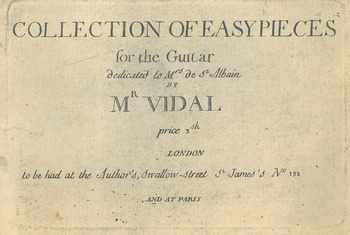
Vidal's activity in London remains mostly obscure. Traces of him have not been found in the newspapers of the capital. However, he had some connection with a certain Mrs de St. Albain, to whom he dedicated a Collection of Easy Pieces for the Guitar. This publication is the only known work by Vidal issued in Britain and seems to be one of the very first works for the Spanish guitar ever published there, in late 1790 or early 1791. The title-page states that it was ‘to be had at the author's At Swallow-Street St. James's N° 132’ (see Figure 4), a central road between Piccadilly and Oxford Street.Footnote 73
Title-page from Collection of Easy Pieces for the Guitar (London: author, c1790–1791). Possibly the first music printed for the Spanish guitar in England. Národní Muzeum, Prague, XLII-A-267. Used by permission

Mrs de St. Albain was the name given in England to Mme St. Aubin née Marie-Françoise Henriette Laché, a Frenchwoman with some skill on the guitar who lived in London permanently after 1789. After being the mistress of Charles-Pierre Maximilien Radix de Sainte-Foy, with whom she had travelled several times to London, she became the lover of the Marquis George James Cholmondeley and gave birth to their illegitimate daughter in August 1789.Footnote 74 It is quite possible that Mme St. Aubin, interested in the guitar, had had some contact with Vidal before she left for London in 1789 and that she introduced him to the high society during his stay in the English capital. His connections with the London beau monde are revealed by the dedication in early 1792 of 6 Sonates pour la guitarre & violon obligé to the Baron of Coleraine, a work published by Koliker after Vidal's return to Paris.Footnote 75 George Hanger, Fourth Baron of Coleraine, was an Englishman who served throughout the American Revolutionary War.Footnote 76 After returning to England he became companion to the Prince of Wales and appointed his equerry in 1791. This dedication places Vidal close to the future King George IV, since the guitarist was in London during the years when Hanger and the prince were intimates.
The return of Vidal to Paris in 1791 may have been motivated by the rumours of a new constitution in France, which finally materialized on 3 September that year, and the promise of an amnesty (finally declared on 30 September 1791 by the Constitutional Assembly) to the emigrants who had abandoned their country in the two previous years. The fact that the ‘Spanish’ guitar was not yet à la mode in England, and thus that no market for it existed at that time, may also have induced Vidal to return to the French capital where he was so well considered and had enjoyed so much success. Vidal certainly returned to Paris at the right time. A decree ordering the emigrants to return before 1 January 1792 – failing which they would be declared rebels, deprived of their rights and even sentenced to death – was proclaimed on 9 November 1791. It may be no coincidence that the only two references to his return in the newspapers, on 14 and 17 October, are very close to these dates. Although the decree was vetoed by the king two days later and did not take effect, ‘the unbending severity of the universal condemnation sent shock waves through the émigré community’.Footnote 77 It is as if Koliker wanted everybody to know that Vidal was a virtuous patriot by having already returned. But when exactly was he back in Paris? The aforementioned report in the Journal Général de France on 17 October 1791 says that this happened ‘a few months ago’. The best guess is that he returned some time soon after 9 July, when a triple tax was proclaimed to be imposed on émigrés ‘if they had not returned within a month’.Footnote 78
CONCERTO POUR LA GUITARRE
After returning from England in 1791, Vidal began to publish his music with Jean-Gabriel Koliker. He had already worked with him in 1786 with the Recueil Périodique, but now this publisher was also in charge of continuing Vidal's Journal de Guitare, as mentioned above. Vidal also changed his modus operandi after his return. He now worked again with different publishers, such as Koliker, Durieu, Boyer and Boüin in 1791–1793. As we have seen, Koliker had started to publish Vidal's Journal de Guitare again, issuing ‘two numbers per week’,Footnote 79 which indicates a resumption of intense activity by the composer. Before 1790 he had always given the address where he had his business and where he had been teaching, but after his return in 1791, there is no trace of his address before 1794. None of the few advertisements for his music contains such information, which suggests that he did not continue with his business in rue Richelieu. However, the music scores of this period do style him maître de guitare, which suggests that he was active giving guitar lessons.
In this new start Vidal made some connections with the bourgeoisie. In early 1792 there appeared Vidal's Six Duos concertants pour guitarre et violon in honour of a certain M. Collot,Footnote 80 most probably Jean Marie Collot d'Herbois (1749–1796), deputy for Paris in the Convention Nationale and briefly president of this institution, a man with an artistic background as an actor and theatre director. Since he was responsible for the execution of more than two thousand people in Lyon, where he was sent to stifle the revolt of October 1793 (after having joined the Comité de salut public the previous month), he was a man to be friends with in the worst times of la Terreur.Footnote 81 Vidal also dedicated a work to Don Alfonso de Aguirre (Alfonso de Aguirre y Yoldi), a Spanish diplomat who spent three years in Paris before returning to Spain in early 1793.Footnote 82
Vidal's Concerto pour la guitarre, advertised on 8 February 1793, was probably the last work Boüin published before closing his business.Footnote 83 In fact, printing the first known guitar concerto, composed by a friend with whom he had worked for almost twenty-five years, could be seen as a poignant way in which to finish his career as a publisher. It is not clear whether this work was written for a five-string or a five-course guitar. As we shall see, Vidal himself would specify a five-string instrument in 1797, although he may have still been using double strings in 1793. This work was a relatively modest composition for a soloist accompanied by only two violins, a viola and a cello, a formula that worked perfectly as a chamber-music quintet and as a concerto,Footnote 84 depending on the number of performers doubling the string parts. It was composed in two fast movements, Allegretto and Rondo Allegretto, a structure that apparently derives from the ‘Italian’ two-movement plan that was relatively common in Paris at that time.Footnote 85
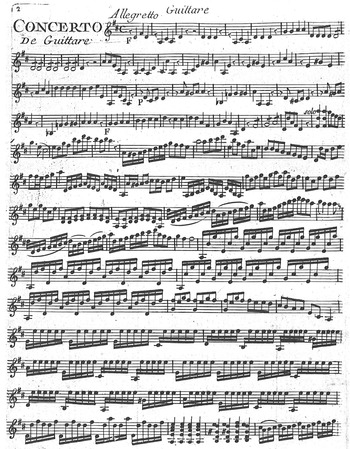
This work was briefly analysed by Stanley Yates in 2010 in the Foreword to the only existing modern edition for the guitar (published with a piano reduction).Footnote 86 The first movement, written in D major, follows a sonata form with three thematic units (D major, A major and D minor) later developed by the soloist. The alternation of major and minor sections is somewhat characteristic of Vidal's language throughout the concerto. In the words of Yates, ‘it is tempting to connect this feature with Vidal's Spanish background and the Iberian sonata style, where the juxtaposition of major and minor modality is a decided feature’.Footnote 87 Figure 5 shows the first page of the guitar part of this movement, and this demonstrates some of the techniques that Vidal employs all over the concerto: running scales typical of violinistic writing, fast ascending arpeggios in triplets and tremolo passages. The second movement, also in D major, was in fact a rearrangement of a movement from the duo No. 5 of Vidal's Six Duo Concertants, Op. 24, for guitar and violin (published c1782 by Boüin).Footnote 88 It follows a rondo structure with the tutti always playing the refrain after the soloist in identical form throughout the movement. The scales and arpeggios in such a rapid tempo are also demanding in this movement, and the demisemiquavers are of considerable difficulty. Even the briefest of consideration of the technical skills required for the interpretation of this work demonstrates clearly that this concerto was not in any way aimed to be performed by amateurs, but by highly skilled guitarists.
Extract (‘Concerto de guittare’) from Concerto pour la guitarre avec accompagnement de deux violons, alto et basse (Paris: Boüin, 1793), 2. Conservatoire Royal de Liège, 1028761. Used by permission

Why did a concerto for the guitar appear in early 1793? The composition of this work coincided with some important changes in the French music-education system. In early 1784 the École royale de chant et de déclamation had been founded with the aim of training singers in the service of the king. Even though the guitar was an instrument frequently used to accompany the voice, no guitarist is known to have entered this institution during its existence. In the beginning, the teaching staff comprised professors of clavecin, basse and violin as well as voice,Footnote 89 and in 1791 wind instruments were requested,Footnote 90 but the guitar was never even considered as a possible part of such an institution. As might be expected, this situation did not change with the opening in July 1792 of a military school of music by Bernard Sarrette.
With such transformations taking place, Vidal may have wished to draw attention to the guitar as a serious musical instrument, not just a simple plaything for amateurs to accompany popular songs. As we shall see, he would try to defend the instrument explicitly in 1797 from various critics, just as another prominent guitarist, François Doisy (1748–1806), would do in the early nineteenth century.Footnote 91 Whatever his hopes may have been, the guitar was not admitted either to the École royale de chant et de déclamation or to the Conservatoire National de Musique that opened its doors in 1795,Footnote 92 only two years after the publication of Vidal's concerto. It is not known what sort of impact this work had. However, its sale was advertised until as late as 1803 in the catalogues of one of the most important publishers of the time, Jean-Jérôme Imbault.Footnote 93 Vidal's concerto remained unique for a time: it was not until the beginning of the nineteenth century, that other French guitarists such as Doisy, Lhoyer and Porro began to write concertos for this instrument.Footnote 94
RUE FEYDEAU NO. 223
In May 1795 a work by Vidal, published by himself, was advertised with a new address at No. 223 rue Feydeau.Footnote 95 This address is quite puzzling because this street has never had more than thirty-four numbers.Footnote 96 To complicate this strange situation further, one month earlier the publisher Thomas Cochet had advertised another composition by Vidal with the address Passage du Théâtre Feydeau No. 23.Footnote 97 And as if this were not enough, one page of a method by Vidal published in 1797 gives the address rue Feydeau No. 28.Footnote 98 The premises numbered 223 in this street were probably 22/3, the third shop unit of number 22,Footnote 99 almost in front of the Théâtre Feydeau at the opposite side of the street; but what about the address rue Feydeau No. 28 that appears on only one page of Vidal's Nouvelle méthode de guitare? There are two options: either it is a mistake, which seems quite unlikely, or Vidal had had his business at that address some time before May 1795. It seems that several pages at the end of this method were added because they carry their own price, something done relatively frequently in order to reuse plates from previously issued scores. It could well be that Vidal had his establishment six numbers away on the same side of the street before moving to the number 22. If so, the best guess is that this would have happened around 1794.
Rue Feydeau was indeed an excellent address for a musician, with its location close to several important theatres and with other significant music businesses flourishing in the area. Between 1785 and 1789 approximately the famous violoncellist Jean Baptiste Bréval had his business at precisely the same number as Vidal, rue Feydeau 28.Footnote 100 Passage Feydeau, annexed to the main street, had two relevant publishers, the aforementioned Cochet and Les Fréres Gaveaux, with whom Vidal published his music later on. He only needed to cross the street and give his manuscripts to either of these two publishers.
As suggested above, Vidal probably established himself at rue Feydeau 28 by c1794. The fact that Boüin retired in 1793 may have urged him to reopen a magasin de musique to sell and publish his own music. Vidal never again called this shop Soirées Espagnoles, as the name had been before leaving for London. France had declared war on Spain in March 1793, so such a name would probably not have been an option. However, he was surely in rue Feydeau 22/3 in May 1795.Footnote 101 With the absence of Boüin, Vidal began a new strategy, this time with one the most important Paris publishers at that time, Jean-Jérôme Imbault.
The 1796 catalogue of the music gravée et imprimée by Imbault shows a significant number of works by Vidal published in a relatively short time, since none of this information appears in Imbault's previous catalogue of 1793.Footnote 102 This concerns Vidal's six pots-pourri for guitar, his Opp. 15, 18, 27, 29, 30, 31 and 32, and the guitar concerto. Perhaps more surprising is that almost all this music had already been published with Boüin before. It could well be that Imbault bought the plates or the scores from Boüin and added the music to his catalogue.Footnote 103 It is also possible, but less likely, that he printed the music again with new plates. Either way, it shows that Imbault took a serious interest in Vidal by selling his best instrumental works (there seems to be no music for voice with guitar accompaniment).Footnote 104 However, two examples of Pot-pourri pour guittare with violin accompaniment published by Imbault have been found with an address where the publisher was between August 1794 and February 1799,Footnote 105 which proves that Imbault printed some of Vidal's music.
In about 1796 Vidal began another project with a new publisher, Jacques François Decombe, who had opened his business L'Accord Parfait in May 1795. Together they started a new Recueil pour guitarre composé d'ariettes nouvelles – yet another monthly periodical that perhaps lasted only about a yearFootnote 106 – which comprised mostly songs with guitar accompaniment and solo pieces, although several duos for guitar and violin and two guitars are also included. Some time between 1795 and 1797 Vidal resumed publishing his Journal de Guitare himself. Some issues of this journal with the address rue Feydeau 223 are found at the Royal Academy of Music in London. It is clear, however, that this new edition of the Journal appeared later than 1794, since the title-pages bear the text ‘d'après le décret du 10 Juillet’.Footnote 107 The fact that some pages have the imprint 2ème année implies that it ran for at least two years (‘2ème année’ does not refer to the republican calendar, which refers to years in roman numerals).
By 1797 a new wave of guitar enthusiasm had arisen, and again a woman may have had something to do with it. On 3 September 1796 Napoléon Bonaparte, already commandant en chef de l'armée d'Italie, married Joséphine de Beauharnais, a woman with a ‘surprising disposition for music’ (‘une disposition surprenante pour la musique’) who had also learned to play the guitar in her youth.Footnote 108 It would not be surprising if the wife of the most important general in France were able to enhance the guitar's reputation.Footnote 109 Vidal may have felt some such new fervour for the instrument, for in 1797 he published the already mentioned Nouvelle méthode de guitare dédiée aux amateurs.Footnote 110 This method, for the first time in Vidal's output expressly for an instrument with five single strings, was advertised in these terms:
Quoique j'aie déjà présenté au public deux méthodes pour la guitare, l’étude continuelle que je fais de cet instrument m'a déterminé d'en offrir une troisième et dernière. J'ai voulu rendre cet art aussi facile qu'il est agréable; les amateurs qui m'ont accordé leur confiance, peuvent regarder cette méthode comme le résultat de toutes les observations, de toutes les lumières que j'ai acquises depuis quarante ans; ils découvriront que j'ai tellement applani les difficultés, qu'il n'en est plus qu'un écolier ne puisse vaincre, même sans le secours du maître.Footnote 111
Although I have already presented two methods for the guitar to the public, my continuous study of this instrument has determined me to offer a third and final one. I wanted to make this art as easy as it is pleasant; the devotees who have afforded me their trust may regard this method as the result of all the observations, all the insights I have acquired over the past forty years; they will discover that I have overcome the difficulties, that there is no longer a student who cannot defeat them, even without the help of the master.
In his Avis aux amateurs at the beginning of the method, Vidal explains that his main object is to ‘spread the news and convince the incredulous, proving to them that the guitar is susceptible to all the charms of harmony’ (‘propager les lumieres et de convaincre les incrédules, en leur prouvant que la Guitare est susceptible de tous les charmes de l'harmonie’).Footnote 112 He also calls the attention of the student to the need to buy a guitar that can be tuned in ‘le ton de l'orchestre’ and always have it tuned like that.Footnote 113 Vidal was defending the instrument from criticism by stating that, if made with good proportions and tuned to the correct pitch, the guitar is ‘neither limited nor unpleasant’ (‘Et vous conviendrez avec moi qu'elle n'est ni bornée, ni désagréable’).Footnote 114
‘AU MOIS DE FÉVRIER 1803’
Although there is no information on Vidal's precise date of birth, he refers in the announcement of the Nouvelle méthode of 1797 to ‘all the insights I have acquired over the past forty years’ (‘de toutes les lumières que j'ai acquises depuis quarante ans’).Footnote 115 If it is supposed that he began to study the guitar between the ages of ten and fifteen, he may have been born some time in the late 1730s or early 1740s. This would make him between twenty-five and thirty in 1769 when he was first mentioned in the Paris press, a quite probable age for an adventurous move from Spain.
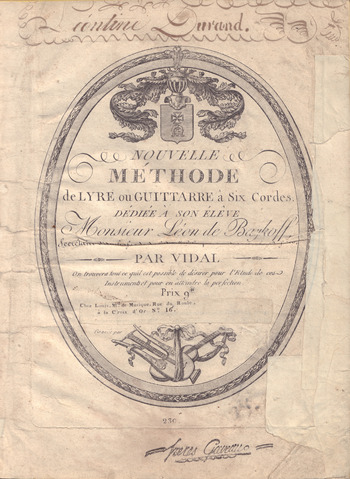
Gerber states that Vidal died in February 1800;Footnote 116 however, newly identified evidence shows that he lived longer. One of the last works he wrote was a method for the new and fashionable lyre-guitare Footnote 117 with the title Nouvelle méthode de lyre ou guittarre à six cordes.Footnote 118 Dedicated to ‘son élève Monsieur Léon de Baykoff secrétaire d'Ambassade S. M. J. l'Empereur de toutes les Russies’ (to his student, Mr Leon de Baykoff, secretary of the Embassy of His Majesty the Emperor of All Russians),Footnote 119 this is the only known work by Vidal written for the six-string guitar. Figure 6 shows the front page of this method. At the top of the image there is a Polish coat-of-arms for the family or clan Lubicz, an emblem probably related to the dedicatee.Footnote 120 The precise dating of this work is uncertain. Léon de Baykoff was the secretary of Arkady Ivanovich Morkov (1747–1827), an ambassador of the Russian empire in Paris named as such on 1 July 1801.Footnote 121 It is not known if he had also been the secretary of the previous ambassador, Stepan Alexeevich Kolychev, but if that were not the case, it would imply that this work would date from after July 1801. In any case, the publication date must be after the creation of the lyre-guitare in early 1799 and sufficiently long enough after his last method published in 1797. The fact that he did not publish the work himself probably indicates that he had stopped his publishing activity for good. The last advertisement found from Vidal's magasin de musique appeared in February 1798, when the Premier Pot-Pourri concertant pour deux violons by Bernardo Lorenziti was advertised from rue Feydeau 223, which corroborates this theory.Footnote 122 The publishers of this new method were the frères Gaveaux, who had their business in Passage Feydeau Nos 12 and 13,Footnote 123 just a few metres away from Vidal's last known location.
Title-page from Nouvelle méthode de lyre ou guittarre à six cordes (Paris: Frères Gaveaux, c1802). The poor condition of the title page of the only known copy precludes displaying properly the line with the name and title of the dedicatee in this reproduction. It reads ‘Monsieur Léon de Baykoff, Secrétaire d'Ambassade de S.M.J. l'Empereur de toutes les Russies’. Luis Briso de Montiano Collection. Madrid. Used by permission

Several songs from the Journal de Guitare par Vidal published by Decombe appeared bearing the address Quai de l’école No. 14, a location from where this publisher operated from December 1800 on.Footnote 124 It is not clear when Decombe began to publish this Journal. All items I have consulted bear an address postdating December 1800, which perhaps indicates that it was being published c1801, although the scarcity of preserved issues precludes any firm conclusions. Vidal also appears in a catalogue of the publisher Jeanne Elisabeth Duhan, who opened her business in April 1802. In a catalogue of 1803 she included the text ‘The majority of these romances have been arranged by Vidal, Phillis and others’.Footnote 125
Vidal died early in 1803. His obituary appeared in Le courrier des spectacles on 19 February, reporting that ‘citizen Vidal, known for his talent in the art of playing the guitar, and no less famous a composer, has just died. He leaves behind a wife to inherit his modesty and talents’ (‘Le citoyen Vidal, connu par ses talens dans l'art de jouer de la guitarre, et non moins célebre compositeur, vient de mourir. Il laisse après lui une épouse héritiere de sa modestie et ses talens’).Footnote 126 Le courrier des spectacles was an eight-page periodical published daily, which suggests that the real date of Vidal's death was most probably one or two days before the announcement, perhaps on Thursday 17 February. Nothing is known so far about the name of his widow or whether they had any children.
CONCLUSION: ‘LE CÉLÈBRE ARTISTE ESPAGNOL’
Joseph Anne Adolphe Ledhuy, who learned the guitar from Vidal, left an interesting testimony about his master and the way he played in his Essais sur la lyre-guitare from c1806:
Cela me rappelle qu’à la première leçon que je reçus de M. Vidal, je remarquois que ce grand guitariste avoit les ongles de la main droite d'une longueur étonnante. Est-ce au moyen de ces ongles, lui dis-je, que vous obtenez ces beaux sons argentins ? ‒ Oui. ‒ En ce cas, je ne couperai plus les miens. – N'imitez pas mon exemple, reprit-il, car pour peu que vous travailliez l'instrument, vous vous appercevrez que cela coupe les cordes – Mais si l'on peut obtenir ces sons qu'avec de pareils ongles ? – Vous les obtiendrez sans cela, tout dépend de l'habitude, et il y a long-temps que j'aurois voulu me défaire de celle-ci. Cet aveu me parut d'autant plus sincère que, dans la suite, je vis souvent M. Vidal coucher ses doigts autant qu'il le pouvoit sur les cordes pour empêcher que ses ongles ne les approchassent, et par là obtenir des sons plus moelleux. Cependant les opinions paroissent se partager sur ces deux manières d'attaquer les cordes; car on m'assuré qu'un amateur, après la mort de M. Vidal, avoit demandé d'en conserver la main dans un bocal. Malgré tout, j'ai suivi le conseils de mon maître; et quoique la manière d'exécuter qu'il cherchoit à m'enseigner étoit en cela différente de la sienne, je m'en suis toujours bien trouvé.Footnote 127
This reminds me that in the first lesson I received from Mr Vidal, I noticed that this great guitarist had astonishingly long fingernails on his right hand. ‘Is it by means of these nails’, I said to him, ‘that you get these beautiful silvery sounds?’ [Vidal] ‘Yes.’ [Ledhuy] ‘In this case, I will no longer cut mine.’ [Vidal] ‘Do not imitate my example’, he continued, ‘because no matter how little you practise the instrument, you will notice that it [the use of nails] cuts the strings.’ [Ledhuy] ‘But if you only can get these sounds with such nails!’ [Vidal] ‘You will get these sounds without them, everything depends on habit, and I have already for a long time wished to get rid of it [the habit of playing with long nails].’ This confession seemed all the more sincere to me because when in the following years, I often saw Mr Vidal leaning his fingers as much as he could on the strings to prevent his nails from touching them, and by doing that obtaining a more velvety sound. However, opinions seem to be divided on the two ways of attacking the strings, since I was assured that a devotee, after Mr Vidal's death, had been told to keep his hand in a jar. Despite everything, I followed my master's advice; and even though the way he tried to teach me was different from his, I always found it good.
This discussion about fingernails reflects the two different ways of playing the guitar at that time. While Italian and French masters seem to have advocated plucking the strings with the flesh of the fingertips, some references in Spanish guitar tutors from the end of the century promote the use of nails.Footnote 128
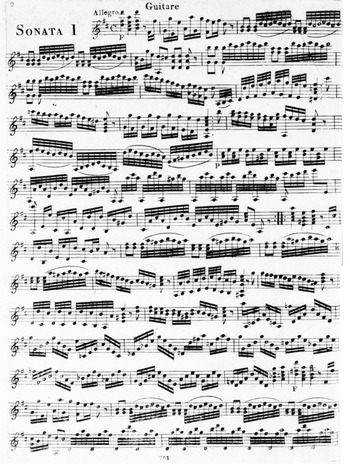
In an advertisement at the end of 1792 for Vidal's Six duos concertants pour deux guittares the composer was hailed as ‘particularly distinguished for his rare talent for difficulty’ (‘M. Vidal s'est particulièrement distingué par son rare talent pour la difficulté).Footnote 129 This may connect with the previously quoted statement in Tablettes de renommée des musiciens about his ‘variations in a learned style worthy of the execution of the greatest masters’. Figure 7 shows one of his ‘difficult’ compositions, obviously requiring a high level of proficiency, where the author combines different techniques such as the use of rapid scales, parallel thirds and octaves, and rapid arpeggio patterns.
Extract from Sonata No. 1 in Six Sonates pour la guitarre avec accompagnement de violon dédiées à Monsieur Launay (Paris: Boyer, 1791–1793), 2. This sonata is a good example of the complex music for which Vidal was praised. Bibliothèque Nationale de France, VMA-3392. Used by permission

The word célèbre was associated with Vidal in several records, something that points out that he was truly one of a kind. Paul Cassaignard, one of his students who went to the United States, advertised himself in Philadelphia in 1792 as ‘pupil of the celebrated Vidal of Paris’.Footnote 130 In a document of 27 July 1800, pertaining to an amnesty petition concerning the guitarist Antoine de Lhoyer, Vidal was called ‘the famous Spanish artist’ (‘le célèbre artiste espagnol’), which also clearly indicates his Spanish provenance.Footnote 131 In a similar vein, Antoine Marcel Lemoine, in a guitar method of 1799, referred to ‘the famous Vidal, the foremost teacher we have on this instrument’ (‘Le célèbre Vidal, le premier proffesseur que nous ayons sur cet instrument’).Footnote 132 All of this shows that Vidal was highly valued among his contemporaries. It is not known how many guitarists developed their technique and knowledge of the instrument under his guidance, but there is no doubt that he had an important influence among all sorts of guitar enthusiasts at that time in Paris.
Although it has not been possible to determine the date and place of birth and other personal information relating to this remarkable guitarist, what is arguably of more importance for musicologists and performers today is the study of the source materials that survive from his extensive musical activities. Vidal wrote four methods for the guitar, kept several important guitar periodicals alive for many years, managed to issue around thirty-five recueils, created an important amount of repertory for solo guitar, two guitars, guitar and violin, and guitar and violoncello, and produced the very first guitar concerto ever known to have been composed and published. Vidal contributed in a decisive way to making this instrument truly fashionable in Paris in the last part of the eighteenth century, by being at once a leading guitarist, composer and teacher, thereby developing le charme de la guitare until his very last days at the dawn of the nineteenth century.
APPENDIX
A preliminary checklist of compositions by Vidal
This checklist is not a detailed inventory of all the works published by this author but a summary of the most important ones, without discussion of republications, missing opus numbers and other aspects. The list shows only those works for which definite evidence of publication survives, through the existence of surviving copies in libraries or private collections, their listing in previous cataloguesFootnote 133 or their advertisement in the press. The checklist gives RISM library sigla for extant sources held in institutions, and mentions known copies held in some private collections; if no copy of a particular work has yet been located, a comment is made to that effect.
Library sigla
- B-Lc
Belgium, Liège, Conservatoire Royal de Musique, Bibliothèque
- CZ-Pnm
Czech Republic, Prague, Národní Muzeum
- DK-Kk
Denmark, Copenhagen, Kongelige Bibliotek
- F-Pn
France, Paris, Bibliothèque Nationale de France
- F-Ps
France, Paris, Bibliothèque de la Sorbonne
- GB-Lam
Great Britain, London, Royal Academy of Music
- GB-Lbl
Great Britain, London, British Library
- S-Skma
Sweden, Stockholm, Statens Musikbibliothek
- S-Sm
Sweden, Stockholm, Musikmuseet arkiv
Methods
Nouvelle méthode de guitarre, dédiée à Mlle Genty, Op. 8 (Paris: Boüin, 1776), not located
Nouveaux principes de guittare pour connaitre l’étendue de l'instrument, dédiés à Madame Rocque de Fournier (Paris: author, c1787), GB-Lam and private collection of Tony Bingham, United Kingdom
Nouvelle méthode de guitare, dédiée aux amateurs (Paris: author, 1797), F-Ps
Nouvelle méthode de lyre ou guittarre à six cordes, dédiée à Monsieur Léon de Baykoff (Paris: Frères Gaveaux, c1802), private collection of Luis Briso de Montiano, Spain
Periodicals
Les soirées espagnoles, ou choix d'ariette d'opéra comique & autres rondeaux, menuets & allemandes avec accompagnements de guittare (Paris: Boüin, 1776–c1783), weekly, F-Pn (year 1776), GB-Lam (beginning of the year 1777)
Recueil périodique d'ariettes avec accompagnement de guitare mêlées d'airs variés dédié à Madame la Presidente de Meslay (Paris: Koliker and Beau, 1786), monthly, S-Sm
Journal de guitarre (Paris: author, 1787–1790) monthly; (Paris: Koliker, 1791–?), twice weekly; (Paris: author, c1797–c1798), fortnightly; (Paris: Decombe, c1801), frequency unknown. Several separate items preserved in GB-Lam, S-Skma, F-Pn and private collection of Kenneth Sparr, Sweden
Recueil pour guitarre composé d'ariettes nouvelles, Airs varies, Préludes, Sonates, Duos concertants pour guitarre & violon ou deux guitares & Overture à la portée des Amateurs (Paris: Decombe, c1796), monthly, GB-Lam
Works for two guitars
Quatre Duo pour deux guitarres, Op. 16 (Paris: Boüin, 1777), not located
Six Duo [sic] concertans pour 2 guittares, dédiés à M. Vallain (Paris: Durieu, 1792), not located
Works for guitar and cello
Six Sonates de guittare avec accompagnement de basse, Op. 10 (Paris: Boüin, 1776), not located
Quatre Sonates aisées pour la guitare avec accompagnement de basse, Op. 17 (Paris: Boüin, 1781), not located
Works for guitar and violin
Six Duos concertants pour guitarre et violon, Op. 24 (Paris: Boüin and Castagnery, c1782), DK-Kk
Pot-pourri Nos 1–5 for violin and guitar (Paris: Boüin, c1783–c1788), not located. Republished 1–6 (Paris: Imbault, c1796–c1801), No. 1 in DK-Kk
Pot-pourri en trio concertant pour guitarre et deux violons dedié à Monsieur le Compte de Monet No. 6 (Paris: author, 1787), F-Pn
Six Sonates pour la guitarre avec accompagnement de violon IV oeuvre de sonates (Paris: author, 1788), not located
Ouverture d'Iphigénie en Aulide, du Chevalier Gluck, arrangée pour la guitare & un violon obligé (Paris: author, 1789), not located
Six Duos concertans, pour guitarre & violon dédiés à M. Collot VIIe œuvre de Duos (Paris: Koliker, 1792), not located. Reedition Imbault, c1799, F-Pn
Six Sonates pour la guitarre & violon obligé, dédiées à M. le Baron de Colleraine (Paris: Koliker, 1792), not located
Quatre Sonates en Pot-pourri, pour guittare, avec accomp. de violon, dédiées à Don Alfonso de Aguirre (Paris: Boüin, 1793), not located
Six Sonates pour la guitarre avec accompagnement de violon dédiées à Monsieur Launay de l'Academie de peinture 12e livre de sonates (Paris: Boyer, 1791–1793), F-Pn (only the guitar part)
Collections (recueils) of works (non-periodical)Footnote *
Recueil d'ariettes d'opéra-comiques Nos 1–17 (Paris: Boüin c1770–1785), including Opp. 9–14, No. 2 in B-Bc; Nos 8, 11, 12, 14 and 15 in GB-Lam; Nos 2, 7 (Lyon: Castaud, c1774), No. 7 in F-Pn
Recueil de Minuets et rondos, Opp. 29, 30, 31, 32 (Paris: Boüin, c1782–c1785), Op. 32 in F-Pn
Recueil de petits airs variés pour guitare Nos 1–7 (Paris: Cousineau, Boüin, author and Decombe, c1776–c1800), including Opp. 15 and 18, F-Pn, GB-Lbl (some missing)
Recueil d'airs avec accompagnement de guitare et clavecin, Op. 19 (Paris: Bignon, 1777), F-Pn
Recueil d'airs en pot-pourris pour guitare et deux violons obligés Nos 1–2 (Paris: Boüin, 1782), not located
Recueils d'ariettes pour la guitare Nos 1, 19 (Paris: Cousineau, 1782, 1786), not located
Collection of Easy Pieces for the Guitar Dedicated Mrs. de St. Albain (London: author, 1790–1791), CZ-Pnm
Concerto
Concerto pour la guitarre avec accompagnement de deux violons, alto et basse (Paris: Boüin, 1793), B-Lc
Works not involving guitar
Six Duos dialoguées, pour un violon, & un alto viola (Paris: Boüin, 1776), not located
Six Romances avec accompt. de forte-piano ou de harpe dédiées à notre ami Gérard par Vidal et Tholet (Paris: author, 1796), not located