Introduction
Understanding why ecological communities contain the species they do is a long-standing question in ecology. Dispersal limitation and environmental filtering are two mechanisms that can affect the species found in a community. Dispersal limitation occurs when a species that could persist in a location is absent because individuals of the species are unable to reach the site (Hurtt & Pacala Reference Hurtt and Pacala1995). Environmental filtering occurs when species occur in locations with the environmental conditions to which they are best adapted (Holyoak et al. Reference Holyoak, Leibold and Holt2005). Numerous studies have examined the relative roles of dispersal limitation and environmental filtering in structuring communities, to the extent that multiple meta-analyses have synthesized how environmental and organismal attributes affect these assembly processes (Astorga et al. Reference Astorga, Oksanen, Luoto, Soininen, Virtanen and Muotka2012, Cottenie Reference Cottenie2005, Soininen et al. Reference Soininen, McDonald and Hillebrand2007). However, the results of individual studies are likely contingent upon the quality of the environmental data used to quantify environmental filtering and the metrics used to quantify dispersal limitation (Chang et al. Reference Chang, Zeleny, Li, Chiu and Hsieh2013).
Correctly identifying the relative influences of dispersal limitation and environmental filtering has important practical applications, such as spatial planning for reserve selection in conservation (Steinitz et al. Reference Steinitz, Heller, Tsoar, Rotem and Kadmon2005). This is particularly important for tropical systems where extinctions are occurring disproportionately (Pimm et al. Reference Pimm, Jenkins, Abell, Brooks, Gittleman, Joppa, Raven, Roberts and Sexton2014). Despite the fact that species richness is highest in the tropics, there is a significant disparity in the number of studies at large spatial scales that have been carried out in the tropics in comparison with higher-latitude regions (Beck et al. Reference Beck, Ballesteros-Meijia, Buchmann, Dengler, Fritz, Gruber, Hof, Jansen, Knapp, Kreft, Schneider, Winter and Dormann2012). Currently, the majority of our knowledge about tropical community assembly comes from plants (Swenson Reference Swenson2013). However, the mechanisms that structure communities of tropical plants, which are sessile, may differ from the mechanisms that structure communities of large-bodied, mobile vertebrates. Primates are a key taxonomic group for understanding tropical regions because they are a major component of vertebrate biomass (Corlett & Primack Reference Corlett and Primack2006) and the most frequently studied tropical organisms (Marshall & Wich Reference Marshall, Wich, Wich and Marshall2016, Marshall et al. Reference Marshall, Meijaard, Van Cleave and Sheil2016). Their distributions are well-studied because primates are more easily and accurately censused than other mammalian forest taxa due to their typically diurnal activity patterns, relatively large bodies and noisy group-living behaviour (Emmons Reference Emmons, Fleagle, Janson and Reed1999, Kamilar & Beaudrot Reference Kamilar and Beaudrot2013).
Here we use a variable selection approach (Clarke & Ainsworth Reference Clarke and Ainsworth1993) to identify the environmental variables that best predict tropical forest primate community similarity in four biogeographic regions spanning the distribution of primates. We then analyse data from a previously published study on the relative influence of dispersal limitation and environmental filtering (Beaudrot & Marshall Reference Beaudrot and Marshall2011). Specifically, we test the following two hypotheses. H1: If dispersal limitation is important for structuring communities, then sites that are close together are expected to share many species in common regardless of environmental characteristics. Community similarity is expected to decrease with increasing geographic distance. H2: If the environment determines community similarity, then sites with similar environmental conditions are expected to share more species in common irrespective of the geographic distance between them (hereafter ‘environmental filtering’). Community similarity is expected to decrease with increasing environmental distance (Chase et al. Reference Chase, Amarasekare, Cottenie, Gonzalez, Holt, Holyoak, Hoopes, Leibold, Loreau, Mouquet, Shurin, Tilman, Holyoak, Leibold and Holt2005). While these two hypotheses are not mutually exclusive, their comparison can reveal the relative strengths of environmental and geographic influences on community composition.
Methods
Our approach involved four steps. First, we used presence-absence data on primate community composition to calculate primate community similarity among sites within a region. Then we calculated the geographic distances between sites. Next, we quantified ecological distance between sites by applying a variable selection approach to select the best temperature, precipitation and soil variables for each region using the highest rank correlation values. Lastly, we applied Mantel and partial Mantel tests to examine the correlations between primate community similarity and the geographic and environmental distance predictor variables.
Data collection and distance matrix calculations
Primate community composition was defined using presence-absence data for species compiled from published sources following the taxonomy of Groves (Reference Groves2001). The data included 124 sites across Africa (N = 23), South America (N = 45), Madagascar (N = 28) and Borneo (N = 28) (Figure 1). Primate communities for each region were defined in three ways – by all species, by diurnal species only or by genera. We first examined all species of primates. We then examined diurnal species only to exclude any potential differences caused by the inclusion of solitary, nocturnal species (e.g. resulting from the fact that they are more difficult to detect when sampling during daylight hours and nocturnal sampling effort likely varied among sites). Lastly, we conducted additional tests at the genus level to exclude any potential results contingent on species designations. All data in this study were from Beaudrot & Marshall (Reference Beaudrot and Marshall2011). See Appendix S1 in Beaudrot & Marshall (Reference Beaudrot and Marshall2011) for species and site information.
World map with blue points depicting locations of tropical forest primate communities in this study.

We calculated pairwise primate community similarity between all sites in each region using the Jaccard Index with the vegdist function from the Vegan community ecology package in R. High values of the Jaccard community similarity index indicate that two sites share many species in common and few species are found only at one of the sites.
We collected geographic coordinates from the community composition site reference when available, or otherwise from the UNEP and IUCN Worldwide Database on Protected Areas (IUCN-UNEP 2009). We calculated geographic distances between all pairs of sites in each region using the pairdist function from the spatstat package in R. Pairdist computes the matrix of Euclidean distances between latitude and longitude.
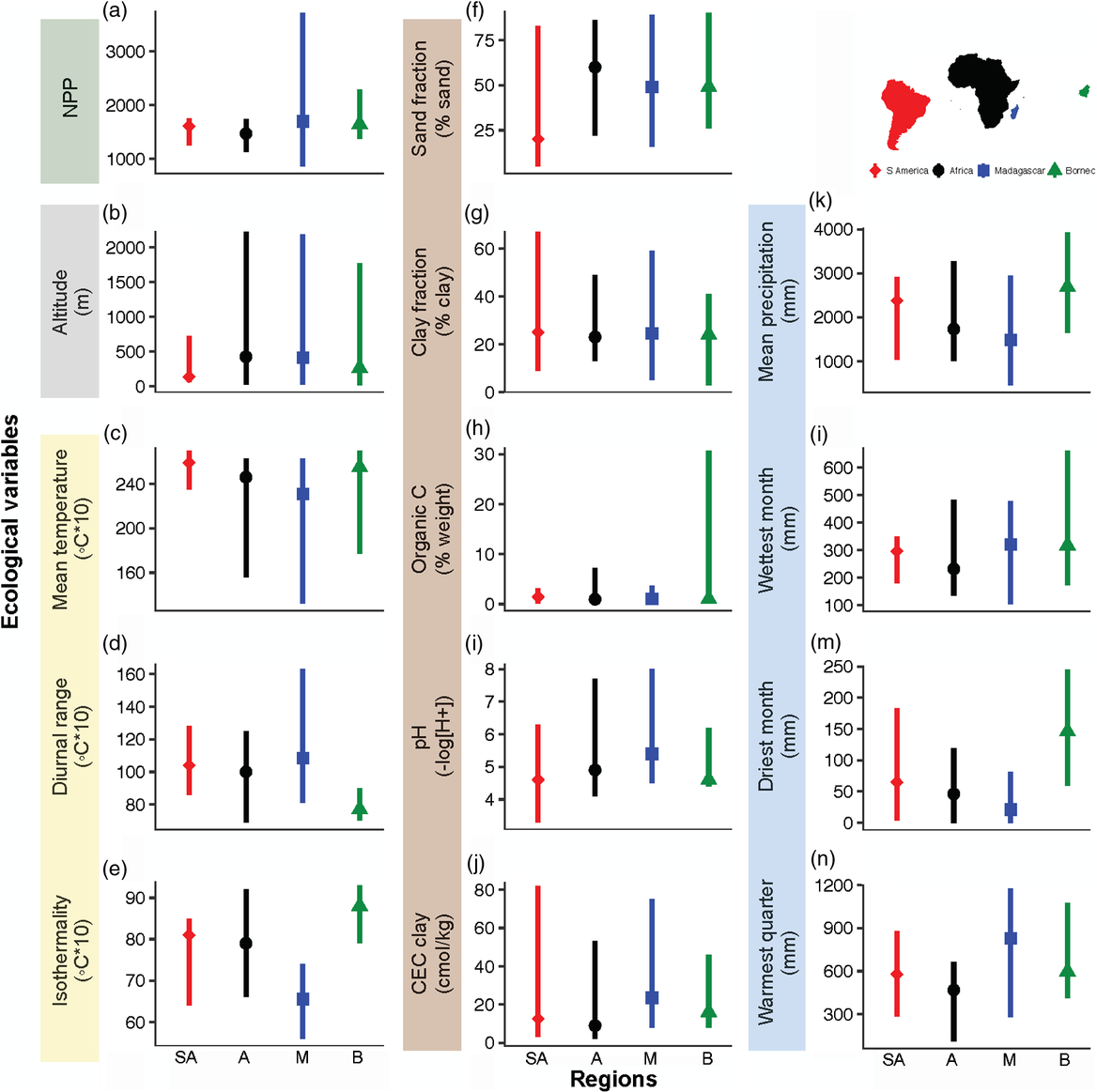
It is likely that the plant species on which primates feed influence primate distributions. Because systematic information on plant community composition was unavailable for each site, we collected information on environmental variables known to affect plant distributions – temperature, precipitation and soil (Franklin Reference Franklin1995). We collected 14 variables for the geographic coordinates of each site from publicly available datasets using ArcGIS (Figure 2). The variables were: net primary productivity, altitude, annual mean temperature, mean diurnal temperature range, isothermality, annual precipitation, precipitation of wettest month, precipitation of driest month, precipitation of warmest quarter, topsoil sand fraction, topsoil clay fraction, topsoil organic carbon, topsoil pH and topsoil cation exchange capacity.
Summary of 14 ecological variables for the primate community sites in each of the four regions. Variable selection was used to identify the subset of these variables that best predicted primate community similarity for each of the four regions and three community definitions (Appendix 1). Lines denote the range of values for sites in each region. Points indicate the median. Red lines with diamond symbols represent South America (SA), black lines with circular point symbols represent Africa (A), blue lines with square point symbols represent Madagascar (M) and green lines with triangle point symbols represent Borneo (B). The ecological variables included an index of net primary productivity (a), altitude (b), three temperature variables, five topsoil variables and four precipitation variables. The temperature variables included mean temperature (c), the diurnal temperature range (d) and isothermality (e). The topsoil variables included the sand fraction (f), clay fraction (g), organic carbon content (h), pH (i) and cation exchange capacity (j). The precipitation variables included mean precipitation (k), precipitation in the wettest month (l), precipitation in the driest month (m), and precipitation in the warmest quarter (n).

We used the ‘bioenv’ function from the ‘vegan’ package in R to select a subset of environmental variables with the highest rank correlation with community data. Specifically, the bioenv function uses a weighted Spearman rank coefficient that calculates the harmonic rank correlation between the community similarity matrix and the environmental variable matrix (Clarke & Ainsworth Reference Clarke and Ainsworth1993). Thus, the rank order of the community similarity matrix is correlated with the rank order of the environmental variable matrix. The bioenv function tests all possible subsets of environmental variables and calculates the rank correlation for each combination. We then calculated a matrix of ecological distances with the subset of best-fit environmental variables for each region using a Euclidean distance calculation.
Mantel tests
We conducted simple Mantel tests to investigate bivariate correlations of community similarity with ecological distance and geographic distance and partial Mantel tests (Smouse et al. Reference Smouse, Long and Sokal1986) to investigate partial relationships between these variables. The partial Mantel tests allowed us to examine the independent relationships between (1) community similarity and geographic distance (i.e. while accounting for their covariation with environmental distance) and (2) community similarity and environmental distance (i.e. while accounting for their covariation with geographic distance). For example, to examine the relationship between community similarity and geographic distance independently from environmental distance, we first regressed community similarity on environmental distance and saved the residuals. We then regressed geographic distance on environmental distance and saved the residuals. We were able to examine the relationship between community similarity and geographic distance independent of environmental distance by examining the correlation between these two sets of residuals. While concerns about the Mantel test have been raised (Bradburd et al. Reference Bradburd, Ralph and Coop2013, Steinbauer et al. Reference Steinbauer, Dolos, Reineking and Beierkuhnlein2013), use of the Mantel test was necessary for direct comparison with previous results.
All tests were performed in R using the ‘mantel’ and ‘mantel.partial’ commands, the Pearson method and 10 000 permutations. We used a similarity matrix for community composition and dissimilarity matrices for ecological and geographic distance.
Spatial scale
Lastly, we calculated the spatial extent of the sampling area in each biogeographic region by measuring the area within the minimum convex polygon surrounding the outermost geographic coordinates for sites in each region. To do this we used the earth.poly function from the fossil package in R. A map of the sites is shown in Figure 1. We note that minimum convex polygon methods are prone to area overestimation and may therefore introduce measurement error.
Results
Environmental variables
There was considerable variation among regions in the ecological variables that best predicted primate community similarity. None of the regions retained all 14 environmental variables, yet each variable was included in at least one region. No single variable was retained for all four regions (Appendix 1). We report the minimum, maximum and median values for each variable in each region in Figure 2.
Some ecological variables were consistently retained for a region irrespective of whether all species, diurnal species or genera were considered. Africa consistently included precipitation of the wettest month; South America consistently included isothermality, precipitation of the warmest quarter, topsoil organic carbon and the topsoil sand fraction; Madagascar consistently included annual mean temperature, precipitation of the wettest month, precipitation of the driest month, and topsoil cation exchange capacity (clay); Borneo consistently included precipitation of the wettest month.
Three ecological variables were retained by the variable selection approach for only one region each: Africa was the only region to include altitude, South America was the only region to include the topsoil organic carbon content and Madagascar was the only region to include net primary productivity (Appendix 1).
Mantel tests
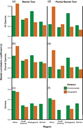
In both the Mantel and partial Mantel tests, ecological distance significantly predicted primate community similarity for all tests (Figure 3), which suggests an important role for environmental filtering for primate communities in all regions. Geographic distance significantly predicted primate community similarity for most tests, which suggests a significant role for dispersal limitation in most cases. The three exceptions were the partial Mantel test for South America and both the Mantel and partial Mantel test for Borneo based on communities defined by genera (Figure 3).
Barplots showing Mantel and partial Mantel results for significant predictors of primate community similarity. Results are shown for the three community definitions for each of the four biogeographic regions. Green bars depict the effects of environmental distance on community similarity based on environmental variables chosen by variable selection, which reflects the level of environmental filtering. Brown bars show the effects of geographic distance on community similarity, which indicate the strength dispersal limitation. Only results significant at the level of a = 0.05 are shown. Correlation coefficients from the Mantel tests are shown for communities defined by all species (a), diurnal species (b) and genera (c). Correlation coefficients from the partial Mantel tests are shown for all species (d), diurnal species (e) and genera (f).

Communities defined by all species and by diurnal species had similar results using both the Mantel and the partial Mantel tests: geographic distance more strongly predicted African and South American communities whereas environmental distance more strongly predicted Malagasy and Bornean communities (Figure 3). These results suggest that dispersal limitation structures primate communities more strongly than environmental filtering in Africa and in South America whereas environmental filtering structures primate communities more strongly than dispersal limitation in Madagascar and Borneo. For communities defined by genera, environmental distance more strongly predicted primate communities than geographic distance in all four regions (Figure 3), which suggests that environmental filtering is a more influential assembly mechanism at the genus level.
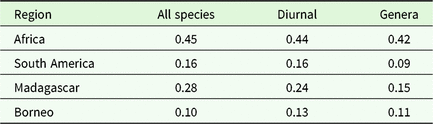
Mantel tests accounted for the greatest amount of variation for primate communities in Africa, followed by Madagascar and then South America. For all regions, more variance was consistently explained at the species level than the genus level (Table 1).
Model summaries providing the proportion of variance explained (i.e. R2) for multiple regression models of primate community similarity with ecological and geographic distance as predictors. Primate communities were defined in three ways (i.e. by all species, diurnal species only or genera) for each of the four regions

Spatial scale
Based on the minimum convex polygon surrounding the sites in each region rounded to the nearest 100 km2, the geographic extent of sampling was greatest for sites in South America (2 126 200 km2) followed by Africa (1 590 100 km2), Borneo (691 900 km2) and Madagascar (475 000 km2). The relationship between the sampling area of the four biogeographic regions and the strength of the partial correlation between diurnal primate community similarity and geographic distance was non-significant (linear regression: R2 = 0.199, df = 2, P = 0.55; Appendix 2), suggesting the differences among regions were not importantly affected by spatial extent.
Discussion
This study examined the relative importance of dispersal limitation and environmental filtering for structuring tropical forest primate communities worldwide. Unlike previously published research, this study used a variable selection approach to identify the set of environmental variables that best predict primate community similarity in South America, Africa, Madagascar and Borneo. Further analysis with these variables demonstrated that applying a variable selection approach can result in qualitatively different conclusions concerning the relative importance of community assembly mechanisms than results produced in the absence of variable selection. We discuss these two key findings in turn below.
Despite increases in variance explained by contemporary environmental conditions following the use of a variable selection approach, much of the variation in primate community composition remained unexplained for all regions. The different evolutionary and biogeographic histories of these regions likely account for much of the unexplained variation (Fleagle & Lehman Reference Fleagle and Lehman2006, Lawes & Eeley Reference Lawes and Eeley2000).
Regional variation in environmental predictors of primate community similarity
The environmental variables that best predicted primate community similarity varied substantially among biogeographic regions. For example, Africa was the only region in which the variable selection retained altitude. It is likely that the change in altitude from the moist and wet forest areas of the Congo basin to the more mountainous regions near the border of Congo with Tanzania and Uganda spans environmental and habitat differences that contribute to faunal turnover (Holt et al. Reference Holt, Lessard, Borregaard, Fritz, Araujo, Dimitrov, Fabre, Graham, Graves, Jonsson, Nogues-Bravo, Wang, Whittaker, Fjeldsa and Rahbek2013) and spans geographic barriers that have prevented the dispersal of some primate species (Harcourt & Wood Reference Harcourt and Wood2012). The retention of several precipitation variables indicates an important role of precipitation seasonality for variation in the species composition of African primate communities and further suggests that the transition from the wet tropical forests of the Congo basin to more seasonal forests to the east is associated with faunal turnover.
The island of Madagascar contains diverse ecological regions ranging from wet tropical forests in the east to dry deciduous forests in the west and spiny forests in the south. Accordingly, the Malagasy sites exhibited the greatest range in net primary productivity of the four regions (Figure 2). Madagascar was also the only region in which net primary productivity was retained, likely because net primary productivity captured the extensive variation in forest types. Habitat characteristics have been argued to be the primary determinants of mammal community composition in Madagascar (Muldoon & Goodman Reference Muldoon and Goodman2010). Variables associated with precipitation seasonality, specifically precipitation of the wettest and driest months, were also consistently retained. Multiple studies have highlighted the importance of rainfall variability on Madagascar for the evolution of species characteristics (Dewar & Richard Reference Dewar and Richard2007) and lemur diversity (Kamilar & Muldoon Reference Kamilar and Muldoon2010). Lastly, topsoil cation exchange capacity was consistently retained for Malagasy sites, which suggests that there is important variation in nutrient retention across Malagasy soils. Heterogeneity in cation exchange capacity can cause variation in tropical fruit crop production (Kainer et al. Reference Kainer, Wadt and Staudhammer2007).
South American communities were consistently predicted by two topsoil variables that were not consistent predictors in other regions: the topsoil sand fraction and organic carbon content. Soil fertility and its effects on floristic diversity have been previously suggested to be determinants of primate community structure in western Amazonia (Haugaasen & Peres Reference Haugaasen and Peres2005, Peres Reference Peres1997). Soil chemical composition varies significantly among major forest types in western Amazonia: topsoil deposition from annual flooding cycles maintains higher levels of macronutrients, which maintains greater floristic diversity in some forests (Haugaasen & Peres Reference Haugaasen and Peres2006). The fraction of both course and fine sand varies significantly between forest types (Haugaasen & Peres Reference Haugaasen and Peres2006) and both primate biomass and species richness vary significantly between habitat types (Haugaasen & Peres Reference Haugaasen and Peres2005).
Bornean primate communities showed the weakest response to environmental variables of the four regions and our models explained the least variance. Precipitation in the wettest month, an important predictor in three of the four regions we sampled (Appendix 1), was the only consistently retained predictor of Bornean primate communities. Borneo is characterized by the greatest variability and largest maximum value for precipitation in the wettest month of any of the regions we sampled (Figure 2), reflecting the substantial longitudinal gradient in weather and the intensity of El Niño–Southern Oscillation effects across Malesia (van Schaik et al. Reference Van Schaik, Marshall, Wich, Wich, Utami, Mitra Setia and van Schaik2009, Wich & van Schaik Reference Wich and Van Schaik2000). The precise mechanisms by which this influences primate community composition are not clear, although they may differ in Borneo from other regions because unlike other regions, rainfall is not associated with either plant productivity or primate species richness in South-East Asia (Fleagle & Reed Reference Fleagle and Reed1996, Kay et al. Reference Kay, Madden, Van Schaik and Higdon1997). One possibility is the role that extremely high rainfall might play in leeching soil nutrients in Asian forests (Kay et al. Reference Kay, Madden, Van Schaik and Higdon1997), a possibility consistent with the importance of several soil characteristics in predicting community composition in Borneo. Although there is limited research on how soil characteristics influence higher trophic levels in tropical forests (Corlett & Primack Reference Corlett and Primack2011), variation in soils across Malesia clearly has important ecological effects. For example, forests of low pH and with high sand content (e.g. peat swamps, heath forests) differ substantially from mineral soils in their plant diversity and species composition, temporal patterns of fruiting phenology and animal abundances (MacKinnon et al. Reference MacKinnon, Hatta, Halim and Mangalik1996, Marshall et al. Reference Marshall, Ancrenaz, Brearley, Fredriksson, Ghaffar, Heydon, Husson, Leighton, McConkey, Morrough-Bernard, Proctor, Van Schaik, Yeager, Wich, Wich, Utami, Mitra Setia and van Schaik2009, Reference Marshall, Beaudrot and Wittmer2014; Paoli et al. Reference Paoli, Wells, Meijaard, Struebig, Marshall, Obidzinski, Tan, Rafiastanto, Yaap, Slik, Morel, Perumal, Wielaard, Husson and D’Arcy2010, Slik et al. Reference Slik, Raes, Aiba, Brearley, Cannon, Meijaard, Nagamasu, Nilus, Paoli, Poulsen, Sheil, Suzuki, Van Valkenburg, Webb, Wilkie and Wulffraat2009), all of which likely influence primate community composition.
Relative influences of environmental filtering and dispersal limitation
Beaudrot & Marshall (Reference Beaudrot and Marshall2011) previously concluded that dispersal limitation structured primate communities more strongly than environmental filtering in the tropical forests of Africa, South America and Borneo. The earlier study used all 14 environmental variables described herein for all regions in order to apply a standardized method for cross-continental comparison (Corlett & Primack Reference Corlett and Primack2006). While the previous environmental distance calculation provided a comparable baseline, it did not allow for meaningful ecological variation across biogeographic regions that could affect primate communities.
Exclusion of extraneous environmental variables improved the percentage of variance explained for all regions in this study. Moreover, this study found a significant negative relationship between primate community similarity and environmental distance for all community definitions in all regions, which suggests a consistent influence of environmental filtering on primate communities in all the biogeographic regions in which they occur.
In some cases, variable selection reversed the previously published finding that primate communities were structured more strongly by dispersal limitation than by niches. Tests at the genus level in this study produced qualitatively different results for primate communities in Africa, South America and Borneo than previously published. Incorporating the best-fit environmental predictors increased the predictive power of the environmental variables to the extent that the ecological distances became stronger predictors of primate community composition than geographic distances were. For South America and Borneo, geographic distance was no longer a significant predictor of primate community similarity, which suggests that dispersal limitation may not be an important assembly mechanism in these regions at the genus level.
We also found qualitatively different results for primate communities defined at the species level in Borneo. Given that only 8% of variation in community composition had previously been explained and this study explained 10% of variation, this difference was not dramatic. Factors not considered in either of the analyses may explain additional variation. For example, historical factors may be particularly important for Bornean communities given the complex biogeographic history of the Sunda Shelf (Slik et al. Reference Slik, Aiba, Bastian, Brearley, Channon, Eichhorn, Fredriksson, Kartawinata, Laumonier, Manson, Marjokorpi, Meijaard, Morley, Nagamasu, Nilus, Nurtjahya, Payne, Permana, Poulsen, Raes, Riswan, Van Schaik, Sheil, Sidiyasa, Suzuki, Van Valkenburg, Webb, Wich, Yoneda, Zakari and Zweifel2011). Competition with non-primates may also influence Bornean primate community composition (Beaudrot et al. Reference Beaudrot, Struebig, Meijaard, Van Balen, Husson and Marshall2013a, Reference Beaudrot, Struebig, Meijaard, Van Balen, Husson, Young and Marshall2013b; Ganzhorn Reference Ganzhorn, Fleagle, Janson and Reed1999).
We found that a more nuanced consideration of environmental variables affects conclusions about the influences of environmental filtering and dispersal limitation on primate communities, particularly at the genus level. Nevertheless, improvements to the geographic distance measure might further affect these conclusions. For example, using a least-cost path analysis and incorporating differences in forest cover or barriers, such as roads, rivers and mountains might produce a more ecologically realistic measure of dispersal costs that further affect results. Determining the relative importance of dispersal limitation and environmental filtering has important applications for biodiversity conservation. Given that conclusions are dependent on the quality of environmental data, a robust understanding of community assembly processes is necessary before management recommendations can be made.
Author ORCIDs
Lydia Beaudrot https://orcid.org/0000-0001-8135-7519; Andrew J. Marshall https://orcid.org/0000-0002-7703-8811
Acknowledgements
We thank several anonymous reviewers and Michael Lawes for feedback on previous manuscript versions.
Financial support
None.
Appendix 1
Variable selection was used to identify the subset of 14 ecological variables that best predicted primate community similarity in four regions: Africa, South America, Madagascar and Borneo. Using the best environmental variables in each region, Mantel and partial Mantel tests were then used to reanalyse data from a previously published study to examine the relative influence of dispersal limitation and environmental filtering in structuring primate communities. Below are the results of the variable selection for each of the four regions and three primate community definitions (i.e. all species, diurnal species only, or genera). The letter o indicates a variable that was retained for only one region. Uppercase X indicates the consistent inclusion of a variable for a region across community definitions (i.e. all species, diurnal species, genera). All other retained variables are indicated with a lowercase x.

Appendix 2
We tested whether the spatial extent of regions predicted primate dispersal limitation (i.e. the partial Mantel correlation between primate community similarity and geographic distance) using linear regression. We did not find a significant relationship; the dashed line shows a non-significant linear relationship. The lack of a significant relationship suggests that the spatial extent of a region is not the cause of dispersal limitation structuring primate communities in these four tropical forest regions.