1. Introduction
Marine ecosystems and resources are critical to the sustainable development of small island developing states (SIDS) (Briguglio, Reference Briguglio1995; Pelling and Uitto, Reference Pelling and Uitto2001). However, marine ecosystems throughout the world face significant threats from pollution, over-exploitation of resources, conflicting use of resources, damage and destruction to habitats (Boersma and Parrish, Reference Boersma and Parrish1999). Seychelles faces similar threats to marine biodiversity (Domingue et al., Reference Domingue, Payet and Shah1999; Cesar et al., Reference Cesar, Van Beukering, Payet and Grandcourt2004). Marine protected areas (MPAs) are especially important to Seychelles (Jennings et al., Reference Jennings, Marshall and Polunin1996; Mathieu et al., Reference Mathieu, Langford and Kenyon2003; Cesar et al., Reference Cesar, Van Beukering, Payet and Grandcourt2004).Footnote 1 The marine environment plays a significant role in supporting the two most important economic sectors: tourism and fisheries. In 2009, tourism contributed an estimated 26 per cent of the gross domestic product (GDP), providing about 30 per cent of employment and 70 per cent of foreign exchange earnings (Republic of Seychelles, 2011). The fishing industry accounted for about 8 per cent of GDP, 7 per cent of jobs and 35 per cent of exports in 2009 (Republic of Seychelles, 2011).
The Government of Seychelles has taken a number of impressive steps to manage its development in a sustainable manner, arguably because of the importance of the environment to the two key sectors of the economy: tourism and fisheries. Environmental protection was given high priority through the Environmental Management Plan of Seychelles (EMPS) 2000–2010. This framework outlines the basic principles for sustainable development in Seychelles. It addresses the issue of environmental protection against the background of new and emerging threats that Seychelles is facing today and in the future. It includes economic valuation of biodiversity and both market and non-market values of biodiversity are recognized in the EMPS in relation to incentive measures.
However, despite these measures, the quality of MPAs in Seychelles is in decline and marine resources are losing their value (Domingue et al., Reference Domingue, Payet and Shah1999; Cesar et al., Reference Cesar, Van Beukering, Payet and Grandcourt2004). A number of human-related practices are threatening the health of MPAs and could potentially compromise the flow of benefits from these resources. Climate change represents the most serious threat to marine biodiversity in Seychelles (Briguglio, Reference Briguglio1995; Pelling and Uitto, Reference Pelling and Uitto2001; Cesar et al., Reference Cesar, Van Beukering, Payet and Grandcourt2004; Republic of Seychelles, 2010; UNESCO, 2011). MPAs are being affected by climate change (Lutchman, Reference Lutchman2005; Antha, Reference Antha2010). However, in some cases, there is little data to establish whether those changes can be solely attributed to climate change or whether there are other reasons for these changes. In 1998, a major coral bleaching event as a result of increased ocean temperature (El Niño), led to significant loss of corals in Seychelles (Turner et al., Reference Turner, Klaus, Englehardt, Souter, Obura and Linden2000; Cesar et al., Reference Cesar, Van Beukering, Payet and Grandcourt2004). These mortalities include those within MPAs.Footnote 2
Invasive alien species (IAS) also pose a great threat to marine biodiversity in Seychelles (Ikin and Dogley, Reference Ikin and Dogley2005; Mwebaze et al., Reference Mwebaze, MacLeod, Tomlinson, Barois and Rijpma2010). IAS cost the Seychelles economy several millions of dollars annually (Mwebaze et al., Reference Mwebaze, MacLeod, Tomlinson, Barois and Rijpma2010). A number of IAS have been introduced in Seychelles and recently three marine IAS were found in the port of Victoria (Republic of Seychelles, 2010). This problem is expected to worsen against the background of increasing trade, transport and tourism, as well as further compounding effects of climate change (Republic of Seychelles, 2010). There have been outbreaks of harmful species that cause damage to reefs (e.g., crown-of-thorns starfish, Drupella diadema), that may have been linked to the devastating El Niño event in 1998 (Lutchman, Reference Lutchman2005). Some measures have been implemented with respect to ballast seawater and currently ships are not allowed to discharge ballast water in close proximity to the islands. Seychelles is also undertaking measures to eradicate IAS from small islands and to restore island ecosystems, where technology and costs permit. However, the resources available are not adequate to completely eliminate the risk.
MPAs are also being negatively affected by local pollution, sewage, sedimentation, land-filling, overfishing and poaching (Domingue et al., Reference Domingue, Payet and Shah1999; Cesar et al., Reference Cesar, Van Beukering, Payet and Grandcourt2004). The exclusive economic zone (EEZ) of Seychelles is an important route for commercial shipping, and ship-based pollution remains a hazard to marine biodiversity (Domingue et al., Reference Domingue, Payet and Shah1999). Development pressure and increased agricultural activity along the coastal zone also contribute to increased pollution.
Economic valuation can help guide policy makers to understand the value of marine resources and the cost of neglecting MPAs by expressing the value of their goods and services in monetary terms (US$). It can play a significant role in communicating the value of marine resources to the Seychellois public. The use of non-market valuation tools has become increasingly important in Seychelles, because marine resources produce benefits which cannot be valued using the traditional economic methodologies (Mathieu et al., Reference Mathieu, Langford and Kenyon2003). For MPAs, the two most relevant valuation tools are the travel cost method (TCM) and the contingent valuation method (CVM) (Nunes and van den Bergh, Reference Nunes and van den Bergh2004; Alban et al., Reference Alban, Appere and Boncoeur2006).
The TCM is one of the most popular tools for estimating recreational demand. TCMs can be divided into single-site and multiple-site models (Freeman, Reference Freeman2003). The latter include the random utility models (RUM) while the former include the individual and zonal (Clawson–Knetsch) methods (Parsons, Reference Parsons, Champ, Boyle and Brown2003). Both the zonal and individual TCM are often used, but individual models are preferred (Hanley and Barbier, Reference Hanley and Barbier2009).Footnote 3 Most published TCM studies of recreation have been conducted in the USA, Europe and Australia.Footnote 4A few TCM studies have been done in developing countries (Maille and Mendelsohn, Reference Maille and Mendelsohn1993; Pendleton, Reference Pendleton1995; Choe et al., Reference Choe, Whittington and Lauria1996; Menkhaus and Lober, Reference Menkhaus and Lober1996; Jeuland et al., Reference Jeuland, Lucas, Clemens and Whittington2010). However, very few TCM studies have been conducted in SIDS despite the increasing number of foreign visitors. This information gap about the value of foreign visitation is significant given the potential economic role of the international community in helping SIDS achieve conservation targets. The TCM provides one avenue to create estimates of the value of international visitation to marine parks in Seychelles.
The objective of this paper is to assess the economic value of a group of marine parks in Seychelles. The TCM is a more appropriate method which can be used to estimate the willingness-to-pay (WTP) of tourists for trips to marine parks from their observed behaviour. The method produces an estimate of the ‘access’ value of the marine parks in their ‘current’ state. Hence, the present analysis cannot tell us how this value would change if conditions in the marine parks change. However, the estimate generated can be used to provide policy makers with some justification for the government investment needed to maintain MPAs in Seychelles. The information generated may also be used by policy makers in setting a more realistic pricing policy for foreign visitors to marine parks in Seychelles. Finally, the results may be used in a high-level indicative cost-benefit analysis (CBA) of MPAs.
The analysis presented in this paper relates to a group of marine parks. Rather than engaging in multiple-site demand equations, the approach taken here was to value the whole group of marine sites visited by foreign tourists using a single-pooled individual TCM, so that the value being measured is the aggregate value of recreation in marine parks in Seychelles.Footnote 5 We focus exclusively on foreign tourists, excluding Seychellois residents who do not have to pay to enter a marine park in Seychelles. This paper expands the limited number of valuation studies undertaken in SIDS which exist in the current literature. The remainder of the paper is structured as follows. Section 2 provides the background of MPAs in Seychelles. Section 3 describes the methodology used in the study, and the survey instrument used in the study. The main results of the TCM analysis are reported and discussed in section 4. The final section gives a synthesis of the findings, and concludes the paper.
2. Marine protected areas in Seychelles
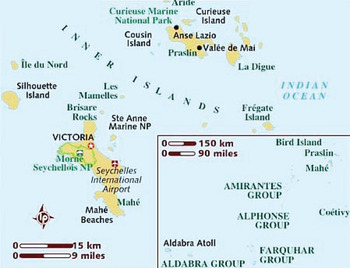
The Seychelles archipelago consists of 115 islands, with a total land mass of approximately 455 km2, distributed in an EEZ of 1.37 million km2 in the middle of the western Indian Ocean. There are two distinct groups of islands: 41 are granitic and are tightly grouped to the north, while 74 are coralline and spread over a large area to the south (figure 1). The human population is estimated at 90,000 people, with 99 per cent on only three islands (Republic of Seychelles, 2011). Mahé, with about 90 per cent of the total population, is the largest island and is the site of Victoria, the capital of Seychelles. Two other islands of major significance with regard to size and population are Praslin, 33.6 km from Mahé, and La Digue, 48 km away (figure 1).
Approximate location of Seychelles islands

Prior to independence in 1976, Seychelles was operating at near subsistence level, with a GDP per capita less than US$1,000. Since then, Seychelles has enjoyed remarkable economic growth and the GDP per capita has expanded roughly seven times to an estimated US$8,720 in 2010, placing the island in the World Bank's ‘upper middle-income’ bracket (IMF, 2012). This growth has been led by the tourist sector, along with fisheries. Yet despite this success, Seychelles faces many typical SIDS problems, especially the lack of human, technical and financial capacity, and a critical shortage of land for development which places heavy pressure on coastal and marine resources (Briguglio, Reference Briguglio1995; Pelling and Uitto, Reference Pelling and Uitto2001; UNESCO, 2011).
Seychelles has a long history of protected areas, with some of the oldest MPAs in the western Indian Ocean. Approximately 46 per cent of the total area of land in Seychelles is under legal protection (Cesar et al., Reference Cesar, Van Beukering, Payet and Grandcourt2004; Lutchman, Reference Lutchman2005). This is partly because of the unique biological diversity within the islands and arguably the early recognition of the attraction that this might have for foreign tourists. Seychelles is widely considered as a ‘biodiversity hotspot’ with ecosystems recognized globally (Myers et al., Reference Myers, Mitteremeier, Mitteremeier, da Fonseca and Kent2000). There are many endemic land species, such as the iconic giant tortoise, and a diversity of marine life, including reefs, turtles, seabirds, whale sharks and marine mammals. These flagship species, in particular the marine mammals, are given legal protection in Seychelles EEZ and are closely monitored.
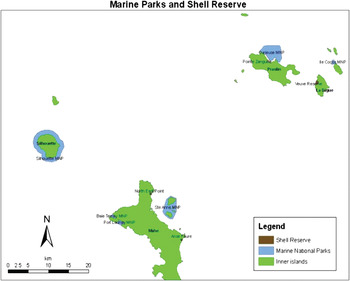
There are more than 25 protected areas in Seychelles, of which 14 are MPAs covering an estimated 228 km2 of ocean (Domingue et al., Reference Domingue, Payet and Shah1999; Lutchman, Reference Lutchman2005). Designation is under the National Parks and Nature Conservancy Act (CAP 141), the Fisheries Act (CAP 82) and the Protected Area Act (CAP 185). A Marine Park Authority was established in 1996 to manage the protection, conservation, enhancement and utilization of Seychelles marine resources. The agency has a total staff of about 30 people and a budget of about US$500,000 for managing six marine parks (Lutchman, Reference Lutchman2005): The St. Anne Marine Park, Baie Ternay Marine Park, Port Launay Marine Park, Curieuse Marine Park, Ile Coco Marine Park and Silhoutte Marine Park, with a total area of 61.77 km2 (figure 2). All of these sites are classified as ‘no-take’ areas and some are important for tourism. However, only two sites (St. Anne and Curieuse) receive active management; other sites are not adequately managed, and Silhouette has no management at all (Cesar et al., Reference Cesar, Van Beukering, Payet and Grandcourt2004; Lutchman, Reference Lutchman2005).
Marine protected areas in Seychelles

Seychelles is a major tourist destination. The national tourism policy places a strong emphasis on the protection of the environment, visitor limitation and the promotion of high-value, low-mass ecotourism rather than mass tourism, to avoid exceeding the carrying capacity (Lutchman, Reference Lutchman2005). In 2010, 175,000 foreign tourists visited Seychelles for leisure, recreation and holidays; the majority (75 per cent) came from Europe (UK, Italy, France, Germany and Switzerland) (Republic of Seychelles, 2011). Additionally, tourism in Seychelles is wholly conducted on the beach and so directly depends on the health of marine biological resources. MPAs clearly benefit the tourism sector. A large number of visitors are entertained annually through marine parks, which attract tourists through the snorkelling and diving experience they offer. On Curieuse alone, a total of 30,155 visitors were recorded in 2008, and for all Seychelles marine parks put together, a total number of 45,424 was recorded in 2007, increasing to 47,493 in 2008 (Seychelles Nation, 2009). Most marine parks operate a fee structure for entry and the revenue is used to maintain different reserves and national parks. The exception is Silhouette Marine Park, which had no entry charge at the time of this study. Access to marine parks is free for all Seychellois residents. Only foreign tourists are required to pay US$10 per person per visit admission fee to enter a marine park.
3. Methodology
3.1. The individual travel cost method
A single-site individual TCM was used to estimate the economic value for a group of marine parks visited by international tourists. We model the demand for trips (V i) by an individual i to the group of marine sites as an additive function of the cost of travel plus: any existing entry fees; income, preferences and socio-economic characteristics of individual i; the attributes of site; and the availability of substitute sites (Hanley and Barbier, Reference Hanley and Barbier2009). In this study, the visitation model is specified as follows:
 $$V_i =f\lpar TC_i \comma \; S_i \comma \; X_i \comma \; e_i \rpar $$
where V i is the number of annual trips by individual i to the group of marine parks in Seychelles, TC i is the total travel costs incurred by individual i in visiting the group of marine parks in Seychelles (as defined by international airfares and in-country travel expenses by individual i, plus time costs and any entry fees for the marine sites), S i represents information on substitute sites, X i denotes preferences of individual i (represented by socio-economic characteristics such as age, gender, income), and e i is the error term which is assumed to be normally distributed with constant variance and zero mean.
The dependent variable can only take non-zero integer values and is therefore censored at zero (V i ≥ 0). Thus, it was not appropriate to use the ordinary least squares (OLS) method to estimate equation (1). A count data model such as the Poisson or negative binomial regression was used instead. However, a limitation of the Poisson model is that it restricts the conditional mean of its distribution to be equal to the variance. This assumption of equi-dispersion of the mean and variance is often violated in recreational demand studies. In many cases, the variance is larger (or smaller) than the conditional mean, implying over-dispersion problems (Cameron and Trivedi, Reference Cameron and Trivedi1986; Cameron and Trivedi, Reference Cameron and Trivedi1990). An alternative model that accounts for the problem of over-dispersion is the negative binomial model (Loomis et al., Reference Loomis, Yorizane and Larson2000; Shrestha et al., Reference Shrestha, Seidl and Moraes2002; Bin et al., Reference Bin, Landry, Ellis and Vogelsong2005). The unobserved heterogeneity that is not captured in the Poisson model is incorporated into the negative binomial model by the inclusion of an additional dispersion parameter, α (Cameron and Trivedi, Reference Cameron and Trivedi1990). In order to test for over-dispersion, a likelihood ratio test based on the parameter (α ) was implemented in this study.
Two other problems commonly arise from the application of count data models for estimating recreation site demand using on-site surveys (Englin and Shonkwiler, Reference Englin and Shonkwiler1995; Shaw, Reference Shaw1988; Chakraborty and Keith, Reference Chakraborty and Keith2000; Loomis, Reference Loomis2003; du Preez and Hosking, Reference du Preez and Hosking2011):
(1) the probability of being surveyed depends on the frequency of visits (the problem of endogenous stratification);
(2) non-users are not sampled (the problem of truncation).
If these two problems are not accounted for, then the estimates generated will be biased and not consistent (Shaw, Reference Shaw1988; Creel and Loomis, Reference Creel and Loomis1990; Loomis, Reference Loomis2003). One simple procedure to fix both endogenous stratification and truncation is to weight each observation by the expected value of trips (Shaw, Reference Shaw1988). When the regular Poisson model is estimated, this correction involves adjusting the dependent variable by subtracting 1 from each of its values (Shaw, Reference Shaw1988; Englin and Shonkwiler, Reference Englin and Shonkwiler1995; Fix and Loomis, Reference Fix and Loomis1997; Loomis, Reference Loomis2003; Hagerty and Moeltner, Reference Hagerty and Moeltner2005; du Preez and Hosking, Reference du Preez and Hosking2011).
The negative binomial model can also be adjusted to correct for truncation, but the use of the negative binomial model makes it far more difficult to correct for endogenous stratification. Most statistical programs do not provide routines to perform such a correction in the negative binomial model. However, the zero truncated negative binomial (ZTNB) model provides a convenient alternative as it produces similar welfare estimates (Shrestha et al., Reference Shrestha, Seidl and Moraes2002; Martinez-Espineira and Amoako-Tuffour, Reference Martinez-Espineira and Amoako-Tuffour2008; Rolfe and Dyack, Reference Rolfe and Dyack2010). The ZTNB models are appropriate and have been applied in numerous studies of recreation (Creel and Loomis, Reference Creel and Loomis1990; Fix and Loomis, Reference Fix and Loomis1998; Coupal et al., Reference Coupal, Bastian and Taylor2002; Shrestha et al., Reference Shrestha, Seidl and Moraes2002; Prayaga et al., Reference Prayaga, Rolfe and Stoeckl2010; Rolfe and Dyack, Reference Rolfe and Dyack2010; du Preez and Hosking, Reference du Preez and Hosking2011; Mwebaze and Bennett, Reference Mwebaze and Bennett2012). Both the Poisson with correction for endogenous stratification (ES Poisson) and the ZTNB models were estimated in this paper to allow comparisons to be made between results and to test for consistency and robustness in the results.
In the count data model, consumer surplus (CS) per trip is estimated as the inverse of the travel cost coefficient (Creel and Loomis, Reference Creel and Loomis1990; Englin and Shonkwiler, Reference Englin and Shonkwiler1995; Shrestha et al., Reference Shrestha, Seidl and Moraes2002). The demand function for trips to the group of marine parks in Seychelles is specified in equation (2), where Vr is the expected number of trips, TC is travel costs per trip, and X n is a vector of explanatory variables affecting demand. We control for observed preference heterogeneity across individuals in this model via the inclusion of age, gender and income.Footnote 6
 $$\ln V_r =\beta _0 -\beta _1 TC+\beta _2 D_{ij} -\beta _3 \lpar D_{ij} \ast TC\rpar -\beta _4 TIME+\ldots\beta _n X_n +e_i .$$
 $$CS =-{1 \over \beta _1} .$$
The issue of multi-purpose and multiple-site trips is a method- ological problem unique to the TCM (Mendelsohn et al., Reference Mendelsohn, Hof, Peterson and Johnson1992; Maille and Mendelsohn, Reference Maille and Mendelsohn1993; Parsons and Wilson, Reference Parsons and Wilson1997; Freeman, Reference Freeman2003). One of the assumptions of the travel cost theory is that the only reason for travelling is to visit the site under study. For single-site visitors, all the travel costs can be allocated to the site; however, for multiple-site visitors, travel costs need to be apportioned in some way between sites. There are no fixed rules on how to do this and several different approaches have been suggested (Parsons and Wilson, Reference Parsons and Wilson1997; Loomis et al., Reference Loomis, Yorizane and Larson2000; Stoeckl and Mules, Reference Stoeckl and Mules2006; du Preez and Hosking, Reference du Preez and Hosking2011; Farr et al., Reference Farr, Stoeckl and Beg2011; Mwebaze and Bennett, Reference Mwebaze and Bennett2012).
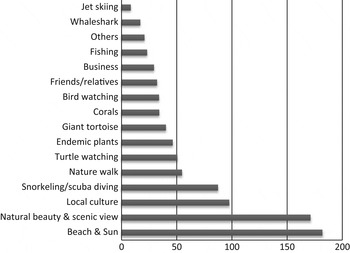
A number of studies suggest the use of dummy variables to account for multiple-site visitors so that the model, in essence, determines the proportion of total travel costs to be allocated to a given site (Parsons and Wilson, Reference Parsons and Wilson1997; Loomis et al., Reference Loomis, Yorizane and Larson2000; Stoeckl and Mules, Reference Stoeckl and Mules2006; Mwebaze and Bennett, Reference Mwebaze and Bennett2012). In this paper, a dummy variable (D ij) for multiple-site trips (D ij = 1 for a multiple-site trip and zero otherwise) and an interactive term with travel costs (D ij * TC) was used to account for multiple-site visitors. Data were collected about the different activities that international visitors engage in, including other sites visited as part of the trip, time spent, and the underlying reasons for the trip (figure 3). The information was used to determine whether a respondent was a single- or a multiple-site visitor and to construct the appropriate dummy variables. We used this information on the purpose of the trip to negate respondents who travelled for business, family and friends, and other purposes.
Stated reasons for trip to Seychelles (weighted scores)

The inclusion of time costs in the TCM has been the subject of much debate (Freeman, Reference Freeman2003; Parsons, Reference Parsons, Champ, Boyle and Brown2003). Some studies use a fraction of the wage rate to approximate the opportunity cost of time (Cesario and Knetsch, Reference Cesario and Knetsch1970; Cesario, Reference Cesario1976; Coupal et al., Reference Coupal, Bastian, May and Taylor2001; Bin et al., Reference Bin, Landry, Ellis and Vogelsong2005; Martinez-Espineira and Amoako-Tuffour, Reference Martinez-Espineira and Amoako-Tuffour2008). However, Loomis et al., (Reference Loomis, Yorizane and Larson2000) argue that the wage rate is not always a good proxy for the value of travel time because of taxes and disutility of travel. Other studies ignore the opportunity cost of time completely (Hanley et al., Reference Hanley, Bell and Alvarez-Farizo2003; Prayaga et al., Reference Prayaga, Rolfe and Sinden2006; Fleming and Cook, Reference Fleming and Cook2008). Note that the decision to exclude travel time implies that the coefficient of travel costs will be overestimated if the opportunity cost of time is positive (and this means that the CS will be underestimated). A number of papers control for the effects of travel time by including a separate time variable measured in hours (Loomis and Walsh, Reference Loomis and Walsh1997; Fix and Loomis, Reference Fix and Loomis1998; Loomis et al., Reference Loomis, Yorizane and Larson2000; Shrestha et al., Reference Shrestha, Seidl and Moraes2002; Mwebaze and Bennett, Reference Mwebaze and Bennett2012). If there is not a perfect correlation between travel cost and travel time, then it should be appropriate to use this approach and avoid relying on the fraction of the wage rate (McConnell and Strand, Reference McConnell and Strand1981; Loomis et al., Reference Loomis, Yorizane and Larson2000). Statistical tests showed the correlation coefficient between travel cost and travel time was 0.0415. Thus, in this paper, we included a separate time variable in the demand function.
3.2. Survey data
In order to estimate tourists' WTP for visiting marine parks in Seychelles, a survey was conducted on three different islands in Seychelles in 2009. However, given the short time frame and limited budget for this exercise, most of the surveys were conducted on the main island of Mahé, around which are located three marine parks (Baie Ternay, Port Launey and St. Anne; see figure 2). The rest of the surveys were conducted on Curieuse Island. No surveys were administered on Silhouette Island.
Data about the value of recreational activities in the group of marine parks were collected from a sample of international visitors at the selected sites. The data for the study were elicited with direct survey methods, using a paper-based visitor interception TCM questionnaire administered in a face-to-face format. Information from the questionnaire was designed to gather data on:
• current visitation rates and patterns;
• preferences and attitudes to recreation in marine parks;
• background demographic information on users; and
• values of current recreational activities assessed with travel costs of the trip (as defined by the airfare to Seychelles plus in-country travel expenses).
A number of sampling strategies were used to obtain a representative sample of the visitor population. Visitors to marine parks were intercepted at random and an in-person written survey was conducted while tourists were walking around the parks and beaches, visitor centre, shops and restaurants. The sample was stratified in order to make it representative of the temporal distribution of trips (e.g., sampling at different hours of the day and during all days of the week and weekends). The sampling occurred across a number of selected sites and time periods so that small groups of respondents were targeted to derive a representative sample of the visitors. Every third individual encountered was invited to participate in the survey. The survey was conducted over a three-month period from January through to March 2009, with 400 successful completions. There were 20 non-responses recorded for all the sites, giving an overall response rate of approximately 90 per cent.
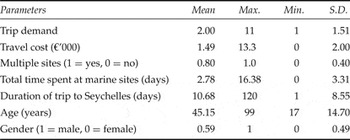
Table 1 gives a summary of the characteristics of international visitation to the group of marine parks in Seychelles. Figure 3 gives the respondents' stated reasons for their overall trip to Seychelles. In the survey, tourists were asked to identify the five most important reasons for their choice of Seychelles as their destination. The most important motivations for the tourists choosing Seychelles are to enjoy the beach and sun, the natural beauty and the scenic view, local culture, snorkelling/scuba diving, nature walks, turtle watching and other reasons (figure 3). The majority of the stated reasons for the trip highlight the benefits of marine resources for the visitors. These results are consistent with the other previous studies. The study by Cesar et al., (Reference Cesar, Van Beukering, Payet and Grandcourt2004) reported that the ‘natural’ condition of the coastal resources of the country makes up 65 per cent of the reason that tourists go to Seychelles.
Characteristics of trips to the group of marine parks in Seychelles

Source: TCM survey (2009).
4. Results and discussion
4.1. Estimated TCM visitation models
Travel costs can be estimated in a number of different ways and there is no fixed rule about the correct method of estimating travel costs. This study used perceived travel costs as reported by respondents. The current literature shows a slight preference for the use of reported costs (Herath and Kennedy, Reference Herath and Kennedy2004; Prayaga et al., Reference Prayaga, Rolfe and Stoeckl2010; Farr et al., Reference Farr, Stoeckl and Beg2011). Arguably, this is because reported costs are most likely to represent the opportunity costs that respondents considered when making their trip decision (Bennett, Reference Bennett1996; Prayaga et al., Reference Prayaga, Rolfe and Stoeckl2010; Mwebaze and Bennett, Reference Mwebaze and Bennett2012). The main means of travel into and from the Seychelles islands is via plane. Tourists visit individual islands and marine parks using small planes, ships and boats (figure 1). For this study, therefore, the travel costs can be divided into two groups:
(1) the cost of making the overall trip to Seychelles; and
(2) the cost incurred in making individual trips to the sites of interest.
The first category includes international airfares which are generally correlated with distance but can vary substantially between origins (Maille and Mendelsohn, Reference Maille and Mendelsohn1993). Using airfares as a proxy for the price of a trip is both appropriate and essential in an international TCM study (Maille and Mendelsohn, Reference Maille and Mendelsohn1993; Menkhaus and Lober, Reference Menkhaus and Lober1996). The second category includes costs associated with trips to the specific marine parks of interest such as in-country travel expenses, entry and guide fees. As visitors travel from the main island of Mahé to the specific sites by various means (light plane, helicopter, boats, etc.), there were substantial within-country trip costs that have been incurred. However, expenditures such as accommodation, meals and incidental expenses were excluded because such expenditures may relate to the discretionary choice of consumer products that are weakly related to the trip demand.
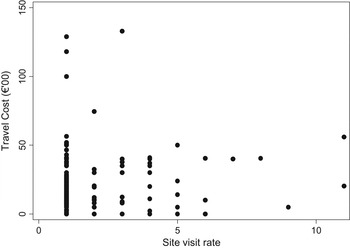
Figure 4 gives a graphical illustration of the data, relating the number of visits to the visit costs as reported by the respondents. One outlier with very high visit rates (141) and another with high travel costs were creating extreme influence on the models and were omitted from the data. The figure shows the expected inverse relationship where the number of visits tends to diminish with increasing travel costs. The data appear to have over-dispersion problems, with a wide range of costs associated with a single trip frequency. Negative binomial models were used to account for the problem of over-dispersion. As noted earlier, the data might also suffer from the problem of endogenous stratification, as the on-site sampling implies that more frequent visitors were more likely to be surveyed and thus over-represented. This problem was solved by subtracting one from all values of the dependent variable (Shaw, Reference Shaw1988; Englin and Shonkwiler, Reference Englin and Shonkwiler1995; Loomis, Reference Loomis2003). This adjustment eliminates the zero truncation problem and so we have a good reason to report the regular Poisson model.
Relationship between travel costs and number of trips to marine parks

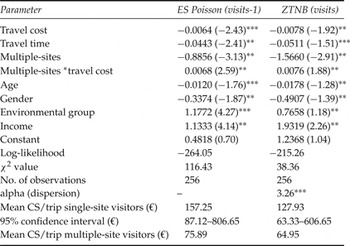
Results for the estimated ES Poisson and ZTNB models using reported costs are given in table 2. The same variables were used in both models to maintain consistency in comparing results across the models. Both models of visitation appear to be robust. The signs and significance of the variables included in the estimated models are consistent with economic theory and the past valuation studies. There are no sign changes in the estimated coefficients in both models and the magnitudes of the coefficients are very similar. The Poisson model adjusted for zero truncation and endogenous stratification (ES Poisson) appears to fit the data well. However, the likelihood ratio tests for α (the over-dispersion parameter) in the ZTNB is highly statistically significant (p ≤ 0.05), confirming that over-dispersion is present, and that the ZTNB model should be preferred over the ES Poisson model.
Estimated TCM of visitation to the group of marine parks in Seychelles

Notes: Coefficient/(t-statistics); ***, **, * indicates significance at the 1%, 5% and 10% levels, respectively.
ES denotes correction for endogenous stratification in Poisson model. Marginal effects are not reported for brevity reason.
The results show that the travel cost variables have negative signs and are statistically significant (p ≤ 0.05) across the estimated models. The negative sign of the transport cost variable indicates a downward sloping demand curve (Creel and Loomis, Reference Creel and Loomis1990; Grogger and Carson, Reference Grogger and Carson1991). This means that international visitors to marine parks in Seychelles will take fewer trips as transport costs increase. The negative sign on the travel cost variable is reinforced by the travel time variable, which has a negative sign and is statistically significant (p ≤ 0.05) in both models. This implies that an increase in the travel time would reduce the number of trips to the group of marine parks. The price elasticity of demand was calculated from the estimated models as −0.0021 and −0.0023 for the ES Poisson and ZTNB models, respectively. Hence the demand for trips to the group of marine parks in Seychelles is clearly inelastic. Demand elasticities for recreational trips are important in providing information to evaluate shifts in visitation patterns if new fees are introduced. This result is relevant for policy discussion since any measures that target transport-related costs (e.g., taxes, entry fees) will influence the quantity demanded of annual trips to the group of marine parks.
The dummy variable for multiple-site trips is negative and statistically significant in the models. This variable was used to capture whether or not respondents visited any other sites on their trip to the group of marine parks. The significance of this coefficient indicates that the slope for multiple-site visitors is different, and so the CS of the single-site and multiple-site visitors is different. The negative coefficient shows that the availability of multiple sites suppresses the demand for trips to the group of marine parks. This means that the values generated from trips to marine parks are lower because respondents visited other sites along the way; in other words the total surplus from the trip is shared across multiple sites.
Our results confirm that the demand for trips to marine parks is also sensitive to income, with the coefficient of income elasticity being positive and statistically significant (p ≤ 0.05) in the two estimated models. With respect to the socio-economic characteristics, the results indicate that the annual number of trips to the group of marine parks is expected to be significantly higher for younger, female tourists than for the average respondent. Finally, the coefficient for membership of an environmental organization was highly statistically significant (p ≤ 0.05), with a positive sign. This implies that international tourists who belong to an environmental group have a higher annual visitation rate than non-members.
4.2. Visitation benefits derived from marine parks
The economic values of trips to marine parks were derived using the trip generation functions reported in table 2. We derive CS estimates using both the ES Poisson and ZTNB models. Following Loomis et al. Reference Loomis, Yorizane and Larson2000: 186), the mean CS per-trip estimates for single-site visitors were obtained using the negative inverse of the travel cost coefficient  $\lpar -{1 \over \beta} \rpar $. Confidence intervals were constructed around the mean values using the formula below (Creel and Loomis, Reference Creel and Loomis1991; Fix and Loomis, Reference Fix and Loomis1998):
 $$CS_L ={1 \over \lsqb \beta _{TC} + 1.96\lpar se\rpar \rsqb }\semicolon \; \quad CS_U ={1 \over \lsqb \beta _{TC} -1.96\lpar se\rpar \rsqb }$$
where se is the standard error of the mean values.
The CS values per individual per trip for single-site visitors are approximately €157 and €128, respectively, for the ES Poisson and ZTNB models. The 95 per cent confidence intervals of the mean CS estimates per trip are reported in table 2. The model predicts that the average CS attributable to recreation in marine parks is between €128 and €157 per visitor per year. In other words, if the whole group of marine parks was closed to foreign visitors for an entire year, the total recreational welfare loss would equal, on average, €128 per individual for single-site visitors (using the results of the preferred ZTNB model).
The correct coefficient associated with travel costs for multiple-site visitors must be calculated, and will equal the coefficient of the travel cost plus the coefficient on the interactive dummy variable (−1/(β1+ β3) (Parsons and Wilson, Reference Parsons and Wilson1997; Loomis et al., Reference Loomis, Yorizane and Larson2000: 186). Taking results from table 2 for the preferred ZTNB model: the travel cost coefficient = −0.0078; the coefficient of the interactive dummy variable with travel cost = −0.0076; and so the mean CS per trip for multiple-site visitors = −1/(−0.0078 +− 0.0076) = −1/ − 0.0154 = 65. The calculation is repeated for the ES Poisson model. The mean CS per person for multiple-site visitors is €65–€76 (table 3).
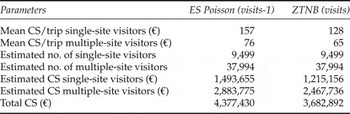
Aggregate annual CS estimates for selected group of marine parks
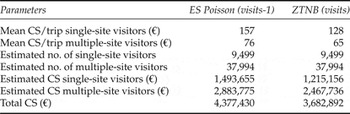
Notes: Visitor statistics for the year 2008/2009 were taken from the annual reports published by the National Statistics Bureau (NSB) of Seychelles. Estimates were also derived from the literature available. The total number of visitors to marine parks in 2008 was 47,493.
The aggregate CS for the group of marine parks was estimated in three steps:
(1) the mean CS per person trip for single-site visitors was multiplied by the estimated annual number of single-site visitors (which is calculated as the proportion of single-site visitors in the sample times the total number of visitors, assuming that the sample is representative of the visitor population);
(2) the mean CS per individual per trip for multiple-site visitors was multiplied by the estimated number of multiple-site visitors (which is calculated as the proportion of multiple-site visitors in the sample times the total number of visitors, also assuming the sample is representative of the visitor population);
(3) The two estimates were added to obtain the total CS.
Based on the total population of 47,493 tourists visiting Seychelles marine parks in 2008, the total social welfare value of visitation in marine parks is approximately €3.7 million in 2009 Euros, using the preferred ZTNB model (table 3).
5. Conclusions
A major problem facing the Seychelles islands is the degradation of MPAs, which are important in ecological terms as well as for generating income from tourism. Economic valuation can help guide policy makers and the Seychellois public to understand the value of marine resources and the cost of neglecting MPAs by expressing the value of their goods and services in monetary terms. This study conducted an analysis of the economic value of a group of marine parks in Seychelles. The TCM was used to establish the WTP of foreign tourists for trips to marine parks in Seychelles from their observed behaviour. The frequency of recreational trips to the group of marine parks is largely influenced by transport costs (as defined by airfares and in-country travel expenses), travel time, proximity of alternative sites and tourists' socio-economic characteristics such as age, gender and income. International tourists place a relatively high value on the recreational opportunity in marine parks in Seychelles. Their average CS measure per trip is approximately €128 for single-site visitors and €65 for multiple-site visitors. The total welfare measure attributable to recreational opportunities in the group of marine parks in Seychelles is approximately €3.7 annually, using the results of the preferred ZTNB model.
These figures are within one order of magnitude of estimates reported by other valuation studies. The study by Mathieu et al., (Reference Mathieu, Langford and Kenyon2003) used the CVM to determine tourists' WTP for visits to marine parks in Seychelles. A survey of 300 tourists produced a mean WTP of US$12.2 (€9.79 in 2009 Euros) per person per year. Another study by Mwebaze et al., (Reference Mwebaze, MacLeod, Tomlinson, Barois and Rijpma2010) estimated the cost of IAS to the economy of the Seychelles islands. They also conducted a CVM exercise to obtain a WTP estimate for a policy to protect marine biodiversity at risk from IAS. Foreign tourists indicated a mean WTP of US$55 (€44) per year to fund conservation policy. Thus the TCM conducted in this paper has generated slightly higher estimates of value for marine biodiversity than the CVM in the two earlier studies. This is consistent with many other studies which have indicated that the TCM tends to produce higher estimates of value than the CVM (e.g., Loomis, Reference Loomis2006; Brander et al., Reference Brander, van Beukering and Cesar2007; Rolfe and Dyack, Reference Rolfe and Dyack2010).
The TCM presented in this paper provides useful information about the role that foreign tourists play in utilizing and valuing scarce marine resources in SIDS. Our results can be used to inform a new fees structure which more accurately reflects the value of marine parks. The TCM analysis indicated an average CS per individual of €128 for single-site visitors and €65 for multiple-site visitors. These figures exceed the average entrance fee of US$10 (€8 in 2009) that most international visitors would have to pay to enter protected areas in Seychelles. Thus it would appear that the Marine Parks Authority have sufficient room to raise their entry fees substantially in light of international demand. The TCM demand curve and travel cost coefficient were used to calculate a price elasticity of demand. It works out at −0.0023 for the preferred ZTNB model, which is less than 1. This shows that the agency is clearly in the inelastic region of the demand curve so that raising fees can increase total revenue. The increased revenue generated from higher fees should be given back to individual parks for use in maintaining and conserving marine sites. Thus the TCM can be used to determine the value of a protected area to those who are able and willing to pay for it, which appears to be an appropriate step in promoting conservation in SIDS.
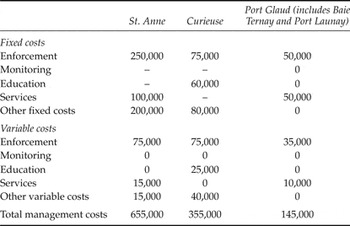
In terms of how useful these results are for CBA, it should be noted that: (i) modelling changes in site quality and (ii) changes in access conditions to individual sites would be more useful to inform policy and management decisions than simply knowing the value of access under current conditions to all sites together. Nonetheless, the results from this study can be used in a high-level indicative CBA of MPAs. Estimates from the TCM can be used to ensure that recreational values are represented in a future analysis of alternative land uses. A simple example is provided to illustrate this argument. We use cost estimates from the study by Cesar et al., (Reference Cesar, Van Beukering, Payet and Grandcourt2004) which calculated the costs of improved management efforts to reverse negative trends of degradation in marine sites in Seychelles. The interventions include expenditures on services, enforcement/compliance, education/awareness, monitoring and infrastructure. For each marine site, assumptions were made regarding the appropriate investments. The estimated costs are reproduced in table 4. The total cost of managing four marine parks to reverse negative impacts is US$1,155,000, which is equivalent to €898,277 at the September 2012 exchange rate. The TCM estimate of total welfare benefits is €3,682,892 for the preferred ZTNB (table 3). The aggregate benefits are therefore significantly higher than the total costs of managing the group of marine parks, with an indicative benefit/cost ratio of approximately 4.0. Hence marine parks represent a good investment of public funds.
Annual costs associated with improved management efforts to reverse negative trends in selected marine parks in Seychelles (US$)

Notes: Figures quoted in the text are converted from US$ to Euros using the current exchange rate (€1 =US$1.29), as at September 2012.
Source: Costs are taken from Cesar et al. (Reference Cesar, Van Beukering, Payet and Grandcourt2004).
For MPAs to produce their full benefits, it is essential to invest in good management – and this is justified through the economic analysis conducted in this study. However, with a limited budget of about US$500,000 per year and 30 staff, some of the marine parks are not being adequately managed. Arguably only three of the six marine parks receive active management and it is likely that many of the potential benefits are not being realized. For example, the Silhouette Marine Park was not being managed at all by the Marine Parks Authority at the time of this study. It is recommended that the Government of Seychelles and international organizations should increase budget allocations to support the management of marine parks. It is also recommended that fees should be collected at all sites where implementation of a fee system is feasible. If sufficient investments are not allocated to support MPAs, a gradual decline in ecological conditions can be expected at marine sites. Given the structure of the economy, with heavy reliance on tourism, it is unlikely that the country can afford to bear the costs associated with environmental degradation in the longer term. There are also limitations to this paper. The study did not address some of the tourism-related issues which are associated with the growth in this activity. Tourism can have both a positive and negative impact on biodiversity. This is a subject for further work.