Background
In 2024, 393 disasters occurred worldwide, up from the annual average of 371 from 2004 to 2023. This increase is mostly attributed to the increase in storms from the annual average of 106 (2004 to 2023) to 147 in 2024.1 Few data have been published regarding pediatric emergency medicine and the care that children require in the acute period after natural disasters. Hurricanes Katrina and Harvey illustrated the importance of a priori consideration of pediatric needs. Following Hurricane Katrina, thousands of individuals from Louisiana were evacuated to Houston, many finding shelter in the Reliant Stadium complex for several weeks. Over 3,000 children were treated by the Mobile Pediatric Emergency Response Team (MPERT) staffed by members of the Section of Emergency Medicine at Baylor College of Medicine and Texas Children’s Hospital. Alternatively, during Hurricane Harvey, which affected Houston, TX, directly, patients who were displaced from their homes were treated within the mass shelter at George R. Brown Convention Center in a clinic operated in collaboration between the Disaster Medical Assistance Team (DMAT) and local Emergency Medical Services (EMS). At the time of treatment, the diagnoses and characteristics of the pediatric patients were recorded for tracking purposes.
The unique nature of 2 separate meteorological events involving Houston and providers at Texas Children’s Hospital, both directly and indirectly, provides a unique opportunity in post-disaster research. Collected data on the qualitative nature of presentations to medical services in the post-disaster pediatric patient will allow us to better understand the relative needs for patient care in a post-disaster setting. The experiences gained following both Hurricane Katrina and Harvey are invaluable, and as we continue to learn from each of these events, using these data to make changes to better prepare our communities for the pediatric patient is imperative.
Our objective was to review prospectively collected data on patient demographics, chief complaints, and resource utilization of internally displaced children in congregate settings established after 2 natural disasters in a large metropolitan area. Our long-term goal is that these data can inform future disaster preparedness plans to account for acute illnesses and exacerbations of chronic illnesses in children and adolescents and young adults (AYAs).
Methods
This retrospective case-control study was granted institutional review board approval and was performed utilizing data that were prospectively collected at the time of presentation to each of the post-hurricane medical care areas; specifically, the MPERT post-Katrina and the DMAT post-Harvey. All pediatric (0-18-year-old) patients were included. Patients were excluded only if they did not have one of the critical elements for data collection (i.e., age and/or diagnosis code).
Retrieved data included the primary visit diagnosis and demographic information. A control group consisting of unaffected pediatric patients was needed. As the local pediatric emergency department (ED) in Houston was continuing normal operations during the Hurricane Katrina response, this ED was selected as the site in which a control group could be used. Pediatric patients presenting to the local ED during the same period that the MPERT was open were used as the control group. This same control group served as a historical control later for the DMAT data, as during this hurricane response, all of Houston, TX, was affected and therefore, an unaffected control group was unavailable.
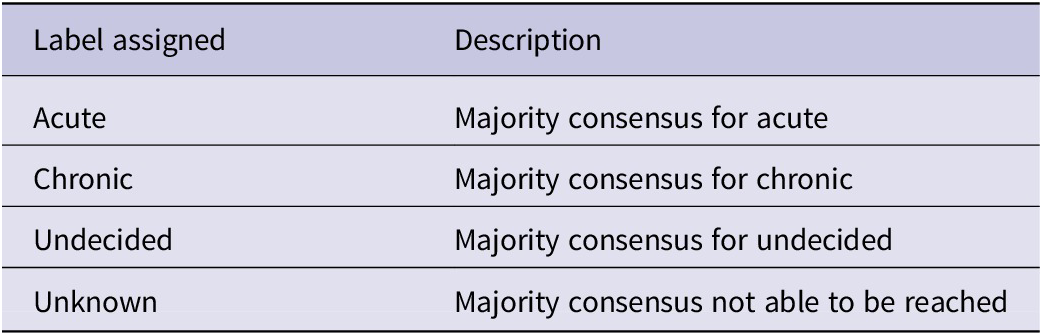
After the data were collected, a database compiling diagnostic codes utilized for all pediatric patients from the MPERT, DMAT, and EC was created. While during the Katrina response, both the EC and the MPERT were utilizing ICD-9, by the time of the Harvey response, this had changed to ICD-10 within the DMAT. The database was presented to five Pediatric Emergency Medicine (PEM) physicians who each served as raters and labeled each diagnostic code as either acute or chronic. They were instructed that chronic conditions were to include acute flares of chronic diseases. If a rater was unable to decide between acute and chronic, the diagnosis was labeled as undecided. When unanimous agreement was not obtained, majority consensus was utilized to determine the assignment of the diagnostic code. If majority consensus was not possible, it was labeled as unknown (Table 1).
Consensus definitions used by pediatric emergency medicine physician raters to categorize acute and chronic presentations

Table 1. Long description
Table 1 defines the four labels used by pediatric emergency medicine physician raters to classify patient presentations. “Acute” indicates majority consensus that the presentation was acute. “Chronic” indicates majority consensus that it was chronic. “Undecided” indicates majority consensus that the presentation could not be classified as acute or chronic. “Unknown” indicates that the raters did not reach majority consensus.
For interrater agreement, a Fleiss Kappa was calculated since there were >2 raters and raters had categorical options (i.e., acute or chronic).Reference Viera and Garrett2 A P-value <0.05 was considered statistically significant. Analyses were conducted using STATA, version 13 (StataCorp LP, College Station, TX). A descriptive analysis of demographic data, including age and gender, was completed using Microsoft Excel. A descriptive analysis was conducted of the labeled diagnostic codes from all 3 locations. A chi-square analysis including a 95% confidence interval was conducted in comparing cases to controls, with a P-value <0.05 considered statistically significant.
Results
The TCH ED serving as the control group totaled 3,587 patients, the MPERT totaled 3,015, and the DMAT totaled 202 patients (Table 2). Sex distribution among case and control groups was equal, and we found that patients seen within the post-hurricane care areas had an older age distribution when compared to the control group. The 5 PEM physicians, utilizing the diagnostic code database, showed substantial agreement for all options combined (ĸ = 0.69; P-value < 0.0001).
Demographic characteristics (age and sex) of pediatric patients presenting to post-disaster medical care areas following Hurricane Katrina and Hurricane Harvey compared with an unaffected Emergency Department Control Population

Table 2. Long description
Table 2 compares pediatric patients treated after Hurricane Katrina by MPERT (n=3,015), after Hurricane Harvey by EMS and DMAT (n=202), and at an unaffected Texas Children’s Hospital Emergency Center (n=3,587). Patients aged 6–18 years comprised 59% of both post-disaster groups versus 36% of controls. Younger children comprised more of the control group: 34% were 29 days to younger than 24 months and 27% were 2–5 years, compared with 19% and 21% after Katrina and 23% and 18% after Harvey. The Katrina group was 49% male and 50% female; the Harvey group was 46% male and 51% female; and controls were 54% male and 46% female. Totals may differ because of missing data and rounding.
Missing diagnosis codes accounted for 423/3,015 (14%) of the MPERT patients and 71/202 (35%) of the DMAT patients, resulting in 2,592 and 131 patients, respectively, with a diagnostic code available for analysis. An additional 12 patients from DMAT data were excluded after the diagnosis code was labeled as undecided (6/131, 4.6%) by raters or unknown due to the inability to reach majority consensus (6/131, 4.6%), finalizing 119 patients for diagnostic code analysis. (Table 3) Of the combined patients that presented to either of the post-hurricane care areas, 22% of them presented with chronic complaints compared to 13.6% of the controls (Difference 8.4%, P < 0.0001, 95%CI 6.52–10.31). A statistically significant difference when compared to controls is seen whether the hurricanes are analyzed separately or combined.
Distribution of acute and chronic pediatric presentations in post-disaster medical care areas following Hurricane Katrina and Hurricane Harvey compared with unaffected Emergency Department Control Population

Table 3. Long description
Table 3 compares acute and chronic pediatric presentations after Hurricanes Katrina and Harvey with an unaffected Texas Children’s Hospital control population. After Katrina, 78.3% of 2,592 MPERT presentations were acute and 21.7% were chronic, compared with 86.2% acute and 13.6% chronic among controls. After Harvey, 73.1% of 119 EMS and DMAT presentations were acute and 26.9% were chronic. Across both hurricanes, 78.0% of 2,711 presentations were acute and 22.0% were chronic. Compared with controls, the combined differences were 8.2 percentage points for acute presentations and 8.4 percentage points for chronic presentations; both were statistically significant. Overall, post-disaster populations had fewer acute and more chronic presentations than controls.
a Diagnoses were missing for 423 (14%) of the 3,015 patients seen in the MPERT.
b Diagnoses were missing for 71 (35%) of the 202 patients seen in the MPERT.
MPERT, Mobile Pediatric Emergency Response Team; TCH, Texas Children’s Hospital; EMS, Emergency Medical Services; DMAT, Disaster Medical Assistance Team.
* P-value ≤ 0.0001.
Discussion
Our goal was to determine the proportion of patients that presented to temporary health care areas after being displaced by a hurricane event with acute or chronic complaints. We found that, when compared to an unaffected control population, pediatric patients presenting to post-hurricane medical areas, independent as to whether they were internally or externally displaced, are more likely to present with a chronic medical complaint, including acute exacerbations of chronic conditions.
Reasons for this shift in presentations to the emergency department in the post-hurricane setting have yet to be fully evaluated but may include loss of medications or supplies with the patient’s displacement, disruption of the local health care system’s safety net within primary practices, or environmental factors contributing to exacerbations.
Disaster preparedness does not necessitate reinvention of clinical care processes already in place. What needs to be considered is effective maximization of existing resources to minimize impact. Ideally, pre-event planning will include discussions and even memorandums of understanding with pediatric providers and institutions to facilitate swift organization and pediatric-appropriate care to be provided in the event of a disaster. In the planning process, it is important to know the types of patients and conditions a medical care area should be equipped to take care of. These data can be used for future planning in institutions and local EMS disaster preparedness initiatives.
There were limitations. As occurs when relying on the front-line physician to determine a primary diagnosis, misclassification bias may be encountered. Additionally, the large amount of missing data, specifically within the database received from the post-Harvey medical care area, could have led to a selection bias that is unable to be assessed. Lastly, the nature of ICD-10 codes requires modifiers to allow more specific diagnoses. In this case, general ICD-10 codes were used, leaving the primary diagnosis general and vague, and we suspect this largely contributes to the high number of undecided and unknown labels found in this patient group.
Future directions include looking into barriers present inherently within a disaster that make patients more susceptible to requiring medical care for chronic conditions. This is where one would start in being able to provide resources and structuring of a response to bring aid to patients. Inquiring into the data management software used within the post-Harvey medical care area may lend insight into how to mitigate the loss of data and the vagueness of the data retrieved for future revisions and utilization.
Conclusion
In looking at both externally displaced patients from Hurricane Katrina and internally displaced patients from Hurricane Harvey, we found that, when compared to an unaffected control population, pediatric patients presenting to post-hurricane medical areas are more likely to present with a chronic medical complaint, including acute exacerbations of chronic conditions.
Competing interests
None.