




No CrossRef data available.
Sex, Lies, and War: How Soft News Brings Foreign Policy to the Inattentive Public
Published online by Cambridge University Press: 03 March 2004
Abstract
This study argues that, due to selective political coverage by the entertainment-oriented, soft news media, many otherwise politically inattentive individuals are exposed to information about high-profile political issues, most prominently foreign policy crises, as an incidental by-product of seeking entertainment. I conduct a series of statistical investigations examining the relationship between individual media consumption and attentiveness to several recent high-profile foreign policy crisis issues. For purposes of comparison, I also investigate several non-foreign crisis issues, some of which possess characteristics appealing to soft news programs and others of which lack such characteristics. I find that information about foreign crises, and other issues possessing similar characteristics, presented in a soft news context, has indeed attracted the attention of politically uninvolved Americans. The net effect is a reduced disparity in attentiveness to select high-profile political issues across different segments of the public.
Information
- Type
- Research Article
- Information
- Copyright
- © 2002 by the American Political Science Association
People who are not interested in politics often get their news from sources quite different from those of their politically engaged counterparts (Chaffee and Kanihan 1997; Key 1961). While alternative news sources for the politically uninvolved have long been available, the last two decades have witnessed a dramatic expansion in the number and diversity of entertainment-oriented, quasi-news media outlets, sometimes referred to collectively as the soft news media.
Political scientists, including public opinion scholars, have mostly ignored the soft news media. And, indeed, most of the time these media eschew discussion of politics and public policy, in favor of more “down-market” topics, such as celebrity gossip, crime dramas, disasters, or other dramatic human-interest stories (Patterson 2000; Kalb 1998b). Yet, as I shall demonstrate, on occasion, the soft news media do convey substantive information concerning a select few high-profile political issues, prominently among them foreign policy crises. This suggests the proliferation of soft news may have meaningful implications for politics, including foreign policy.
Scholars have long pondered the barriers to information and political participation confronting democratic citizens. The traditional scholarly consensus has held that the mass public is woefully ignorant about politics and foreign affairs (Delli Carpini and Keeter 1996; Converse 1964; Almond 1950), and hence, with rare exceptions, only relatively narrow segments of the public—the so-called “attentive public” or “issue publics”—pay attention to public policy or wield any meaningful influence on policymakers (Graebner 1983; Cohen 1973; Rosenau 1961; Key 1961). By, in effect, broadening access to information about some political issues, soft news coverage of politics may challenge this perspective, at least in part. If a substantial portion of the public that would otherwise remain aloof from politics is able to learn about high-profile political issues, such as foreign crises, from the soft news media, this may expand the size of the attentive public, at least in times of crisis. And a great deal of research has shown that intense public scrutiny, when it arises, can influence policymakers, both in Congress and the White House (Baum 2000; Powlick 1995; Bosso 1989; Rosenau 1961; Key 1961).
This possibility raises a number of questions. First, to what extent and in what circumstances do the entertainment-oriented, soft news media convey information about serious political issues? Second, what types of political topics appeal to such media outlets? Third, how might their coverage differ from that found in traditional news sources? Finally, who is likely to consume political news presented in this entertainment-oriented media environment, and why? These are the primary questions motivating the present study.
I argue that for many individuals who are not interested in politics or foreign policy, soft news increasingly serves as an alternative to the traditional news media as a source of information about a select few political issues, including foreign policy crises. This is because the soft news media are in the business of packaging human drama as entertainment. And, like celebrity murder trials and sex scandals—the usual fare of soft news outlets—some political issues, prominently among them foreign crises, are easily framed as compelling human dramas.1
Gamson and Modigliani (1987, 143) offer the following operational definition of a frame: “a central organizing idea or story line that provides meaning to an unfolding strip of events, weaving a connection among them. The frame suggests what the controversy is about, the essence of the issue.” This definition adequately captures my use of the term in this study [but see Druckman (2002) for a discussion of differing definitions and uses of the term].
This study focuses primarily on foreign policy crises. My argument, however, is general, and so not unique to foreign policy. Indeed, it also applies to a fairly narrow range of domestic political issues. Nonetheless, I focus on foreign crises for three reasons. First, ceteris paribus, foreign crises are more likely than most issues to transcend traditional partisan boundaries. Hence, public attention to foreign crises is relatively less likely to be affected by heightened public cynicism regarding partisan politics (Nye, Zelikow, and King 1997; Dionne 1991). Second, beyond celebrity murder trials and sex scandals, few issues are as likely to capture the public's imagination as the prospect of large-scale violence and the potential death of large numbers of Americans at the hands of a clearly identifiable villain. Combined, these two factors make foreign crises an appealing subject matter for the largely apolitical, entertainment-oriented soft news media. Third, Americans know and care less about foreign than domestic affairs (Kegley and Wittkopf 1996; Reilly 1995; Sobel 1989; Graber 1984), especially in the post-Cold War era (Moisy 1997; Holsti 1996), and most foreign policy news is typically ignored entirely by the soft news media. Hence, while my argument extends beyond foreign policy, I nonetheless focus on foreign crises as, in effect, a “most difficult” test of the argument.
The remainder of this study proceeds as follows. In the next section, I introduce and define my key independent variable, soft news. I also discuss my dependent variable, attentiveness to foreign crises (or other similarly accessible political issues). I begin the section by considering the distinguishing characteristics of a soft news outlet, and the propensity of the soft news media to cover select political issues, including foreign crises. I then consider the types of political issues covered by soft news programs and the manner in which such programs frame those political issues they elect to cover. Finally, building on previous theories of passive learning (Neuman, Just, and Crigler 1992; Zukin with Snyder 1984), I develop an “incidental by-product” model of information consumption (e.g., Popkin 1994). I argue that by repackaging news about select political issues, including foreign crises, as entertainment, soft news dramatically reduces the cognitive costs of paying attention. As a result, even individuals who are not interested in politics may be willing to pay attention to such information.
To test my hypotheses, in the third section I conduct a series of statistical investigations into the correlates of attentiveness to a series of foreign crisis issues, plus, for purposes of comparison, several noncrisis issues. Across each test, my results strongly support the incidental by-product model. Finally, the Conclusion summarizes my findings and considers several implications for politics, public policy, and democracy.
POLITICS, FOREIGN POLICY, AND SOFT NEWS
The Soft News Media
Since the early 1980s, the growth of cable—and, more recently, satellite television and the internet—has created a highly competitive media environment, especially in television (Patterson 2000; Baum and Kernell 1999; Webster and Lichty 1991). Rising competition for viewers has forced broadcasters to find new ways to raise their profit margins, such as increasing the audience for news (Grossman 2000; Zaller 1999; Kalb 1998a, 1998b; Hess 1998; Auletta 1993; Hallin 1991) and lowering production costs. To do so, they have, in part, repackaged certain types of news into inexpensively produced forms of entertainment (Davis and Owen 1998; Kalb 1998b), sometimes referred to as soft news.2
While I focus primarily on television, similar trends toward the blending of news and entertainment have also occurred in elements of the radio and print media (Patterson 2000; Davis and Owen 1998). I focus on television because, in addition to being the primary source of news for most Americans, as noted by Neuman et al. (1992, 114), television “can break the attention barrier for issues of low salience…newspapers and magazines are better sources for new information when the audience is already motivated to pay attention” (see also Patterson 1980). Nonetheless, in the statistical analyses that follow, I also account for the effects of the print and radio soft and hard news media.
Though the term soft news is widely employed by media scholars (e.g., Patterson 2000; Kalb 1998b; Scott and Gobetz 1992), no commonly accepted definition exists. Patterson (2000, 3) observes that soft news has been defined, variously, as a residual category for all news that is not “hard,” as a particular vocabulary in presenting the news (e.g., more personal and familiar and less distant or institutional), and as a set of story characteristics, including the absence of a public policy component, sensationalized presentation, human-interest themes, and emphasis on dramatic subject matter, such as crime and disaster. Though admittedly imprecise, for my purposes, the latter definition—based on the aforementioned story characteristics—appears most useful for distinguishing the soft news media from traditional news outlets.
While virtually all news-or information-oriented media present at least some stories possessing some or all of the above characteristics, only a subset focuses primarily on such material, largely (though not necessarily entirely) to the exclusion of traditional—local, national, or international—political or public policy topics and themes. And it is the latter media outlets with which I am concerned. Clearly, in at least some instances, the difference between soft and hard news is one of degree rather than kind. And a few media outlets (several of which I discuss below) are not easily categorized as belonging unambiguously in either category.3
Because the dividing line between the soft and the hard news media is not in every instance entirely clear, in my statistical analyses I rely on empirical testing to determine the appropriate placement of several relatively ambiguous cases, such as local TV news.
Two examples of the dramatic proliferation of the soft news media on television are daytime and late-night talk shows and entertainment and tabloid news programs.4
While the talk show format differs from the traditional news format, it is nonetheless similarly geared toward providing information to viewers about real-world personalities, issues, and events.
One example of an arguably less clear-cut program format, in turn, is network news magazines. While such programs do cover hard news topics, particularly when major events arise, recent content analysis studies [Zaller 1999; Kalb 1998a; Committee of Concerned Journalists (CCJ) 1998] have found that they focus primarily on soft news topics, such as celebrity profiles and crime dramas.5
A content analysis of stories on 60 Minutes between January and June 1998 revealed that 60% of the 62 segments aired addressed soft news topics (i.e., celebrity profiles, “Can you believe?” investigative reports, and lifestyle pieces), while only 13% dealt with traditional hard news topics (Kalb 1998a). Zaller (1999) finds that between 1968 and 1998, 60 Minutes' score on a news quality index fell by over half. And the news quality score for 60 Minutes greatly exceeded those of its competitors. Finally, a 1998 study (CCJ 1998) found that five prime-time network news magazines (20/20, 48 Hours, 60 Minutes, Prime Time Live, and Dateline) devoted a combined total average of just 5.5% of their coverage during Fall 1997 to topics relating to either government, military/national security policy, foreign affairs, education, or the economy. In sharp contrast, they devoted nearly half of their total airtime to stories pertaining to entertainment/celebrities, personality/profiles, crime, or human-interest topics. During the same period, the corresponding averages for network news stories (ABC, CBS, and NBC) were 35% of airtime devoted to the aforementioned hard news topics and just 12% devoted to the above soft news topics. Overall, government and foreign affairs were the two most common topics on network evening newscasts, while the top topics on network news magazines were crime, human interest, and personality/profile.
Equally important, large numbers of Americans consume soft news. Table 1 presents the average Nielsen ratings for several soft news television programs during the first 6 months of 1999.6
Ratings for Network News Magazines are averages for the period September 21, 1998 to September 20, 1999.
CNN's ratings typically spike during international crises. Yet the single largest audience in CNN's history, 5.4 million households (January 17, 1991), was smaller than the average audience for the lowest-rated network news program (Noah 1997).
For instance, the largest circulation newspaper in America is not the Wall Street Journal but, rather, The National Enquirer.

Soft News Coverage of Foreign Crises.
The preceding discussion begs the question of why social scientists should care about the rise of soft news. In fact, any political relevance of soft news depends on the extent to which such programs actually cover political issues, such as foreign crises. And, indeed, soft news programs have covered every major U.S. foreign military crisis since 1990. I searched program transcripts, using Lexis–Nexis, and TV Guide listings for a variety of soft news programs to determine whether and to what extent they covered the Persian Gulf War, the ongoing series of post-Gulf War crises with Iraq, and four other high-profile U.S. foreign crises of the past decade—Somalia, Haiti, Bosnia, and Kosovo. Where such transcripts were inaccessible (e.g., Oprah Winfrey), I contacted several programs directly. For purposes of comparison, I also searched Lexis–Nexis for soft news coverage of several more traditional and less dramatic political issues (the later results are discussed below, under Statistical Investigations). Table 2 presents the results of these inquiries. These figures—which represent the number of separate broadcasts of each program that addressed a given issue—are extremely conservative, due to limited availability of transcripts, sporadic program listings, and unwillingness of some programs to provide the requested information, as well as recent start-dates or cancellation of several of the programs.

To determine whether these raw figures constitute “significant” coverage, I compared soft news coverage of four foreign crises in the 1990s with coverage of those crises on ABC's World News Tonight. The results indicated that, taken together, the number of separate broadcasts of the TV talk shows listed in Table 2 mentioning the U.S. interventions in Bosnia and Kosovo, combined, was equivalent to 73% of the total number of separate broadcasts of World News Tonight which mentioned those conflicts.9
The TV talk show figures represent the sum of between seven and nine programs (depending on the year).
If one counts the total number of stories on World News Tonight, soft news coverage still appears to be nontrivial. In the case of Bosnia and Kosovo, the number of TV talk show broadcasts is equivalent to over half (56%) of the total number of stories on World News Tonight. The corresponding figure for Somalia and Haiti is 40% as many stories as ABC network news broadcasts. Finally, the number of Extra broadcasts mentioning Bosnia is equivalent to 40% of the total number of Bosnia stories on World News Tonight.
How Soft News Programs Cover Foreign Crises.
While, like traditional news outlets, soft news programs do appear to cover foreign crises regularly, they do not necessarily do so in the same manner. Where traditional news outlets typically cover political stories in manners unappealing—either too complex or too arcane—to individuals who are not intrinsically interested in politics, the soft news media self-consciously frame issues in highly accessible terms—which I call “cheap framing”—emphasizing dramatic and sensational human-interest stories, intended primarily to appeal to an entertainment-seeking audience.
Neuman, Just, and Crigler (1992) identify five common frames readily recognized and understood by most individuals. These include “us vs. them,” “human impact,” “powerlessness,” “economic,” and “morality.” To this list, Powlick and Katz (1998) add an “injustice” frame. Graber (1984) found that several of these frames—“human impact,” “morality,” and “injustice”—resonated strongly with her interview subjects.11
These findings complement a large literature in social psychology on individual media uses and gratification. This literature (e.g., Katz, Blumler, and Gurevitch 1973–1974; Katzman 1972; McQuail et al. 1972; Katz and Foulkes 1962) argues that individuals use the media to fulfill various social and psychological needs, including diversion, easing social tension and conflict, establishing substitute personal relationships, reinforcing personal identity and values, gaining comfort through familiarity, learning about social problems, and surveillance. In fact, the frames most frequently employed by typical individuals are directly linked to several of the predominant uses of the media identified by psychologists.
In a separate content analysis, Patterson (2000) reaches conclusions similar to those of the CCJ study. He also found substantial increases in sensationalism in news reporting and in the proportion of news stories lacking any public policy component.
A review of the content of soft news coverage of several 1990s foreign crises offers support for the findings of the aforementioned studies. In each case, rather than focus on the more arcane aspects of these crises, such as military tactics or geopolitical ramifications, the soft news media tended to focus on highly accessible themes likely to appeal to viewers who were not necessarily watching to learn about military strategy or international diplomacy. For instance, during the Persian Gulf War, while CNN and the major networks filled the airwaves with graphic images of precision bombs and interviews with military experts, the daytime talk shows hosted by Oprah Winfrey, Geraldo Rivera, and Sally Jesse Raphael, as well as A Current Affair, focused on the personal hardships faced by spouses of soldiers serving in the Gulf and on the psychological trauma suffered by families of Americans being held prisoner in Iraq as “human shields.”
Similarly, in mid-1995, in covering the escalating U.S. military involvement in Bosnia, a review of the nightly news broadcasts of the three major networks indicates that they addressed a broad range of issues—including international diplomacy, military tactics, the role of NATO, “nation building,” and ethnic cleansing, to name only a few. In contrast, the soft news media devoted most of their coverage to a single dramatic story: the travails of U.S. fighter pilot Scott O'Grady, who was shot down over enemy territory on June 2, 1995. Captain O'Grady's heroic story of surviving behind enemy lines for 5 days on a diet of insects and grass, before being rescued by NATO forces, represented an ideal made-for-soft news human drama. To determine the nature and extent of soft news coverage of Bosnia in June 1995, I reviewed Lexis–Nexis transcripts from 12 soft news programs for which the appropriate data were accessible.13
The programs I reviewed included Extra, Dateline, Jay Leno, David Letterman, Conan O'Brien, A Current Affair, Live with Regis and Kathy Lee, Entertainment Tonight, Howard Stern, E! News Daily, The E! Gossip Show, and The Geraldo Rivera Show.
More recently, when, on August 20, 1998—3 days after President Clinton's grand jury testimony regarding his relationship with Monica Lewinsky—the United States launched cruise missile strikes against suspected terrorist targets in Afghanistan and Sudan, coverage by the soft and hard news media once again differed dramatically. Whereas traditional news coverage encompassed a variety of themes—ranging from describing circumstances “on the ground” in Afghanistan and Sudan, to profiling Osama bin Laden, to reviewing military tactics, to calculating likely effects on international terrorism—that of the soft news media focused primarily on a single dramatic and highly accessible theme: the uncanny parallels between real-world events and a (until then) relatively obscure movie, called Wag the Dog. In the film, a fictional president hires a Hollywood producer to “produce” a phony war to distract the public from his involvement in a sex scandal.
Once again, using Lexis–Nexis, I reviewed transcripts from 12 soft news programs.14
The programs I reviewed included Entertainment Tonight, Access Hollywood, Extra, The Daily Show, E! News Daily, Jay Leno, Conan O'Brien, Politically Incorrect, Howard Stern, 60 Minutes, 20/20, and Dateline. In those cases where I could not determine from the soft news program abstracts whether the Wag the Dog theme was addressed in a given story, I counted the story as non-Wag the Dog-related coverage of the missile strikes. Hence, the figures reported below are conservative.
Because of the narrower (1-week) time frame in the latter comparison, in this instance I compared stories rather than broadcasts.
More than ever before, consumers have a choice of consuming soft or hard news. And substantial numbers have opted primarily, if not exclusively, for the former, entertainment-oriented variety of programming. This raises the question of whether these developments have any meaningful implications for who is becoming informed about foreign crises.
Incidental Attention
The American people know little about politics (Delli Carpini and Keeter 1996; Converse 1964) and, over time, have grown less politically engaged (Niemi et al. 1989; Bennett 1986) and more cynical about all things political (Nye et al. 1997; Dionne 1991; Miller 1974). Moreover, for the past decade, Americans have been less concerned with foreign affairs than at any time since World War II (Moisy 1997; Holsti 1996). For instance, in the 1950s and 1960s, when asked by Gallup to name the most urgent problem facing the nation, about half of the public regularly mentioned issues relating to foreign affairs; in the past decade, the corresponding average fell to a postwar low of less than 8% (Baum 2000). These data suggest that, for many Americans, politics, including foreign policy, is of little interest.
Those who consider politics a waste of time are unlikely to pay attention to political information unless the time and effort required to do so (i.e., the expected costs) are extremely small, thereby removing any incentive to ignore it (Salomon 1984). One means of minimizing the costs associated with paying attention to low-benefit political information might be to attach or “piggyback” it to low-cost entertainment-oriented information. This would allow individuals to learn about politics passively (Neuman, Just, and Crigler 1992; Zukin with Snyder 1984), even if they are neither interested in the subject matter nor motivated to learn about it (Zukin with Snyder 1984; Robinson 1974; Wamsley and Pride 1972; Blumler and McQuail 1969; Fitzsimmons and Osburn 1968; Krugman 1965). Political information might thus become a free bonus, or incidental by-product, of paying attention to entertainment-oriented information.16
Passive learning is possible because individuals are more likely to accept information presented in a nonconflictual manner, which does not arouse excitement (Krugman and Hartley 1970). Individuals learn passively by first choosing to expose themselves to a particular type of information (e.g., political news), say by watching the network news, but then surrendering control of the specific information to which they are exposed (Zukin and Snyder 1984). For instance, individuals unwilling to read about a political issue in the newspaper may be willing to watch a news story about the issue, even if they are not particularly interested in the subject matter, simply because watching television requires less effort (Eveland and Scheufele 2000). Incidental learning is merely an extreme form of passive learning, whereby the individual actively seeks one variety of information, say entertainment, and is unwittingly exposed to and accepts information of another sort entirely (e.g., political news).
This does not imply that the distinction between traditional and soft news has disappeared or that politically apathetic individuals have come to anticipate heightened benefits from consuming political news. Along these lines, Lutz (1975) points out an important distinction between first- and second-order cognitive effects in influencing attitude change. The former concerns information that directly addresses a given attitude object, such as an advertisement intended to convince a viewer to buy a particular brand of toothpaste. The latter concerns the effects of such new information, or attributes, on attitudes that are not the overt object of the information. In other words, the effects of information on attitudes tend to diffuse beyond the immediate object of attention, through a sort of cognitive branching process. So the toothpaste commercial may inadvertently trigger a change in a viewer's attitudes about other, seemingly unrelated objects. This suggests that information attended to by a viewer due to its entertainment value may have the unintended effect of influencing that individual's attitudes toward other things, such as, say, a foreign policy crisis.
This does not imply that transforming news into entertainment will affect all viewers similarly. Indeed, survey evidence (e.g., Pew Center Media Consumption poll, May 1998; Media Monitor 1997b,) indicates that most people who consume traditional news do so primarily (albeit not exclusively) to learn about the issues of the day.18
Though broadcasters have sought to make traditional news more accessible, continued falling ratings (e.g., Lichty and Gomery 1992) suggest that the audience for traditional news has not broadened.
Yet, even for the latter, politically uninterested individuals, piggybacking is possible only if information about a political issue can be attached to entertainment-oriented information without increasing the costs of paying attention. And this requires framing the information in terms accessible to even politically disengaged individuals (i.e., cheap framing).19
While there are many potential sources of accessibility, none approach the overwhelming predominance of the mass media in determining which issues command public attention, at least temporarily (Iyengar 1990; Krugman and Hartley 1970). Krugman and Hartley (1970) note that, as an ideal vehicle for passive learning, television has allowed many people to develop opinions on serious issues about which they would previously have replied “don't know” if queried (because they would have avoided learning about such issues).
This discussion suggests that by engaging in cheap framing and piggybacking, the soft news media may substantially reduce the expected costs of paying attention to those issues that lend themselves to these practices, such as political sex scandals, celebrity murder trials, and foreign policy crises. This, in turn, might induce individuals who do not normally seek information about politics or foreign affairs to attend to some information about such issues, even if their intrinsic interest, per se, remains low.
Summary and Hypotheses
Most of the time, the soft news media avoid politics entirely, in favor of more sensational issues, such as crime dramas, scandals, and celebrity gossip. Many entertainment-seeking television viewers may therefore remain largely uninformed about the day-to-day political issues facing the nation. When, however, an issue crosses over, via piggybacking, from network newscasts to the soft news media, a far broader audience will likely confront it. And unlike the relatively mundane or arcane presentation of political information offered by network newscasts, soft news programs employ cheap framing to appeal to entertainment-seeking audiences. Hence, for many individuals, the expected benefit of learning about politics, per se, is quite small. Yet the cognitive costs of paying attention to information about select political issues, including foreign crises, may, on occasion, be smaller still, due in no small measure to the efforts of soft news programmers to exploit such issues' previously untapped entertainment value and resulting suitability for piggybacking. A number of hypotheses follow from the theory. Four of these, which I test in the next section, are as follows.
H1: People watch soft news programs to be entertained, not to learn about politics or foreign affairs.
H2: Ceteris paribus, people who are uninterested in foreign affairs and consume soft news should be more attentive to foreign crises (and other similarly accessible issues) than their counterparts who are similarly uninterested in foreign affairs but do not consume soft news.
H3: Ceteris paribus, soft news consumption should be most strongly positively related to foreign crisis attentiveness among the least politically engaged members of society and least strongly positively related to attentiveness among the most politically engaged members of the public.
H4: Ceteris paribus, other less accessible or dramatic, or more partisan, political issues are less likely to be covered by the soft news media, and hence, attentiveness to such issues should not be significantly related to consumption of soft news.
STATISTICAL INVESTIGATIONS
In this section, I conduct a series of statistical tests of each of the above hypotheses. Rather than rely on a single test or data set, I conduct multiple tests, employing five dependent variables, two data sets, and two distinct indicators of attentiveness: (1) the extent to which a respondent “followed” an issue and (2) a response of “don't know” or “not familiar” when asked about a specific issue. Both of these indicators, while differing in some respects, share a common underlying relationship with attentiveness. In other words, I argue that individuals who are attentive to a given issue are, relative to their inattentive counterparts, more likely to indicate that they have “followed” the issue and less likely to respond “don't know” or “not familiar” when asked about it. Given the difficulty in precisely measuring psychological constructs, such as attentiveness, if my hypotheses are supported across all five dependent variables, in both operationalizations of attentiveness, and in the two distinct data sets, this will represent far stronger evidence than would be possible using any single indicator or survey. (See Appendix B for a discussion of reliability and validity testing regarding the second indicator.) I begin, however, by testing the first hypothesis, concerning viewers' motivations for consuming soft news.
Why People Watch Soft News
While the preceding evidence showed that large numbers of Americans watch soft news, it did not explain why. Might some individuals tune in to soft news programs with the explicit intent of learning about foreign crises or other political issues? Such individuals may reason that, when a crisis or other major issue arises, the soft news media will offer more interesting coverage than network newscasts or newspapers. If so, the incidental by-product model would be irrelevant. Hypothesis 1, however, predicts that soft news viewers watch such programs for their entertainment value, not to learn about politics. To test this hypothesis, I employ a 1996 survey (Pew Center Media Consumption poll, May 1996), which asked respondents the extent to which they prefer news about entertainment, famous people, crime, national politics, or international affairs (among other topics), as well as to what extent they consume a variety of soft news media.20
The topical news interest scales run from 1 (minimum) to 4 (maximum) (see Appendix A).
I created an entertainment news interest index, based on the first three items mentioned above and a soft news consumption index based upon the latter series of questions.21
The previously cited Media Monitor (1997a) study indicated that the first three items are among the primary topics of the soft news media. Five types of soft news programs are included in this additive scale, including entertainment news magazines, network news magazines, daytime television talk shows, MTV, and tabloid newspapers (i.e., The National Enquirer, The Sun, and The Star). Importantly, testing revealed that the reported results persist even when any single item is dropped from the scale.
Soft News Consumption and Following Foreign Crises
For the next investigation, my data are drawn from the aforementioned 1996 Pew Center survey of public media consumption habits. In addition to asking respondents which types of television and radio programming, magazines, and newspapers they watch, listen to, and read, the survey also asked if respondents had followed several foreign crisis issues.
As dependent variables, I focus on three questions, asking respondents how closely they had followed three foreign crisis-related issues: Bosnia, the Israel–Lebanon conflict, and a congressional debate on terrorism. In each case, responses fell into one of four categories: “not at all closely,” “not too closely,” “fairly closely,” or “very closely.” (Because the response categories form a reasonably symmetric ordinal scale, ordered logit is an appropriate estimator.) The independent variables, in turn, fall into three categories: socioeconomic status (age, education, family income, married, white gender), interest in and knowledge about politics (political knowledge, voted in 1992, political partisanship, approve Clinton, party Identification), and media consumption habits (cable subscriber, soft news index, hard news index). The latter two variables consist of a broad range of questions concerning respondents' interest in and attention to news and entertainment programming on television, on radio, in magazines, and in newspapers. I collapsed these variables into two indexes, the first representing the extent of respondents' exposure to a series of “hard” news sources and topics and the second capturing respondents' exposure to the soft news media. In addition to the two indexes, I separately control for respondents' level of interest in international affairs. Table 3 lists the components of each index (see Appendix A for variable coding and definitions).

Most of the items in the respective indexes fall fairly unambiguously into either the “hard” or the “soft” category. Yet several are less clear-cut. In particular, some readers might argue that network news magazines belong in the hard news category, while local television news is more appropriately characterized as soft news. Yet, as noted, recent studies have found that network news magazines cover primarily soft news topics. And local TV news, while it certainly offers large doses of soft news—and is clearly “softer” than, say, network newscasts—routinely covers traditional local, national, and international political and policy issues. In fact, according to a study of 49 stations in 15 cities (Rosenstiel, Gottlieb, and Brady 2000), “politics and government” is second only to “crime and law” as the most prevalent topic on local TV newscasts. Hence, at least by my definition, local TV news seems to be more appropriately characterized as “hard” news.
Nonetheless, rather than prejudge the proper location of these items, I conducted a variety of tests to determine their appropriate placement in, or exclusion from, my indexes. First, I compared α reliability scores with and without the suspect items and with each item moved to the opposing category. In each case, the reliability scores were highest when the items were located as in Table 3. (In fact, the hard and soft news indexes in Table 3 produce fairly strong α reliability scores of 0.72 and 0.66, respectively, and correlate only modestly, at 0.19.) Next, I reran all of my models with one or both of the suspect items excluded or placed in the opposing index. The results indicated that excluding local news or network news magazines had only a modest effect on the reported results, while placing either item in the opposing index consistently weakened the results. Further testing also revealed that the results reported below persist in the absence of any single item from either index and, hence, are in no way artifacts of a particular index construction or item.22
For instance, the hard news index performed similarly when national news, local news, or internet news was removed.
Turning to my findings, in Table 4 I report the results from a series of ordered logit analyses employing the three dependent variables.23
I employ probability weighting (“pweight” in Stata) in all models.
Many of the political interest and participation variables, however, are insignificant in some or all of the models. In several instances, this is attributable in part to multicollinearity among the control variables. For example, approval of President Clinton and party ID are correlated at 0.43. Nonetheless, for three reasons, this is not a major concern for my analyses. First, multicollinearity weakens, rather than strengthening, coefficients on collinear variables. Second, all of the suspect variables are included in my models only as controls, and hence, their substantive interpretations are not important for testing my hypotheses. Third, and most important, additional testing revealed that including or excluding these controls does not materially affect the coefficients or significance levels for the key causal variables.

To determine whether exposure to soft news exerts differing effects on respondents with varying levels of overall interest in international affairs, I interact the latter variable with the soft news index. The results strongly support Hypothesis 3.25
The coefficients on the soft news index are also significant at p < 0.05 or better in all three models when the interaction terms are omitted (not shown).
The corresponding effects on respondents' probability of following the three issues “not very” closely, though not insignificant, are somewhat smaller in magnitude. Overall, the magnitude of the effects of increased soft news consumption declines as respondents' self-reported interest in news about international affairs increases.
One potential problem with my approach concerns the possibility of reverse causality between interest in international affairs and interest in the three foreign crisis issues. It is possible that respondents interested in these issues report systematically greater interest in international affairs because of their interest in those issues. (Indeed, the “interest in news about international affairs” question was asked after the foreign crisis questions, thereby perhaps increasing the possibility that the former may have influenced responses to the latter.) To investigate this, I constructed a system of two equations (not shown), simultaneously estimating the influence of attentiveness to a foreign crisis on interest in news about international affairs and the influence of the latter on the former. I then estimated the system, employing three-stage least squares (“reg3” in Stata). I repeated this process for each of the three crisis attention variables. In each case, the results—which were robust across numerous specifications of the exogenous variables—indicated that interest in international affairs increased the likelihood of being attentive to foreign crises, while being attentive had no effect on interest in international affairs. Such results are, of course, only as good as the instruments created for the endogenous variables. In this case, the R2 values for the various models suggest that the instruments for interest in international affairs (0.40 for Bosnia, 0.29 for Lebanon, and 0.38 for terrorism) were superior to those for attentiveness to the three crisis issues (0.23, 0.26, and 0.20, respectively). Hence, these results must be interpreted with caution.
Figure 1 indicates that, among respondents who follow international affairs “not at all closely,” as attentiveness to the soft news media increases from its lowest to its highest levels, the probability of following the Israel–Lebanon conflict more than “not at all closely” increases by 38 percentage points (from 0.40 to 0.78). The corresponding increases for the congressional antiterrorism debate and Bosnia are 58 percentage points (from 0.34 to 0.92) and 47 percentage points (from 0.46 to 0.93), respectively.28
Among the highest soft news consumers, those most interested in international affairs are modestly less likely to have followed the terrorism debate than their less intrinsically interested counterparts. This suggests that for politically engaged individuals, soft news represents something of a distraction. These differences, however, are extremely small and thus are most likely substantively meaningless.
Figure 1 does not reveal how much attention respondents paid to the three issues. To estimate the magnitude of the {effect} of soft news, we can observe the extent of self-declared attentiveness as soft news consumption increases. In fact, a majority of respondents whose likelihood of following the three issues “not at all closely” declined as their soft news consumption increased appear, in these data, to have instead followed them “fairly closely.” This suggests that the soft news effect is substantial. As soft news consumption increases, the corresponding probabilities of following the Israel–Lebanon conflict, antiterrorism debate, and Bosnia intervention “fairly closely” increase by 19 (from 0.09 to 0.28), 34 (from 0.08 to 0.42), and 41 (from 0.10 to 0.51) percentage points, respectively.29
Variations in soft news consumption produce somewhat weaker effects on the probability of following the three issues “not too closely” or “very closely” (not shown).
The relationships are strongest for the antiterrorism debate (which is clearly linked by the public to international terrorism). This is most likely due, in large measure, to the national trauma produced by the World Trade Center and Oklahoma City bombings. Millions of Americans perceived themselves as holding a personal stake in the terrorism debate, and so it was a more immediate concern (and thus more accessible) than Bosnia or the Israel–Lebanon conflict.
The question remains whether, as predicted by Hypothesis 4, the above interaction disappears if the respondents are asked about an issue covered intensely by the traditional news media but not by the soft news media. If the interaction persists, this would suggest that the above relationships may be artifacts of some omitted variable(s), such as, perhaps, greater overall media exposure by soft news consumers. One appropriate political issue for addressing this question is a presidential primary election. Primaries are highly partisan events and, hence, less appealing to a politically cynical populace. They ought therefore to be less amenable than foreign crises to cheap framing and piggybacking.31
Primary elections involving major scandals or celebrities may not follow this general pattern. Examples here include Gary Hart's affair with Donna Rice, which derailed his campaign in 1988, Bill Clinton's various scandals during the 1992 primary (e.g., Gennifer Flowers and marijuana use), and the involvement of Warren Beatty and Donald Trump in the 2000 primaries. Each of these candidates attracted some soft news media coverage, due either to their personal foibles or to their personal notoriety.
The exceptions were late-night talk shows and MTV. The former programs, which were not included in the Pew survey, have a long tradition of political humor. And in 1996, MTV continued its “Rock the Vote” campaign, intended to bring young voters into the political process. These figures cover the period January through April 1996. Because the Pew Center survey was concluded in early May, this was an appropriate cutoff point. Moreover, by May, the primary season was largely concluded and the nomination wrapped up. Hence, adding May and June to the figures in Table 2 changes the overall tallies only marginally. (Key words employed in this search included Bob Dole, Steve Forbes, Lamar Alexander, Phil Gramm, Pat Buchanan, Alan Keyes, primary, campaign, candidate, election, caucus, and Republican. All “hits” mentioned at least one candidate, plus at least one of the other key words.)
Fortunately, the same survey asked whether respondents had followed news about the Republican presidential candidates during the 1996 primary election campaign. As with the previous models, the dependent variable is a four-category scale, measuring the extent to which respondents followed the Republican primaries. I tested this dependent variable against three distinct models. The first, shown in the fifth column in Table 4, includes an interaction between the soft news index and interest in national politics.33
Here, I replaced interest in national politics with interest in international affairs in the hard news index.
The theoretical distinction between foreign crises and presidential primaries rests upon the differing degrees to which each is amenable to cheap framing and piggybacking.34
This distinction may not always hold for general presidential elections, which are much higher profile and geared less toward appealing to party loyalists. Having won their party's nomination, candidates typically seek to broaden their appeal to the center of the political spectrum. This makes general election campaigns potentially more amenable to cheap framing and piggybacking. For instance, the 2000 presidential election attracted substantial soft news media coverage, especially among daytime and late-night talk shows. Indeed, talk shows have always offered occasional coverage of presidential politics. During the 1960 presidential campaign, for instance, Richard Nixon sought to “humanize” himself by playing piano on The Tonight Show (Rosenberg 2000). And in 1992, Bill Clinton courted young voters by playing his saxophone on the Arsenio Hall Show and appearing on MTV. Yet, prior to 2000, such instances were relatively rare and arguably of limited political consequence.
A second survey (Pew Center, Believability of Media/People poll, May 1998) allows a more general test of this distinction. Respondents were asked the same media exposure questions employed in the 1996 survey (plus questions regarding several newer programs). They were also asked how closely they had followed several high-profile issues, including the Monica Lewinsky scandal, tobacco regulation, and the 1998 election campaigns. (See Appendix A for question wording.)
As a further test of Hypothesis 4, I conducted a series of ordered logit analyses, employing, as dependent variables, respondents' self-reported extent of following each of these issues. I also constructed hard and soft news indexes similar to those presented in Table 2 and included a similar set of control variables. (The coding of all variables is identical to that in the 1996 Pew survey. See Appendix A for a listing of the items included in the hard and soft news indexes.35
The α reliability scores for the new soft and hard news indexes are 0.70 and 0.75, respectively.
Though the Lewinsky scandal became intensely partisan, soft news media coverage focused primarily on the more sensationalistic, sexually oriented aspects, rather than on partisan politics in Washington. Indeed, a key word search of three soft news programs (Access Hollywood, Entertainment Tonight, and Extra), using Lexis–Nexis (Baum n.d.), revealed that, while covering the scandal—including the House and Senate impeachment hearings and trial—in literally hundreds of broadcasts, the three programs, in sharp contrast to the network news, mentioned the word “Democrat” or “Republican” a combined total of twice in their scandal coverage (both of which were incidental to the stories).
The time frames for these content analyses were as follows: (1) 1998 elections, January 1, 1998–November 3, 1998; (2) tobacco debate, January 1, 1998–December 31, 1998; and (3) Lewinsky scandal, January 21, 1998–April 30, 1998. One news content monitoring report found that in the week following the January 21, 1998, breaking of the Lewinsky story, tabloid TV news magazines accounted for about one-third of all coverage of the scandal (Lowry 1998, F1).
Not surprisingly, the results, shown in Table 4 indicate that attentiveness to neither the tobacco debate nor to the 1998 election campaigns is significantly related to soft news exposure, while both are strongly related to hard news exposure. In contrast, attentiveness to the Lewinsky scandal, which received substantial soft news coverage, is strongly related to soft news exposure (p < 0.01).38
Consistent with Hypothesis 3, all of these patterns persist when an interaction with interest in news about national politics is included (not shown).

Finally, to see if the distinction I have drawn between foreign crises and other foreign policy issues is valid, I also conducted content analyses of soft news coverage of NAFTA and the World Trade Organization (January 1, 1992, to February 29, 2000).39
Key words for the latter analyses included NAFTA, World Trade Organization or WTO, and Monica Lewinsky. Key words for the 1998 elections included election or campaign and Congress, or governor or legislature. Key words for the tobacco debate included Congress and tobacco (all hits included both terms). Traditional news programs covered these issues extensively. The identical search terms produced 58 stories related to the 1998 elections on ABC's World News Tonight. The corresponding figures for the CBS Evening News, NBC Nightly News, and Jim Lehrer News Hour were 36, 45, and 56 stories, respectively. The tobacco search terms returned 30 related stories on ABC's World News Tonight. The corresponding figures for the CBS Evening News, NBC Nightly News, and Jim Lehrer News Hour were 22, 29, and 30 stories, respectively.
Due to their relatively greater complexity and the absence of easily identifiable moral “heroes” or “villains,” these two foreign affairs issues seem relatively unlikely to appeal to the soft news media. All WTO coverage focused on the protests at a December 1999 WTO meeting in Seattle. Perhaps due to the absence of serious injuries or fatalities, even the protests failed to attract substantial soft news media coverage of the WTO. Not surprisingly, coverage of NAFTA and the WTO was far greater in network news. For instance, during the same time periods, the CBS Evening News covered NAFTA and WTO in 67 and 23 separate broadcasts, respectively, and the figures for the other major networks are comparable.
Soft News Consumption and Familiarity with Foreign Crises
It remains possible that the relationships identified in the prior analysis are artifacts of either the survey instrument or my operationalization of attentiveness. As noted, attentiveness is difficult to precisely measure. Hence, in this section I replicate the results from the prior investigations, using an additional, distinct yet conceptually related, operational indicator of attentiveness: respondents' familiarity with the Northern Ireland conflict and peace process. For this analysis, I employ a July 1998 poll (Gallup Media/Social Security poll, July 1998) addressing several major public policy issues, including the peace process in Northern Ireland. The United States has been intimately involved for many years in efforts to resolve the civil war in Northern Ireland. Moreover, the Clinton Administration played a central role in drafting the Good Friday peace agreement ending the conflict and in convincing the various parties to sign it. Additionally, the conflict has attracted the attention of high-profile celebrities, such as the Irish rock band U2, whose efforts to promote the peace process were widely reported by the soft news media. Hence, while the Northern Ireland peace process is not the archetypal U.S. foreign crisis, I believe that it is an appropriate issue for further testing Hypotheses 2 and 3.41
A review of Lexis–Nexis transcripts revealed that many soft news programs covered the issue, often on numerous occasions. A partial list of soft news programs covering Northern Ireland includes A Current Affair, The View, Live with Regis and Kathy Lee, 20/20, 48 Hours, 60 Minutes, David Letterman, and Comedy Central's The Daily Show. Interestingly, exposure to hard news is here unrelated to familiarity with Northern Ireland. This most likely reflects the overwhelming domestic orientation of most traditional news programs in 1998, which were heavily focused on the politics of the Lewinsky scandal. While the soft news media also focused on the scandal, they were more likely to highlight possible relationships between the president's domestic difficulties and his foreign policy initiatives.
As dependent variables, I focus on two questions concerning respondents' sympathies in the conflict and their estimation of the prospects for a peaceful settlement. I transformed the responses into binary variables, coded 0 for responses of “don't know/not familiar (with)” and 1 otherwise.42
Overall, 22 and 15% of respondents, respectively, chose “don't know/not familiar with.”
The hard and soft news index items produced α reliability scores of 0.60 and 0.59, respectively.
Due to differences in question availability, format, and performance, four controls not included in Table 4 are added (age2, African American, Hispanic, unemployed, liberal–conservative) and three that were present in Table 4 are excluded (political knowledge, political partisanship, and white). Once again, variations in model specification produce only marginal changes in the reported results.
Results from logit analyses of the two dependent variables are reported in the second and fourth columns in Table 5. Consistent with Hypothesis 2, in both models, exposure to soft news is positively associated with attentiveness to Northern Ireland (p < 0.05). Once again, I translate the coefficient on soft news index into probabilities of offering an opinion as exposure to soft news varies. The results indicate that, as exposure to soft news increases from its minimum to its maximum values, the probability of having an opinion about the Northern Ireland peace process increases by 25 and 13 percentage points, for the first and second dependent variables (Questions A and B), respectively. Among these respondents, soft news programs were indeed a source of information about the Northern Ireland peace process.

To test Hypothesis 3, it is necessary to identify an appropriate indicator for respondents' propensity to follow politics or international affairs. While this survey does not include such direct questions, research has shown education to be closely related to political knowledge and engagement (Krause 1997; Bennett 1995; MacKuen 1984; Converse 1964). Hence, I employ education as an indicator of respondents' political engagement. I therefore interact education and the soft news index to capture the differing effects of exposure to soft news on respondents at differing levels of education.
The results, shown in the third and fifth columns in Table 5, once again support my hypothesis. For both dependent variables, exposure to soft news exerts a far stronger effect on attentiveness to Northern Ireland among less educated respondents. Indeed, the effects of exposure to soft news diminish in a stepwise fashion as respondents move up the education ladder. In the two graphics in Figure 2, I again translate the key coefficients into probabilities.

Among respondents who completed only primary school, as exposure to soft news increases from its lowest to its highest values, the probability of having an opinion about Northern Ireland increases by 55 and 54 percentage points, respectively, for the two dependent variables (Questions A and B). In contrast, among respondents possessing a graduate degree, a maximum increase in exposure to soft news is associated with modest increases of 5 and 0.3 percentage points, respectively. Despite differences in survey organization, dates, items available for inclusion in the hard and soft news indexes, control variables, and operationalizations of attentiveness across the two data sets, the curves in Figures 1 and 2 and 2 are strikingly similar. Combined, the results from these several analyses represent substantial additional support for the theory.
CONCLUSION
Beginning in the 1980s, news broadcasters, facing unprecedented competitive pressures, came to recognize that real-life human drama could attract a large audience and could be produced at a far lower cost than fictional drama. According to Danny Schechter, a former producer for CNN and ABC's news magazine 20/20, the Persian Gulf War drove home for news executives the huge ratings potential of military conflicts, which could be realized by transforming war reporting into a made-for-television soap opera:
It started with the Gulf War—the packaging of news, the graphics, the music, the classification of stories.… Everybody benefited by saturation coverage. The more channels, the more a sedated public will respond to this.… If you can get an audience hooked, breathlessly awaiting every fresh disclosure with a recognizable cast of characters they can either love or hate, with a dramatic arc and a certain coming down to a deadline, you have a winner in terms of building audience. (Scott 1998)
Through cheap framing, the soft news media have successfully piggybacked information about foreign crises (and other highly accessible issues, such as the Lewinsky scandal) to entertainment-oriented information. Soft news consumers thereby gain information about such issues as an incidental by-product of seeking entertainment. My statistical investigations demonstrated that individuals do learn about these types of issues—but not other, less accessible or dramatic issues—from the soft news media, without necessarily tuning in with the intention of doing so.
Substantial scholarly research has shown that public opinion can, at least sometimes, influence policy outcomes, including in foreign policy (Kernell 1997; Powlick 1995; Bartels 1991; Ostrom and Job 1986; Page and Shapiro 1983). And even minimal attention to politics through the mass media disproportionately increases partisan stability in voting (Zukin 1977). This suggests that soft news media coverage of foreign policy may have significant practical consequences for American politics. Indeed, while viewers of many of these programs are not among the most politically engaged Americans (Davis and Owen 1998), low-attention individuals do vote in significant numbers. According to the Pew Center surveys employed in this study (1996 and 1998), over 60% of respondents who consumed more than one standard deviation above the mean quantity of soft news and were eligible to vote in 1992 and 1996, respectively, indicated that they had done so. While self-declared voting rates in surveys are typically inflated [by about 10%, according to Kelly and Mirer (1974)], the difference between these respondents and the self-declared voting rates for frequent hard news viewers is less than 18 percentage points in both surveys. And, in the same surveys, individuals who did not attend college were 22 and 26 percentage points less likely to have voted in 1992 and 1996, respectively, than their college-educated counterparts; substantial differences to be sure, but hardly overwhelming. Clearly, many soft news viewers and politically inattentive individuals vote. While determining the precise policy effects of this phenomenon is beyond the scope of this project, in a democratic political system, in which leaders are directly accountable to the public, it seems unlikely that heightened awareness of policy decision making by a previously disengaged segment of the population would be entirely without consequence.
Indeed, I have presented some evidence suggesting that the soft news media may not necessarily cover political issues in the same way that traditional news programs do. And research has shown that the nature of the political information people consume can influence the substance of the opinions they express (Iyengar and Kinder 1987; Key 1961). This, in turn, raises the possibility that, at least in some instances, and regarding some issues, the opinions of individuals whose primary source of political information is the soft news media might differ materially from those of their more politically attentive counterparts. Along these lines, elsewhere (Baum n.d.) I report evidence that, among individuals who are not highly educated or politically aware, increased soft news consumption—net of demographic and political characteristics and hard news consumption patterns—is associated with substantially reduced support for America's overseas commitments as well as an increase in the propensity to view those issues and themes most prevalent in the soft news media (e.g., crime, morality, scandal, or foreign crisis issues), relative to other policy areas, as the nation's most urgent problems.45
For instance, in one March 1998 Gallup Poll, among respondents with less than a 12th-grade education, greater soft news consumption was associated with significantly reduced support for NATO. And in the 2000 National Election Study (NES), increased exposure to daytime talk shows was associated with significantly reduced approval of President Clinton's handling of foreign policy (VAR 000515) and reduced support for U.S. overseas commitments (VAR 000513a). Finally, in a May 1998 Pew Center poll asking respondents to name the nation's most important problems, greater exposure to soft news, but not hard news consumption, was associated with an increased propensity to mention issues pertaining to foreign crises (including terrorism), crime, morality, or scandal and a reduced propensity to mention other, less dramatic policy issues, such as the state of the economy and education. In each instance, these effects weaken as respondents move up the political awareness or education ladders.
My findings further suggest that some of the barriers to information and political participation confronting democratic citizens may be falling. Where America's foreign policy was once the domain of a fairly small “foreign policy elite,” the soft news media appear to have, to some extent, “democratized” foreign policy. This represents both a challenge and an opportunity for America's political leaders. It is a challenge because leaders can no longer count on communicating effectively with the American people solely through traditional news outlets (Baum and Kernell 1999; Hess 1998). To reach those segments of the public who eagerly reach for their remotes any time traditional political news appears on the screen, leaders must reformulate their messages in terms that appeal to programs preferred by these politically uninterested individuals.
The rise of the soft news media also offers an opportunity, because, to the extent that they are able to adapt their messages accordingly, soft news outlets allow leaders to communicate with segments of the population that have traditionally tuned out politics and foreign affairs entirely. This may allow future leaders to expand their support coalitions beyond the traditionally attentive segments of the population. Broader support coalitions, in turn, may translate into more effective leadership, particularly in difficult times.
Finally, from the citizens' perspective, one might be tempted to take heart from the apparent leveling-off of attentiveness to foreign policy across differing groups of Americans. After all, a more broadly attentive public might yield more broad-based participation in the political process. Many democratic theorists would likely consider this a desirable outcome. Yet it is unclear whether more information necessarily makes better citizens, particularly if the quality or diversity of that information is suspect. Indeed, one might also be tempted to wonder about the implications of a citizenry learning about the world through the relatively narrow lens of the entertainment-oriented soft news media.
References
Almond Gabriel A.
1950
The American People and Foreign Policy
New York
Harcourt, Brace
Bark
1998
For TV, 18 to 49 Is Best Advertising Age
San Diego Union-Tribune
6 October: Sect. E
Bartels Larry M.
1991
Constituency Opinion and Congressional Policy Making: The Reagan Defense Buildup
American Political Science Review
85
June
457 74Google Scholar
Baum Matthew A.
n.d.
Infotainment Wars: Public Opinion and Foreign Policy in the New Media Age
Typescript
Baum Matthew A.
2000
Tabloid Wars: The Mass Media, Public Opinion and the Use of Force Abroad
Ph.D. dissertation
San Diego
University of California
Baum Matthew A.
Kernell Sam
1999
Has Cable Ended the Golden Age of Presidential Television?
American Political Science Review
93
March
99 114Google Scholar
Bennett Stephen E.
1986
Apathy in America, 1960–1984: Causes and Consequences of Citizen Political Indifference
Dobbs Ferry & New York
Transnational
Bennett Stephen E.
1995
Comparing Americans' Political Information in 1988 and 1992
Journal of Politics
57
May
521 32Google Scholar
Blumler Jay G.
McQuail Denis
1969
Television in Politics: Its Uses and Influence
Chicago
University of Chicago Press
Bosso Christopher J.
1989
Setting the Agenda: Mass Media and the Discovery of Famine in Ethiopia
Manipulating Public Opinion: Essays on Public Opinion as a Dependent Variable
Michael Margolis
Gary A. Mauser
Pacific Grove, CA
Brooks/Cole
153 74
Chaffee Steven H.
Kanihan Stacey F.
1997
Learning About Politics from the Mass Media
Political Communication
14
October–December
421 30Google Scholar
Cohen Bernard C.
1973
The Public's Impact on Foreign Policy
Boston
Little, Brown
Converse Philip E.
1964
The Nature of Belief Systems in Mass Publics
Ideology and Discontent
David E. Apter
New York
Free Press
206 61
Committee of Concerned Journalists (CCJ)
1998
Changing Definitions of News
Report. Available at http://www.journalism.org/lastudy.html
Davis Richard
Owen Diana
1998
New Media and American Politics
New York and Oxford
Oxford University Press
Delli Carpini Michael X
Keeter Scott
1996
What Americans Know About Politics and Why It Matters
New Haven, CT
Yale University Press
Dionne E. J.
1991
Why Americans Hate Politics
New York
Simon & Schuster
Druckman James N.
2002
The Implications of Framing Effects for Citizen Competence
Political Behavior
in pressGoogle Scholar
Edwards George C. III
1990
Presidential Approval: A Source Book
Baltimore and London
Johns Hopkins University Press
Eveland William P.
Scheufele Sietram A.
2000
Connecting News Media Use with Gaps in Knowledge and Participation
Political Communication
17
July–September
215 37Google Scholar
Fitzsimmons Stephen J.
Osburn Hobart G.
1968
The Impact of Social Issues and Public Affairs Television Documentaries
Public Opinion Quarterly
32
Autumn
379 97Google Scholar
Gamson William A.
Modigliani Andre
1987
The Changing Culture of Affirmative Action
Research in Political Sociology, Volume 3
Richard D. Braungart
Greenwich, CT
JAI
137 77
Graber Doris A.
1984
Processing the News: How People Tame the Information Tide
New York
Longman
Graebner Normal A.
1983
Public Opinion and Foreign Policy: A Pragmatic View
Interaction: Foreign Policy and Public Policy
E. D. Piper
R. J. Turchik
Washington, DC
American Enterprise Institute
11
34
Grossman Lawrence K.
2000
It's Time to Treat Broadcasting Like Any Other Business
Columbia Journalism Review
39
November/December
64Google Scholar
Hallin Daniel
1991
Whose Campaign Is It, Anyway?
Columbia Journalism Review
39
January–February
43 6Google Scholar
Hess Stephen
1998
The Once to Future Worlds of Presidents Communicating
Presidential Studies Quarterly
28
Fall
748Google Scholar
Holsti Ole R.
1996
Public Opinion and American Foreign Policy
Ann Arbor
University of Michigan Press
Iyengar Shanto
1990
Shortcuts to Political Knowledge: The Role of Selective Attention and Accessibility
Information and Democratic Processes
John A. Ferejohn
James H. Kuklinski
Urbana and Chicago
University of Illinois Press
160 85
Iyengar Shanto
Kinder Donald R.
1987
News that Matters
Chicago
University of Chicago Press
Kalb Marvin
1998a
Get Ready for the Really Bad News
Los Angeles Times
10 July: Sect. BGoogle Scholar
Kalb Marvin
1998b
The Rise of the ‘New News’: A Case Study of Two Root Causes of the Modern Scandal Coverage
Discussion Paper D-34 (October). Cambridge, MA: Joan Shorenstein Center on the Press, Politics and Public Policy, Harvard University
Katz Elihu
Foulkes David
1962
On the Use of the Mass Media as ‘Escape’: Clarification of a Concept
Public Opinion Quarterly
26
Autumn
377 88Google Scholar
Katz Elihu
Blumler Jay G.
Gurevitch Michael
1973–1974
Uses and Gratifications Research
Public Opinion Quarterly
37
Winter
509 23Google Scholar
Katzman Natan
1972
Television Soap Operas: What's Been Going on Anyway?
Public Opinion Quarterly
36
Summer
200 12Google Scholar
Kelly Stanley Jr.
Mirer Thad W.
1974
The Simple Act of Voting
American Political Science Review
68
January
572 91Google Scholar
Kernell Samuel
1997
Going Public: New Strategies of Presidential Leadership
3rd ed
Washington, DC
CQ Press
Krause George A.
1997
Voters, Information Heterogeneity, and the Dynamics of Aggregate Economic Expectations
American Journal of Political Science
41
October
1170 200Google Scholar
Krugman Herbert
1965
The Impact of Television Advertising: Learning Without Involvement
Public Opinion Quarterly
29
Autumn
349 56Google Scholar
Krugman Herbert E.
Hartley Eugene L.
1970
Passive Learning from Television
Public Opinion Quarterly
34
Summer
184 90Google Scholar
Lichty Lawrence W.
Gomery Douglas
1992
More Is Less
The Future of News: Television, Newspapers, Wire Services, Newsmagazines
Philip S. Cook
Douglas Gomery
Lawrence W Lichty
Washington, DC
Woodrow Wilson Center Press
3
33
Lowry Brian
1998
With Clinton Under Fire, Viewers Vote for the News
Los Angeles Times
30 January: Sect. FGoogle Scholar
MacKuen Michael
1984
Exposure to Information, Belief Integration, and Individual Responsiveness to Agenda Change
American Political Science Review
78
June
372 91Google Scholar
McGuire William J.
1968
The Nature of Attitudes and Attitude Change
The Handbook of Social Psychology
2nd ed., Volume 3
Lindzey Gardner
Elliott Aronson
Reading, MA
Addison–Wesley
136
314
Media Monitor
1997a
Defining Journalism Down: Visual and Verbal Images in Tabloid TV News Shows
Center for Media and Public Affairs [CMPA] 11(November/December): 5
Media Monitor
1997b
What Do the People Want from the Press?
Center for Media and Public Affairs [CMPA] 11 (May/June): 2
Miller Arthur H.
1974
Political Issues and Trust in Government
American Political Science Review
68
September
951 72Google Scholar
Moisy Claude
1997
Myths of the Global Information Village
Foreign Policy
107
Summer
78
87Google Scholar
Niemi Richard G.
Mueller John
Smith Tom W.
1989
Trends in Public Opinion: A Compendium of Survey Data
New York
Greenwood Press
Neuman W. Russell
Just Marion R.
Crigler Ann R.
1992
Common Knowledge: News and the Construction of Political Meaning
Chicago
University of Chicago Press
Noah Timothy
1997
Beating Swords into TV Shares. U.S. News and World Report Online edition (December 1): <http://www.usnews.com/usnews/home.htm>
Nye Joseph S.
Zelikow Philip D.
King David C.
1997
Why People Don't Trust Government
Cambridge, MA
Harvard University Press
Ostrom Charles W. Jr.
Job Brian L.
1986
The President and the Political Use of Force
American Political Science Review
80
June
541 66Google Scholar
Page Benjamin I.
Shapiro Robert Y.
1983
Effects of Public Opinion on Policy
American Political Science Review
77
March
175 90Google Scholar
Patterson Thomas E.
1980
The Mass Media Election: How Americans Choose Their President
New York
Praeger
Patterson Thomas E.
2000
Doing Well and Doing Good
Faculty Research Working Paper Series, RWP01-001 (December). Cambridge, MA: John F. Kennedy School of Government, Harvard University
Popkin Samuel
1994
The Reasoning Voter
2nd ed
New York
University of Chicago Press
Powlick Philip J.
1995
The Sources of Public Opinion for American Foreign Policy Officials
International Studies Quarterly
39
December
427 52Google Scholar
Powlick Philip J.
Katz Andrew Z.
1998
Testing a Model of Public Opinion-Foreign Policy Linkage: Public Opinion in Two Carter Foreign Policy Decisions
Presented at the 1998 Meeting of the Midwest Political Science Association, Chicago
Robinson Michael
1974
The Impact of the Televised Watergate Hearings
Journal of Communication
24
Spring
17
30Google Scholar
Rosenberg Howard
2000
Candidates on Talk-Show Circuit: If You Don't Schmooze, You Lose
Los Angeles Times, September 15: Sect. F
Rosenstiel Tom
Gottlieb Carl
Brady Lee Ann
2000
Time of Peril for TV News: Quality Sells, but Commitment and Viewership Continue to Erode
Report by The Project for Excellence in Journalism, Columbia University Graduate School of Journalism, November/December. Pp. 84–99
Salomon Gavriel
1984
Television Is ‘Easy’ and Print Is ‘Tough’: The Differential Investment of Mental Effort in Learning as a Function of Perceptions and Attributions
Journal of Educational Psychology
76
December
647 58Google Scholar
Scott David K.
Gobetz Robert H.
1992
Hard News/Soft News Content of the National Television Networks, 1972–1987
Journalism Quarterly
69
Summer
406 12Google Scholar
Scott Janny
1998
The President Under Fire: The Media; A Media Race Enters Waters Still Uncharted
The New York Times
1 February, Late Edition—Final, Sect. 1:1Google Scholar
Shapiro Robert Y.
Mahajan Harpreet
1986
Gender Differences in Policy Preferences: A Summary of Trends from the 1960s to the 1980s
Public Opinion Quarterly
50
Spring
42
61Google Scholar
Smith M. Brewster
Bruner Jerome S.
White Robert W.
1956
Opinions & Personality
New York
John Wiley and Sons
Wamsley Gary
Pride Richard A.
1972
Television Network News: Rethinking the Iceberg Problem
Western Political Quarterly
25
Summer
434 50Google Scholar
Webster James G.
Lichty Lawrence W.
1991
Ratings Analysis: Theory and Practice
Hillsdale, NJ
Lawrence Erlbaum Associates
Wechtel Paul L.
1967
Conceptions of Broad and Narrow Attention
Psychological Bulletin
68
November–December
417 29Google Scholar
Weinstein Steve
1998
CNN Adds Newsmagazines to the Mix
Los Angeles Times
6 January: Sect. FGoogle Scholar
Zaller John R.
1991
Information, Values, and Opinion
American Political Science Review
85
December
1215 37Google Scholar
Zaller John R.
1992
The Nature and Origins of Mass Opinion
New York
Cambridge University Press
Zaller John R.
1999
A Theory of Media Politics
Typescript. Available at <http//www.sscnet.ucla.edu/polisci/faculty/zaller>
Zaller John R.
Feldman Stanley
1992
A Simple Theory of Survey Response
American Journal of Political Science
36
August
579
616Google Scholar
Zukin Cliff
1977
A Reconsideration of the Effects of Information on Partisan Stability
Public Opinion Quarterly
41
Summer
244 54Google Scholar
Zukin Cliff
Snyder Robin
1984
Passive Learning: When the Media Environment Is the Message
Public Opinion Quarterly
48
Autumn
629 38Google Scholar
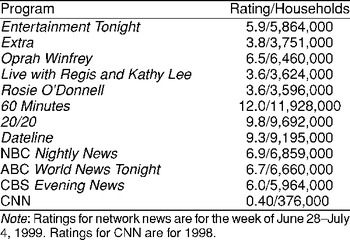
Nielsen Ratings for Select Soft and Hard News Programs
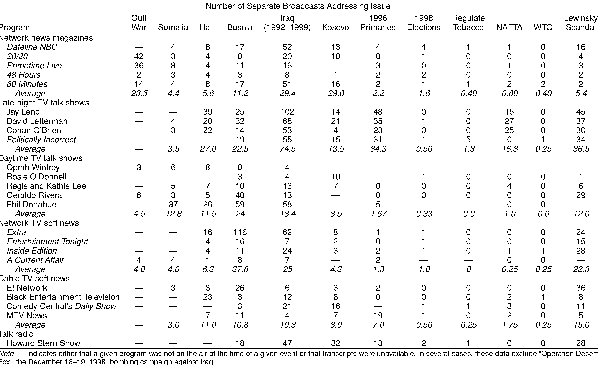
Partial Listings of Soft News Coverage of 1990s U.S. Foreign Crises and Other Political Issues
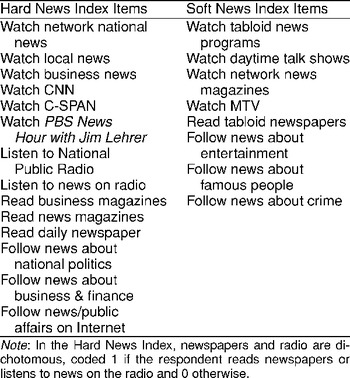
Items Included in Pew Survey Soft and Hard News Indexes
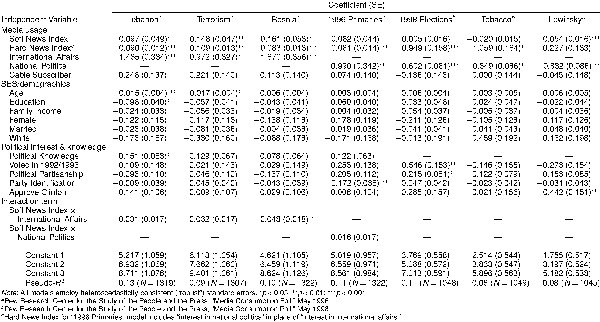
Ordered Logit Analysis of Likelihood of Being Attentive to Three Foreign Crises and Other Political Issues
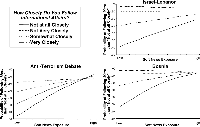
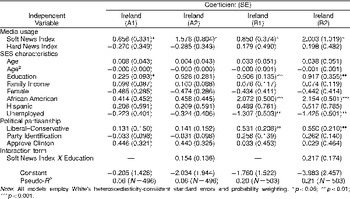
Logit Analysis of Attentiveness to Northern Ireland, as Soft News Consumption and Education Level Vary
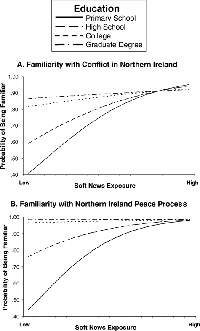
 You have Access
- 342
- Cited by
Comments
No Comments have been published for this article.