Introduction
Retrospective reports of adult patients with obsessive-compulsive disorder (OCD) suggest that about one third to one half of adult OCD patients have an onset of their first symptoms before the age of 15 (Reference Alsobrook, Leckman, Goodman, Rasmussen and Pauls1). It is generally considered that OCD is probably a neurodevelopmental deviation rather than being an acquired degenerative process and this acceptation in fact underscores the importance of studies aiming paediatric OCD patients (Reference Rosenberg and Keshavan2). However, childhood-onset OCD may provide some important clues about the aetiology of the adult-onset form of the disease. Furthermore, the concept of developmental discontinuity between juvenile and adult OCD forms has also been suggested, and in this perspective, identifying age-specific correlates of the disorder across the life cycle should be an important issue (Reference Geller, Biederman and Faraone3).
Neuropsychological measures have been used to investigate the cognitive functions of adult OCD patients (Reference Savage, Deckersbach and Wilhelm4,Reference Penadés, Catalán, Andrés, Salamero and Gastó5), and similar deficits have also been found in the paediatric population (Reference Behar, Rapoport and Berg6–Reference Andrés, Lázaro, Salamero, Boget, Penadés and Castro-Fornieles8). It is stated that the processes of attention and memory in OCD are observed to be selective and biased and this bias is directed towards threat-relevant stimuli, which is in relation with obsessions and compulsions (9–15). In addition, dysfunction in memory and visuospatial processes in patients with OCD do not result from memory impairment per se(Reference Ceschi, Van der Linden, Dunker, Perroud and Brédart16–Reference Tolin, Abramowitz, Brigidi, Amir, Street and Foa18), but rather arise from an impaired ability to apply efficiently elaborated strategies (Reference Irak and Flament9,Reference Flament, Koby and Rapoport19,Reference Cox20). Various lines of evidence consistently emphasise an impairment of response suppression and motor inhibition abilities in childhood-onset OCD, whereas there is less consistent evidence speaking for reduced set-shifting, fluency, conceptual thinking and planning abilities (9,21–26). However, there are other groups who have not reported these dysfunctions in either children (Reference Beers, Rosenberg and Dick27) or adults (Reference Simpson, Rosen, Huppert, Lin, Foa and Liebowitz28) with OCD, and described similar performances for these patients in comparison with the control subjects (Reference Andrés, Lázaro, Salamero, Boget, Penadés and Castro-Fornieles8).
OCD has been suggested to relate to a hyperactive cortico-striatal-pallidal-thalamic circuitry resulting clinically in impaired inhibition of repetitive thoughts and behaviours (Reference Insel29,Reference Fitzgerald, Welsh and Gehring30). This approach makes sense as OCD is mainly characterised by the dysfunction of orbitofrontal cortex (OFC), the dorsolateral prefrontal cortex (DLPFC), anterior cingulate cortex, head of the caudate nucleus and the thalamus (Reference Aouizerate, Guehl and Cuny31–Reference Shin, Choi, Kim, Hwang, Kim and Cho33). These structures form the neural substrate of executive functions (Reference Stuss and Benson34). However, the deficits in executive function in adult OCD patients have not been consistently documented (Reference Kuelz, Hohagen and Voderholzer11,Reference Tallis35). This might be because of differences in patient selection, matching criteria and testing procedures (Reference Aouizerate, Guehl and Cuny31). Studies on cognitive functions of paediatric OCD patients have conflicting results. In an early study using Money Road Map Test and Stylus Maze learning task, which are sensitive tests to frontal cortex/basal ganglia damage, significant differences had been found between untreated OCD adolescents and the age-, sex-, handedness- and Intelligence Quotient (IQ)-matched controls (Reference Behar, Rapoport and Berg6). Another early study including 42 children and adolescents with OCD and 35 matched healthy subjects showed that the patient group had impaired performance in the Wisconsin Card Sorting Test (WCST) and Rey Osterrieth Complex Figure Test (Reference Cox, Fedio, Rapoport and Rapoport7). Andrés et al. (Reference Andrés, Boget and Lázaro36) showed differences between child and adolescent OCD patient groups and a healthy control group in Digit Span, Coding and Stroop Test (ST) (Reference Andrés, Lázaro, Salamero, Boget, Penadés and Castro-Fornieles8). Another study showed that children and adolescents with OCD had impaired performances in ST and in some variables of WCST (categories and perseveration errors) before naturalistic therapy, but after treatment their performances improved properly (Reference Andrés, Boget and Lázaro36). One other study comparing the neuropsychological performances of patients either with Tourette syndrome (TS) or OCD showed that neither of the patient groups had significantly worse WCST performances, whereas the patients with OCD had visuospatial/constructional deficits (Reference Gladstone, Carter, Schultz, Riddle, Scahill and Pauls37). Beers et al. claimed that children with OCD performed as well as healthy children on a broad neuropsychological test battery and that the psychiatric symptoms were not related to cognitive performance (Reference Beers, Rosenberg and Dick27). However, there are studies reporting no significantly different neuropsychological test results in juvenile OCD patients, when compared with healthy controls or psychiatric control group (Reference Douglass, Moffitt, Dar, McGee and Silva38). It has been suggested that OCD children with lower average of IQ, a history of tics and/or depression showed worse performance on WCST (Reference Cox, Fedio, Rapoport and Rapoport7).
Our hypothesis was that the OCD group would have greater baseline deficits in executive functions because of their abnormalities in flexibility, interference control and response inhibition as OCD is a neuropsychiatric disorder that involves fronto-striatal circuitry. The aim of the study was to compare general intelligence, set-shifting, abstraction-flexibility, verbal fluency and response inhibition measures of paediatric OCD patients with age- and gender-matched healthy controls. We hypothesised that paediatric OCD cases would have deficits in set-shifting and flexibility.
Materials and methods
Subjects
Diagnosis, based on Diagnostic and Statistical Manual and Mental Disorder-IV (DSM-IV) criteria, was made by two psychiatrists. One of the psychiatrist is an experienced, certified child psychiatrist – the first author (Y. I. T.) – who further verified the diagnosis by using a semi-structured interview; Schedule for Affective Disorders and Schizophrenia School-Age Children, Present and Lifetime Version (K-SADS-PL) (Reference Kaufman, Birmaher and Brent39). Informed consent procedure was verbal, as is customary, given the literacy levels of the parents. All OCD cases were free of any remarkable medical history other than OCD and were screened for psychosis, eating disorders, mood disorders, substance use disorders and attention deficiency hyperactivity disorder with corresponding K-SADS-PL modules. Pervasive developmental disorders and mental retardations were ruled out with clinical interviews using DSM-IV criteria. Inclusion criteria for OCD patients were the presence of DSM-IV OCD diagnosis, being at age of 7–16, lack of any comorbid psychiatric diagnosis and being drug-naive. Exclusion criteria for OCD patients were having a comorbid psychiatric disorder or a history of neurological disorder or head trauma, which could possibly cause neurodevelopmental problems. The parents were fully informed about the study and that they are not obliged to attend, but none has refused to participate. These subjects were also screened for OCD with K-SADS-PL and clinical interviews.
The control group was selected from children at age of 7–16 years, who had no known psychiatric disorder or serious and/or chronic medical disorders, among those who admitted to the department of paediatrics for routine vaccination. All control subjects were also screened for psychosis, eating disorders, mood disorders, substance use disorders, attention deficiency hyperactivity disorder, pervasive developmental disorders and mental retardation with K-SADS-PL and clinical interviews. The study and the control groups were matched according to their ages and their educational levels.
Clinical assessment
For clinical diagnosis, children underwent the clinical interviews and K-SADS-PL.
Schedule for affective disorders and schizophrenia for school-age children, present and lifetime version. K-SADS-PL is a semi-structured instrument developed by Kaufman et al. to screen psychopathology in children and adolescents between ages 6 and 18 by gathering information from both parents and the offspring (Reference Kaufman, Birmaher and Brent39). The K-SADS-E is a semi-structured interview for children and adolescents aged 6–18 years, which assesses the current and the severest episodes of mood disorders (major depression, dysthymia and mania), anxiety disorders (separation anxiety, panic disorder, agoraphobia, social phobia, simple phobia, generalised anxiety disorder, OCD, post-traumatic stress disorder), eating disorders (anorexia and bulimia), attention-deficit/hyperactivity disorder (ADHD), conduct disorder and oppositional defiant disorder, substance abuse and dependence, elimination disorders (enuresis and encopresis), speech disorder, Tourette's disorder, psychotic disorders and pervasive disorders in the past (lifetime). Reliability and validity of K-SADS-PL was verified in Turkey in 2004 (Reference Gökler, ÜNal, Pehlivantürk, Kültür, Akdemir and Taner40).
Neurocognitive assessment
Patients underwent neuropsychological examinations, which were performed in the same order by the same examiner. Tests were administered by a trained neuropsychologist (E. E. B.), in a blind manner to the diagnostic status of the participants. Completion of the battery took roughly two and a half hours. Wechsler Intelligence Scale for Children-Revised Form (WISC-R) and other tests were administered on separate sessions and the tests were given in a fixed order in each session; WISC-R followed by WCST, ST and Verbal Fluency Test. Parents were not present during the testing of children and adolescents. Neuropsychological test battery was performed to all groups with its routine procedure. These tests are described below respectively:
Wechsler Intelligence Scale for Children-Revised (WISC-R). This is an intelligence test for children between the ages of 6–16 that can be completed without reading or writing. It consists of two scales, the Verbal and Performance scales, each with several subtests (Reference Savasır and Sahin41). The Verbal scale measures language expression, comprehension, listening and the ability to apply these skills to solve problems. The examiner asks the questions orally and the examinee gives a spoken response. We used five verbal subtests of the WISC-R: Information, Similarities, Arithmetic, Comprehension and Digit Span. The Performance scale assesses the non-verbal problem-solving skills, perceptual organization, speed and visual-motor proficiency. Included are tasks like puzzles, analysis of pictures, imitating designs with blocks and copying. We used five performance subtests of the WISC-R: Picture Completion, Picture Arrangement, Block Design, Object Assembly and Coding. The Verbal Intelligence Quotient (VIQ) and Performance Intelligence Quotient (PIQ) obtained from the test are the summary measures of verbal and performance skills, and the Full Scale Intelligence Quotient (FSIQ), based on the 10 tests included in the VIQ and PIQ scales, is an index of general intellectual functioning. The WISC-R was adapted and standardised in Turkey in 1997. A few items were changed, but in general, Turkish version closely resembles the original version. Approximately 11 age groups (6–16 years) constituted the standardization sample set. Test-retest reliabilities were 0.97 for VIQ, 0.93 for PIQ and 0.97 for FSIQ. Subtest reliabilities ranged between 0.51 and 0.86 (Reference Savasır and Sahin41).
Stroop Color Word Interference (ST) test. In the present study, attention was evaluated by using the TBAG version of the ST. Its reliability and validity for the Turkish population has been shown by Karakaş et al. (Reference Karakaş, Erdoğan, Sak, Soysal, Ulusoy and Yüceyurt42). The test measures processing speed and is accepted as the ‘gold standard' of selective attention (Reference Karakas43,Reference van Mourik, Oosterlaan and Sergeant44). In this test, attention is selective to the task-relevant stimulus; the examinee is expected to respond to this stimulus and inhibit a competing automatic response. Defects in these abilities result in perseverations, stereotypic behaviours and difficulty in controlling behaviours. In the present study, ST-TBAG form was used and the test was given to both groups. ST-TBAG is based on the ST version developed for Turkish society combining Victoria form, which is composed of three cards and six rows of four items in each, with the characteristics of the original ST. It is consisted of five charts that include the names of four colours, with specific words or points printed either in different colours or in black and white; errors, corrections and duration are recorded for each chart. It has five different parts which are reading words related to colour names printed in black (1st card/1st part), reading words of colour names printed in colour (2nd card/2nd part), telling the colours of shapes (3rd card/3rd part), telling the colours of the words printed in colour avoiding colour names (4th card/4th part) and telling the colour of the words printed in colour denoting colour names only (2nd card/5th part). Stroop interference score was calculated by subtracting a predicted color-word card (CW) score (predicted CW = [(W score ×C score)/(W score + C score)]) from raw CW score. The higher the resultant score, the less susceptibility to interference.
Wisconsin Card Sorting Test (WCST). The WCST was revised by Heaton and it measures abstract reasoning, building and canceling strategies, problem solving, maintaining attention and mental flexibility abilities, which are considered as frontal lobe functions (Reference Heaton, Chelune, Talley, Kay and Curtiss45). These abilities are deficient in patients with frontal lobe syndrome, and the deficiency in frontal lobe functions leads to perseverations. This test is basically structured on total errors, number of categories completed, trials to complete the first category and the number of failures to maintain set.
Verbal Fluency Test (VFT). Verbal Fluency Test is a useful test that can be used to evaluate executive functions and language (Reference Parker, Crawford, Crawford, McKinlay and Parker46). The category test can be used to evaluate semantic memory. This test has two main parts:
• Letter fluency: In a timed test (1 min), the subject generates words beginning with the letters K, A and S (‘Association' score).
• Category fluency: Two different tasks are given to the participants.
• Task 1: In tasks of category fluency, subjects are asked to produce exemplars of a particular category in a 60-s trial. We also provided a semantic category (animals) and scored the number of words generated (‘Animals' score).
• Task 2: We combined letter fluency with category fluency in which the subject had to switch between the names of the animals and the names of animals beginning with ‘K'.
Data analysis
The demographic characteristics for the OCD and control groups were compared by ‘paired samples t-test' for quantitative variables (age) and with the ‘chi-squared test' for dichotomous variables (gender). In the OCD and control groups, the effect of intelligence on test scores was investigated by using ‘multivariate analysis of variance' (MANOVA).
Performances of the OCD and control groups on neuropsychological tests, except for the ST, were compared by using ‘multivariate analysis of covariance' (MANCOVA) and Bonferroni multiple comparisons test, for calculating the contribution of the intelligence scores. As the ST results did not have a normal distribution, data were analysed by using Mann-Whitney U-test.
Results
Demographic variables
All cases were Caucasian and were recruited from three outpatient clinics located in Ankara (Gazi University Faculty of Medicine, Department of Psychiatry; a private clinic and SSK Children Hospital, Department of Child and Adolescent Psychiatry) who fulfiled the inclusion criteria. Subjects enroled in the study were 20 OCD patients (8 boys, 12 girls; age 7–16 years; mean ± SD = 11.6 ± 2.7). All patients were diagnosed for the first time in their lives and had never been evaluated for psychiatric disorders or treated with psychopharmacological medication or received psychotherapeutic intervention.
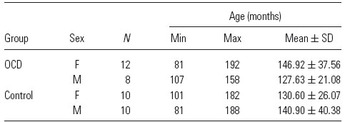
Control subjects (10 boys, 10 girls; age 7–16 years; mean ± SD = 11.3 ± 2.8) were mainly recruited as described in Materials and methods section. Gender difference was not statistically significant between the groups (X 2 = 0.400;df = 1;p = 0.527). There was no statistically significant difference between the ages of OCD and control subjects (t = 0.33,df = 38, p = 0.744) (Table 1).
Descriptive table of the demographic data of all groups

F, female; M, male.
Neuropsychological assessment
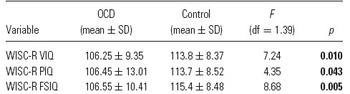
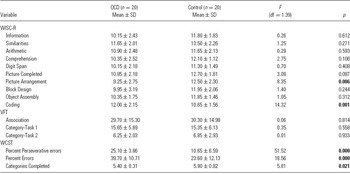
Performances of the OCD and control groups on WISC-R were first compared by using MANOVA. Significant differences among the groups were found in almost all subtests of the WISC-R, except for the Arithmetic and Digit Span subtests. To better understand the possible influence of intelligence, FSIQ scores were taken into account as a covariant in different set of statistical analysis (MANCOVA) (Table 2). This approach showed that only the differences in WISC-R Picture Arrangement (F = 8.35,df = 1, p = 0.006) and Coding (F = 14.32,df = 1, p = 0.001) scores remained significant among all groups, after FSIQ scores were included in the analysis (Table 3).
Mean and standard deviation of WISC-R test variables in patients with OCD and healthy controls; multivariate analysis of variance, p < 0.05 (bold values are statistically significant values)

Mean and standard deviation of WISC-R, WCST and VFT scores in OCD patients and healthy controls; multivariate analysis of covariance, p < 0.05 (bold values are statistically significant values)

VFT, Verbal Fluency Test.
Performances of the OCD and control groups on WCST and Verbal Fluency Test were compared by using MANCOVA, involving the FSIQ scores as described earlier (Table 3). Some variables of the WCST also showed a worse performance in the OCD group (perseverative responses: F = 51.52, df = 1, p = 0.001; percent errors: F = 18.55, df = 1, p = 0.0001 and categories completed: F = 5.81, df = 1, p = 0.021). There was no significant difference in scores of the Associations (F = 0.06, df = 1, p = 0.81), Category-Task 1 (F = 0.35, df = 1, p = 0.56) and Category-Task 2 (F = 0.01, df = 1, p = 0.93) of Verbal Fluency Test between the OCD and control groups (Table 3).
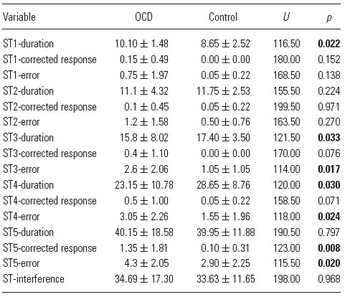
As the ST results did not have a normal distribution, they were analysed by using Mann-Whitney U-test (Table 4). The OCD group exhibited worse performance on STR1-duration (U: 116.50, p = 0.022), STR3-duration (U: 121.50, p = 0.033), STR3-error (U: 114, p = 0.017), STR4-duration (U: 120, p = 0.030), STR4-error (U: 118, p = 0.024), STR5-correct response (U: 123, p = 0.008) and STR5-error (U: 115.50, p = 0.020) when compared with the control group (Table 4).
Mean and standard deviation of Stroop Test-TBAG form scores in OCD patients and healthy controls; Mann-Whitney U-test, p < 0.05 (bold values are statistically significant values)

Discussion
Our main objective was to determine the possible disruptions in executive functions of children diagnosed with OCD. To achieve this objective, we performed a neuropsychological test battery composed of WISC-R, ST-TBAG form, WCST and Verbal Fluency Test. The intelligence scores (WISC-R) and executive function measures obtained by neuropsychological test results (ST-TBAG form, WCST and Verbal Fluency Test) of OCD and control groups were analysed using MANCOVA, where FSIQ was implicated as a covariant to better understand the influence of intelligence. Our results showed that WISC-R Picture Arrangement and Coding scores remained statistically significant even when co-analysed with FSIQ scores. In a similar manner, the OCD group exhibited worse performance on STR1-duration, STR3-duration, STR3-error, STR4-duration, STR4-error, STR5-correct response, and STR5-error when compared with the control group, again based on MANCOVA analysis where FSIQ score was taken as a covariant. Some variables of the WCST (perseverative responses, percent errors, abstraction-flexibility and categories completed) also showed worse performances in the OCD group. There was no significant difference between the groups regarding Verbal Fluency Test scores.
ST is considered to be capable of measuring selective attention, cognitive flexibility and processing speed for the evaluation of executive functions (Reference Howienson, Lezac and Loring47). Stroop effect by definition, which is basically a demonstration of a reaction time, is the interference that a subject experiences when asked to tell the physical colour of a word, written as a name of a colour, ignoring the semantic perception of the written word. Participant is to overcome the strong tendency that automatically forces him to pick the semantic part and read out the word itself. This kind of a task indeed requires flexibility skills and an efficient modification of the perceptual structure (Reference Karakaş, Erdoğan, Sak, Soysal, Ulusoy and Yüceyurt42,Reference Burke and Light48). It has been stated that the deficiencies in such a skill are particularly related to damages in OFC (Reference Stuss and Benson49). Besides, ST paradigm can evoke prominent and repeatable magnetic resonance imaging (MRI) signals not only in OFC but also in right and left anterior cingulate, right precuneal, left inferior frontal and left opercular regions (Reference Brown, Kindermann, Siegle, Granholm, Wong and Buxton50–Reference Leung, Skudlarski, Gatenby, Peterson and Gore52).
Anterior cingulate (AC) should play a key role in cognitive functions by modulating the stimuli and/or by regulating the response choice; therefore, dysfunctions in this zone presumably contribute to failures in ST performance (8,34,51,53–56).
Similar to ST, in WISC-R Coding subtest, the order of the provided numbers is the distracting factor for the examinee who is required to match the digits with correct symbols in a timely manner. The completion of the task hereby also requires flexibility skills together with adequate control of the attention and behaviour in order to override the possibility of mistakes which might be caused by the predominant effect of the numbers' order. Children who are diagnosed with OCD experience difficulties in handling of the mentioned distracters in ST and WISC-R Coding subtest (Reference Andrés, Lázaro, Salamero, Boget, Penadés and Castro-Fornieles8,Reference Beers, Rosenberg and Dick27). Beers et al. (Reference Beers, Rosenberg and Dick27) and Andrés et al. (Reference Andrés, Lázaro, Salamero, Boget, Penadés and Castro-Fornieles8) performed a detailed analysis of the OFC functions of OCD patients, in comparison with healthy subjects, based on ST and a Coding subtest. Both research groups found that children and adolescents with OCD exhibited differences as evaluated with ST scores. Furthermore, cognitive skills were also tested at pre- and post-treatment periods in these mentioned studies and it was found at the first assessment that the OCD group performed worse on inhibition of automatic responses (Reference Andrés, Lázaro, Salamero, Boget, Penadés and Castro-Fornieles8,Reference Beers, Rosenberg and Dick27). In harmony with these findings, our results also showed that children with OCD had lower performances in ST and WISC-R coding subtest.
Other useful instruments being used for the assessment of executive functions are the WCST and the Verbal Fluency test. WCST, in brief, assesses abstract reasoning, the ability to shift and maintain between sets and feedback utilising (Reference Pennington and Ozonoff57). Stuss and Benson also showed that WCST can well measure the functionality of the dorsolateral area of the prefrontal cortex (DLPFC) (Reference Stuss and Benson34). This area relates with executive functions, sustaining attention, programming and planning of the behaviour and ability to exchange the behaviour according to personal characteristics (45,58–60). Verbal Fluency is designed to measure the speed and flexibility of verbal thought processes. More recent brain imaging studies using techniques such as functional magnetic resonance imaging (fMRI) and positron emission tomography (PET) suggest that verbal fluency tasks evoke the activation of frontal lobes, particularly the prefrontal cortex in the language dominant hemisphere (Reference Phelps, Hyder, Blamire and Shulman61,Reference Pujol, Vendrell and Deus62).
These findings are partially consistent with previously reported few studies dealing with paediatric OCD patients. However, they have controversial findings as well, e.g. Beers et al. did not report any differences in WCST, Verbal Fluency and Trail Making Test (TMT) variables as well as in WISC-III scaled scores (Reference Beers, Rosenberg and Dick27). The sample characteristics of Beers's study (drug-naive patients without comorbidity) were similar to our study. One prominent difference was that the FSIQ scores in the OCD group were significantly lower in our sample set. Cox et al. suggested that there might be executive dysfunction in OCD patients only when there is an additional complication like depression or low IQ (Reference Cox, Fedio, Rapoport and Rapoport7). However, determined differences among groups in our study remained significant when the influence of IQ was taken into calculation; thus, it seems unlikely that the differences in WCST performances are due to general cognitive problems. In accordance with the findings of Beers et al., we did not find any significant differences in Verbal Fluency Test results. Two previous studies reported impaired WCST performance in OCD patients (Reference Cox, Fedio, Rapoport and Rapoport7), similar to our results. The results considering the WCST performance of adult OCD patients have been conflicting (Reference Kuelz, Hohagen and Voderholzer11). While some studies report that OCD patients have increased levels of WCST total errors (Reference Gambini, Abbruzzese and Scarone63), perseverative errors (Reference Head, Bolton and Hymas64) and categories completed (Reference Hymas, Lees, Bolton, Epps and Head65), some others do not (66–69). It has been argued that these inconsistencies might be because of differences of clinical state, medication effects, intelligence or the heterogeneity of the symptoms (Reference Penadés, Catalán, Andrés, Salamero and Gastó5). A recent meta-analysis study reported that adult OCD patients had significant deficits in fluency measures (Reference Henry32); however, other studies reported no significant difference in letter fluency and shift fluency (Reference Fenger, Gade, Adams, Hansen, Bolwig and Knudsen70). We also did not find any significant difference in Verbal Fluency Test. The significantly worse WCST performance of OCD patients in our study is consistent with these studies, showing that paediatric OCD patients have impaired abstraction-flexibility and set-shifting abilities. However, the results of neuropsychological studies obtained from adults may not be completely valid to compare with paediatric studies as developmental differences are evident in neuropsychological test performance.
Normative sample results of WCST indicated that from 6.5 to approximately 19 years of age, WCST proficiency increases significantly and makes a plateau until age of 60 (Reference Fenger, Gade, Adams, Hansen, Bolwig and Knudsen70). Other studies claim that WCST performance reaches to adult levels at age 10 (Reference Welsh, Pennington and Groisser71). Thus, there may be a ceiling effect for WCST in the adult OCD population (Reference Fenger, Gade, Adams, Hansen, Bolwig and Knudsen70). This may also be the case in other neurodevelopmental disorders, such as attention deficit/hyperactivity disorder: While studies conducted with child and adolescent cases report impaired WCST performance, this is not the same in adult studies (Reference Hervey, Epstein and Curry72,Reference Romine, Lee, Wolfe, Homack, George and Riccio73). Therefore, while questions about the significance of WCST results and suitability of this test in adult OCD research were raised, possibly because of ceiling effects, WCST may be a developmentally appropriate research instrument in paediatric OCD patients. To evaluate the change of set-shifting and abstraction abilities with age in OCD, longitudinal studies are necessary.
Results of neuropsychological studies are useful in at least two ways. First, neuropsychological measures can help confirm that certain brain regions and/or neural networks are implicated in the genesis of a disorder, and second they can be useful to elucidate the information processing characteristics, which might contribute to emergence and/or maintenance of the symptoms, such as obsessions and compulsions. Our results indicated that OCD patients had impaired set-shifting and abstraction along with visuospatial/constructional and verbal comprehension abilities. This makes sense in the light of previous studies, which showed that neural substrate of executive functions might lie in the frontal cortex (Reference Stuss and Benson34) and that OCD patients have frontal cortex-subcortical dysfunctions (Reference Aouizerate, Guehl and Cuny31). Proper set-shifting ability requires adoption of a new rule, as well as inhibiting a previously learned one (Reference Evans, Lewis and Iobst74), and thus, relates with both dorsolateral prefrontal and OFC functions (Reference Chamberlain, Blackwell, Fineberg, Robbins and Sahakian75). Reported neuropsychological impairments might also have behavioural implications; the difficulties in attention maintenance and set-shifting may be related with core symptoms of OCD by impairing the patient's ability to shift thoughts from unpleasant subjects to more acceptable ones (Reference Chamberlain, Blackwell, Fineberg, Robbins and Sahakian75,Reference Tolin, Hamlin and Foa76). However, these children have some problems that might be experienced in academic and social situations in adolescence and adulthood (Reference Andrés, Lázaro, Salamero, Boget, Penadés and Castro-Fornieles8). The relationship among these impairments and cognitive structure of the patients as well as treatment response, effects of cognitive mediation prognosis, brain structure and functioning should be evaluated in future studies.
The present study has some limitations. First, small sample size might lead to both type 1 and type 2 errors. Bonferroni correction for the multiple comparisons could also lead to increased type 1 error. We did not match the patients and the controls for IQ, but reported MANCOVA results with FSIQ as a covariate along with analysis of variance (ANOVA) results. However, it has been argued that matching cases and controls for IQ may also lead to ‘matching fallacy', as IQ might be reduced in subjects with neuropsychiatric disorders as a function of the disorder (Reference Voglmaier, Seidman, Niznikiewicz, Dickey, Shenton and McCarley77). Second, there is lack of a continuous variable evaluating depression. We ruled out the presence of major depression by K-SADS-PL screening, but sub-syndromic depression might influence the results. However, a recent meta-analysis suggested that there was no evidence that the presence of depression affected performance on tests of executive functions (Reference Henry32). Third, this study was not planned to match the neuropsychological similarities or dissimilarities between OCD and other disorders such as attention deficits hyperactivity disorder, tics, etc. Finally, we did not follow up the patients' neuropsychological prognosis.
Conclusion
1 On the basis of our findings, it appears that children with OCD show deficits associated with inhibition of a habitual behaviour pattern, difficulty in concentrating and controlling automatic responses, such as repetitive behaviours, and in warding off distraction, which are measured by ST. Those are related to changes in fronto-striatal pathways and OFC function.
2 Children with OCD also show deficits associated with abstract problem solving, the ability to shift and maintain set, utilise feedback and perceptual organization on WCST, suggesting frontal-striatal dysfunction and/or DLPFC dysfunction. These areas also relate to executive functions, sustaining attention, programming and planning of the behaviour and ability to exchange the behaviour according to personal characteristics. Hence, it can be suggested that impaired mental set-shifting might be a crucial biological marker in the diagnosis of OCD.
3 Lack of significant differences in verbal fluency measures in face of impaired verbal comprehension suggested that the verbal retrieval and recall of the information and executive control of verbal input are intact in these children while these patients have problems in abstraction and comprehension of verbal stimuli.
4 Finally, neuropsychological assessment can help confirm that certain brain regions and/or neural networks such as frontal cortex are implicated in the genesis of a disorder, and elucidate information processing characteristics, which might contribute to emergence and/or maintenance of symptoms, like obsessions and compulsions.
5 The relationship among these impairments and cognitive structure of the patients as well as treatment response, effects of cognitive mediation prognosis, brain structure and functioning should be evaluated and detailed in future studies.