Rescue workers help victims following natural, manmade, and technological disasters.Reference Neria, Nandi and Galea 1 Firefighters, emergency medical technicians (EMTs), and police officersReference Perrin, DiGrande and Wheeler 2 - Reference Marmar, Weiss and Metzler 4 may encounter fatalities among disaster victims, injured colleagues, and other unpleasant sights.Reference Slottje, Witteveen and Twisk 5 - Reference Guo, Chen and Lu 8 Previous studies have shown that rescue operations cause stress and are associated with mental health problems among rescue workers.Reference Guo, Chen and Lu 8 - Reference Leykin, Lahad and Bonneh 11 Stressors experienced by rescue workers can cause mental disorders such as depression, anxiety, and posttraumatic stress disorder (PTSD).Reference Katsavouni, Bebetsos and Malliou 12 - Reference Duckworth 14 Factors that may be associated with increases in PTSD symptoms include age, gender, marital status, education, period of time working in rescue operations during disasters, period of employment as a firefighter or EMT, early arrival in areas where a disaster has occurred, lack of psychological care, and exposure to human remains.Reference Perrin, DiGrande and Wheeler 2 , Reference Sifaki-Pistolla, Chatzea and Vlachaki 15 - Reference Haynes, Kelly and Warner 19 Resilience has been shown to reduce PTSD symptoms,Reference Wrenn, Wingo and Moore 20 and early arrival in disaster areas has been shown to increase them.Reference Perrin, DiGrande and Wheeler 2 Many covariates are potential confounding factors that influence changes in PTSD symptoms, but no decisive predictors of PTSD have been identified except for resilience and early arrival.
There are gaps and conflicting results in previous work on PTSD among rescue workers. Green reported that younger people tend to have more PTSD symptoms than older people,Reference Green, Grace and Lindy 21 but Bromet found no association between age and PTSD.Reference Bromet, Sonnega and Kessler 22 Witteveen and Fullerton reported that unmarried people were more likely to experience PTSD,Reference Witteveen, Bramsen and Twisk 23 , Reference Fullerton, Ursano and Wang 24 but Marmar found no association between marital status and PTSD.Reference Marmar, Weiss and Metzler 4 Epstein reported that those with low levels of education were more likely to have PTSD than those with higher levels of education,Reference Epstein, Fullerton and Ursano 25 but Fullerton found no association.Reference Fullerton, Ursano and Wang 24 Sifaki-Pistolla reported that those who worked in rescue operations for longer periods were more likely to have PTSD than those with less exposure.Reference Sifaki-Pistolla, Chatzea and Vlachaki 15 However, Pietrzak found no association between total hours of work as a rescue worker and PTSD.Reference Pietrzak, Feder and Singh 16 Chang reported that a long employment history as a firefighter or EMT was one of the highest risk factors for PTSD,Reference Chang, Connor and Lai 10 but Ehring found no association between length of employment and PTSD.Reference Ehring, Razik and Emmelkamp 26 Epstein reported that those witnessing burn victims and human body parts were more likely to have PTSD,Reference Epstein, Fullerton and Ursano 25 but Fullerton reported that exposure to human remains was not associated with PTSD.Reference Fullerton, Ursano and Wang 24 It has therefore not been demonstrated definitively whether any of these factors are associated with PTSD symptoms.
The most common scale used to screen rescue workers for mental health problems is the Impact of Event Scale–Revised (IES-R).Reference Matsuoka, Nishi and Nakaya 27 - Reference Cetin, Kose and Ebrinc 30 To screen for PTSD symptoms among rescue workers, it is important to examine the association between confounding factors and PTSD symptoms (measured through responses to questions on the IES-R), because confounding factors may affect the development of PTSD symptoms.Reference Pietrzak, Feder and Singh 16 Positive or negative statistical associations between confounding factors and PTSD symptoms suggest that these confounding factors are associated with PTSD.
We constructed several hypotheses about PTSD among rescue workers after disaster operations. We hypothesized that age, gender, marital status, longer period of time working in rescue operations, early arrival in areas where a disaster has occurred, ongoing counseling support, and exposure to human remains would be associated with changes in PTSD symptoms. We also hypothesized that holding the position of commander would be associated with PTSD symptoms. Commanders direct others to rescue victims from disaster areas, and it is therefore possible that their decisions during operations may expose others to danger. Previous research has found that supervisory responsibilities increase PTSD symptoms,Reference Berninger, Webber and Cohen 31 but no studies have clarified the association between being a commander and developing PTSD symptoms.
To the best of our knowledge, existing studies assessing differential item functioning with the IES-R in PTSD have only examined subgroup differences by country. They have not explored differences between subgroups for other demographic characteristics. The existing studies also only examined associations with clinical variables and did not include measures of the effect of latent factors (ie, unobserved factors of PTSD) or symptoms on behavioral subphenotypes. It is difficult to show overall associations of confounding factors with unobserved factors and symptoms using standard chi-square difference tests.Reference Proitsi, Hamilton and Tsolaki 32 This needs more detailed statistical analyses.
Japanese rescue workers arrive shortly after disasters occur and are often exposed to human remains in the acute phase of disasters.Reference Sakuma, Takahashi and Ueda 13 There are also numerous other stressors associated with working on rescue operations, but few Japanese rescue workers have access to support to manage mental distress related to their work.Reference Sakuma, Takahashi and Ueda 13 It is therefore necessary to identify factors mitigating stressors associated with PTSD among rescue workers. This study aimed to identify confounding factors—covariates that influence the IES-R score through PTSD symptoms—including those affecting the IES-R score through both unobserved factors and symptoms on the scale. It is important to clarify associations with confounding factors such as age, gender, marital status, longer period of time working in rescue operations, early arrival in disaster areas, access to counseling support, and exposure to human remains.
METHODS
Measurement
The IES-R has a 3-factor structure (8 items assessing intrusion, 8 assessing avoidance, and 6 assessing hyperarousal). The scale was developed by Weiss to assess probable PTSD among individuals suffering from severe stress.Reference Weiss 29 The IES-R items were answered on a 5-point rating scale (0=“not at all,” 1=“a little bit,” 2=“moderately,” 3=“quite a bit,” and 4=“extremely”). The cutoff value was 24 points from a maximum of 88. Individuals with an IES-R score of above 24 may have PTSD. The Connor-Davidson Resilience Scale (CD-RISC) was used to screen people for high, intermediate, or low resilience. This scale includes 25 items rated on a 5-point scale (0=“not true at all,” 1=“rarely true,” 2=“sometimes true,” 3=“often true,” and 4=“true nearly all of the time”).Reference Connor and Davidson 33 The score is the sum of all items and ranges from 0 to 100, and higher scores indicate better resilience. We chose the IES-R and the CD-RISC because they are among the best-known self-report measures in the fields of psychological distress and resilience assessment.Reference Weiss 29 , Reference Arias González, Crespo Sierra and Arias Martínez 34
Participants
Participants were aged 20 to 65 years. All were firefighters or EMTs who had responded to the Great East Japan Earthquake (GEJE) in 2011. Rescue workers who live at or near a disaster site may experience different stressors during the rescue operation. We therefore excluded rescue workers who lived at the disaster site. Participants were recruited through email and telephone contact with fire departments in Japan, and registered on a network of firefighters and EMTs involved in rescue operations during (and within 6 months of) the GEJE. The questionnaire was sent to 373 participants, 220 of whom returned the completed version (response rate=58.9%). This research was carried out with the permission of the fire departments involved. Recruitment started in April 2015 and was completed in August 2015. Ethical approval was granted by the Clinical Research Ethics Committee of Chiba University (approval number 1731). All participants provided informed consent by post.
Analysis
Demographic characteristics and CD-RISC scores, by probable PTSD status assessed using the IES-R, were compared using Wilcoxon rank sum test statistics or the chi-square test. We used a confirmatory factor analysis (CFA)Reference Halberstadt, Dunsmore and Bryant 35 to confirm the 3 factors proposed by Weiss, and then constructed a multiple indicators, multiple causes (MIMIC) model. CFA was used to clarify the quality of the factor structure, and Geomin rotation was used.Reference Lalanne, Chassany and Carrieri 36
Internal consistency reliability was assessed using the Cronbach α coefficient; a value greater than 0.7 indicates good reliability.Reference Bland and Altman 37 , Reference Lance, Butts and Michels 38 Pearson correlation coefficients were used to confirm concurrent validity. We also confirmed the correlations between items of the CD-RISC and total scores, subscales, and clusters with the cutoff values of the IES-R. Values of 0.80 to 1.00 suggest a very strong correlation, 0.60 to 0.79 suggest a strong correlation, 0.40 to 0.59 suggest a moderately strong correlation, 0.20 to 0.39 suggest a weak correlation, and 0 to 0.19 suggest a very weak correlation or no correlation.Reference Weir 39 , Reference Cheng, Liu and Yu 40
The MIMIC model was used to assess the association between confounding factors and unobserved factors or symptoms in the IES-R. The MIMIC model, a special case of structural equation modeling, makes it possible to explain associations between scale scores and confounding factors.Reference Proitsi, Hamilton and Tsolaki 32 MIMIC models can investigate relationships between confounding and unobserved factors and also associations between confounding factors and symptoms such as those of PTSD.Reference Proitsi, Hamilton and Tsolaki 32 Another advantage of MIMIC models is that they can evaluate relationships after controlling for all of the confounding factors in the model.Reference Ríos-Bedoya, Pomerleau and Neuman 41 , Reference Lewis, Yang and Jacobs 42 In this study, the first MIMIC model was an unadjusted direct effects model that included CD-RISC, age, marital status, longer period of time working in rescue operations, and counseling support as confounding factors. The next MIMIC model added direct paths from the confounding factors to the indicators constrained to zero. Modification indices (MIs) were used to improve the model fit indices when there was a difference in symptoms. When direct effects are added, including confounding factors and indicators, MIs of more than 3.84 suggest a difference in the relationship between the confounding and unobserved factor.Reference Schuler, Musekamp and Bengel 43 , Reference Kim, Yoon and Lee 44 We used stepwise forward selection for model selection.Reference Proitsi, Hamilton and Tsolaki 32 We compared the less constrained model with the more constrained one using a chi-square difference test with Mplus version 7.31 (Muthén & Muthén, Los Angeles, CA) DIFFTEST procedure.Reference Muthén and Muthén 45 , Reference Baas, Cramer and Koeter 46 A significant DIFFTEST (P<.05) indicated a difference between the 2 models.Reference Liao, Cowling and Lam 47 CFA and MIMIC analyses used weighted least squares mean and variance estimation. This is designed to fit categorical or ordered variables and does not assume a normal or continuous distribution.Reference Li 48
Model fit indices were evaluated using the P value for the model chi-square test, the comparative fit index (CFI), the Tucker-Lewis index (TLI),Reference Tucker and Lewis 49 and the root mean square error of approximation (RMSEA). A chi-square test with a P value above .05 indicated a good model fit,Reference Hu and Bentler 50 CFI and TLI values of >0.95 indicated an acceptable fit to the data,Reference Hu and Bentler 50 and RMSEA values <0.08 indicated an acceptable fit. Missing values were handled using the full information maximum likelihood method. Other analyses were conducted with Stata, version 13 (Stata Corp LP, College Station, TX).
RESULTS
Sample Characteristics
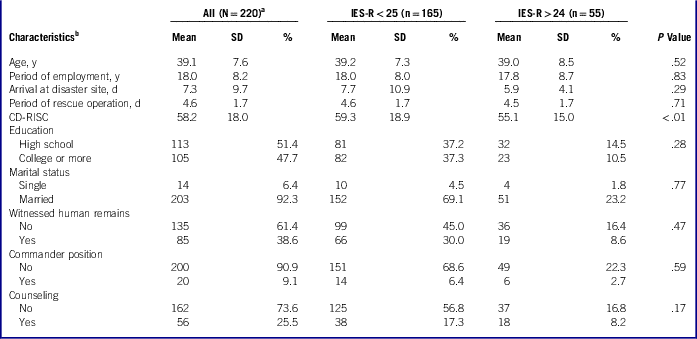
Questionnaires were sent to 373 rescue workers, and responses were received from 220 participants. Fewer than 1% of participants were missing data for the IES-R score, and fewer than 5% were missing data on any of the confounding factors. Table 1 shows demographic data by IES-R score. IES-R scores suggested that 25% of the participants had probable PTSD (ie, IES-R score of ≥24). All of the participants were men, and there were no differences in probable PTSD by age, period of employment, or period of rescue operation. The only statistically significant difference between IES-R score groups was CD-RISC score. Participants scoring at least 24 on the IES-R tended to show higher CD-RISC scores.
Characteristics of Japanese Rescue Workers by Impact of Event Scale–Revised (IES-R) Score, 2015

Abbreviations: CD-RISC, Connor-Davidson Resilience Scale; IES-R, Impact of Event Scale–Revised.
a There were missing values, so the total number of responses for each covariate ranged from 217 to 220.
b All of the participants were men.
Confirmatory Factor Analysis
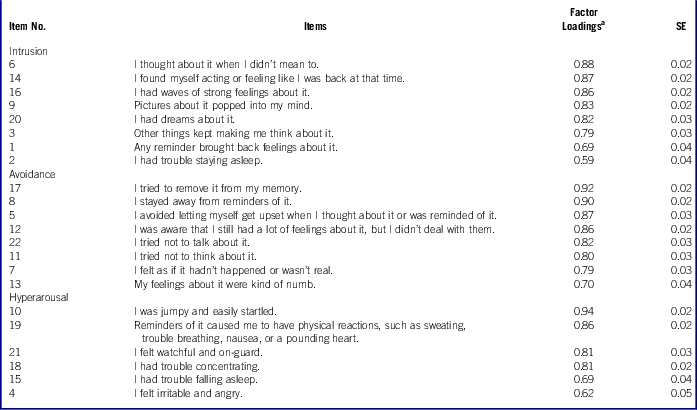
Table 2 shows the results of the 3-factor CFA (with Weiss’s 3 factors) using the IES-R. The CFA verified the improved factor structure using MIs. Factor loadings were 0.59 to 0.88 for intrusion, 0.7 to 0.92 for avoidance, and 0.62 to 0.94 for hyperarousal. The model fit indices suggested an acceptable fit (chi-square=362.6, df=195, P<.001, RMSEA=0.063, CFI=0.988, and TLI=0.986). High Cronbach α values were observed for all of the factors: 0.91 for avoidance, 0.89 for intrusion, and 0.86 for hyperarousal. Supplementary Table 1 shows that all the factors were strongly correlated. The correlation was 0.85 between intrusion and avoidance, 0.84 between intrusion and hyperarousal and 0.8 between avoidance and hyperarousal. All correlations were statistically significant at P<.05.
Factor Loadings for Impact of Event Scale–Revised (IES-R) Score Among Japanese Rescue Workers, 2015

a Factor loadings are standardized STDYX estimates, and significance was set at P<.001.
Model fit indices are chi-square=362.6, degrees of freedom=195, P<.001, root mean square error of approximation=0.063, comparative fit index=0.988, and Tucker-Lewis index=0.986.
Multiple Indicators, Multiple Causes Model
The MIMIC model draws on the CFA using the IES-R. It therefore requires that analysis to be acceptable, and in this case, the factor loadings and model fit were good. In the next stage, the confounding factors for CD-RISC, age, marital status, longer period of time working in rescue operations, early arrival in disaster areas, ongoing counseling support, exposure to human remains, and education level were added to the CFA model using a forward stepwise method. Age, marital status, longer period of time working in rescue operations, and exposure to human remains were not statistically significant. CD-RISC, education, ongoing counseling support, and early arrival in disaster areas were statistically significant.
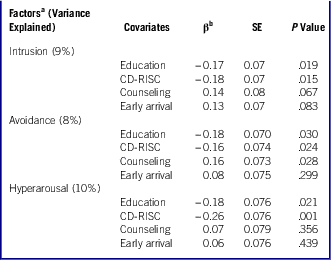
Table 3 shows the standardized path coefficients from the MIMIC model between confounding factors and unobserved factors in the IES-R. This model had good fit indices (chi-square=4040.9, df=266, P<.001, RMSEA=0.05, CFI=0.99, and TLI=0.99). The DIFFTEST with chi-square test comparing the nondirect path model with the direct path model was also statistically significant (P<.001). Higher education and CD-RISC score were statistically significantly associated with decreased intrusion, avoidance, and hyperarousal. Counseling was statistically significantly associated with increased avoidance.
Multiple Indicators, Multiple Causes Model Predicting Impact of Event Scale–Revised Score Among Japanese Rescue Workers, Including Covariates of Education, Connor-Davidson Resilience Scale (CD-RISC) Score, Counseling, and Early Arrival, 2015

a The model fit indices are chi-square=4040.9, degrees of freedom=266, P<.001, root mean square error of approximation=0.05, comparative fit index=0.99, and Tucker-Lewis index=0.99.
b βs are standardized STDYX estimates.
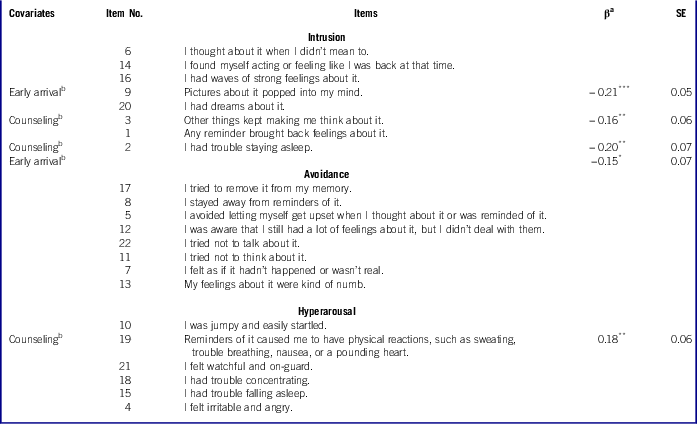
Table 4 shows the standardized path coefficients between confounding factors and items on the IES-R. In the direct path model, counseling was statistically significantly associated with decreases in “I had trouble staying asleep” and “Other things kept making me think about it.” Counseling was statistically significantly associated with an increase in “Reminders of it caused me to have physical reactions, such as sweating, trouble breathing, nausea, or a pounding heart.” Early arrival in disaster areas was statistically significantly associated with increases in “I had trouble staying asleep” and “Pictures about it popped into my mind.” There were no statistically significant associations between counseling or early arrival in disaster areas and either intrusion or hyperarousal.
Direct Path Multiple Indicators, Multiple Causes Model Predicting Impact of Event Scale–Revised Score Among Japanese Rescue Workers, 2015

* P<.05; ** P<.01; *** P<.001
a βs are standardized STDYX estimates. Model fit indices are chi-square=404.9, degrees of freedom=266, P<.001, root mean square error of approximation=0.05, comparative fit index=0.99, and Tucker-Lewis index=0.99.
b Modification index is above 3.84.
Correlation Between the CD-RISC and the IES-R
Supplementary Table 2 shows the correlations between items of the CD-RISC and total score, subscales, and clusters with the cutoff values of the IES-R. Statistically significant CD-RISC items had very weak to weak correlation with the IES-R. Total scores using the IES-R were statistically significantly correlated with decreases in several items: “able to adapt to change,” “can deal with whatever comes,” “past success gives confidence for new challenges,” and “not easily discouraged by failure.” Scores above 24 in the IES-R were correlated with decreases in “past success gives confidence for new challenges.” Intrusion was correlated with decreases in “able to adapt to change” and “not easily discouraged by failure.” Avoidance was correlated with decreases in “can deal with whatever comes” and “past success gives confidence for new challenges.” Hyperarousal was correlated with decreases in “able to adapt to change,” “can deal with whatever comes,” “past success gives confidence for new challenges,” “tend to bounce back after illness or hardship,” “focus and think clearly under pressure,” “prefer to take the lead in problem solving,” “not easily discouraged by failure,” and “think of self as strong person.” Total scores and avoidance were correlated with increases in “have to act on a hunch.” IES-R scores of over 25 were correlated with increases in “sometimes fate or God can help.”
DISCUSSION
This study aimed to identify confounding factors from among covariates associated with both unobserved factors and items in the MIMIC model using the IES-R. A previous study suggested gender differences in PTSD,Reference Chiu, Webber and Zeig-Owens 6 but we were unable to test this because all our participants were men. Another study showed that 10% to 44% of firefighters and police officers experienced PTSD over 1 year,Reference McFarlane 51 - Reference Berger, Coutinho and Figueira 53 and work in rescue operations has been considered a risk factor for an increase in PTSD symptoms.Reference Fullerton, Ursano and Wang 24
In this study, 25% of the participants had probable PTSD. The participants, who were responsible for rescuing victims during the GEJE, were thought to have suffered from the stressful rescue operations. The GEJE differed from other disasters because there were victims of both the earthquake and the tsunami. More than 18 550 victims drowned or were missing after the tsunami,Reference Ishigaki, Higashi and Sakamoto 54 and rescue workers were generally unable to rescue the survivors.
Only CD-RISC showed any statistical significance against IES-R score, so it is possible that it was associated with unobserved factors or items. The CFA model fit indices indicated acceptable model fit. The assessment of Cronbach α revealed excellent values, and we considered this assessment to be acceptable for this study. To confirm our hypothesis, the MIMIC model was composed of these confounding factors, not adding the direct path (path linked from confounding factors to items). Path coefficients between confounding factors measuring CD-RISC, ongoing counseling support, and education and the unobserved factors were statistically significant, and there was a good overall model fit. Early arrival in disaster areas and counseling were statistically significant after MIs were added to the MIMIC model. The other confounding factors (age, marital status, longer period of time working in rescue operations, and exposure to human remains) were not statistically significant. There are possible positive associations suggesting that higher education and resilience reduce the 3 factors (intrusion, avoidance, and hyperarousal). This finding is consistent with previous work,Reference Pietrzak, Feder and Singh 16 , Reference Wisco, Marx and Wolf 18 and these variables have also been shown to be correlated with positive emotions.Reference Feder, Ahmad and Lee 55 , Reference Tugade, Fredrickson and Barrett 56 This finding might also apply to clinical symptoms because of the link to probable PTSD.
When MIs were used in the direct path model to improve model fit, both counseling and early arrival in disaster areas were statistically significant confounding factors. Counseling was a statistically significant predictor of improvement in “I had trouble staying asleep” and “Other things kept making me think about it,” whereas early arrival in disaster areas was a statistically significant predictor of improvements in “I had trouble staying asleep” and “Pictures about it popped into my mind.” This finding for “I had trouble staying asleep” is consistent with previous work showing that early arrival at disaster sites is associated with PTSD symptoms.Reference Berninger, Webber and Cohen 31 The association between early arrival and “Pictures about it popped into my mind” is thought to result from exposure to large amounts of human remains. Those arriving early at a disaster may encounter severely injured victims and human remains. These are stressful scenes not usually witnessed in daily operations, and previous work has shown that rescue workers exposed to large amounts of human remains suffer from PTSD.Reference McCarroll, Ursano and Fullerton 57
Surprisingly, we found a negative association between counseling and avoidance. In the direct path model, we found that counseling increased symptoms among rescue workers. Counseling was a statistically significant predictor of “Reminders of it caused me to have physical reactions, such as sweating, trouble breathing, nausea, or a pounding heart,” an indicator of psychophysiological reactions. Essentially, however, a counseling intervention is therapy intended to treat mental disorders, and previous work has shown associations indicating that counseling reduces PTSD, although psychological debriefing is detrimental to mental health.Reference Ertl, Pfeiffer and Schauer 58 , Reference Rose, Bisson and Churchill 59 A previous study showed that early interventions usually consist of psychological first aid, psychological debriefing, and crisis counseling, and no effective interventions are provided in a disaster setting.Reference North and Pfefferbaum 60 This study took place 4 years after the GEJE, but there was still a negative association with counseling. These results suggest that counseling does not reduce all probable PTSD symptoms, and it may even complicate PTSD symptoms such as psychophysiological reactions. One reason for this negative association is that rescue workers recall feelings and incidents during the counseling process. Previous work using magnetic resonance imaging showed that activity in the hippocampus is associated with increased PTSD symptoms.Reference Kitamura, Saitoh and Takashima 61 , Reference Tse, Montoya and Wong 62 Memories recalled during counseling might therefore complicate PTSD symptoms by triggering psychophysiological reactions. Cognitive behavioral therapy programs have been shown to reduce mental stress or distress following stressful incidents.Reference Chen, Shen and Gao 63 However, no systematized counseling or mental health support, such as cognitive behavioral therapy programs, is offered to Japanese rescue workers. Although rescue operations are stressful, previous work has found that it is possible that rescue workers will be viewed as weak if they acknowledge these stresses.Reference Litchfield and Hinckley 64 , Reference Stergiou-Kita, Mansfield and Bezo 65 It is possible that they do not even fully disclose these negative feelings during treatment with a psychotherapist. We therefore suggest that the avoidance factor in probable PTSD is affected by the Japanese culture. A previous study showed that the Japanese culture, compared with that in the United States, emphasizes connectedness rather than self-focus.Reference Boiger, Güngör and Karasawa 66 , Reference Zimbardo 67 It is possible that support provision may worsen mental health in Japan, because the expression of negative emotion is difficult culturally. However, no previous research has addressed this, and the association between the expression of negative emotions and avoidance remains unknown. Previous work has shown that about 70% of rescue workers who had undergone counseling had mental functional impairments,Reference Corrigan, McWilliams and Kelly 68 although to the best of our knowledge there have been no studies on Japanese rescue workers.
We used associations between the IES-R and the CD-RISC to examine items in the CD-RISC correlated with clusters in the IES-R. Almost all the items in the CD-RISC had a negative correlation. This suggests that some of the CD-RISC items may not express resilience for particular stressors. It is also possible that the resilience of rescue workers was influenced differently if their PTSD symptoms were higher, although this study did not find any differences at cluster level in the IES-R.
This study found no statistically significant associations with age, period of employment, period of rescue operation, marital status, or being a commander. Unlike a previous study,Reference Pietrzak, Feder and Singh 16 we did not find that exposure to human remains was associated with PTSD symptoms. This may be because rescue workers are regularly exposed to human remains or body parts during rescue operations. Prior experience in rescue operations might therefore decrease this stressor.Reference Guo, Chen and Lu 8
This study had several limitations. First, the study sample included only men. Almost all Japanese firefighters are men,Reference Takeyama, Itani and Tachi 69 , Reference Hosoda, Osaki and Okamoto 70 but previous research has shown that the association between corticotropin-releasing factor level and PTSD symptoms differs by gender.Reference Wiersielis, Wicks and Simko 71 , Reference Cénat and Derivois 72 It is possible that not including gender as a confounding factor (because of the absence of women in the sample) changed the observed associations with PTSD symptoms. Second, this was a cross-sectional study, and negative associations observed for rescue operations do not necessarily indicate an effect on probable PTSD symptoms. Third, collecting retrospective data about events that occurred 4 years in the past may have led to recall bias, which could have distorted the results. It is also possible that daily operations were associated with probable PTSD, but this study was unable to account for this as a confounding factor. Previous studies have shown that firefighters may have associations between avoidance symptoms and a delay of a few months in onset of PTSD.Reference North, Oliver and Pandya 73 , Reference North and Oliver 74 Many studies have defined delayed-onset PTSD as occurring a year or more after exposure to the trauma.Reference North and Pfefferbaum 60 , Reference Smid, Mooren and van der Mast 75 - Reference North, Nixon and Shariat 77 This study did not examine differences between acute-onset and delayed-onset PTSD, because the events in which we were interested were some years ago. Fourth, this study did not differentiate between different types of counseling methods, so it is possible that counseling methods vary in their associations with probable PTSD. In previous work, cognitive behavioral therapy in particular has been associated with a decrease in PTSD symptoms.Reference Kar 78 Fifth, it is possible that the rescue workers might have different reactions to this disaster than others, because of its duration and nature, including earthquake, tsunami, and radiological leaks. The results may therefore not be generalizable and further study would be needed to examine this.
Despite these limitations, this study also has several strengths. To our knowledge, it was the first to assess the associations between demographic confounding factors and PTSD among rescue workers using the IES-R. Previous studies have identified many confounding factors, but it is important that these are associated with both unobserved factors and with scale items assessing symptoms. This study found a negative association of counseling with avoidance and psychophysiological reactions. It is necessary to ensure that rescue workers receive counseling to fully assess their mental health. The next stage of our study is to research which characteristics of counseling could help to support rescue workers’ mental health. We also believe that work on interventions or training to mitigate mental distress is important. Future work involving a longitudinal study is needed to assess these associations in more detail.
CONCLUSIONS
This study explored associations between multiple covariates and PTSD symptoms, as measured using the Impact of Event Scale-Revised. Higher levels of education and resilience improved the symptoms of intrusion, avoidance, and hyperarousal. Counseling and early arrival were associated with improvement in certain items, but counseling was also linked to increased avoidance and worsening psychophysiological reactions.
Acknowledgments
The authors would like to thank the rescue workers who participated in the study. We especially thank Dr. Noriyoshi Takei for his advice on the statistical methodology. We thank Melissa Leffler, MBA, from Edanz Group (www.edanzediting.com/ac), for editing a draft of this manuscript.
Source of Funding
This study was supported by the Academic Contributions from Pfizer Japan, Inc.
Institution and Ethics Approval and Informed Consent
Ethical approval was granted by the Clinical Research Ethics Committee of Chiba University (approval number 1731).
Conflict of Interest Disclosure
The authors declare that there are no conflicts of interest.
Supplementary materials
To view supplementary material for this article, please visit https://doi.org/10.1017/dmp.2018.62