Responders evaluating patients at mass casualty incident and disaster scenes typically use a triage algorithm to help prioritize the use of limited patient care and transport resources. Multiple triage algorithms have been developed and are in use around the world.Reference Jenkins, McCarthy and Sauer1Reference Lerner, Schwartz and Coule2 In general, limited research has been conducted to contribute to the creation or refinement of these triage systems.
Mass casualty incidents and disasters frequently cross jurisdictional lines, and thus involve responders from multiple local agencies, who may be using different triage tools. This variability can be compounded by programs such as the Emergency Management Assistance Compact and Disaster Medical Assistance Teams of the National Disaster Medical System, which bring responders from a variety of backgrounds to work with local personnel during a disaster response. Although the operational and clinical implications of using multiple triage systems at the same incident are unknown, it seems reasonable to assume that for operational simplicity, communication interoperability, and clinical efficiency, it is preferable for all of the responders at a given incident to use the same triage system, or at the very least operate from some common elements (eg, nomenclature of triage categories).
In 2006, the National Association of EMS Physicians convened a workgroup as part of the Terrorism Injuries Information, Dissemination, and Exchange project, funded by the Centers for Disease Control and Prevention, to examine the science supporting the existing mass casualty triage systems, and make a recommendation for adopting 1 of them as a national standard.Reference Lerner, Schwartz and Coule2 The workgroup focused on primary triage in a geographically defined location, and did not consider further prioritizing patients once they had been assigned to initial triage categories (ie, secondary triage), the triage of medical procedures and resources such as ventilators (ie, tertiary triage), or triage across a diffuse geographic area (ie, population-based triage). This workgroup concluded that no existing triage system had enough scientific evidence to justify its universal adoption and that many had identified shortcomings in their methodologies. The workgroup instead developed the SALT (Sort-Assess-Lifesaving Interventions-Triage/Treatment) Triage system (Figure), which was based on a combination of expert opinion and the limited research available and incorporated the widely accepted best practices of existing triage systems. Preliminary research on SALT Triage has suggested that it is an effective and valid approach.Reference Lerner, Schwartz, Coule and Pirrallo3Reference Cone, Serra, Burns, MacMillan, Kurland and Van Gelder4
The SALT (sort-assess-lifesaving interventions-triage/treatment) Triage System

The development of SALT Triage, an evidence-based nonproprietary triage system that incorporates the best features of currently used triage systems, was a first step in developing a national guideline for mass casualty triage. It was not flexible enough, however, to allow communities to modify their existing triage systems and materials to be compatible. Therefore, the workgroup, in cooperation with national government and nongovernment organizations, identified the need to develop the Model Uniform Core Criteria for Mass Casualty Triage. These criteria identify the key components that a triage system should include to meet the proposed national guideline. Although SALT Triage will remain a freely available triage system that meets all of the components of the Core Criteria, agencies, manufacturers, community leaders, and others also could develop or modify other existing triage systems to meet the Core Criteria. This allows for local flexibility but will ensure baseline interoperability between jurisdictions.
This article describes the process that was used to develop the Model Uniform Core Criteria for Mass Casualty Triage. It is intended to provide background information for the process of developing the position paper that is published separately.
PROCESS OF DEVELOPING THE MODEL UNIFORM CORE CRITERIA
The original intent of the Terrorism Injuries Information, Dissemination, and Exchange workgroup was to identify a triage system that could be put forth as the “best” and thus be recommended for adoption across the United States as the national triage system. As the group researched the available science, however, it was determined that no single system could be recommended.Reference Lerner, Schwartz and Coule2 Using the available science and expert opinion, the workgroup developed a new triage system, SALT Triage.5 The SALT Triage system was conceptually endorsed by the American College of Emergency Physicians, American College of Surgeons Committee on Trauma, American Trauma Society, National Association of EMS Physicians, National Disaster Life Support Education Consortium, and State and Territorial Injury Prevention Directors Association.5 This nonproprietary triage system is specific and has limited flexibility for integration into existing triage schemes or for the development of new triage schemes. The identification of core criteria related to mass casualty triage was deemed necessary to establish a national guideline that allowed for such flexibility. The guideline would allow localities and manufacturers to incorporate those criteria into their planned triage systems and to more easily adapt existing tools to conform to a standard. This process would create interoperability but still allow flexibility for the triage system to reflect local needs and allow for creativity and innovation when developing new triage systems.
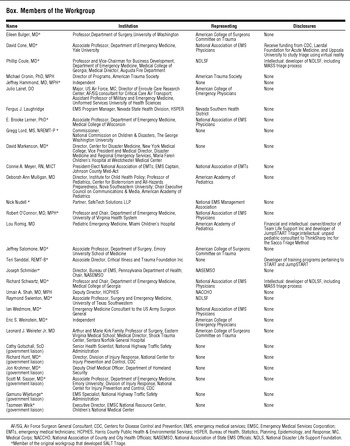
An expanded workgroup was established that consisted of some of the members of the original workgroup that developed SALT Triage, along with additional representatives of government and nongovernment agencies who were selected by those organizations based on their knowledge of mass casualty triage. (The Box lists the members of the workgroup, their affiliations, and any potential conflict of interest disclosures.)
Members of the Workgroup

The Core Criteria were designed by the workgroup to reflect the available science, while acknowledging that there are significant gaps in research. When no science was available, decisions were made by expert consensus derived from clinical and operational experience with available triage systems. The criteria apply only to providers who are organizing multiple victims in 1 or more discrete geographic locations, regardless of the size of the incident. The criteria also address only primary triage and do not consider secondary or tertiary triage. The criteria are classified by whether they were supported by available direct scientific evidence (“science”), indirect scientific evidence (“indirect science”), or expert consensus (“consensus”), and whether they were used in existing triage systems.
It is recognized that these are not commonly used terms; however, the breadth of the available research articles was limited, so these basic categories were used rather than a formal level of evidence evaluation. Furthermore, a formalized literature evaluation was not done. It is hoped that future efforts will involve such an evaluation and improve upon this process.
“Science” was defined as the existence of at least 1 peer-reviewed publication that explicitly tested the criterion in regard to mass casualty triage. The data within those articles were found to support the concept identified in the criteria, but the workgroup did not score the articles based on the quality of the study. Therefore, this designation indicates that data exist, but the strength of its support is not represented. “Indirect science” was defined as the existence of at least 1 peer-reviewed publication that studied the criterion under different circumstances or in a different patient population. Again, this term was not intended to reflect the strength of the evidence within the cited publications, but instead to reflect the population that was studied. “Consensus” was defined as criteria that were unanimously agreed to by the workgroup; there also may be existing nonresearch publications that support the concept. A criterion was considered to be part of an existing triage system if it was included in 1 or more of the triage systems that are in use today, excluding SALT Triage.
The Model Uniform Core Criteria for Mass Casualty Triage include 4 general categories: general considerations, global sorting, lifesaving interventions, and assignment of triage categories.
CATEGORY 1: GENERAL CONSIDERATIONS
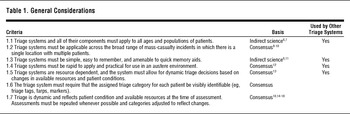
The category “general considerations” consists of criteria that apply generally to any triage system (Table 1). All but 2 of the criteria in this section are based on consensus, with some supporting literature; these are not peer-reviewed research studies, but instead are articles that describe the opinions of other experts in the field. The lack of research in this category reflects the difficulties that are encountered in studying these ideas.Reference Cone and Koenig8 Specifically, randomized clinical trials during an actual mass casualty event are likely not possible, nor are other prospective designs. Therefore, it is likely that any recommendations for mass casualty triage must be based on retrospective studies, simulation studies, or studies involving other patient populations.
General Considerations

Criteria 1.1 and 1.3 are supported by indirect science. Criterion 1.1 describes the general idea that triage systems must apply to all ages and populations of patients. This concept is indirectly supported by a study in Taipei, which found that during an actual mass casualty incident, none of the pediatric patients were triaged, compared to 86% of the adult patients in a system that used a separate pediatric triage system.Reference Wang and Hung6 Wallis and Carley found that when triaging pediatric patients in an emergency department, the CareFlight system, which can be used for both adults and children, performed the best compared to JumpSTART, START, and the Pediatric Triage Tape, although the difference between CareFlight and the Pediatric Triage Tape was minimal.Reference Wallis and Carley7 Although neither of these articles directly supports the criterion, both suggest that a single system that can be accurately applied to all patients likely is optimal.
Criterion 1.3 states that triage systems must be simple, easy to remember, and amenable to quick memory aids. This is indirectly supported by a study by Kilner and Hall that found that triage accuracy improved when a memory aid was provided.Reference Kilner and Hall11 Furthermore, a study by Wang and Hung noted that there was a performance gap among EMS personnel performing actual mass casualty triage; they attributed this to personnel having difficulty recalling triage procedures.Reference Wang and Hung6
CATEGORY 2: GLOBAL SORTING
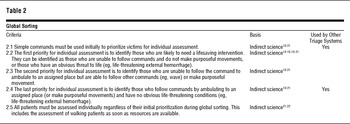
Global sorting provides criteria for approaching a scene and organizing individuals before they are assessed by a responder one at a time (Table 2). These criteria require the use of verbal commands to prioritize patients into 1 of 3 categories for individual assessment. Each criterion is supported by indirect science, primarily by 3 articles that illustrated associations between the ability to follow commands and severity of injury or the need for lifesaving interventions.Reference Holcomb, Niles, Miller, Hinds, Duke and Moore19Reference Meredith, Rutledge and Hansen20Reference Garner, Lee, Harrison and Schultz21 In other words, a victim who cannot follow the command to walk to a designated location or to wave his or her hand is the most likely to need immediate treatment.
Global Sorting

Prioritizing patients who are the most likely to need lifesaving interventions first is further supported by the work of Kragh et al, who demonstrated improved survival if the bleeding of patients with uncontrolled extremity hemorrhage was controlled with a tourniquet.Reference Kragh, Walters and Baer14Reference Kragh, Walters and Baer15Reference Kragh, Littrel and Jones16 If a first responder is able to rapidly identify victims with uncontrolled extremity hemorrhage, the responder's immediately applying a tourniquet will most likely improve the chance of survival. However, data from the 2004 Madrid train bombings and an emergency department–based study suggest that patients with significant injuries may be among those at the scene who follow the direction to walk.Reference Garner, Lee, Harrison and Schultz21Reference de Ceballos, Turégano-Fuentes, Perez-Diaz, Sanz-Sanchez, Martin-Llorente and Guerrero-Sanz22 With this in mind, it is recommended that all patients be assessed individually at some point during the triage process, regardless of their ability to walk or wave.
It is important to emphasize that global sorting is not intended to be completely accurate. It is possible that individuals will not follow the commands correctly and thus will be prioritized incorrectly. For example, an individual who has tympanic membrane rupture as a result of injuries sustained in a blast incident may be unable to hear verbal commands to walk to the designated area. Similarly, people who do not speak English may not be able to understand commands given only in English. Unaccompanied children and/or individuals who have sustained head injuries and brain trauma may be ambulatory and may wander without purpose. Alternatively, it is possible that minimally injured or noninjured victims may carry injured children or smaller adults to the designated area when the “walk” command is given. Although there is no scientific evidence to support these possibilities, it was the consensus of the panel, with support of the published data described above, that every victim must be assessed individually.
CATEGORY 3: LIFESAVING INTERVENTIONS
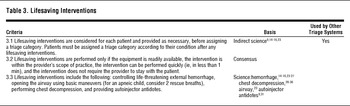
The third category of the Model Uniform Core Criteria is “lifesaving interventions (Table 3). The interventions selected in this section are actions that are supported by direct science and known to be lifesaving if provided early, and in many cases they may change the urgency of a victim's condition. For example, a victim with uncontrolled extremity hemorrhage needs immediate care; if a first responder applies a tourniquet immediately to that victim and controls the hemorrhage, it will improve that victim's chances of survival. This is supported by data from Kragh et al, in which it was noted that when a tourniquet was applied when shock was absent, there was a significant association with survival (90% vs 10%; P < .001).Reference Kragh, Walters and Baer14 Controlling a victim's hemorrhage immediately may also extend the time before that victim requires definitive care, allowing another victim to be treated and/or transported first, while not diminishing the chance of the first victim surviving his or her injury.
Lifesaving Interventions

The selected interventions are actions that most field providers are capable of performing and are those for which the needed resources are likely to be readily available to immediately perform the intervention. It is important to note, however, that if the procedures are beyond the scope of practice of the triage personnel or if they do not have the tools, training, or both to perform the intervention, then the intervention should not be attempted. Some of these lifesaving skills are taught typically in cardiopulmonary resuscitation and trauma courses as “standard of care,” and therefore the workgroup believed that the recommended interventions were based on available science.323334
The recommendation (criterion 3.1) that these interventions be provided before assigning a triage category is based on indirect science, mainly related to findings by the military of the need for immediate hemorrhage control.Reference Kragh, Walters and Baer14Reference Kragh, Walters and Baer15Reference Kragh, Littrel and Jones16Reference Bellamy23 Some data also detail the need for chemical-agent antidotes early in a response to an incident involving a chemical release.Reference Baker9
CATEGORY 4: INDIVIDUAL ASSESSMENT OF TRIAGE CATEGORY
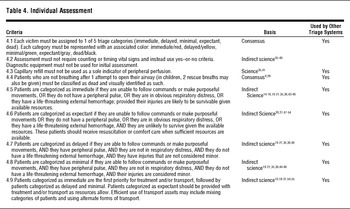
There are 9 criteria in the “individual assessment of triage” category (Table 4). The first of these criteria establishes that primary triage will consist of 5 triage categories, and each category will be represented by a standardized color. There is no scientific evidence to support the number of categories or the colors used, but these are, in general, consistent with the most commonly used triage systems, and thus the de facto standard of care.
Individual Assessment

Criterion 4.2, which states that victim assessment must be simple and not require the use of equipment, is based on indirect science. Some preliminary studies demonstrate that radial pulse quality, respiratory rate, and the motor component of the Glasgow Coma Scale (eg, the ability to follow commands) were reliable methods for identifying victims who needed treatment.Reference McManus, Yershov and Ludwig35Reference Holcomb, Salinas, McManus, Miller, Cooke and Convertino36Reference Burkle, Newland, Orebaugh and Blood37 Furthermore, the use of diagnostic equipment in the field may not enhance the ability of the rescuer to identify victims who need immediate treatment.Reference Holcomb, Salinas, McManus, Miller, Cooke and Convertino36Reference Sztajnkrycer, Baez and Luke38 Finally, the measurement of vital signs in children compared to adults is more difficult and time consuming.Reference Waisman, Aharonson-Daniel, Mor, Amir and Peleg39 Taken together, all of these factors led the workgroup to recommend against using diagnostic equipment to measure injury severity, and to note that basic observations such as presence of a radial pulse can be accomplished quickly and are sufficient to identify patients who need immediate care.
Although several triage systems use or have used capillary refill to identify severely injured victims, 2 studies have shown this to be a poor predictor of outcome in adults.Reference McManus, Yershov and Ludwig35Reference Schriger and Baraff41 The workgroup agreed that there is no scientific evidence for the use of capillary refill when triaging patients and that it should not be used to assess circulation. The recommendation that patients who are not breathing should be considered dead was made based on consensus, but is also supported by the International Liaison Committee on Resuscitation, which recommends initiating cardiopulmonary resuscitation for any victim who is not breathing or moving,33 and the finding that during the 1995 Oklahoma City bombing, no victim who received cardiopulmonary resuscitation survivedReference Hogan, Waeckerle, Dire and Lillibridge42; however, this is obviously a resource-based decision. Although the survival rate for traumatic cardiac arrest is low (typically <5%), it is not zero.Reference Willis, Cameron, Bernard and Fitzgerald56 When sufficient personnel and resources exist, efforts can and should be made to resuscitate these patients (however, by definition this situation would not be considered a mass casualty incident).
Criteria 4.5 to 4.8 describe the criteria for assigning a triage category. These criteria are supported by indirect science in that there are numerous research articles in the non–mass casualty setting supporting the treatment/transport priority of patients with the listed signs and symptoms. The final criterion, 4.9, discusses the priority of treatment/transport once patients are categorized. The Model Uniform Core Criteria are focused only on primary triage. The workgroup acknowledges that additional work is needed to develop a national guideline for secondary triage that would better address the issue of how to prioritize patients within these 5 triage categories. Furthermore, such a protocol would need to address the nuances of transport decisions and modalities as well as destination decisions. These issues are not addressed in the Core Criteria; criterion 4.9 instead simply identifies the priority order of the 5 triage categories.
CONCLUSIONS AND FUTURE DIRECTIONS
The Model Uniform Core Criteria for Mass Casualty Triage were designed to increase interoperability among various mass casualty triage protocols. Systems/communities can choose to modify their protocols to meet the developed criteria or they can choose to adopt SALT Triage, a freely available triage system that already meets the Core Criteria. A comparison between a locality's current mass casualty triage protocol and the Model Uniform Core Criteria for Mass Casualty Triage likely would reveal that only small changes to the currently used triage system would need to be made for the present protocol to be compliant.
The intent of the Core Criteria is to ensure that providers at a mass casualty incident use triage methodologies that incorporate core principles in an effort to promote interoperability and standardization. At a minimum, each triage system must incorporate the basic criteria that are listed in the Core Criteria. Mass casualty triage systems in use can be modified using these criteria to ensure interoperability and standardization.
The gaps in science are clear and stated within the present article. The intent of the workgroup was that as more science becomes available, the criteria will be updated to reflect the change in knowledge and that a formalized literature review would be conducted to support future updates. This may be similar to the review of the cardiac arrest treatment literature by the International Liaison Committee on Resuscitation that takes place every 5 years.57 If changes are made to the Model Uniform Core Criteria for Mass Casualty Triage, the SALT Triage scheme will be simultaneously adjusted so that it is always compliant with the Core Criteria. The exact process for these updates is not yet defined, but it is hoped that at regular intervals (eg, 5-year intervals) a workgroup will be convened to review the current literature through a formalized literature review and determine whether there is new evidence that supports or refutes any of the elements of the criteria. Future workgroups would then incorporate this updated information into the Core Criteria and generate a list of revised criteria.
It is also important to conclude by noting that this guideline only scratches the surface of the decisions that need to be made during a mass casualty incident. In the future, the Model Uniform Core Criteria need to be expanded to address issues surrounding secondary triage, including ordering transport, selecting destinations, patient tracking, and keeping together families with small children. Furthermore, triage is only a small part of the overall response to a mass casualty incident, and all response activities should be conducted within the community's formal response system.
Author Disclosures: Author and workgroup member disclosures are listed in the Box.