Migratory amphidromous shrimps move up- and down-stream during their life cycle, first as planktonic larvae drifting passively to the estuary and then again as juveniles emerging from the sea and moving upstream into the freshwater rivers and streams where they live as adults (Chace & Hobbs Reference CHACE and HOBBS1969). The distance migrated can be on the order of hundreds of kilometres (Rome et al. Reference ROME, CONNER and BAUER2009). Shrimps may be subjected to multiple stressors, including fishing (Hein et al. Reference HEIN, PIKE, BLANCO, COVICH, SCATENA, HAWKINS and CROWL2011, Holthuis Reference HOLTHUIS1980) and land-use change both during their migrations (Pringle & Scatena Reference PRINGLE, SCATENA, Hatch and Swisher1999) and in their adult upstream habitat.
Land-use change takes many forms (Pringle & Scatena Reference PRINGLE, SCATENA, Hatch and Swisher1999). In Costa Rica, there is increasing conversion of land to intensive agriculture (e.g. banana or pineapple plantations), which is associated with higher levels of pesticides in surface waters (Castillo et al. Reference CASTILLO, DE LA CRUZ and RUEPERT1997). Traditional methods of toxicity testing indicate that the surface waters in the region downstream from banana plantations are of impaired quality potentially leading to acute or chronic toxicity in invertebrate aquatic organisms (Castillo et al. Reference CASTILLO, MARTINEZ, RUEPERT, SAVAGE, GILEK, PINNOCK and SOLIS2006). These levels can potentially threaten the long-term persistence of migratory shrimps but little information exists on the impacts of agriculture on shrimp populations.
In Costa Rica, agricultural expansion is often associated with an increase in human population (Vargas Reference VARGAS1995), which can translate into increased fishing pressure on shrimps since they are an important component of a subsistence fishery. Shrimps are fished for bait and for direct consumption (Hidalgo pers. comm.), but little information exists on the impacts of fishing on shrimp populations. Shrimps are fished by hand with nets, spearguns or hook and line (Chace & Hobbs Reference CHACE and HOBBS1969), with traps (Vargas pers. comm.) as well as by poisoning of whole stream reaches with bleach or insecticides (Greathouse et al. Reference GREATHOUSE, MARCH and PRINGLE2005).
Although shrimps are important components of tropical freshwater ecosystems, population data are uncommon and historical population data are rarer still (but see Collart & Magalhaes Reference COLLART and MAGALHAES1994, Lewis et al. Reference LEWIS, WARD and MCIVER1966, Walker & Ferreira Reference WALKER and FERREIRA1985). Like many Neotropical regions inhabited by shrimps, the Sarapiquí region of Costa Rica, downstream from La Selva Biological Station (LSBS), has experienced dramatic land-use change and river fragmentation over the past few decades, as a result of massive conversion of secondary forests to banana plantations and pasture. Unlike many other sites, however, we collected historical shrimp population data at La Selva Biological Station prior to massive landscape conversion downstream.
In this study, our main objective was to compare shrimp relative abundance between a historical time period (1988–1989; pre-disturbance) and a recent time period (2008–2011; post-disturbance). We hypothesized that recent shrimp abundance would be lower at three stream sites located within or bordering La Selva Biological Station, potentially as a result of downstream changes in land use affecting recruitment success upstream. A secondary objective was to measure inter-annual variability in shrimp abundance; using data from 2008–2011 to inform future monitoring efforts. We hypothesized that shrimp abundance would exhibit little inter-annual variability. A final objective was to evaluate the efficacy of using modified minnow traps to collect shrimp population data.
This study was conducted at La Selva Biological Station (LSBS) (10°26″N, 84°01″W), a 1600-ha forested reserve that is relatively protected from hunting and fishing, located in the Sarapiquí drainage (2793 km2) of Costa Rica's northern Caribbean slope. In the early 1980s, the Sarapiquí region was a mosaic of forests, cattle pastures and crops (Butterfield Reference BUTTERFIELD, McDade, Bawa, Hespenheide and Hartshorn1994); in the late 1980s and early 1990s an unprecedented increase in conversion of forest and pasture to banana production occurred in the region (Montagnini Reference MONTAGNINI, McDade, Bawa, Hespenheide and Hartshorn1994). The areal extent increased from <5% of the Sarapiquí region to >15% and the population increased 185% (Vargas Reference VARGAS1995). In the late 1990s and early 2000s (post-expansion), the area under intensive agricultural cultivation remained relatively constant. Since the late 1990s, pastures used for cattle production have decreased and some regrowth of forests has occurred. The most recent land-use data indicate that, in 2005, the areal extent of forest, including forest regrowth, had increased to 56% of the region while agricultural land-use (both intensive agriculture and pasture) was 43% (Montoya & Malavasi Reference MONTOYA and MALAVASI2008).
Stream reaches sampled in this study were in the Sabalo and Salto rivers. The Salto River is a third-order river with a completely forested watershed and its headwaters are encompassed by Braulio Carrillo National Park, which is contiguous with LSBS. The Sabalo River defines part of the border of LSBS and is bordered on the other side by a cattle pasture. The watershed of the Sabalo is a mix of protected forest (95%) and agricultural land use (5%), with cattle pastures comprising the majority of the extent of agricultural land.
Fifteen species of amphidromous shrimp occur in Costa Rica, with seven species occurring on the Caribbean side (Obregon Reference OBREGON1986). Adult and juvenile shrimps occurring at LSBS have migrated 50–55 km upstream from the ocean. In this study we focus on Macrobrachium olfersi Wiegmann 1836 (Decapoda) because it occurs at high enough densities to allow us to estimate its abundance.
From December 1988–December 1989 and January 2008–December 2011, relative abundance of shrimps was measured from one to three times per month from three stream reaches: one in the Sabalo River (Sabalo) and two in the Salto River (Salto1 and Salto2). The Sabalo River is a fourth-order river (wetted width = 12 m, discharge = 1.01 m3 s−1) with little variability in mean temperature (25.3 °C), pH (6.0) or conductivity (47 μS cm−1) yearly. The Salto River is a smaller river than the Sabalo (wetted width = 6.5–8 m, discharge = 0.79–0.84 m3 s−1) and had a higher conductivity (98 μS cm−1) but is relatively similar in temperature (25.3 °C) and pH (6.1–6.4). During each time period, three modified minnow traps were placed in pools along each 100-m stream reach, baited with raw chicken and left for two nights before being collected. On the morning of the second day, all shrimps were identified to species, sex was determined and total length (cm) measured. Shrimps were collected in the same stream reaches and following the same methodology during the two time periods.
The abundance data (counts of individuals per stream reach) were examined with an auto-correlation function to test for temporal correlations between repeated samples at a stream reach. Auto-correlation analysis uses Pearson correlation coefficients to relate the abundance from t+1 with the abundance at time t, where t can represent various time lags and determine if there is a significant relationship (Zuur et al. Reference ZUUR, IENO, WALKER, SAVELIEV and SMITH2009).
A combination of approaches was used to examine the effect of site and year on M. olfersi relative abundance. Generalized linear models were used to determine the most appropriate distribution for modelling counts and a Bayesian approach implemented with JAGS software in Program R with package rjags was used to calculate the means and confidence intervals for each site and time period (http://sourceforge.net/projects/mcmc-jags/files/rjags/stats/timeline). All models were fitted using Markov Chain Monte Carlo (MCMC) methods with 5000 iterations, 2000 iterations of burn in, and diffuse priors. The effect of site and year on relative abundance was estimated separately for the dry and wet season. A Poisson error distribution and dispersion parameter were specified in the generalized linear and Bayesian model structures to better account for zero-inflation in count data and to adjust precision of standard errors. Using the pwr package in Program R (http://cran.r-project.org/web/packages/pwr/index.html), we performed a power analysis to examine the effectiveness of traps to detect changes in relative abundance (Cohen Reference COHEN1992). Model inputs were the mean number of shrimp individuals across all the sites from 2008–2011 and the standard deviation. All other analyses were performed using the software R version 2.13.0 (R Foundation for Statistical Computing, Vienna, Austria). For the analysis, alpha was set a priori to 0.05.
Total individuals of Macrobrachium olfersi captured and identified during the historical (1988–1989) and recent sampling periods (2008–2011) were 343 and 399 individuals, respectively. Autocorrelation function analysis showed that the abundance of M. olfersi at a stream reach was not significantly related over any of the temporal correlations. Thus each sample of relative abundance at a stream reach through time was considered an independent sample of the population in all other analyses.
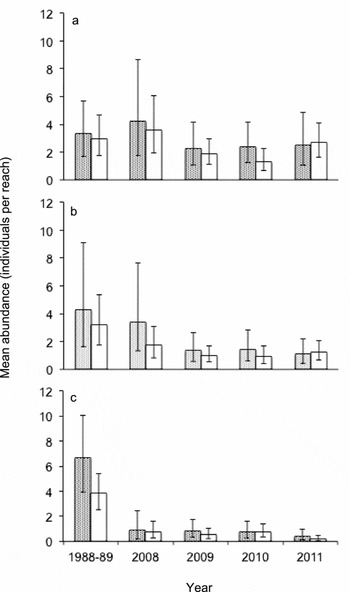
Within stream reaches from 2008–2011, M. olfersi populations exhibited little inter-annual change in relative abundance (Figure 1). From 2008–2011, mean abundance was somewhat variable, ranging from 0.42–4.2 shrimps per sampling period across all stream reaches. However, relative abundance of M. olfersi in the Sabalo reach was significantly lower than in the Salto1 or Salto2 reaches.
Relative abundance (individuals per site) of Macrobrachium olfersi during the historical (1988–1989) and recent time period (2008–2011) in three stream reaches, Salto1 (a), Salto2 (b), and Sabalo (c), at La Selva Biological Station during the wet (dotted bars) and dry (white bars) seasons. Mean and confidence interval were estimated in a Bayesian framework using 5000 MCMC iterations and three chains.

In the dry and wet seasons, M. olfersi exhibited the same patterns in abundance across stream reaches and years during the recent time period. We found shrimp abundance in two reaches (Salto1 and Salto2) to be relatively constant among years and between recent (2008–2011) and historical (1988–1989) time periods (Figure 1). In the Salto2, the mean abundance decreased between time periods in both the wet and dry seasons but the decline was not statistically significant. In comparison, the Sabalo reach showed a significant decrease (87%) in relative abundance between current and historical time periods suggesting a site-level change. The Sabalo reach went from having the highest M. olfersi abundance compared with the other reaches during the historical period to having the lowest abundance in the recent period.
The mean and SD (1.89 ± 1.11) used in the power analysis was derived from all the stream reaches during the recent period. Results indicate that 360 samples are required to observe a decrease in abundance of 10%, 60 samples to observe a 25% decline, and 17 samples to observe a 50% decline at our study sites.
Our findings suggest that M. olfersi populations in protected upstream reaches at LSBS were resistant and/or resilient to major land-use change downstream even though the downstream larval drift and upstream migration of juveniles were vulnerable to downstream perturbations. The similarity in abundance of M. olfersi between pre- and post-disturbance sampling periods was surprising, given the extent of downstream disturbance in the Sarapiquí watershed. While toxicity tests revealed degraded water quality and chronic or acute impairment of invertebrate communities in water downstream from banana plantations (Castillo et al. Reference CASTILLO, MARTINEZ, RUEPERT, SAVAGE, GILEK, PINNOCK and SOLIS2006), resulting from pesticide run-off, M. olfersi populations in forested streams at LSBS had the same relative abundance between historical and current sampling periods.
The lack of continuous temporal data from post-banana plantation expansion (1990–2007) makes it difficult to evaluate whether shrimp abundance is relatively resistant or very resilient (or a combination of the two) to this downstream disturbance. If M. olfersi was resistant to perturbation, its abundance would change little in response to disturbance and maintain a relatively constant level, whereas a population with high resiliency would decrease but quickly recover to previous levels post-disturbance (Holling Reference HOLLING1973).
The resilience and/or resistance of M. olfersi populations inter-annually in recent time periods, and between recent and historical time periods at the two forested sites, can be explained by the nature of their amphidromous migratory life cycle and continuous, year-round breeding. Amphidromous Macrobrachium olfersi releases much higher quantities of larvae per individual (2300 larvae) than non-migratory Macrobrachium spp. (~10 times more) (Mossolin & Bueno Reference MOSSOLIN and BUENO2002). Shrimp larvae are present year-round in high densities relative to other drifting invertebrates (Ramírez & Pringle Reference RAMÍREZ and PRINGLE2001). We suggest that this large and constant year-round supply of shrimp larvae moving downstream may contribute to a similarly constant upstream migration of juvenile shrimps that could offset potential declines in recruitment resulting from episodic mortality events caused by pesticide run-off. Thus, the life cycle and natural history of amphidromous shrimps may confer some stability to upstream recruitment. Moreover, recolonization of downstream stream reaches suffering from massive shrimp and fish kills may also be facilitated by the migratory life cycle of shrimp species (McDowall Reference MCDOWALL2007, Reference MCDOWALL2010), further contributing to population resilience.
We suggest that the major decrease in shrimp abundance (between 1988 and 2011) in the unprotected Sabalo stream reach is due to local factors (e.g. fishing of shrimp) versus regional landscape-scale disturbances downstream. In contrast to the protected status of our two study stream reaches within interior forests of LSBS (which showed no change in shrimp abundance between sampling time periods) the Sabalo study reach is directly adjacent to pasture and therefore accessible to local fisherman. Local people have been observed in the Sabalo collecting shrimps (Sanchez pers. comm.). Thus, our working hypothesis is that direct harvesting of adult shrimps is responsible for declines in shrimp abundance in our Sabalo study reach. An alternative hypothesis is that pollution from agricultural run-off is responsible, although this is unlikely given that the majority of the Sabalo watershed is forested and the remaining agricultural extent (5%) is primarily cattle pasture.
In the Sabalo study reach, a large change in shrimp relative abundance occurred between time periods and we were able to detect it with a small number of samples (n = 71 for the wet season in the Sabalo). However, smaller changes in shrimp populations could be occurring that are below our level of detection (25%). Based on the results of the power analysis, to detect a 10% change in M. olfersi relative abundance, three times as many samples (n = 360) as those we collected (n = 60, 64, 71, during the wet season at the Salto1, Salto2 and Sabalo respectively) would be required. Our use of three traps per study reach was a tractable way to monitor shrimp populations but was not powerful enough to detect smaller (i.e. < 25%) changes in abundance. Future monitoring might consider sampling more intensely within a stream reach (i.e. a higher density of traps) during the wet season.
In conclusion, our data provide a rare opportunity to examine migratory shrimp population dynamics over both short and long timescales. Our findings strongly suggest that shrimp populations in protected stream reaches were resilient or resistant to regional landscape-scale perturbations occurring downstream from our study reaches. While our sampling methodology was unable to detect changes in shrimp abundance < 25%, we did find a decline of 87% in relative abundance of M. olfersi in our unprotected study stream reach. While we suggest that the mechanism of the decline is due to local fishing of shrimps, this hypothesis needs to be further investigated.
ACKNOWLEDGEMENTS
We are grateful to M. Hidalgo for help with fieldwork and to my committee and the Pringle lab for helpful feedback that improved this manuscript. This study was supported by the National Science Foundation through the Long-Term Studies Environmental Biology program (DEB 9528434, DEB 0075339, DEB 0545463) and the Organization for Tropical Studies.