Introduction
The performance of birds and quality of eggs are the main factors affecting the income of poultry producers. Macro nutrients such as protein and energy have effects on these factors, as do the trace elements. Manganese (Mn), which is the fifth most abundant element on earth, is one of these trace elements. Since the 1930s, Mn has been known to be essential in animals (Suttle, Reference SUTTLE2010). In poultry nutrition, Mn plays an important role in bone formation (Underwood, Reference UNDERWOOD1977) and in many biochemical processes by activating enzymes, such as pyruvate carboxylase, superoxide dismutase and glycosyl transferase (Suttle, Reference SUTTLE2010). Mn is essential for embryonic development, normal growth of the body and bones, reproduction, and carbohydrate and lipid metabolism (Underwood, Reference UNDERWOOD1977). Furthermore, Mn has an important function in preventing perosis and maintaining eggshell quality (Cox and Balloun, Reference COX and BALLOUN1968; Lu et al., Reference LU, LUO, JI, LIU and YU2007; Suttle, Reference SUTTLE2010).
The dietary Mn requirement for poultry suggested by the NRC (1994) may no longer be sufficient to maintain the optimal performance and eggshell quality of birds due to the considerable improvement in their performance. In most studies conducted to determine the Mn requirement of birds, between 15-200 mg/kg Mn is added to the diets, and these amounts, particularly for egg layers, can be much higher than the levels recommended by the NRC (1994). The element is added to the diets of poultry as inorganic or organic Mn. The organic sources of Mn are known to have more positive effects on eggshell quality compared to the inorganic sources (Gheisari et al., Reference GHEISARI, SANEI, SAMIE, GHEISARI and TOGHYANI2011a; Xiao et al., Reference XIAO, WU, ZHANG, YUE, WANG, JI and QI2015).
This review examines the nutritional role of Mn and its inorganic and organic sources on the performance of broilers, and the production and eggshell quality of laying hens.
Manganese requirements of broilers and laying hens
Nowadays, the increased performance capacity of birds has necessitated an increasing Mn requirement, and research has been carried out to determine the optimum Mn level for both laying hens and broilers. For laying hens, the NRC (1994) proposed a Mn requirement of 20 mg/kg. However, the Mn requirement for maximal performance, including egg production, egg mass and optimal eggshell quality in laying hens, as a result of changes in genetics, management and nutrition of birds over the past 50-60 years, is estimated to be higher than NRC levels. Various Mn levels for laying hens have been reported by researchers. For instance, the Mn requirement of laying hens was recommended as 50 mg/kg by Ochrimenko et al. (Reference OCHRIMENKO, LEMSER, RICHTTER, KRAUSE and BONSAK1992), 105 mg/kg by Sazzad et al. (Reference SAZZAD, BERTECHINI and NOBRE1994), 120 mg/kg for second-cycle hens by Fassani et al. (Reference FASSANI, BERTECHINI, OLIVEIRA, GONCALVES and FIALHO2000) and 60 mg/kg by Leeson and Summers (2005). In contrast to these results, Yıldız et al. (2010) stated that dietary Mn addition was not necessary for the basal diet (14 mg/kg Mn) of 22-42-week-old laying hens.
There has been a marked increase in disorders, such as perosis, due to the rapid growth of broilers. NRC (1994) recommends 60 mg/kg of Mn in broiler diets. Sunder et al. (Reference SUNDER, PANDA, GOPINATH, RAJU, RAO and KUMAR2006) showed that supplementation of Mn at 100 mg/kg optimised performance parameters, mineralisation and the immune systems of broilers. The Mn requirement of broilers has been suggested as 83 (Berta et al., Reference BERTA, ANDRASOFSZKY, BERSENYI, GLAVITS, GASPARDY and FEKETE2004), 70 (Leeson and Summers, 2005), 122 (Lu et al., Reference LU, JI, LUO, LIU and YU2006), 137 (Sunder et al., Reference SUNDER, PANDA, GOPINATH, RAJU, RAO and KUMAR2006) and 130 mg/kg (Li et al., Reference LI, LIN, LU, XI, WANG, HAO, ZHANG, LI and LUO2011). The reason for the varying dietary Mn levels for laying hens and broilers recommended by past research may be due to differences in the age and genotype of the animals studied as well as management and rearing factors.
Availability and sources of manganese
High levels of dietary calcium, phosphorus, phytate and cellulose decrease the absorption of Mn in the intestinal tract of poultry (Halpin and Baker, Reference HALPIN and BAKER1986; Wedekind and Baker, Reference WEDEKIND and BAKER1990a; Reference WEDEKIND and BAKER1990b). The Mn content of cereal grains used in poultry diets is between 5-45 mg/kg based on dry matter, whereas protein sources and bran contain more (Suttle, Reference SUTTLE2010), as Mn availability in these cereal grains is low (Turk et al., Reference TURK, GUNJI and MOLITORIS1982; Halpin and Baker, Reference HALPIN and BAKER1986). Therefore, commercial corn-soybean meal based diet cannot meet the Mn needs of laying hens and broilers.
In the poultry sector, cheaper trace mineral salts, such as sulphates and oxides are added in high amounts to ensure adequate dietary requirements are met (Ao and Pierce, Reference AO and PIERCE2013). As a Mn source, Mn-sulphate is reported to be more available than Mn-oxide and Mn-carbonate (Black et al., Reference BLACK, AMMERMAN, HENRY and MILES1984). Korol et al. (Reference KOROL, WOJCIK, MATYKA and HANSEN1996) demonstrated that Mn-oxide contained 61-74% available Mn and this was lower than Mn-sulphate, which was taken as 100%. Similarly, Gheisari et al. (Reference GHEISARI, SANEI, SAMIE, GHEISARI and TOGHYANI2011a) noted that the dietary addition of Mn-sulphate instead of Mn-oxide improved performance parameters such as feed intake and feed conversion ratio of laying hens and decreased the percentage of broken eggs.
The availability of inorganic sources of trace elements is relatively low and an important portion of inorganic elements are excreted with faeces without absorption in the digestive system. The bioavailability of organic Mn sources (chelates or propionates) was found to be higher than inorganic sources (Mn-sulphate) for broilers (Brooks et al., Reference BROOKS, GRIMES, LLOYD, VALDEZ and SPEARS2012), allowing an organic Mn source to be added to the diet at 50 or 75% less than its inorganic counterpart (Gheisari et al., Reference GHEISARI, RAHIMI-FATHKOOHI, TOGHYANI and GHEISARI2011b). Gheisari et al. (Reference GHEISARI, RAHIMI-FATHKOOHI, TOGHYANI and GHEISARI2011b) recommended that diets supplemented with Mn at 40 mg/kg from organic sources, can be used instead of Mn-oxide at 100 mg/kg to support broiler chick performance. Xiao et al. (Reference XIAO, WU, ZHANG, YUE, WANG, JI and QI2015) showed that as an organic source, Mn-amino acid complexes improved eggshell quality parameters in aged laying hens compared to inorganic Mn-sulphate. Organic Mn was observed to have greater efficacy than inorganic Mn (Mn-sulphate) and, as a methionine ligand, was more effective in facilitating Mn absorption than Mn-glycine (Ji et al., Reference JI, LUO, LU, LIU and YU2006).
Conversely, other studies comparing the availability of inorganic with organic sources of Mn have reported no significant difference in either performance or eggshell quality in laying hens and broilers. Swiatkiewicz and Koreleski (Reference SWIATKIEWICZ and KORELESKI2008) showed that substitution of inorganic Mn with a Mn-amino acid complex in the diet had no effect on the performance or eggshell quality of laying hens. Similar results were reported by Yıldız et al. (2011). In a study in broilers, Wang et al. (Reference WANG, LU, LI, LIU, ZHANG, YAO and LUO2012) indicated that there was no significant difference in bioavailability between Mn-proteinate and Mn-sulphate fed to 1-21-day-old broilers. Berta et al. (Reference BERTA, ANDRASOFSZKY, BERSENYI, GLAVITS, GASPARDY and FEKETE2004) reported that Mn-fumarate had less efficacy than Mn-oxide. Similarly, it was shown that the relative bioavailability of a Mn-amino acid chelate was lower than Mn-sulphate for broilers aged between 1-21 days of age (Miles et al., Reference MILES, HENRY, SAMPATH, SHIVAZAD and COMER2003).
Effect of manganese on performance parameters
broilers
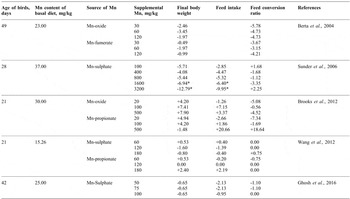
Many experiments have been undertaken to determine the optimum Mn level required to obtain optimal growth of broilers ( Table 1 ). Unfortunately no significant effect on performance has been observed when Mn was added to diets at up to 200 mg/kg, whilst performance parameters were adversely affected when Mn was added to the diets at high levels (400 mg/kg and above). Body weight, feed conversion ratio and mortality, and carcass parameters, such as carcass weight or the amount of abdominal fat of broilers, were not influenced by supplemental Mn at 180 mg/kg (Collins and Moran, Reference COLLINS and MORAN1999). Berta et al. (Reference BERTA, ANDRASOFSZKY, BERSENYI, GLAVITS, GASPARDY and FEKETE2004) demonstrated that dietary supplementation of Mn at 30, 60 or 240 mg/kg as Mn-oxide or -fumarate did not affect body weight, feed conversion ratio or mortality of broilers. Sunder et al. (Reference SUNDER, PANDA, GOPINATH, RAJU, RAO and KUMAR2006) reported that no addition or a high dosage (1600 mg/kg and above) of Mn to broiler diets increased leg abnormality scores, deteriorated performance parameters and adversely impacted immune response. Yan and Waldroup (Reference YAN and WALDROUP2006) showed that the performance parameters of broilers were not affected by Mn supplementation at 100, 200, 400, 600 or 800 mg/kg, regardless of the source (Mn-oxide or -sulphate, or organic Mn). Miles et al. (Reference MILES, HENRY, SAMPATH, SHIVAZAD and COMER2003) reported that feed intake was not affected by the source (sulphate or -amino acid chelate) or amount of dietary Mn (500, 100 or 1500 mg/kg), but body weight decreased in 21-day-old broilers fed diets containing Mn at 1500 mg/kg. Ghosh et al. (Reference GHOSH, MANDAL, ROY and PATRA2016) reported that dietary addition of Mn at 50, 75 and 100 mg/kg to a basal diet containing 25 mg/kg Mn did not benefit the growth performance of broilers.
While no effect of Mn on poultry performance has been found when the birds are fed a balanced diet or raised in a neutral environment, it may be effective in stressful situations. Nevertheless, from the trials published to date, approximately 90 mg/kg Mn in diets can be said to be essential for maintenance of normal development of broilers.
Effect of sources and dosages of Mn on performance of broilers.

1Numbers in columns indicate the percentage change relative to the control group; significant difference found *(P < 0.05).
laying hens
Manganese is one of the enzyme cofactors involved in the synthesis of cholesterol, which is the main structure of ovarian steroids (Klimis-Tavantzis et al., Reference KLIMIS-TAVANTZIS, KRIS-ETHERTON and LEACH1983). Cao and Chen (Reference CAO and CHEN1987) and Feng and Feng (Reference FENG and FENG1998) reported that a dietary deficiency of Mn caused changes in circulating ovarian steroids in layer hens, and consequently reduced reproduction in hens.
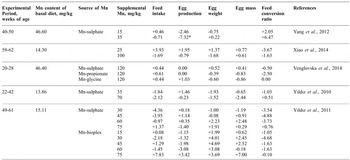
The dietary addition of Mn at 50 or 75 mg/kg increased egg production and egg weight (Hossain and Bertechini, Reference HOSSAIN and BERTECHINI1998). Xiao et al. (Reference XIAO, WU, ZHANG, YUE, WANG, JI and QI2015) reported that for 50-week-old laying hens fed supplemental Mn (inorganic Mn at 0, 25, 50, 100 and 200 mg/kg or organic Mn at 25, 50, 100 and 200 mg/kg), organic Mn at 50 mg/kg had the highest feed efficiency and the lowest feed intake when the data were extrapolated out from the 12-week feeding trial to 55-62 weeks of age. However, Sazzad et al. (Reference SAZZAD, BERTECHINI and NOBRE1994) observed that the performance parameters of 23-35-week-old laying hens were not affected by dietary supplementation of Mn at 20, 40 or 80 mg/kg. Similarly, Yıldız et al. (2010) reported that the dietary supplementation of Mn (35 or 70 mg/kg) did not affect the performance of laying hens between 22-42 weeks of age. Similarly, Faria et al. (Reference FARIA, JUNQUEIRA, SAKOMURA and SANTANA1999) showed that dietary Mn levels (70, 140 or 210 mg/kg) did not affect the performance of laying hens as did Venglovska et al. (Reference VENGLOVSKA, GRESAKOVA, PLACHA, RYZNER and COBANOVA2014) who stated that feeding 120 mg/kg did not affect the performance of 20-week-old hen layers.
In an experiment conducted by Yıldız et al. (2011) dietary addition of Mn (15-70 mg/kg), regardless of its form, did not affect performance, but egg weight was increased by supplementation with organic Mn (Mn-Bioplex) in laying hens at 49 weeks of age. In broiler breeders, the addition of Mn at up to 240 mg/kg feed did not affect performance or hatchability parameters (Xie et al., Reference XIE, TIAN, ZHU, ZHANG, LU and LUO2014). Yang et al. (Reference YANG, ZHONG, AN, ZHANG, ZHANG, HAN, YAO, COTE and SUN2012) reported that egg production decreased with increasing amount of supplemental Mn (15 or 35 mg/kg) but egg weight, feed intake and feed conversion ratio were not affected in laying hens at 40 weeks of age, and this contradiction may be due to the age of hens used in the experiment, as rate of egg production reduces with age and as such mineral requirements may decline. The lack of a supplemental Mn effect on bird performance may be due to sufficient Mn in the basal diets or an insufficient treatment period ( Table 2 ).
Effect of sources and dosages of Mn on performance of laying hens.

1Numbers in columns indicate the percentage change relative to the control group; significant difference found *(P < 0.05)
Effect of manganese on eggshell quality
Manganese plays an important role in eggshell quality by promoting the synthesis of mucopolysaccharides (Leach, Reference LEACH1976). A dietary deficiency of Mn decreases eggshell thickness (Leach and Gross, Reference LEACH and GROSS1983), and Sazzad et al. (Reference SAZZAD, BERTECHINI and NOBRE1994) reported that eggshell thickness was improved in laying hens fed supplemental Mn (20, 40 or 80 mg/kg), as Mn-oxide. Similarly, Xiao et al. (Reference XIAO, ZHANG, WU, ZHANG, YUE and QI2014) reported that dietary Mn supplementation (25 or 100 mg/kg) improved eggshell quality parameters, such as breaking strength and thickness in eggs from 50-week-old laying hens. In agreement, Venglovska et al. (Reference VENGLOVSKA, GRESAKOVA, PLACHA, RYZNER and COBANOVA2014) reported that the percentage of cracked eggs from 20-week-old laying hens was decreased by Mn supplementation at 120 mg/kg, regardless of the source. Fassani et al. (Reference FASSANI, BERTECHINI, OLIVEIRA, GONCALVES and FIALHO2000) reported maximal eggshell thickness from laying hens fed a diet containing Mn at 200 mg/kg. Thus, both the source and level of Mn in the diet influences eggshell quality. Furthermore, organic Mn is more effective than inorganic sources of Mn at improving eggshell quality. Xiao et al. (Reference XIAO, WU, ZHANG, YUE, WANG, JI and QI2015) reported that at 100 mg/kg, dietary supplementation of organic Mn increased the eggshell breaking strength, whilst inorganic Mn increased the eggshell thickness, in aged laying hens. In a study on broiler breeders, the dietary addition of Mn (120 and 240 mg/kg) increased eggshell breaking strength without affecting the thickness (Xie et al., Reference XIE, TIAN, ZHU, ZHANG, LU and LUO2014).
However, some research results reported that eggshell quality parameters were not affected by the addition of Mn to diets. For example, Yıldız et al. (2010) reported that the eggshell quality of 22-24-week-old laying hens was not affected by supplemental Mn. In another study by the same researchers, laying hens were fed a diet containing Mn at 15, 30, 45, 60 or 70 mg/kg, in an inorganic or organic form, for 12 weeks without any effect on the eggshell quality parameters but, compared to the inorganic Mn-sulphate, the Mn-Bioplex supplement decreased the percentage of damaged eggs (Yıldız et al., 2011).
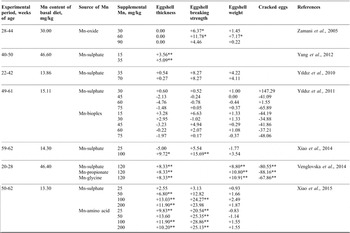
As shown in Table 3 , the addition of Mn to the diet generally has beneficial effects on eggshell quality parameters, such as thickness and fracture resistance, and decreases the portion of damaged eggs. Therefore, Mn is effective in decreasing economic losses to egg producers by increasing the number of marketable eggs.
Effect of sources and dosages of Mn on eggshell quality from laying hens.

1Numbers in columns indicate the percentage change relative to the control group; significant difference found *(P < 0.05), **(P > 0.01).
Conclusions
The minimum dietary addition for Mn for laying hens and broilers is ~60 mg/kg when fed as its sulphate salts or organic forms, so that the total Mn in the diet is maintained at ~90 mg/kg. This level is sufficient to improve eggshell quality parameters of laying hens and prevent various disorders such as perosis and to maintain normal development of broilers. Manganese sulphate is frequently used as the standard rather than other inorganic or organic sources. The availability of Mn-sulphate is higher than other inorganic sources such as Mn-oxide, but its availability in poultry is lower than organic sources (i.e., Mn-proteinate or -amino acid chelates). Organic Mn sources can be used to decrease the amount of Mn added to the diets of poultry, due to this higher bioavailability.