INTRODUCTION
Since the peace of Westphalia in 1648, the state has emerged as the dominant political actor in world politics and religion has been subordinated to the state in most western democracies (Philpott Reference Philpott2009). Since then, secularists have advocated that the subordination of religion to the state is a key component for democracy, and this has become the dominant position among scholars and philosophers (Philpott Reference Philpott2009). Furthermore, secularists predicted that religion would continue to decline in influence as the process of democratization spread around the world.
Interestingly, though, this has not happened. Contrary to secularization theory, religious influence has grown despite the spread of democracy. The rise of Islamic nationalism since the 1970s and the power of the religious right in the United States are signs of its continued influence (Philpott Reference Philpott2009). According to the World Values Survey (2009), the percentage of respondents identifying religion as an important part of their life rose from 62% in 1989 to 72% in 2005.
Consistent with this finding is the fact that religion continues to play a role in state governance, but to varying degrees. Secularists contend that religious influence negatively affects the ability of states to progress. Thus, it is important to determine if religion can remain viable in a secular state without impeding the formation and consolidation of democratic institutions. I contend that it can, so long as the state protects the rights of minority religions, and promotes secular legislation.
This article proceeds as follows: the first section provides a brief literature review and a discussion of the debate regarding the importance of religion and democratization. The next section explains the role that religious competition plays in promoting democracy. In the third section, I present my theory and hypotheses. The final sections are devoted to my research design and the empirical results. The article concludes with a couple of topics for future research.
THE DECLINE OF RELIGIOUS INFLUENCE?
Secularization theory and modernization theory are similar in regarding religion as a traditional cultural characteristic that will decline in influence as states modernize. Modernization theorists contend that it is social and economic development that are the keys to the creation of a stable democracy (Lipset Reference Lipset1959). Almond and Verba (Reference Almond and Verba1963) proposed that in “parochial cultures” people are unable to separate politics from religious institutions, but in a modern political system, religion and government are separate institutions. According to Inglehart and Norris (Reference Inglehart and Norris2004), the process of modernization includes the division of church and state, and the rise of secular-rational bureaucratic states. Similarly, Inglehart and Welzel (Reference Inglehart and Welzel2005) contend that democratic institutions are the result of increases in human autonomy and self expression that are part of a sequence leading from socioeconomic development to democracy. As existential conditions improve, people are less dependent on traditional values and place increasing dependence on self-expression. Thus, these theories implicate traditional cultural values like religion as impediments to democratization. This is the reason why the study of religious influence has taken a backseat to other areas in the democratization literature.
However, while modernization theorists provide social and economic characteristics of democracies, such as high income and literacy rate, they do not provide prerequisites for democracy (Rustow Reference Rustow1970). Economic development is important once a democracy has been established, but economic development does not explain how democracies come into existence (Przeworski and Limongi Reference Przeworski and Limongi1997). Moreover, modernization theory does not tell us where cultural and economic values come from in the first place, or if they are the by-product of democracy rather than the cause.
Consequently, the study of religion and democracy has seen a resurgence in political science over the last decade (Fox Reference Fox2001; Grim Reference Grim2008; Kuru Reference Kuru2007; Philpott Reference Philpott2009). These studies can trace their roots to Huntington (Reference Huntington1996) who challenged the way secularists downplay the role of religion in the modern state. Huntington (Reference Huntington1996) predicted that the conflicts of the post-Cold War era would be between religious civilizations. He believed that clashes between religious civilizations would undermine the role of secular institutions because religion provides people with an identity that transcends state boundaries. Furthermore, he wrote that economic and social developments were driving people toward traditional beliefs by separating them from their identities and that people would turn to religion to fill that void.
Modernization theorists counter by insisting that it is the absence of modernization (industrialization, urbanization, and rising levels of education and wealth) that explains why religion continues to play an important role in governments around the world (Inglehart and Norris Reference Inglehart and Norris2004; Inglehart and Welzel Reference Inglehart and Welzel2005). Their causal arrow flows from economic development to the evolution of cultural values involving individual autonomy and then to democracy. Thus, they argue that secularization is taking place in affluent societies, but not in poorer societies where the sacred still dominates.
However, this argument has been challenged by scholars like Kuru (Reference Kuru2007) who provide evidence of the continuing influence of religion in developed societies. Contrary to secularist predictions, religion is still visible to varying degrees in developed states. For example, in the United States, “In God We Trust” appears on all currency and official oaths are still made by placing a hand on the Bible. In fact, according to Kuru (Reference Kuru2007), highly developed countries have a higher percentage of official religions (57%) than under-developed countries (20%).
Fox and Sandler (Reference Fox and Sandler2005) reach a similar conclusion in their study of Middle Eastern and Western democracies. They find that 80.8% of Western democracies support one religion over another either officially or in practice, and half place at least some restrictions on minority religions. They assert that the United States is the only Western democratic state with a true separation of church and state at the federal level. Interestingly, though, Fox and Sandler (Reference Fox and Sandler2005) note that surveys of the United States population show that the United States is the most religious of the Western democracies. Based on their findings, Fox and Sandler (Reference Fox and Sandler2005) conclude that religion is not incompatible with democracy.
THE IMPORTANCE OF RELIGIOUS COMPETITION
One of the seminal studies in this area is Gill's (Reference Gill1998) analysis of the Catholic Church's political strategy in Latin America. Gill (Reference Gill1998) takes a religious economy approach to studying this issue. He sees people as the consumers of religious goods, and churches as the producers. In the face of religious competition in Latin America, the Catholic Church is more likely to expend efforts to attract and retain members by opposing government repression and poverty. Therefore, religious pluralism creates an environment in which the Church has to compete for followers. However, when the Church holds a monopoly, there is no incentive to attract and retain followers. This is because the Church can rely on the government for money and other resources. Thus, he concludes that the Catholic Church opposed authoritarianism in countries where it was threatened by religious competition, but supported it in countries where it held a religious monopoly.
Recent research on this subject supports Gill's (Reference Gill1998) theory regarding the importance of religious competition for democracy. According to a study by the Hudson Institute for Religious Freedom (2008), the presence of religious freedom is positively correlated with political liberty, press freedom, economic freedom, and the longevity of democracy. Based on these results, Grim (Reference Grim2008) conducted his own cross-national study and also found that increases in religious freedom and competition transferred into positive political outcomes. He points out that this relationship is cyclical because positive political outcomes lead to the strengthening of religious freedom. Conversely, when religious freedom and competition are suppressed by a dominant social group, political suppression usually follows. The result is violence that in the end leads to more restrictions on religious freedom.
THEORY AND HYPOTHESES
The separation of church and state is not a prerequisite for democracy. The few remaining communist countries in the world maintain a complete absence of religion from the public sphere, and yet, have low levels of democracy. Conversely, almost all democracies have an established religion, are influenced by religious doctrine, provide financial support to religious organizations, and practice religious customs. Moreover, the citizens of democracies are no less religious than their counterparts in non-democracies. Even the United States, which is unique in adding an establishment clause to its constitution, can hardly be labeled a completely secular state.
Instead, the key to understanding the difference between democracies and non-democracies is the existence of institutions that protect religious freedom and promote pluralism. The emergence of these institutions depends primarily on a context in which one religion is unable to dominate the others. This is an argument advanced by Olson (Reference Olson1993) for explaining the development of representative institutions that protect property and contract rights. He states, “…the emergence of democracy is due to historical conditions and dispersions of resources that make it impossible for any one leader or group to assume all power…” (Olson Reference Olson1993, 573). Likewise, in a society where one religious group is unable to dominate the others, a stalemate occurs, and the society is forced to adopt institutions that protect religious diversity. Therefore, in order to understand why there are institutions that protect religious pluralism in a society, it is important to understand the strategic interaction between groups that formed the institutions. This is why religious competition is important. As Gill (Reference Gill1998) asserts, religious competition prevents a single religion from forming an alliance with an authoritarian regime. Instead, it forces religious groups to compete for followers and oppose restraints on their freedom.
This study is an attempt to build on Gill's (Reference Gill1998) theory by broadening the scope of the research from Latin America to other regions of the world. While Gill's (Reference Gill1998) research covers 12 Latin American countries and focuses on the Catholic Church, this study includes 117 countries and multiple religions. It is important to show that religious competition is an essential ingredient for democracy in other contexts with various histories, cultures, and religious institutions.
A context in which religious competition flourishes is important for the development of democracy. The institutions that arise from this strategic interaction are not dependent on the state, nor are they necessarily confined to the rule of law. They are societal constructs that emerge from religious competition. Once norms emerge that promote religious and ethnic diversity within a society, the result is representative democracy. For instance, in the United States, the ingredients for democracy were in place long before the drafting of the Constitution. The original 13 colonies were settled by religious sects that were anything but tolerant of other groups. However, over time, the inability of one group to dominate the others fostered the development of religious pluralism. The key point is that democracy does not emerge from scratch, but is a product of existing institutions that promote diversity. As Grim (Reference Grim2008) puts it, increases in religious freedom and competition lead to positive political outcomes. On the other hand, when religious freedom and competition are suppressed then political suppression follows. Thus, it is unlikely that democracy can exist without institutions that support religious pluralism because the suppression of religious diversity is the suppression of political dissent (Gill Reference Gill1998). This is why religious intolerance is an obstacle to democratic reforms.
Moreover, prior literature has mostly overlooked religious pluralism as a key ingredient of political stability. Religious pluralism allows minority religions to practice freely, and have their voice represented in government. Conversely, when restrictions are placed on minority religions and one religion has law-making authority, the result is a religious monopoly that silences dissent. The result is often instability and violence. If minority groups cannot freely express themselves or participate in the political process, then they will resort to violence instead. In a cyclical pattern, this instability just leads to more restrictions by the authoritarian government.
Therefore, societies with a high level of religious pluralism are more stable, and produce environments that are favorable to the creation and maintenance of democratic institutions. Conversely, an alliance between the dominant religion and the state to the exclusion of all others produces a monopolistic environment in which neither the dominant religion nor the government are concerned with the needs of the masses or with protecting the rights of dissenters. This theory leads to the following hypotheses:
H1:
As restrictions on minority religions increase, the probability of democracy decreases.
H2:
As religious influence over legislation increases, the probability of democracy decreases.
H3:
An official relationship between church and state increases the probability of a country being democratic.
Importantly, the first two hypotheses do not depend on whether the country has an official established religion, but instead, on the degree to which the dominant religion influences government policy. As the third hypothesis predicts, countries that maintain an official relationship between church and state are actually more likely to be democratic. Thus, it is not necessary for governments to be completely divorced from religion in order to promote democratic principles. It is necessary, however, for there to be a high degree of religious pluralism and for the dominant religion to have minimal law-making authority.
RESEARCH DESIGN
The sample for this research was obtained from Fox's (Reference Fox2004) Religion and State Project (RAS). The units of analysis are countries with a population over 250,000 and all Western democracies.
The sample includes 80 democracies and 37 non-democracies, and covers the years 1990–2002.Footnote 1 The selection of countries was based solely on data availability (see online supplemental material).
Estimation Method
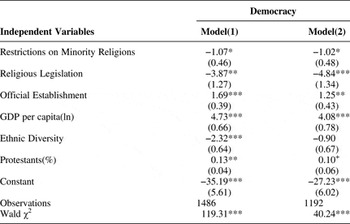
The model is a binary pooled cross-sectional time series with random effects (BTSCS).Footnote 2 Since the dependent variables are dichotomous, I use logistic regression with maximum likelihood estimation. Beck, Katz, and Tucker (Reference Beck, Katz and Tucker1998) pointed out the problems with assuming temporal independence with BTSCS data. Temporally dependent observations can lead to incorrect estimates of the standard errors. Thus, they recommend adding temporal dummy variables for each year. However, based on the results from a standard likelihood ratio test, I concluded that the inclusion of temporal dummy variables was not necessary. The regression results are presented in Table 1.
Logit Analysis of Religion and State Relations, 1990–2002

Note: Standard errors in parentheses.
***p < 0.001, **p < 0.01, *p < 0.05, +p < 0.10 (two tailed).
Dependent Variables
I tested two models with separate dependent variables representing democracy. The dependent variable in the first model was obtained from Cheibub, Gandhi, and Vreeland (Reference Cheibub, Gandhi and Vreeland2009). This is a dichotomous variable with democracies coded “1” and non-democracies coded “0.” The determination of whether a country is a democracy is based on a combination requiring all of the following factors: (1) direct election of the executive; (2) popular election of legislators; (3) participation by multiple parties; (4) the opposition parties have a legitimate chance of winning elections and taking office; and (5) the incumbent's term was not arbitrarily extended without an election during his/her tenure in office. The purpose of the latter three criteria is to identify dictatorships that appear democratic. There are many countries that hold regular popular elections of the executive and legislature, but opposition parties do not have a legitimate chance of winning.
In order to show the results are robust using a different measure of democracy, I include a second model with Polity IV scores as the dependent variable.Footnote 3 The Polity IV measure scores each country on a 21-point scale from −10 to +10 ranging from fully institutionalized autocracies to fully institutionalized democracies. Countries are scored on a 10-point democracy scale based on the following factors: (1) competitiveness of political participation (1–3); (2) competitiveness of executive recruitment (1–2); (3) openness of executive recruitment (1); and (4) constraints on the chief executive (1–4). Autocracy scores are then calculated based on negative versions of the same factors. The two scales are added together and a score ranging from −10 to +10 is assigned to each country. However, I recoded this variable so that scores ranging from −10 to −5 are coded “0” for non-democracy, and scores ranging from +5 to +10 are coded “1” for democracy. I created a dichotomous variable in order to draw a clear distinction between the regime categories for autocracy and democracy.
Independent Variables
The three variables of interest in this article are religious measures obtained from the RAS. The RAS coders scored each country based on human rights reports, academic resources, and media sources. The first independent variable is a measure of the level of restrictions on minority religions. This variable is a proxy for the concept of religious freedom. It measures the degree to which the state permits minority religions to practice their faith without persecution. The ordinal scale taken directly from the RAS is as follows:
0. No (minority) religions are illegal and there are no significant restrictions on minority religions.
1. No (minority) religions are illegal but some or all (minority) religions have practical limitations placed upon them or some religions have benefits not given to others due to some form of official recognition or status not given to all religions.
2. No religions are illegal but some or all (minority) religions have legal limitations placed upon them.
3. Some (minority) religions are illegal.
4. All (minority) religions are illegal.
The second variable of interest is a measure of the level of religious influence over legislation. This variable represents religious pluralism, which entails more than just the absence of persecution. While permitting minority religions to practice freely may promote religious freedom, it does not mean that state policy is representative of the country's religious diversity. The absence of persecution is not the same as the absence of discrimination. Thus, this variable measures the degree to which the state recognizes religious diversity in its legislation. This variable is coded as follows:
1. No religious laws are legislated as law.
2. Most aspects of the law are secular but there are some isolated instances of religious legislation.
3. A substantial portion of the state's laws are religious or state law is based in great part on religious law but is not 100% religious law.
4. State law is religious law.
The third variable tested is a measure of the official relationship between the government and the dominant religion, and therefore, is an overall measure of the separation of church and state. It is coded as follows:
0. Hostile: Hostility and overt prosecution of all religions (e.g., the ex USSR).
1. Inadvertent Insensitivity: There is little distinction between regulation of religious and other types of institutions (e.g., China).
2. Separationist: Official separation of church and state and the state is slightly hostile toward religion (e.g., France).
3. Accommodation: Official separation of church and state and the state has a benevolent or neutral attitude toward religion in general (e.g., The United States).
4. Supportive: The state supports all religions more or less equally.
5. Cooperation: The state falls short of endorsing a particular church but certain churches benefit from state support more than others. (e.g., Austria and Belgium).
6. Civil religion.
7. The state has multiple established religions.
8. The state has one established religion.
Control Variables
I include three control variables in the model which are frequently cited as good predictors of democracy. The first is GDP per capita, which is a measure of economic development.Footnote 4 I logged this variable in order to create a more normal distribution due to the large distance between countries at the upper and lower ends of the distribution. The association between economic development and democracy has been firmly established in the literature, and therefore, it is necessary to control for this relationship.Footnote 5 The Ethnic Diversity variable is a measure of the number of minorities with 5% or more of the population in each country. The assumption is that countries with more fragmentation are less likely to be democratic. The Protestants variable is the percentage of the total population that is Protestant.Footnote 6 In the tradition of Max Weber (Reference Weber and Parsons1930), Protestant cultural values have been associated with capitalism and democracy in Western countries. Since Protestants are concentrated primarily in Europe, North America, and their former colonies, the inclusion of this variable is a way to control for cultural differences between countries that share a common Western culture and the rest of the world.
RESULTS
The results support all three hypotheses. The first hypothesis predicts that an increase in the restrictions on minority religions decreases the probability of democracy. Both models provide empirical support for this proposition. As the coefficients in Table 1 demonstrate, the relationship between minority restrictions and democracy is negative and significant. This finding is important because it is evidence of a relationship between religious freedom and democracy. Societies that suppress minority religions are less likely to be democratic.
The second hypothesis predicts that an increase in religious legislation decreases the probability of democracy. The relationship between religious legislation and democracy is negative and significant in both models indicating that religious pluralism is an important predictor of democracy. Societies that permit the dominant religion to monopolize legislation are less likely to be democratic.
Finally, the third hypothesis predicts that democracies are actually more likely to have an official relationship between church and state, despite having more religious freedom and less religious legislation. The positive and significant relationship between official establishment and democracy in both models confirms this hypothesis. This finding is important because it means that democracies are not free from religious influence. In fact, the opposite is true. Many democracies maintain an official established religion and continue to be influenced by religious institutions.
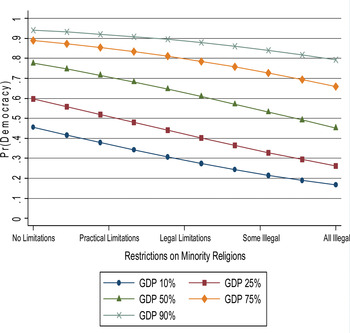
For ease of interpretation, Figures 1 and 2 provide graphic illustrations of the predicted probabilities of democracy based on the first two explanatory variables (Long and Freese Reference Long and Freese2003). Since economic development is the factor most commonly linked to democracy, the levels of gross domestic product (GDP) per capita are included, as well. Figure 1 represents the predicted probabilities of a country being democratic given an increase in the restrictions on minority religions. The five lines represent the different levels of economic development. For example, the lowest line shows the predicted probabilities for the poorest countries in the bottom 10th percentile of GDP per capita, while the top line represents the wealthiest countries in the top 90th percentile. As Figure 1 illustrates, minority restrictions have a substantial impact on countries in all five categories of economic development. However, the impact is greatest among the poorer countries below the 50th percentile. For instance, countries in the 25th percentile have a 60% probability of being democratic when they place no limitations on minority religions; however the probability plummets to less than 30% when minority religions are banned outright. Thus, another important finding from this research is that minority restrictions have a regressive impact on the probabilities of a country being democratic. In other words, the effects are greater in poorer countries.
(Color online) Change in Predicted Probabilities of Democracy as Restrictions on Minority Religions Increase.

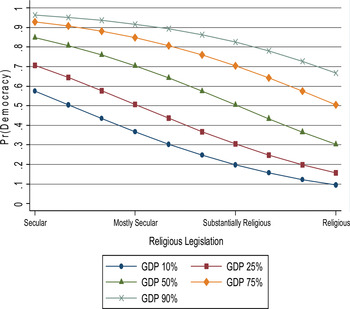
(Color online) Change in Predicted Probabilities of Democracy as Religious Legislation Increases.

Figure 2 paints an even more dramatic picture for the effects of religious legislation. Looking once more at the 25th percentile, the probability of a country being democratic in a secular country is over 70%, but the probability drops to less than 20% in a theocracy. Moreover, comparing the five levels of economic development shows that the impacts are once again regressive with the poorest countries being the most affected.
As expected, there is a significant relationship between GDP per capita and democracy, but as the results from this study demonstrate, when economic development is held constant, the results for the religion variables are significant. This is strong evidence that religious influence has an independent effect on the probability of democracy. Furthermore, Figures 1 and 2 show that the relationship between religion and democracy is important at all levels of development. Thus, these findings have important implications for understanding the differences between democracies and non-democracies that go beyond development.
DISCUSSION
There is a lot of literature focused on the role of economic institutions in promoting development and democracy, but much less attention has been paid to institutions that protect religious freedom and promote religious pluralism. The findings from this research support the idea that democracy emerges from societies that develop institutions that protect minority religions and decrease the amount of religious influence over legislation. These institutions arise from religious competition that produces a stalemate where no one religious group is able to dominate the others.
This is an idea similar to free market economics (Gill Reference Gill1998). The system functions most effectively when there is competition. On the other hand, when a dominant religion is able to form an alliance with the political elite and consolidate power, the result is theocracy and/or authoritarianism. Societies that develop institutions that promote religious pluralism inhibit the formation of this type of alliance.
The regulation of religious competition is no less significant than the regulation of political competition. Social regimes drive political regimes, and religion continues to be the most influential social regime in modern society (Gill Reference Gill1998). Thus, the absence of religious competition is equivalent to the absence of political competition. Authoritarian regimes use the dominant religion as a tool for consolidating power, and suppress minority religions as outlets for dissension.
However, another important implication from this research is that religion is not incompatible with democracy. Despite what the term separation of church and state may denote, democracies are not completely divorced from religious influence. The evidence suggests that quite the opposite is true. Democracies promote official religions and practices, provide public support for religious institutions, and the citizens of democracies are no less religious than their counterparts in non-democracies. Thus, religious societies are capable of establishing and practicing democratic principles.
CONCLUSION
Future research should investigate the relationship between religious pluralism and political stability. There is likely to be a causal relationship between the absence of religious pluralism and levels of violence and political instability. It would also be interesting to look at the relationship between religious institutions and organized interests. How much of an influence does religion have over grass roots politics in democracies? Religious movements like the religious right in the United States may not control policy making at the national level, but they may be the driving force behind politics at the local level.