Introduction
Identifying the factors that are responsible for variation in size of population is a central goal in theoretical and applied ecology, and has important implications for pest management. Among these factors, density-dependent intra-specific competition is considered to be one of the main factors governing population size, mainly due to its effect on life history traits. Numerous studies have shown that intraspecific competition can negatively affect insect development and life history traits (see Applebaum & Heifetz, Reference Applebaum and Heifetz1999 for a review). Juvenile crowding when resources (i.e., water, carbohydrates, mineral nutrients and so on) are limited, causes competition and often results in longer larval development periods, higher larval mortality, and lower pupal masses (Mercer, Reference Mercer1999; Tammaru et al., Reference Tammaru, Ruohomaki and Montola2000; Gibbs et al., Reference Gibbs, Lace, Jones and Moore2004). In addition, larval crowding can profoundly affect female reproduction, especially in capital breeders in which the potential reproductive output is determined by the food quality and quantity during the larval development (Awmack & Leather, Reference Awmack and Leather2002). Therefore, competition for food among larvae can negatively affect female fecundity and survival to adulthood (see Fantinou et al., Reference Fantinou, Perdikis and Stamogiannis2008; Frouz et al., Reference Frouz, Lobinske and Ali2009; Reiskind & Lounibos, Reference Reiskind and Lounibos2009; Tsurim et al., Reference Tsurim, Silberbush, Ovadia, Blaustein and Margalith2013 for examples). Thus, intraspecific competition during the larval period has the potential to reduce the overall fitness of insects.
Many insect species are pests and are responsible for huge annual losses in global crop production (Thacker, Reference Thacker2002). Today, a great arsenal is available to control insect pests but to be effective, substances should target the most susceptible stage to maximize effectiveness and thus minimize the number of applications (Thacker, Reference Thacker2002; Van Driesche et al., Reference Van Driesche, Hoddle and Center2008). Accurate prediction of the insect growth rate and timings of emergence is therefore essential for developing effective pest management strategies and mathematical models greatly help in determining insect emergence dates and population size in order to construct optimal treatment schedules (Li et al., Reference Li, Gao, Ma, Xie and Wang2004; Yonow et al., Reference Yonow, Zalucki, Sutherst, Dominiak, Maywald, Maelzer and Kriticos2004; Moravie et al., Reference Moravie, Davison, Pasquier and Charmillot2006; Georgescu & Morosanu, Reference Georgescu and Morosanu2007; Zhang et al., Reference Zhang, Chen and Nieto2008; Jiao et al., Reference Jiao, Chen and Cai2009; Ainseba et al., Reference Ainseba, Picart and Thiéry2011; Baumann et al., Reference Baumann, Schwappach and Schmidt2013). Models sometimes fail to provide useful predictions for pest management due to the lack of basic knowledge of pest ecology (Shaffer & Gold, Reference Shaffer and Gold1985; Ainseba et al., Reference Ainseba, Picart and Thiéry2011). One of the main challenges of applied ecology is to define the factors that would refine predictions. Hence, current models often neglect some important factors related to juvenile growth because of a lack of data. By considering such factors models could give a better estimate of the period of appearance of the pest and allow determination of an optimal window of treatment. As intraspecific larval competition has the potential to impact the duration of larval development, mortality rate and female fecundity, a better understanding of this effect on pest life history traits might be incorporated into mathematical models to improve our predictive capability.
The European grapevine moth Lobesia botrana (Denis & Schiffermueller) (Lepidoptera: Tortricidae) is the major pest of grapes in Europe, north Africa and west Asia (Bovey, Reference Bovey and Balachowsky1966; Roehrich & Boller, Reference Roehrich, Boller, Van der Gesst and Evenhuis1991; Thiéry, Reference Thiéry and Kreiter2008) owing to its wide geographical distribution and the great damage it can cause to vineyards. L. botrana is a multivoltine tortricid in which wild females can mate several times and lay up to ca. 100 eggs singly on flower buds or berries during their 1–2 weeks lifespan. This polyphagous species is an interesting model to study competition since larvae may experience overcrowding in bunches. For example, up to 25–35 larvae per bunch have been observed in the wild (Thiéry et al., Reference Thiéry, Monceau and Moreau2014; Thiéry & Chuche, unpublished data). Except in pergola training systems, most growers keep limited numbers of bunches on vines and larvae rarely move between bunches so they may have to deal with intraspecific competition (Torres-Vila et al., Reference Torres-Vila, Stockel and Roehrich1995). Lobesia botrana may cause serious damage to bunches either by quantitative or qualitative losses especially by facilitating the infection of pathogenic fungi such as the grey mold disease Botrytis cinerea Persoon: Fries (Leotiales: Sclerotiniaceae, Roehrich & Boller, Reference Roehrich, Boller, Van der Gesst and Evenhuis1991) or black mold Aspergillus spp. (Thiéry, Reference Thiéry and Kreiter2008). Therefore, important economic losses are due to L. botrana and associated fungi (Thiéry, Reference Thiéry and Kreiter2008, Reference Thiéry2011). In insect, pest management programmes aimed at controlling L. botrana, pesticides are used extensively, even though techniques such as mating disruption allow a reduction in their use (Ioriatti et al., Reference Ioriatti, Anfora, Tasin, de Cristofaro, Witzgall and Lucchi2011). For most of the current techniques (mating disruption, Bt or growth regulators), knowledge of population dynamics of the adults or the structure in age of the juvenile instars is fundamental (Ainseba et al., Reference Ainseba, Picart and Thiéry2011). Thus, prediction of larval development and size of population become critical and mathematical models are extensively used (Briolini et al., Reference Briolini, Di Cola and Giliolo1997; Milonas et al., Reference Milonas, Savopoulou-Soultani and Stavridis2001; Moravie et al., Reference Moravie, Davison, Pasquier and Charmillot2006; Ainseba et al., Reference Ainseba, Picart and Thiéry2011; Amo-Salas et al., Reference Amo-Salas, Ortega-López, Harman and Alonso-González2011; Baumann et al., Reference Baumann, Schwappach and Schmidt2013).
The purpose of the present study was to determine whether intraspecific competition occurs during the larval stage in this species and if so, whether larval crowding can impact development rates and adult fitness of L. botrana. With this knowledge, we are able to determine whether intraspecific competition should be incorporated into mathematical models to improve the predictive capability of models. To examine the effect of larval crowding on both developmental and reproductive life history traits, we compared different amounts of larvae on the same food quantity and quality and measured a series of developmental and reproductive traits.
Materials and methods
Study system: moths, their origin and maintenance
The strain of L. botrana (INRA Bordeaux) used for this study originated from over 5000 larvae collected in a French Sauternes vineyard (cultivar sauvignon). This rearing line was based on large numbers of caged adults (several thousands a week) in order to avoid genetic drifts. The stock colony was maintained without diapause on a semi-artificial diet (as described in Thiéry & Moreau, Reference Thiéry and Moreau2005), with the following composition: 150 ml water, 3 g agar, 9 g maize flour, 11 g wheat germ, 9 g yeast, 0.9 g ascorbic acid, 0.3 g benzoic acid, 0.3 ml maize oil, 0.3 g nipagine, and 0.2 g iprodione, at 24±1 °C, 60±10% RH with a light:dark cycle of 16 h light and 8 h of dark. The first 15-photophase hours were at 1000 lux luminosity and the last one (dusk) at 25 lux. All tests were performed under the same conditions.
Larval diet treatments and general procedure
The influence of different levels of larval competition in L. botrana was tested by rearing larvae at four different densities (1, 5, 10 and 20 larvae) on 10 ml of artificial diet (see composition above) in small plastic cups (3.2 cm height, Ø 4 cm) with an aerated cover, treatments referred further as D1, D5, D10 and D20. As compared to grape bunches, artificial food presents the advantage of reducing the chance of secondary effects due to fungal contamination (by B. cinerea and Aspergillus carbonarius or niger, for example), which can occur when larval densities are high. Such fungi may have positive effects on fitness traits (at least demonstrated in B. cinerea) and this would have interfered with our objective (Savopoulou-Soultani & Tzanakakis, Reference Savopoulou-Soultani and Tzanakakis1988; Mondy & Corio-Costet, Reference Mondy and Corio-Costet2000). The number of grouped larvae (from one to 20) for each density treatments were chosen to be congruent with densities observed in the wild (see above). Hatching eggs were collected every 3 h in order to obtain newborns (<3 h old) which were immediately and gently deposited in the different treatments using a fine paint brush. A total of 552 newly hatched larvae (<24 h) were individually allocated at random to the four experimental treatments (D1, D5, D10 and D20, see table 1 for detailed number of replicates). To our knowledge, cannibalism has not been recorded in this species and was not observed during these experiments.
Survival of L. botrana to pupation (larva>pupae), adult eclosion (pupae>adult) and adult sex ratios for larvae reared at different densities on artificial diet. Treatments (larval density) with the same letter are not significantly different (P>0.05) based on 95% CI overlap.

1 N pupae/N larvae.
2 N adults/N pupae.
Larval performance
Larvae from each treatment were monitored once a week until pupation. Pupae were then carefully removed from the diet and weighed to the nearest 0.1 mg. In each treatment, pupal mass was determined in a randomly chosen sub-sample of at least 40 pupae (range: 42–105). As adult moths could not be weighed with enough accuracy, we used the mass of living pupae as an index of adult body size. Pupae were then placed individually in glass tubes (70 mm, Ø 9 mm) covered with a cotton plug and stored in the test room until emergence. Adults were sexed at emergence. We recorded the following variables: (1) probability of reaching pupae (larva>pupae, equivalent to larval mortality), (2) probability of completing metamorphosis (pupae>adult, equivalent to pupae mortality), (3) pupal mass, (4) total development time (larval+pupal) and (5) adult sex ratio.
Adult performance: reproductive life history traits
All newly emerged adults resulting from the different larval densities were used to evaluate the reproductive output of females. Newly (<1-day-old) emerged females were individually confined in 0.5 litre transparent cellophane bags as mating and oviposition chambers and provided with water ad libitum through a soaked cotton dental wick. One- or two-day-old virgin males originating from the same experimental treatment were randomly assigned to virgin females 1 h before dusk, i.e., just before their sexual activity. Females could behave and oviposit freely inside the cellophane bag until death. Each mating bag was checked every morning.
Five variables were considered: (1) the percentage of mated females (female mating success) assessed by the production of fertile eggs (non-mated female lay some infertile eggs at the end of their life), (2) delay before the first egg was laid (days), (3) total achieved fecundity (number of eggs laid), (4) duration of egg laying (days) and (5) longevity of mated females (days).
Statistical analysis
Prior to all statistical analyses, replicates for each treatment were compared to ensure that they were all equivalent. No differences were ever observed and they were thus pooled by treatment. The effect of the density treatments on probability of reaching (larva>pupae) and completing (pupae>adult) metamorphosis as well as the female probability of mating was tested using binomial regression based on likelihood ratio-based χ 2-statistics for unbalanced design (Fox & Weisberg, Reference Fox and Weisberg2011). These probabilities were assorted with their 95% confidence interval (95% CI).
For each treatment, deviation from balanced sex ratio was tested using binomial tests. Then, sex ratios were compared between treatments with χ 2 test. Total development duration, pupal mass, delay before first egg laid, egg laying duration, fecundity (controlled for female pupal mass in using this parameter as a covariate) and mated female longevity were compared between treatments using analysis of variance (ANOVA) (after checking for both normality and homoscedasticity using Shapiro–Wilk and Levene tests, respectively). The model also included a sex effect in interaction with the treatment effect in total development duration and pupal mass analyses to account for potential differences between females and males. In all cases, the statistical significance of each parameter was assessed by F-ratio statistics for unbalanced designs.
All statistical analyses were performed with the R software v. 3.0.1 (R Development Core Team, 2013) implemented car package for likelihood ratio-based χ 2-statistics analysis and F-ratio statistics for unbalanced designs.
Results
Larval development
The reduction in larval viability, which is the probability of reaching the pupal stage differed between treatments (binomial regression: χ 2 3=42.15, P<0.0001). Larval mortality increased with increasing density (table 1). The probability of completing metamorphosis (pupae>adult) slightly differed between treatments according to binomial regression (χ 2 3=8.96, P=0.03). However, all 95% CIs around the probability of reaching adult stage overlapped suggesting no strong differences between treatments (table 1). Adult sex ratio was balanced (binomial tests all P-values >0.15) and did not differ between treatments (Chi square test: χ 2 3=0.46, P=0.93).
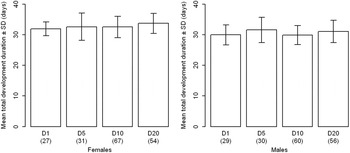
Male development duration was always shorter than female development duration (ANOVA: F 1,346=37.76, P<0.0001) and differed between treatments (F 3,346=3.40, P=0.02, fig. 1) with a similar pattern in both sexes (i.e., no interaction sex×treatment: F 1,346=0.92, P=0.43). Overall, larval development duration was similar in all treatments except between D10 and D20 (fig. 1).
Mean total development duration (larval+pupal) in male and female L. botrana in different treatment (larval density) assorted with standard deviation (SD). The numbers in parentheses indicate number of larvae that reached the adult stage.

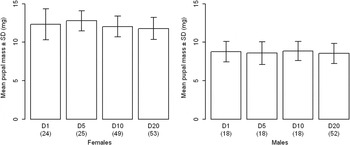
Females were heavier than males in all treatments (ANOVA: F 1,249=350.14, P<0.0001, fig. 2). There were no differences between treatments (F 3,249=2.00, P=0.11) nor interaction between sex and treatment (crowding) (F 3,249=1.30, P=0.27, fig. 2).
Mean mass of male and female L. botrana pupae in different treatment (larval density) assorted with standard deviation (SD).

Reproductive life history traits
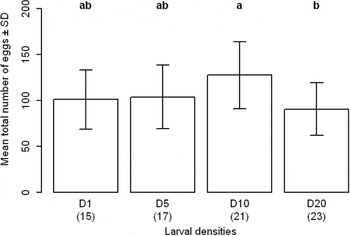
The number of matings did not differ between treatments (binomial regression: χ 2 3=4.74, P=0.19, table 2). The delay to the first egg laid and egg laying duration were not affected by crowding in development (ANOVA: F 3,72=1.18, P=0.32 and: F 3,72=1.64, P=0.19, respectively; table 2). The total number of eggs was not related to females pupal mass (ANOVA: F 1,59=2.60, P=0.11) and varied with crowding (F 3,59=2.86, P=0.04, fig. 3) without interaction with female body mass (F 3,59=2.21, P=0.89). Overall, the number of eggs laid was similar in all treatments except between D10 and D20 (fig. 3). Mated female lived around eight days and this was also not affected by crowding during larval development (ANOVA: F 3,71=1.17, P=0.33; table 2).
Mean total number of eggs laid by female L. botrana reared at different treatments (larval densities) assorted with standard deviation (SD). The numbers in parentheses indicate number of mated females. Treatments (larval densities) with the same letter are not significantly different (P>0.05) based on Tukey HSD tests.

Reproductive life history traits of adult stages according to the treatments. Mating success (i.e., the probability of mating) is assorted with its 95% CI. Mean delay before mating, mean egg laying duration and mean female longevity are assorted with their standard deviation (SD).

1 N female mated/N female tested.
Discussion
The principal finding of this work is that density of L. botrana larvae has little effect on the life history traits of survivors. Thus, the timing of eclosion, the duration of subsequent oviposition and fecundity appear to be more uniform in L. botrana than in other species. The main effect of larval crowding in this work was the strong increase of larval mortality.
Depending on L. botrana population size in vineyards, large numbers of larvae per bunch can occur in the wild. For example up to 25 larvae per bunch have been observed in the wild on Merlot (Thiéry et al., Reference Thiéry, Monceau and Moreau2014) and 35 larvae per bunch on Cabernet sauvignon bunches (Thiéry & Chuche, unpublished data). In this study, we found that the main effect of high intraspecific competition during larval development was a strong mortality but the impact of crowding on the individual fitness was less than expected. This contrasts with effects observed in other species after crowding in the same larval stage (Chippindale et al., Reference Chippindale, Alipaz, Chen and Rose1997, Reference Chippindale, Gibbs, Sheik, Yee, Djawdan, Bradley and Rose1998; Fantinou et al., Reference Fantinou, Perdikis and Stamogiannis2008). Sex ratio and pupal mass were not significantly different between treatments. In addition, larval competition had only a slight effect on reproductive life history traits. Female fecundity was slightly decreased at high density (20 larvae per container) compared to intermediate density (10 larvae), whereas the probability of mating, duration of egg laying and the delay before the first eggs were not affected by density. Finally, the longevity of mated female was not affected by density treatment. This study was conducted under laboratory conditions and obviously further field work is necessary to confirm these results.
For all densities, larval development duration was shorter for males compared to females. Such a protandry is commonly found in fruit Tortricids and several other Lepidoptera (Rodriguez-del-Bosque et al., Reference Rodriguez-del-Bosque, Smith and Browning1989; Wiklund et al., Reference Wiklund, Kaitala, Lindfors and Abenius1993), and is known for L. botrana (Roehrich & Boller, Reference Roehrich, Boller, Van der Gesst and Evenhuis1991; Moreau et al., Reference Moreau, Benrey and Thiéry2006a , Reference Moreau, Benrey and Thiéry b , Reference Moreau, Arruego, Benrey and Thiéry c ; Thiéry et al., 2014). In addition, female pupae were heavier than males, a classical trait in many lepidopteran species (Raven, Reference Raven1961; Slansky & Scriber, Reference Slansky, Scriber, Kerkut and Gilbert1985). By feeding during a longer period, L. botrana females may reach this larger size but in turn, this results in a slower development time (Thiéry & Moreau, Reference Thiéry and Moreau2005; Moreau et al., Reference Moreau, Benrey and Thiéry2006a , Reference Moreau, Arruego, Benrey and Thiéry c ).
The most important effect of intraspecific competition was the decrease of the probability of larval survival with the increasing crowding. Many studies have found that larval densities increase larval mortality and our results are in agreement with this general trend (Hooper et al., Reference Hooper, Sibly, Maund and Hutchinson2003; Ireland & Turner, Reference Ireland and Turner2006; Frouz et al., Reference Frouz, Lobinske and Ali2009). The proximal factors behind this increased mortality were not identified in this study. Cannibalism is not recorded in this species and can be excluded as a main factor. However, aggressive contacts among individuals may increase with higher density and induce more stress. Such stressed larvae may stop feeding, grow more slowly and thus would be increasingly exposed to aggressive encounters. In turn, this could increase the probability of death (see Renshaw et al., Reference Renshaw, Service and Birley1993 for an example). It is also possible that higher larval density increased larval movement to find food or that the ingestion of frass could slow their growth or increase their mortality (Bédhomme et al., Reference Bédhomme, Agnew, Sidobre and Michalakis2005).
Although there was a strong effect on larval survival, the duration of development, pupal mass and reproductive life history traits were not strongly affected by density. We observed slightly prolonged larval development duration and a marginally decreased fecundity at high density (20 larvae per container) compared to intermediate density (10 larvae). Previous studies on insects investigating the role of intra-specific competition do not all reach the same conclusions. In general, strong intraspecific competition during the larval stage has important consequences for larval development and on reproductive life history traits and thus on adult reproductive success (Mercer, Reference Mercer1999; Tammaru et al., Reference Tammaru, Ruohomaki and Montola2000; Gibbs et al., Reference Gibbs, Lace, Jones and Moore2004; Fantinou et al., Reference Fantinou, Perdikis and Stamogiannis2008; Frouz et al., Reference Frouz, Lobinske and Ali2009; Reiskind & Lounibos, Reference Reiskind and Lounibos2009; Tsurim et al., Reference Tsurim, Silberbush, Ovadia, Blaustein and Margalith2013). In L. botrana despite high larval crowding that may have caused a high level of stress as indicated by the mortality at the highest density, the effect of larval competition on developmental and reproductive life history traits is insignificant. The duration of larval development (around 30 days of development) and number of eggs laid (around 100 eggs per female) are similar between the different treatment densities. In addition, the pupal mass of the two sexes considered together was not different between treatments. The absence of a strong difference between larval densities could be explained by larval mortality which was highest at high density and in turn the per capita food available for the survivors could be the same in each treatment especially if larval mortality occurs during the initial phase of development just after larval hatch as observed in Glyptotendipes paripes (Frouz et al., Reference Frouz, Lobinske and Ali2009). Therefore, one may hypothesize a compensatory mortality at high density with the result that more food per capita is available for survivors. Thereby, survivors could reach the same mass as larvae at low densities in contrast to the numerous studies reporting a decrease in adult body size at high density (Renshaw et al., Reference Renshaw, Service and Birley1993; Ireland & Turner, Reference Ireland and Turner2006). In our experimental design, females did not have access to additional food, so resources mobilized for the production of eggs derived from reserves accumulated during the larval stage (Awmack & Leather, Reference Awmack and Leather2002). Previous studies showed that pupal mass is often a good predictor of fecundity in this species (Moreau et al., Reference Moreau, Thiéry, Troussard and Benrey2007). Therefore, the lack of pupal mass reduction is consistent with the minor penalty on reproductive success that we found as a consequence of larval crowding. An alternative explanation is that several dead larvae may be eaten by survivors as extra food. As larval mortality increases with density, the number of available dead bodies would also increase. The occurrence of cannibalism in our model species is probably marginal but necrophagy may have occurred as in other Lepidoptera (see Chapman et al., Reference Chapman, Williams, Escribano, Caballero, Cave and Goulson1999, Reference Chapman, Williams, Martinez, Cisneros, Caballero, Cave and Goulson2000 for example). Therefore, we cannot completely exclude this additional food source in our competition treatments. This latter argument explains faster growth of survival in Chrironomidae (McLachlan, Reference McLachlan1983). In addition, a study on mosquitoes demonstrates that, with larvae under low-food supply, individuals who have the opportunity to cannibalize may survive longer than those which do not, indicating a strong benefit of this behaviour (Church & Sherratt, Reference Church and Sherratt1996). Further experiments should thus consider dead body removal or incorporating larval powder in the basic food to assess the relevance of such hypothesis. Finally, we cannot completely exclude that individual trait variation could have been masked by the high mortality at the higher density and in such context only the best competitors would have reached the adult stage, explaining the absence of difference between treatments.
One of this study's goals was to assess the effect of larval density on the life history traits of L. botrana in order to know if incorporating such factors into mathematical models would improve predictive capability. In the light of our results, it is clear that larval crowding does not fundamentally alter the development time or the reproductive capacity of this pest. Therefore, we believe that this feature does not need to be incorporated into the L. botrana mathematical models, and the effect of larval competition in L. botrana appears lower than the effects of grape cultivars for example (Moreau et al., Reference Moreau, Benrey and Thiéry2006a , Reference Moreau, Benrey and Thiéry b , Reference Moreau, Thiéry, Troussard and Benrey2007; Thiéry et al., Reference Thiéry, Monceau and Moreau2014). Further experiments in natural conditions should confirm such results by considering the number of berries in bunches, the cultivar and also the bunch growth stage which all have been shown to affect the individual fitness.
Acknowledgements
This research was supported by INRA and University of Bourgogne. KM was supported by a post doctoral grant of Région Aquitaine. This research is part of the Labex Cote programme.