Congenital left-to-right shunts, such as patent arterial ducts, are still an important cause of pulmonary vascular disease in the developing world.Reference Butrous, Ghofrani and Grimminger 1 The natural history of large unrestrictive patent arterial ducts shows that, if not closed in infancy, many patients develop pulmonary arterial hypertension and progressive pulmonary vascular occlusive disease by the age of 2 years.Reference Campbell 2 There is, however, a small subset of patients who may not develop pulmonary vascular occlusive disease even by the second and third decade of life.Reference Yu, Huang and Wang 3 – Reference Roy, Juneja and Saxena 5
Haemodynamics of pulmonary blood flow differ in patent arterial ducts from other left-to-right shunts, because in addition to increased pulmonary blood flow due to a large shunt there is additional direct transmission of aortic pressures into the pulmonary vasculature during the systolic as well as the diastolic phase of the cardiac cycle. Both these factors are interlinked and the reversibility of pulmonary hypertension is masked using the conventional invasive assessment tools. As a result, there are no established sensitive or specific haemodynamic parameters for the assessment of the suitability for closure in terms of pulmonary hypertension.Reference Viswanathan and Kumar 4 A contemporary approach for determining the suitability is to consider the reactivity of the pulmonary circulation to pulmonary vasodilators and/or trial occlusion of the patent arterial duct by a balloon or a device.Reference Yu, Huang and Wang 3 – Reference Roy, Juneja and Saxena 5 With refinements in the techniques and the availability of various occluders, transcatheter closure of patent arterial ducts has become increasingly possible in these patients. A good, immediate, and short-term outcome after device closure has been reported in the literature.Reference Thanopoulos, Tsaousis, Djukic, Hakim, Eleftheraskis and Simeunovic 6 – Reference Sadiq, Akram, Butt and Sheikh 11 In the long term, however, if the pulmonary arterial hypertension does not regress, these patients may have symptomatic deterioration and reduced life expectancy after closure, compared with leaving the patent arterial duct alone.Reference Rigby 12 In the absence of cut-off values for various haemodynamic variables to document pulmonary vascular occlusive disease, the management of these patients with large unrestrictive patent arterial ducts becomes a major challenge.
In this study, we aim to determine various pre-occlusion and immediate post-occlusion haemodynamic variables associated with regression of pulmonary hypertension during the long-term follow-up, so that we can identify the subgroup of patients with large unrestrictive patent arterial ducts, who may benefit from patent arterial duct occlusion.
Materials and methods
The present study was carried out at two cardiac tertiary-care hospitals between January, 2002 and December, 2013. The study protocol received approval from the research ethics board from both the hospitals. A total 647 patients undergoing device closure of patent arterial duct were evaluated for inclusion in the study. After obtaining informed consent from patients or their parents, preliminary evaluation was performed, including a detailed history, clinical examination, oxygen saturation ⩾93%, standard 12-lead electrocardiogram, chest X-ray, and transthoracic echocardiogram. Patients with established pulmonary vascular occlusive disease evident by oxygen saturation <93% in room air and absence of cardiomegaly with signs of pruning on chest radiograph were excluded from the study.
Echocardiography assessment
Transthoracic echocardiogram was used to confirm the diagnosis and to assess the degree of pulmonary hypertension. Non-invasive measurement of pulmonary arterial hypertension was based on estimation of pulmonary artery systolic pressure, diastolic pressure, and mean pulmonary artery pressure using tricuspid and pulmonary regurgitant jets, inferior caval vein dimension, as well as transductal Doppler gradient according to the American Society of Echocardiography guidelines.Reference Rudski, Lai and Afilalo 13 Pulmonary arterial hypertension was defined as severe with mean pulmonary artery pressure >55 mmHg and unrestricted transductal flow with diastolic equalisation of Doppler tracing and systolic gradient <20 mmHg. In addition, left and right ventricular dimensions and functions were recorded, and the patent arterial duct was evaluated for suitability for device occlusion.Reference Rudski, Lai and Afilalo 13 In total, 45 (7%) patients over the age of 2 years, having a large unrestrictive patent arterial duct fulfilling the inclusion criteria, were finally selected.
The procedure and the devices
Complete haemodynamic assessment was carried out on all patients under general anaesthesia. Both femoral arterial and venous accesses were obtained. Aortography was performed from the retrograde arterial approach. Various parameters for pulmonary hypertension were assessed in air and with 100% oxygen and balloon occlusion, each for 10 minutes. Angiography was performed in the lateral projection and in some patients also in the right anterior oblique 30° projection. The narrowest point and the ampulla of the duct were measured. The balloon used for trial occlusion was either Tyshak (Numed, Inc., Hopkinton, New York, United States of America) or a sizing balloon (AGA Medical Corporation, Plymouth, Minn, United States of America). Balloon sizing also helped with the exact measurement of the size of the patent arterial duct. Patent arterial duct was classified anatomically as described by Krichenko.Reference Krichenko, Benson, Burrows, Moes, McLaughlin and Freedon 14 Amplatzer Duct Occluder (AGA Medical Corporation, Plymouth, Minneapolis, United States of America), Amplatzer Muscular Ventricular Septal Defect Occluder (AGA Medical Corporation), and Amplatzer Septal Occluder (AGA Medical Corporation) were used to close the duct from the femoral venous approach depending on the shape and size of the duct and the ampulla.
Subgroup of severe pulmonary hypertension based on cardiac catheterisation
A total of 24 patients fulfilled the cardiac catheterisation-based conventional criteria for severe pulmonary hypertension (mean pulmonary artery pressure >55 mmHg). The median age of this subgroup was 8 years (range 2–27 years) with male-to-female ratio of 1:3.
Follow up
Follow up was performed at 1, 3, 6, and 12 months and yearly afterwards. A detailed clinical examination and echocardiography were performed. Pulmonary hypertension was assessed using transthoracic echocardiography. The median follow-up duration was 80 months (range 41–151 months). The mean follow-up in the subgroup with catheterisation-based criteria for severe pulmonary hypertension was 82±28.5 months (range 42–142 months).
Residual pulmonary hypertension was categorised as mild to moderate (right ventricular systolic pressure 36–55 mmHg) and severe (right ventricular systolic pressure>55 mmHg) using tricuspid regurgitant jet velocity and inferior caval vein dimensions.Reference Rudski, Lai and Afilalo 13 In view of inherent inability of echocardiography techniques to estimate severe pulmonary hypertension accurately, four patients with estimated persistent severe pulmonary arterial hypertension underwent repeat cardiac catheterisation.
Statistical analysis
The data were analysed using SPSS version 17. Frequencies were calculated for categorical variables such as gender and anatomical type of the patent arterial duct. Mean±standard deviation, median, and range were calculated for continuous variables including age, weight, and haemodynamic variables under various situations. The Shapiro–Wilk test was applied to test for normal distribution of continuous variables. Independent t-test and the Mann–Whiney U-test were used to determine any significant difference in quantitative variables between various categorical groups. Paired Sample t-test was used to determine any significant difference in haemodynamics following various interventions including 100% oxygen, balloon occlusion, and device occlusion, considering p<0.05 as significant. Univariate analysis was applied to determine any significant association between various haemodynamic parameters and regression in pulmonary hypertension. Multivariate analysis was performed to determine the most significant factors predicting regression in pulmonary hypertension. Receiver operator curve was used to calculate the specificity and sensitivity of these factors using area under the curve. Logistic linear regression model was calculated to determine the predictive frequency of outcome using the defined factors.
Results
In total, 45 patients with large patent arterial duct and severe pulmonary arterial hypertension underwent attempted device closure, which was successful in 43/45 (96%) patients; two patients underwent surgery after failed device closure attempts. The median age was 10 years (range 2–27 years) and the male:female ratio was 1:2.5. The patients had a median weight of 20 kg (range 9–56 kg). The median oxygen saturation in room air was 97% (range 93–99%). The median patent arterial duct size at the narrowest point on angiography was 7.4 mm (range 5.3–17.0 mm).
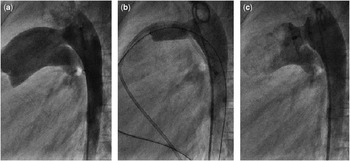
The median fluoroscopy and procedure times were 27 (range 19–105) and 52 minutes (range 30–125), respectively. Amplatzer duct occluder was used in 28 patients (62.2%), muscular ventricular septal defect device in 13 (28.9%), and atrial septal defect device in four (8.9%) patients (Fig 1a–c).
( a ) Aortogram in lateral projection showing a large patent ductus arteriosus (PDA), ( b ) balloon occlusion confirming a large PDA with a waist, ( c ) post-aortogram showing an Amplatzer ventricular septal defect device configured across PDA.

Baseline haemodynamics
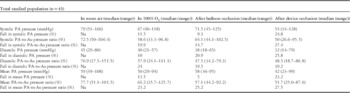
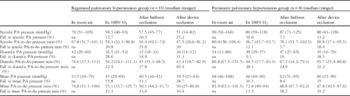
The median pulmonary-to-systemic blood flow ratio and pulmonary vascular resistance index are shown in Table 1. The median pulmonary artery systolic pressure, pulmonary-to-systemic systolic pressure ratio, mean pulmonary artery pressure, and pulmonary-to-systemic mean pressure ratio for the entire group as well as groups with regressed pulmonary arterial hypertension and persistent pulmonary arterial hypertension are summarised in Tables 2 and 3.
Haemodynamic data based on pulmonary vascular resistance index (PVRI) and Qp:Qs.

PH=pulmonary hypertension
Haemodynamic data based on pulmonary artery (PA) pressures.

Ao=aortic
Haemodynamic data based on pulmonary artery (PA) pressures in regressed and persistent pulmonary hypertension groups.

Ao=aortic
Reversibility with 100% oxygen inhalation
Following 100% oxygen inhalation for 10 minutes, the median pulmonary-to-systemic blood flow ratio increased with a drop in vascular resistance index (Table 1). The pulmonary artery systolic pressure decreased from a median of 79 to 67 mmHg (p<0.001), and the pulmonary-to-systemic systolic pressure ratio decreased from 72.5 (range 50.0–106.4%) to 58.6% (range 33.3–96.8%, p<0.001). The mean pulmonary artery pressure decreased from 59 to 50 mmHg (p<0.001), with the pulmonary-to-systemic mean pressure ratio decreasing from 77.7 to 61.2% (p<0.001) following oxygen inhalation (Tables 2 and 3).
Reversibility with balloon occlusion
Following balloon occlusion, pulmonary artery systolic pressure did not show a significant fall, but the pulmonary-to-systemic systolic pressure ratio showed a significant fall in the pulmonary arterial hypertension responsive group (Tables 2 and 3). This, however, was not the case in the persistent pulmonary arterial hypertension group. Pulmonary artery mean pressure showed a similar trend with a significant fall in the pulmonary arterial hypertension responsive group only (Tables 2 and 3). The pulmonary-to-systemic mean pressure ratio for the entire group, however, dropped to 57.1% (p<0.001) following balloon occlusion (ratio decreased by 25% of the original).
Pulmonary hypertension after patent arterial duct device occlusion – immediate follow-up
Following device occlusion, the average pulmonary artery systolic pressure and pulmonary-to-systemic systolic pressure ratio decreased significantly (p<0.001) (Tables 2 and 3). The pulmonary artery mean pressure and pulmonary-to-systemic mean pressure ratio also decreased significantly (p<0.001).
The immediate post-device occlusion decrease in systolic, mean, and diastolic pulmonary artery pressures as well as reduction in pulmonary-to-systemic systolic, mean, and diastolic pressure ratios were significantly more than after 100% oxygen inhalation (p<0.001). All the parameters correlated significantly with post-balloon occlusion measurements (p=0.02–<0.001) with no statistically significant differences (p=0.1–0.98).
Progress during follow-up
At the 24-hour follow-up, pulmonary hypertension regressed completely in 20/43 (46%) patients. At the 6-month follow-up, pulmonary hypertension regressed in 28/43 (65.1%) patients. At the latest follow-up, pulmonary hypertension had regressed completely in 35/43 (77.8%) patients. Mild-to-moderate pulmonary hypertension persisted in four patients (9.3%), with mean right ventricular systolic pressure of 40.1±5.5 mmHg (range 36–55 mmHg), whereas four patients (9.3%) continued to have severe pulmonary hypertension.
Repeat cardiac catheterisation was performed in the latter four patients, at a median follow-up of 53 months (range 24–110), and persistent severe pulmonary arterial hypertension was confirmed in all four patients (Table 4). Pulmonary vascular resistance index in air as well as 100% oxygen did not decrease significantly; the mean follow-up pulmonary vascular resistance index in air was 10.1±0.8 WU m2 (p=0.3). The initial pre-procedure haemodynamic data on these four patients showed an elevated pulmonary vascular resistance index (12.4±1.3 WU m2 in air and 8.6±1.1 WU m2 in oxygen). The decision of closure however, was based on the reduction in pulmonary artery-to-systemic pressure ratio on trial occlusion rather than the absolute value of the pulmonary vascular resistance index.
Haemodynamic data on four patients with persistent severe pulmonary hypertension at initial evaluation and follow-up.

ADO=after device occlusion; Ao=aortic; MVSD=muscular ventricular septal defect; PA=pulmonary artery; PVRI=pulmonary vascular resistance index
Factors associated with regression in pulmonary hypertension
According to univariate analysis, factors significantly associated with the regression of pulmonary hypertension included younger age (p=0.002), lower baseline pulmonary vascular resistance index (p=0.002), pulmonary vascular resistance index after oxygen inhalation (p<0.001), pulmonary artery (systolic, diastolic, and mean) pressures (in air, p=0.005, with oxygen, p=0.002, following balloon occlusion, p=0.007, and after device occlusion, p<0.001). Other variables included higher percentage fall in vascular resistance index with oxygen (p=0.001), pulmonary blood flow-to-systemic blood flow ratio (p=0.008), and pulmonary blood flow-to-systemic blood flow ratio in oxygen (p=0.007).
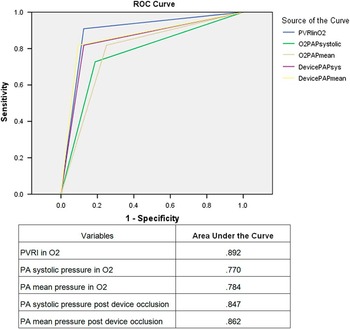
There was also a significant association between regression in pulmonary hypertension and pulmonary-to-systemic pressure ratios (systolic p=0.001, diastolic p=0.003, and mean p=0.007) following device occlusion only. In the rest of the settings for haemodynamic assessment, including ambient air, oxygen, or balloon occlusion, there was no significant association with pulmonary-to-systemic pressure ratio. Percentage fall in pulmonary artery pressures and pulmonary-to-systemic pressure ratios under all settings did not have any significant association with regression of pulmonary hypertension. Multivariate analysis showed that pulmonary vascular resistance index in oxygen ⩽6 WU m2, pulmonary artery systolic pressure in oxygen ⩽75 mmHg, and pulmonary artery mean pressure in oxygen ⩽55 mmHg had the strongest association with regression of pulmonary hypertension (p<0.001). These variables predicted 97.8% of patients with regressed pulmonary hypertension in the long term (receiver operator curve, area under curve 0.89, 0.77 and 0.78, respectively) (Fig 2). Following device closure, pulmonary artery pressures (systolic ⩽65 mmHg and mean ⩽55 mmHg, p<0.001) were associated significantly with regression of pulmonary hypertension. The two parameters predicted 91.9% of patients with regressed pulmonary hypertension (receiver operator curve, area under curve systolic 0.85 and mean 0.86).
Predictive value of various variables for regression of pulmonary arterial hypertension in the long-term follow-up following patent ductus arteriosus occlusion. PA=pulmonary artery; PAP=pulmonary artery pressure; PVRI=pulmonary vascular resistance index; ROC=receiver operator curve.

Analysis of the subgroup of patients with catheterisation-based diagnosis of severe pulmonary hypertension
Pulmonary hypertension regressed in 20/24 (83.3%) patients. Using univariate linear model analysis, regression of pulmonary hypertension was significantly associated with systolic pulmonary artery pressure-to-aortic pressure ratio<75% (p=0.02), >15% fall in systolic pulmonary artery pressure (p=0.02), and >25% fall in systolic pulmonary artery pressure-to-aortic pressure ratio >25% (p=0.04) following balloon occlusion. Other significant variables in the post-balloon occlusion setting included mean pulmonary artery pressure <55 mmHg (p=0.02), >30% fall in mean pulmonary artery pressure (p=0.008), mean pulmonary artery pressure-to-aortic pressure ratio <60% (p=0.02), and >40% fall in mean pulmonary artery pressure-to-aortic pressure ratio (p=0.02).
In the post-device occlusion setting, systolic pulmonary artery pressure <70 mmHg (p=0.03), diastolic pulmonary artery pressure <40 mmHg (p=0.04), mean pulmonary artery pressure <55 mmHg(p=0.03), >25% fall in systolic (p=0.02) and diastolic (p=0.03) pulmonary artery pressures, >15% fall in mean pulmonary artery pressure (p=0.02), systolic, diastolic, and mean pulmonary artery pressure-to-aortic pressure ratio <75% (p=0.004, 0.003, and 0.002, respectively), >15% fall in systolic and diastolic pulmonary artery pressure-to-aortic pressure ratio (p=0.007), and >20% fall in mean pulmonary artery pressure-to-aortic pressure ratio (p=0.02) were significantly associated with regression of pulmonary hypertension.
Using multivariate linear model analysis, regression of pulmonary hypertension was significantly associated only with pulmonary vascular resistance index in oxygen <8 WU m2 (p=0.001) and >25% fall in pulmonary vascular resistance index following oxygen inhalation (p=0.007). None of other variables under baseline conditions, after oxygen inhalation, after balloon occlusion, or after device closure had any significant association with regression of pulmonary hypertension in this subgroup.
Complications
There were no deaths. Procedural failure occurred in two patients; the device embolised to the left pulmonary artery in one patient, who subsequently underwent surgical ligation and retrieval of the device, whereas the device could not be configured in a tubular patent arterial duct and this patient also needed surgical ligation. There was no obstruction caused by device protrusion in the descending aorta in any patient. Mild left pulmonary artery stenosis caused by muscular ventricular septal defect device in two patients has not needed any further intervention. Arterial pulse loss in four patients was managed medically. The other minor complications included local haematoma at the puncture site (n=2), bleeding requiring transfusion (n=1), ventricular tachycardia needing cardioversion (n=1), and supraventricular tachycardia needing treatment (n=2).
Discussion
Large unrestricted patent arterial duct with pulmonary arterial hypertension after 2 years of age is seen more often in the developing world, where the initial diagnosis is likely to be delayed.Reference Butrous, Ghofrani and Grimminger 1 Surgical closure of the patent arterial duct in the older children and adults is associated with an increased risk, as these patients develop calcification and aneurysmal dilatation of the duct with age.Reference Toda, Moriyama, Yamashita, Iguro, Matsumoto and Yotsumoto 15 , Reference Taira and Akita 16 With the development of interventional techniques and availability of various occluders, transcatheter closure of large patent arterial ducts has become increasingly possible with good early results.Reference Thanopoulos, Tsaousis, Djukic, Hakim, Eleftheraskis and Simeunovic 6 – Reference Sadiq, Akram, Butt and Sheikh 11 In this study, we report a series of patients of this subset from a developing country, with a follow-up of up to 12 years, and aim to determine various pre-occlusion and immediate post-occlusion haemodynamic variables associated with regression of pulmonary hypertension during follow-up, so that we can identify the subgroup of patients with large hypertensive patent arterial duct, who would benefit from patent arterial duct occlusion.
Thanopoulos et alReference Thanopoulos, Tsaousis, Djukic, Hakim, Eleftheraskis and Simeunovic 6 initially reported on device closure of seven patients with large patent arterial ducts and pulmonary arterial hypertension. The oldest patient was 12 years old, and all the patients had a significant left-to-right shunt (pulmonary blood flow-to-systemic blood flow ratio ⩾1.9:1). A decrease of >30% in pulmonary artery pressure during balloon occlusion was used as a criterion to close the patent arterial duct, and the pulmonary vascular resistance index was not included among the criteria for closure. On repeat cardiac catheterisation after 1 year, the pulmonary artery pressures continued to decrease in all patients. Zabal et alReference Zabal, García-Montes and Buendía-Hernández 10 reported on 168 patients with isolated patent arterial duct and pulmonary artery systolic pressure ⩾50 mmHg. The pulmonary artery systolic pressure was 63.5±16.2 mmHg, the pulmonary-to-systemic blood flow ratio was 2.7±1.2, and the total pulmonary vascular resistance index was 3.69±2.15 WU m2, indicating a selective group, in whom pulmonary arterial hypertension was often half systemic. At a mean follow-up of 37.1±24 months, a further decrease of the pulmonary artery systolic pressure to 30.1±7.7 mmHg (p<0.0001) occurred. Both groups of patients cannot be compared with groups reporting near-systemic pulmonary artery pressures, as in our series.
Yan et alReference Yan, Zhao and Jiang 8 reported successful occlusion in 20 out of 29 adults with large patent arterial ducts and severe pulmonary arterial hypertension. The majority of these patients had systemic or near-systemic pulmonary artery pressures, as in our series. The criteria to close or not to close were also the same as the ones we have used. Pulmonary vascular resistance, although calculated, was not taken into consideration. In 6/20 patients, pulmonary vascular resistance was >10 WU in air and did not decrease below 10 WU in 4/6 patients. The follow-up was only up to 3–6 months, and one of these patients, in whom the initial pulmonary vascular resistance was >20, showed persistent high pulmonary artery systolic pressure on echocardiography.
The response of the pulmonary vasculature to high pulmonary blood flow in patients with patent arterial duct is variable and unpredictable.Reference Giroud and Jacobs 18 There appears to be a spectrum in the development of pulmonary vascular occlusive disease with a small subset that remains operable until adulthood. In these “borderline” patients, the current protocol, also used in our study, is to measure pulmonary artery pressure in air and after giving a pulmonary vasodilator such as 100% oxygen or nitric oxide. Trial balloon or device occlusion is performed for 10–30 minutes and a patient is categorised as a responder if there is a 25% decrease in pulmonary artery pressure on trial occlusion or a >50% fall in the ratio between pulmonary and aortic diastolic pressures.Reference Roy, Juneja and Saxena 5 – Reference Lee, Leung, Kwong, Kwok, Yip and Chow 9 Those who do not fulfil the above criteria are categorised as non-responders and managed medically. Pulmonary vascular resistance index, although measured, is not included among the criteria for proceeding to duct closure. In our study, although reversibility was significantly more evident in the group with regression of pulmonary arterial hypertension in the long term, it was not an independent predictor. Similarly, although comparative pulmonary artery pressure-to-aortic pressure ratio had significant association with regression of pulmonary hypertension in the post-device closure setting, it was, however, not predictive of favourable outcome in the multivariate analysis.
The assessment has some pitfalls as well. Balloon occlusion may not be complete as the balloon may not stabilise adequately and an occluder may be used to ensure complete occlusion.Reference Lee, Leung, Kwong, Kwok, Yip and Chow 9 Such an approach has cost implications in our setting, as a device would be wasted if the patient turns out to be a non-responder and the device has to be removed. With the availability of various devices and the fact that interventional cardiologists can now close most patent arterial ducts in the catheterisation laboratory,Reference Atiq, Aslam and Kazmi 17 , Reference Giroud and Jacobs 18 it is easy not to strictly adhere to even these guidelines. If there was a decrease of 15 to 20% instead of 25% and with borderline haemodynamics, the decision would often be “to close” rather not to close. This is supported by our results showing variable responses to oxygen inhalation and balloon occlusion, despite being responsive in the long run after duct occlusion.
Although a good immediate-term and short-to-medium-term outcome is reported,Reference Roy, Juneja and Saxena 5 – Reference Sadiq, Akram, Butt and Sheikh 11 the concern is the long-term outcome, because if pulmonary arterial hypertension does not regress these patients may be worse off in terms of symptoms and life expectancy than they would have been without closure.Reference Rigby 12 Viswanathan et alReference Viswanathan and Kumar 4 reported on 21 patients with patent arterial duct and severe pulmonary arterial hypertension by using the above criteria. Of 16 responders, who underwent closure, two (12.5%) continued to have elevated pulmonary artery pressures on follow-up. In our study, pulmonary artery pressure did not decrease in 4/43 (9.7%) patients, during a median follow-up of 80 months (range 41–151), and with one patient being symptomatic as well. This is a major concern in the long term.
The efforts for differentiation of reversible and irreversible pulmonary arterial hypertension in these patients have been ongoing since Heath and Edwards described six grades of pulmonary vascular occlusive disease. A morphometric approach was subsequently proposed, which quantifies and grades from A to C.Reference Rabinovitch, Haworth, Castaneda, Nadas and Reid 19 , Reference Haworth 20 The results of the morphometric analysis of lung biopsy may be predictive of late outcome, but lung biopsy is not practical. The correlation between lung morphology, pulmonary vascular resistance, and outcome in children with CHD is also not always linear.Reference Bush, Bust and Haworth 21 Measurement of the pulmonary vascular resistance index has been the gold standard, and a value of 6–8 WU m2 is widely accepted as a cut-off for operability. An elevated pulmonary vascular resistance >7 WU m2 and age >5 years were important risk factors for death on long-term follow-up over 30 years in patients with ventricular septal defect.Reference Moller, Patton, Varco and Lillehei 22 In our series, all four patients who have continued to have raised pulmonary artery pressures had a raised pulmonary vascular resistance index at initial assessment, and the decision to close the patent arterial duct was based on response to oxygen and trial occlusion. In retrospect, if pulmonary vascular resistance index had been included in the criteria for closure, these patients would have been excluded. On the contrary, however, one patient with high pulmonary vascular resistance index but with response to balloon occlusion has shown normalisation of pulmonary artery pressure on follow-up. Therefore, despite symptomatic relief, long-term normalisation of pulmonary artery pressures is variable and unpredictable. Even among these four patients, patient number 4 in Table 4 who had device closure at 19 years of age showed a persistent decrease in pulmonary artery pressures from 132/55 mmHg (80), which was at systemic level, to 67/30 mmHg (45) after 24 months; one would think that this patient – up to this point – should be considered as a “positive responder” to closure. This illustrates the difficulty of separating “operable” from “inoperable” cases with current assessment techniques.
The assessment of the pulmonary vascular resistance index can also be flawed for various reasons.Reference Viswanathan and Kumar 4 Even if all efforts are made to ensure no sampling or measurement errors, the pulmonary vascular resistance index is often calculated by assuming oxygen consumption, which is less accurate. For patients breathing oxygen, it is crucial to include values for dissolved oxygen in the calculation of resistance to avoid underestimation of the resistance. In addition to the absolute value, response to pulmonary vasodilators has been considered an important clue to assess reactivity of pulmonary circulation.Reference Yu, Huang and Wang 3 , Reference Kannan, Sivasankaran and Tharakan 23 The data on this aspect are also limited by the fact that these studies have looked at the immediate response and post-operative outcome without any data on long-term survival and morbidity or mortality. The role of arterial desaturation at rest and on exercise may well be useful but its role in patients with patent arterial duct has not been investigated.
The role of pulmonary vasodilators in patients with secondary pulmonary arterial hypertension is being investigated. Endothelin-receptor antagonist Bosentan has been approved for patients with idiopathic pulmonary arterial hypertension. Its benefit has been shown in patients with Eisenmenger syndrome with improvement in pulmonary artery pressure, 6-minute walk distance, NYHA class, and oxygen saturation.Reference Galie, Beghetti and Gatzoulis 24 , Reference Maiya, Hislop, Flynn and Haworth 25 Sildenafil, a phosphodiesterase 5 inhibitor, is also being used in patients with Eisenmenger syndrome and has been shown to decrease pulmonary artery pressure.Reference Singh, Rohit and Grover 26 , Reference Humpl, Reyes, Holtby, Stephens and Adatia 27 Despite symptomatic improvement, there are no data to support their role in long-term potential reversibility of pulmonary vascular occlusive disease. We have used these agents routinely in the latter part of the study both before and after intervention.
A comprehensive assessment taking into consideration the clinical evaluation, radiological and electrocardiographic findings, echocardiography, and exercise testing with pulse oximetry or arterial blood gas should be performed before cardiac catheterisation. It is evident from our study that pulmonary vascular resistance index in oxygen ⩽6 WU m2, pulmonary artery systolic pressure in oxygen⩽75 mmHg, and pulmonary artery mean pressure in oxygen ⩽55 mmHg have the strongest association with regression of pulmonary hypertension (p<0.001). These variables predicted 97.8% of patients with regressed pulmonary hypertension in our series. Systolic pulmonary artery pressure <65 mmHg and mean pulmonary artery pressure <55 mmHg, p<0.001) following device closure, were significantly associated with regression of pulmonary hypertension on follow-up assessment.
The two parameters together predicted 91.9% of patients with regressed pulmonary hypertension.
Study limitations
The measurement of pulmonary vascular resistance has been performed by assuming oxygen consumption, which can be a source of error.Reference Wilkinson 28 We used LaFarge and Miettinen equation, which has been shown to produce the closest estimation.Reference Rutledge, Bush and Shekerdemian 29 These predictive equations do not accurately estimate oxygen consumption in patients with CHD. As all children in our study were >2 years of age, the concern about its poor correlation in children <3 years of age would not be a significant issue.Reference Rutledge, Bush and Shekerdemian 29
Although there is no evidence-based guideline for selection of vasodilators, ACCF/AHA 2009 Expert Consensus Document on Pulmonary Hypertension states that inhaled Nitric oxide is the preferred vasodilator, whereas intravenous Epoprostenol and intravenous adenosine are acceptable alternatives.Reference McLaughlin, Archer and Badesch 30 Nitric oxide testing, although important, was not used to check acute vasoreactivity. This was due to its non-availability because of resource limitations.
Follow-up cardiac catheterisation has only been performed on patients with evidence of severe pulmonary arterial hypertension. The decision was supported by studies showing good correlation of right ventricular systolic pressure calculated through tricuspid regurgitant jet.Reference Groh, Levy and Holland 31 As higher values correlated poorly, only the patients with right ventricular systolic pressure >55 mmHg were re-catheterised. The sample size in the present study was small and further larger multicentre studies are required to confirm these findings.
Conclusion
Device closure of large patent arterial duct and severe pulmonary arterial hypertension with selective use of various Amplatzer devices is safe and effective. Although symptomatic improvement occurs in all, pulmonary arterial hypertension may not regress in all patients. In addition to more diligent non-invasive assessment and direct measurement of pulmonary artery pressure, an accurate measurement of pulmonary vascular resistance index may help further exclusion of borderline patients. Systolic and mean pulmonary artery pressure and pulmonary vascular resistance index in oxygen are the most important prognostic variables associated with regression of pulmonary arterial hypertension.
Acknowledgement
We acknowledge the catheterization laboratory team of both hospitals involved in the procedural management of the patients enrolled in our study.
Financial Support
This research received no specific grant from any funding agency, commercial, or not-for-profit sectors.
Conflicts of Interest
None.
Ethical Standards
The authors assert that all procedures contributing to this work comply with the ethical standards of the national guidelines on human experimentation in Pakistan and with the Helsinki Declaration of 1975, as revised in 2008, and has been approved by the Ethical review committees of Children’s Hospital and Punjab Institute of Cardiology, Lahore, Pakistan.