Implication
Feeding strategies promoting solid feed consumption would benefit the performance and health of calves kept in cold temperatures. Adding water to a dry texturized starter diet with 10% chopped alfalfa hay during winter increased feed intake during the first weeks of life, improved growth rate during the pre-weaning period and elevated concentration of volatile fatty acids (VFA) in the rumen, which is indicative of a metabolically more developed rumen fermentation.
Introduction
Cold stress is associated with impaired calf performance and thus significant economic losses to calf industry (Nonnecke et al., Reference Nonnecke, Foote, Miller, Fowler, Johnson and Horst2009; Roland et al., Reference Roland, Drillich, Klein-Jöbstl and Iwersen2016). Calves raised below their thermoneutral zone tend to consume more feed. However, meeting nutritional needs of the neonatal calves under this condition is difficult, because a large proportion of feed energy is directed toward metabolic heat production to maintain the increased requirements for thermoregulation (thermal balance). Therefore, less energy will be available to support growth (National Research Council (NRC), 2001; Drackley, Reference Drackley2008; Roland et al., Reference Roland, Drillich, Klein-Jöbstl and Iwersen2016). For example, Scibilia et al. (Reference Scibilia, Muller, Kensinger, Sweeney and Shellenberger1987) reported that calves kept at –4°C required 32% more energy for maintenance than those housed at 10°C. Moreover, high energy requirements relative to BW and immature cold defense mechanisms exacerbate the adverse effects of cold stress on young calf performance (Gonzalez-Jimenez and Blaxter, Reference Gonzalez-Jimenez and Blaxter1962). These imply that feeding strategies encouraging more liquid or solid feed consumption would alleviate the negative effects of cold stress on growth efficiency and health of young calves (NRC, 2001; Nonnecke et al., Reference Nonnecke, Foote, Miller, Fowler, Johnson and Horst2009).
Very recently, we found that a wet texturized starter diet (50% dry matter (DM)) significantly improved solid feed intake and growth efficiency of young calves reared under high ambient temperature (Beiranvand et al., Reference Beiranvand, Khani, Omidian, Ariana, Rezvani and Ghaffari2016). These positive responses were attributed to the increased adhesiveness of the starter diet that reduced the dustiness and aggregated the smaller particles which made the starter feed more palatable and enhanced intake. To our knowledge no evidence exists how DM content of starter diet would affect calf performance during the cold months of winter, leading to the hypothesis that a wet starter diet would increase solid feed consumption and provide a more uniform supply of nutrients, thus leading to more energy being available for calf growth during cold stress. Therefore, the objective of this investigation was to examine feed intake, growth efficiency, ruminal VFA pattern and feed sorting behavior of young calves receiving starter diets with different DM content during the cold winter months.
Material and methods
Calves, treatments and management
The experiment was implemented at the FKA Agri-Animal Production Co. (Isfahan, Iran). The study took place from December 2014 to February 2015, when average ambient temperature (outside the barn) was 2.1°C. Mean values for wind velocity, and minimum and maximum relative humidity were 1.46 m/s, 36.1%, and 77.7%, respectively, according to the daily official microclimatic reports of the Meteorological Network Station at Najaf-Abad (Isfahan, Iran).
A detailed description of calf management and measurements is provided in our previous paper (Beiranvand et al., Reference Beiranvand, Khani, Omidian, Ariana, Rezvani and Ghaffari2016). In brief, 45 male Holstein calves were selected for the study. Calves were separated at birth from their mothers, weighed and housed in individual pens (1.5×2.5 m) that were bedded with sawdust and replenished every 2 or 3 days. The calves were fed colostrum (at least 4 l) within 2 to 6 h after birth. The calves at day 3 of age (43.4±3.4 kg of BW) were distributed at random to one of three starter diets that were identical in ingredient and nutrient composition but differed in moisture content as follows: (1) 90% DM (DM90, control), (2) 75% DM (DM75) and (3) 50% DM (DM50). Calf starter diet was formulated to meet or exceed the recommendations of the NRC (2001). The starter diet comprised 55.1% ground ingredients (soybean meal, barley and corn gluten meal), 21.9% whole corn, 10% rolled barley and 10% chopped alfalfa hay (Table 1). The calves were fed pasteurized waste milk (38±0.5°C) at the rate of 10% of their initial BW, twice daily in equal amounts at 0800 and 1600 h until day 45. From day 45, the milk quantity decreased to the half amount and was offered only in the morning. Weaning occurred at day 50. The milk was analyzed for fat (3.46±0.09%), CP (2.62±0.05%) and lactose (4.76±0.07%) using an automated near-IR spectroscopy analyzer (Milkoscan 134 BN Foss Electric, Hillerød, Denmark). The calves had free access to the starter diet and water (via a nipple) throughout the trial (70 days). Health of the calves was monitored daily and ill calves were treated in accordance with the standard protocols established by the herd veterinarian. None of the calves were removed from the study.
Ingredients and chemical composition of the calf starter diet

DM=dry matter.
1 The particle size distribution of the chopped alfalfa as determined using the Penn State Particle Separator (Kononoff et al., Reference Kononoff, Heinrichs and Buckmaster2003) was as follows: 1% greater than 18 mm, 17% between 8 and 18 mm, 41% between 1.18 and 8 mm and 41% less than 1.18 mm. The geometric mean particle size of chopped alfalfa hay was 2.6 mm, as calculated according to the American National Standards Institute (ASAE, 1995; method S424.1).
2 Contained per kilogram of supplement: 250 000 IU of vitamin A, 50 000 IU of vitamin D, 1500 IU of vitamin E, 2.25 g of Mn, 120 g of Ca, 7.7 g of Zn, 20 g of P, 20.5 g of Mg, 186 g of Na, 1.25 g of Fe, 3 g of S, 14 mg of Co, 1.25 g of Cu, 56 mg of I and 10 mg of Se.
3 Calculated using NRC (2001) equations.
4 Calculated according to the ASAE (1995; method S424.1).
Sample collection and measurements
The amount of starter feed offered and refused (collected daily before delivery of fresh starter diet in the morning) were weighed daily for each calf to determine individual starter DM intake. Calves were weighed at the trial initiation and then every 10 days over the course of the experiment. Body measurements including heart girth, hip width, body barrel and body length were made on days 1 (initial), 50 (weaning) and 70 (end of study). Ruminal contents were sampled about 3 h after the morning feeding using a stomach tube on days 70 of the experiment, with subsequent pH measurement (HI 8314 membrane pH meter; Hanna Instruments, Villafranca, Italy). Then, the ruminal contents were squeezed through four layers of cheesecloth and 10-ml aliquots were acidified with 2 ml of 25% (wt/vol) meta-phosphoric acid and stored at –20°C until analyzed for VFA. Calf behavior was recorded on pre- (day 35) and post-weaning (day 70) periods by the researchers who recorded the occurrence of standing, ruminating, eating starter feed, laying and non-nutritive oral behavior. Calf behavior (10 calves per treatment) in each period was recorded for 15 h, beginning after the morning feeding (at 0800 h). Selection (sorting) for or against the different particle sizes of starter diet was determined on the last 3 consecutive days of experiment (days 68 to 70) as the proportion of particle-size fraction of starter diet offered and that of remained ort after 24 h access to starter feed. Samples of starter feed and ort were separated using the 4-screen (2, 1.18, 0.5, and 0.125 mm) particle separator (Automatic Sieve Shaker, M. 120; Techno Khak, Khavaran, Tehran, Iran) into 5 fractions as described by Nasrollahi et al. (Reference Nasrollahi, Khorvash, Ghorbani, Teimouri-Yansari, Zali and Zebeli2012). Dry matter content of each fraction was determined by oven drying (55°C for 48 h).
Laboratory analysis
Starter feed and refusals were mixed thoroughly and ground to pass a 1-mm screen in a Wiley mill. Next, ground samples were analyzed in triplicate for DM, CP (N×6.25), ether extract and crude ash contents, according to the standard procedures of the Association of Official Analytical Chemists (1990). Neutral-detergent fiber and ADF, both exclusive of residual ash, were determined according to Van Soest et al. (Reference Van Soest, Robertson and Lewis1991). Thermostable α-amylase (100 μl/0.50 g of sample; number A3306; Sigma Chemical Co., St. Louis, MO, USA) was included in the NDF procedure. The individual VFA molar concentrations in the rumen fluid were quantified with a gas chromatograph (model CP-9002; Chrompack, Middelburg, The Netherlands) as described by Beiranvand et al. (Reference Beiranvand, Khani, Omidian, Ariana, Rezvani and Ghaffari2016). Peaks were separated using a 50 m×0.32 mm×0.30 μm fused silica capillary column (CP-Wax Chrompack Capillary Column, Delft, The Netherlands).
Data analysis
All data were analyzed as a completely randomized design using the Proc Mixed in SAS (SAS Institute, 2002). Starter feed intake, average daily gain (ADG), and feed efficiency were classified in three categories and analyzed separately for: (1) pre-weaning (days 1 to 50), (2) post-weaning (days 51 to 70) and (3) overall (days 1 to 70) periods. The data obtained over time within the same calf (starter feed intake and growth measurements; every 10 days) were analyzed using the repeated-measures approach, where time of measurement and treatment-by-time interactions were included in the model as fixed effects. Four covariance structures were tested (i.e. first-order autoregressive, Toeplitz, compound symmetric and unstructured), and the covariance structure that provided the smallest Bayesian information criterion fit statistics was used to model the error term for random effects of repeated measurements. Rumen fermentation, skeletal growth measurements, and behaviors were analyzed using the above model excluding the effect of time and its interaction with treatment. Birth weight and weaning weight were included in the model as covariates for the pre- and post-weaning performance measurements (starter feed intake, ADG and feed efficiency), respectively. Initial skeletal growth variables were considered as covariates in the model for skeletal growth measurements (days 50 and 70). To test for the sorting occurrence of starter diets, the sorting values for each particle size fraction were first subtracted from 100, and then analyzed (Miller-Cushon et al., Reference Miller-Cushon, Bergeron, Leslie, Mason and DeVries2013). For a pre-planned comparison of treatment means, P-values were specified for (1) DM90 v. the average of DM75 and DM50, and (2) the linear and quadratic effects of adding water to the starter diet using the Contrast statement of SAS. The difference between least-squares means was identified using the PDIFF option of SAS with the Tukey adjustment. Significant treatment differences were noted at a probability of P⩽0.05 and trends were considered at 0.05<P⩽0.10.
Results and discussion
Climatic conditions
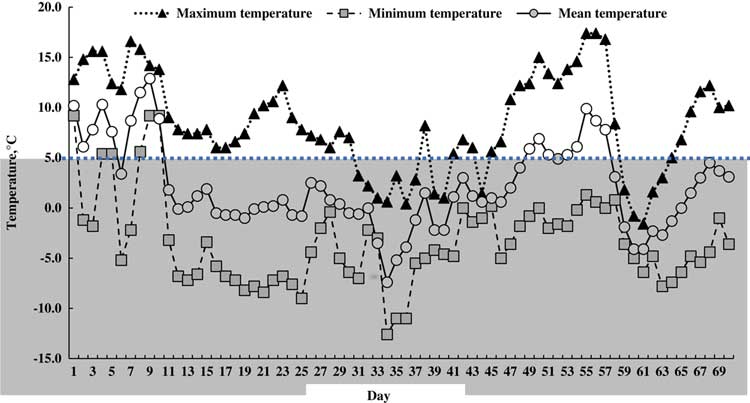
Ambient temperature during the experiment averaged 2.1°C and ranged from –7.4 to 12.9°C (Figure 1). This indicates that calves experienced a high degree of cold stress because the lower critical temperature for a newborn calf (less than 3 weeks of age) ranges from 15 to 25°C (Arieli et al., Reference Arieli, Schrama, Van der Hel and Verstegen1995), which then declines to near 5°C as calf age advances beyond 21 days (Drackley, Reference Drackley2008). When ambient temperature drops below the thermoneutral zone, the calf metabolic rate is increased to generate heat and maintain homeothermy, thereby increasing the maintenance requirement (NRC, 2001). In general, the larger surface area to body mass ratio as well as the underdeveloped heat conservation mechanisms (i.e. low proportion of subcutaneous fat and thin skin) contribute considerably to body heat loss in neonatal calves, thereby increasing their susceptibility to the adverse effects of cold exposure (Litherland et al., Reference Litherland, Da Silva, LaBerge, Schefers and Kertz2014). This indicates that strategies stimulating more starter feed intake in young calves exposed to cold may have positive effects on cold tolerance and provide more energy being available to support growth (NRC, 2001; Drackley, Reference Drackley2008).
Mean, minimum, and maximum daily temperature over the 70-day experiment.

Starter feed intake and growth performance
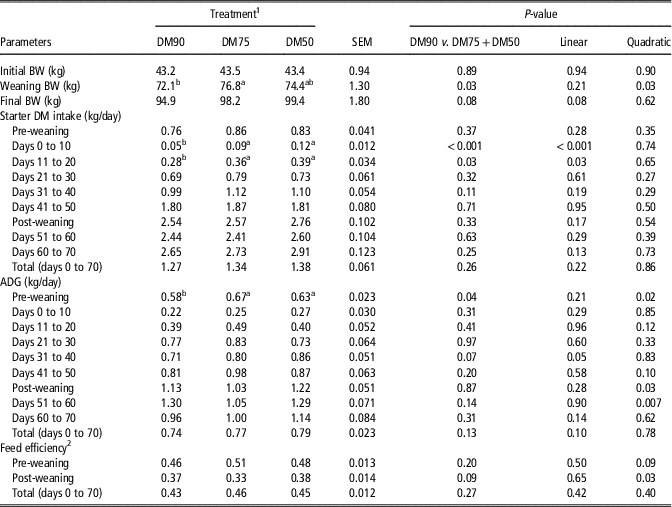
Least-squares means of BW (initial, weaning and final), starter feed intake, ADG and feed efficiency, calculated for pre-weaning (days 1 to 50), post-weaning (days 51 to 70) and overall (days 1 to 70) periods, are provided in Table 2. Initial calf BW averaged 43.4±3.4 kg and was not different (P=0.98) across treatments. Weaning weight was quadratically (P=0.03) affected and calves fed the DM75 diet weighed heavier than control calves (76.8 v. 72.1 kg). Final calf BW (d 70) tended to increase linearly (P=0.08) with increasing water content. We found a linear increase (P⩽0.03) in starter feed intake from day 1 through 20 of the experiment, but this effect disappeared thereafter. Mean starter feed intake and BW were unaffected by treatment but increased with calf age (P<0.001) during the experiment (70 days; Supplemental Figure S1). Increasing moisture content of starter diets had a quadratic effect (P⩽0.03) on pre- and post-weaning ADG; the calves consuming DM75 diet recorded the greatest ADG during the pre-weaning period (0.67 kg/day; P=0.02) whereas they had the lowest ADG during the post-weaning period (1.03 kg/day; P=0.03). Feed efficiency during the pre-weaning period tended to be greatest for the calves receiving DM75 diet (P=0.09 for quadratic effect), whereas the opposite trend was observed during the post-weaning period (P=0.03 for quadratic effect) causing the overall feed efficiency being unaffected (P=0.40) by the treatments. In support, Beiranvand et al. (Reference Beiranvand, Khani, Omidian, Ariana, Rezvani and Ghaffari2016) added water to a dry texturized starter diet (with the same composition and physical form as offered in this experiment) and found that weaning and final BW increased linearly as the DM content of the calf starter diet decreased to 50%.
Effect of adding water to dry starter diet on intake, average daily gain (ADG) and feed efficiency of Holstein calves (n=15 per treatment)

a,bLeast square means within a row with different superscripts differ (P<0.05).
1 DM90, DM75 and DM50 are starter diets with 90%, 75% and 50% dry matter (DM) content, respectively.
2 Calculated as kilogram of BW gain/kg of total DM intake.
The literature is inconsistent with regard to the effects of moisture level in the diet when fed to ruminants. Recently, our research team found that increasing the moisture content of a texturized starter diet linearly increased pre-weaning and overall starter feed intake. The authors suggested that the addition of water to a dry starter diet decreased the dustiness and aggregated the smaller particles which improved palatability and enhanced starter diet consumption (Beiranvand et al., Reference Beiranvand, Khani, Omidian, Ariana, Rezvani and Ghaffari2016). Lahr et al. (Reference Lahr, Otterby, Johnson, Linn and Lundquist1983) also found that high-moisture complete diets improved texture and diluted undesirable flavors, which contributed to the increased diet palatability in dairy cows. In contrast, Khan et al. (Reference Khan, Bach, Castells, Weary and von Keyserlingk2014) found that heifers receiving a dry ration (65% DM) tended to consume more feed DM than those fed the moderate (50% DM) and wet (35% DM) rations. Lee et al. (Reference Lee, Kim, Oh and Kwak2010) reported that feeding steers with a wet total mixed ration (TMR; 59% DM) increased rumination and chewing efficiency as compared with a dry ration (89% DM), which contributed to the improvements in ruminal environment and animal productivity. However, in a study with dairy cows, Felton and DeVries (Reference Felton and DeVries2010) demonstrated that a wetter TMR (44.1% DM), as compared with a less wet TMR (50.8% to 56.3% DM), increased sorting against long particles and decreased intake of DM, starch and NDF. The reduction of the diet DM level below 45% increases bulk of feed (caused by non-expressible water), which is associated with increased rumen fill, and thus declined DM intake (Robinson et al., Reference Robinson, Burgess and McQueen1990; Miller-Cushon and DeVries, Reference Miller-Cushon and DeVries2010). This may help to explain the discrepancies in DM intake of animals in response to high-moisture diets.
In comparison to the starter feed intake by calves raised under high ambient temperature (Beiranvand et al., Reference Beiranvand, Khani, Omidian, Ariana, Rezvani and Ghaffari2016), calves in the present study consumed on average 240 g DM/day more starter feed. This difference might be explained by the high surface to mass ratio and poor insulation of young calves, contributing considerably to the heat loss during the cold ambient temperatures that cannot be compensated by the heat production from ruminal fermentation (Berman, Reference Berman2003). This encourages preruminant calf to supply more energy via increased feed intake because in cold ambient temperature a greater proportion of feed energy is directed towards heat production to maintain core body temperature (Nonnecke et al., Reference Nonnecke, Foote, Miller, Fowler, Johnson and Horst2009; Roland et al., Reference Roland, Drillich, Klein-Jöbstl and Iwersen2016).
The ADG during the pre-weaning and total experimental period was comparable with the ADG reported by Beiranvand et al. (Reference Beiranvand, Khani, Omidian, Ariana, Rezvani and Ghaffari2016) in the summer. This observation was unexpected, because although calves in both experiments received similar starter diets and were reared under the same calf management conditions, in our previous study (Beiranvand et al., Reference Beiranvand, Khani, Omidian, Ariana, Rezvani and Ghaffari2016) calves experienced an excessive heat load compared with calves in the present experiment which were kept in a very low ambient temperature (average 2.6°C). In agreement, Nonnecke et al. (Reference Nonnecke, Foote, Miller, Fowler, Johnson and Horst2009) reported that calves raised in cold (average temperature 5°C) and warm (average temperature 15°C) environments exhibited similar growth rate, which was linked to the increased intake of concentrate feed by cold-stressed calves.
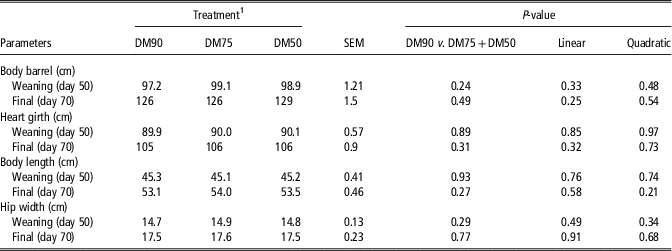
Least-squares means for weaning (day 50) and final (day 70) measurements of body barrel, heart girth, body length and hip width are presented in Table 3. None of the skeletal growth measurements were affected (P⩾0.21) by the moisture content of the starter diets, which is possibly caused by the minimal differences in starter feed intake (weaning and final) among treatments. In agreement, Beiranvand et al. (Reference Beiranvand, Khani, Omidian, Ariana, Rezvani and Ghaffari2016) detected no difference in heart girth and hip width among calves receiving starter diets with different moisture content during hot ambient temperature.
Effect of adding water to dry starter diet on skeletal growth measurements of Holstein calves (n=15 per treatment)

1 DM90, DM75 and DM50 are starter diets with 90%, 75% and 50% dry matter (DM) content, respectively.
Ruminal pH and volatile fatty acids
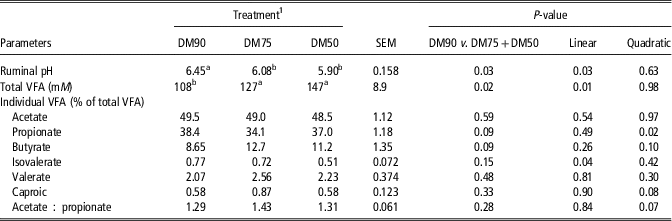
Ruminal pH and VFA patterns are given in Table 4. The ruminal pH of calves fed DM90 diet was 6.45 and declined linearly to 5.90 (P=0.03) as the moisture level of starter diet increased. Total ruminal VFA concentration increased linearly (P⩽0.05) as the moisture content of starter diet increased. Molar percentage of isovalerate decreased linearly as the moisture content of starter diet increased. A quadratic relationship was seen in the molar percentage of propionate (P=0.02) and acetate : propionate (P=0.07), with the lowest and greatest values observed in calves consuming DM75 diet, respectively.
Effect of adding water to dry starter diet on rumen pH, total volatile fatty acids (VFA) and molar percentage of individual VFA of Holstein calves (n=15 per treatment)

a,bLeast square means within a row with different superscripts differ (P<0.05).
1 DM90, DM75 and DM50 are starter diets with 90%, 75% and 50% dry matter (DM) content, respectively.
The lower rumen pH in calves offered high-moisture starter diets can be explained by the greater total VFA production (acid load), which possibly exceeded the capacity of absorption for VFA from the rumen (Dijkstra et al., Reference Dijkstra, Boer, Van Bruchem, Bruining and Tamminga1993). The numerical greater starter feed consumption in calves fed high-moisture starter diets in the days immediately before rumen fluid sampling (i.e. days 60 to 70; Table 2), can partially help to explain the greater VFA production in calves fed wet starter diets. Moreover, calves consumed more starter feed during the pre-weaning period, which possibly promoted the rumen-reticulum development and establishment of ruminal fermentation that facilitates the microbial fermentation of organic matter in the rumen and thus greater VFA production (Baldwin et al., Reference Baldwin, McLeod, Klotz and Heitmann2004; Sweeney et al., Reference Sweeney, Rushen, Weary and De Passillé2010). Propionate and butyrate are known to have strong stimulatory effects on papillae development in the rumen (Garnsworthy, Reference Garnsworthy2005) because their metabolism in the rumen epithelium stimulates blood flow through the rumen, and thus directly influences gene expression within the rumen (Baldwin et al., Reference Baldwin, McLeod, Klotz and Heitmann2004). This may imply that the consumption of high-moisture starter diet possibly promoted the development of ruminal epithelium. In agreement, Beiranvand et al. (Reference Beiranvand, Khani, Omidian, Ariana, Rezvani and Ghaffari2016) found that the total ruminal VFA concentration and molar proportions of acetate and propionate increased linearly as the DM content of starter diets decreased. That observation was explained by the increased intake of the starter feed. Conversely, studies with dairy cows indicated that moisture content of diets did not affect rumen fermentation characteristics; Leonardi et al. (Reference Leonardi, Giannico and Armentano2005) reported that reducing the DM content of TMR from 80% to 64% had no effect on ruminal pH and VFA concentrations in dairy cows. Similarly, Robinson et al. (Reference Robinson, Burgess and McQueen1990) also found that moisture content of the mixed diet (DM contents of 65%, 45% and 35%) did not affect total VFA and molar proportions of major VFA.
Calf behavior and sorting activity
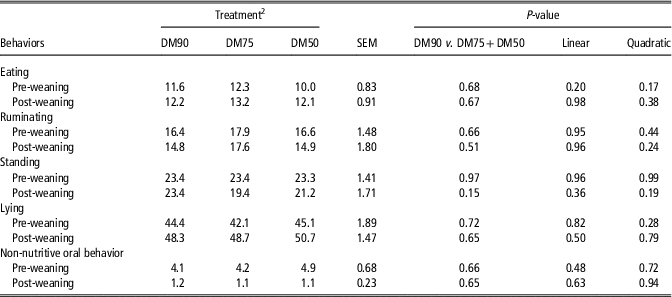
The effect of adding water to a dry starter diet on the nutritional behavior of calves is reported in Table 5. Average time devoted to eating, ruminating, standing, lying and non-nutritive oral behavior did not differ (P⩾0.10) across treatments, which is consistent with our previous observations (Beiranvand et al., Reference Beiranvand, Khani, Omidian, Ariana, Rezvani and Ghaffari2016). In this study, calves devoted the largest proportion of their time to laying, on average 43.9% and 49.2% (as a proportion of total activities) in pre- (day 35) and post-weaning (day 70) periods, respectively. This was anticipated as laying behavior is believed to conserve heat and diminish critical temperature in calves raised in the cold environment (Roland et al., Reference Roland, Drillich, Klein-Jöbstl and Iwersen2016).
Effect of adding water to dry starter diet on time that calves devoted to different behavioral activities during the 15 h of observation in pre- and post-weaning periodsFootnote 1 (n=10 per treatment)

Values (%) represent the time devoted to each behavior as a proportion of total activities.
1 Pre-weaning =35 days of age; post-weaning = 70 days of age.
2 DM90, DM75 and DM50 are starter diets with 90%, 75% and 50% dry matter (DM) content, respectively.
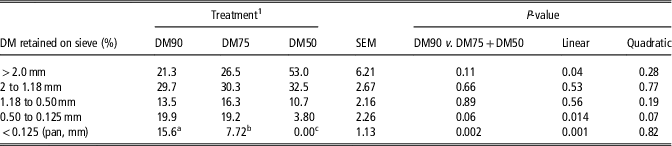
Adding water to the dry starter diet up to 50% considerably affected particle size distribution leading to a greater proportion of DM being retained on 2.0-mm screen (top), a lower proportion of DM on the 0.125-mm screen, and the complete disappearance of fine particles (<0.125 mm) relative to DM90 and DM75 diets (Table 6). The amount of DM retained on the second (1.18 mm) and third (0.50 mm) screen was not substantially influenced by the addition of water to calf starter diet and averaged 30.8% and 13.5%, respectively. Similarly, decreasing the DM content of a TMR led to a decrease in the fine particle fraction due to being bound to the large particles (Felton and Devries, Reference Felton and DeVries2010; Miller-Cushon and Devries, Reference Miller-Cushon and DeVries2010).
Particle-size distribution of starter diets (mean ± SD; n=5 per treatment)

a,b,cLeast square means within a row with different superscripts differ (P<0.05).
1 DM90, DM75 and DM50 are starter diets with 90%, 75% and 50% dry matter (DM) content, respectively.
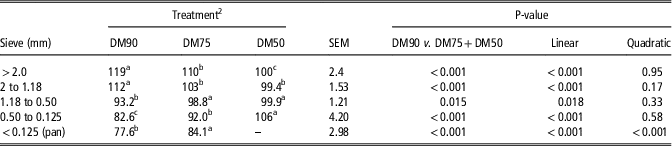
Sorting measurements of starter diet in weaned calves (day 70) are presented in Table 7. The extent of preferential consumption for long (>2 mm) and medium (2.0 to 1.18 mm) particles decreased (P<0.001) as moisture content of the starter diet increased. For example, calves offered the DM90 diet consumed on average 119% and 112% of the predicted intake for the long and medium particles respectively, whereas calves fed the DM50 diet consumed on average 99.6% and 99.4% of predicted intake for long and medium particles, respectively. Calves offered the DM90 and DM75 diets only consumed 82.6% and 92.0% of their predicted intake of 0.50 to 0.125-mm particles, respectively, whereas the intake of this particle fraction exceeded the predicted value (106%) in calves offered DM50. All calves sorted against 1.18 to 0.50-mm particles and the extent of sorting against this particle fraction was greatest in calves fed the DM90 diet (93.2%).
Starter sorting measurement (%) of particle-size fractions determined based on individually housed calves (day 70)Footnote 1

a,b,cLeast square means within a row with different superscripts differ (P<0.05).
1 Sorting activity was calculated as the proportion of particle size composition of starter presented with that of refused after 24 h of feed delivery. Values less than 100% indicate selective refusal (sorting against), more than 100% indicate selective consumption (sorting in favor of) and equal to 100% indicate no sorting. Data were averaged over 3 days for five calves on each treatment.
2 DM90, DM75 and DM50 are starter diets with 90%, 75% and 50% dry matter (DM) content, respectively.
Contrary to adult cows, limited information exists on feed sorting behavior of young calves. To our knowledge, this is the first investigation to date that reports the sorting behavior of young calves when offered starter diets with varying moisture contents. In general, DM content of the diet is known to control feed sorting in mature cows (Miller-Cushon and DeVries, Reference Miller-Cushon and DeVries2017), and adding water to a dry diet has been proposed as an effective management practice that helps to bind fine particles to larger particles (increased ration adhesiveness), which in turn would attenuate the degree of diet selection and increase nutrient utilization in dairy cows (Miller-Cushon and DeVries, Reference Miller-Cushon and DeVries2017). New evidence suggests the ability of calves to sort the mixed diet (concentrate and chopped hay) from early in life (Miller-Cushon et al., Reference Miller-Cushon, Bergeron, Leslie, Mason and DeVries2013). An observational study (Costa et al., Reference Costa, Adderley, Weary and von Keyserlingk2016) also found that weaned calves (day 65) with free access to both total mixed diet and calf starter diet, preferentially sorted for long (>19 mm) particles (consisting primarily of forage) and against small (<8, >1.18 mm) particles. In a recent study with weaned calves (Gordon and DeVries, Reference Gordon and DeVries2016), a molasses-based liquid was added to a high-grain mixed ration, where calves fed the control diet preferentially selected for long particles (>19 mm) and did not sort these particles in the treatment diet. Conversely, calves did not sort short particles (<8, >1.18 mm) in the control diet but sorted against short particles in the treatment diet.
Calves fed the dry starter diet discriminated against the fines, and consumed only 82.6% and 77.6% of their predicted intake of 0.125-mm and <0.125-mm particles, respectively (Table 7). This observation agrees with earlier studies (Gardner, Reference Gardner1967; Bateman et al., Reference Bateman, Hill, Aldrich and Schlotterbeck2009) that reported poor palatability (acceptability) of fine particles in calves, and subsequently less starter feed consumption and lower growth rate compared with starter diets with less fine particles. As presented in Table 6, there were no fine particles (<0.125 mm) in the pan for DM50, suggesting that these particles were stuck to the longer particles and possibly were consumed more extensively by the calves. The greater consumption of these fine particles likely supplied more nutrients and thus, provided more energy for calf growth, which besides numerically greater DM intake, may help to explain the superior performance of calves presented high-moisture starter diets. However, in the present experiment we did not measure sorting of specific dietary nutrients (starch, NDF and protein) in each particle size fraction, which is expected to differ considerably among treatments. Such measurements will help to better understand the reasons for the superior performance of calves offered high-moisture starter diets, and deserves more experimentation.
Conclusion
This study provided evidence that adding water to a dry texturized starter diet of young calves raised in a cold environment benefited their growth efficiency and increased total VFA in the rumen, which is indicative of a more functional rumen fermentation. Although our previous investigation found that adding water to dry starter diet up to 50% promoted more solid feed intake and growth rate during summer, it appears that calves would benefit more from a wet starter diet with a DM content of 75% during winter. Addition of water to a dry starter diet in the physical form offered in this study appears an easy and simple management practice in cold weather to improve calf performance in commercial calf-rearing operations. Further experimentations are needed to evaluate the effect of adding water to the dry starter diet with different physical forms on calf performance.
Acknowledgements
This research project was supported financially by FKA Agri-Animal Production Co. (Isfahan, Iran). The authors thank Jamshid Jalilnejad (FKA Agri.-Animal Production Co.) for his collaboration throughout the study. The authors thank Amir Khamesi-Tehrani, Mahmoud Motamedi, Alireza Shafiee, Alireza Mirzakhani, Farzan Sabzevari, Vahid Moharamdi and Mohammad Mohammadi (all from FKA Agri.-Animal Production Co.), Farzad Hashemzadeh-Cigari (from Isfahan University of Technology, Isfahan, Iran) and the farm veterinarians Hamid-Reza Sahabi, Mehdi Safahani-Langrodi and Mohsen Khosravi-Bakhtiari for their help with experiments.
Declaration of interest
Authors declare no conflicts of interest.
Ethics statement
The Iranian Council of Animal Care (1995) approved the study protocol and calves were managed in compliance with its guidelines and policies.
Software and data repository resources
Data were not deposited in an official repository.
Supplementary material
To view supplementary material for this article, please visit https://doi.org/10.1017/S1751731118002367