Introduction
Childhood adversity, in the form of sexual or physical trauma, is associated with the development, maintenance and recurrence of a range of psychiatric disorders later in life (Carr et al. Reference Carr, Martins, Stingel, Lemgruber and Juruena2013). In particular, there is a widely reported association between the experience of childhood abuse, such as physical and sexual trauma, and the occurrence of both psychotic disorder (Mäkikyrö et al. Reference Mäkikyrö, Sauvola, Moring, Veijola, Nieminen, Järvelin and Isohanni1998; Schreier et al. Reference Schreier, Wolke, Thomas, Horwood, Hollis, Gunnell, Lewis, Thompson, Zammit and Duffy2009; Arseneault et al. Reference Arseneault, Cannon, Fisher, Polanczyk, Moffitt and Caspi2011a; summarised and reviewed in Varese et al. Reference Varese, Smeets, Drukker, Lieverse, Lataster, Viechtbauer, Read, Van Os and Bentall2012) and low-level psychotic experiences (PEs) (Alemany et al. Reference Alemany, Arias, Aguilera, Villa, Moya, Ibáñez, Vossen, Gastó, Ortet and Fañanás2011; Morgan et al. Reference Morgan, Frissa, Verdecchia, Stewart, Fear, Reichenberg, Hotopf and Hatch2013; Van Nierop et al. Reference Van Nierop, Lataster, Smeets, Gunther, Van Zelst, De Graaf, Ten Have, Van Dorsselaer, Bak, Myin-Germeys, Viechtbauer, Van Os and Van Winkel2014). The mechanism for this relationship remains unclear (Sheinbaum et al. Reference Sheinbaum, Ros, Kwapil, Ballespi, Mitjavila and Barrantes-Vidal2012; Kelleher et al. Reference Kelleher, Keeley, Corcoran, Ramsay, Wasserman, Carli, Sarchiapone, Hoven, Wasserman and Cannon2013b; Van Nierop et al. Reference Van Nierop, Lataster, Smeets, Gunther, Van Zelst, De Graaf, Ten Have, Van Dorsselaer, Bak, Myin-Germeys, Viechtbauer, Van Os and Van Winkel2014), but does not appear to be explained by confounding by genetic (Arseneault et al. Reference Arseneault, Cannon, Fisher, Polanczyk, Moffitt and Caspi2011b; Alemany et al. Reference Alemany, Goldberg, Van Winkel, Gastó, Peralta and Fañanás2013) or socioeconomic factors (Varese et al. Reference Varese, Smeets, Drukker, Lieverse, Lataster, Viechtbauer, Read, Van Os and Bentall2012), or by recall bias (Bonoldi et al. Reference Bonoldi, Simeone, Rocchetti, Codjoe, Rossi, Gambi, Balottin, Caverzasi, Politi and Fusar-Poli2013). Furthermore, there are likely to be multiple causal pathways to psychosis, involving an array of factors acting over the life course (Krieger, Reference Krieger1994; Morgan et al. Reference Morgan, Charalambides, Hutchinson and Murray2010).
We have previously reported: (a) associations between childhood abuse, and life events and PEs (Morgan et al. Reference Morgan, Reininghaus, Fearon, Hutchinson, Morgan, Dazzan, Boydell, Kirkbride, Doody and Jones2014a); (b) that associations are strongest for those experiences involving severe threat/violence (Morgan et al. Reference Morgan, Reininghaus, Reichenberg, Frissa, Hotopf and Hatch2014b) and (c) that exposure to both childhood abuse and life events combines to increase risk the beyond effect of each alone (Morgan et al. Reference Morgan, Reininghaus, Reichenberg, Frissa, Hotopf and Hatch2014b). That is, we found evidence that one way in which early and later stress combines is by compounding risk, such that the influence of these two groups of factors together was greater than the sum of the separate effects. This may be because both operate on similar mechanisms, for example, the stress response (Collip et al. Reference Collip, Nicolson, Lardinois, Lataster, Van Os and Myin-Germeys2011).
However, this may not be the only way in which early and later stress may be involved in the development of psychosis. It is well documented that early adversity increases likelihood of subsequent adversity (Kuijpers et al. Reference Kuijpers, Van Der Knaap and Winkel2012; Iverson et al. Reference Iverson, Litwack, Pineles, Suvak, Vaughn and Resick2013), possibly through social processes whereby the negative effects of early adversity persist over time, restricting subsequent opportunities and increases likelihood of poverty and exposure to adverse events (Pantazis et al. Reference Pantazis, Gordon and Levitas2006). It is therefore possible that part of the effect of childhood adversity on risk of psychosis is mediated via increased likelihood of exposure to adult stresses. In other words, childhood adversity and life events may both combine synergistically to increase risk (through effects on similar biological and psychological mechanisms) and be on a causal path, such that some of effect of childhood adversity on psychosis is mediated through increased likelihood (due to social processes) of subsequent adverse life events. This would imply a contributory environmental mechanism for the effect of childhood abuse on psychosis risk, and the possibility that intervening on adulthood negative experiences at a population level could reduce occurrence of psychosis.
As noted, we have previously found and reported evidence of synergistic (combined) effects (Morgan et al. Reference Morgan, Reininghaus, Reichenberg, Frissa, Hotopf and Hatch2014b). In this paper, we extend the analysis to consider whether there is evidence of mediation. Our aim was to assess the extent to which the association between childhood abuse and PEs, demonstrated previously (Morgan et al. Reference Morgan, Reininghaus, Reichenberg, Frissa, Hotopf and Hatch2014b) might be explained by the experience of both violent and non-violent adulthood life events, using mediation modelling. Using a large representative household survey conducted in South East London (UK) adult residents, we investigated the direct and indirect effects of childhood abuse on low-level PEs, hypothesising that the previously reported association between childhood abuse and psychosis would be mediated through adulthood violent life events. Lastly, we tested the specificity of any mediation via violent life events, by comparing it with mediation via non-violent life events. In this way, we aimed to assess to what extent these cross-sectional data were consistent with a pathway from childhood abuse to PEs via adulthood life events.
Methods
Participants
Data for this analysis were taken from SELCoH-1. The South East London Community Health study (SELCoH; full details of methods available elsewhere (Hatch et al. Reference Hatch, Frissa, Verdecchia, Stewart, Fear, Reichenberg, Morgan, Kankulu, Clark and Gazard2011)) is a representative household survey of South East London residents collected between 2008 and 2010. The analytic sample was composed of 1698 adult (16+) residents of Lambeth and Southwark, two London boroughs, residing in 1075 households selected through random sampling of the small user residential postcode address file. Sampled units were weighted in the analysis to account for non-response within households. Ethical approval was received from the King's College London Research Ethics Committee (CREC/07/08-152) and all participants provided informed consent and were interviewed by researchers.
Data collection
Exposure
Trained research workers asked study participants about any experiences of sexual abuse (‘Did anyone who was responsible for your care ever sexually abuse you?’), or physical abuse (‘did anyone ever hit you so hard that it left bruises or marks?’), before the age of 16 years. Based on these two binary items (reflecting any childhood physical abuse and any childhood sexual abuse), a binary variable reflecting ‘any physical or sexual abuse during childhood’ was derived.
Outcome
The Psychosis Screening Questionnaire (Bebbington & Nayani, Reference Bebbington and Nayani1995) was used to assess PEs. This is a five-item questionnaire that assesses different psychotic symptom domains experienced in the previous year. These comprise: hypomania, strange experiences, paranoia, hallucinations and thought disorder. Each domain contains an initial ‘probe’ item, which is followed by secondary questions. Because the present study was focused on non-affective psychosis, responses to the hypomania item were not examined. Individuals were considered have PEs if they endorsed one or more secondary items in the four remaining domains. This approach was consistent with a previous analysis of PEs originating from this data (Morgan et al. Reference Morgan, Reininghaus, Reichenberg, Frissa, Hotopf and Hatch2014b). The PSQ displays good correspondence with psychosis items on the Schedules for Clinical Assessment in Neuropsychiatry (Bebbington & Nayani, Reference Bebbington and Nayani1995), and has seen frequent use in population studies (Johns et al. Reference Johns, Nazroo, Bebbington and Kuipers2002, Reference Johns, Cannon, Singleton, Murray, Farrell, Brugha, Bebbington, Jenkins and Meltzer2004; Bebbington et al. Reference Bebbington, Bhugra, Brugha, Singleton, Farrell, Jenkins, Lewis and Meltzer2004a).
Covariates
Age was grouped into 10-year categories. Employment was categorised into unemployed v. not unemployed (containing those who were employed, students, or retired). Ethnicity was operationalised as a five-category variable including White, Black Caribbean, Black African, Asian and Other groups. Highest educational attainment was categorised into ‘no qualifications’, ‘GCSE’, ‘A-Level’, and ‘degree level and above’.
Potential mediators
Adverse life events collected in SELCoH were, in the last year: separation, death of a loved one, serious accident/injury, homelessness, witnessing violence, exposure to a war zone in the last year, victim of a crime in the previous year, injury with a weapon, or being attacked. Scores were generated for each individual based on the number of different violent (witnessing violence, exposure to a war zone, victim of a crime, injury with a weapon, or being attacked) and non-violent life events (separation, death of a loved one, serious accident/injury, homelessness) experienced in the previous year.
Mediation analysis
Mediation analyses were carried out in MPlus version 7 (Muthén & Muthén, Reference Muthén and Muthén1998) and took account of non-response weights and clustering of responses within households. To test our hypotheses, we examined whether the effects of childhood physical and sexual abuse on PEs were mediated through (a) violent life events in the previous year and (b) non-violent life events in the previous year using multiple mediation analysis. Total effects were apportioned into direct and indirect effects for violent and non-violent adverse life events. Logit coefficients and odds ratios for total and specific indirect effects of violent and non-violent adverse life events were estimated using maximum likelihood estimation in Mplus (Muthén & Muthén, Reference Muthén and Muthén1998).
Results
Description
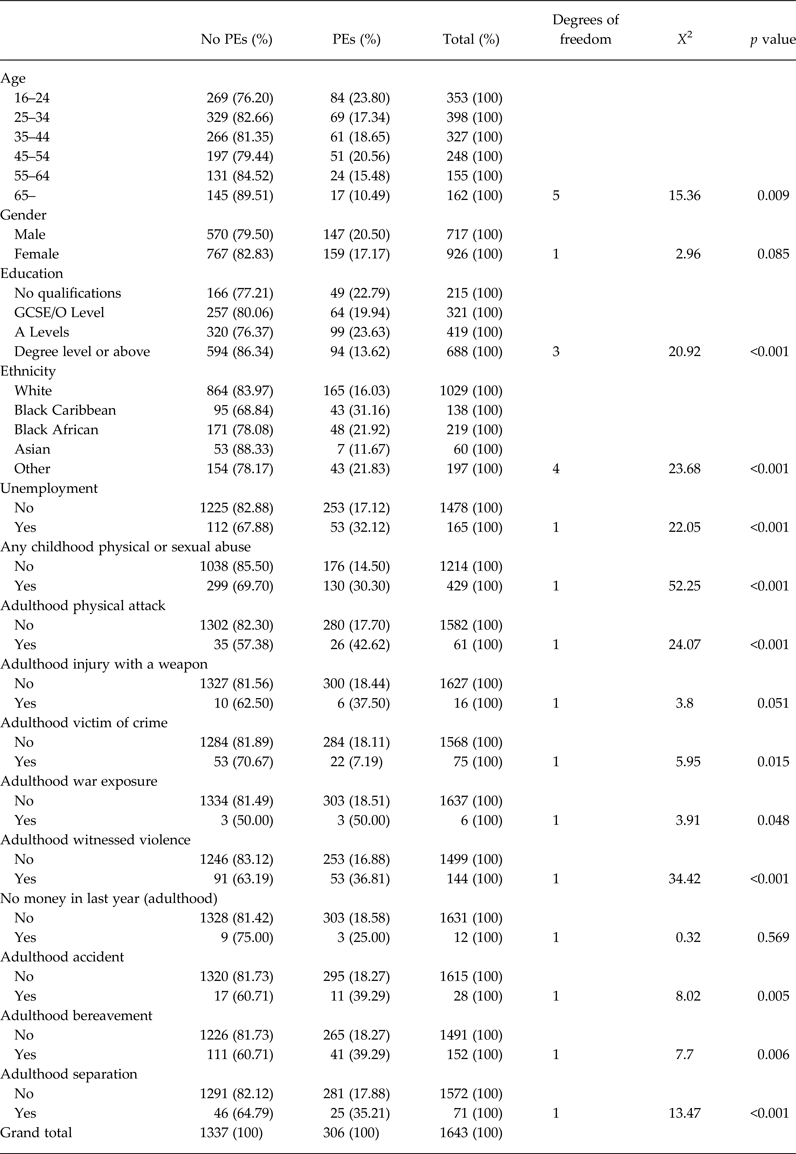
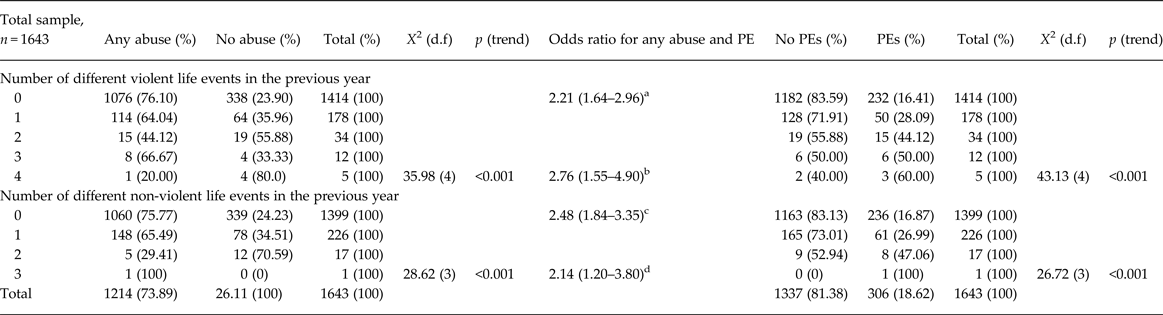
Among the total survey sample of 1698, 55 participants with missing data on PE (n = 8), childhood abuse (15), educational attainment (19), ethnicity (2), unemployment (9), violent events (20) and non-violent events (16) were excluded. The overall analytic sample therefore consisted of 1643 SELCoH participants interviewed between 2008 and 2010, of whom 306 reported PEs and 1337 did not. Basic socio-demographic characteristics and data on adulthood adverse life events by PE status are shown in Table 1. Associations were found between PEs and reporting childhood abuse, younger age, lower overall educational attainment, non-White ethnicity, being unemployed, and recent attack, crime victimisation, war exposure, witnessing of violence, experience of an accident, death of a partner and separation. There were strong linear trends for the odds of reporting PEs across scores for both non-violent and violent life events. There were also strong linear trends in odds of reporting either physical or sexual abuse during childhood, across score for both non-violent and violent life events (displayed in Table 2).
Sociodemographic characteristics of sample analysed

Categorical distributions of violent and non-violent adulthood life events by PE status and by childhood abuse status, for the total sample

Footnotes refer to the association between abuse and PEs among those with:
a No violent life event in the previous year.
b At least one type of violent life event in the previous year.
c No non-violent life event in the previous year.
d At least one type of non-violent life event in the previous year.
Mediation
To assess pathways from childhood abuse to psychosis via violent and non-violent life events, estimates of the total effects of any physical or sexual abuse while growing up were partitioned into direct (i.e. unmediated) and indirect (total and specific) effects using multiple mediation analyses. There was strong evidence for unadjusted direct (OR 1.7, 95% CI: 1.3–2.23) and total indirect effects (OR 1.54, 95% CI: 1.36–1.75) of abuse on PEs status, indicating partial mediation of this effect via violent and non-violent life events. This evidence for an association remained strong upon adjustment for age, gender, unemployment, ethnicity and educational attainment (direct effect: OR 1.58, 95% CI: 1.19–2.1; total indirect effect: OR 1.51, 95% CI: 1.32–1.72; see Table 2). In the fully adjusted model, an estimated 47% of the total effect of abuse on PEs was mediated via adulthood adverse life events, of which violent life events made up 33% and non-violent life events the remaining 14%.
In other words, the overall association between childhood abuse and PEs was explained partially by indirect effects via the experience both of adulthood violent and non-violent adverse life events. However, the proportion of the total indirect effect mediated through violent life events was around twice as large as that mediated through non-violent life events (see Table 3).
Total, direct, total indirect and specific indirect effects (odds ratios) for childhood abuse, violent life events in the previous year, and non-violent life events in the previous year, on the presence of PEs

a p values are from Wald tests.
b Violent life events comprised adulthood witnessed violence, being exposed to a war zone, being victim to a crime, injury with a weapon, or being attacked.
c Percentages based on logit coefficients.
d Non-violent life events comprised adulthood separation, death of a loved one, serious accident/injury, and homelessness. Model I was unadjusted for covariates. Model II was adjusted for age only. Model III was adjusted for age and gender, and Model IV was adjusted for age, gender, unemployment, educational attainment and ethnicity.
Discussion
Summary of main findings
Previous research from our group has found evidence for effect moderation, or synergy between adverse life events and childhood abuse on risk for PEs, such that the combined effect of abuse and life events was greater than the effect of each alone. Given that a variable can be both a moderator and mediator (Baron & Kenny, Reference Baron and Kenny1986), the present analysis assessed hypotheses involving mediation, to assess if adulthood violent life events could be on the causal pathway between childhood abuse and PEs, alongside their role as moderators.
We found evidence that the association between childhood abuse and PEs was partially explained by a pathway through the experience of adverse life events in the previous year. In particular, there was evidence for mediation via both violent and non-violent life events, with weak evidence suggesting that the indirect effect via adulthood violent life events was stronger than that via non-violent adulthood life events.
Previous literature
To our knowledge, no previous studies have assessed a mediating role for adverse life events in PEs. Morgan et al. (Reference Morgan, Kirkbride, Hutchinson, Craig, Morgan, Dazzan, Boydell, Doody, Jones, Murray, Leff and Fearon2008) found a linear relationship between markers of social disadvantage and the odds of psychosis in the AESOP study, suggesting that the interplay of environmental adversities could be important in the aetiology of psychosis. A further study, based on the same data, suggested that the effects of parental separation on psychosis risk were partly mediated through later educational and social disadvantage (Morgan et al. Reference Morgan, Reininghaus, Fearon, Hutchinson, Morgan, Dazzan, Boydell, Kirkbride, Doody and Jones2014a). Although less burdensome than psychotic disorders, low-level PEs are important because these experiences are associated with an elevated risk of both psychotic disorder (Kaymaz et al. Reference Kaymaz, Drukker, Lieb, Wittchen, Werbeloff, Weiser, Lataster and Van Os2012; Werbeloff et al. Reference Werbeloff, Drukker, Dohrenwend, Levav, Yoffe, Van Os, Davidson and Weiser2012; Fisher et al. Reference Fisher, Caspi, Poulton, Meier, Houts, Harrington, Arseneault and Moffitt2013a) and other adverse mental health outcomes, including suicidality (Kelleher et al. Reference Kelleher, Lynch, Harley, Molloy, Roddy, Fitzpatrick and Cannon2012, Reference Kelleher, Corcoran, Keeley, Wigman, Devlin, Ramsay, Wasserman, Carli, Sarchiapone and Hoven2013a) and the use of mental health services (DeVylder et al. Reference Devylder, Oh, Corcoran and Lukens2014; Bhavsar et al. Reference Bhavsar, Maccabe, Hatch, Hotopf, Boydell and Mcguire2017).
Methodological limitations
Reports of PEs and life events were collected at the same time point, limiting inference about the temporal relationship between the variables. In some subjects, PEs could have preceded life events. Prospective studies are necessary to clarify the temporal association between adverse events over the life course and the occurrence of PEs (Fisher et al. Reference Fisher, Schreier, Zammit, Lewis, Maughan, Munafo, Harrison and Wolke2011; Fisher et al. Reference Fisher, Schreier, Zammit, Maughan, Munafo, Lewis and Wolke2013b). In total 55 records (3%) were dropped because of missing data on one or more of the modelled variables. However, this compared favourably to other studies of this type (Bebbington et al. Reference Bebbington, Bhugra, Brugha, Singleton, Farrell, Jenkins, Lewis and Meltzer2004b; McManus et al. Reference Mcmanus, Meltzer, Brugha, Bebbington and Jenkins2009; Hatch et al. Reference Hatch, Woodhead, Frissa, Fear, Verdecchia, Stewart, Reichenberg, Morgan, Bebbington, Mcmanus, Brugha, Kankulu, Clark, Gazard, Medcalf and Hotopf2012). Furthermore, the crude association between abuse and PEs, and between life events and PEs, was similar in those with missing data, suggesting that important selection bias due to missing data was unlikely. The dichotomous measure of childhood abuse was based on two binary items (physical, and sexual abuse in childhood), rather than a more extensive questionnaire, limiting our ability to evaluate the severity, extent, or personal significance of childhood trauma exposure in detail. Given that the outcome for this study was PEs occurring in a general population sample, any generalisation of our findings should be limited to general, non-clinical populations, rather than to patients. We have recently demonstrated, however, that those reporting PEs in this study do experience greater use of mental healthcare over time (Bhavsar et al. Reference Bhavsar, Maccabe, Hatch, Hotopf, Boydell and Mcguire2017), implying that PEs could be a significant marker for clinically important morbidity at a general population level.
There is a possibility that people with PEs could have over-reported exposure to childhood abuse, or to adverse life events. However, in relation to childhood abuse, misclassification has been found to be limited in previous studies (Bonoldi et al. Reference Bonoldi, Simeone, Rocchetti, Codjoe, Rossi, Gambi, Balottin, Caverzasi, Politi and Fusar-Poli2013). We included only life events in the previous year, which limited the influence of recall bias. Nevertheless, some evidence indicates that higher levels of neuroticism, with which PEs are correlated, increase misreporting of childhood traumatic experiences in health research (Reininghaus et al. Reference Reininghaus, Priebe and Bentall2013; Reuben et al. Reference Reuben, Moffitt, Caspi, Belsky, Harrington, Schroeder, Hogan, Ramrakha, Poulton and Danese2016). Data on number of specific life events, or severity of life events, would have been informative for this analysis, but this data was not available on this sample. Although we adjusted for a large range of possible confounders, unmeasured or unknown confounding, and residual confounding for inaccurately measured confounding variables, remained possible sources of bias.
The relationship between trauma, psychosis and other trauma-related psychopathology is likely to be complex. For example, Morrison et al. (Reference Morrison, Frame and Larkin2003) a variety of potential pathways linking post-traumatic stress disorder (PTSD) and psychosis to trauma, including the possibility that the type of trauma-related psychopathology is determined by mood, physiology and attributional style, driving either the presentation of psychotic or PTSD, which are postulated to manifest a common post-traumatic response. On the other hand, Mueser et al. (Reference Mueser, Rosenberg, Goodman and Trumbetta2002) suggest that PTSD symptoms might themselves influence the symptomatic severity of psychosis, and its response to treatment. Our study did not aim to examine the role of PTSD symptoms as a modifier or mediator of the effect of adulthood trauma on PEs. Therefore, although unlikely to have introduced bias into the results reported here, it remains possible that PTSD acts as an intermediate factor in the relationship between adulthood violence exposure and the development of PEs, a proposition that requires further study. More generally, it is possible that trauma over the life course influences risk for PEs via changes in sensitivity to stress, which has been conceptualised as an ‘affective pathway’ to psychosis (Myin-Germeys & Van Os, Reference Myin-Germeys and Van Os2007). Although the outcome analysed in the present report was sub-clinical symptoms of psychosis, our results are consistent with the explanation that childhood traumatic events influence stress-reactivity and affect the expression of psychotic symptoms later in life, in the context of stressful events, such as further exposure to violence.
PEs and childhood abuse
Although there is now relatively strong evidence that childhood abuse is related to the occurrence of psychosis and PEs, exact mechanisms remain unclear. However, causal pathways to psychosis are likely to be complex and probably involve the interplay of genetic risk with an array of social environmental factors, including experiences of abuse and trauma, over the life course (Morgan et al. Reference Morgan, Charalambides, Hutchinson and Murray2010). In keeping with this complexity, childhood abuse could plausibly exert its influence on PEs in a variety of ways; for example, through effects on the stress sensitivity of the mesolimbic dopamine system (Howes & Kapur, Reference Howes and Kapur2009), regulation of the hypothalamic-pituitary-adrenal axis (Borges et al. Reference Borges, Gayer-Anderson and Mondelli2013), the developmental of maladaptive cognitive schema (Garety et al. Reference Garety, Kuipers, Fowler, Freeman and Bebbington2001, Reference Garety, Bebbington, Fowler, Freeman and Kuipers2007), and changes to affective and cognitive processing (Fisher et al. Reference Fisher, Schreier, Zammit, Lewis, Maughan, Munafo, Harrison and Wolke2011, Reference Fisher, Schreier, Zammit, Maughan, Munafo, Lewis and Wolke2013b; Rottenberg et al. Reference Rottenberg, Yaroslavsky, Carney, Freedland, George, Baji, Dochnal, Gádoros, Halas and Kapornai2014).
Childhood abuse and adulthood adverse life events
Some pathways from childhood abuse to PEs could involve the experience of adversity in adulthood. Although a number of separate socio-environmental risk factors (e.g. deprivation, migration, urban residence and ethnicity) have been linked to PEs (Das-Munshi et al. Reference Das-Munshi, Becares, Boydell, Dewey, Morgan, Stansfeld and Prince2012; Linscott & Van Os, Reference Linscott and Van Os2013; Schofield et al. Reference Schofield, Das-Munshi, Bécares, Morgan, Bhavsar, Hotopf and Hatch2016), including exposure to trauma (Morgan et al. Reference Morgan, Reininghaus, Fearon, Hutchinson, Morgan, Dazzan, Boydell, Kirkbride, Doody and Jones2014a), it is also widely accepted that markers of social adversity tend to cluster in individuals over time (Pantazis et al. Reference Pantazis, Gordon and Levitas2006). For example, physical or sexual abuse during childhood is associated with sexual (Russell, Reference Russell1983; Siegel et al. Reference Siegel, Sorenson, Golding, Burnam and Stein1987; Mayall & Gold, Reference Mayall and Gold1995) and physical (Briere & Runtz, Reference Briere and Runtz1987; Chu & Dill, Reference Chu and Dill1990) violence exposure later on in life. There are various possible explanations for this relationship- for example, childhood victimisation may be accompanied by residential instability and institutionalisation, which in turn may result in greater opportunities for other adversities, including violence exposure, in adulthood (Finkelhor, Reference Finkelhor1979). A likely explanation for re-victimisation is the effect of the original victimisation on psychological vulnerabilities. People exposed to violence as children may feel powerless to defend themselves from such exposures as adults, leading to increased vulnerability (Russell, Reference Russell1983).
Conclusions
Our findings suggest tentatively that a putative socio-developmental pathway between childhood abuse and PEs might involve the experience of adversity in adulthood. This is potentially important for public health, because intervening on adulthood adversity in those exposed to childhood trauma might be a more efficient and practicable strategy for the prevention of psychoses than intervening on childhood trauma per se. The distinction between violent and non-violent adulthood life events in possibly mediating the association between abuse and PEs could, if replicated, be important in the targeting, design and implementation of early intervention services. Further research on the inter-relationships of modifiable social environmental risk factors involved in the occurrence of psychoses could identify ways of intervening to reduce risk. Our results emphasise the potential clinical relevance of repeated traumatic experiences, including those occurring during adulthood, in influencing mental health and underline the importance of understanding the mechanisms of recurrent victimisation in future research on mental disorders.
Acknowledgements
We acknowledge the assistance of Souci Frissa and David Pernet in data preparation.
Financial Support
VB is supported by the Wellcome Trust (101681/Z/13/Z). MH, SLH and PM are supported by the National Institute for Health Research (NIHR) Biomedical Research Centre at South London and Maudsley NHS Foundation Trust and King's College London. This paper represents independent research funded by the National Institute for Health Research (NIHR) Biomedical Research Centre at South London and Maudsley NHS Foundation Trust and King's College London. The views expressed are those of the authors and not necessarily those of the NHS, the NIHR or the Department of Health.
Conflict of Interest
The authors have no conflicts of interest to declare.
Availability of Data and Materials
The data that support the findings of this study are available from Professor Matthew Hotopf but restrictions apply to the availability of these data, which were used under license for the current study, and so are not publicly available. Data are however available from the authors upon reasonable request and with permission of Professor Matthew Hotopf.