

The renaissance of Apuleian studies of the past few decades shows no signs of abating.Footnote 1 The summer of 2014 may well be the highest watermark yet recorded in the tide of interest in Apuleius: June and July alone saw the release of two monographs, one each from Oxford University Press and Cambridge University Press, and one edited conference volume, from Routledge.Footnote 2 The clearest sign that the sophist of Madauros has come into his own is his admission into the exclusive club of the Oxford Classical Texts: the first volume of his complete works containing the Metamorphoses edited by Maaike Zimmerman came out in 2012. One of the most salutary effects of this renewed interest has been the reappraisal of the ‘whole Apuleius’: Apuleius has more to offer than just the Metamorphoses, and recent scholarship on the rhetorica and the philosophica have shown not only how these opera minora can help us understand the opus maius, but also how they are important and interesting documents in their own right.Footnote 3
Perhaps then it is an auspicious time to revisit some old questions that have bedevilled scholarly treatments of the ‘whole Apuleius’. Which texts should be accepted as authentic and which should be rejected? The Apuleian corpus is riddled with vexing problems of authenticity and transmission. To give an incomplete list:
-
(1) Is the poem ascribed to Apuleius in the Anthologia Latina (712 Riese) authentic?Footnote 4
-
(2) Is the spurcum additamentum found in the margin of the most important manuscript of the Metamorphoses (10.21) authentic?Footnote 5
-
(3) While it is almost universally believed that the Herbarius and the Physiognomia are not by Apuleius, how did they acquire their ascription?Footnote 6
-
(4) How did a high medieval political tract called De monarchia come to be ascribed to Apuleius?Footnote 7
-
(5) What is the status of the rhetorical fragments transmitted at the beginning of the De deo Socratis, the so-called ‘False Preface’?Footnote 8
-
(6) Are the De Platone et eius dogmate and the De mundo (both undoubtedly by the same author) authentic?Footnote 9
-
(7) Is the Asclepius authentic, and, if not, how and when did it become an interloper in the philosophical corpus?Footnote 10
-
(8) Is the Peri hermeneias authentic, and, if so, why does it have a separate transmission?Footnote 11
-
(9) What of the so-called Summarium librorum Platonis transmitted after the De mundo in one thirteenth-century manuscript discovered by Raymond Klibansky?Footnote 12
One could go on. There are few ancient Latin authors who give rise to as many problems as Apuleius, and the authenticity of various works in the corpus has given rise to some of the best detailed philological treatments of questions of authorship in Latin literature. In 1960, Josef Redfors composed an exhaustive study on the question of the authenticity of the De Platone and the De mundo; one major component of that analysis was the minute lexical study of particles and other Latin function words. Ultimately, he could reach no conclusion: his analysis uncovered too many contradictory indications to point definitively one way or another. Fifteen years later, in a review of Beaujeu's 1973 Budé edition, Michael McGann cautiously proposed a way out of Redfors's impasse, noting that ‘there is perhaps room for a statistical approach to the problem’.Footnote 13 More than a decade later still, Londey and Johanson stated much the same thing with regard to the Peri hermeneias: ‘It is possible that more compelling grounds for accepting or rejecting Apuleian authorship of the Peri Hermeneias may eventually emerge from stylometric studies.’Footnote 14
Taking up these two decades-old challenges, we will examine the last four questions of those posed above, using the methods of computational philology for authorship attribution. Our intention is not to supplant other modes of analysis, but to shed new light on old problems by using new tools based on old methods. In so doing, we will show how current computational methods can be employed for authorship attribution and authentication in ancient Latin texts, an area that has been surprisingly quiet ever since the controversy over the Historia Augusta in the 1980s and the 1990s.Footnote 15
METHODOLOGY
The present study’s methodology is drawn from the field of computational stylistics or ‘stylometry’, a vibrant multidisciplinary research domain within Digital Humanities (or Humanities Computing). In this field, scholars and scientists study the writing style of (literary) texts through advanced statistical quantification, typically relying on computational means.Footnote 16 Interesting applications of stylometry in literary studies include plagiarism detection, as well as in ‘stylochronometry’, or establishing the sequence of an author's works, such as in the well-known studies of the Platonic dialogues.Footnote 17 Authorship attribution, where scholars attempt to automatically determine the identity of a (possibly anonymous) text's author by inspecting its stylistic characteristics, nevertheless, remains the most popular branch of stylometry.Footnote 18 The fundamental assumption underlying this field is that ‘by measuring some textual features we can distinguish between texts written by different authors’,Footnote 19 an idea which has found its most ambitious (and tendentious) formulation as the ‘Universal Stylome Hypothesis’.Footnote 20
Empirical research demonstrates that a variety of computational techniques can in many cases discriminate between the writing styles of distinct authors.Footnote 21 In experiments where computers are ‘trained’ on example material from candidate authors, algorithms achieve outstanding performance in attributing previously unseen texts to the correct author, solely based on the target author's stylistic characteristics. Although the prerequisites for such attributions should not be underestimated (one should, for example, have enough example material per author),Footnote 22 these techniques can be put to interesting use in philological research. In addition to a series of more technical inquiries focussing on methodological issues,Footnote 23 recent literary studies have applied stylometry to diverse domains, including nineteenth-century German literature, French Enlightenment theatre and twelfth-century Latin literature.Footnote 24
Apart from the advanced degree of computational quantification which is currently common in stylometry, the field shows a number of major differences with respect to earlier practices of authorship attribution.Footnote 25 The most important methodological innovation in the field can be traced back to the investigations of the disputed authorship of the pseudonymous Federalist Papers by the American statisticians Mosteller and Wallace in the 1960s.Footnote 26 In their influential study, Mosteller and Wallace argued that, for authorship attribution, scholars should move away from a text's conspicuous characteristics (uncommon nouns, for example, or rare syntactical constructions), which until then had been the customary focus of stylistic inquiry in attribution studies. Instead, they proposed to study a text's most common, yet most inconspicuous, components: its function words.
There is widespread acceptance that a text’s function words (for Latin, this applies primarily to particles, prepositions, conjunctions and some adverbs) offer an exceptionally privileged stylistic category for the study of authorship.Footnote 27 These items are frequent throughout all texts; hence, they yield a statistically reliable base for textual comparison. They are fairly independent from the genre or theme of a text, which is why they are attractive for determining authorship across generic and thematic boundaries. Finally, an often-heard, yet slightly more controversial, claim is that the use of these words, at least when studied on a larger textual scale, are not under an author's conscious control. This is an important idea, because this aspect of function words would make them resistant to imitation (by students or epigones, for example) and outright forgery. The idea underlying the use of function words is that we attempt to reduce texts to a set of features that differ in nothing besides authorship.Footnote 28
In this paper we shall apply a stylometric methodology to a corpus of Latin prose texts from antiquity, in particular texts which stand in some relation to Apuleius. Our corpus includes philosophical texts by Seneca and Cicero; works by authors of the generation preceding Apuleius, including Suetonius and Pliny the Younger; works of Apuleius’ contemporaries such as Aulus Gellius and Tertullian, and works by authors in the generation following Apuleius, such as Cyprian. We have restricted our analyses to the first 9,000 words of each text, in order not to let shorter texts be too heavily outbalanced by some of the longer texts in the corpus, such as the Met. Our methodology will solely consider the most common words in the texts analysed.
We have not lemmatized the texts, or applied word-stemming to them: our earlier exploratory experiments (which we do not report for the sake of brevity) showed that an approach based on plain inflected surface tokens generally yielded much more stable results than lemma-based approaches. More details on the pre-processing are given below. In each of the analyses described below, we have automatically extracted those words which had the highest cumulative frequency in the texts analysed. As will be illustrated below, these lists are typically dominated by (uninflected) function words, such as particles and prepositions. Nevertheless, these lists will occasionally also include high-frequency inflected word forms such as est, which typically serve a grammatical function and are thus suited for stylometric analysis. Note that for all the analyses reported below, we have also automatically deleted all frequency information related to personal pronouns in texts, a procedure known as pronoun-culling.Footnote 29 This removal is meant to minimize the stylistic influence of narrative perspective and also genre to some extent, which are often betrayed by the personal pronouns in a text and thus interfere with analyses, which focus on authorship.Footnote 30 To normalize any differences in orthography we have also replaced every v with u in the corpus (irrespective of their representing vowels or not).
Although this is by no means the first application of stylometry to classical Latin texts, the methodology is still not considered mainstream in contemporary classical scholarship. In the first sections below, we will therefore demonstrate that our method can yield valid results with texts of undisputed authorship, before moving on to the disputed works of Apuleius. We will deliberately adopt a non-technical and introductory language that allows the broader readership of this journal to follow the main argument in our paper.Footnote 31
CLUSTERING
All our analyses below are based on a text representation that is called a ‘bag-of-words model’ in fields such as information retrieval and computational linguistics.Footnote 32 For each text in a corpus, our text representation or model will first lowercase the text, remove all punctuation, and then split the text into individual words along white space. The resulting list of words will then be used to create a frequency table, reminiscent of the way tabular information is displayed in standard spreadsheet applications: the frequency table will have a column for every word that has been attested in the corpus and a row for every text in the collection. The cells in the table will be populated by the relative frequency of every word in every text. All subsequent analyses are then applied to this frequency table only. The ‘bag-of-words model’ has a number of obvious shortcomings from the point of view of stylistic analysis, the most important shortcoming being that the original word-order in the document is completely lost under this kind of (seemingly superficial) text representation.Footnote 33 Nevertheless, numerous empirical tests have shown that this kind of text model is both extremely efficient and extremely effective for the study of authorship.
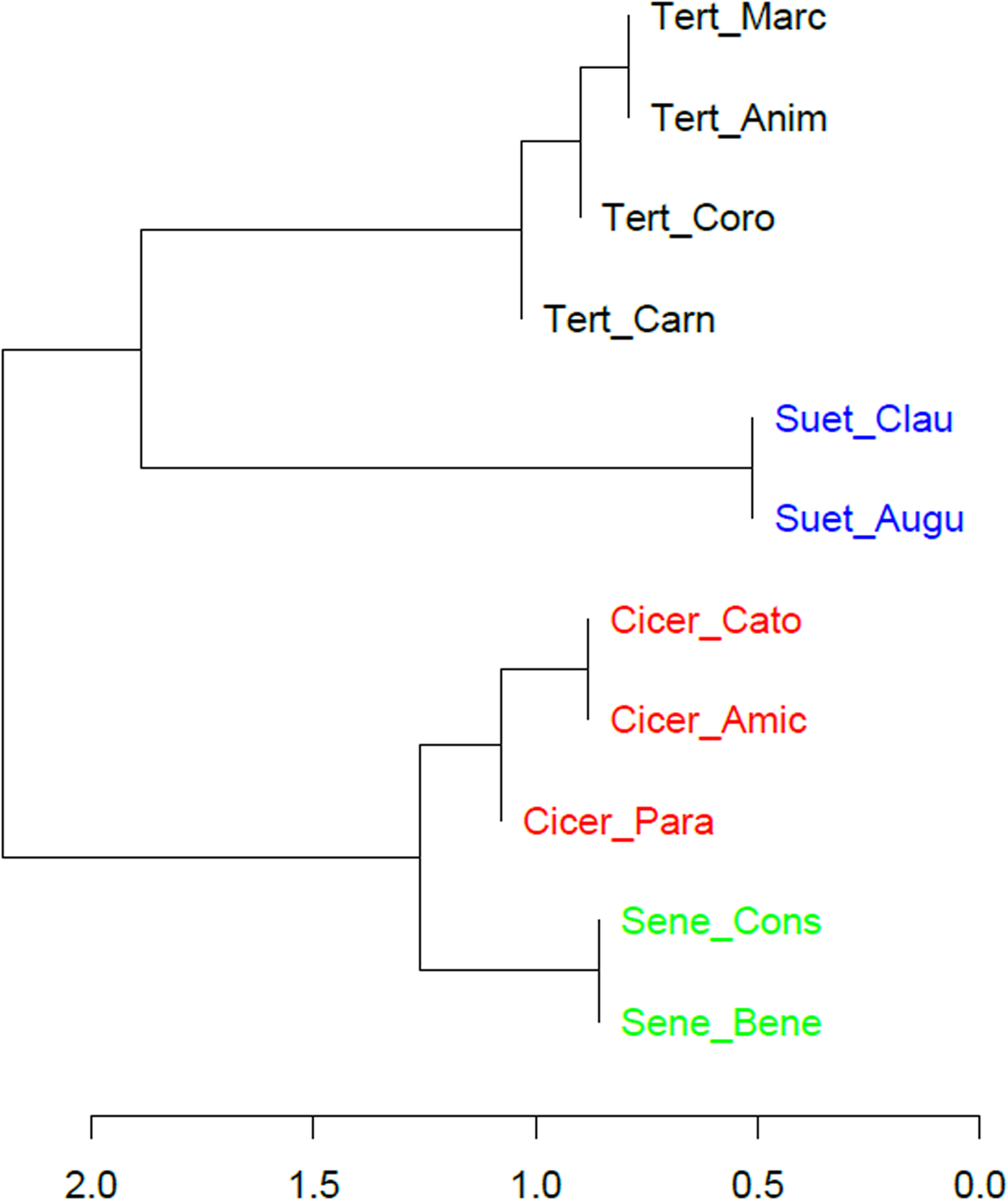
Figure 1 shows an example of a dendrogram, the typical output of the first kind of statistical analysis we will discuss here: hierarchical cluster analysis.Footnote 34 With this procedure, we pair each text with every other text and calculate the stylistic distance between each pair. These distances are calculated on the basis of the relative frequencies of the most frequent words (MFW) in the entire text collection. Here and throughout, we use a classic distance metric in stylometry: Burrows's Delta, a relatively simple yet demonstrably effective metric for estimating the stylistic distance between texts on the level of authorship.Footnote 35
Cluster Analysis Dendrogram (no sampling), 100 MFW

Burrows's Delta is determined as follows. Suppose that we wish to calculate the deltas between all text pairs in given text collection on the basis of 30 high-frequency words. First, we select the 30 items which have the highest cumulative frequency in the entire text collection and restrict our subsequent distance calculations to them. Next, we compute the relative frequency of each of these items in each text (if a word occurs 5 times in a text that counts 200 words in total, its relative frequency in that text is 0.025). As such, each text will be represented by a list of 30 numerical values. We then calculate the standard deviation of each word's relative frequency in all of the texts analysed, which yields a list of 30 standard deviations, one for each word analysed. (The standard deviation is a statistical measure which captures how strongly the values in a list of values diverge from their mean value.) Finally, we calculate the actual stylistic distance between two texts A and B, by determining the absolute difference in the relative frequency of each word in the two texts, and weigh that absolute difference by dividing it by the standard deviation associated with that word. Burrows's Delta is the sum of the resulting thirty weighted differences. Because of the standard deviation weighting, Burrows's Delta tunes down the contribution of words whose frequencies display significant fluctuation in the text collection. This reduces the effect of content-specific items and focusses the analysis more closely on style-related lexical items.
The resulting distances (‘deltas’) between all texts are then collected in a large distance table that serves as the input for the actual cluster analysis. The result of a cluster analysis is especially useful to visualize at a glance which texts are more alike than others. One can think of this kind of cluster analysis as a ‘bottom-up’ procedure, which is data-driven, instead of being guided towards a specific solution by the researcher, what is called an ‘unsupervised’ technique. First, the cluster analysis will determine which two texts in the corpus are closest to each according to the distance table.Footnote 36 It will then merge these two texts into a new abstract node, representing the ‘average’ of these two texts in terms of relative word frequencies. In the dendrogram, the analysis will position this new node at a further stage in the tree than the original texts (represented as ‘leaves’ in the resulting plot). Next, the procedure will work its way up an imaginary tree, iteratively merging these nodes and texts that are most similar to each other, until all texts have been merged at the top tier in the tree.
Figure 1 can be thought of as being created right to left: relatively closer text pairs will cluster more to the right. The horizontal difference between two nodes in the graph reflects the distance between nodes: dissimilar texts and nodes will only be joined at a later stage in the procedure (i.e. more to the left) and at a more advanced position in the tree, whereas highly similar groups of texts will tend to form tight clusters from the beginning onwards. The stylistic distance between texts and nodes can therefore be read from the horizontal axis in the cluster plot. Figure 1 displays the result of a standard cluster analysis for a fairly random initial selection of texts by four major classical and early Christian authors: Tertullian (De anima, Ad Marcianum, De corona militis, De carne Christi), Suetonius (the lives of Claudius and Augustus), Cicero (Cato maior de senectute, Laelius de amicitia, Paradoxa stoicorum) and Seneca (De constantia, De beneficiis).
As before, the analysis only considers the relative frequencies of the 100 words which are most frequent throughout the texts analysed in this experiment. Moreover, words were only included in this list if they appeared in all of the texts considered here: in technical terms we set the ‘culling level’ at 100% (i.e. a word's presence in 100% of the texts is required, meaning that it should occur at least once in each text), as an attempt to avoid the interference of content-related artefacts in this analysis. As can be clearly gleaned from the dendrogram, the cluster analysis has no difficulties in grouping the individual texts based on their authorship. This is a remarkable result, because this analysis too is fully unsupervised: it only has access to the 100 MFW frequencies for each text and has no information whatsoever about the provenance of these texts. As one might expect, the œuvres of Cicero and Seneca seem to have more stylistic affinities and as a group they tend to be relatively different from Tertullian and Suetonius.
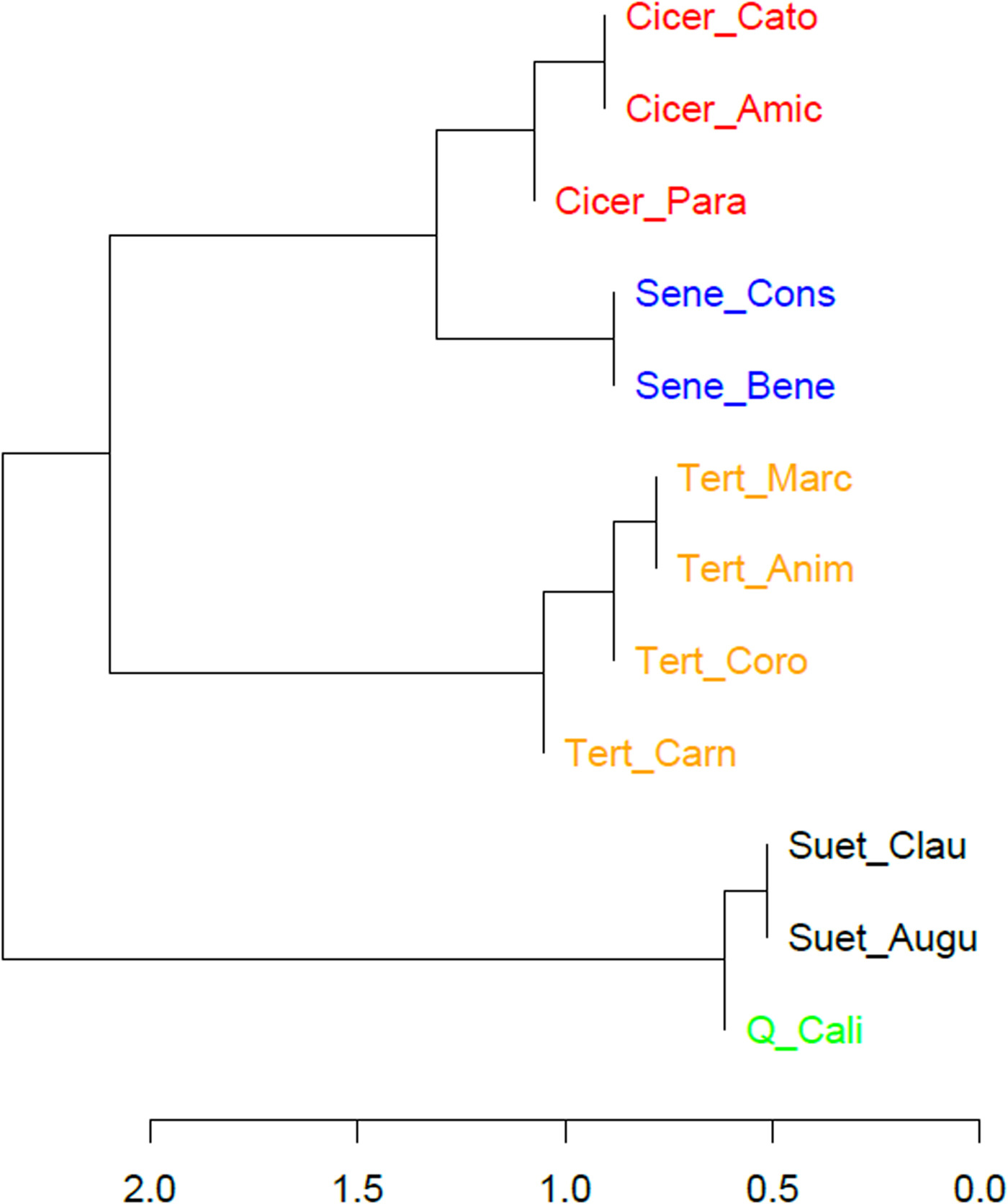
An experiment can illustrate how we can use dendrograms for authorship attribution. Say we take Suetonius’ Caligula, and pretend that it is an anonymous text of which the authorship is disputed or even unknown. Would a cluster analysis that has no indication of the text's origin be able to position it under the correct author's branch, even when the analysis only has access to the relative frequencies of the 100 MFW? Figure 2 shows that this is indeed the case: the Caligula (attributed to the unknown author Q) neatly fits in with the rest of Suetonius’ works. This result would give us ample reason to investigate the stylistic similarities between these texts in more depth and indeed—if more corroborating evidence were available—to consider attributing the Caligula to Suetonius.
Cluster Analysis Dendrogram (no sampling), 100 MFW

Of course, there is no reason whatsoever to doubt the authenticity of the Caligula as in the dummy example above. So let us take a slightly more challenging case: the works of Pliny the Younger. His two major works are the Epistulae and the Panegyricus, but they have entirely separate lines of transmission, and are very different in genre, content and style. Supposing for the moment that the question were still to be settled, what could we learn from a computational analysis?
CONSENSUS TREES
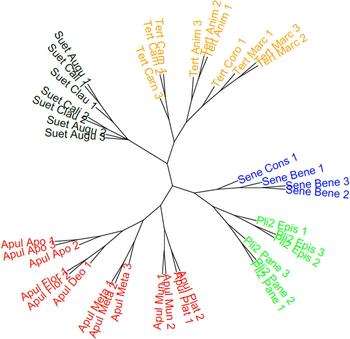
Here, we can introduce a useful extension to traditional cluster analyses in stylometry which takes its inspiration from stylometric studies by Eder.Footnote 37 It has been noted that traditional cluster analyses can sometimes be unstable: small changes in the parameters for an experiment (for example, the exact number of MFW considered) can sometimes yield rather different dendrograms. Therefore, it is often helpful to run different cluster analyses for different parameters and to combine the results in a single dendrogram. A Bootstrap Consensus Tree (BCT), like the one plotted in Figure 3, does exactly this: this (unrooted) dendrogram is based on a series of cluster analyses that are based on different ‘frequency bands’: a first tree is built for the frequencies of the band of the 1–100 MFW in the texts (band 1), a second tree for the 50–150 MFW band (band 2), and so on, all the way up to, for example, the 2950–3000 MFW (the final frequency band). In each of these cluster analyses, we thus perform an experiment on a different slice of high-frequency words, which might introduce subtle discrepancies between individual trees. Note that in each iteration, the same texts are analysed: only the set of words by means of which these texts are represented changes. Next, this series of experiments can be summarized in a BCT like Figure 3, which ignores cluster nodes between texts that were not present in at least 50% of the experiments. This type of analysis also considers words with much lower frequencies than the typical function words, which might increase the effect of content-related lexis. Nevertheless, a BCT typically yields very reliable results, because it tests for stylistic similarities across different frequency bands, rendering it relatively insensitive to highly specific, content-related features of texts, such as those in a single specific frequency band.
Bootstrap Consensus Tree (3,000-word samples)

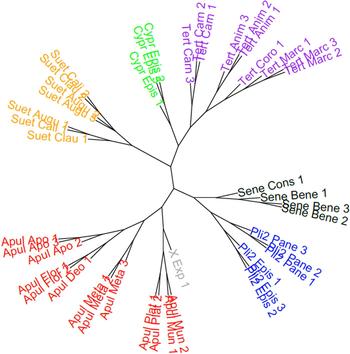
For the experiment in Figure 3, we have added both works by Pliny the Younger to the set of works analysed in Figure 2. We left out Cicero, however, in order not to overload the analysis and subsequent visualisation with different authors and texts. We added the Epistulae by Cyprian to the analysis, however, as a relatively difficult test to assess whether the procedure is able to distinguish between the epistolary production of two authors, which might obviously share many genre-related, rather than author-related, stylistic characteristics. (Note that we did not specify a culling rate now, to be able to obtain a sufficient number of MFW from this varied text collection.) The different frequency bands analysed in Figure 3 are 1–100 MFW (band 1), 50–150 MFW (band 2), 100–200, …, 2850–2950, 2900–3000. This analysis includes multiple samples for each text, since it is useful to assess the internal stylistic coherence of texts (here truncated to their 9,000 first words to maximize comparability) into consecutive windows or samples from each text. This will also serve as a better control for the length of the texts analysed. Here, each leaf in the BCT represents a 3,000-word sample from each text (the leaf names are followed by a number indicating the index of the sample).
The branch structure of the dendrogram resulting from a BCT can be read in a manner similar to a standard cluster dendrogram. Although the exact orientation of the circular BCT tree is irrelevant, texts that are stylistically similar will be positioned closer to each other. Additionally, the length of each pair of branches reflects the stylistic distance between the items joined under a particular node. The BCT accurately captures the fact that the samples taken from the Panegyricus form a tight cluster and could well be assigned to the same author as the Letters, because samples from both texts are, generally speaking, much closer to each other than to any of the other authors studied in this analysis. In other words, the works of Pliny make up a varied but coherent collection of texts.
Similarly, we can use a BCT to show that the works of Apuleius are likewise coherent and therefore suitable for computational analysis. For the analysis in Figure 4, we leave out Pliny the Younger, but now include the four works universally accepted as authentically Apuleian: the Metamorphoses, the Apology, the De deo Socratis and the Florida. Here, we see how samples from Apuleius’ texts form a tight cluster that is clearly different stylistically than those from the other authors analysed. At this point, we can add De Platone and De mundo, the two philosophical works whose authenticity is usually but not universally accepted. Figure 5 convincingly demonstrates how samples from these two philosophica neatly fit in with the other, undisputed texts under Apuleius’ clade in the diagram. The attribution of these two works to the Apuleian corpus is extremely stable across a wide variety of algorithmic settings. We have not obtained a single experimental result that would cause one to have any suspicion that these two texts were not written by Apuleius, that is to say the individual responsible for authoring the Metamorphoses, the De deo Socratis and the Florida. Since this analysis rests on the MFW, most of which are inconspicuous function words, we can rule out the possibility of deliberate skilled imitation. Further, owing to the relative length of the two taken together, we have considerable confidence in the robustness of our results for the De Platone and the De Mundo. This is not always the case for the smaller texts, which we will discuss in the next sections, since they offer a less substantial set of features to test.
Bootstrap Consensus Tree (3,000-word samples)

Bootstrap Consensus Tree (3,000-word samples)

PRINCIPAL COMPONENTS ANALYSIS
In present-day stylometry, it is common not to limit a study to a single technique, but to compare the output of different methodologies. In the virtual absence of ground truth in historical corpora, especially when it comes to authorship, it is worthwhile to assess the stability of experimental outcomes using different methodologies, which all have their strengths and weaknesses. Thus here we introduce a third technique, called Principal Components Analysis (PCA), which is complementary to the previous clustering approaches. This method is taken from multivariate statistics and has often been successfully applied to authorship attribution.Footnote 38 Techniques for the clustering of texts, like the BCT discussed above for instance, are suitable for the stylometric analysis and visualisation of larger corpora, but they have one major drawback: it is difficult for someone using them to find out how specific stylistic characteristics have contributed to the placement of texts in a graph. PCA has the drawback that, as a visualisation technique, it can only be reliably applied to a relatively small set of authors at the same time (typically three or four). It does have the advantage, however, that it tends to give very reliable results for such smaller sets, and it clearly visualizes the features from which it is constructed—in the present case, these features are the relative frequencies of the most common words in texts.
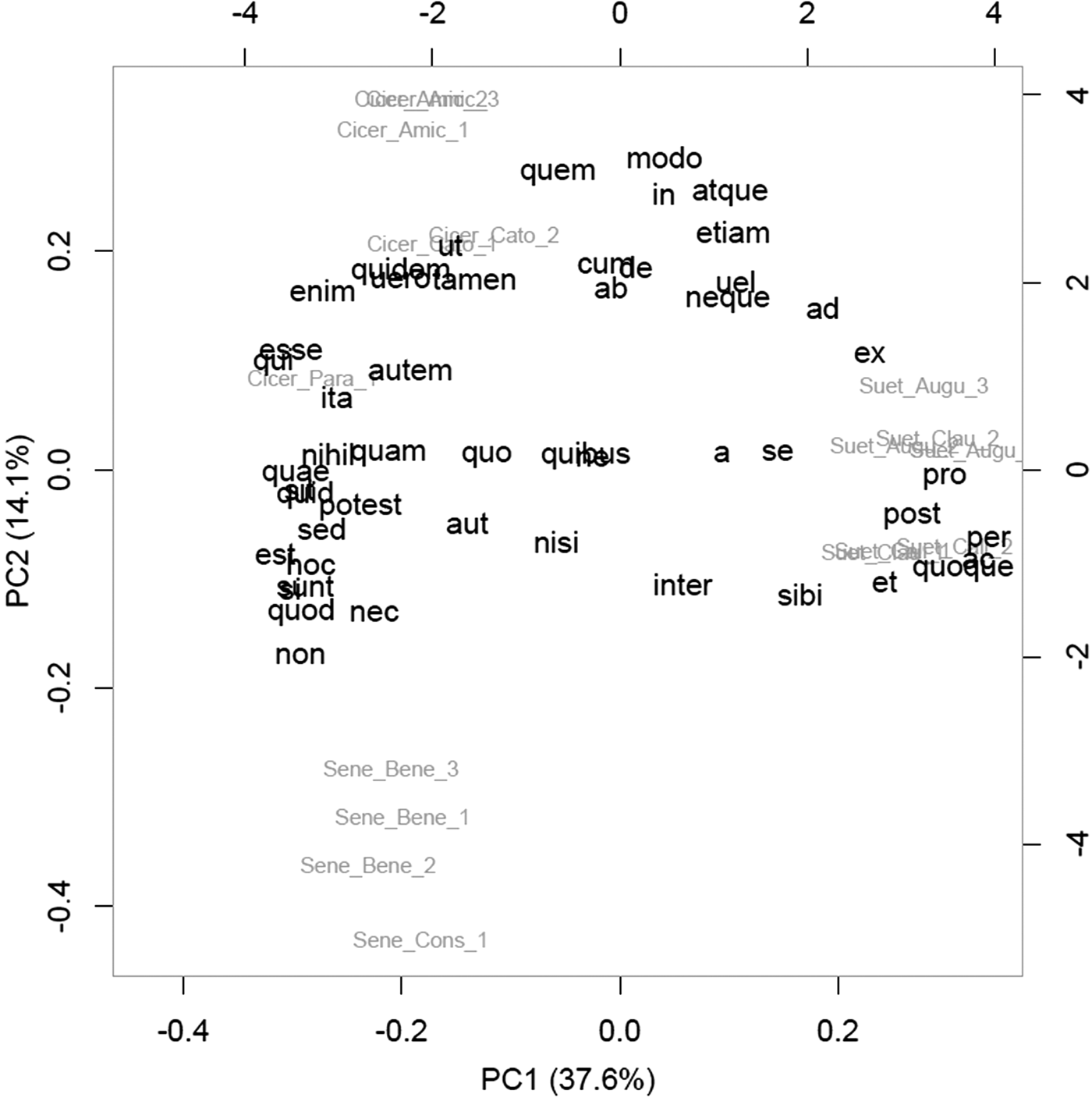
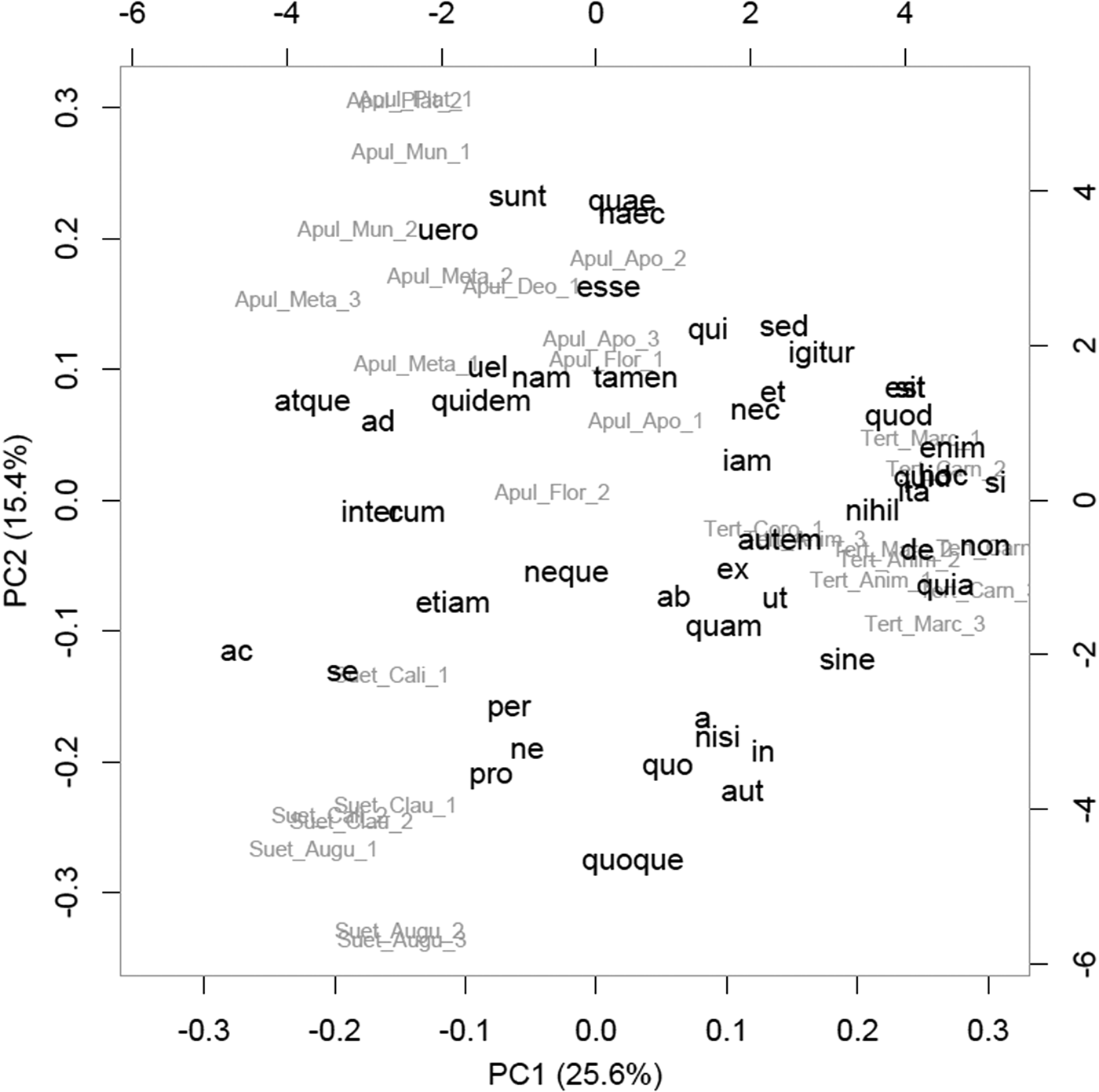
Like cluster analysis, PCA operates on the relative frequencies of a small number of MFW in the frequency table of a corpus. PCA will attempt to visualize the main stylistic variation in a text collection by projecting the texts into a two-dimensional scatterplot, in which each text (or sample from it) is plotted as a dot.Footnote 39 Generally speaking, the placement of these dots reflects the stylistic similarity or dissimilarity between texts: texts that are close to each other in style will form tight clusters of dots in a plot, whereas distant dots can be said to be more stylistically dissimilar. (Note that the ‘dot’ is placed at the middle of the text tag.) Figure 6 is such a scatterplot resulting from a PCA of 3,000-word samples extracted from the previously analysed texts by Cicero, Seneca and Suetonius. This PCA was applied to the 50 MFW in this corpus. The position of each sample is indicated by a grey label (Sene_Bene_2, for example, is the second sample extracted from Seneca's De beneficiis). Samples written by the same author form relatively tight clusters, although PCA is also an entirely unsupervised technique. This means that the PCA does not try to place Suetonius’ works in a similar region in the plot (it does not even have access to the potentially preconceived meta-information about these texts), but rather lets the frequency information speak for itself.
Principal Components Analysis with feature loadings (3,000-word samples), 50 MFW

In Figure 6, note the Latin words scattered across the plot. These so-called ‘feature loadings’ relate to the original relative word frequency which forms the basis of the analysis. They offer us an important insight into which word combinations are responsible for the particular placements of the text in the scatterplot. Each ‘feature loading’ can be thought of as a magnet, so to speak. For example, et is found in the far-right half of the plot: therefore, samples which display an elevated frequency of et are hence assigned positions in the plot further toward the right edge. Put another way, if the corpus contained only two samples and each sample had an equal frequency of the word sed, it would be placed directly between the two samples. If one of these two samples contained sed twice as often as the other, sed would be placed twice as close to it, and so on. In Figure 6, the loadings reveal how Cicero prefers etiam, where Suetonius strongly favours quoque. This example illustrates how the PCA loadings will often focus on stylistic oppositions that can be found in texts. From the perspective of studying authorship, the oppositions created between alternatives such as etiam and quoque are uniquely important, because such subtle oppositions can often be more easily linked to differences in authorial style.
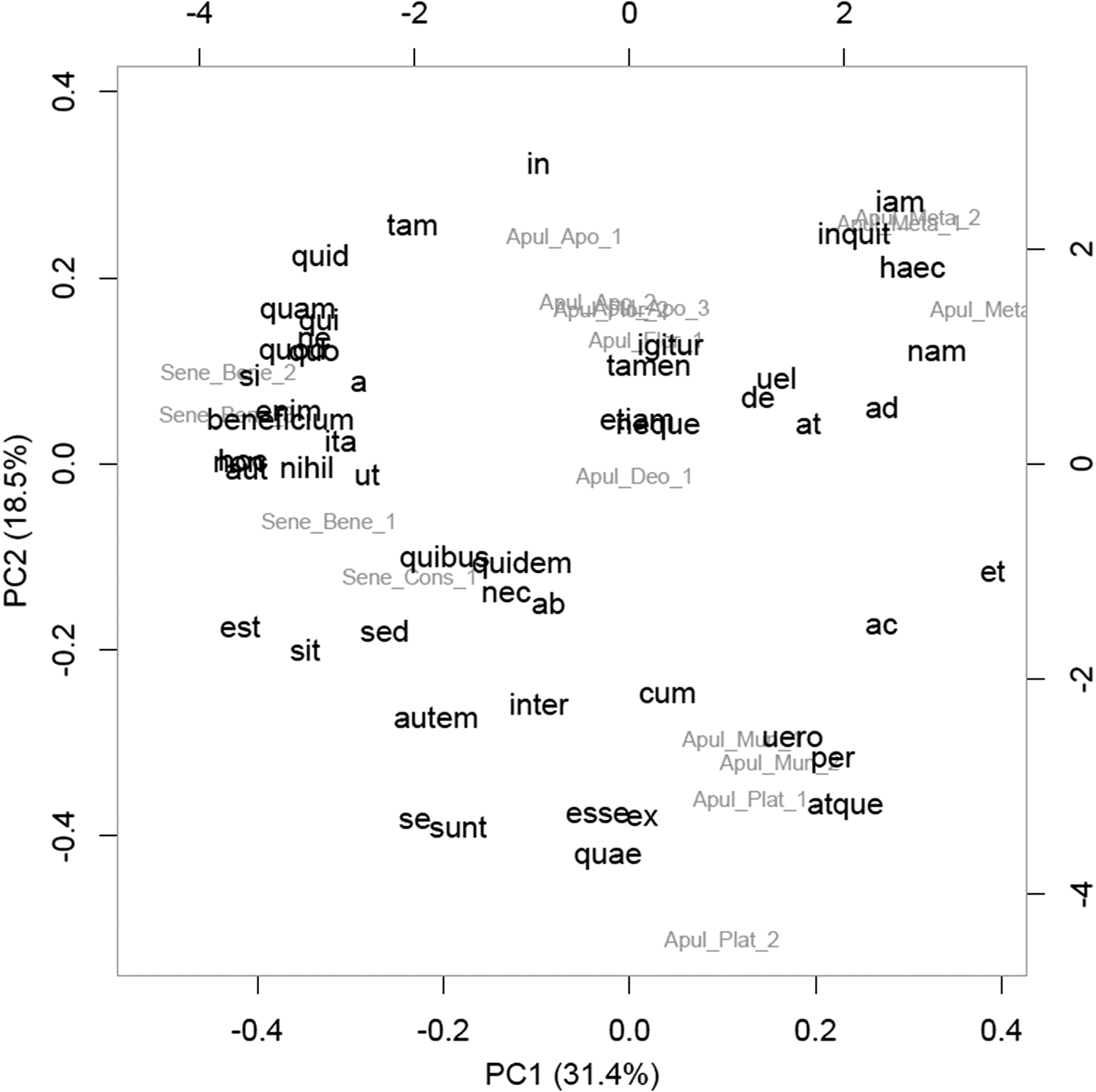
This visualization technique can now be used to inspect which words are typical of the Apuleian corpus, including now the De Platone and the De mundo. A PCA (50 MFW) of this corpus with, for instance, Suetonius and Tertullian shows its range and coherence (Figure 7). The three authors’ works cluster relatively tightly together—the Apuleian works are the most widely separated, yet still fairly coherent—and De Platone and De mundo fall right among the other works by Apuleius, directly between the rhetorical works and the Metamorphoses. Visualizing the PCA with the loadings clearly shows some of the characteristic words of Apuleius’ lexicon across both the Met. and the rhetorica. This is extremely clear if we compare the Apuleian corpus with a single control author: in this case, the horizontal opposition in the first component will typically be used to set both œuvres apart (placing them on the left and the right), whereas the PCA will invariably reserve the vertical spread in the second component to represent the considerable variation we find inside Apuleius’ œuvre. A representative example of this trend can be found in Figure 8 where we have compared Apuleius and Seneca (50 MFW): here the threefold genre-driven stylistic division we typically encounter in Apuleius’ texts seems to have been pushed to the extreme by the PCA.
Principal Components Analysis with feature loadings (3,000-word samples), 50 MFW

Principal Components Analysis with feature loadings (3,000-word samples), 50 MFW

Conducting analyses at various levels of MFW with different parameters and different combinations of control authors always revealed the same effects. Importantly, Figures 7 and 8 demonstrate that our methods are not able to completely distinguish the stylistic differences related to authorship and those related to genre. Contemporary stylometric scholarship suggests, nevertheless, that the authorial signal tends to be stronger than the genre-related signal; hence, the genre-induced separations between Apuleius’ different sorts of works quickly vanish, if we add other authors.Footnote 40 In Figure 7, for instance, it is clear that the threefold division of Apuleius’ œuvre tends to collapse, whenever a third author is added to the analysis.
ASCLEPIVS, PERI HERMENEIAS, EXPOSITIO
In this section we report experiments with two texts which are attributed to Apuleius by the manuscripts, but the ascriptions of which have been debated, the Asclepius and the Peri hermeneias, and we also examine the authorship of another text transmitted with Apuleius. The length of these texts (and particularly of the second) naturally warrants caution from a statistical point of view: for shorter texts, quantitative techniques are necessarily less reliable than for longer texts—‘there's no data like more data’, as the maxim goes. Nevertheless, we hope to demonstrate that a number of stylometric experiments provide powerful indications as to the authenticity of these materials.
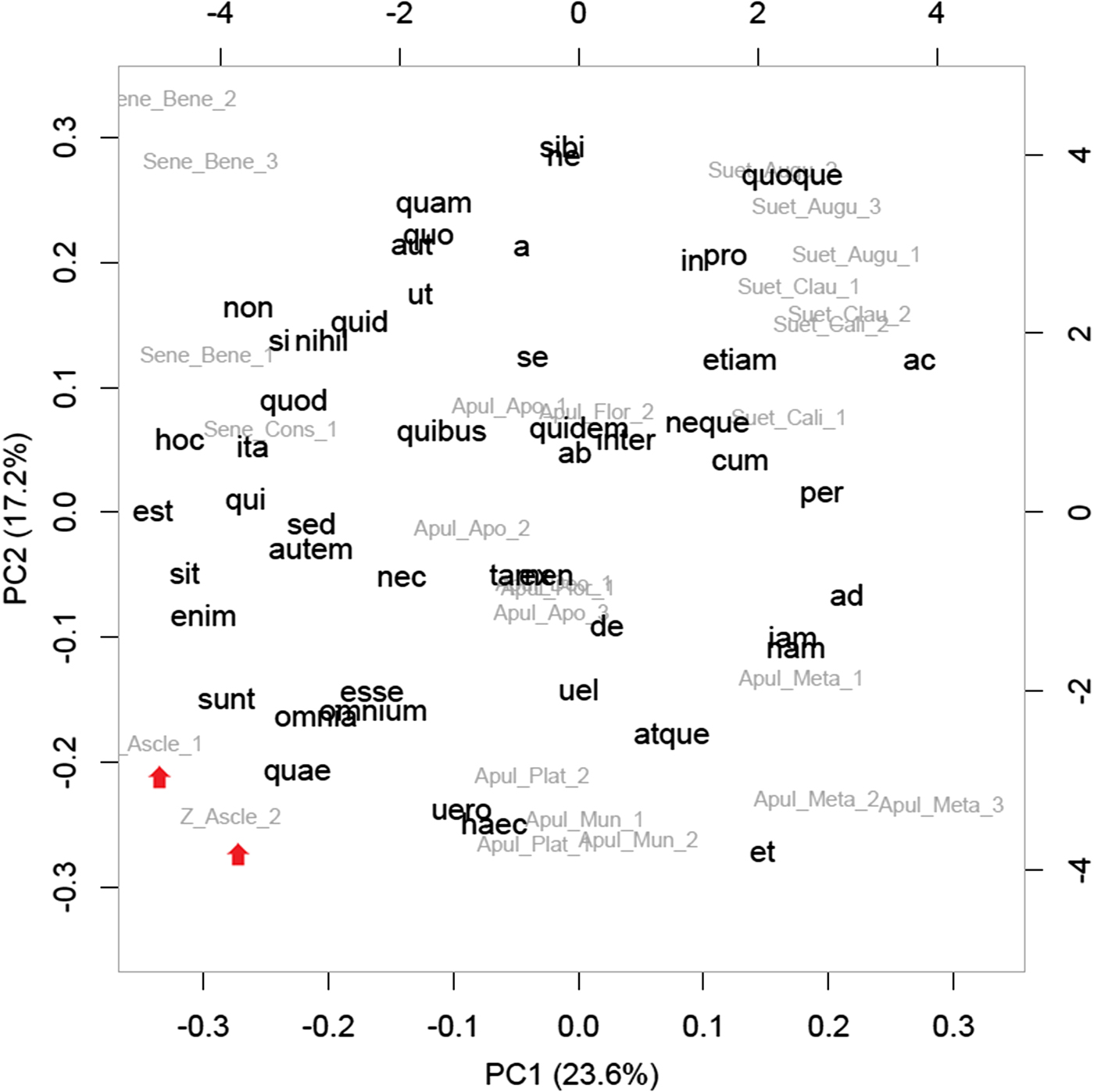
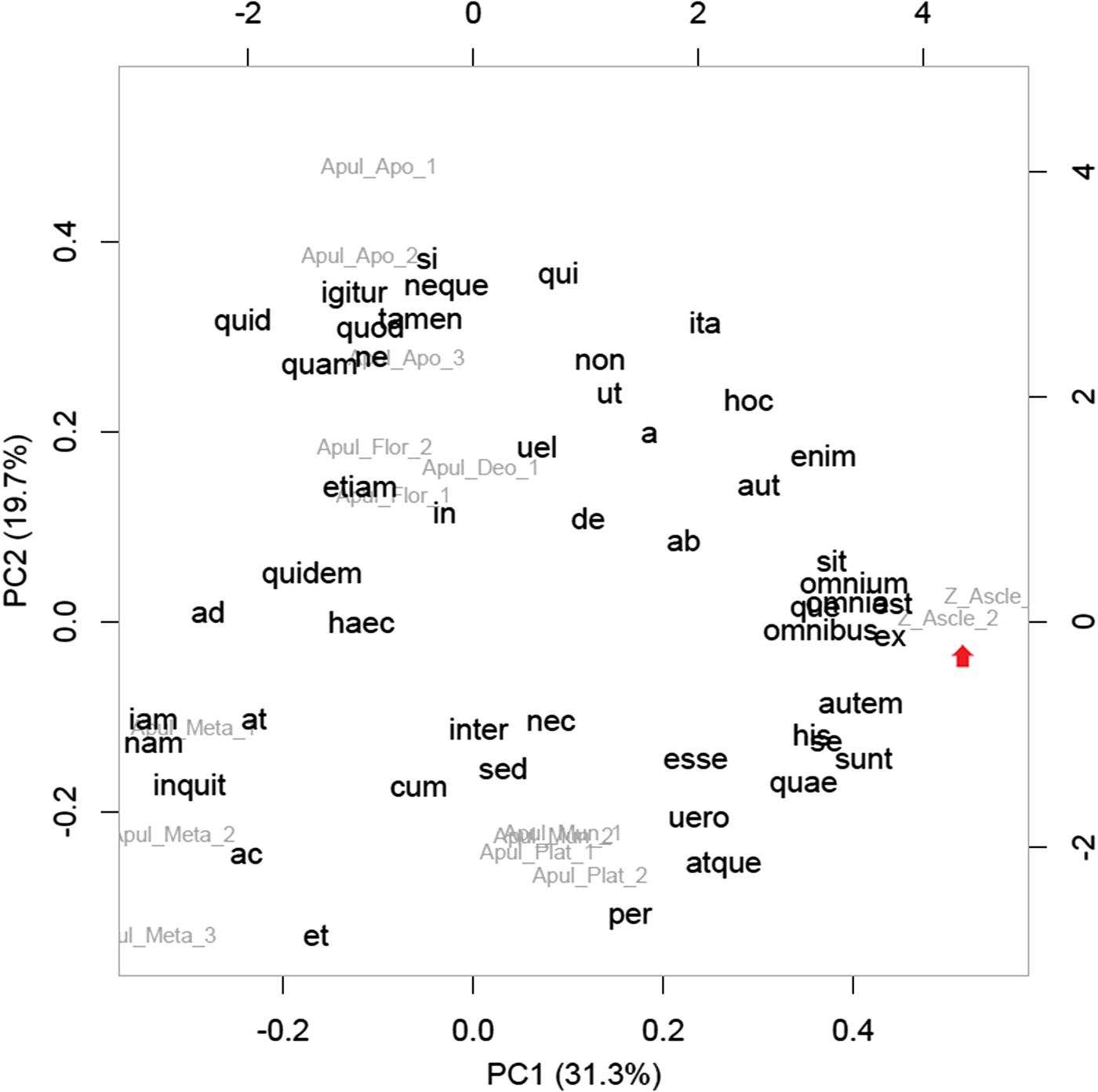
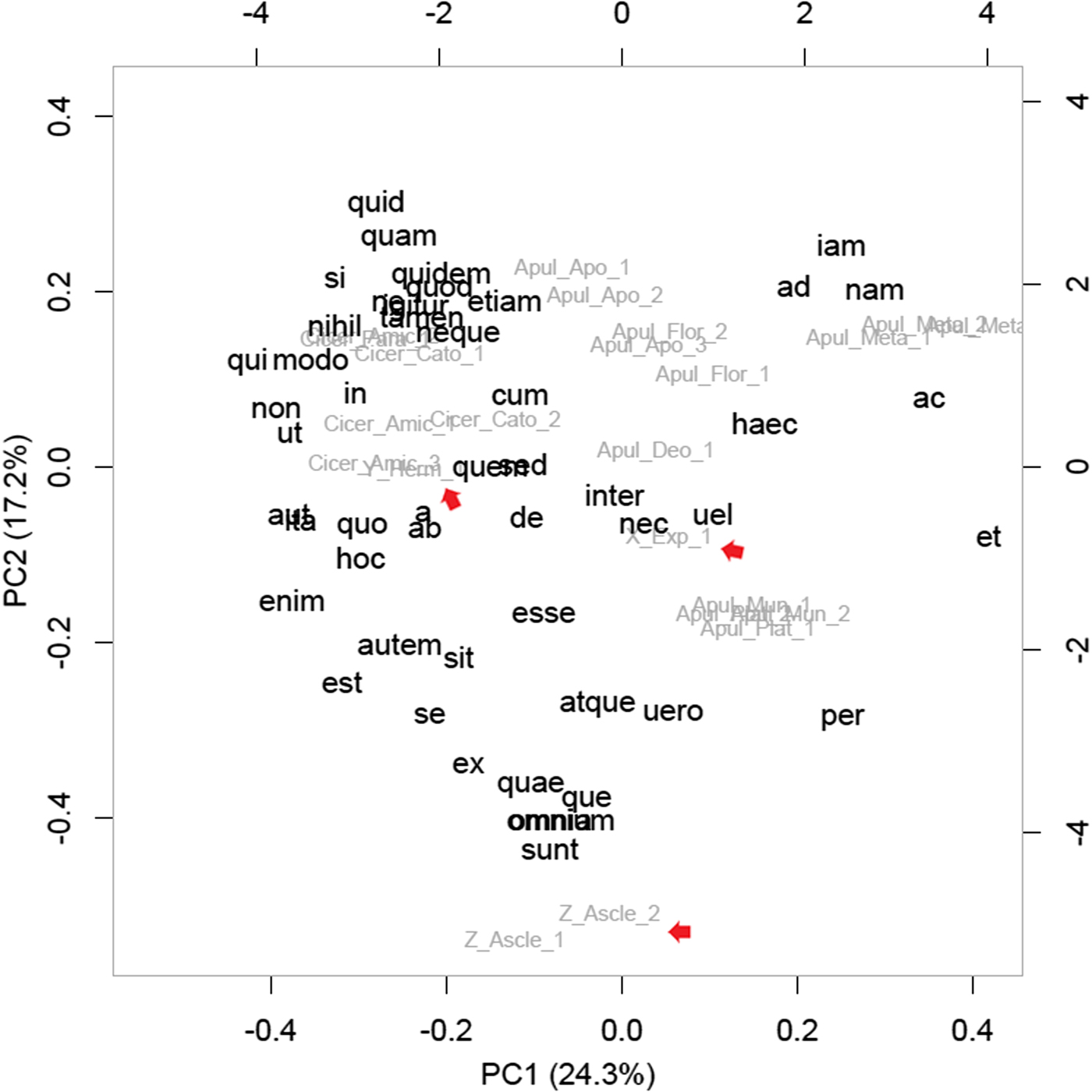
First, the Asclepius. We have assigned the text to unknown author Z, and conducted a PCA with the accepted corpus, with Seneca and Suetonius for initial comparison of 50 MFW (Figure 9). Even this preliminary analysis is highly suggestive: the Asclepius’ samples cluster together at the margins, relatively far from the other samples. So next we exclude the comparison authors, and just examine the Asclepius with the accepted corpus, once again at 50 MFW (Figure 10). Here we find considerable diversity across the corpus, but general consistency. The Asclepius samples again cluster at the extreme right margin. The horizontal dimension and the left-right oppositions in PCA scatterplots are relatively more important than the vertical dimension. (This can be gauged from the percentages listed near the axis labels, which indicate how much of the original variation is captured by a particular dimension.) Therefore, it is important that the Asclepius is generally separated from the accepted corpus on the horizontal axis, as is for instance the case in Figure 10. To ensure that these results are not only describing differences in content, we have run the similar experiments with different settings. The results were unchanged and the Asclepius never mingled with the accepted works. The trends in our experiments corroborate the results obtained in traditional scholarship, which argue against the authenticity of the Asclepius.Footnote 41
Principal Components Analysis with feature loadings (3,000-word samples), 50 MFW

Principal Components Analysis with feature loadings (3,000-word samples), 50 MFW

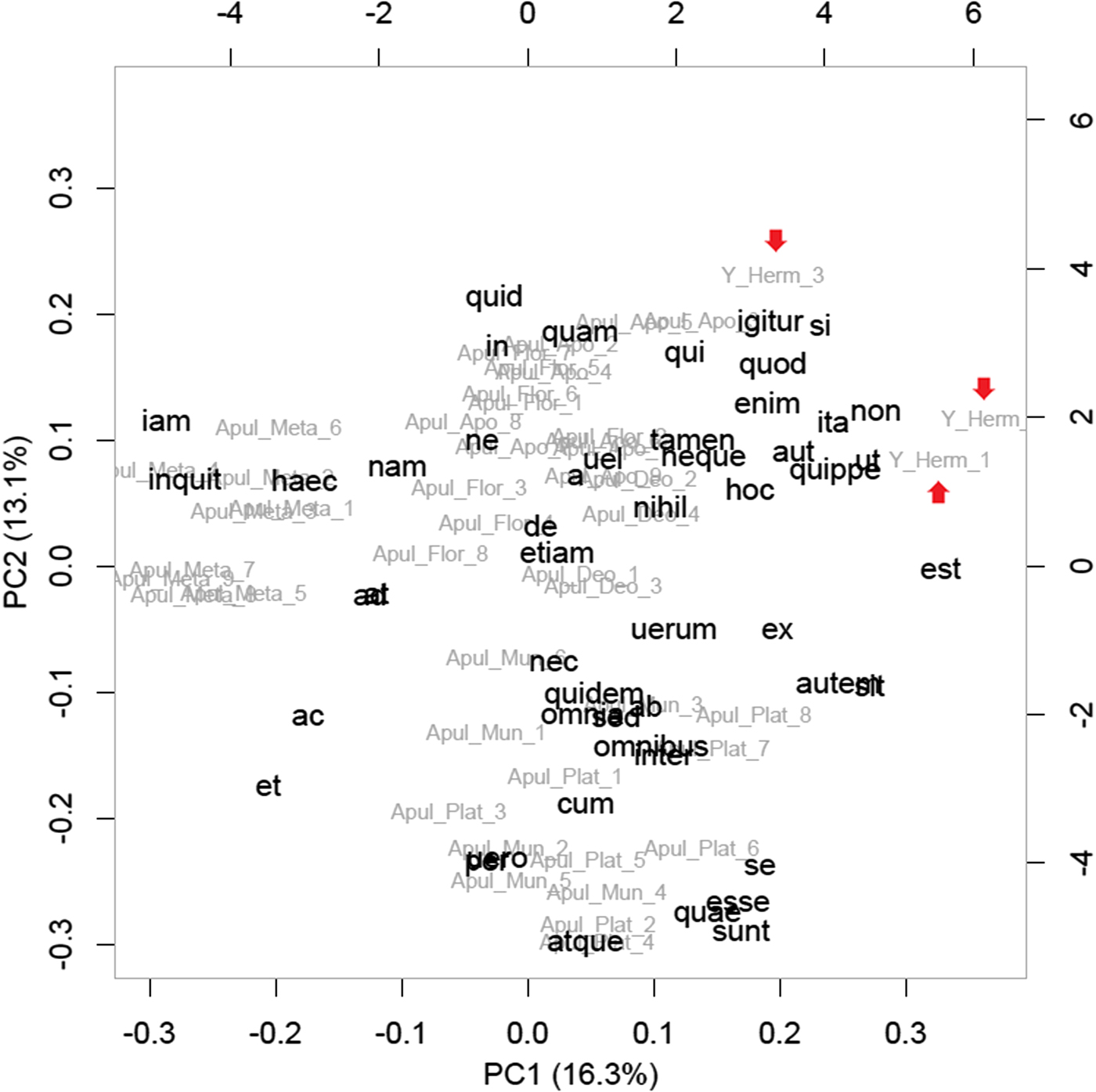
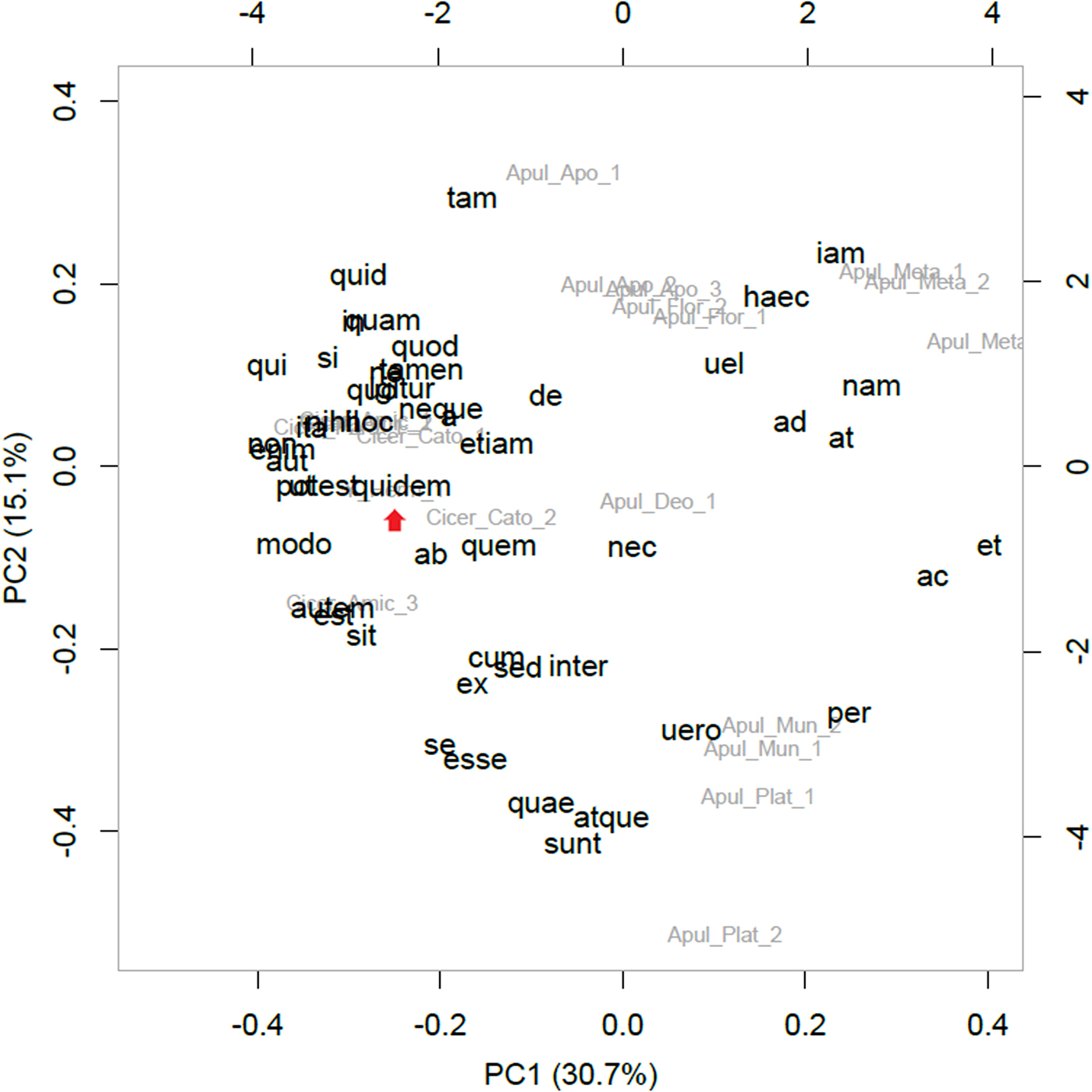
Testing the Peri hermeneias gives us similar results. Comparing it to the Apuleian corpus (adopting a small sample size of 1,000 words), we find that it is less internally coherent (the samples tend to be widely separated) but still gravitates toward the margins of the PCA plot (Figure 11). When we increase the sample size to 3,000 words again and add a third author for comparison, here Cicero, the result is striking (Figure 12). Unlike the Asclepius which tended to cause the samples of Apuleius and the background authors to cluster together more closely, the Peri hermeneias is directly intermingled with the works of Cicero, with a fairly clear vertical zone separating it from Apuleius’ works.
Principal Components Analysis with feature loadings (1,000-word samples), 50 MFW

Principal Components Analysis with feature loadings (3,000-word samples), 50 MFW (NB: in this figure, the sample from the Peri hermeneias is hiding behind quidem)

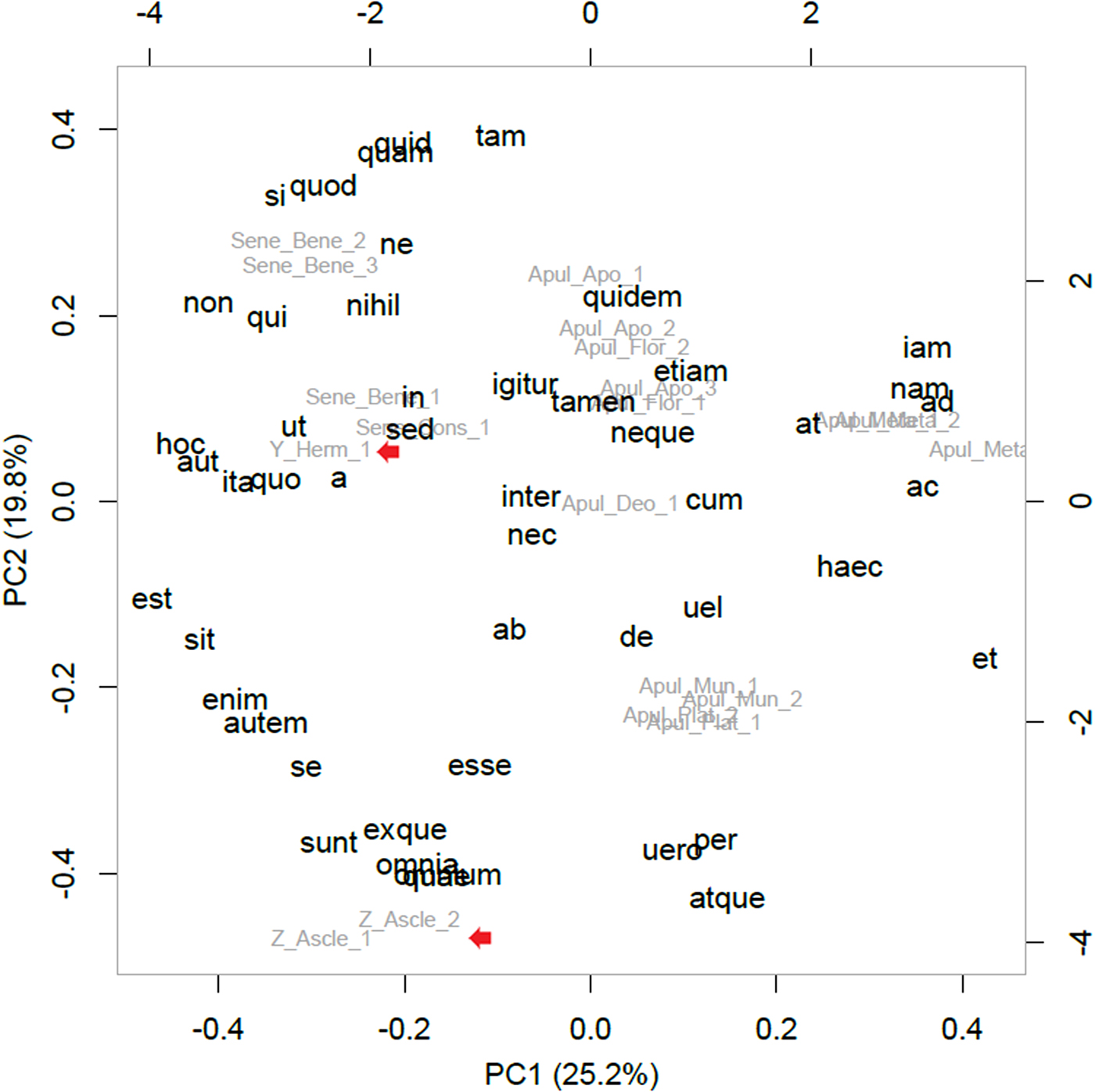
Notwithstanding its brevity, the relative ease with which the Peri hermeneias can be lured away from Apuleius’ texts suggests that it is not by Apuleius, but perhaps also that it is stylistically closer to Cicero and Apuleius (that is to say, to classical prose) than the Asclepius is. For these two works, our cautious conclusion must therefore be that they represent the works of two different authors, neither of whom is Apuleius. Conducting a PC analysis of the two texts with Apuleius and Seneca (Figure 13) reinforces this conclusion. This plot also shows once again that the Peri hermeneias is closer to our classical, or pre-second-century, comparands than the Asclepius is.
Principal Components Analysis with feature loadings (3,000-word samples), 50 MFW

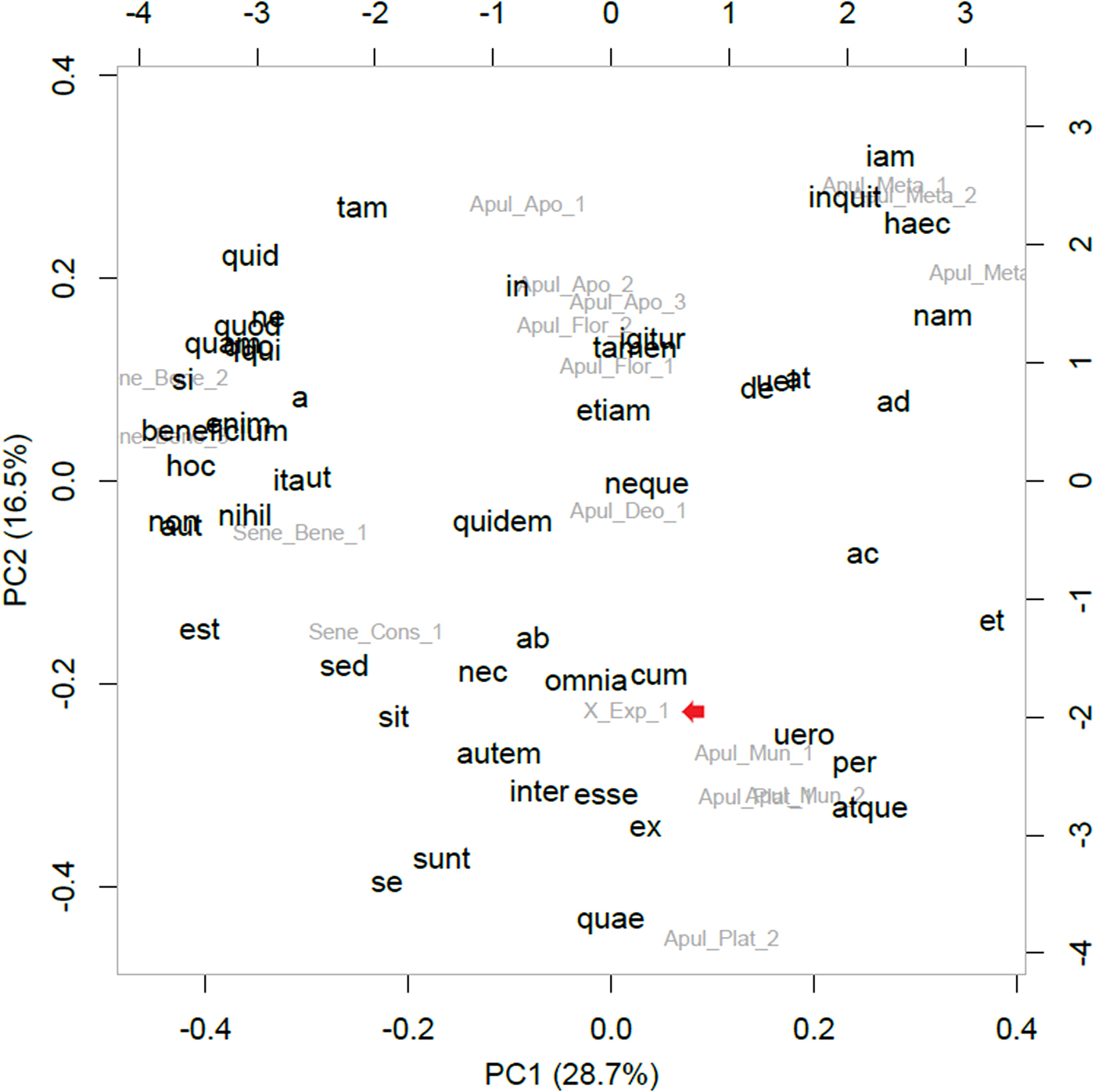
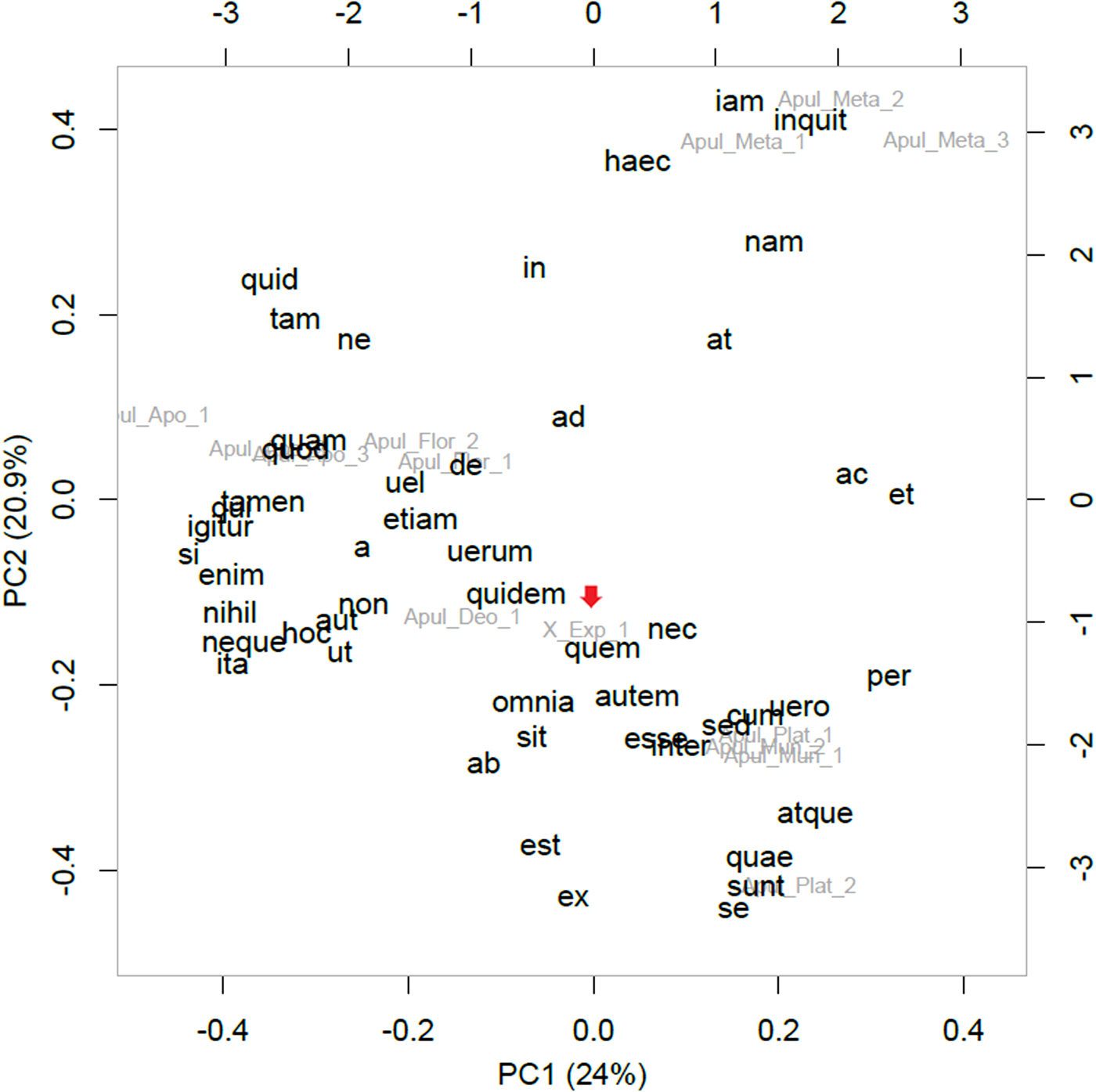
The Summarium librorum Platonis, or, to use its more correct title, the Expositio compendiosa de Platonis pluribus libris, is a summary of fourteen Platonic dialogues found in a single manuscript of the philosophica after the end of the De mundo. Despite the fact that it has been known for sixty years, it has not yet been published. We have used the text from the forthcoming editio princeps. There are many compelling reasons to posit that this text was in fact composed by Apuleius and originally was an integral part of the De Platone; they are laid out in detail in the introduction to the forthcoming edition. Here we are only examining the evidence that can be garnered from computational analysis. First we conducted a PC analysis at 50 MFW with Seneca (Figure 14): the result is that the Expositio closely clusters with the De Platone and the De mundo, and there is a somewhat clear vertical axis that separates Apuleius and the Expositio from Seneca. Removing Seneca (Figure 15), we find once that the works of Apuleius tend to form three distinct clusters—the philosophica, the rhetorica and the Met.—with the De deo Socratis appropriately located between the first two. The Expositio, far from gravitating out of the main group, as the Asclepius and the Peri hermeneias did, remains closely linked with the De Platone and the De mundo. How much closer the Expositio is stylistically to the authentic corpus than the two disputed works are can be seen by comparing a PCA plot of all three together with the accepted works and Cicero (Figure 16).
Principal Components Analysis with feature loadings (3,000-word samples), 50 MFW

Principal Components Analysis with feature loadings (3,000-word samples), 50 MFW

Principal Components Analysis with feature loadings (3,000-word samples), 50 MFW

The Asclepius gravitates toward the lower gutter, far from all the other works; the Peri hermeneias nestles with Cicero. There is a porous but still relatively clear vertical axis that separates Cicero and the two disputed works from Apuleius; the Expositio remains on the right side, still anchored to the De Platone and the De mundo. Based on this consistent collocation of the Expositio with Apuleius in general and the philosophica in particular, it should come as no surprise that a BCT with a wide range of imposters still shows the close relationship it shares with the Apuleian corpus (Figure 17).Footnote 42
Bootstrap Consensus Tree (3000-word samples)

WORD FREQUENCIES
Digging into the data provided by the PCA charts, and particularly their loadings, shows this method's affinities with traditional philological analysis. One can do this two ways: by looking at the words which stand either with or in opposition to the text samples of a given author, and then analysing the absolute frequency of those words in a given text or author; or by examining oppositional pairs, that is words with roughly the same meaning that stand at opposite sides of the chart, such as nam and enim.
One effective way of examining the evidence from individual words is the use of Craig's Zeta, a comparison method that constructs a double list of words preferred and avoided when two sets of texts are compared.Footnote 43 Instead of looking at relative frequencies, this measure will extract equal-sized slices of words from two corpora, and compare in how many of these slices a particular word is present or not. Using the Peri hermeneias as our primary set and the authentic works as our secondary set, the significant words not attested in the former include the following (with the number of times they are found in the authentic works, excluding obviously the Expositio):

Anyone who still wants to defend the authenticity of the Peri hermeneias needs to consider and explain how these 10 words which occur together over 700 times in the authentic works, or about twice in every 300 words, do not occur at all in a work of almost 4,000 in length, where we would expect around 27 occurrences. By contrast, there are 30 in the slightly longer De deo Socratis, and 34 in the first book of the Metamorphoses.
The list for the Asclepius is equally illuminating:

These nine words occur more than 500 times together, about once every 200 words in the corpus as a whole; and yet, there is not a single instance in the almost 9,000 words of the Asclepius, where we would expect an average of about 45 in an authentic work of this length. (Compare 20 instances in the two books of the De Platone, of almost exactly the same length; 50 in the first two books of the Metamorphoses; and 54 instances in the shorter Florida). Of the items in the lists above, only inde and prorsus are not in the Expositio. To them one could add ergo, which is found 72 times in the authentic works. The other words not found in Expositio are too laden with generic and topical significance to be relevant to this inquiry.
Overall, this individual-word approach is fairly robust and insensitive to genre and content. None the less, it is still open to the charge of selective bias: it is possible (if not likely) that Apuleius simply never felt it was quite the right place to use alioquin, inde, prorsus, profecto or longe in the Peri hermeneias or in Asclepius. The other approach, examining oppositional pairs, complements the potential weaknesses in the individual-word approach. Given two words that are generally interchangeable, how often does a given author prefer one over the other? These pairs are in opposition when they occur on opposite sides of the PCA plots above.
A good example here is nam and enim, roughly equivalent in meaning, and consistently in opposition on the charts above.Footnote 44 Here, instead of dealing in absolute frequency, we can look at the relative frequency of one to the other. In the accepted corpus, of roughly a 100,000 words, the frequency of nam to enim is 9:10 (0.90), although in the philosophical corpus this ratio drops to 3:4 (0.76). By contrast, the ratio in Pliny the Elder is much lower at 2:5 (0.42), in Cicero is even lower at almost 1:3 (0.37), and in Tertullian lower still at 3:10 (0.30); in Tacitus, by contrast, the ratio is considerably higher at 8:5 (1.68), and astonishingly higher in Sallust at almost 12:1 (11.7). Now in the Expositio and the Peri hermeneias, the ratio is not significantly different than that in the philosophica at roughly 6:10 (0.58 and 0.63 respectively). In the Asclepius, however, the ratio is a miniscule 6:100 (0.06), lower, in fact, than in any other author we tested. In absolute terms, nam occurs only 6 times, while enim has 103 attestations; in the De Platone, by contrast, a work of roughly the same length, there are 19 instances of nam and 25 of enim. Hence, we can conclude two things: that the author of the Asclepius uses nam/enim far more frequently than Apuleius, and that he has a massive preference for enim. The Expositio has 7 instances of nam and 12 of enim; from this we can conclude that both the absolute frequency of the pair and their relative frequency to one another is roughly consistent with Apuleian usage.
Another pair worth examining is igitur/ergo. In the accepted corpus, we find a frequency of roughly 2:1 (2.08), and looking at just the De Platone, we find 8 instances of igitur and none of ergo. We can posit that Apuleius had no strong preference for using this pair at all, but when he did he more often preferred igitur. Just for the sake of comparison, we find ratios of 3:1 in Cicero (3.35) and 4:1 in Gellius (4.26), while, on the other side, we find a frequency of 1:5 (0.19) in Pliny the Younger, and 1:50 (0.02) in Seneca. For the disputed works, we find nothing inconsistent in the Expositio, which has one attestation of igitur and none of ergo. But in the Peri hermeneias there is a very high absolute frequency of the pair (unsurprising, given the genre) and a large preference for igitur over ergo, to the tune of 10:1 (9.75). In the Asclepius, igitur is not attested at all, while ergo is found 55 times. Anyone who wants to defend the authenticity of the Asclepius would have to account for this glaring discrepancy with Apuleius’ usual style.
None of these little case studies is meant to offer definitive proof one way or another. Rather they illustrate the kind of data stylometric techniques analyse when they produce the results they do. And while we have only looked at the data here for a small number of cases, the program analysed 50 or more of the MFW. Hence, the examination of the Apuleian corpus we have conducted is similar in method to that conducted by Redfors in 1960, which examined many of the same terms, such as nam, enim, igitur and ergo.Footnote 45 But extending his manual calculations with computational methods vastly increases the quantity of data available for analysis. Thereby we can go beyond his judgement that the question of the De Platone and the De mundo represents an unlösbares Echtheitsproblem. Footnote 46 Computational methods allow us to make a definitive claim in favour of their authenticity; indeed, they allow us to recharacterize his question as a lösbares (and even gelöstes) Echtheitsproblem.
CONCLUSIONS AND PERSPECTIVES
The conclusions we have reached indicate first that the authorship of the De Platone and the De mundo should no longer be questioned, as indeed a majority of scholars have for some time held. The only remaining objections to the attribution of these handbooks to Apuleius are based particularly on rhythm, both on the presence of cursus mixtus, or a combination of metrical and rhythmic period terminations, and on the frequency of false quantities. But all the scholars who have studied these questions—Redfors, Oberhelman and Hall, and Holmes—have cautioned that we simply have too little surviving literature from the end of the second century to have suitable comparanda. Since the works are in fact authentic, their attribution to Apuleius should stand as the starting point for examination into the history of later Latin prose rhythm. It is undoubtedly interesting that we can fix the beginnings of cursus mixtus in North Africa in the second half of the second century, and it is even more interesting that at its beginning it was used in alternation with the more formal system of clausulae. Hence, the development of cursus should not be thought of only as an unconscious evolution, but at its beginning a deliberate stylistic choice, dependent on register, genre and audience. Further, perhaps ‘false quantities’ are not simply ‘false’, but are rather deployed or not deployed according once again to register, genre and audience.
The second conclusion we can draw is that the Asclepius is probably not by Apuleius—despite certain superficial similarities with Apuleius’ style, in a comparison with other texts it leaps out too often to warrant an attribution. In other words, in word choice, and particularly in the use of function words, Apuleius, Cicero, Seneca, Tertullian and a number of other authors are closer to each other than any of them are to the Asclepius. This fact corroborates the hypothesis of a fourth-century date for the translation.
The third conclusion we can provisionally draw is that there is no good reason to accept the attribution of the Peri hermeneias to Apuleius, despite the fact that it generally seems closer in style to Apuleius than the Asclepius. One must emphasize that its small size makes definitive judgement on statistical grounds alone impossible. None the less, we have identified a number of potential problems with the attribution, which admit no easy riposte. Given the serious objections that have been raised to Apuleian authorship, the results we have reached, though not conclusive, are still damning. Computational methods have given us no particular reason to support the attribution, and any number of reasons to doubt it, a fact which makes the burden of proof on those who would accept the attribution even heavier. More positively, however, the Peri hermeneias consistently remained more closely collocated with the classical texts under analysis than the Asclepius; more research is obviously needed, but as a preliminary hypothesis, our findings suggest that dating it to a generation after Apuleius would not be inappropriate.
The fourth reasonably solid conclusion we can draw is that there is no reason to dismiss the authenticity of the Expositio, that it is consistently more closely linked to Apuleius in general and the philosophica in particular than either the Asclepius and the Peri hermeneias or any of our background texts, and that there is a high probability that it is by the same author on statistical grounds. This is not to say that there are no stylistic differences—they are many and obvious—but on the aggregate these differences are not sufficient to disprove Apuleian authorship or to overwhelm the stylistic similarities. We must stress that computational methods alone will not give us any definitive answers; rather, they work to corroborate or undermine other types of evidence. Elsewhere the whole case for Apuleian authorship has been laid out: let it suffice here to mention that there are undeniable intertextual links between it and the De Platone, that it is certainly a product of the second century, and that it contains some of the conspicuous and obvious features of Apuleius’ style. Here we add that stylometry offers no case for rejecting the attribution, and several good reasons for accepting it.
In addition to these specific conclusions regarding the authenticity of individual works, our data also suggest a model for classifying Apuleius’ different works. In the plots above, the corpus is usually split into three relatively distinct groups: the Metamorphoses, the rhetorica and the philosophica. The De deo Socratis, being a rhetorical performance-piece on a philosophical topic, tends to fall between the latter two. This dovetails with the traditional classification of Apuleius’ works, and once again demonstrates the sensitivity of our computational methods. Examining just Apuleius’ works (with the Expositio included), as presented in Figure 15 above, we can get some sense in technical terms of how this division comes about: nam is strongly preferred in the Met. and enim avoided, while the rhetorica in particular, but also the philosophica, use both, without so strong a preference for nam. In adversative particles, a threefold division can be seen: the Met. prefers the strong (and sometimes narratological) at,Footnote 47 while the rhetorica goes for the strong tamen, while the philosophica tend toward sed, autem, uerum and uero.
We have only scratched the surface of the possible applications of modern stylometry to classical texts. We have cleared up some of the problems plaguing the works attributed to Apuleius. We have also demonstrated how stylometric experiments for authorship attribution in classical Latin texts can be designed and executed. Finally, we have shown some of the additional benefits that can be reaped from the application of these kinds of analysis for the study of style and genre. Computational experiments designed to test generic questions may well in the future be able to give even more precise results as to the lexical choices that are one constituent of genre. Methods similar to the ones we use here may also be effective in sorting through the difficulties of other vexed corpora, such as the corpus Caesarianum or the Major Declamations of ps-Quintilian. At the least, we hope that the use of computational methods in conjunction with traditional philology in exploring classical literature will continue to expand and shed light on problems and questions both new and old in the field of Classics more broadly.