INTRODUCTION
Recognition of interaction between Copan and Late Classic western El Salvador goes back decades (Longyear Reference Longyear and Boggs1944:4–5). One of the most-studied ceramic types of the Late Classic in this region is Copador polychrome (a portmanteau from Copan and El Salvador), also found in southeastern Guatemala (Moisa Reference Moisa2013:24–26). Copador was used by the general populace in western and central El Salvador and Copan, judging from both its ubiquity in the archaeological record (Bill Reference Bill1997:400; Hirth Reference Hirth, Boone and Willey1988:Figure 10), and its use by villagers at the non-elite site of Joya de Ceren (Beaudry-Corbett Reference Beaudry-Corbett and Sheets2002; Bill Reference Bill1997:400; Hirth Reference Hirth, Boone and Willey1988:Figure 10; Moisa Reference Moisa2013; Sheets Reference Sheets2006). The production locations of cream ware ceramics, including Copador, are still uncertain (Bishop et al. Reference Bishop, Beaudry, Leventhal, Sharer, Urban and Schortman1986). A number of examples were certainly made in the Copan Valley and eventually made their way to the south (Bishop Reference Bishop, Beaudry, Willey, Leventhal, Demarest and Fash1994:425–426).
Archaeologists generally tend to treat Copador as a borderland anomaly. From the perspective of archaeology in El Salvador, Copador vessels have been interpreted as symbols of identification or affiliation with Copan and the Maya (Beaudry-Corbett Reference Beaudry-Corbett and Sheets2002:124–126; Bruhns Reference Bruhns and Lange1996:290–291). Across the modern border in Honduras, Copador is viewed as evidence of ties to El Salvador (Bill Reference Bill1997:303, 411–413). This is not an unsurprising phenomenon. “Hybrid” or “blended” material culture that defies cultural boundaries causes problems for archaeological typologies designed for creating homogenous spatial and temporal units of analysis (Card Reference Card and Card2013:4–5; Deagan Reference Deagan and Card2013:260–262). In the case of Copan and El Salvador, this issue highlights a larger discussion over defining the southern boundaries of Mesoamerica. Different approaches to and definitions of Mesoamerica and areas to the south use different criteria, generally with an increased focus on the archaeological in contrast to Kirchhoff's (Reference Kirchhoff1943) emphasis on language and ethnographic practices (Creamer Reference Creamer1987; Sheets Reference Sheets, Adams and MacLeod2000:408–411). These various approaches, nonetheless, generally present El Salvador as a frontier (Sheets Reference Sheets, Adams and MacLeod2000). This is especially the case during the Classic period, when western and central El Salvador have often been seen as being particularly influenced, and likely inhabited, by speakers of Mayan languages (Bruhns Reference Bruhns and Lange1996:290–292; Fowler and Earnest Reference Fowler and Earnest1985:24–25; Sheets Reference Sheets, Adams and MacLeod2000:423–434, Map 9.4).
Monumental architectural and sculptural styles at the two largest Late Classic sites in central and western El Salvador—Chalchuapa and Campana San Andrés—also suggest ties to Copan. It has previously been argued that Tazumal Monument 21 was designed to emulate the iconic material culture of the literate Classic Maya region to the north, specifically the portrait stelae of Copan (Cobos Reference Cobos1994:73). Elites exchanged prestige items in this region, with recognizable high-value imports generally moving from the north (Copan or other cities) to the south. As at Chalchuapa, adobe pyramidal platforms at Campana San Andrés in the Zapotitan Valley suggest similarities with Kaminaljuyu to the west, while Copador and other artifacts tie the center to Copan. The most famous of these is an eccentric effigy chert like those chipped at Copan, found in Structure 7 of Campana San Andrés in 1977 by Jorge Mejía Rivas (Bello-Suazo Reference Bello-Suazo2009:84, 136; Cobos Reference Cobos1994:35–36) along with stingray spines, Spondylus shell, and Copador and Peten-style pottery (Moisa Reference Moisa2013:62–63). The presence of tenoned stone sculptures in offerings on the site's southern acropolis has also led to suggestions of interaction with Copan (Boggs Reference Boggs1943a:110–111; Fowler Reference Fowler1995:100–101).
A miniature flask deposited in a burial in the main pyramid at the Tazumal complex of Chalchuapa now provides an explicit historical link to Copan. Two identical vertical texts on the vessel name its original owner as K'ahk' Uti' Witz' K'awiil (Copan Ruler 12), whose long and distinguished reign (a.d. 628–695) coincides with the height of Copador use at Copan, as well as with evidence for Copan's influence outside of the Copan valley into southeastern Guatemala, southern Belize, and, as it now seems, even into western El Salvador. This vessel and its placement in an elite funerary context at the largest political center in Late Classic El Salvador suggest explicit diplomatic ties between Copan and at least one polity to the south. This vessel is one of the few modeled miniature flasks of its kind to contain a Primary Standard Sequence (albeit a truncated one) and the only one inscribed with the names and titles of a known Classic Maya ruler.
GRAVE 20, TAZUMAL, EL SALVADOR
Hieroglyphic texts are extremely rare in El Salvador, and the two best-known examples are both found in Western El Salvador. A Late Preclassic stela fragment found in Structure E3–1 of the El Trapiche group at Chalchuapa (Sharer Reference Sharer1974: Figure 7) contains an eroded, presently indecipherable text in fine-line inscriptions arranged in single columns, reminiscent of other Late Preclassic texts in eastern Mesoamerica (e.g., Justeson and Kaufman Reference Justeson and Kaufman1993; Mora-Marín Reference Mora-Marín2001). A jade celt recovered from Lake Güija on the El Salvador-Guatemala border is in the style of Early Classic Peten inscriptions and was most likely later deposited in the lake (Houston and Amaroli Reference Houston and Amaroli1988:2–3). By contrast, common regional ceramic types such as Copador, Ulua Polychromes, and various brown and black modeled types are typically dominated by illegible pseudoglyphic designs.
A miniature flask (A1–2798) in El Salvador's National Museum of Anthropology (Museo Nacional de Antropología or MUNA) is inscribed with one of the few legible Maya inscriptions found in El Salvador, though the vessel was almost certainly made in Copan, Honduras. It was found during excavations directed by Stanley Boggs in the Tazumal group in Chalchuapa in 1952. Boggs (Reference Boggs1943b, Reference Boggs and Longyear1944:56–72) began work at Chalchuapa in 1942 and directed over a decade of extensive excavations, primarily in the largest monumental structure in pre-Columbian El Salvador, Structure B1–1 (Figure 1). This pyramid and palace structure was modified repeatedly during the Late Classic period and contains numerous tombs from this period, such as Tomb 14, excavated in 1950 and containing jade, carved stone, and ceramics (Bello-Suazo Reference Bello-Suazo2009:137; Fowler Reference Fowler1995:117–124). Only the early portions of the B1–1 excavations were published (Boggs Reference Boggs1943b, Reference Boggs and Longyear1944). Boggs (Reference Boggs1962, Reference Boggs1963) had planned to produce a monograph on the entire project but increasing duties in overseeing archaeological work in El Salvador prevented him from completing this task (Andrews Reference Andrews1996:58). Photographs of Flask A1–2798 have previously been published in two general volumes on the archaeology of El Salvador (Bello-Suazo Reference Bello-Suazo2009:86; Fowler Reference Fowler1995:104), but without a clear image of the glyphic texts or precise provenience information.
Structure B1-1, Tazumal, El Salvador, during excavation by Boggs, prior to restoration. Structure 1E is the small shrine in good condition in the center-right of the image. Photograph by Stanley Boggs, courtesy of Middle American Research Institute, Tulane University.

Boggs's Tazumal excavations uncovered 22 tombs, several containing multiple burials. The Tazumal flask was found in 1952 in Structure 1E-sub, Grave 20. This structure is a T-shaped shrine or temple section (Boggs Reference Boggs1962:491) near the top of what is today known as Structure B1–1. Many of Boggs's original records were obtained two decades ago by the Middle American Research Institute at Tulane University. Photographs and notes on the artifacts found in Grave 20 are included in this collection but the field notebook containing Boggs's field notes on these particular excavations did not make it into the Tulane collection. A catalog card in the Tulane collection for the flask has a date of April 15, 1952, but we suspect this is the date the object was catalogued by the museum, not the date of excavation.
The current disposition of the human remains from Grave 20 is not known. However, Boggs's notes at Tulane record that they were of a flexed adult placed on a bench with the body oriented east. A photograph in the National Museum, dated to January 25, 1952, depicts human remains found under the stairs leading to Structure 1E, in a context “1E – 0,” which may equate to 1E-sub (Figure 2).Footnote 1 The remains were found at the beginning of an exploratory trench placed through the stairs. The photograph depicts what may be a flexed burial with two long bones and what may be a fragmented mandible, sitting in situ in a partially pedestalled area. No artifacts are visible in the photograph but it resembles the description Boggs (1942–1963) gives of the remains in Grave 20. This trench is not marked on the architectural plan of Structure 1E in Boggs's notes at Tulane.
Photograph 52-2-7 in the archives of the Museo Nacional de Antropología, El Salvador. The photo dates to January 25, 1952 and records human remains found in an exploratory trench under the stairs of Structure 1E at Tazumal, labeled Structure 1E-0 by Boggs. This is likely a photograph of Grave 20. Photograph courtesy of the National Museum of Anthropology, El Salvador.

The location of Grave 20 under Structure 1E indicates that the context dates to the Late Classic, agreeing with the textual information on the flask. Boggs's (1942–1963) notes call Grave 20 “Late Classic” and, in a profile of Structure 1E, the architectural strata associated with the central pyramidal mound contemporary with and attached to Structure 1E are marked by Boggs as containing Copador sherds.
Photographs and inventories of the various grave lots indicate that Grave 20 included the following artifacts (Figures 3–4):
-
1. The miniature flask (A1–2798).Footnote 2
-
2. A round perforated medium green flecked vitreous jade ring or large bead (A2–21), measuring 3.2 × 4.2 cm across, the center perforated with a nearly cylindrical hole 2 cm in diameter.Footnote 3
-
3. A tubular-rectangular medium-green vitreous jade perforated bead (A2–22), measuring 3.2 × 3.4 cm across, 2.6 cm thick, the diameter of the perforation at 1.7 cm.
-
4. A round dark green jade bead, biconically drilled, 1.3 cm in diameter.
-
5. A brownish “discolored” jade flat plaque, measuring 2.5 × 3.5 cm, with two holes drilled through the plaque.
-
6. An irregular ovoid, flat, light green, flecked jade plaque with two holes drilled through this object near the edges and an additional transverse hole piercing the object perpendicularly, measuring 2.4 × 3.7 cm.
-
7. A flat, quatrefoil jade plaque (A2–23) measuring 4.1 cm x 4.5 cm, and 0.5–1.0 cm thick, with a cylindrical “neck” projecting from the back where the main perforation occurs, and cross-cut by two “side–side” perforations.Footnote 4
-
8. A flat, quatrefoil light green vitreous jade plaque (A2–24), measuring 4.0 × 4.8 cm, and 1 cm thick. The design, neck, and perforations of this plaque match the previous plaque (A2–23).Footnote 5
-
9. A flat, light green jade sculpture of a fish in profile, measuring 2.4 × 4.4 cm. There are five small holes drilled through this plaque, suggesting it was attached to a larger object.
-
10. One or more pyrite reflectors. The nature, appearance, or number of these is not recorded in Boggs's extant notes beyond the word “reflector” but the presence of a “reflector” is noted for Grave 20 in one of the comparative grave lot charts in the Tulane notes. While it is likely that this may be a mirror, we cannot say without additional description or images.
The inventories of other graves in Boggs's notes focus mostly on ceramics, so any ceramics other than the “tear flask” Boggs notes in Grave 20 should be listed. A master inventory of ceramic type by tomb shows no additional ceramics from Grave 20. We can be confident that the flask, the jade objects, and the pyrite reflectors were the only artifacts found in Grave 20.
Jadeite objects from Grave 20. Photograph from notes of Stanley Boggs, courtesy of Middle American Research Institute, Tulane University.

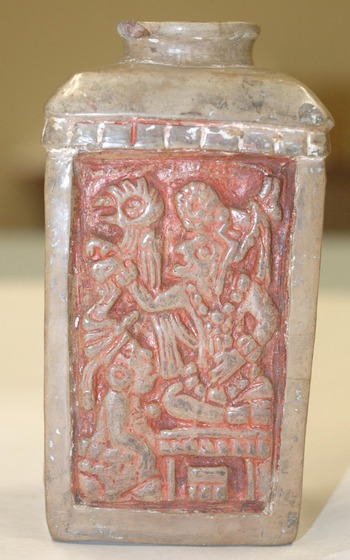
The Tazumal Flask, A1-2798. Photograph by Card.

THE TAZUMAL FLASK
The flask is rectangular, 12.5 cm tall, 6 cm wide, and 4.9 cm long. The top of the vessel is a short round neck with an orifice 3.5 cm in diameter. Red pigment, likely cinnabar based on visual inspection, fills the recessed spaces of two identical texts on the narrow sides of the vessel, and in two wider iconographic panels. The base is slightly recessed but does not have any red pigment. No evidence of stucco can be seen on the vessel today, but in 1952 the frames of the panels were covered with dark blue stucco and the upper crenelated edge above the panels was covered with yellow stucco. This flask is similar to other “poison bottles” found in the Late Classic southeast Maya region around Copan and to a lesser extent at lowland Maya sites such as Piedras Negras (Houston et al. Reference Houston, Stuart and Taube2006:115).
More specifically, it appears to be an example of the Don Gordon Modeled-Carved type of the Tipon Group at Copan (Willey et al. Reference Willey, Leventhal, Demarest and Fash1994:59–61, 219–220, 321, 404) also known as the Madrugada Modeled-Carved type in the Surlo Group (Bill Reference Bill1997:265). This type was produced at Copan during the Coner phase (Bishop and Beaudry Reference Bishop, Beaudry, Willey, Leventhal, Demarest and Fash1994; Eppich and Loughmiller-Cardinal Reference Eppich and Loughmiller-Cardinal2014) but is part of a larger polished black-brown tradition in the southeastern Maya highlands with carved or modeled variants, such as the Chiquihuat group at Chalchuapa, particularly Chingo Plano-relief found in Tazumal graves (Bill Reference Bill1997:225–226; Sharer Reference Sharer and Sharer1978:42–49; Willey et al. Reference Willey, Leventhal, Demarest and Fash1994:60–61).
The type specimen for classifying this kind of bottle at Copan (1-1214; Willey et al. Reference Willey, Leventhal, Demarest and Fash1994:219–220) was recovered from a tomb and contained cinnabar. Other examples of “poison bottles” have been found in burials, a cache in Structure 9N-8, and in refuse in elite residential groups at Copan (Hendon Reference Hendon1987:373; Starratt Reference Starrat2001:121–123). It should be noted that not every reported example of a miniature “poison bottle” is inscribed or is Madrugada Modeled-Carved. A flask containing mercury sulfide found under Copan Stela M is not a Madrugada Modeled-Carved vessel and does not have a text or complex iconography but a simple incised quincunx-circle pattern (Strömsvik Reference Strömsvik1942:73, Figure 18d).Footnote 6 Another example of non-Madrugada miniature “poison bottles” is a set of five small vessels found in Structure 7 at Joya de Ceren, each with distinct modeled decoration and containing a particular hue of cinnabar (McKee Reference McKee and Sheets2002:67). Sheets (Reference Sheets2006:73) suggests that rather than being containers for powdered pigment, these were paint pots, perhaps a set for painting gourds and other objects, left in place in a domestic context during the eruption that destroyed the village.
Not all Madrudgada Modeled-Carved flasks have texts but, when they do, they appear to have been mold-stamped. The scale of production of mold-stamped flasks is unknown, but a number of examples bear similar stamped texts, a pattern recognized over a century ago in examples from Copan, the Ulua Valley, and Guatemala (Gordon Reference Gordon1898:19–21, Figures 11–13). The text on the Tazumal flask also appears to have been stamped, but its unique and personalized content, discussed below, suggests that it may have served as a specially commissioned vessel.
Several disc or canteen-shaped flasks have been found in western El Salvador (Demarest Reference Demarest, Boone and Willey1988:369–371, Figure 19; Longyear Reference Longyear and Boggs1944:9, Plate XIII, no. 10). One was found in Tomb 2 in the same structure at Tazumal as the flask under discussion here (Bello-Suazo Reference Bello-Suazo2009:86; Fowler Reference Fowler1995:105).Footnote 7 It bears the thrice-repeated glyphic formula che-ha-ka ch'o-ko—probably meaning “Chehak, the Youth (ch'ok)”—frequently found on other flasks of this type.Footnote 8 The intended contents of such flasks have been the subject of some debate. Early interpretations referred to them as poison bottles both due to their size and shape, reminiscent of chemical flasks in Old World traditions (they are also occasionally called perfumeras for similar reasons) and the regular appearance of cinnabar on or inside of the flasks. But the application of cinnabar to objects in funerary contexts may explain this (see Loughmiller-Cardinal and Zagorevski Reference Loughmiller-Cardinal and Zagorevski2016 for discussion of red pigment in flasks).
Epigraphic, iconographic, and chemical evidence has increasingly suggested that many of these flasks (and other miniature vessels) probably contained mahy, a tobacco-lime mix of snuff that would have required a humidity-controlled container (David Stuart, personal communication 1999; Dunkelman Reference Dunkelman2007:12; Houston et al. Reference Houston, Stuart and Taube2006). Although partially repainted and of unknown provenience, one of these vessels labeled yotoot umahy “his snuff-container” recently tested positive for nicotine (Eppich and Loughmiller-Cardinal Reference Eppich and Loughmiller-Cardinal2014; Zagorevski and Loughmiller-Newman Reference Zagorevski and Loughmiller-Newman2011). This tobacco could well have been intended for recreational purposes, making these flasks akin to snuff containers in other contexts worldwide. Tobacco also had ritual and medicinal uses, however, as noted in several colonial dictionaries and early accounts (Eppich and Loughmiller-Cardinal Reference Eppich and Loughmiller-Cardinal2014; Houston et al. Reference Houston, Stuart and Taube2006:105). One Colonial Yucatec title for priests was ah kin may (probably for ajk'iin máay, “tobacco priest”), and tobacco containers were symbols of the Aztec priesthood (Houston et al. Reference Houston, Stuart and Taube2006:114–115). Classic-period flasks were almost certainly luxury items which mimicked the more mundane tobacco-containing gourds used by ritual specialists.
The Tazumal flask is part of a distinct subset of such bottles: architectural flasks. Like the disc-shaped flasks, these vessels likely contained tobacco (Dunkelman Reference Dunkelman2007:12). A second rectangular flask (A1–661), also in the National Museum in El Salvador, has neither a text nor a firm provenience (Fowler Reference Fowler1995:104). Both of these rectangular flasks have an inward-sloping upper section, separated from the main body of the flask by a segmented line similar to the depiction of curtains in painted polychrome vessel scenes. Viewed together with recessed panels and flanking vertical walls reminiscent of columns, the overall effect is one of a small building, providing privileged views through a curtained-doorway into a palace chamber. Similar architectural motifs are present on a third flask in the National Museum in San Salvador, originally from Colonia Santa Lucía, Ilopango, San Salvador. This example was not examined in person by the authors, but, like other examples (Dunkelman Reference Dunkelman2007:13), it contains a figure holding vegetative material in an outstretched hand, likewise posed within a recessed iconographic panel representing the inner chamber of a building. However, this vegetative material appears to represent a stalk of corn, not a tobacco leaf (Bello-Suazo Reference Bello-Suazo2009:87, 137; Fowler Reference Fowler1995:43). Similar architectural designs are found on vessels besides flasks, such as a modeled bowl from Tabasco, which notably depicts God L, the merchant deity of the underworld and conspicuous consumer of assorted sumptuary items including fine jade jewelry, jaguar skin clothing, and tobacco (Finamore and Houston Reference Finamore and Houston2010:168–169, Plate 54). As several scholars have noted (e.g., Dunkelman Reference Dunkelman2007; Eppich and Loughmiller-Cardinal Reference Eppich and Loughmiller-Cardinal2014), God L is a frequent subject of the iconography of tobacco flasks.
Iconography
As noted above, the Tazumal flask resembles a model house. Each of the four sides contributes to the whole, with a pitched roof, curtains, tall vertical columns, and recessed panels representing doorways. The two wider side panels complete the illusion, providing different scenes clearly taking place within a palace environment, with figures seated on benches or thrones, neither of which appears to be linked to the flanking hieroglyphic texts.
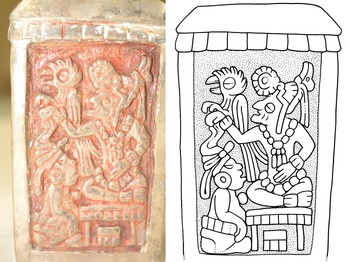
The first panel (Figure 5) depicts a fairly well-known mythological scene in which the creator deity God D receives tribute in the form of quetzal birds from a dwarf. On the Tazumal flask, the central figure is clearly depicted as an old, chapfallen, and wrinkled man. On his forehead he sports a beaded diadem and his elongated head is topped by a cut-shell YAX element, both characteristic insignia of the aged creator deity long known as God D (Martin Reference Martin2015; Schellhas Reference Schellhas1904; Stone and Zender Reference Stone and Zender2011:46–47; Taube Reference Taube1992:31–41).Footnote 9 The richly attired Old God sits cross-legged on a bench and holds up his right hand, on which perches an oversized quetzal. Below him and probably, by this convention, in front of his throne, is a small square box or basket, perhaps a container of tribute. Seated to lower left is a chubby dwarf, who has likely just brought the quetzal for the Old God. Parallel scenes are known from at least three Late Classic polychrome vessels, all unfortunately unprovenanced. These are K4999, K7727, and a vase recently published by Raphael Tunesi (Reference Tunesi2008:Figure 1).Footnote 10 The three unprovenanced vases all contain a spoken hieroglyphic caption wherein God D acknowledges the receipt of the quetzal birds by observing uutz i wa' tali uutz or “it's good when good things are coming”. Although none of the three unprovenanced vases can be confidently dated, Tunesi (Reference Tunesi2008:18) notes stylistic similarities with another vessel bearing a hieroglyphic date and suggests a late seventh-century attribution. As will be seen in the next section, this is in substantial agreement with the reference to K'ahk' Uti' Witz' K'awiil (Copan Ruler 12) on the Tazumal flask, since this king ruled between a.d. 628–695 and seems to have been particularly active in the second half of the seventh-century. As will also be seen, given the historical ties to this expansionist Copanec ruler, it is surely no coincidence that the Tazumal flask features such a striking mythological scene. Tribute payment in the form of quetzals is here represented in mythological terms as payment properly due to the aged creator god: a not-so-subtle message for the recipient of the Copanec ruler's flask.
Quetzal Tribute for God D, the first of two iconographic scenes on the Tazumal Flask. Photograph by Card, drawing by Zender.

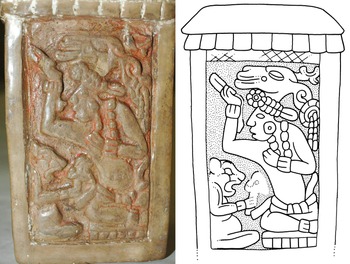
The second panel (Figure 6) presents a less familiar scene also situated within an indoor throne-room setting. This panel presents a seated young lord wearing a deer-head headdress and brandishing an unknown object in his upraised right hand. His headdress is rather unique, being fastened to his head with a segmented band and a beaded diadem. The animal is nonetheless clearly marked as a deer's head, with the cheek spot and dotted muzzle frequently seen on mammals in Maya art (see Stone and Zender Reference Stone and Zender2011:185); the creature also sports unmistakable antlers and a large ear labeled with the characteristic scroll representing the deer's musky scent (Houston Reference Houston2010). The tip of the deer's ear is decorated with an unusual beaded tassel.Footnote 11 To the lower left sits a short-eared and rather portly anthropomorphic rodent. The rodent grasps something in its outstretched right arm, perhaps a face or mask, possibly mounted on a stick which the animal holds, but an indistinct impression makes the identification uncertain. Without more context it is difficult to know precisely what is taking place here, but several similar scenes may prove relevant. On an unprovenanced architectural flask in the collections of the National Museum of Ethnology in Leiden, a standing ballplayer wears a deer-head headdress and towers over a chubby rabbit (Schele and Miller Reference Schele and Miller1986:258, Plate 103).Footnote 12 The body of the rabbit is labeled with the hieroglyphs 9-na-ba (baluun nahb, “nine handspans”), probably in reference to the circumferential size of a typical ballgame ball (see Zender Reference Zender2004a). As Schele and Miller (Reference Schele and Miller1986) have noted, this Classic scene may be echoed in the K'iche’ Popol Vuh in an incident where the Hero Twins task a rabbit to pretend to be a ball in order to trick the Lords of Xibalba during a sacred ballgrame. More importantly, such scenes set up an expectation that the wearer of the deer-headdress interacts with not just any rodent, but specifically with a chubby rabbit, a consideration to which we will return presently. The Tazumal flask scene is even more suggestive of several “just-so” stories, in which gods dispense characteristic attributes of animals in exchange for gifts of food or drink (Stone and Zender Reference Stone and Zender2011:47). Thus, we know of two vessel scenes in which deer receive their antlers from the creator deity God D in exchange for offerings of tamales (Stone and Zender Reference Stone and Zender2011:229), and several additional scenes in distinct media where hummingbirds receive their wings in exchange for maize gruel (Stone and Zender Reference Stone and Zender2011:209). At least two similar scenes involve gods interacting with rodents—e.g., K4999 and a small panel in the collections of the Museo de la Escultura Maya in Campeche published by Tunesi (Reference Tunesi2008:Figure 8)—although their significance remains somewhat unclear. While speculative, we consider that the Tazumal flask scene may depict a notably short-eared rodent receiving long ears in reciprocal exchange for some proffered item. Is this meant to relate “how the rabbit received its ears?” In this connection, it is worth considering that the young lord with the deer headdress represents a youthful aspect of God D, particularly given the aforementioned beaded diadem and parallels with the “just-so” scenes discussed above.Footnote 13 If so, then it may once again be significant that the Tazumal flask features a scene of noble/divine largesse in exchange for gifts, taxes, or tribute.
Young Lord wearing deer's head, the second of two iconographic scenes on the Tazumal Flask. Photograph by Card, drawing by Zender.

Epigraphy
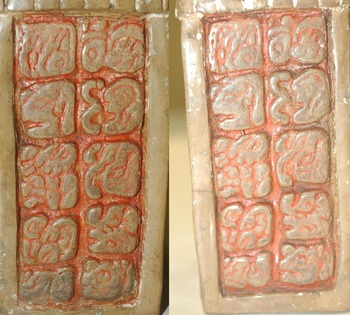
The epigraphic contents of the Tazumal flask are fascinating and, as previously noted, unprecedented in their provision of the name and titles of a known historical individual. Both narrow sides of the flask have the same two-column text impressed into them (Figure 7). However, substantial differences in the quality of the impressed text have allowed us to produce a composite rendering that reconciles the best details of the two versions, producing a somewhat more legible inscription overall, though a few uncertainties remain nonetheless (Figure 8).
The repeating text panels on the Tazumal Flask. Photographs by Card.

Composite drawing of the text, using the clearest details from both panels. Drawing by Zender.

The text opens at A1 with the common if still imperfectly understood “step verb” of the PSS dedicatory formula on pottery and other portable objects (Coe 1973; Stuart Reference Stuart and Kerr1989). The sign depicts a profile stairway with a stylized climbing footprint, and can probably be read as T'AB, for t'ab[ayi] “it goes up”, still of somewhat uncertain meaning as a dedicatory verb (for further discussion see Stuart Reference Stuart and Houston1998:409–417, 2005b:35). This is followed at B1 to A2 with a unique vessel type classification comprised of the signs SAK-ta (at B1) and perhaps either ji or chi (at A2). Unfortunately, the latter sign, apparently representing the profile head of some kind of animal, is equally indistinct in both impressions, with few diagnostic details. Still, it seems likely that SAK here conveys either sak “white, pale” (in reference to the color of the flask) or its homonym sak “handmade, artificial” (with reference to a natural object such as a gourd or shell perhaps simulated in clay).Footnote 14 Unfortunately, the following ta and ji/chi syllables—if correctly read—are less amenable to interpretation.Footnote 15
With the remainder of the text we are thankfully on firmer ground. Blocks B2-B3 provide K'AHK'-TI' (B2), WITZ' (A3), and K'AWIIL (B3). Taken together, these provide K'ahk' (U)ti' Witz' K'awiil, the throne name of Copan's Ruler 12 (Stuart Reference Stuart2007). This name is at present unique, with no known namesakes, and, lest there be any question about the Copan association, it is immediately followed by the Copan emblem glyph: K'UH (for k'uh[ul] “holy, divine”; at A4) and the “bat” hieroglyph (at B4), still of uncertain reading. Usually, the Copan emblem glyph “bat” is conflated with the stone-markings of the syllable ku and occasionally wears a lord's headband (providing the requisite AJAW). Here it remains unclear whether the ku is merely indistinct (due to a poor impression from the original stamp) or is in actuality absent (in which case we must appeal to abbreviation), but the AJAW element seems to be present in the form of the headband passing just above the animal's eyes and tied at the upper right, obscuring what would be the animal's ears. The final two blocks are particularly interesting in that they provide a title composed of “south” (at A5) and OOK?-K'IN-ni (at B5). Although enigmatic, Copan Ruler 12 carries this title in several Copan inscriptions, including Stela 6 (East), Altar K (West), and the incised peccary skull from Tomb 1 (Zender Reference Zender2009).Footnote 16 Tentatively the text as a whole can be read as follows:
T'AB SAK-ta ? K'AHK'-TI' WITZ' K'AWIIL K'UH ?-AJAW no?-? yo-OOK?-K'IN-ni
t'ab[ayi] (u)sakta… k'ahk' [u]ti' witz' k'awiil, k'uh[ul] … ajaw ?nojol ?[y]ook'in
“The pale/handmade ?vessel of K'ahk' Uti' Witz' K'awiil, divine lord of Copan, South(ern) ?Yook'in, was dedicated.”
Despite the difficulties with some of the signs in this text there seems no question that the Tazumal flask was commissioned by the explicitly named Copanec ruler K'ahk' Uti' Witz' K'awiil. This suggests that the vessel was given as a gift to unknown elites at Tazumal and is suggestive of the relatively higher rank of the Copanec king, considerations discussed in more detail below. Seen in this way the iconographic and epigraphic “texts” on this vessel possibly provided parallel narratives: just as the creator god is due quetzals and other tribute-offerings—both in payment for past performance (the creation of the world and its inhabitants) and in exchange for magical gifts (the rabbit's ears)—so, too, is the Copanec ruler who dispenses such fine modeled-carved flasks and their contents due a measure of consideration from his recipient(s).
DISCUSSION AND CONCLUSIONS
Inscribed Maya objects found at locations different from their places of origin have become increasingly well-attested at Classic Maya sites. A clear parallel can be found in the presence of polychrome vessels hieroglyphically tagged as the (former?) possessions of Naranjo lords, but found in Late Classic tombs at the nearby sites of Buenavista del Cayo, Holmul, Tikal, and Uaxactun (Callaghan Reference Callaghan, Kovacevich and Callaghan2014:114–117, 120; Reents-Budet Reference Reents-Budet1994:129–130; Stuart Reference Stuart and Kerr1989:158). Callaghan (Reference Callaghan, Kovacevich and Callaghan2014) argues that vessels dedicated to high-ranking lords would have been of greater inalienable value than otherwise identical vessels of less exalted ownership. Intriguingly, the deposition of a finely made and personally inscribed vessel of the late seventh and early eighth-century ruler of Naranjo, K'ahk' Tiliw Chan Chahk, in a tomb at the much smaller site of Buenavista del Cayo not only emphasizes the importance of the gift but, until very recently, also represented the only clear evidence for political ties between the two sites (Houston et al. Reference Houston, Stuart, Taube, Barbara Kerr and Kerr1992; Reents-Budet Reference Reents-Budet1994:300–305; Taschek and Ball Reference Taschek, Ball, Barbara and Kerr1992). Recent archaeological excavations at Buenavista uncovered another inscribed object revealing the ancient name of the ruling dynasty of Buenavista. With this information we can now recognize from Naranjo inscriptions that K'ahk' Tiliw Chan Chahk of Naranjo oversaw at least two military incursions into Buenavista del Cayo, once in a.d. 696 and again in a.d. 726 (Yaeger et al. Reference Yaeger, Brown, Helmke, Zender, Cap, Rodriguez and Batty2015). Thus, the “Buenavista vase” represents a reliable proxy for the expansion of the Naranjo kingdom into the Belize River valley. It is worth considering that the Tazumal flask represents a similar episode of Copanec political expansion into El Salvador.
Given their portability and inherent value even to those not explicitly named in their inscriptions, associating inscribed objects with human remains in Maya tombs is not always possible (Carrasco et al. Reference Carrasco Vargas, Sylviane Boucher, Vera Tiesler Blos, Renata Garcia Moreno and Javier Vazquez Negrete1999:49; Guenter Reference Guenter, Navarro-Farr and Rich2014:158; Stuart Reference Stuart and Kerr1989:158). Nonetheless, we are confident that K'ahk' Uti' Witz' K'awiil was entombed beneath Structure 10L-26 at Copan, as indicated both by the material culture of his burial setting and the inscriptions on Copan's hieroglyphic stairway (Fash et al. Reference Fash, Beaubien, Magee, Fash, Williamson and Drooker2001; Stuart Reference Stuart, Andrews and Fash2005). There is no compelling reason to believe he was buried with the flask that names him at Tazumal. The more problematic issue becomes one of history and motivation. The text on the Tazumal flask names no one other than the Copan ruler and discusses no events other than the flask's dedication and the bare fact of his ownership of it. The presence of the royally inscribed Copan flask in a tomb at Tazumal suggests a potentially unequal diplomatic relationship—and this might conceivably be buttressed by the flask's twin mythological scenes of tribute and royal largesse—yet there remain other alternatives.
Stuart (Reference Stuart and Kerr1989:158) notes the larger problem with tying objects and texts to entombed individuals in the case of four vessels, apparently inscribed by the same hand and all tagged with the name of Aj Numsaaj Chan K'inich (Naranjo Ruler 1) but found in tombs at Tikal, Uaxactun, and in numerous collections without provenience. Ruler 1 reigned from a.d. 546 to at least a.d. 615, was placed on the throne of Naranjo by Tuun K'ab Hix, ruler of the Snake dynasty of Dzibanche (Martin and Grube Reference Martin and Grube2008:70–72), and he ruled for long enough to see several successive Snake dynasts, including Sky Witness, who likely presided over the defeat of Tikal in a.d. 562 (Martin and Grube Reference Martin and Grube2008:104). While the Uaxactun burial may well be contemporary with Naranjo Ruler 1 (Fahsen Reference Fahsen1992:2), Burial 72 at Tikal probably dates to several decades after his death (Coggins Reference Coggins1975:332–333; Eberl Reference Eberl2007:Figure 4.6). Are these vessels heirlooms? Signs of political domination over defeated polities by Dzibanche and its allies? Looted vessels from the tomb of an erstwhile foe? One suggestion has been that a number of cacao vessels tagged with the name of Ruler 1 name may instead have referred to lineage members (Reents-Budet Reference Reents-Budet1994:206–207), but this seems overly complicated. It seems reasonable to suppose that a long-lived ruler of a large site—Ruler 1 reigned for almost seven decades, and presided over not less than four katun endings (Martin and Grube Reference Martin and Grube2008:71)—might easily have commissioned sufficient vessels during his reign to have given away at least as many as have been found thus far. Royal vessels were likely exchanged between nobility at periodic feasts (Foias Reference Foias2013:190–191, 200–201; Taschek and Ball Reference Taschek, Ball, Barbara and Kerr1992) without that exchange being recorded in accompanying texts.
As noted above, archaeological evidence has long suggested some kind of relationship or influence between western and central El Salvador and Copan, though the emulative nature and small quantity of such evidence has previously been interpreted as better fitting minimal influence rather than an outright Copan hegemony (Demarest Reference Demarest, Boone and Willey1988:365–374). Objects and imagery associated with authority—including monumental architecture, an eccentric effigy chert, and inscribed objects—generally seem to have moved south from Copan into El Salvador. The origin of pseudo-inscribed objects such as Copador ceramics are not as clear, but their design favors the texts and imagery associated with power and authority in the north. A flask with similar edge markings to the Tazumal flask was found in Burial 24, CV-43 in the Copan Valley, apparently dating to the time of its sixteenth ruler, Yax Pasaj Chan Yopaat (Coggins Reference Coggins, Boone and Willey1988:115–116, Figure 13). Another was encountered in CV-20 (Willey et al. Reference Willey, Leventhal, Demarest and Fash1994:219–220, 321, 404). This latter vessel chemically sources to Copan (Bishop and Beaudry Reference Bishop, Beaudry, Willey, Leventhal, Demarest and Fash1994) and is similar in finish and form to other architectural flasks (Eppich and Loughmiller-Cardinal Reference Eppich and Loughmiller-Cardinal2014). Finally, we should not forget to mention the fragmentary flask excavated from El Cafetal Structure 8, in the El Paraíso Valley between Copan and Quirigua (Canuto and Bell Reference Canuto and Bell2008:14, Figure 10). As noted above, this flask contains the same che-ha-ka nominal sequence as the previously mentioned disc flask excavated in Tazumal Structure 1E, Tomb 2.
The Tazumal flask follows the previously noted pattern, but adds several specific details to the relationship. This vessel provides a temporal anchor to the seventh century and suggests diplomatic relations between Chalchuapa, the largest site in El Salvador, and Copan during the beginning of its expansion as a regional power under K'ahk' Uti' Witz' K'awiil.Footnote 17 The longest-lived ruler in the Copan dynasty, he may have been born around a.d. 612, and is recorded as having acceded to power on 9.9.14.17.5 6 Chicchan 18 Kayab (February 5, 628). Ruler 12 achieved the rare status of a five katun lord, his lengthy 67-year reign ending on 9.13.3.5.7 12 Manik 0 Yaxkin (June 15, 695) (Martin and Grube Reference Martin and Grube2008:200–203).
Though he left behind more monuments than any other Copan king, none of them date to the first 24 years of his reign (Martin and Grube Reference Martin and Grube2008:201). This changed with a major monumental program surrounding the period ending of 9.11.0.0.0 (October 8, 652) when a new system of causeways focused settlement and ritual on the Main Group (Newsome Reference Newsome2001:58). This period ending became the focus of significant ritual attention in the Main Group and was also marked by a set of five stelae on hilltops along the edge of the valley. This centralization of activity and creation of royal “boundary” stelae circumscribing the valley have been interpreted as a solidification of power in the hands of the royal dynasty (Newsome Reference Newsome2001:46).
Ruler 12's activities also extended well beyond Copan. The 9.11.0.0.0 commemoration was also marked at Quirigua, where Altar L names Ruler 12 as a ritual participant, and on Stela 23 at Santa Rita, 12 km up the Copan Valley from the Main Group (Martin and Grube Reference Martin and Grube2008:201). These monuments make him the only Copan ruler to commission monuments outside of Copan's site core and the modern village of Copan Ruinas (Newsome Reference Newsome2001:47, 229, n13). It is also at this time that Copan began to influence the royal names and sculptural styles of distant Pusilha and Nimli Punit (Grube et al. Reference Grube, MacLeod and Wanyerka1999; Prager Reference Prager2013; Schele and Grube Reference Schele, Grube and Albright1994:118). The Copador phenomenon and trade of other polychromes in the larger region also suggest a broader engagement to the south and east of Copan at this time (Fash and Stuart Reference Fash, Stuart and Culbert1991:159–160; Newsome Reference Newsome2001:46), a phenomenon in which Copan-affiliated Quirigua did not participate (Sharer Reference Sharer and Culbert1991:192). Many of the vessels in Ruler 12's tomb under Structure 10L-26 were Copador (Fash et al. Reference Fash2001:154).
Interaction with the area to the southeast, which had been devastated by the Ilopango eruption more than a century earlier, harkened back to Copan's Late Preclassic affiliations. Earthen mounds at Late Preclassic Copan were similar to those at Kaminaljuyu and Chalchuapa (Traxler Reference Traxler, Bell, Canuto and Sharer2004:58). Usulutan resist pottery and other ceramics of the Uapala sphere were typical of Late Preclassic Copan (Andrews and Fash Reference Andrews, Fash, Andrews and Fash2005:396–397; Schortman and Urban Reference Schortman, Urban, Bell, Canuto and Sharer2004:323–325) and would continue even after Peten-style architecture began to be constructed there (Fash and Stuart Reference Fash, Stuart and Culbert1991:149–153). Rulers 12 and 13 may have ritually emphasized this regional identity by placing potbelly monuments in stela foundation caches (Newsome Reference Newsome2001:55–56).
The Copan/El Salvador Cream Ware phenomenon and especially Copador coincides with the beginning of Ruler 12's reign and the practice of placing Copador vessels in stela caches began with him (Bill Reference Bill1997:12–13, 412). The shared Copador vessel style suggests not only an economic component to the increased “influence” between Late Classic Copan and polities to the south but may represent an emphasis of local regional identity over ties to the Peten (Bill Reference Bill1997:411). Rarer elite goods such as monumental carvings and an eccentric effigy chert had raised the possibility of elite diplomatic ties, possibly even including pilgrimages to Copan (Demarest Reference Demarest, Boone and Willey1988:380–381).
The royal inscription on the Tazumal flask further strengthens the diplomatic hypothesis. Miniature flasks are typically found in Late Classic burials, with Copan at the center of their distribution (Eppich and Loughmiller-Cardinal Reference Eppich and Loughmiller-Cardinal2014). The creation and distribution of Late Classic Maya polychrome vessels parallels the production and distribution of modeled flasks, particularly given that full inscriptions occurred only on monochrome incised, carved, or modeled ceramics at Copan and are not painted on polychromes as in the Peten (Coggins Reference Coggins, Boone and Willey1988:113). The Tazumal flask is unique in having a PSS dedicating it to a named ajaw and was found in a tomb in the largest monumental structure at the largest site in El Salvador. By contrast, the canteen flasks also likely produced at Copan either have no inscriptions, or the inscriptions were mass-produced and repetitive, stamped along with the iconographic panels. Though here it remains noteworthy that some of these also link Copan and Tazumal, as noted above. These vessels are much more common, and fragments of them are found in numerous non-royal contexts, including refuse of elite residential areas both in and outside the Copan valley. This variation in nature and context mirrors the commissioning of fine polychromes to be painted by master artists and given by powerful lords to lesser nobles, while less finely crafted polychromes with repetitive or pseudoglyphic texts were supplied (in some cases over significant distances) to lesser nobility and commoners (Reents-Budet Reference Reents-Budet1994:96–99, 140, 179–184).
The personalized inscription on the Tazumal flask, accompanied by scenes with overtones related to tribute, found in a burial in the central structure of the largest site to the south of Copan, escalates this pattern and suggests a diplomatic gift from a political center to allied but less powerful rulers. Eppich and Loughmiller-Cardinal (Reference Eppich and Loughmiller-Cardinal2014) suggest this role for the Copan-produced tobacco flasks based on both their distribution in the region and the cross-cultural patterns of tobacco use and gifting. The Naranjo-produced and royally tagged vessels discussed above are likewise considered to be gifts from the more powerful Naranjo ruler to allies and vassals at smaller sites like Buenavista del Cayo. In the light of these explicit diplomatic ties, the other objects found at Late Classic sites in El Salvador take on new significance. The sculpted, tenoned stone heads at Campana San Andrés, if tied to Copan, are not on the scale of the carved benches at non-royal elite compounds commissioned with the blessings of Copan Rulers 15 and 16 (Jackson Reference Jackson2013:25–28), nor the monuments at secondary sites in the Usumacinta drainage recording visits by their liege-lords from major cities (Jackson Reference Jackson2013:37–41). However, the pattern of personal gifting suggested by the Tazumal flask, rather than local emulation of elite Classic Maya material culture or prestige goods obtained through third parties, could potentially suggest a significantly larger political sphere of influence for Copan during the consolidation and expansion of power undertaken by K'ahk' Uti' Witz' K'awiil.
RESUMEN
La interacción durante el período clásico tardío entre Copan y El Salvador occidental ha sido reconocido arqueológicamente por medio de artículos de prestigio, influencias en monumentos y el uso común del tipo de cerámica polícroma Copador. Un frasco grabadoexcavado en 1952 por Stanley Boggs, en la pirámide principal de Tazumal, El Salvador, ofrece evidencias históricas de estos lazos. Frascos de este tipo fueron usados en varios casos para contener tabaco y muchos se produjeron en el área de Copan. El frasco de Tazumal se encontró en un entierro acompañado de fragmentos de jade y pirita y luego estuvo guardado en el Museo Nacional de Antropología después de la excavación, muchos años antes de los avances históricos en el deciframiento de la escritura maya. El frasco es único en que tiene una Secuencia Primaria Estándar que se dedica como propiedad de K’ahk’ Uti’ Witz’ K’awiil (Rey 12 de Copan), un gobernante de larga vida del siglo VII que presidió sobre la expansión de Copan y la dispersión de su influencia lejos del valle de Copán. El frasco es el único texto jeroglífico de El Salvador que nombra un individuo reconocible o que se puede fechar a un período calendárico absoluto, uno de los pocos vasos miniaturas mayas del período clásico fichados con el nombre de un individuo y el único que nombra a un ajaw (señor). La iconografía muestra temas de tributo y el intercambio de regalos entre patrones y clientes políticos. La combinación del texto, la iconografía y el contexto del frasco de Tazumal sugiere que Copan tenía una relación política formal con el oeste de El Salvador durante el reino de Rey 12. En esta capacidad, el frasco es similar en uso a varias vasijas cilíndricas de las tierras bajas mayas, marcando relaciones entre tributarios o aliados en la época clásica.
ACKNOWLEDGMENTS
We would like to thank Will Andrews for not only supporting the conduct of this research, but for working, along with Kathryn Sampeck, to obtain the original Tazumal excavation notes made by Stanley Boggs. Marcello Canuto and MARI also provided access and support in working with the Boggs archive. This research would not have occurred had Arquitecta Astrid Chang and Licenciada Claudia María Alfaro Moisa not brought the various inscribed objects in the Museo Nacional de Antropología to our attention, and we thank them and the others of the Museo and the Secretaria de Cultura a la Presidencia de la Republica de El Salvador for their aid and support. We thank the reviewers for their useful comments and suggestions, which have substantively improved this research.