The growth of contemporary urban China and its success in the global marketplace relies paradoxically on the millions of rural labourers, entrepreneurs and service workers who have migrated to the cities and coastal areas from the countryside. As many as 150 million short-term and long-term labour migrants are the human source of this economic miracle.Footnote 1 Despite official discourse which decries the size of China's current population and the widespread acceptance of it as a national problem, even among ordinary and largely pronatalist citizens, the magnitude of the population and its structural identity as rural within China's bifurcated household registration system make it the hidden productive force behind China's economic dynamism. While working in towns and cities, the migrants have homes in the countryside which they have left, often only temporarily, and with which most retain significant ties. These are deeply embedded ties of organic relations to family and wider kin that simultaneously enmesh them in political relations defined by household registration (hukou 户口) and local entitlements.
This article approaches issues involving the current mobility of the rural population by inverting the usual urban perspective and looking at this mobility through exploring the lives those who do not move.Footnote 2 It begins by proposing a framework for examining contemporary Chinese biopolitics, that draws upon historical work on patterns of constructing rural society and national polity through regulating fertility, family structure, residence and mobility. It then proceeds to a micro-analysis of who remains in the countryside and links this with an exploration of emergent structural features of rural communities as they are remade in the early 21st century in the wake of the abolition of agricultural taxes and levies. The ethnographic approach adopted here is one which highlights the agency, choices and practices of local men and women in charting their courses in a social world being drained of people.
This article proposes the utility of what I term “family strategies,” identifying a repertoire of diverse and fruitful practices through which people strive to recreate and repopulate their social worlds. The concept of family strategy that I propose is one that internally embodies state processes of constructing rural social worlds, but shifts the focus to a popular one of exploring strategies through which diverse actors located within families make, nurture and remake families that can sustain them now and in the future.Footnote 3 There is no assumption that all members of a family will agree or act in concert, and there is a recognition of uneven power associated with diverse positioning within families, most notably in terms of gender and generation. Particular attention is given to revealing points of divergence, atypical cases and fragility by addressing a range of non-standard marriage practices (sister-exchange, the levirate and uxorilocal marriage), practices of connecting with and caring for family and kin, and exit strategies for married women. The argument follows the path pioneered by Elisabeth Croll in linking the study of historical directions in polity and economy with local and gendered practices in everyday life.Footnote 4
Three Communities
No one community can present the full range of circumstances encountered in the Chinese countryside, nor, indeed, can several. The present study adopts a strategy of examining three geographically separated communities in west China, with certain shared features but also with substantial differences. This is not a sufficient basis upon which to generalize about communities in rural west China as a whole, but allows for a range of issues to be identified and explored through local cases. All the villages are predominantly Han and are in three separate counties in eastern Sichuan and western Chongqing. They are all mainly agricultural, some distance from any city or town, and lacking in good transportation. All have significant (continually fluctuating) numbers of people migrating out of their communities. Most of the migrants are working away on a relatively long-term basis, although so far only a few households in each village have completely left and moved their household registration to a town or city.
The best situated community, which I call by the pseudonym Stone Bridge, is three or four hours' drive from Chengdu. It enjoys reasonably good land, although it is hilly and not all land has reliable access to water. Despite the favourable situation of the county, economic opportunities and growth have been uneven within it. While the county seat and some towns are expanding, other places, such as Stone Bridge, are being bypassed. Local residents are leaving, and all the township government staff live in urban centres elsewhere and commute to work as required, while they await better postings. People who remain in Stone Bridge work primarily in grain and vegetable production. There are high rates of out-migration, primarily to Chengdu, Guangdong and Xinjiang, but also to many other intra- and inter-provincial destinations. About 100 men registered in the village remain unable to marry.
Azalea Village, across the border in rural Chongqing, is located in a relatively remote low mountain region. It lies at the end of its county furthest from the county seat and is largely overlooked by local authorities. Unlike nearby lower villages designated bases for agriculture, Azalea Village is designated a tourist area, although no public funds have yet been spent at this purely scenic site and any possible development would be spillover from sites still partly under construction in the neighbouring county. In the meantime, the main source of livelihood is subsistence agriculture on the limited amount of paddy land available and on the slopes of the three mountains that encompass the village. Azalea Village is much further from any market than is Stone Bridge and little food is produced for sale. Occasionally a truck will appear at the village edge to buy squash or grain. There is a coal mine within the village, contracted to an entrepreneur who now hires mainly men from still poorer communities. A number of mine accidents, including two in 1993 and 1995 in which miners were killed, as well as the known hazards of inhaling coal dust, have made most village men avoid working in the mine. There are high rates of out-migration in this village as well, with many people working in urban Chongqing and some venturing to Yunnan, Beijing and numerous other locations, primarily as unskilled construction labour or as sellers of newspapers and fruit on city streets. The village is marked by declining size, resulting from a combination of mortality of the elderly and of workers in hazardous jobs, fair compliance with the birth planning regime, and the marriage out of both women and men.
Li Home is situated in a topographically similar low mountain region of eastern Sichuan in a nationally designated poverty county. Li Home is not close to any town, and only since 1992 has had a road, which is marginally passable when dry and not at all when there is rain. While Li Home is perhaps not much poorer than Azalea Village, the fact that the entire county has almost nothing but agriculture in upland terrain with limited and uneven water supply means that local people must go much further away to find work or any income opportunities. The advantages that flow to the county because of its poverty designation may in a few years result in industrial development and economic growth in the most accessible corner of the county, but the chief effect for Li Home has been limited to subsidies for wells that provide improved access to drinking water. Out-migration is consequently massive and every household requires external income from migrants far away. The predominant destinations are the shoe factories and construction sites of Guangzhou, although smaller numbers go either to various border regions or to other coastal areas. The village has been notable in its growth in officially registered population, as compliance with the birth planning policies has not been good despite considerable pressure, but the younger adults are almost all absent working far away.
The villages were the sites of ethnographic fieldwork that included household visits and a survey of just over 50 households in each village, interviews with local leaders and key informants, and generous access to local documents including household registers, land records, tax records, population planning records and policy documents. The work was conducted in Azalea Village in 2003, in Stone Bridge in 2004 and in Li Home in 2005, with some follow-up and updating to 2005 in the first two sites.
A Larger Frame
Rural–urban migration has been and continues to be a widespread pattern reshaping the global landscape, and China's recent changes can in part be seen within this comparative framework. But, while China is not unique in this respect, it does have distinctive elements that shape the changes unfolding throughout the country and in rural sending communities in particular. In contrast with familiar Foucaultian models of modernity and biopolitics, China is distinguished by a very early and perdurable presence of the state in communities, households and bodies throughout the polity.
Consider the strikingly contemporary analysis of Philip C.C. Huang, writing of Shang Yang's policies in the Qin dynasty.Footnote 5 Huang argued first for the centrality of Lord Shang's policies of building a secure state through a smallholding economy, offers of land and tax exemptions to attract migrants, tax incentives for partible inheritance, early and universal marriage, and sustained population growth accomplished through high rates of fertility. He further argued for the capacity of this involuted peasant economy to sustain large and complex cities and urban elites, despite diminishing marginal rates of return for the average rural cultivator. Huang concluded by enquiring about the future of this nexus in the rural development context of the 1980s.
The present article is formulated as an initial exploration of how key elements of this linkage are now being addressed in the 21st century. From this perspective, the familial reach of the state is not a modern or marginal phenomenon, either in general or in its distinguishing characteristics. The question of the state remains immanent within rural families, although somewhat less directly and apparently so than in the recent post-Liberation period or even the early years of the reform era.Footnote 6 It is a goal of this article to trace key elements of this complex in rural west China to explore the underlying logic of Chinese biopolitics and illuminate its specific contemporary forms. This may then allow an anthropologically grounded engagement with distinctively Chinese variants or responses to what is known elsewhere as neoliberalism.Footnote 7
At the policy level, the present formulation of biopolitics is most apparently one in which state control and regulation of rural–urban migration relaxed significantly and allowed a massive flow of population from rural to urban areas following Deng Xiaoping's Southern Tour in 1992. At the popular level, this is a relatively recent change that builds directly on a partially continuing regime of biopolitics created within the lifetimes of middle-aged adults in the countryside. That earlier regime, established in the 1950s, 1960s and 1970s, still provides a living and indispensable basis for the present policies, in the decisive forms of a legacy of a large population and of population management through the household registration system. During the 1950s, substantially separate urban and rural environments had been built through the creation of parallel worlds of state organs, enterprises and benefits in the cities and localized collective structures and entitlements in the countryside. The relative peace and security of the early 1950s and the incorporation of the rural entities through collectivization from the late 1950s to the early 1980s resulted in a growth of rural population that laid the basis for the contemporary flexible and subsidized supply of labour to the urban and coastal regions.
In the earlier part of this era (1950–74), the countryside was constructed as overwhelmingly agricultural. From 1975, there was a return to building a more diverse rural economy through enterprises at the higher levels (brigade and commune) of the collective system, and a still more active growth of township and village enterprises on collective and private bases during the 1980s. This was a dramatically successful element of the rural economic reform and contributed significantly to both raising rural incomes and generating large-scale capital accumulation for the Chinese economy locally and nationally. The initiative was notably one that allowed vast numbers of underemployed rural people to leave agriculture while not leaving the countryside, and the country was dotted with small labour-intensive workshops. However, political and economic thresholds at the end of the 1980s resulted in the collapse of an estimated one million rural enterprises in 1990 and a reconsideration of China's economic path. Deng Xiaoping's Southern Tour in 1992 reaffirmed the reform path and shifted the focus of growth and investment to urban and coastal regions, precipitating the movement of the rural labour force that has since become so pronounced and such an integral part of China's current economy.
The movement of predominantly young workers from the countryside to fuel this transformation was made possible by a rural society in which some (mostly male) migration occurred in the early years after Liberation, while the vast majority remained in the countryside within a social structure shaped since the 1950s by the survival of children (whether through increased fertility or decreased mortality), by limited mobility, and by a succession of programmes for building community institutions predicated upon a stable agnatic residential core. The middle-aged and older people who now make up the majority of the remaining population in these sending communities spent much of their lives within this framework and their life course remains marked by those decades. The rapid opening to rural–urban migration that has occurred since 1992 has benefited from and been subsidized by what remains of this earlier transformative period, in its systemic provision of and lifelong care for the migrant labour force.Footnote 8
A continuing pillar of these agnatic rural communities is the state's bifurcate household registration system that has been in effect since 1958. This system divides people into agricultural (rural) and non-agricultural (urban) categories, with corresponding entitlements at specific locations. The migrant population consists primarily of people with rural registration who are working somewhere other than their registered rural domicile on a temporary basis. It also includes those who have, especially since the turn of the century, been permitted to convert to an urban registration when they meet minimum standards of secure employment and purchase of a home. This urbanized population is relevant to the present argument in that the links with originating communities may be retained to some degree, and especially because the people so leaving are the most successful out-migrants, thereby draining capable and healthy people (and with them, their families) from the countryside. For the purposes of this study, however, the focus is upon those who still have rural registration, since their ties remain closest with rural communities and they are often translocal in practice. The rigid separation between the two forms of registration has been softened and the entitlements connected with registration have been eroded, but it still functions to tie rural people to specified rural places for administrative purposes and as the locus of remaining and emerging safety net provisions in the form of (possible) access to land and entitlements.Footnote 9
The 16th Congress of the Chinese Communist Party in 2003 brought a change in policy that has reduced direct accumulation of capital from agricultural areas. This has been most marked in the decision to phase out agricultural taxes and levies within five years, a process that was completed ahead of schedule by 2005 in all three study sites. While some of the funds for local government will be replaced by transfers from the centre, this generated a crisis in local government finances and a concurrent amalgamation of administration units and downsizing in staff. By 2005 in Li Home, for example, the positions of all eight team heads and the village women's head ended, as the village cut to only three cadres: Party secretary, village head and accountant. It was rumoured that Li Home was about to be amalgamated with two neighbouring villages, with a further cadre reduction of two-thirds. All levels above Li Home up to the county were experiencing the same crisis and comparable reductions. The abolition of taxes and levies is explicitly a reduction in villagers' burden and a systematic effort to address national economic disparities through financial adjustments. However, it leaves villages and higher levels of local government with very few personnel or resources.
At the same time, and as a step in the same direction, there have been some financial transfers to villagers, administered through town(ship) credit co-operatives. Since 2004 a grain subsidy (liangshi butie 粮食补贴) was paid to holders of land-use rights, apparently to encourage production of grain, although the amounts issued were initially small (8.75 yuan/mu 亩 in 2005; 1 mu = 1/6 acre). Also in 2004, investigations began to identify people who would be eligible for support payments on the basis that they were born between 1934 and 1945 and have only one surviving child. Where both parents were living, each could make a claim. These payments were more substantial (500 yuan/year) and began to be issued late in 2004. Stone Bridge also enjoyed the more restricted advantage of having some of its villagers benefit from its township's allocation of extra resources to a limited number of certified single-child households: some fertilizer in 2004 or a goat in 2005.Footnote 10
Rural residents were beginning in these years to experience a further stage in the state's retreat from a political economy of localized community building. In its place were more remote amalgamations, transfers of community functions (such as care of five-guarantee households) to the township level, and restructuring of government on narrow administrative lines. These changes were combined with the reduction and then abolition of taxes and levies and the creation of new financial transfers, signifying a threshold change from funding community building to cutting taxes. However, there was no indication as of 2005 that these changes were having an effect on migration.Footnote 11
But the state continued to record and manage the fertility and mobility of the rural population carefully through procedures of household registration, birth planning and authorization for temporary residence elsewhere. A skeleton smallholder framework based on agnatic patrilocal kinship remained, but the still growing population was available for planned market mobilization for the state's primary goal of national economic development. Before and after these recent changes, rural residents remained primarily dependent on their own and their families' work, and on the present and future work of their children. The effects of the stringent birth planning programmes, in effect since the late 1970s in Sichuan, were by this time having a marked effect on the labour force and the size of young adult sibling cohorts. People were needed to work away from the village for a cash income, and young men and women were those who went from these communities in the highest proportions by the turn of the century. Their departure drained rural communities and families.
Mobility
It is commonly said that villages have come to be composed of “women, children and the elderly” (sanba liuyi jiujiu 三八六一九九) as men migrate to work elsewhere.Footnote 12 This generalization may have been closer to the truth in the past. Certainly out-migration is dramatic and is remaking rural China even more rapidly than the changes in birth planning policy. The movement of young adults responds very rapidly to changing economic opportunities and political constraints.
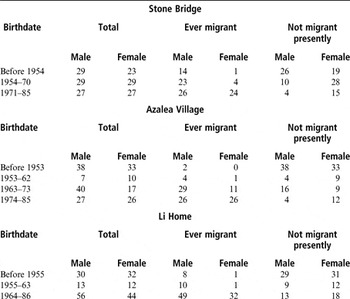
The change in composition of the rural population through migration can be indicated by two key indicators. The first of these is the pattern by age of out-migration in the life histories of the adults in each of the three communities. In each case, it breaks down into an earlier generation with a familiar pattern of predominantly male migration, one or two transitional period(s), and a current phase in which young men and young women are both leaving, but with some local variations. These patterns are presented in detail for each village in Table 1, which reveals a general pattern of increase as work opportunities in the larger world grew dramatically after 1992, as well as reflections of specific local circumstances.
Migration for Work in Three Villages, by Gender and Age, 2005

Source: Samples in each community, 2005.
In the case closest to the stereotype, Stone Bridge had a considerable number of men working away (but often not far away) from an early period, especially in concrete construction, perhaps because of the village's location not too far from more affluent areas. Among those in the sample born up to 1952, 14 men and one woman had migrated for work; of those born between 1954 and 1970, 23 men and four women had done so. All of those born between 1971 to 1985 who are in the workforce have migrated for work, except one couple (b. 1971, 1973) in a uxorilocal marriage who are both wholly occupied in agriculture, two married women (b. 1972, 1972) who are both in agriculture and one young woman (b. 1985) currently in agriculture. There are also three young women at university and one young man in upper middle school on a scholarship, all of whom have left or will leave the countryside through education. The trajectory over time in Stone Bridge has been a pronounced move from some (often seasonal) migrant work by men in the construction trades, to a tendency for men to migrate, near or far, while women have stayed and worked the land, to a pattern in which almost all young people migrate for work, although a very few women remain and work the land.
In Azalea Village, of 71 adults in the sample born before 1953, only two men had ever migrated away to work; migration increased somewhat among those born between 1953 and 1962, with four men and one woman in this cohort working away at some time. Migration for work became common but not universal for those born between 1963 and 1973. It became nearly universal for both men and women born between 1974 and 1985: of 27 men, only one had never migrated for work (one other had left by changing to an urban registration through education at the specialized middle-school level), and of 26 women, only five have (so far) not migrated and presently do agricultural work.
In Li Home, there is still more out-migration. Among those people born before 1955, eight men and one woman had migrated at some time. The transitional phase in the community was early and short: of those born between 1955 and 1963, ten of 13 men and one of 12 women had migrated for work. For those born between 1964 and 1986, migration had become standard and was reported for 49 of 56 men and 32 of 44 women. This is connected with a higher exit rate than is explained by work alone. Of the seven men who did not migrate for work, five left through higher education and change to urban registration, a major channel draining some of the most able young villagers from the countryside at an early age. One remaining man runs a store in the township together with his wife, and one is disabled and cannot work. Among the women, one young woman was on the point of leaving for university and corresponding exit from the countryside at the time of the fieldwork, one is a non-resident daughter-in-law with a university education and urban registration, two work in a small business outside the village, and one is disabled. However, seven of the older married women in this group (b. 1964–76) have always done agricultural work and one daughter (b. 1986) has so far not left the village and is temporarily doing housework so that her mother can work the land.
It is also helpful to use a second indicator and approach the question of who leaves and who stays by looking at who is present at a particular point, since migration is not necessarily permanent and it is very common for work away to be interspersed with periods at home, especially in connection with seasonal work or family obligations. I selected the cases of all adults under 40 who were no longer in school and who were in the study village at the time of fieldwork for a case-by-case examination. The primary observations are slightly different for each community, but can be briefly summarized (see Table 1).
From this viewpoint, Stone Bridge further exemplifies the more conventional pattern in which some middle-aged women have remained relatively settled in the village, although even they may have worked away at some time, while virtually no middle-aged men do so, and young people of both genders are almost wholly absent from the village. Women here, as in the other villages, also tend to do more of the agricultural work, at a level disproportionate to their numbers, since even the men who are present are less likely to do agricultural work than are the women.Footnote 13 The young middle-aged women who are currently present are very often those whose family circumstances, such as the lack of a mother-in-law available for childcare or eldercare, have required a mature adult presence, and this is more likely to result in a wife staying or returning to the countryside. Stone Bridge also provided an instance, in a set of linked households, of a case where families explored the possibilities of settling in Xinjiang on a long-term basis. The marginal attractiveness of agriculture there resulted in a series of movements back and forth with some family clusters settling in Xinjiang and others returning to Stone Bridge. The presence of family in both locations leaves future options open.
Azalea Village did have a few younger adult men present and working in agriculture. This was perhaps a result of the timing of the initial field research when, partly due to the SARS outbreak in 2003, work outside was reported to be hard to find. Men variously worked long hours in agriculture, went to the mine, played mahjong or waited. There was also a small core of men who had tried migrant work and had not been very successful. This village exemplifies efforts on the part of men who have returned from migrant labour without capital and who are seeking to make a living in a village that had comparatively abundant land by Sichuan standards (slightly over 1 mu/person in the best endowed team). The under-40 women in this village were also present largely for familial reasons, but here they were primarily wives in atypical marriage situations (remarriage or non-Han speaking Hani, Dai or Bulang women from Yunnan), pregnant or with young children.
In Li Home, the extreme lack of local opportunities and small amounts of land meant that very few adults under 40 were to be found in the village. Two young men had appropriated for themselves access to the eels in the paddy fields of this and neighbouring villages, three men were present to marry and establish new families (two remarrying uxorilocally), and one had a permanent disability. Slightly more married women were present, and again each had family responsibilities for which there was no apparently adequate alternative person available to provide care.Footnote 14
Adult women in the village, in addition to their family and household responsibilities, worked full-time in agriculture wherever physically able to do so. The main exception to this was the case of an occasional new mother with an indulgent mother-in-law and a household that did not need her labour, although this situation did not seem to extend beyond the child's infancy, as the mother would commonly return to work in the city within 12 months. The same participation in agricultural work is true of adult men apart from two types of exceptional situation. The few middle-aged men who were resident in the countryside were also agricultural workers, and did this full-time unless they had some other occupation (construction worker, carpenter, village cadre). Such non-agricultural work was fairly common among men remaining in the countryside, and generally meant that they did less agricultural work, although their other work was rarely full-time. Occasionally young men who had left school but not yet migrated were exempt from agricultural work, unlike their sisters or female cousins. The overall result is a pattern of feminization of agricultural work that is more skewed than the gender difference in rural residence would suggest.Footnote 15
Family Strategies
The present moment is reminiscent of the threshold in Skinner's classic analysis of rural Chinese society where the rural universe expands to become much larger while the key social unit shrinks from standard market town to village.Footnote 16 The determining factor now is not intensified commerce but changing governance and the units in question are different, but the analogy is suggestive. Rural residents have open before them a vast and expanding world through which they are moving at a dizzying pace. The young people travel to Beijing, the south-east coast and the remote borders; communities include members who have worked on inner Asian railways, who have married into Taiwan and have been sightseeing in Canada. At the same time, their social world shrinks as villages provide much less for their members; villages have become of limited significance in managing land and have been divested of whatever other resources they once had. Economic and administrative functions previously performed by team, brigade or village are being assumed by the government (minzheng 民政) at the township level. Team leadership is being phased out, village leadership is being reduced and recruiting capable younger people to fill the remaining positions is a challenge. Between the pull of governance to higher levels and the pull of economic activity to indeterminate remote locations, much that remains is now focused on smaller units. This is not a “return to the family” since the family had been present throughout, but the increasing vacuum and reconfiguration of rural life at team and village levels give families much more salience.
Family and kinship are at the heart of life in rural China and form the over-determined vehicle through which social life is grounded and finds expression. For decades, rural China has benefited from demographic stability and growth (apart from 1959–61), enabling effective and multifaceted family and kinship relations to nurture and sustain people and communities through a sequence of profound transformations. A consequence of this has been a rich and full set of available kinship ties and a limited burden of partial and fragmented families. The middle-aged people who form the backbone of rural communities at present are often part of large sibling sets which can share in the care of the elderly and co-operate in many ways, including the management of migration. The reduction in young adults as a result of both birth planning programmes and state endorsed out-migration poses problems. The micro-dynamic perspective of the ethnographic approach allows some insight into how people manage their lives in these conditions by creating and re-creating families with available human resources and cultural repertoire.
The concept of “family strategy,” the means through which diverse actors located within and between families act to make families that can sustain them now and in the future, is especially appropriate in identifying the focal medium through which biopolitics operates in the perdurable Chinese polity and rural social world. A further purpose in emphasizing families as the loci of strategies is to bring the language of research close to the idiom through which people are practically addressing and solving complexly related issues in rural social life and its governance.Footnote 17
These include the most fundamental and, indeed, some of the most obvious questions involving families. These have already long been addressed as significant issues in rural life, and earlier research need not be repeated or reviewed at length. Certainly, people very often seek to have excess or early births, and quite often succeed, despite fines and other sanctions. And, in order to have children enter the family in the customary way, people strive to achieve a conventional patrilocal marriage for young men. This section focuses instead on less readily apparent elements within the local repertoire of practical kinship in these communities. Through being less obvious and pushing the limits of the normative, they reveal much about currently available and utilized means of sustaining rural families.
The following discussion begins with the critical issue of making marriages for young men in relatively poor communities such as these, confronting a severe shortage of young women. The focus then moves to rural women and their unmarked strategies for managing marriage, maintaining connections with kin and resolving subsequent family challenges. While men and women, and especially conjugal couples in stable and more or less contented partnerships, have substantively shared goals of building successful, economically viable and caring families, points of divergence can be revealing, as they shine light on issues in more normative families as well as in those whose fragility occasions concern. This section examines a range of non-standard marriages, practices of connecting with and caring for family and kin, and exit strategies for married women.
None of these villages was a thriving location into which families would eagerly marry a daughter, and each had more than usual difficulty continuing families through the preferred major marriage form. Similarly, it was not easy to attract men to marry in uxorilocally, although there were a small number of cases in which this was achieved. Indeed, the best matches in each of these villages were the people who could most successfully leave, making the recruitment of wives (or husbands) to these communities problematic. One result was the use of a large repertoire of non-standard marriage forms which had been used in the past and were being revived, including sister-exchange, the levirate, marriage with divorced or widowed women (with or without children from the first marriage). Despite – or because of – the illegality of some of these practices, and the personal tragedies and social problems connected with all of them, they have attracted attention as the means people in marginal rural communities are devising to (re-)create families. They are all high-stakes choices made within – or pushing the bounds of – local knowledges and practices.
Sister-exchange was a relatively rare but effective means whereby two bachelors with unmarried sisters could arrange a solution to both their marriage challenges. The sisters would have little choice, unless their natal families backed their resistance. Indeed, such backing may well be a reason for the rarity of this option. One such case I found among younger people involved the two husbands and one of the two wives each having varying degrees of physical disability, generating shared social vulnerabilities. The levirate was equally rare, but perhaps more for demographic reasons, as it required the availability of an unmarried younger brother to marry an older brother's widow. This was a practice described as present in living memory in the time of the Long March, when a young husband in Li Home disappeared as a soldier and his wife eventually remarried one of his younger brothers. More recently, it followed the death of a young coal miner in Azalea Village. It would be misleading to view this as purely advantageous to the new husband and his family, as it is a choice that allows the widow continued life with her children in her marital home, rather than face the economic necessity of remarriage elsewhere and the probable loss of her children.Footnote 18 Widows and divorcées were also potential marriage partners for rural bachelors and for those themselves widowed or divorced, especially if they were willing to assume responsibility for children not retained by their father's patriline. Men with especially challenging marital situations occasionally made this choice.
Perhaps the most common option has been for poorer men to seek wives from less affluent parts of the country, notably Yunnan province, although this may not be a stable or reliable option. Each village had its own cultural repertoire of effective choices, and I was told that this was one that had been tried but abandoned in Stone Bridge, since the Yunnan wives married earlier had chosen to run away. Men in Azalea Village, which had declined from over 700 officially registered residents in the 1970s to just over 550 in 2003, had taken more drastic steps to retain Yunnan brides, in choosing marriage with non-Han speaking minority nationality women from Yunnan who could less easily depart. In two recent cases, the young wives could still not speak with their marital families and were clearly distressed, but others appeared to be remaining by choice. A particularly interesting case is that of a Bulang woman (one of seven Yunnan wives in the village at the time of the fieldwork) married to a man whose previous wife had left him, who had introduced two women from her natal village to her husband's two younger brothers. All were living together in a growing joint family. Women entering these communities are critically important and may be bringing with them vitality and resilience that goes unmarked as they are apparently absorbed into their marital kin units. When women are brought into communities through non-standard and even painful means, they bring with them agency and creativity and do more than continue local patrilines.
An additional interesting strategy is indicated by the unusually high incidence of marrying out in the uxorilocal marriage form on the part of young men in the small community of Azalea Village. I could identify 19 such marriages within the period of the household registration records held in the village (close to ten years).Footnote 19 This marriage form is not unusual as a means for a poor man with brothers to improve his own situation and meet the needs of a family without sons. It is surprising, however, to find it so commonly practised, and is a mark of exceptional difficulty in attracting wives to this desolate mountain village. For men in this village, marrying out (but not too far away) is a viable family strategy, even when it leaves no son at home. This was, indeed, my village landlady's hope for her only child, then approaching adulthood. She was still complaining about her parents having married her into this village (they said they had chosen a good man over a good village, as they had) and her goal was that her son would marry out and she and her husband would go and live with him in a nearby better place. This was far from the traditional ideal of bringing in a daughter-in-law and a striking indicator of emergent models of fluid relations to kin and to space.
Finding a marriage partner for a woman was not an absolute problem, but much in her life hinged upon the match made. Her parents would make considerable effort to achieve a desirable match, and she would then have a marriage and family to build on that basis. One of the unexpected findings of this project was the persistence with which daughters were married to local neighbouring villages, as late as 2005. Data on 129 married-out daughters from families in the three samples showed no perceptible change over time in the locations into which daughters were married, despite marked increase in the out-migration of the daughters for work, even before marriage. While there are a few cases of women marrying to distant locations, these occur in earlier years as well as more recently, and there is no evidence that young women's migration for work is resulting in expanded or different choices of first marriage partner, at least in these three villages.Footnote 20 The young women may well migrate for work after marriage as well as before, (very commonly) with their husbands or separately, but there is a sense in which local marriage formally, potentially or actually keeps young married women not far from their natal kin.Footnote 21
Although women are fundamentally hinged in space in a way that men are not, through normative patrilocal residence which separates women's natal and marital spaces, women remain more likely to be present in the countryside. This pattern may be partly seen as a limited success on the part of parents, chiefly of mothers, in marrying daughters close to home (although the daughters can still leave to work). In the present context, it is also open to interpretation as a strategy compensating for the lack or reduced number of sons, and the reduced number of sons in local residence. Where elderly villagers can sometimes benefit from having both a son (or sons) who works away and a son who stays at home, reduced sibling sets now make married daughters more essential. Married-out daughters may retain ties with their natal families in any case, although this is less marked in these communities than in those I have researched elsewhere,Footnote 22 but they can be truly necessary in providing financial and personal care in the absence of sons. This is not new, but is a portion of the practical kinship repertoire which is active and being retained through current shifts in migration and demographic patterns.Footnote 23
Married women under 40 who are still resident in these villages are primarily there to care for family members. These are normally a woman's own children (perhaps returning home to oversee schooling) or her husband's parents, but it is not surprising to find her also caring for one of own parents, in the absolute absence of a brother and sister-in-law or simply in their temporary migrating absence. Where her parent is reasonably healthy, she is likely to make frequent trips from her nearby marital village to provide care and manage household affairs, as circumstances require; and there are several cases in these villages of elderly and frail mothers without sons who have moved into the homes of their married-out daughters where they are receiving loving care. Married women also care for their own children, although now possibly by sending remittances from distant workplaces, and even more commonly for their grandchildren. The uterine family has become a centrepiece of the life project of rural grandmothers, forming a link beyond children to grandchildren. This is so normal as to be taken for granted, but it can be expressed as well in exceptionally embracing form. Perhaps the most striking instance in this study is that of a grandmother in Stone Bridge who waded into a river to save her son's infant daughter from drowning, and who is raising this child with the help of remittances from an unmarried migrant daughter. Even with reduced fertility, the countryside remains full of children being raised by grandmothers, often with the help of grandfathers.
A final element in current family strategies is the renewed fragility of marriages, at the same time as the conjugal tie is increasingly and critically important.Footnote 24 It is perhaps not surprising that the separations of long-term migration present stresses for marriages, or that migrant men may form attachments or even second families when away. This may be one reason women often accompany their husbands, when possible, even when finding work for themselves is problematic (many work as helpers to their husbands' construction work). The frequency of young women becoming widowed is also a rising concern, connected with the hazardous work many of the young men do: these small samples include three young widows of coal miners, one of a high-voltage electrical worker and one of a man suffocated in a silo.Footnote 25 A further consequence of the employment possibilities of migration is that women can and do leave marriages, simply by going away to work and not returning. Without the co-operation of her natal family, her husband will have no way to locate her, if she truly wishes to disappear. In some such cases, and in the cases of young widows, small children may be registered with their paternal grandparents and remain there when the mother leaves.
There are also women who have arrived in the study villages to remarry. These arrivals are not adequate indicators of outcomes for women who choose to leave, since those who remarry into these three communities are women who are not escaping poverty. Among middle-aged women, there are both ambiguous and clear cases of women in long-term employment in different cities from their husbands, and these are often cases of marital separation, although (usually shorter) separations also happen for employment and economic reasons. There are also cases of a grandmother choosing to live with one son while her husband lives with another, and the newer variant of a grandmother on long-term childcare visit to an urban daughter (leaving her husband at home) or living with a grandchild in the back of a local shop that provides her with a living independent of her husband and sons. In short, one of the implications of large-scale migrant (and local) work being available for both men and women is an increased fragility of marriage at a time when the conjugal tie is increasingly important, an increase in partial, fragmented and merged families, and uncertainty about the custody and care of children.
Conclusions
Seeking to retain or stabilize current rural circumstances will not solve the problems of remote and mountain villages. Intensified mobility and urbanization appear in both the Chinese and the global context to provide choices that the overwhelming majority of younger rural people will explore. At the same time, vast numbers of people will remain living in the countryside, rural sending communities, however remote, will continue to be necessary to the dynamism of urban China, and the governance of China will require rural stability and excess fertility. In this, rural residents are intrinsic to the unfolding of urban and national futures.
As the less advantaged areas of the countryside are selectively drained of people, temporarily or permanently, and as both those who leave and those who remain face emergent and uncertain policy regimes, the future of the countryside depends on the micro-processes of how local and translocal rural people create and recreate connections with each other through time, generation and space. There is less to work with in this task than might previously have been imagined, as communities are eroded and replaced with financial transfers, and as the numbers of available kin shrink through population planning and labour migration. In the interstices of economic necessity and emergent governance, resilient and subtle strategies of making families, kin and relatedness underlie future possibilities for rural China.