Introduction
Abiotic stresses limit plant productivity (Rodriguez et al., Reference Rodríguez, Canales and Borras-Hidalgo2005) and may reduce crop yields by more than 50% (Bray et al., Reference Bray, Bailey-Serres, Weretilnyk, Gruissem, Buchannan and Jones2000). Water deficit is the major abiotic stress that adversely affects crop production worldwide (Daryanto et al., Reference Daryanto, Wang and Jacinthe2017; Ebrahimian et al., Reference Ebrahimian, Seyyedi, Bybordi and Damalas2019), particularly in dry land (areas having an aridity index from 0.05 to 0.65), which occupies >40% of the total land surface area and is home to approximately 35% of the world’s population (Safriel and Adeel, Reference Safriel, Adeel, Hassan, Scholes and Ash2005). Water deficit induces an array of negative effects on vital physio-biochemical activities such as carbon assimilation rate, leaf gas exchange, photosynthetic pigment contents, enzyme activity and ion balance, thereby leading to a reduction in growth and yield of plants (Prasad et al., Reference Prasad, Staggenborg, Ristic, Ahuja, Reddy, Saseendran and Yu2008). Furthermore, water deficits induce the overgeneration of reactive oxygen species (ROS), such as OH−, H2O2, superoxide radicals and O2 −, which damage many vital, structural and functional components of the plant system (Farooq et al., Reference Farooq, Wahid, Kobayashi, Fujita and Basra2009) and are major limitations of plant growth in water-deficit areas of arid regions (Hussein et al., Reference Hussein, Amin, Azab and Gahin2015).
Cluster bean (Cyamopsis tetragonoloba) is a multipurpose legume that has been grown for its seed, which contains galactomannan gum that is extensively used as a lubricant, binder, thickener and emulsifier in several industries (Yadav and Shalendra, Reference Yadav and Shalendra2015). India is the major cluster bean-producing country, and 80% of the world’s production comes from the hot arid region of India (Yadav and Shalendra, Reference Yadav and Shalendra2015). Cluster bean is an important crop in the northwestern hot arid region of India (Rathore et al., Reference Rathore, Singh, Soni and Beniwal2007, Reference Rathore, Singh and Beniwal2009), and its production is severely affected by water-deficit conditions under rainfed conditions in hot arid environments (Garg et al., Reference Garg, Burman and Kathju2006). In cluster bean, yield reduction due to water deficit has been reported to range from −11 to > −60%, depending on the magnitude of the water deficit and the stage of the crop at which the crop is exposed to stress. It has been demonstrated that late-season drought has a greater reduction in yield than mid- and early-season drought (Garg et al., Reference Garg, Burman and Kathju2005; Rao, Reference Rao, Kar, Garg, Singh and Kathju2009).
Exogenous application of plant bioregulators (PBRs) has emerged as an effective adaptation method for crops to moisture limitation by neutralising moisture stress-induced adverse effects (Srivastava et al., Reference Srivastava, Ratnakumar, Minhas and Suprasanna2016). Salicylic acid (SA) or ortho-hydroxy benzoic acid is a phenolic growth regulator and has been found to play an important role in the regulation of various physiological processes, including the growth and development of plants and responses to stresses (Raskin, Reference Raskin1992; Senaratna et al., Reference Senaratna, Merritt, Dixon, Bunn, Touchell and Sivasithamparam2003).
Although the role of SA in plant stress resistance has long been known (Raskin, Reference Raskin1992), the role of derivatives of SA in modulating the plant response to water-deficit stress has been little explored. Furthermore, the effects of SA and its derivatives on the physio-biochemical activities of plants depend on species, developmental stage, SA concentration and environmental conditions (Shraiy and Hegazi, Reference Shraiy and Hegazi2009). In the present study, we hypothesised that exogenous application of SA and its derivatives will enhance yield by modulating ROS scavenging systems, cell membrane stability and photosynthetic pigment contents of cluster bean under water-deficit conditions and that their effects depend on the type of chemical and dose used. To test this hypothesis, plants were sprayed with different concentrations of SA and its derivatives at the vegetative and preflowering stages. We then assessed the relative plant water content, activity of antioxidant and carbon metabolism enzymes, membrane stability, contents of photosynthetic pigments, growth and seed yield of the crop. The objectives of this study were to evaluate the relative efficacy of exogenously applied SA and its derivatives on plant water relations, antioxidant defence systems and seed yield of rainfed cluster bean under water-deficit conditions. This is, to our knowledge, the first report on the effects of derivatives of SA on the yield and physio-biochemical processes of cluster bean under water-deficit conditions.
Materials and Methods
Experimental site
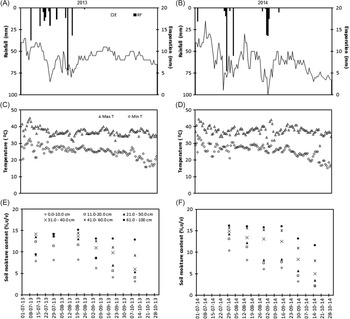
Field experiments were conducted for 2 years (2013 and 2014) in the kharif season from July to October at the Research Farm of Central Arid Zone Research Institute (CAZRI) in Bikaner (28°4′ N; 74°3′ E; 238.3 m above mean sea level), India. The experimental site falls under a hot arid climate. The average annual rainfall of the region is 287 mm, with more than 85% of rainfall received from July to September. Crop received 241 and 230 mm of rainfall during the crop growing season in 2013 and 2014, respectively. Weather data during the crop growing seasons in 2013 and 2014 are given in Figure 1. The soil at the experimental site is loamy sand (Typic Torripsamments), and the topsoil layer (0–20 cm) has 1.51 g kg−1 organic carbon (Walkley-Black), 11.2 kg ha−1 P (Olsen), 240.7 kg ha−1 available K (1N NH4-acetate), pH 8.3 (soil/H2O, 1:2.5), bulk density 1.532 Mg m−3 and moisture retention at field capacity, 9.36% (v/v) and at permanent wilting point, 3.06% (v/v) at the start of experimentation.
Rainfall, evaporation (A,B); maximum and minimum temperatures (C,D) and soil moisture content in different layers of soil (E,F) during the clusterbean growing season in 2013 and 2014 at experimental site. Evaporation and rainfall are sum of daily values, temperatures values are daily mean and soil moisture content was measured at 15 days intervals.

Treatments and experimental design
In the study, three PBRs, that is, SA, thiosalicylic acid (TSA) and 5-sulfosalicylic acid (SSA), were used at concentrations of 0.5, 1.0 and 1.5 mM, respectively. PBRs were applied as foliar spray at the vegetative and preflowering stages of the crop. For better comparison, two additional treatments were kept as water spray and untreated control. Thus, there were 11 treatments. The experiment was laid out in a randomised complete block design with 11 treatments and three replications with a plot size of 5.0 m × 3.5 m. Crops were planted at 35 cm row-to-row spacing and 10 cm plant-to-plant spacing in rows using seeds at a rate of 16 kg ha−1. The selection of PBR concentrations was based on a preliminary test, in which concentrations of 0, 0.25, 0.5, 1.0, 1.5, 2.0 and 2.5 mM were examined on cluster bean seedlings in pot experiments (data not shown). To prepare a solution of SA and its derivatives, the required amount of SA was dissolved in a small amount of ethanol (0.5 ml), and then distilled water was added to achieve concentrations of 0.5, 1.0, 1.5, 2.0 and 2.5 mM. PBRs were sprayed by a manually operated sprayer using 350 mL aqueous solution per plot (application rate 200 L per hectare). Equal amounts of water were sprayed in the water spray treatment, while untreated control plots remained unsprayed.
Crop establishment and management
Prior to land preparation, farmyard manure of 2.5 Mg ha−1 was applied uniformly. After receiving adequate monsoon rain, the land was prepared by using a tractor-drawn disc harrow. A basal dose of 20 kg N ha−1 and 40 kg P ha−1 was applied at sowing time. Crop (Cultivar RGC-1003) was sown at 35 cm row distances and 10 cm plant-to-plant distances in each row on 12 July 2013 and 30 July 2014.
Measurements
Plant water relation traits
The relative water content (RWC) and leaf water potential (LWP) of leaves were determined at the postflowering stage. To determine the RWC, a leaf sample was taken from each treatment, and fresh weight was recorded. Then, the leaf was rehydrated for 4 hours, and turgid weight was recorded and subsequently oven-dried at 85 °C until constant weight (dry weight). RWC was determined using Equation (1).
 $${\rm{RWC}}\left( \% \right) = 100 \times \left( {{\rm{fresh}}\,{\rm{weight}}-{\rm{dry}}\,{\rm{weight}}} \right){\rm{/}}\left( {{\rm{turgid}}\,{\rm{weight}}-{\rm{dry}}\,{\rm{weight}}} \right)$$
The LWP of fully expanded youngest leaves was measured with a WP 4 Dew-Point Potential Meter (Decagon Device, Pullman, Washington, USA) at 9.30–11.30 h.
Membrane stability index
For measuring membrane stability index (MSI), leaf samples (0.1 g) were cut into discs and placed in 10 mL of double-distilled water in two sets. One set was kept at 40 °C for 30 minutes, and its conductivity (C1) was recorded. The second set was kept in a boiling water bath (100 °C) for 10 minutes, and its conductivity (C2) was recorded. The conductivity was measured with a conductivity metre, and the MSI was calculated using Equation (2):
 $${\rm{MSI}} = \left[ {1-\left( {{{\rm{C}}_1}-{{\rm{C}}_2}} \right) \times 100} \right]$$
Photosynthetic pigments and lipid peroxidation
Chlorophyll and carotenoid contents were extracted by the nonmaceration method (Hiscox and Israelstam, Reference Hiscox and Israelstam1979). Fresh leaf samples (0.05 g) were taken and extracted in 10 ml of DMSO at 65 °C for 4 hours. The concentrations of chlorophyll a, b and carotenoids were determined spectrophotometrically [Double Beam UV Visible Spectrophotometer (Model: 2203) Systronics] by reading the absorbance at 645, 663 and 470 nm, respectively. Lipid peroxidation was measured in terms of 2-thio-barbituric acid reactive substances and expressed as equivalents of malondialdehyde (MDA) by the method of Cakmak and Horst (Reference Cakmak and Horst1991). MDA content was determined using Equation (3)
 $${\rm{MDA}}\left( {\rm\mu {\rm{mol}}\,{{\rm{g}}^{ - 1}}{\rm{FW}}} \right) = \left[ {\left( {{\rm{A}}\,532-{\rm{A}}\,600} \right) \times {\rm{V}} \times 1000{\rm{/}}\varepsilon } \right] \times {\rm{W}}$$
where ε is the specific extinction coefficient (ε = 155 mM cm−1), V is the volume of crushing medium, W is the fresh weight of leaf and A 600 and A 532 are the absorbances at 600 and 532 nm wavelengths, respectively.
Enzyme activities
Fresh leaf samples (0.5 g) were homogenised in ice-cold 50 mM potassium phosphate buffer (pH 7.0) containing 0.1 mM ethylenediaminetetraacetic acid and 1% (w/v) polyvinylpolypyrrolidone. The homogenate was filtered and centrifuged at 4 °C for 20 minutes at 15 000 × g. The supernatant was collected, and an appropriate aliquot dilution of the crude extract was used for enzyme assays. Catalase (CAT; EC 1.11.1.6) activity was measured following the decomposition of H2O2 at 240 nm as described by Chance and Maehly (Reference Chance and Maehly1955). The activity of superoxide dismutase (SOD; EC 1.15.1.1) was determined based on the photochemical inhibition of p-nitro blue tetrazolium chloride following Becana et al. (Reference Becana, Aparicio-Tejo, Irigoyen and Sanchez-Diaz1986). Ascorbate peroxidase (APOX; EC 1.11.1.11) activity was determined by measuring the decrease in absorbance at 292 nm due to ascorbate oxidation (Nakano and Asada, Reference Nakano and Asada1981). Guaiacol peroxidase (GPOX; EC 1.11.1.7) activity is measured by the oxidation of guaiacol as increase in absorbance at 470 nm.
The activity of NADP-malate dehydrogenase (NADP-MDH; EC 1.1.1.82) was determined using oxaloacetate as a substrate (Holaday et al., Reference Holaday, Martindale, Alred, Brooks and Leegood1992), and a decrease in A340 due to the enzymatic oxidation of NADPH was measured. Nitrate reductase (NR; EC 1.6.6.1) activity was measured by following the method of Jaworski (Reference Jaworski1971).
Growth, yield components and yield
Growth parameters of the crop were recorded at three times (i.e., 50, 60 and 70 DAS) by destructive sampling from each treatment, leaves were separated and leaf area was determined by using a leaf area metre (Systronics India Ltd., Model 211). Five plants were taken from each plot and dried at 70 °C until constant weight for dry matter estimation. The crop growth rate (CGR) and net assimilation rate (NAR) were determined using Equations (4) and (5):
 $${\rm{CGR(g}}\,{{\rm{m}}^{ - 2}}{{\rm{d}}^{ - 1}}{\rm{)}} = {{\rm{W}}_2}-{{\rm{W}}_1}{\rm{/}}{{\rm{t}}_2}-{{\rm{t}}_1}$$
 $${\rm{NAR(mg}}\,{\rm{c}}{{\rm{m}}^{ - 2}}{{\rm{d}}^{ - 1}}{\rm{)}} = \left( {{{\rm{W}}_2}-{{\rm{W}}_1}} \right)\,\left( {{\rm{ln}}\,{\rm{L}}{{\rm{A}}_2}-{\rm{ln}}\,{\rm{L}}{{\rm{A}}_1}} \right){\rm{/}}\left( {{{\rm{t}}_2}-{{\rm{t}}_1}} \right)\,\left( {{\rm{LA}}2-{\rm{L}}{{\rm{A}}_1}} \right)$$
where W1 and W2 are plant dry weights at times t1 and t2, respectively, and LA1 and LA2 are the leaf area values at times t1 and t2, respectively.
At the time of harvesting, yield components, i.e., number of pods, number of seeds and 1000-seed weight, were recorded from 10 randomly taken plants from the central 1 m × 1 m area of each plot. At crop maturity, an area of 2 × 2 m was manually harvested and threshed from each plot to determine seed and biomass yield.
Economic return
To determine the economic return, the cost of cultivation (CC), gross return (GR) and net return (NR) were calculated based on the prevailing market price of inputs and outputs. CC was calculated by adding the price of inputs used for the production of crops. GR was calculated by multiplying the yield of seed and straw with their respective prices prevailing in local markets. NR was calculated by subtracting CC from GR (NR = GR – CC). The benefit to cost ratio (BCR) was calculated by dividing NR by the CC.
Statistical analysis
The experiment was conducted as a completely randomised design with three replications. Collected data were statistically analysed using SAS software (SAS Institute, Cary, NC, USA). Tukey’s honest significant difference test was used to compare the mean effect of the treatments at p < 0.05. The Pearson correlation coefficient was used to measure relationships between growth traits, MSI, RWC, contents of photosynthetic pigments, activities of antioxidant enzyme, yield components and seed yield.
Results
Climatic conditions
Rainfall, temperatures and evaporation during the crop growing season are presented in Figure 1 (A–D). The crop received 241 and 230 mm of rainfall during 2013 and 2014, respectively. Daily maximum temperatures ranged from 31.2 to 43.1 °C during 2013 and from 28.3 to 44.0 °C during 2014 (Figure 1C, D). There was no rainfall 45 days after sowing of crops in both years, and the soil water content declined very rapidly, particularly in the top layers (0–40 cm) (Figure 1 E, F). The soil moisture contents 60 days after sowing were less than 60% of the field capacity of the soil; hence, the crop experienced a water deficit.
Plant water relations
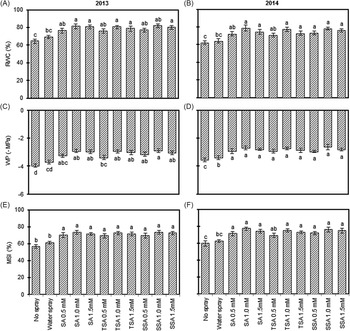
Exogenous application of PBRs affected RWC and water potential (Ψw) (Figure 2 A–D). The application of PBRs resulted in significantly (p < 0.05) greater RWC and water potential than the water spray control (WS). Averaged across both years, PBR application enhanced RWC and water potential by 9–17% and 13–22%, respectively, compared to those under WS. Among the various PBRs used, the application of 1.0 mM SA and SSA had a greater enhancement in water relation parameters.
Relative water content (A, B), and water potential (C, D) and membrane stability index (E, F) of clusterbean during 2013 and 2014. Values are mean ± 1 S.E. Bars having different letter/s are significantly different according to Tukey’s honest significant difference test at α = 0.05.
†SA: salicylic acid; TSA: thiosalicylic acid; SSA: 5-sulfosalicylic acid; RWC: relative water content; WP: water potential; MSI: membrane stability index.

Membrane stability index
The MSI measured at the postflowering stage was significantly (p < 0.05) influenced by the exogenous application of PBRs (Figure 2 E–F). PBR application enhanced the MSI and averaged across both years; the PBR-treated plants had 12–18% greater MSI than the water-sprayed plants. The difference in the MSI of plants treated with different types and concentrations of PBRs was not significant.
Photosynthetic pigment contents
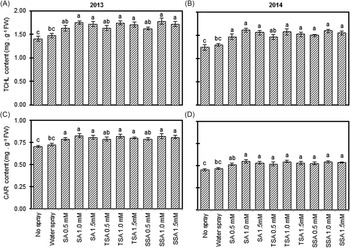
The total chlorophyll content (TCHL) and carotenoid contents of leaves varied significantly (p < 0.05) with the type and application rates of PBRs (Figure 3 A-D). PBR-treated plants had significantly higher contents of photosynthetic pigments, and when averaged across years, their application had 11–18% higher TCHL and 9–13% higher carotenoid contents than water-sprayed plants.
Chlorophyll (A, B), and carotenoid’ contents (C, D) of clusterbean during 2013 and 2014. Values are mean ± 1 S.E. Bars having different letter/s are significantly different according to Tukey’s honest significant difference test at α = 0.05.
†SA: salicylic acid; TSA: thiosalicylic acid; SSA: 5-sulfosalicylic acid; DAS: days after sowing.

Lipid peroxidation and activities of antioxidant enzymes
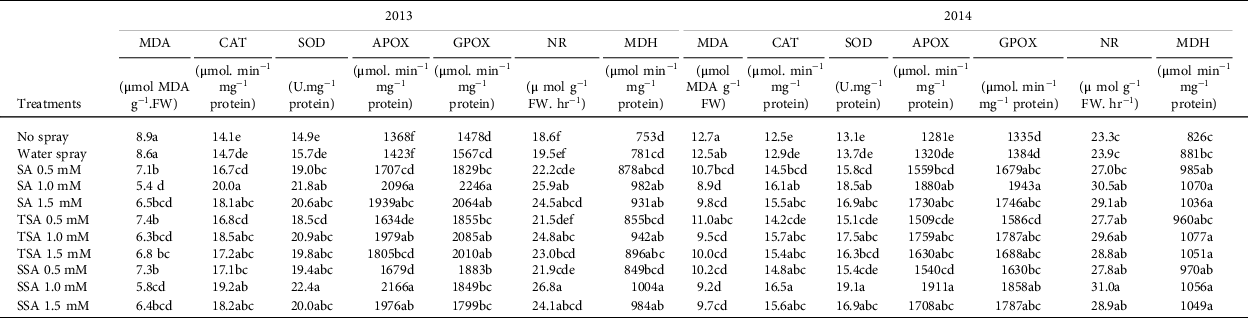
The application of PBRs had significant (p < 0.05) effects on the extent of lipid peroxidation (measured in terms of MDA content) and the activities of antioxidant enzymes (Table 1). PBR application significantly reduced lipid peroxidation, and PBR-treated plants had a 15–34% lower extent of lipid peroxidation than plants treated with water sprayed. Application of 1.0 mM SSA resulted in the greatest reduction in lipid peroxidation. The application of SA and its derivatives at 1.0 and 1.5 mM significantly (p < 0.05) enhanced the activities of antioxidant enzymes (Table 1). When averaged over both years, application of PBRs recorded 12–24%, 13–29%, 14–30% and 16–33% higher activities of CAT, SOD, APOX and GPOX, respectively, than WS. Application of 1.0 mM SSA had the greatest activity of CAT, SOD and APOX, and application of 1.0 mM SA had the greatest activity of GPOX.
Effects of exogenous application of PBRs on the activities of enzymes, and extent of lipid peroxidation of clusterbean

SA: salicylic acid; TSA: thiosalicylic acid; SSA: 5-sulfo-salicylic acid, MDA: malondialdehyde; CAT: catalase; SOD: superoxide dismutase; APOX: ascorbate peroxidase; GPOX: guaiacol peroxidase; NR: nitrate reductase; MDH: malate dehydrogenase. Values in a column followed by similar letter/s are not significantly different according to Tukey’s honest significant difference test at α = 0.05.
Carbon and nitrogen metabolism enzyme activity
PBR application resulted in higher activities of MDH and NR enzymes (Table 1). The activity of MDH ranged from 753 to 1077 μmol min−1 mg −1 protein and that of NR ranged from 18.6 to 31.0 μmol g−1 FW hr −1. PBR application had a greater enhancement in the activity of NR (12–25% greater than WS) than that of MDH (8–19% greater than WS). Application of 1.0 mM SSA had the greatest values of activities for both NR and MDH, followed by application of SA at 1.0 mM, although both the values were statistically at par.
Growth attributes
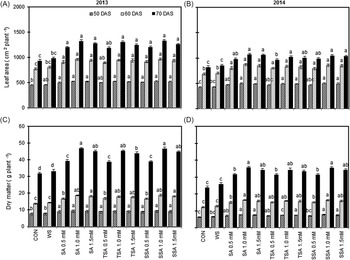
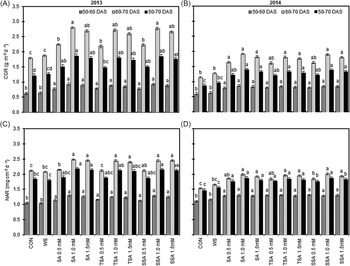
Leaf area and dry matter accumulation were enhanced (p < 0.05) with the application of PBRs (Figure 4). The application of PBRs resulted in 13–22% higher leaf area and 16–29% higher dry matter accumulation than the application of WS measured at 70 DAS. The CGR measured between 50 and 70 days after sowing ranged from 0.87 to 1.86 g m−2 d−1, and the NAR for the corresponding duration ranged from 1.46 to 2.17 mg cm−2 d−1 (average 1.88 mg cm−2 d−1) (Figure 5). The application of PBRs resulted in 9–20% greater NAR and 20–45% greater CGR than the application of WS. The application of 1 mM SA and SSA resulted in greater CGR and NAR than the other treatments. The differences in growth attributes between 0.5 mM SA, SSA, TSA and WS were not significant.
Leaf area (A, B), and dry matter production (C, D) at different growth stages of clusterbean during 2013 and 2014. Values are mean ± 1 S.E. Bars having different letter/s are significantly different according to Tukey’s honest significant difference test at α = 0.05.
†SA: salicylic acid; TSA: thiosalicylic acid; SSA: 5-sulfosalicylic acid; DAS: days after sowing.

Crop growth rate (A, B), and net assimilation rate (C, D) at different growth stages of clusterbean during 2013 and 2014. Values are mean ± 1 S.E. Bars having different letter/s are significantly different according to Tukey’s honest significant difference test at α = 0.05.
†SA: salicylic acid; TSA: thiosalicylic acid; SSA: 5-sulfosalicylic acid; CGR: crop growth rate; NAR: net assimilation rate, DAS: days after sowing.

Yield components and yield
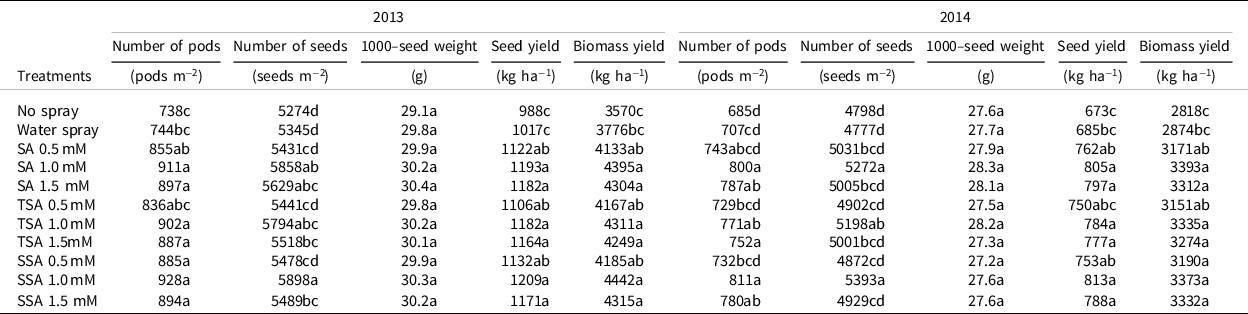
Yield components were greater in 2013 (average pod number 862 m−2, seed number 5560 m−2) than in 2014 (average pod number 754 m−2, seed number 4798 m−2) (Table 2). All yield attributes were significantly (p < 0.05) influenced by PBRs except 1000-seed weight. The application of PBRs resulted in a greater increase in the number of pods (7–16% higher than WS) than in the number of seeds (2–10% higher than WS) and 1000-seed weight (1–2% higher).
Yield components and yield of clusterbean under different PBRs application treatments

SA: salicylic acid; TSA: thiosalicylic acid; SSA: 5-sulfosalicylic acid.
Values in a column followed by similar letter/s are not significantly different according to Tukey’s honest significant difference test at α = 0.05.
Seed yield ranged from 673 to 1209 kg ha−1, and aboveground biomass yield ranged from 2818 to 4442 kg ha−1 (Table 2). The seed and biomass yields were 1.4 and 1.3 times higher, respectively, in 2013 than in 2014. Seed and biomass yields showed a significant (p < 0.05) response to PBR application, and their application resulted in 8–16% higher yields than those with WS (Table 2). Application of 1.0 and 1.5 mM of PBRs had significantly greater yields than that without application of PBRs. Yield differences under 0.5 mM application of PBRs and those without application of PBRs were not significant.
Economic return
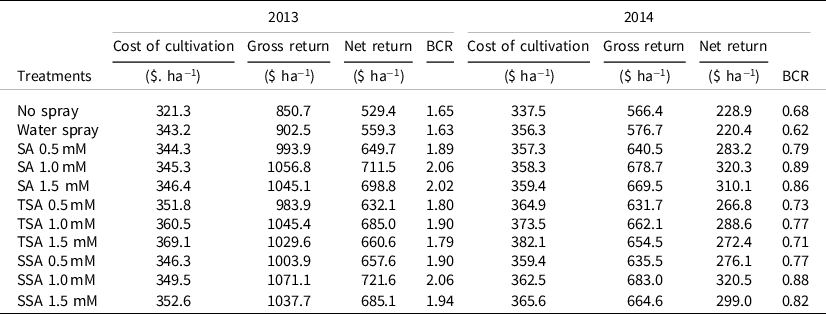
The CC and NRs of cluster bean ranged from US $321.3 to 382.1 ha−1 and US $220.4 to 721.6 ha−1, respectively (Table 4). The application of PBRs resulted in a higher economic return (20–34% higher NR than WS). The application of SSA and SA at 1.0 mM had a higher NR and BCR than the other treatments.
Discussion
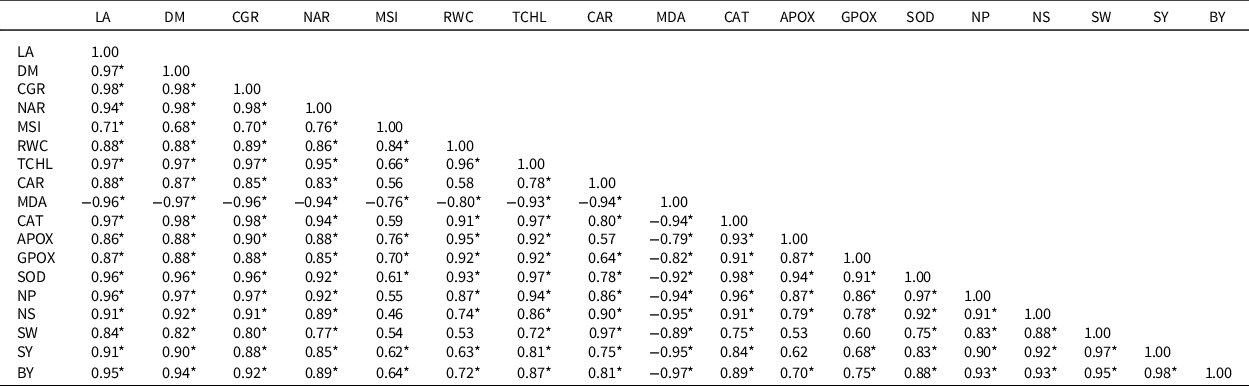
PBRs evoke various physio-biochemical responses in plants under stress conditions (Dawood et al., Reference Dawood, Sadak and Hozayen2012; Srivastava et al., Reference Srivastava, Ratnakumar, Minhas and Suprasanna2016). Exogenous application of SA has been reported to enhance yield under water-deficit conditions (Estaji and Niknam Reference Estaji and Niknam2020; Pourghasemian et al., Reference Pourghasemiana, Moradi, Naghizadeh and Landberg2020). There are a few studies regarding the effects of derivatives of SA in inducing stress tolerance in plants. Senaratna et al. (Reference Senaratna, Merritt, Dixon, Bunn, Touchell and Sivasithamparam2003) demonstrated that benzoic acid, sulfosalicylic acid and methyl salicylic acid were effective in inducing abiotic stress (heat, drought and chilling) tolerance in bean and tomato. Ezhilmathi et al. (Reference Ezhilmathi, Singh, Arora and Sairam2007) reported that SSA enhanced the vase life of cut flowers of Gladiolus grandiflora, and this enhanced vase life due to the application of SSA is associated with enhanced scavenging of ROS. However, the effects of the application of SA derivatives on the yield of crops at the field scale along with the physio-biochemical mechanism responsible for their effects are not well documented. The results of our study indicate that the application of SA and its derivatives modulated physio-biochemical processes that led to the amelioration of growth (Figure 4 and 5) and yield (Table 2) of clusterbean under water-deficit conditions. Our study indicated that SSA is more effective than SA in ameliorating the growth and yield of cluster bean and may have a significant practical application in crop production in water-scarce regions. The beneficial effects of SA and its derivatives might be attributed to alleviation of water-deficit-induced overaccumulation of ROS due to enhanced activities of antioxidant enzymes (Table 1) with application of these bioregulators. Damage to biological membranes by the overproduction of ROS is a key limitation to plant growth under water-deficit stress (Carrasco –Rios et al., Reference Carrasco-Ríos, Rojas and Pinto2013). Enhancement of antioxidant activity plays an important role in enhancing plant stress tolerance and decreasing oxidative damage in plants (Nathawat et al., Reference Nathawat, Rathore, Meel, Bhardwaj and Yadava2016). In this study, the application of PBRs reduced oxidative damage (from −15 to −34% reduced MDA, Table 1), which can be explained by scavenging ROS due to increased (from 12 to 33% higher) activities of antioxidant enzymes (Table 1). The reduction in oxidative damage to the cell membrane was confirmed by the MSI results in this study, as PBR-treated plants had significantly higher MSI (from 12 to 18% higher) (Figure 2) than untreated plants. Protection from oxidative damage in the present study is further supported by correlation analysis (Table 3), which showed a very strong negative relationship (from −0.79 to −0.94) between the content of MDA and the activities of antioxidant enzymes. In addition to protecting from oxidative damage, the application of SA and its derivatives maintained higher plant water status (treated plants had from 9 to 17% higher RWC, Figure 2 A, B). It has been reported that PBRs maintain the hydration of cells through the accumulation of osmolytes, which helps to maintain RWC under water shortage conditions (Pooja et al., Reference Pooja and Kumar2012; Hayat et al., Reference Hayat, Hasan, Fariduddin and Ahmad2008, Reference Hayat, Hayat, Alyemeni and Ahmad2012).
Correlation between different measured parameters

LA: leaf area at 70 DAS; DM: dry matter production at 70 DAS; CGR: crop growth rate (50–70 days after sowing); NAR: net assimilation rate (50–70 days after sowing); MSI: membrane stability index; RWC: relative water content, TCHL: total chlorophyll content, CAR: carotenoid content; MDA: malondialdehyde content; CAT: catalase; APOX: ascorbate peroxidase; GPOX: guaiacol peroxidase; SOD: superoxide dismutase; NP: number of pod; NS: number of seed; SW: 1000-seed weight; SY: seed yield; BY: biomass yield, *significant at α = 0.05.
The chlorophyll content decreases under water-deficit conditions mainly due to its oxidation and damage to the ultrastructure of chloroplasts (Farooq et al., Reference Farooq, Wahid, Kobayashi, Fujita and Basra2009). In this study, the application of PBRs maintained a higher chlorophyll content in leaves (Figure 3). Decreased oxidative damage (Table 1) along with the maintenance of higher auxin and cytokinin activity (Maity and Bera, Reference Maity and Bera2009) might be attributed to the maintenance of chlorophyll contents (Figure 3) with the application of PBRs observed in this study. NR and MDH enzymes play an important role in plant metabolism (Scheibe, Reference Scheibe2004). Water deficit decreases the activities of NR (Singh and Usha, Reference Singh and Usha2003) and MDH (Chen et al., Reference Chen, Ren, Zhang, Reed, Zhang and Shen2015) enzymes. In this study, PBR application enhanced the activity of NR (from 12 to 25%) and MDH (from 8 to 19%) (Table 1), which might be attributed to the increased water status of plants along with the protection of NR enzymes against proteinase under water-deficit conditions (Rane et al., Reference Rane, Lakkineni, Kumar and Abrol1995).
The oxidative damage to chloroplasts, reduction in leaf area (due to decreased cell division and elongation) and stomatal opening are among key limitations to photosynthesis and hence plant growth under water-deficit conditions (Prasad et al., Reference Prasad, Staggenborg, Ristic, Ahuja, Reddy, Saseendran and Yu2008). In this study, application of PBRs enhanced growth (Figure 4 and 5), which might be attributed to their ability to maintain higher plant turgor [due to higher RWC and water potential (Figure 2)], contents of photosynthetic pigments (Figure 3) and decreased oxidative damage [evident by lower extent of lipid peroxidation (Table 1)]. It has been reported that nitric oxide (NO) participates in various physiological processes, including responses to abiotic stresses. NO and SA correlate in the regulation of defence responses and signalling, and crosstalk between SA and NO regulates the functionality of both signalling molecules to determine plant growth under stress conditions (Prakash et al., Reference Prakash, Singh, Tripathi, Sharma and Corpas2021). The cooperative roles of both of these molecules in signalling and defence responses improve the growth and development of plants under stress conditions (Rai et al., Reference Rai, Pandey and Rai2020). It has been reported that NO participates in the signal transduction of SA in the regulation of stomatal movement (Liu et al., Reference Liu, Zhang and Lou2003). Shan and Wang (Reference Shan and Wang2017) reported that exogenous application of SA induced the production of NO in maize under drought stress, which led to increased contents of osmolytes, root hydraulic conductivity and RWCs of leaves under drought stress. Chavoushi et al. (Reference Chavoushi, Najafi, Salimi and Angaji2019) demonstrated that both SA and NO stimulate defensive mechanisms by enhancing antioxidant systems and thus maintaining ROS balance in safflower under drought stress. SA-induced NO production participated in the regulation of osmotic adjustment (by regulation of stomatal movement, increased root hydraulic conductivity, increased contents of osmolytes), and enhancement in ROS scavenging could be a possible reason for the better water balance and protection from oxidative damage due to the application of SA and its derivatives observed in this study.
In this study, the application of PBRs augmented yield components (from 7 to 17% higher pod number, from 2 to 10% higher seed number) and yield (from 8 to 16% higher) (Table 2). Adequate production and transport of photoassimilates are essential for the development of yield components and yield (Dawood et al., Reference Dawood, Sadak and Hozayen2012; Rathore et al., Reference Rathore, Nathawat, Bhardwaj, Renjith, Yadav, Kumar, Santra, Yadava and Yadav2017). The enhanced growth (evident by higher NAR and CGR, Figure 5) leads to adequate production of assimilates for the development of yield components with PBR application, which are responsible for the enhanced yield components (Table 2) due to PBR application observed in this study. The greater increase in the value of yield compared to the increase in cost due to PBR application is responsible for the better economic return under PBR application in the present study (Table 4).
Cost of cultivation and economic returns of clusterbean under different PBRs application treatments

†SA: salicylic acid; TSA: thiosalicylic acid; SSA: 5-sulfosalicylic acid; BCR: benefit to cost ratio (1 US $ = Rs. 64.0).
The effects of PBRs on physio-biochemical processes and the growth of plants depend on the type, dose and method of application of PBRs and plant species (Hovarth et al., Reference Hovrath, Szalai and Janda2007, Nathawat et al., Reference Nathawat, Rathore, Soni, Singh and Yadava2021). Furthermore, the optimal concentration of a particular PBR is plant species specific. For instance, the optimal concentration of SA for inducing drought tolerance varies substantially among crop species, that is, 0.75 mM for Phaseolus vulgaris L. (Sadeghipour and Aghaei, Reference Sadeghipour and Aghaei2012) and 2–3 mM for Impatiens walleriana (Antonic et al., Reference Antonic, Milosevic, Cingel, Lojic, Trifunovic-Momcilov, Petric, Subotić and Simonović2016). In this study, foliar application of SA and its derivatives modulated various physio-biochemical processes and enhanced crop performance; SSA and SA were more effective than TSA and the 1.0 mM concentration was more effective than the 0.5 and 1.5 mM concentrations. Relative to the 0.5 mM concentration, the application of 1.0 mM SA and its derivatives resulted in a higher water content (from 6 to 8% higher RWC, Figure 2 A, B), MSI (from 6 to 7%, Figure 2 E, F), photosynthetic pigment content (from 4 to 9%, Figure 3), antioxidant enzyme activity (from 6 to 27%, Table 1) and CGR (from 16 to 19%, Figure 5 A, B). These beneficial effects declined with an increase in the concentration of application from 1.0 mM to 1.5 mM. These results indicate that 1.0 mM is a suitable concentration for exogenous application of SA and its derivatives to alleviate the negative effects of water deficit on the growth and yield of rainfed cluster bean. It has been reported that higher concentrations of SA made permanent changes at the level of membrane organisation of the cells, which led to injurious effects on the metabolism and growth of plants (Uzunova and Popova, Reference Uzunova and Popova2000). In Hibiscus, SA promoted shoot growth at 0.5 mM but retarded growth at 1.0 mM (Sakhanokho and Kelley, Reference Sakhanokho and Kelley2009).
Conclusions
The results of the present study demonstrated that exogenous foliar application of SA and its derivatives (TSA and SSA) modulated physio-biochemical processes and improved the yield of rainfed cluster bean under water-deficit conditions. The enhanced seed yield of crops with the application of SA and its derivatives is associated with the enhancement of enzymatic antioxidant systems coupled with the ability to maintain better water relations and the content of photosynthetic pigments. The SSA was more effective for improving crop performance. Additionally, the results indicated that 1.0 mM is the optimal concentration for the foliar application of SSA in cluster bean. Economic analysis indicated that exogenous application of SA and its derivatives is effective in fetching higher economic returns. The SSA can be considered a potential PBR for improving the yield of cluster bean under water-deficit conditions. These results point to the potential of derivatives of SA for minimising the negative effects of moisture-deficit stress on crops and thus provide strong evidence for them to achieve more sustainable crop production in the hot arid region of India and for promising insights for solutions in similar agroecosystems facing the challenge of water deficits worldwide.
Financial Support
This work was supported by ICAR-Central Arid Zone Research Institute, Jodhpur, India through institute project CAZRI/T02/47.
Declaration of Competing Interests
The author declare that they have no known competing financial interests or personal relationship that could have appeared to influence the work reported in this paper.