Introduction
Capacity assessments continue to engage psychiatrists in Ireland and elsewhere, with the commencement of the Irish Assisted Decision-Making (Capacity) Act 2015 (ADM(C)A) in 2023; ongoing revisions to mental health laws, protections for vulnerable adults and protection of liberty standards in Ireland and abroad. This paper will consider whether emotion is sufficiently taken into account in our current understanding of capacity to make decisions. We will look at how emotions contribute to decision-making, and what can go wrong when emotions go awry. Examples of conditions where emotions are excessive (Emotionally Unstable Personality Disorder; EUPD) and suboptimal (frontal lobe damage) will be examined. Future consideration of emotional functioning in other conditions (schizophrenia, autism, psychopathy) and its impact on decision-making would be fruitful but is not included here.
Capacity test is focused on a cognitive model
Current ‘state of the art’
Ireland, and other common law countries, have followed the UK in enshrining in statute the definition of capacity arising from English common law (e.g. Northern Ireland (Davidson et al. Reference Davidson, Daly, Harper, McIlroy and Montgomery2023); Singapore (Chua et al. Reference Chua, Kong and Dunn2025)). These enactments retained the old definition of capacity, while enshrining greater protections for citizens, moving closer to the requirements of the UN Convention on the Rights of Persons with Disabilities (UNCRPD). The Irish legislation set up a system of three levels of decision-making assistance and covers decisions about personal property, personal welfare, and advance directives. It does not apply to involuntary admissions for mental healthcare.
This test is ostensibly a cognitive one. The Mental Capacity Act 2005 of England and Wales defines capacity as being able to understand, retain, weigh up, and communicate a decision (see also s.3(2) of Irish ADM(C)A 2015). Australian territories base their understanding of capacity on English common law – in particular, on the case of Re MB (An adult: medical treatment) [1997] EWCA Civ 3093 (Stewart Reference Stewart2023) where Lady Justice Butler-Sloss for the Court of Appeal concluded that:
A person lacks capacity if some impairment or disturbance of mental functioning renders the person unable to make a decision whether to consent to or to refuse treatment. That inability to make a decision will occur when
(a) the patient is unable to comprehend and retain the information …
(b) the patient is unable to use the information and weigh it in the balance….
Canadian jurisprudence is also cognitively focused, requiring ‘understanding’ (which requires ‘processing’ and ‘retaining’) and ‘appreciating’ (which includes ‘applying’ and ‘weighing’) (Supreme Court of Canada (SCC) in Starson v Swayze [2003] 1 SCR 722 at [78]).
As such the common law understanding of capacity is relatively consistent throughout common law jurisdictions, and cognitive in its focus.
Some civil law jurisdictions stress the cause of incapacity and the protections needed, rather than on the definition of incapacity (Swiss Institute of Comparative Law 2008 at p. 86). They couch broadly potential causes of impairment and provide more detail on civil remedies. In France, those who are ‘unable to look after their interests’ by reason of a ‘medically diagnosed impairment of mental or physical faculties’ which impairment ‘prevents expression of their wishes’ are entitled to a Curatorship (supported decision-making) or Tutorship (substituted decision-making) (Code Civil 2016).
Similarly Germany operates a guardianship system (Swiss Institute of Comparative Law 2008 at pp. 86–87). Again, the possible causes of incapacity are broadly envisioned, with the focus in detail on the operation of the guardianship system.
The principal condition for the institution of any protective measure is either mental illness of the adult (psychische Krankheit) or physical, mental or emotional disability (körperliche, geistige oder seelische Behinderung), (sec. 1896 para. 1 Bürgerliches Gesetzbuch/German Civil Code).
This is the first jurisdiction we have found, featuring ‘emotional’ disability as an explicit cause of decision-making incapacity.
Problem cases
This cognitive test for capacity may not be sufficient to capture impairments in decision-making ability in some circumstances.
Emotionally unstable personality disorder
The issue of capacity can arise acutely where a patient wishes to refuse life-saving treatment. Crisis presentations of psychiatric patients might involve hypokalaemia (low potassium) in bulimia, as in Re Q (2022) EWCOP 6, or treatment following self-harm/suicide attempt, as with the dialysis needed following self-poisoning in the Kerrie Wooltorton case (RIP age 26, 19 September 2007).
Kerrie Wooltorton was a 26 year old teacher with a diagnosis of EUPD and previous suicide attempts. She presented to an Emergency Department having taken a fatal dose of antifreeze and presented staff with a letter stating that she did not wish to be treated for the overdose. She had drafted the letter 3 days earlier. It stated that she wished to die in a place where she was not alone and comfort and care were available. She was judged to have capacity (so her advance decision was not relevant) and her refusal of treatment at the time was respected. She died in hospital two days later (see Adam Gabatt, The Guardian, 1 October Reference Gabatt2009; House of Commons EDM 23 November 2009).
The case led to many ethical and legal discussions and debates about mental capacity, advance directives, and the scope of the common law right to refuse medical treatment. These have yet to be resolved and the Wooltorton case leaves a lasting concern about how the current capacity regime deals with EUPD.
‘Frontal lobe paradox’ is a recognised problem
The ‘frontal lobe paradox’ was described by Walsh (Reference Walsh1985), also previously called the ‘knowing-doing dissociation’ by Teuber (Reference Teuber, Warren and Akert1964). It poses a problem for capacity assessments. It describes a set of patients with prefrontal cortex damage, who perform normally on clinical and neuropsychological testing, but show a large disparity in adaptive functioning in everyday life. They also appear to have intact insight as they can logically explain what they should have done, when mistakes are pointed out. However, they cannot use this theoretical knowledge to guide their actions. Indeed, they seem to overestimate their own adaptive functioning and underestimate their need for assistance (George and Gilbert Reference George and Gilbert2018).
The work of Damasio on ventro-medial prefrontal cortex (VMPFC) functioning will be discussed in detail below. Subsequent research on the impact of VMPFC dysfunction is summarised by Worthington (Reference Worthington2019) at p. 33:
…people with VMPFC damage may be more impulsive in their decisions (Newcombe et al. Reference Newcombe, Outtrim and Chatfield2011), less likely to consider future consequences (Bechara et al. Reference Bechara, Damasio, Damasio and Anderson1994), insensitive to the likelihood of unfavourable outcomes (Clark et al. Reference Clark, Bechara and Damasio2008), react differently to perceived unfairness (Koenigs and Tranel Reference Koenigs and Tranel2007) and less likely to take in to account the morality of their actions to achieve an outcome (Young and Koenigs Reference Young and Koenigs2007).
These limitations tend to evade clinical and office-based testing, including capacity assessments.
The role of emotion in decision-making
Before considering capacity further, the role of emotion in the decision-making process will be reviewed.
Normal emotions contribute to decision-making
Incidental emotions are emotions ‘carried over’ from what has gone before. These can affect decision-making in predictable directions. Effects take place through (a) content of thought, (b) depth of thought, and (c) content of implicit goals (Lerner et al. Reference Lerner, Li, Valdesolo and Kassam2015).
According to cognitive theories of affect, emotional response depends on how we appraise a situation (Arnold Reference Arnold1960; Lazarus Reference Lazarus1991). This cognitive appraisal spills over into subsequent decisions via emotions generated (Schwarz Reference Schwarz, Higgins and Sorrentino1990): judgemental biases have been shown which relate to anger, sadness (e.g. Keltner et al. Reference Keltner, Ellsworth and Edwards1993). This is explained (e.g. Raghunathan and Pham Reference Raghunathan and Pham1999) by suggesting that emotions contain inherent goals or ‘action tendencies’ – and shape decision-making by activating these goals, until the emotion-eliciting problem is resolved. For example, anger includes the ‘goal’ to change a situation, move against a person/obstacle by fighting it. The action tendency inherent in anxiety is to reduce uncertainty. Sadness is associated with irrevocable loss; the action tendency here is to change circumstances and/or to seek rewards. Thus, sadness is associated with more high-risk, high-reward choices; anxiety is associated with low-risk, low-reward choices (see Raghunathan and Pham Reference Raghunathan and Pham1999).
Emotions have been found experimentally to affect risk perception. For example, sad people have been found experimentally to be more pessimistic and happy people more optimistic (George and Dane Reference George and Dane2016). Angry people are more likely to see negative events as predictable (and blame others for them). Surprise leads people to judge that positive events are unpredictable (and brought about by others). Pride leads to appraisals that positive events are predictable and brought about by oneself (Raghunathan and Pham Reference Raghunathan and Pham1999, table at p. 806).
Emotions also affect the depth of thought. Negative emotions signal threat, and demand increased vigilance and systematic processing; increased processing can be associated with reduced accuracy (Ambady and Gray Reference Ambady and Gray2002). Positive emotions convey lower threat and lead to increased use of heuristics (cognitive short-cuts) and automatic processing (Bless et al. Reference Bless, Schwarz, Clore, Golisano, Rabe and Wolk1996). People who are angry also rely on heuristics (Bodenhausen et al. Reference Bodenhausen, Sheppard and Kramer1994).
Thus, high incidental emotion can affect our decision-making by influencing how we appraise facts, evaluate our level of control and risks involved, and how we choose to act.
Excessive emotions overwhelm decision-making
Intuitively we can appreciate that strong emotions can overwhelm our ability to appraise, evaluate, and think clearly. In a clinical context, we can consider the impact of EUPD on decision-making.
There is some limited research available. A meta-analysis in 2017 found twenty-eight relevant studies (Paret et al. Reference Paret, Jennen-Steinmetz and Schmahl2017). One study specifically investigated whether there was a propensity to risky decision-making in EUPD/Borderline Personality Disorder (BPD) (Svaldi et al. Reference Svaldi, Philipsen and Matthies2012). This showed that women with BPD made risky decisions significantly more frequently than members of the control group. Moreover, they show reduced ability to use feedback to their advantage. Deficits in decision-making were correlated with severity of BPD symptoms, and with impulsivity. Therefore, the authors conclude, risky decision-making may be both a symptom and perpetuating factor of the disorder.
The above meta-analysis concluded that BPD patients valued delayed rewards less (‘delay discounting’); were able to stop reward-related behaviour normally (‘reversal learning’); BPD patients earned less overall in the Iowa Gambling Test (IGT) (discussed below).
The IGT appears to measure the emotion-related learning function of the ventro-medial prefrontal cortex (VMPFC). This is involved with emotional processing and deterrence from negative outcomes. The authors of the meta-analysis note that in their qualitative review they found a tendency of BPD patients to neglect the risk of losing. They note that this complements other data showing a reduced sensitivity to rewards and punishments.
Higher BPD symptom severity has been found to correlate with delay discounting (Völker et al. Reference Völker, Spitzer, Limberg, Grabe, Freyberger and Barnow2009) on neuropsychological testing, reversal learning (in a study pairing aversive stimuli with learning to assess impact of emotion) (Paret et al. Reference Paret, Hoesterey, Kleindienst and Schmahl2016), and poorer performance on gambling tasks (the Game of Dice Test: GDT) (Paret et al. Reference Paret, Hoesterey, Kleindienst and Schmahl2016 at p. 306; Svaldi Reference Svaldi, Philipsen and Matthies2012).
A somewhat related area is that of alexithymia, which is an inability of the person to name or identify their own emotions. Alexithymia is commonly seen in patients with EUPD. A 2017 Chinese study (Zhang Reference Zhang, Wang, Zhu, Li, Zhu, Yu and Wang2017) with 42 participants (identified as alexithymic using a validated scale) were matched with controls and administered the IGT and the GDT. They found selective impairments in the IGT performance (emotion-driven fast cognition), while GDT performance (logical driven, slower cognition) did not differ from that of controls.
Insufficient emotions impair decision-making
Decision-making has been observed to alter in certain circumstances where emotions are hypofunctional.
Ventro-medial prefrontal cortex: Damasio and the IGT
The ‘somatic marker’ theory of Antonio Damasio, set out in Descartes’ Error, (Damasio Reference Damasio1994) suggests that decision-making is influenced by biological signals, including those that express emotions and feelings. We learn associations between situations and ‘bioregulatory states’ (including emotions) with experience. The VMPFC is the linkage between the areas storing the emotion and those storing the knowledge gained from experience. When we face a similar situation again, the same emotion is first activated, and then the knowledge retrieved.
Damasio was able to show that damage to the VMPFC affects social behaviour and decision-making. We remember that these patients usually do well in neuropsychological testing but not in adaptive functioning (frontal lobe paradox). Damasio developed the IGT to show these effects on decision-making in practice.
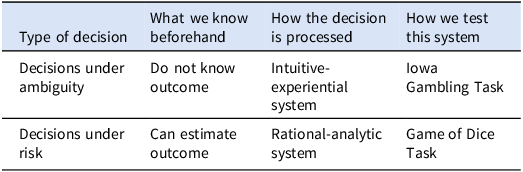
The IGT assesses how participants engage with ‘risky’ decisions. Decision theory is incorporated into experimental psychology from economics literature, which divides decisions by calculability of outcome probability: decisions are ‘under ambiguity’ (uncertainty) or ‘under risk’ (Etner et al. Reference Etner, Jeleva and Tallon2009). Decisions under ambiguity are those where we do not know what the outcome of the decision might be. Decisions under risk are those where we can calculate the risk/probability of what the outcome might be. Medical treatment decisions are investigated experimentally as decisions under ambiguity (we cannot calculate the outcome).
Decisions under ambiguity are thought to be processed by an ‘intuitive-experiential’ (‘System 1’) which acts quickly, effortlessly, with strong emotional input. Decisions under risk are thought to be processed by a ‘rational-analytical’ system (‘System 2’) which is slow, effortful, controlled and emotionally neutral (Pabst et al. Reference Pabst, Schoofs, Pawlikowski, Brand and Wolf2013). Studies where participants simultaneously carry out tasks designed to employ System 1 and System 2 together seem to show no impairment compared with doing each task separately, suggesting that they are separate and parallel systems (Turnbull et al. Reference Turnbull, Evans, Bunce, Carzolio and O’Connor2005; Kahneman Reference Kahneman2011).
Two commonly used psychological tests used to assess ‘risky decision-making’ styles include the IGT and the Game of Dice Task (GDT). Difficulties completing these tasks can show problems in the functioning of the intuitive-experiential decision-making process, or the rational-analytic decision-making process. Specifically, deficiencies in IGT completion (intuitive decision-making) seem to correlate with emotional processing deficits and, in particular, suggest that emotions are needed for learning from experience (Bechara et al. Reference Bechara, Damasio, Damasio and Anderson1994). Patients with VMPFC damage failed to learn from experience and the effect of this is to make riskier decisions in the IGT (also Clark et al. Reference Clark, Bechara and Damasio2008). Emotions appear to be the key we need to access the knowledge gained from experience and to use experience to make decisions (Table 1).
Summary of psychological models of risky decision-making

Table 1 Long description
Panel A: Table with columns labeled Type of decision, What we know beforehand, How the decision is processed, and How we test this system. Rows compare decisions under ambiguity and decisions under risk. Decisions under ambiguity involve unknown outcomes, intuitive-experiential processing, and testing via the Iowa Gambling Task. Decisions under risk involve estimable outcomes, rational-analytic processing, and testing via the Game of Dice Task.
Decision-making competence
Having considered the process of decision-making, we will turn to decision-making competence. Kluge (Reference Kluge2005) considers decision-making as a whole-person enterprise which includes cognitive, emotional, and valuational domains.
First, cognitive competence has three components: inferential, where the decision-maker understands the implications of the decision; conceptual competence, where they understand the concepts involved; and mnemonic competence, where they can conceptualise the decision/implications beyond the present moment.
Second, emotional competence means that the decision-maker’s emotional response to the matter must be appropriate to the decision and of a reasonable strength, given the decision at hand.
Third, valuational competence is broken into psychological and ethical components. The decision-maker must have an internal (psychological) mechanism for resolving conflicts between values. Ethical valuational competence means he can rank these values in order of importance. Ideally, Kluge recommends, this order should rank affective values lowest, consensus values (social values) next, and values based in principle at the highest level. Finally, Kluge adds that the values so categorised should be ethically acceptable: for example, the values espoused or their ranking should not denigrate the dignity of the patient themselves or of others. In particular, looking at the decision-making process of a patient with EUPD, regarding whether to accept life-saving treatment, the patient would not have ethical valuational competence, in Kluge’s view, where he denigrates his own dignity in his decision-making process.
On the one hand, this conception of competence – particularly valuational competence – risks imposing external values (e.g. of the assessor) on the patient. On the other hand, the example of a patient unable to consider their own dignity and value in making a treatment decision strengthens the case for a mechanism to protect such a patient from decisions arising out of this impairment.
The value of Kluge’s construct of competence is useful both in EUPD and frontal lobe damage. Patients with EUPD often cannot focus on a time period greater than the present moment (mnemonic cognitive competence). In EUPD, it can be difficult to resolve conflicts between values – and affective values may triumph in a period of high emotion (psychological valuational competence). Patients may also struggle to rank values because of the nature of their condition – EUPD involves not only affective disruption, but also interpersonal disruption and a disruption of their view of themselves. Intrapersonal and interpersonal disruption can lead to treatment refusal as part of a self-destructive tendency and instability in their relationship with the team (Winburn and Mullen Reference Winburn and Mullen2008).
Patients with frontal lobe damage also struggle to think beyond the present moment and can be impulsive (Bechara et al. Reference Bechara, Damasio, Damasio and Anderson1994) and discount potentially negative outcomes (Clark et al. Reference Clark, Bechara and Damasio2008). Koenigs et al. (Reference Koenigs, Young and Adolphs2007b) and Ciaramelli et al. Reference Ciaramelli, Muccioli, Ladavas and di Pellegrino(2007) have shown experimentally that patients with VMPFC damage tend to show reduced use of social emotion in decision making and are more likely to judge that ‘the ends justify the means’ (see also Young and Koenigs Reference Young and Koenigs2007 at p. 77). While these experiments related to abstract moral problem-solving it would be interesting to see whether VMPFC also impairs their ability to identify and rank their own values in decision-making.
Arguably the stability of emotional response is what allows valuational competence in Kluge’s model. The conceptualisation from Kluge allows clear consideration of how we might assess these forms of competence.
From competence to capacity
Assessing capacity
Capacity, says Kluge (Reference Kluge2005), is competence plus volition – a free act of the will. The model allows us much greater freedom to incorporate emotional disruption into our idea of capacity, than traditional cognitive models.
Capacity is a legal concept and technically is pronounced by the court, but the court will base its pronouncement on a clinical assessment of the patient’s decision-making competence.
Grisso and Applebaum (Reference Grisso and Appelbaum1998) suggest that doctors are constantly ‘assessing’ capacity in patients, by noticing the patient’s overall presentation. They set out criteria for when we should consider a formal capacity assessment (Grisso and Applebaum Reference Grisso and Appelbaum1998 at pp. 62–76):
-
1. Abrupt changes in patients’ mental state.
-
2. When patients refuse treatment (where refusal will likely risk an adverse outcome for the patient and/or there is a concern that the basis of the patient’s refusal is a reduced decision-making ability).
-
3. When patients consent to treatment that will be especially invasive or risky
-
4. When patients display risk factors for impaired decision-making: diagnosis (e.g. severe mental illness; lower IQ; dementia; delirium; acquired brain injury); some medications that may impair cognitive functioning; age.
This list is not directive; these factors should be considered as part of the context, for example, demands of the particular decision (complex v simple); situational demands (stressors, including the patient’s emotional state); risk versus benefit (e.g. high risk / low benefit needs a higher threshold for capacity than the reverse) (Grisso and Applebaum Reference Grisso and Appelbaum1998, Chapter 3).
Appelbaum and Grisso carried out the MacArthur study wherein they developed an instrument for assessing capacity in research settings. They compiled the US legal understanding of capacity as it stood at the time, and integrated it with medical understanding and practice. They produced the MacArthur Competence Assessment Tool-Treatment (MacCAT-T) for assessing capacity to make treatment decisions (Grisso et al. Reference Grisso, Appelbaum and Hill-Fotouhi1997). This covers:
-
1. understanding relevant information;
-
2. reasoning about risks and benefits;
-
3. appreciating the nature of their situation and the consequences of their choices;
-
4. expressing a choice.
MacCAT-T is often used in research studies and Curley et al. Reference Curley, Murphy, Plunkett and Kelly(2019) used it to compare the MacCAT-T scores, and clinical assessment based on the legal definition in the Irish ADM(C)A 2015. They found that these assessments accorded closely with each other. The MacCAT-T was developed explicitly with legal criteria in mind, however, so this does not allow us to comment on the incorporation of emotion into assessment by MacCAT.
Do we currently consider emotion when assessing capacity?
Canadian philosopher of psychiatry Louis Charland, and American forensic psychiatrist Paul Appelbaum, debated in 1998 the question of whether we sufficiently consider emotion when assessing capacity.
Charland’s thesis (Charland Reference Charland1998) is that emotion has a positive role to play in decision-making but we do not take emotions into account when assessing capacity. He focuses on the US concept of ‘appreciation’.
Appreciation… ‘refers to a patient’s recognition that information…is significant for and applicable to their own circumstances’ (Grisso et al. Reference Grisso, Appelbaum and Hill-Fotouhi1997 at 128, emphasis added).
This is a process which requires the input of emotion:
It would appear, then, that some form of positive affect is required if the significance component of the MacArthur account of appreciation is to be satisfied (Charland Reference Charland1998 at p. 368)
He also suggests that making a choice in the first place requires emotion, as choices are tied to our values, and these require meaning and emotion.
Finally, he wonders whether ‘reasoning about risks and benefits may require the input of emotions – values are generated by emotions, which we need to manipulate information.
He feels that this differing theoretical framework would sometimes lead to results which conflict with current assessments.
Appelbaum responds (Appelbaum Reference Appelbaum1998) that we should be cautious about overturning ‘the wisdom of the common law, distilled, as it is, over centuries’. Appelbaum thinks that discounting the personal relevance of some information is not enough to vitiate the ‘appreciation’ requirement; ‘[r]ather, the patient’s belief must be substantially irrational, unrealistic, or a considerable distortion of reality’ (Grisso and Appelbaum Reference Grisso and Appelbaum1998 at p. 45).
Appelbaum does not agree that attributing personal significance to choices necessarily requires emotion and may well be a purely cognitive function. Appelbaum goes on to consider theories that emotions bring information relevant to decision-making and accepts that decision-making without such information would be fraught with difficulty. But he thinks that patients impaired by absence of emotional input would not be found incapacitous using the current test anyway. He also feels that it would be difficult to define and assess ‘emotional competence’.
Appelbaum did not really challenge the point that we do not account for emotions in the current capacity tests or assessment. He just didn’t seem to think it worthwhile or necessary.
It is possible that both were partly correct – emotions play a role in decision-making; sometimes this does not play a part in the outcome of the capacity assessment; but sometimes we consider them and they impact the outcome of the assessment using the current definition.
A more recent study of Court of Protection decisions in the UK (Kane et al. Reference Kane, Keene, Owen and Kim2021) looked at the application of the UK capacity criteria found in the Mental Capacity Act 2005. A qualitative analysis of the rationales given by the court for a finding of incapacity revealed nine major categories of concerns: namely, abilities to 1) to grasp information or concepts, 2) to imagine/ abstract, 3) to remember, 4) to appreciate, 5) to value/ care, 6) to think through the decision non-impulsively, 7) to reason, 8) to give coherent reasons, and 9) to express a stable preference. The authors report that the criterion ‘to value/care’ ‘could relate to generalised apathy…, fear, or other emotion which overwhelms ability to value relevant information’ (see Table 2, p. 7). This suggests that this specialised UK court has, in the years since the US debate above, begun to take some account of the impact of emotion on certain decision-making abilities.
Operationalising our new perspective
Should we change the test for capacity?
Capacity assessment is designed to assess a mismatch between the person’s abilities and the demands of the situation. When the demands spark overwhelming emotions in a person whose ability to process these may be limited already, there are risks of several negative impacts on decision-making ability. If we ignore the role of emotions, we risk failing to identify some people at risk of harm.
On the other hand, the current trend of courts and international human rights instruments is towards limiting the power of the state and strengthening protections for individual autonomy. The UN Convention on the Rights of Persons with Disabilities, Article 12, sets out that
’States Parties shall recognize that persons with disabilities enjoy legal capacity on an equal basis with others in all aspects of life’.
This has been interpreted strictly by the CRPD Committee (United Nations CRPD Committee 2014) to mean that there must be universal recognition of legal capacity, and therefore substituted decision-making should not be permitted. While this has not been taken up practically by States Parties to the Convention, it has marked a move towards narrowing the scope of incapacity and its effects. Even the current definition of capacity and substituted decision-making regimes are thought too broad-ranging by some human rights campaigners (Dhanda Reference Dhanda2007). Adding an assessment of emotions risks widening our definition of incapacity.
We have seen that the Court of Protection of England and Wales has already begun incorporating emotional concepts into the current capacity test. Given this, we may not need to change the legal capacity definition itself. Indeed, it seems unwise to rush to radically alter ‘the wisdom of the common law carefully distilled’ if this is unnecessary. We can consider, for example, that the UK/Irish requirement to ‘weigh up’ information, or ‘appreciate’ in US law, might bear the weight of emotion, if we follow the example of the CoP. In particular, ‘valuing/caring’ and ‘expressing a stable preference’ should be helpful elements for incorporating emotional difficulties. It is also possible to see clinically where emotion can overwhelm a person’s ability to ‘understand’ and ‘retain’ information, when highly agitated; and even impact on someone’s ability to ‘communicate’ at times, say, when a severe trauma is playing a role in the decision-making process.
In the spirit of capacity law itself, we can seek the least restrictive way of bringing about our desired outcome: we can look again at our assessment process as the easiest way to incorporate emotion into capacity.
Supporting decision-making
There is some research on techniques to help manage the unwanted effects of emotion on decision making (Lerner Reference Lerner, Li, Valdesolo and Kassam2015). These include:
-
– Time delay;
-
– suppression (though this can intensify emotion and is cognitively costly);
-
– reappraisal;
-
– Induce a counteracting emotional state.
-
– Saturate the decision-maker with cognitive facts but this does not seem to work. (Though this may be the common method of seeking consent from patients.)
-
– Increase awareness of misattribution – that is, noting the source of the positive or negative mood can eliminate the carryover effect of incidental emotion
-
– Tell decision-makers they will need to explain their decision (thus making them monitor their decision-making process) – can help eliminate effects of incidental emotion.
Recommendations for assessing emotional and valuational aspects of decision-making
In the process of the capacity assessment, can we assess the impact of emotion on decision-making? Based on the research considered above, the following recommendations are offered for consideration, so as better to assess the impact of emotion on decision-making competence.
(Relying on Kluge (Reference Kluge2005), Charland (Reference Charland1998) and Kane et al. (Reference Kane, Keene, Owen and Kim2021)):
-
1. Can the patient apply the information to his own situation? (Charland)
-
2. Does he care about the decision to be made and the outcome/s? (Kane)
-
3. Is he able to motivate himself to make a choice? (Charland)
-
4. Can he think through the problem in a non-compulsive way? (Kane)
-
5. Is the patient displaying appropriate emotions, and is the strength of emotion manageable by him at the time of decision? (Kluge)
-
6. Is he able to identify which of his values are at play, what is important to him in this decision and why? Ideally, he will be able to appeal to values based in principle over consensus/social values, over affect-based values. (Kluge)
-
7. Are the values relied on ethically acceptable in the broadest sense? Do they account for, or discount, the dignity of the patient himself, or of others? (Kluge)
-
8. Are the values expressed now consistent with previous values, or do they vary substantially across time? (collateral may assist) (Kane)
Conclusion
These are some suggestions to increase awareness of the impact of emotions on decision-making competence. Future research might ask: Are there cognitive skills, that can scaffold patients with frontal lobe deficits or EUPD, which can be learned? Do emotional regulation skills counter the impact of incidental emotion or change how we engage our values in decision-making? Further work on decision-making supports for those with emotional difficulties will be profitable for the implementation of supported decision-making regimes and of great value in this field.
Funding statement
This research received no specific grant from any funding agency, commercial or not-for-profit sectors.
Competing interests
The author declares none.
Ethical standards
The author asserts that all procedures contributing to this work comply with the ethical standards of the relevant national and institutional committee on human experimentation and with the Helsinki Declaration of 1975, as revised in 2008.