Introduction
Most diseases are believed to be caused by a combination of genetic variations that increase the susceptibility to a disease, on the one hand, and environmental factors, on the other. With respect to genetic factors, several diseases such as obesity, cardiovascular diseases and diabetes in adult animals and humans could have their origin in embryonic environments.Reference Barker 1 – Reference Sundrani, Roy, Jadhav and Joshi 6 Many female reproductive disorders related to early oocyte formation, which is vulnerable to many environmental factors, also have their sources in the prenatal environment.Reference Chan, Tsoulis and Sloboda 7 Adult ovarian folliculogenesis and steroidogenesis are highly influenced by the prenatal environment.Reference Grzesiak, Knapczyk-Stwora, Duda and Slomczynska 8 Among the environmental factors, maternal food restriction (MFR) may adversely affect fetal growth and development, and thereby, the reproductive outcomes of the offspring.Reference Chan, Tsoulis and Sloboda 7 , Reference Bernal, Vickers, Hampton, Poynton and Sloboda 9 , Reference Sloboda, Hickey and Hart 10 Ovarian functions, including fecundity, are controlled by steroid hormones, the synthesis of which, in turn, is defined by steroidogenic enzymes and the expression of their genes.Reference Sirotkin and Harrath 11 However, little is known about the influence of MFR on the expression of ovarian genes controlling ovarian steroidogenesis and folliculogenesis. Moreover, the limited data available are contradictory in nature; some authors have reported that calorie restriction leads to a decrease in the expression of ovarian genes controlling steroidogenesis and folliculogenesis,Reference Bernal, Vickers, Hampton, Poynton and Sloboda 9 , Reference Sharov, Falco and Piao 12 , Reference Guzman, Garcia-Becerra and Aguilar-Medina 13 whereas others have found either an increased expression of these genes under the same conditionsReference Cordier, Leveille and Dupont 14 or no differences in mRNA expression at allReference Cordier, Leveille and Dupont 14 , Reference Pisani, Antonini and Pocar 15 between females exposed to high- and low-energy diets, when compared with the controls.
Thus, we sought to determine whether and how MFR, during pregnancy, can affect the expression of key ovarian genes involved in steroidogenesis, follicle development and reproductive performance in subsequent generations (first and second) of female offspring in rats. Among these genes, we focused on aromatase (Cyp19), insulin-like factor 3 (Insl3), cytochrome P450 17A1 (Cyp17a1) and growth differentiation factor 9 (Gdf-9). Aromatase cytochrome P450 is encoded by the Cyp19 gene and converts androgens to estrogens.Reference Godwin 16 The expression of Cyp19 mRNA in ovarian granulosa cells is differentially regulated during follicular growth.Reference Fitzpatrick, Carlone, Robker and Richards 17 , Reference Stocco 18 Aromatase gene expression is negligible in fetal ovaries, while in the ovaries of sexually mature animals it is restricted to the granulosa cells of healthy large antral follicles and to luteal cells of the corpus luteum.Reference Stocco 18 , Reference Guigon, Mazaud and Forest 19 The Insl3 gene has been described in women, rodents and ruminant ovaries.Reference Bathgate, Balvers, Hunt and Ivell 20 – Reference Hanna, Yao, Patta, Jensen and Wu 24 Insl3 has been detected within the internal layers of the theca, which may suggest a role in the production of androgen by these cells,Reference Glister, Satchell and Bathgate 25 and has also been identified in the oocytes, suggesting an involvement in oocyte maturation.Reference Kawamura, Kumagai and Sudo 26 Gdf-9, belonging to the tumor growth factor-β superfamily, is secreted exclusively by the oocyte in rodents;Reference Gilchrist, Lane and Thompson 27 however, in other mammals it has been found in the cumulus and mural granulosa cells.Reference Hosoe, Kaneyama, Ushizawa, Hayashi and Takahashi 28 , Reference Lin, Li and Xu 29 It plays a key role during follicular developmentReference Orisaka, Tajima, Tsang and Kotsuji 30 by inducing the differentiation of theca cells and their androgen production, and is involved in the proliferation of granulosa cells.Reference McGrath, Esquela and Lee 31 , Reference Orisaka, Jiang, Orisaka, Kotsuji and Tsang 32
Interrelationships between the analyzed genes are possible. For example, Insl3 knock-down resulted in a decrease in Cyp17a1 expression.Reference Glister, Satchell and Bathgate 25 Notably, the protein encoded by Cyp17 is an enzyme that mediates the production of androgens DHEA or androstenedione in rodent gonads.Reference Miller 33 , Reference Rainey, Carr, Sasano, Suzuki and Mason 34 Despite the importance of these genes and their products in the control of ovarian steroidogenesis and other steroidogenesis-related processes, it remains to be established whether MRF can affect ovarian functions via these genes, and at which age/stage of the reproductive cycle.
By focusing on two rat offspring generations, we have examined whether MFR affects the expression of the steroidogenesis-related genes Cyp19, Cyp17a1, Insl3 and Gdf-9 in the ovaries of first (FRG1) and second (FRG2) generations offspring at pre-pubertal age (week 4) and during adulthood (week 8).
Methods
Experimental design
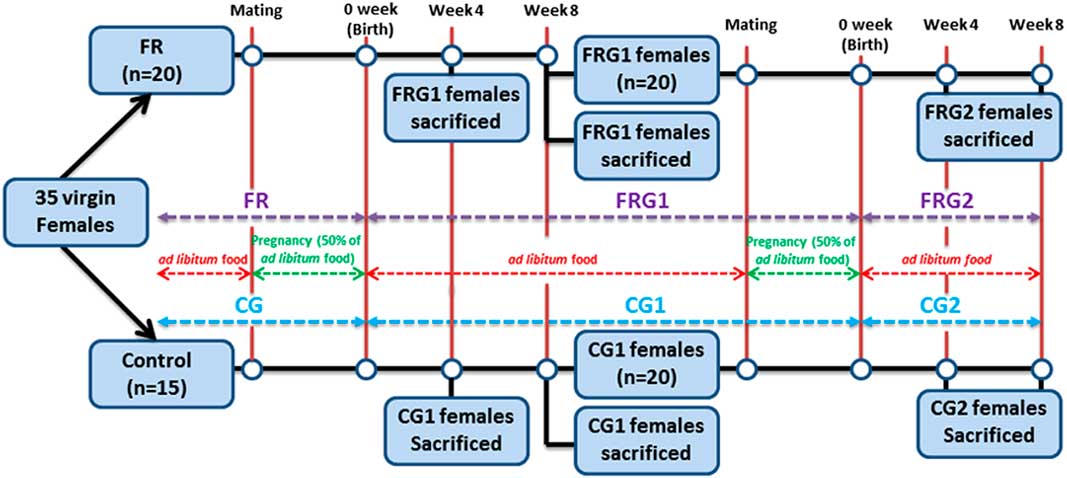
The study was approved by the Research Ethics Committee at King Saud University. Adult, virgin female Wistar rats weighing 230±20 g (40 days old), obtained from the Animal Unit at King Saud University, were provided ad libitum access to tap water and food (23% protein, 4.5% fat, 3030 kcal/kg; lab diet 5001, Brentwood, MO, USA). The experimental design employed in this study is summarized in Fig. 1. After being maintained in separate cages for 4 days of adaptation, each female was put together with a virgin 40 days-old male until the appearance on the cage floor of a white vaginal plug. This was counted as day 0 of gestation, after which the mated females were randomly divided into two groups. The first group (normal control – C; n=15) was fed ad libitum. The second group was supplied with only 50% of ad libitum food throughout gestation and was called the food-restricted group (FR, n=20). First-generation offspring rats were fed ad libitum: those obtained from FR were called food-restricted group of the first generation (FRG1) and those obtained from the control were called the control of the first generation (CG1). After complete weaning, some of the first-generation females were euthanized with chloroform before puberty (week 4; n=10) and some in adulthood (week 8; n=10). Their ovaries were removed and ovarian fat was discarded. The ovaries were immediately fixed in RNA later, and total RNA was extracted and stored at −80°C. The remainder of the FRG1 and CG1 females were allowed to reach sexual maturity and treated exactly like their mothers (CG1 females were fed ad libitum, whereas FRG1 females were fed 50% ad libitum throughout gestation). After parturition, we obtained the second-generation offspring that were fed ad libitum: those obtained from FRG1 were called the food-restricted group of the second generation (FRG2) and those obtained from CG1 were called the control of the second generation (CG2). The FRG2 and CG2 offspring females were humanely euthanized with chloroform at 4 and 8 weeks, and their ovaries were treated in exactly the same way as for the ovaries of offspring females of the first generation.
Diagram summarizing the experimental design used in this study.

Total RNA isolation and quantitative real-time polymerase chain reaction
Transcript levels were analyzed using freshly prepared mRNA that was extracted using the DNA/RNA Mini kit (Qiagen, Hilden, Germany). The purity, concentrations and quality of RNA were measured using the Agilent Small RNA analysis kit and the Agilent 2100 Bio-analyzer system (Agilent Technologies, Waldbronn, Germany), according to the manufacturer’s instructions. A sample of 1 μg of total RNA was reverse-transcribed into cDNA using a high-capacity cDNA reverse transcription (RT) kit (Applied Biosystems, Warrington, USA). RT was performed using the following thermal cycling conditions for polymerase chain reaction (PCR) analysis: 10 min at 25°C, 2 h at 37°C and 5 min at 85°C. Once cDNA was synthesized, the obtained samples were immediately stored at −20°C. We used 96-well plates and CFX 96 RT-qPCR for all the experiments concerning the mRNA expression of the selected genes. The expression of the GAPDH gene was used to normalize the RNA samples to that of the endogenous control. We used a PCR SYBR Green Supermix (Applied Biosystems) to perform the reactions. Real-time PCR was carried out using a 7500 real-time PCR system (Applied Biosystems). The Cyp19 primers were: forward 5′-TGAGTCTCCCAAGGTCATCC-3′ and reverse 5′-GGGTTCAGCATTTCCAAAAA-3′. The Cyp17a1 primers were: forward 5′-ACTGAGGGTATCGTGGATGC-3′ and reverse 5′-TCGAACTTCTCCCTGCACTT-3′. The Insl3 primers were: forward 5′-CTTCCTCACCAGGCTTCTCA-3′ and reverse 5′-CACCACCTGAGCCCTACAAT-3′. The Gdf-9 primers were: 5′-GATGTGACCTCCCTCCTTCA-3′ and reverse 5′-GCCTGGGTACTCGTGTCATT-3′. The GAPDH primers were: forward 5′-GGTATCGTCGAAGGACTCATGAC-3′ and reverse 5′-ATGCCAGTGAGCTTCCCGTTCAGC-3′. Primers were added to the reaction mix at a final concentration of 250 nM. From each sample, 5 μl cDNA were added to a volume of 20 μl of PCR mixture (0.5 μl specific primers, 12.5 μl of SYBR Green Supermix and 7 μl RNase-/DNase-free water). PCR cycles were as follows: 50°C for 2 min and 95°C for 5 min, followed by 40 cycles at 95°C for 15 s, 62°C for 30 min and 30 s at 72°C. The amplified products were separated using agarose gel in order to confirm that no spurious products had been amplified. Thereafter, we followed the 2-ΔΔCt (Livak) relative expression method to analyze the obtained results.
Statistical analysis
Experimental values were expressed as means±SD of a one-way analysis of variance. A posteriori comparisons were done using the Tukey’s method. Variance and normality assumptions were checked using the Brown and Forsythe test and the Shapiro–Wilk test, respectively. P values were considered significant if they were ⩽0.05. Statistical data analysis was conducted using the SPSS version 16.0 statistical package (SPSS, Chicago, IL, USA). Additionally, Bonferroni multiple comparison tests using Stata/SE version 13.0.168 were applied.
Results
Gene expression
Cyp19
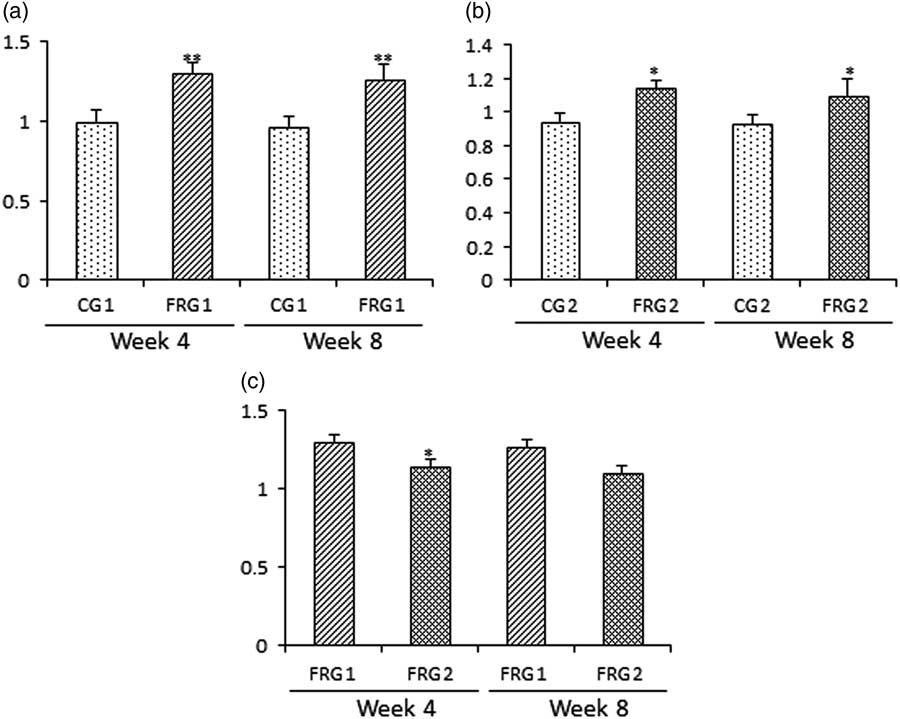
Cyp19 mRNA levels were significantly higher in the ovaries of FRG1 and FRG2 females than in those of controls, both at week 4 (P=0.0034 and P=0.0217, respectively; Fig. 2a and b) and at week 8 (P=0.0049 and P=0.0508, respectively). When the two generations were compared, Cyp19 mRNA levels were found to be significantly higher in the FRG1 than in the FRG2 females at week 4 (P=0.015 and P=0.056, respectively, Fig. 2c). The difference was not significant at week 8.
Effect of MFR on the mRNA expression level of Cyp19 gene. The mRNA level was positively associated with MFR in FRG1 (a) and FRG2 (b) females at 4 and 8 weeks compared to control females. However, the Cyp19 gene expression was higher in ovaries of FRG1 females compared to FRG2 (c). All results are an average±S.E.M. of three independent experiments, each performed in triplicate. ***P<0.0005, **P<0.005 and *P<0.05 compared to control (CG1 and CG2).

Cyp17 a1
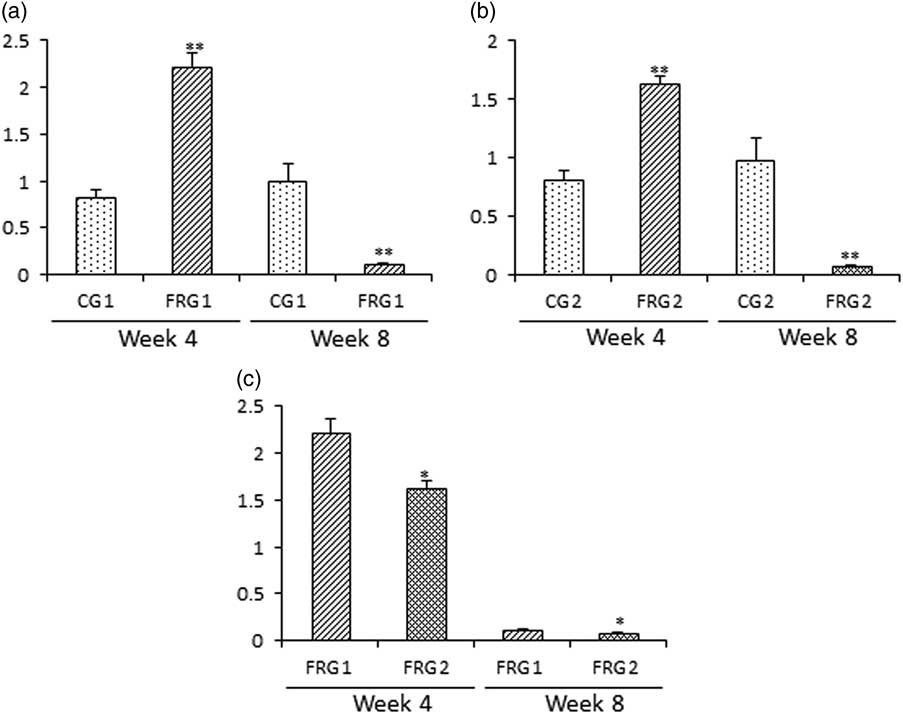
Cyp17a1 mRNA levels at week 4 were significantly higher in the ovaries of both FRG1 and FRG2 females than in the ovaries of the controls (P=0.0032 and P=0.0042, respectively; Fig. 3a and b). However, at week 8, the Cyp17 mRNA levels were significantly lower in the ovaries of the FRG1 and FRG2 groups than in those of the control rats (P=0.0018 and P=0.0016, respectively; Fig. 3a and b). When the two generations were compared with each other, the levels of Cyp17a1 mRNA were found to be significantly lower in the ovaries of the FRG2 females than in those of the FRG1 females, both at week 4 (P=0.016) and 8 (P=0.015).
Effect of MFR on the mRNA expression level of Cyp17 gene. The mRNA level was positively associated with MFR in FRG1 (a) and FRG2 (b) females at 4 weeks compared to control females. However, the Cyp17 mRNA level decreased significantly in ovaries of FRG1 and FRG2 females at 8 weeks compared to controls (a and b). The Cyp19 gene expression was higher in ovaries of FRG1 females compared to FRG2 (c) at both 4 and 8 weeks. All results are an average±S.E.M. of three independent experiments, each performed in triplicate. ***P<0.0005, **P<0.005 and *P<0.05 compared to control (CG1 and CG2).

Insl3
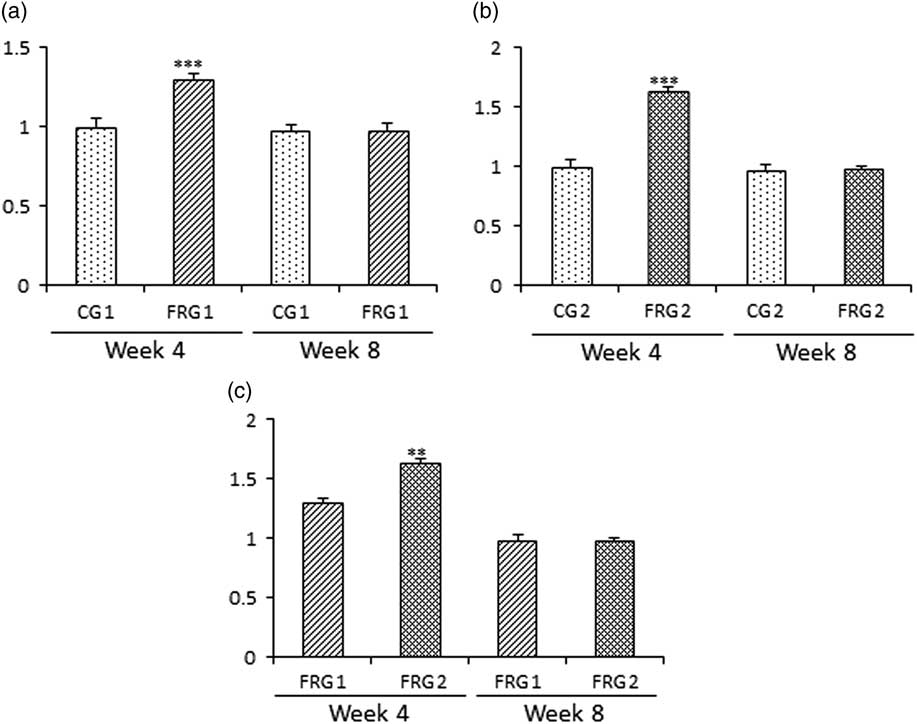
Insl3 mRNA levels were significantly higher in the ovaries of 4-week-old females in both FRG1 and FRG2 groups, when compared with those of the controls (P=0.0007 and P=0.0001, respectively; Fig. 4a and b). In the ovaries of 8-week-old females, however, Insl3 mRNA levels were not different from the controls, for both the FRG1 (P=0.4003) and FRG2 (P=0.3897) females. However, when compared between the two generations, Insl3 mRNA levels were significantly higher in the FRG2 than in the FRG1 females at week 4 (P=0.002, Fig. 4c).
Insl3 mRNA levels were significantly higher in ovaries of 4-week-old females in both FRG1 (a) and FRG2 (b) groups than in those of the control animals, whereas no significant difference was found in ovaries of 8-week-old females compared to controls. However, when the two generations were compared to each other at week 4, Cyp19 mRNA levels were significantly higher in FRG2 females than in FRG1, whereas no significant difference was found in ovaries of 8-week-old females. All results are an average±S.E.M. of three independent experiments, each performed in triplicate. ***P<0.0005, **P<0.005 and *P<0.05 compared to control (CG1 and CG2).

Gdf-9
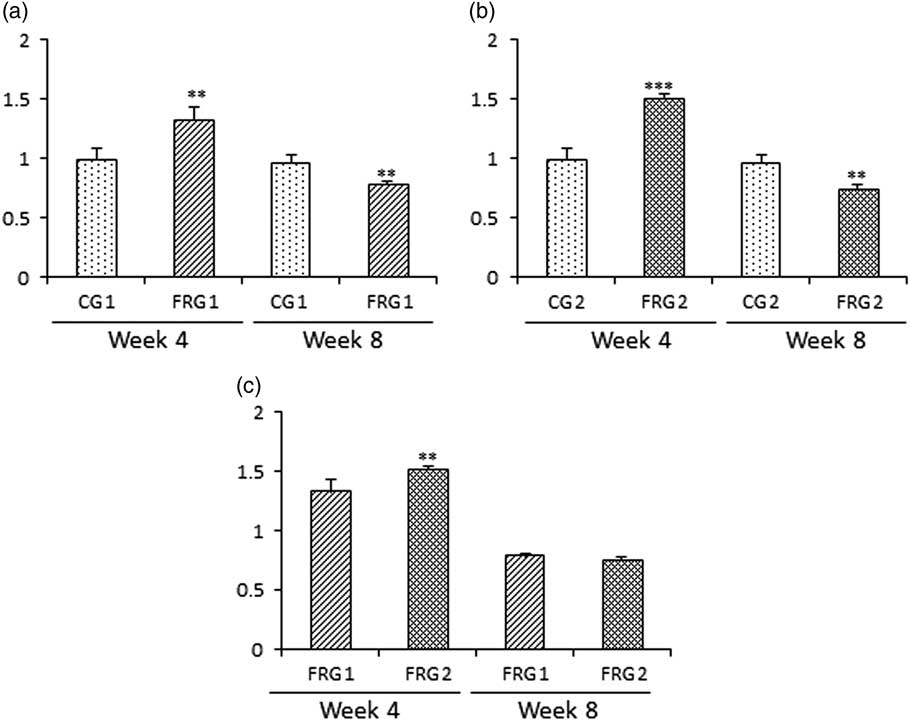
Gdf-9 mRNA levels were significantly higher in the ovaries of 4-week-old rats in both the FRG1 and the FRG2 groups, when compared with the controls (P=0.0073 and P=0.0003, respectively; Fig. 5a and b). There was, however, a significant decrease in Gdf-9 mRNA levels in the ovaries of 8-week-old rats in both FRG1 and FRG2 females, compared with those of the controls (P=0.0047 and P=0.0023, respectively; Fig. 5a and b). At week 4, Gdf-9 mRNA levels were significantly higher in the FRG2 females than in their FRG1 counterparts (P=0.025; Fig. 2), whereas no significant difference was observed in 8-week-old females of the two MFR groups.
In comparison to controls, Gdf-9 mRNA levels were significantly higher in the ovaries of 4-week-old rats in both FRG1 (a) and FRG2 (b) groups. There was, however, a significant decrease in Gdf-9 mRNA levels in the ovaries of 8-week-old rats in both FRG1 and FRG2 females compared to the controls (a and b). Gdf-9 mRNA levels were significantly higher in ovaries of FRG2 4-week-old females than in their FRG1 counterparts, whereas no significant difference was observed in 8-week-old females. All results are an average±S.E.M. of three independent experiments, each performed in triplicate. ***P<0.0005, **P<0.005 and *P<0.05 compared to control (CG1 and CG2).

Discussion
Reprogramming of the ovarian maturity and aging in response to MFR
Many factors have been reported to play key roles in folliculogenesis and steroidogenesis owing to their effects on oocyte development at various follicular stages.Reference Pisani, Antonini and Pocar 15 , Reference Fernandez, Palomino, Parraguez and Peralta 35 In the present study, the mRNA expression levels of four steroidogenic-related genes (Cyp19, Cyp17a1, Insl3 and Gdf-9) were investigated, in relation to malnutrition during pregnancy, in female offspring. In general, our data demonstrated that MFR significantly increased the expression of steroidogenic-related genes in the females of both first and second generations at week 4. This meant a priori that MFR has the capacity to induce steroidogenesis during early life (females at week 4). However, when the effects of MFR on gene expression were considered in the different groups at week 8, differences were found in terms of the different genes analyzed. In fact, in contrast to the Cyp19 gene, which was still upregulated at this age, Cyp17 and Gdf-9 were found to be significantly downregulated in the ovary of the FRG1 and FRG2 females at week 8, suggesting an inhibitory role of MFR on the expression of these two steroidogenic-related genes at this age. This last result is consistent with previous reportsReference Bernal, Vickers, Hampton, Poynton and Sloboda 9 , Reference Sui, Jia and He 36 and may suggest that 8-week-old females, which should normally be in their optimal reproductive capacity, were developing premature ovary aging.
Notably, fetal growth restriction can be considered as a part of the life history strategy for FRG1 and FRG2 females that were in utero when their mothers underwent food restriction.Reference Ellison 37 – Reference Jasienska, Thune and Ellison 40 Since prenatal undernutrition leads to reduced longevity in mice,Reference Ozanne and Nicholas Hales 41 these females may have been predisposed to a shorter life because of a higher risk of extrinsic mortality. To overcome this challenge, these females may have had to adjust their reproductive capacity, for example, by changing the intensity and duration of their reproductive lifespan, the timing of the stages of folliculogenesis, as well as the onset of reproductive maturity. Owing to the shortage of food, sensed through nutritional or endocrine signaling during fetal life,Reference Gluckman, Hanson, Beedle and Spencer 42 to ensure the reproductive success before death, these females may have changed the timing of their reproductive lifespan, to make it more intensive, but relatively limited in time, which is consistent with the life history strategy of population regulation.Reference Stearns 43 Thus, at 4 weeks of age, the upregulation of genes for early steroidogenesis might induce enhanced folliculogenesis for a greater number of primordial follicles. This is consistent with a previous study that rat maternal calorie restriction leads to an early pubertal onset.Reference Sloboda, Howie, Pleasants, Gluckman and Vickers 44 In particular, the upregulation of Gdf-9, which is essential for promoting the molecular dialogue between the oocyte and the surrounding granulosa cells,Reference Gilchrist, Lane and Thompson 27 , Reference Fernandez, Palomino, Parraguez and Peralta 35 , Reference Mcgrath, Esquela and Lee 45 may induce the transition of primordial follicles to the primary follicular stage and enhance follicular survival at an age as early as 4 weeks.Reference Gilchrist, Lane and Thompson 27 , Reference Berberoglu, Aktas, Fidan, Yazici and Aral 46 The upregulation of Gdf-9 was consistent with that of Cyp17a1 in the ovary of 4-week-old FRG1 and FRG2 females. In fact, Cyp17a1 is responsible for androgen production (testosterone, androstenedione and dihydrotestosterone), and has been reported to enhance the activation and growth of primordial follicles.Reference Murray, Gosden, Allison and Spears 47 – Reference Yang, Zhang and Li 49 According to our results, however, MFR caused a significant decrease in the expression of two different steroidogenic factors (Cyp17a1 and Gdf-9) at 8 weeks, which normally corresponds to the peak of sexual activity. This decrease suggested an early decline in ovarian function, as well as in reproductive lifespan, ultimately leading to premature ovarian aging. This finding was consistent with previous reports showing that decreased Gdf-9 mRNA levels in offspring from underfed mothers contributed to an early disruption in follicular growth.Reference Bernal, Vickers, Hampton, Poynton and Sloboda 9 , Reference Vitt, McGee, Hayashi and Hsueh 50 This finding may also help to explain the results of previous studies showing that malnutrition during pregnancy leads to premature ovarian aging in offspring,Reference Bernal, Vickers, Hampton, Poynton and Sloboda 9 a relatively short reproductive lifespan,Reference Faria Tda, Brasil Fde, Sampaio and Ramos Cda 51 and a decrease in adult progesterone levels for female offspring later in life.Reference Sloboda, Howie, Pleasants, Gluckman and Vickers 44
We expected that, in 8-week-old FGR1 and FGR2 females, the decreased availability of aromatase substrates, as a result of Cyp17a1 downregulation, would lead to a decline in the expression of Cyp19, as was the case with Cyp17 and Gdf-9. On the contrary, Cyp19 mRNA levels were significantly higher in the ovary of the first- and second-generation 8-week-old female offspring following MFR, when compared with the respective control. However, this is in agreement with previous studies reporting that a decline in serum androgen levels is associated with increased aromatase activity in aging women.Reference Shaw, Srouji and Welt 52 In fact, ovarian steroidogenesis is unexpectedly preserved, as reflected by the consistent level of aromatase, in older, regularly cycling women (35 years of age), despite the anatomic and physiological declineReference Burger, Dudley, Mamers, Groome and Robertson 53 – Reference Sowers, Zheng and McConnell 56 represented by a dramatic depletion of ovarian follicles.Reference Block 57 – Reference Gougeon, Ecochard and Thalabard 59 This also may explain the selective preservation of estradiol synthesis in older, premenopausal women, since aromatase converts androgens to estrogens,Reference Godwin 16 , Reference Sui, Jia and He 36 mainly in the healthy, large antral follicles.Reference Guigon, Mazaud and Forest 19 , Reference Turner, Macpherson and Millar 60 , Reference Sakurada, Shirota, Inoue, Uchida and Shirota 61
Intergenerational effect of MFR on female reproduction
It is well known that, in animals, a substantial proportion of the total energy demand is devoted to reproduction, and the mechanisms by which this energy is allocated are central to the process of sexual selection.Reference Kunz and Orrell 62 To counter the threat represented by energy restriction experienced during their fetal life,Reference Gluckman, Hanson, Beedle and Spencer 42 the FRG1 and FRG2 females apparently underwent reshaping of their reproductive physiology and behavior through early onset of the expression of steroidogenesis-related genes. This result is consistent with the ‘thrifty phenotype’ hypothesis proposed by Hales and BarkerReference Hales and Barker 63 in 1992 and later extended by Gluckman and Hanson to the ‘predictive adaptive response’ hypothesis.Reference Gluckman and Hanson 64 In other words, our life history strategies are not fixed but can change in response to the environmental signals we receive during development. Notably, the shortage of nutrients during fetal life may act as a forecast of the possible nutritional environment that will be faced after birth, and the fetus could respond and adapt to that predicted situation by adopting specific strategies, in order to maximize its chances of surviving and reproducing.Reference Hales and Barker 63 , Reference Martin-Gronert and Ozanne 65
Among the steroidogenesis-related genes, at week 4, Cyp19 and Cyp17 displayed higher expression levels in the ovaries of FRG1 females than in those of FRG2, whereas Insl3 and Gdf-9 were downregulated in the ovaries of FRG1 rats, when compared with their FRG2 counterparts. Many reports have demonstrated that the impact of steroidogenesis-related genes on reproductive physiology is species-specific.Reference Vitt, Mazerbourg, Klein and Hsueh 66 , Reference Abadjieva and Kistanova 67 As cited above, Gdf-9 and Insl3 play a key role in inducing the proliferation and differentiation of the follicular cells since primordial stages until maturation and ovulation.Reference Eppig, Wigglesworth and Pendola 68 , Reference Paulini and Melo 69 All these being considered, it is worth noting that, because the FRG2 females were doubly constrained, energetically, via their parents (FRG1) and grandparents, these females ensured their reproductive success by intensifying the proliferation and differentiation of their follicular cells, when compared with their mothers (FRG1). Moreover, they may learn from their parents and grandparents to increase fertility before the onset of reproductive maturity, which is consistent with population regulation in the theory of life history.Reference Stearns 43 Our results seem to be consistent with the finding of Liang and Zhang, who demonstrated that F2 offspring were more vulnerable to MFR than the F1 offspring and grandmothers.Reference Liang and Zhang 70 However, other studies reported no female intergenerational reproductive effects as a consequence of food deprivation during gestation.Reference Meikle and Westberg 71 , Reference Rogers, Hunter and Rosen 72 Thus, in view of these contradictory findings, additional studies are required to elucidate the impact of maternal malnutrition on the reproductive activities of the offspring.
In conclusion, the shortage of nutrients experienced by the FRG1 and FRG2 females via their mothers when they were in utero, might be perceived as a ‘warning message’ about an increased risk of mortality during postnatal life. To overcome this challenge, these females may have reprogrammed their reproductive capacity to precociously reach puberty, through the upregulation of the steroidogenic-related genes. However, the downside of this strategy may be represented by early ovarian aging, since we found that MFR was inversely correlated with reduced ovarian steroidogenesis-related genes (Gdf-9 and Cyp17) in female offspring of the first and second generations at week 8, an age normally corresponding to maximal reproductive capacity in female rats. The effect of MFR was more significant in FRG2 than in FRG1 females, which may reflect intergenerational reproductive effects of food deprivation of mothers during gestation.
Acknowledgments
The authors would like to thank Dr Deborah Sloboda from the Departments of Biochemistry and Biomedical Sciences, Obstetrics and Gynecology, and Pediatrics, McMaster University, Hamilton, Canada, for the constructive criticism on an earlier draft of the manuscript.
Financial support
The authors would like to extend their sincere appreciation to the Deanship of Scientific Research at King Saud University for funding this research RG-164.
Declaration of interest
The authors have not competing interests to declare.
Ethical standards
The authors assert that all procedures contributing to this work comply with the ethical standards of the relevant national guides on the care and use of laboratory animals.