INTRODUCTION
In the 2008 elections, political mothers occupied the spotlight. While the politicization of parenthood is not a new phenomenon (Elder and Greene Reference Elder and Greene2007), the recent elections highlighted motherhood in unprecedented ways. Sarah Palin's candidacy, especially, brought forth a renewed debate on the place of working mothers and mothers in politics. Furthermore, Palin's decision to emphasize her motherhood experience and family life rather than downplay it is somewhat different from women candidates' strategies of the past.Footnote 1 And while Hillary Clinton generally emphasized her “toughness” and political experience during her 2008 presidential bid (Lawrence and Rose Reference Lawrence and Rose2010), images of Clinton arm in arm with her daughter were replete in media coverage of her campaign. She was also careful to point out that she was a “mom first and a candidate second.”Footnote 2
The presence of political mothers, however, is not new. Patty Murray (D-WA), one of the first women elected to the U.S. Senate with small children still at home, ran in 1992 under the campaign slogan “just a mom in tennis shoes.” Nancy Pelosi (D-CA) frequently references the value she places on motherhood and family, once remarking that “there is no more important responsibility than raising a family.”Footnote 3 All of these women have capitalized politically on their domestic roles and have chosen to highlight their experience as mothers rather than ensconce their family lives.
Although some political candidates may successfully run and serve as political “moms,” such a presentation may handicap others, however. A long-standing body of research shows that female candidates, especially those vying for top political positions, may need to emphasize their “masculine” traits and obscure telltale signs of their femininity, including their roles as wives and mothers. Political history is replete with examples that seem to confirm the negative consequences of combining motherhood with politics. Jane Swift, the first woman governor of Massachusetts, incited public outrage when she became pregnant with twins while serving in office. While many Americans praised Sarah Palin's ability to juggle motherhood and politics, just as many, if not more, questioned her choice to run for vice president with five children at home, including an infant with Down syndrome.Footnote 4 We are hard-pressed to find many examples of male candidates who receive such scrutiny of their family life, save for when the media discovers an adulterous affair.
In this article, I examine the question of whether being a mother or father helps or hurts female and male candidates. Although many scholars have examined both the influences of gender and family obligations on the political careers of men and women, almost no research investigates how the interaction between gender and family life affects voter evaluations of candidates. This research has important implications for how candidates might need to negotiate the presentation of their family lives to voters. I argue that because of entrenched gender roles and perceived role conflictFootnote 5 concerning ideas about mothers and public figures, parental status will matter differently for evaluations of male and female candidates. In what follows, I outline the literature concerning both the role of gender and family life in the campaigns and careers of political candidates. I then suggest hypotheses concerning how parental status might affect voter evaluations of male and female candidates. Next, with an experiment, I test these hypotheses by presenting respondents with six different cases of gender/family combinations. I ask respondents to rate the candidates for governor on several different candidate evaluation measures and issue competencies.
I find that parental status is indeed politically relevant, though in very different ways for men and women. Specifically, I find evidence that not having children severely disadvantages women candidates, but has the opposite effect for men. I also find that mother candidates with young children are not substantially penalized compared to other women, but that father candidates are rated lower than men without children. Furthermore, substantial differences in perceived issue competencies emerge between mother candidates and childless women. Finally, I draw conclusions concerning how parental status matters in evaluations of candidates and lay out questions that future research might examine in order to fully understand the electoral consequences of being a parent (or not).
EXISTING LITERATURE
The Role of Gender in Politics
The effect of gender on candidates' political fortunes has been well documented in scholarly literature. Although women run for office at much lower rates than men (Elder Reference Elder2004; Lawless and Fox Reference Lawless and Fox2005), women who do run are as successful as men in their bids (Burrell Reference Burrell1994; Darcy, Welch, and Clark Reference Darcy, Welch and Clark1994). Many scholars take this finding to mean that sex discrimination is no longer a formidable barrier for women who wish to enter politics.Footnote 6 However, even though women win their elections at a comparable rate to men, they must overcome several obstacles that men rarely, if ever, face. Research concerning the effect of gender in politics highlights the fact that voters often use gender stereotypes in their evaluations of candidates. Some scholars have found that women candidates perceived to possess typically masculine traits (assertive, coarse, tough, aggressive, stern, active, rational, confident) receive higher evaluations than candidates who embody typically feminine traits (warm, gentle, kind, domestic, passive) (Huddy and Terkildsen Reference Huddy and Terkildsen1993a; Koch Reference Koch1999; Rosenwasser and Seale Reference Rosenwasser and Seale1988). Furthermore, voters perceive women and men as better suited for different policy areas: Men are judged more competent on “masculine” issues, such as the economy, terrorism, and the military, whereas women are perceived as better able to handle “compassion” issues, such as education, health care, child care, and poverty (Cook, Thomas, and Wilcox Reference Cook, Thomas and Wilcox1994; Dolan Reference Dolan2004; Rosenwasser and Seale Reference Rosenwasser and Seale1988; Sapiro Reference Sapiro1981/1982). While women may have an advantage when the political context makes compassion issues more salient, their gender is more often a handicap, especially during political moments when “male” issues achieve high political concernment (Lawless Reference Lawless2004).Footnote 7
How does parental statusFootnote 8 interact with gender in perceptions of women candidates? On the one hand, voters might perceive mothers as too feminine or soft for a top political job, and therefore less qualified or competent. They also might worry about a mother's ability to balance a demanding political career with family obligations or penalize her for trying to do so. On the other hand, political mothers might be able to play to gender stereotypes and be perceived as especially competent on compassion issues, especially those that are related to children and families. Furthermore, the advantage women generally have on compassion issues might disappear for childless women candidates.
The Role of Family Life in Politics
A substantial body of research has uncovered the various ways in which the private lives of men and women affect their political choices and experiences to different degrees. As Sue Thomas (n.d.) puts it: “The corollary of masculinized understandings of political leadership is feminized understandings of women's appropriate private roles and spheres of labor.” Women in politics are less likely than men to have children, and when they do have children they have fewer (Carroll Reference Carroll1989; Kirkpatrick Reference Kirkpatrick1974). Women with children are more likely than men to enter politics at a later age because of child-care responsibilities, and mothers of young children are underrepresented in political office compared to fathers of young children (Carroll Reference Carroll1989; Dodson Reference Dodson1997; Kirkpatrick Reference Kirkpatrick1974 Stoper Reference Stoper, Githens and Prestage1977; Thomas Reference Thomas2002). Furthermore, women officeholders are much more likely than their male counterparts to perform most of the domestic labor in the home, regardless of their political responsibilities (Thomas Reference Thomas2002). Because of their “double duty” (i.e., a demanding public career combined with primary responsibility for taking care of the home and children), women politicians are less likely than men to seek higher office (Carroll Reference Carroll1989; Fulton et al. Reference Fulton, Maestas, Maisel and Stone2006) and are more apt to name family obligations as a reason for retirement (Blair and Henry Reference Blair and Henry1981).
Indeed, political women must negotiate their private lives with their public careers at virtually every stage of their political tenure, including the initial decision to run for office. In a study of qualified and eligible potential officeholders, Jennifer F. Lawless and Richard Logan Fox (2005) found that 65 out of 100 women interviewed believe that children make running for office much more difficult, in contrast to only 3 out of 100 men who cite this same hindrance.Footnote 9 Women who are childless face obstacles as well; one study based on focus group interviews with voters indicated that single and/or childless female candidates make voters uncomfortable (Barbara Lee Family Foundation 2004). This line of research suggests that gender role expectations and family obligations are more salient for political women than for political men. Women are constrained by family responsibilities and must negotiate their private lives in ways that men do not.
The higher salience of family to women candidates compared to male candidates is evident in their self-presentations. In an analysis of campaign advertisements for Senate and gubernatorial races, Dianne G. Bystrom and her colleagues (2004) found that males were much more likely than females to feature their families in their ads. Also, female candidates were significantly more likely than men to include in their ads pictures of children who were not the candidate's own.Footnote 10 The authors of this study explain the telling implications of these findings: “Women candidates may want to show voters that they are more than wives and mothers and to dismiss any concerns voters may have over their abilities to serve in political office due to family obligations” (Bystrom et al. Reference Bystrom, Banwart, Kincaid and Robertson2004, 44). Apparently, some female candidates perceive their domestic lives as a liability in campaigns and attempt to de-emphasize their private roles to voters.Footnote 11
If some female candidates are downplaying their domestic lives, including their experience with motherhood, does this strategy help their candidacies? The little research in this area has not reached a consensus regarding the effect of parental status on voter evaluations, but some studies suggest that voters do care about candidates' family lives and have different expectations for women and men candidates.Footnote 12 One study (Barbara Lee Family Foundation 2001) found that voters prefer male candidates to have teenage children and female candidates to have adult children. Focus group participants in this study expressed anxiety about female candidates in executive positions, particularly in relation to time balance and loyalties to their family versus their constituents. For men, this concern was not an issue since voters make the assumption that a male candidate, even if a father, has “someone else” to tend to the family (that someone else, undoubtedly, is his wife) (Barbara Lee Family Foundation 2001). On the other hand, Jennifer Schenk Sacco (Reference Sacco2007) found that women candidates without children receive higher evaluations than mother candidates. A study conducted by the Pew Research Center (2008) reached similar conclusions as Sacco's and also noted that Republicans are significantly less likely to support a mother of young children compared to a father of young children. The little research that exists seems to suggest that parental status matters differently for men and women candidates, but how and to what extent remains contested.
In this article, I attempt to shed light on unanswered questions concerning how voters view mother candidates. From the literature reviewed here, several implications emerge. The gender of a candidate matters in voter evaluations, with male candidates often having the advantage (with the exception of compassion issues). Furthermore, masculine qualities may carry greater salience for executive positions that involve more responsibility, such as mayor, governor, or president (Huddy and Terkildsen Reference Huddy and Terkildsen1993b). Women are more constrained by their family responsibilities than are men in terms of the decision to enter politics and their political ambition. They also sometimes attempt to mask their family lives in their campaigns, preferring to emphasize their masculine qualities. But more than a handful of women candidates have chosen to present their motherhood experience as an asset. The salient question then becomes, does family life matter beyond political career decisions and candidate self-presentation? That is, how does parental status affect the political fortunes of men and women at the ballot box?
HYPOTHESES
I expect that parental status will matter more for evaluations of women candidates than for men. Specifically, I hypothesize that women with younger children will receive the most negative evaluations, compared to their male counterparts and women with older children or no children. There are two reasons this pattern might emerge: One is that voters may believe that the candidate will lack the time and dedication to properly serve her role in office if she has young children at home. Indeed, some evidence indicates that voters worry that “a woman candidate with small children could be hindered by torn loyalties” (Barbara Lee Family Foundation 2001, 34). If this hypothesis holds true, voters will perceive women with young children as having significantly less time to fulfill their role as governor compared to other candidates. The second reason voters might give mothers with young children more negative evaluations has to do with ideas about what constitutes the proper place for women. Although it is more or less acceptable for a woman to work outside of the home,Footnote 13 a position that carries as much responsibility and time demands as governor might seem unsuitable for women with younger children. Voters might form a negative impression of mother candidates if they believe she is violating her traditional role as mother and keeper of the private home. Thus, mother candidates, especially those with young children, are caught in a bind. As Lawless and Fox (Reference Lawless and Fox2005, 60) put it:
Women who venture out of the “proper sphere” often find themselves in a catch-22: if they achieve professional success then they have likely neglected their “womanly” duties; if they fail professionally, then they were wrong to attempt entering the public domain in the first place.
I also hypothesize that this negative attitude toward mother candidates with young children might apply to mothers with older children as well, although to a lesser extent in light of voters' perception that they have already fulfilled their “motherly” duties and thus can pay more attention to their political careers. The one exception to this “mother disadvantage” might be competency ratings on compassion issues—I expect that respondents will perceive women with children as better able to handle child care and children's issues in comparison to their male counterparts and women with no children.
The woman candidate without children presents an interesting case. On the one hand, voters might perceive the absence of children as an asset to her campaign; a woman without children will clearly have more time to devote to serving her public position. This idea was exemplified in discussion about Janet Napolitano's nomination for Secretary of Homeland Security. Though he received harsh criticism for his comment, Pennsylvania Governor Ed Rendell claimed that Napolitano was a perfect fit for the job since she has no family, “she has no life,” and thus can “devote, literally, 19–20 hours a day to [the job].”Footnote 14 However offensive this comment may have seemed, the underlying idea is that childless women may be better able to handle demanding political jobs since they are free from family obligations that might conflict with their careers. If voters perceive the absence of children as a positive trait, then we would expect to see women without children receiving higher evaluations. On the other hand, voters might feel uncomfortable with a childless woman and question her character. Some research indicates that having a family is an important trait in candidates since “voters look to see how a candidate connects with her family … for reassurance that she understands voters' lives” (Barbara Lee Family Foundation 2001, 34). Voters might perceive a role conflict with childless women as well and question their decision to choose a career but not a family. Therefore, childless female candidates might receive a penalty in voter evaluations. Furthermore, the advantage women generally have on compassion issues might disappear for childless women candidates.
METHODS
In order to examine how gender and parental status interact in evaluations of political candidates, this study employed an experimental design. Because of the limitations of survey data, including social desirability issues and the inability to adequately control for other factors, an experiment allowed me to isolate the effect of parental status and gender on voter evaluations of male and female candidates.Footnote 15
The sample consisted of 317 undergraduate students in an introductory political science course.Footnote 16 Respondents participated voluntarily and were told that the study was about voter reactions to political candidates. Men comprised 52.7% of the sample while 47.3% of the respondents were women. Although the ages of respondents ranged from 18 to 40, the mean age in this sample was 20 years. The sample overrepresents Democrats, with 56.5% of respondents identifying with the Democratic Party, 23.0% as Republicans, 14.2% as Independent, and 4.7% who identify with an “Other” party. While the respondents in this study are not representative of the national voting population, there are advantages in using a student sample as well. College students and young people generally are more likely to support female candidates and hold more egalitarian ideas about women in politics (Dolan Reference Dolan2004); thus, they are probably less likely to hold biases against a female candidate. Because college students are among those least likely to endorse gender stereotypes or discriminate against female candidates, any bias that does emerge holds greater weight.
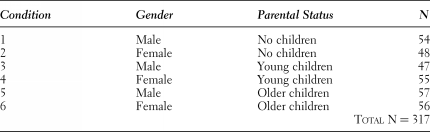
Respondents were presented with a picture of a mock candidate, a short description, and an excerpt from a speech purportedly given by the candidate at a campaign rally.Footnote 17 The speech excerpt is based on text from Virginia gubernatorial candidate Terry McAuliffe's campaign website in order to mimic real-life campaign talk. In the experiment, I varied three factors—the gender of the candidate, whether or not the candidate has children, and the ages of the children—for a total of six different conditions (see Table 1). To ensure that the candidate's parental status was obvious, the picture included the candidate's children with a caption stating their names and ages.Footnote 18 The description reiterated the fact that the candidate is a parent and again listed the names and ages of the children.Footnote 19 For the childless condition, I explicitly stated that the candidate was married and had no children.Footnote 20
Experimental conditions
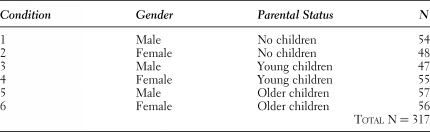
I controlled for both the race and sexuality of the candidates by including all white candidates who are in heterosexual marriages.Footnote 21 The description also stated that the candidate is running for governor of Connecticut. I chose the governorship since past research indicates that women may be at a greater disadvantage for executive positions that carry more responsibility and that are often thought of as “masculine” positions (Huddy and Terkildsen Reference Huddy and Terkildsen1993b). Thus, if a bias against women candidates exists, the governorship is where we would most expect to find it (save for the presidency). The time demands of the governorship may make parental status more relevant as well since voters may question a mother candidate's ability to balance her family life with running the state.
The candidate was evaluated on a host of dimensions, and the questions I asked came mostly from past candidate evaluation experimental studies. First, the respondents were asked to rate the candidates on overall impression. Next, respondents were asked their level of agreement with general “good politician” or “strong leader” statements, such as:
• Candidate Smith will make a good governor.
• Candidate Smith is qualified for office.
• Candidate Smith has qualities I look for in an elected official.
• Candidate Smith will get things done in office.
These four indicators, along with the overall impression score, were combined to form a summary scale measuring what I call the “good candidate” evaluation. The four measures all correlated positively with a Cronbach alpha score of .853.
Additionally, two other questions tap into perceived ability to handle the responsibility of the governorship; these questions are especially important in determining if voters believe mother candidates would be less committed to their jobs than father or childless candidates. Respondents were asked if
• Candidate Smith will have enough time to fulfill her/his role as governor.
• Candidate Smith will be committed to the job.
These two measures were analyzed separately as distinct dependent variables. While both questions generally relate to the candidate's ability to perform in office under time constraints, the measures are theoretically and empirically different. While the first question taps into practical time constraints the candidate might face, the second question relates to the candidate's perceived motivation or drive to fulfill his or her responsibilities as governor.
Respondents were also asked the likelihood that they would vote for the candidate and the perceived likelihood that the candidate would win the election.Footnote 22 Issue competency questions asked the respondent, “Based on your impression of Candidate Smith, how well would Candidate Smith handle each of the following issues?”
• A military or police crisis
• A terrorist threat
• Child care
• Improving the welfare of children
RESULTS
Gender Differences in Evaluations of Candidates
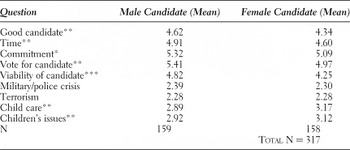
The first cut at the data shown in Table 2 reveals a pattern that suggests pessimistic consequences for female candidates: In the aggregate, male candidates receive higher evaluations on every measure except competency on child-care and children's issues. Men and women candidates also score about the same on military and terrorism issues. Because the hypothetical candidates were pictured and described in exactly the same way, the male advantage can be attributed solely to his gender. Table 2 shows significant differences across both the good candidate and commitment to office dimensions: Respondents believe that the male candidate is a better candidate and will be more committed to the office than the female candidate. Additionally, respondents are more likely to say that they would vote for the male candidate and that the male candidate is likely to win his election in comparison to the female candidate. Overall, then, this evidence suggests that men have the gender advantage in politics.
Differences in evaluations of male and female candidates

+ p < .10; * p < .05; ** p < .01; *** p < .001.
Note: For each indicator, the higher the number, the more positive the rating.
Scale: Candidate evaluation questions range from 1 to 7, with 1 indicating the lowest scores and 7 the highest. The issue questions ranged from 1 to 4, with 1 being the least competent and 4 being the most competent.
Differences in Evaluations of Women by Parental Status
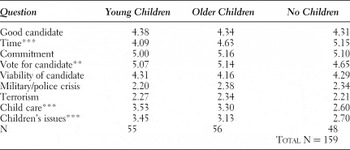
Looking at gender effects in the aggregate may mask important differences in how voters evaluate different kinds of men and women. In this study, parental status was manipulated to see how mothers fare with voters as compared to childless women and male candidates. I hypothesized that women with younger children would receive relatively low scores compared to men with younger children and women with older children. Expectations concerning the childless woman candidates were less defined, since on the one hand voters might believe a woman without child-care responsibilities would have more time and energy to fulfill her political duties, but on the other hand voters might feel uncomfortable with a childless woman and question her decision to choose a career but not a family. The results shown in Table 3 provide partial support for all hypotheses. Women with young children are disadvantaged compared to women with older children and women with no children with respect to evaluations of time capacities. Women with no children are perceived to have substantially more time to fulfill their role as governor compared to women with children, especially young children (5.15 vs. 4.09, p < .001). The gap between women with young children and women with older children is significant as well (4.09 vs. 4.63, p = .04) and narrows somewhat between women with older children and childless women (4.63 vs. 5.15, p = .06). Among women, parental status seems to make little difference for good governor evaluations, commitment to the job, and perceived viability of the candidate, but respondents are more likely to express willingness to vote for a mother candidate rather than a childless female.
Differences in evaluations of female candidates by parental status

* p < .10; ** p < .05; *** p < .001.
Note: For each indicator, the higher the number, the more positive the rating.
Scale: Candidate evaluation questions range from 1 to 7, with 1 indicating the lowest scores and 7 the highest. The issue questions ranged from 1 to 4, with 1 being the least competent and 4 being the most competent.
Women with young children do not have a significant disadvantage in comparison to women with older children and women with no children, except on the time variable. As I expected, mothers with young children are perceived to have less time to fulfill the governorship than women with older children and no children, and this relationship is strong (p < .001). Women with young children receive the highest scores on child-care and children's issues competencies, while women with no children receive the least favorable evaluations. Although these findings run against the expectation that women with young children will receive the most negative evaluations overall, it confirms the hypothesis that childless women lose their gender advantage on compassion issues, particularly when these issues are related to children.
Differences in Evaluations of Men by Parental Status
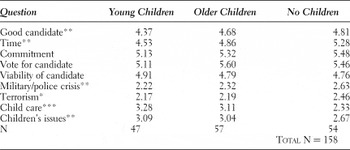
Although men may receive higher evaluations than women overall, parental status also has some effect on perceptions of male candidates. In general, men with no children receive slightly higher scores than father candidates. Evidence provided in Table 4 suggests that men with no children are perceived to have more time to fulfill their political obligations and are more committed to the job than are men with young children and older children. Additionally, men with young children are significantly disadvantaged on the good candidate variable compared to men with older children and no children. Childless men also score higher on likelihood of receiving the respondent's vote and viability, though these differences are not significant. Men with no children also receive higher competency ratings on handling a military/police crisis and a terrorist threat. As with female candidates, father candidates score higher on child-care and children's issues.
Differences in evaluations of male candidates by parental status

* p < .10; ** p < .05; *** p < .001.
Note: For each indicator, the higher the number, the more positive the rating.
Scale: Candidate evaluation questions range from 1 to 7, with 1 indicating the lowest scores and 7 the highest. The issue questions ranged from 1 to 4, with 1 being the least competent and 4 being the most competent.
Differences in Evaluations of Men and Women across Different Conditions
Women with young children versus men with young children
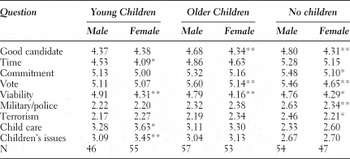
Although women with young children may not have a significant disadvantage in comparison to women with older children and women with no children, they may fare poorly compared to male candidates. Holding parental status constant allows us to consider gender differences among men and women with the same family description. When looking at men with young children compared to women with young children in Table 5, we see that men and women score about the same on the good candidate and commitment variables, but are slightly different with respect to time capacities, with women scoring lower. The most substantial difference emerges on viability: Respondents are much more likely to believe that the male with young children is likely to win his election than the female with young children. As has been the case throughout this analysis, women do better on child-care and children's issues competency.
Differences in evaluations of male and female candidates by parental status

* p < .10; ** p < .05; *** p < .001.
Note: For each indicator, the higher the number, the more positive the rating.
Scale: Candidate evaluation questions range from 1 to 7, with 1 indicating the lowest scores and 7 the highest. The issue questions ranged from 1 to 4, with 1 being the least competent and 4 being the most competent.
Men with older children versus women with older children
In comparing men with older children to women with older children in Table 5, the male advantage gap widens. Respondents are more likely to positively evaluate the male candidate on the good candidate variable and are more likely to say that they would vote for the male candidate and that he will win his election compared to his female counterpart. It is interesting to note that men are not rated much lower on child-care and children's issues in the older children condition, though women still receive the higher competency evaluations. Clearly, there is something about having younger children that makes a woman seem better able to handle children's issues. On the one hand, this seems counterintuitive—women with older children have more years of experience in raising a family than do women with younger children and might be sager on these matters. But women who are still raising their children, who are in the throes of the motherhood experience, might be perceived as having a more accurate perspective than their older mother candidate counterparts.
Men with no children versus women with no children
As we see in Table 5, women with no children do significantly worse on every single indicator than do men with no children, except for children's issues and time capacities, where they are rated almost exactly the same. The results from this analysis indicate that gender matters most for candidates who are childless. Men with no children receive much higher evaluations than do their female counterparts, and are considered better candidates, more committed to the job, more likely to receive the respondent's vote, and more viable a candidate. This finding, taken with the results comparing women candidates across parental statuses, provides strong support for the hypothesis that voters penalize women with no children. Voters hold opposite feelings toward male candidates without children—childless men consistently receive the highest scores across conditions, not only in comparison to women. Perhaps men pictured with their children project an image of femininity or softness that makes voters uncomfortable. Whatever the reason, it is clear that when candidates are childless, the gender of the candidate matters more than ever in how they are perceived by voters.
The time variable: Parental status and perceptions of candidates
One variable deserves additional discussion because of its consistent effects across conditions. The time question, which asked respondents to agree or disagree with the following statement: “Candidate Smith would have enough time to fulfill his/her role as governor,” cuts at the heart of what it means to be a parent candidate in politics. Regardless of the parental status considered, men are perceived as more likely to have enough time for politics than are the women candidates, even in comparison to women without children. Regardless of gender, too, candidates with young children are perceived to have substantially less time to serve than are candidates with older children and candidates with no children.Footnote 23 While voters perceive men with children as having less time to be governor than men without children, the differences among women candidates is much more pronounced. Because all of the conditions except for gender were the same in these comparison groups, the factor that causes different evaluations of time capacities is gender alone. The results of this experiment indicate that voters perceive more of a conflict for female candidates between their family and politics than they do for male candidates.
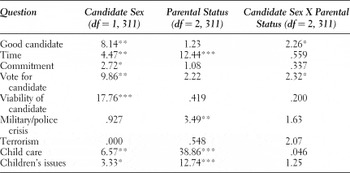
Impacts of candidate sex, parental status, and the interaction on evaluations
Thus far, the results of my analysis suggest that both gender and parental status affect evaluations of political candidates, and that the effects are different for men and women. In order to examine the individual effects of candidate sex, parental status, and the interaction between the two, I conducted a two-way ANOVA for each dependent variable (see Table 6). The results of this analysis basically confirm and crystallize the evidence discussed previously, but the effects of each variable can be seen more clearly. First, candidate sex has the largest and most consistent impact on voter evaluations of candidates. Candidate sex is a significant predictor for all evaluation measures, with men always scoring higher than women, except on compassion issues. Parental status clearly drives differences in evaluations of candidates' time capacities, though candidate gender is significant as well. It is interesting that parental status also affects competency ratings on military issues. Men with no children seem to be driving this effect, since they receive the highest scores compared to women and to father candidates. Of course, as discussed above, being a parent is an important predictor for competency on child-care and children's issues. Significant interaction effects emerge on the good candidate and vote choice variables. On the good candidate measure, childless men are significantly advantaged compared to men with children, especially men with young children. Parental status does not seem to affect evaluations of women on the good candidate variable. With vote choice, women with no children receive significantly lower scores compared to their mother counterparts, but this effect does not exist for male candidates. Clearly, not having children affects men and women very differently when it comes to evaluations of candidates and vote choice—childlessness advantages men, but it penalizes women.
Impacts of candidate sex, parental status, and the interaction on evaluations of candidates

* p < .10; ** p < .05; *** p < .001.
Note: Scores are F-ratios.
Subgroup differences in evaluations
Perhaps the demographic characteristics of the sample may be driving some of these findings. Previous literature suggests that both the gender and partisan identification of the respondent can influence support for a woman candidate. Although party affiliation is generally a stronger predictor of vote choice than the gender of the candidate (Dolan Reference Dolan2004; King and Matland Reference King and Matland2003), some studies have found that women are slightly more likely to support women candidates (Dolan Reference Dolan2008; Paolino Reference Paolino1995; Plutzer and Zipp Reference Plutzer and Zipp1996; Sanbonmatsu Reference Sanbonmatsu2002; Sigelman and Sigelman Reference Sigelman and Sigelman1982). In this study, however, there were no significant gender differences in evaluations of female or male candidates, including vote choice. Female candidates, then, seem to have no advantage among women voters.Footnote 24
Partisan identification as a predictor of support for a female candidate
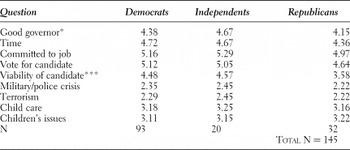
Why do voters evaluate women candidates consistently lower than men? Why do childless women fare so much worse than their male counterparts and mother candidates? The results from Table 7 demonstrate that more positive evaluations of female candidates are partly dependent on the respondent's party identification. The Republicans assign the women candidates the lowest scores on almost every single indicator compared to Democrats and Independents, though not all variables reach significance. The variable where this difference is most obvious is found on the viability question—Republicans are substantially less likely to say that the woman candidate will win her election. These findings are consistent with past research suggesting that political liberals and Democrats are more likely to support female candidates (Dolan Reference Dolan2004). Republicans, who espouse socially conservative ideas and traditional attitudes toward women in politics (Bennett and Bennett Reference Bennett and Bennett1992), may be uncomfortable with a woman running for a highly visible office like the governorship. Also, because women candidates are perceived as more liberal than male candidates (Alexander and Andersen Reference Alexander and Andersen1993; Huddy and Terkildsen Reference Huddy and Terkildsen1993a; Koch Reference Koch2000), Republicans may have a negative reaction to their inferred political ideologies (King and Matland Reference King and Matland2003; Koch Reference Koch2000). No such partisan differences existed for evaluations of male candidates.
Differences in evaluations of female candidates by partisan identification

* p < .10; ** p < .05; *** p < .001.
Note: For each indicator, the higher the number, the more positive the rating.
Scale: Candidate evaluation questions range from 1 to 7, with 1 indicating the lowest scores and 7 the highest. The issue questions ranged from 1 to 4, with 1 being the least competent and 4 being the most competent.
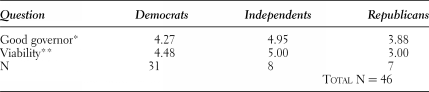
Furthermore, there are significant partisan differences in evaluations of women without children, as shown in Table 8 below. Republicans are significantly less likely than Democrats or Independents to rate the female candidate positively on the good candidate variable and viability. Again, no such partisan differences exist for childless male candidates. Why would there be substantial partisan differences in evaluations of childless women but not childless men or the other conditions in this experiment? One explanation rests on partisan differences in ideologies about the family. Jo Freeman (Reference Freeman1993) contends not only that the two parties differ in their ideologies of the family but also that they are completely polarized on these issues.Footnote 25 Republicans place tremendous value on the nuclear family and the preservation of it; a woman who chooses not to have children may seem deviant or otherwise makes Republicans feel uncomfortable. Because the number of Republicans in this sample and in this specific condition is relatively low, this finding is tenuous. On the other hand, the partisan differences in evaluations of childless female candidates do reach statistical significance, and the differences in means are quite large. It is also worth noting that the distaste Republicans express for female candidates in this study echoes the real-life political world in which Democratic women make up the vast majority of female politicians (CAWP 2009).Footnote 26 More research concerning the interaction between parental status, gender, and partisan differences in evaluations is necessary in order to answer this question properly.
Differences in evaluations of childless female candidates by party
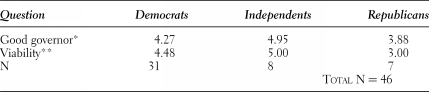
* p < .10; ** p < .05; *** p < .001.
Note: Only differences that were significant are shown.
DISCUSSION
This study has provided evidence that the parental status of candidates matters differently for male and female candidates. But even before considering how being a parent matters, this experiment provides solid evidence that simply being a woman is a disadvantage for political candidates. Gender, irrespective of parental status, matters a great deal to the fate of political contenders, especially to Republican respondents. Even though the candidates were pictured and described exactly the same for this experiment, college students from a liberal university city gave higher evaluations to male candidates. Although real-life political races involve other factors that matter to vote choice besides gender, the findings from this study indicate that sex discrimination may still be operating under the surface, albeit in subtle, hidden ways.Footnote 27 This finding should give pause to both scholars and practitioners who believe that voters are no longer biased against women candidates.
Although men do better than women regardless of their parental status, whether or not a woman candidate is also a mother matters to voters. The respondents in this sample, especially Republicans, did not respond favorably to the childless female candidate. Voters may not have been able to relate to a woman candidate without a family or may have questioned why she deviated from the standard path of marrying and having children. For women, especially, choosing not to reproduce causes more whispers and sideway glances than it does for men who are childless. Voters in this study may have been responding to a subconscious feeling of discomfort with a woman who is not like most other women.Footnote 28 Furthermore, a woman without children may appear too “masculine” and fail to strike the necessary balance of possessing both masculine and feminine qualities; voters may penalize her for seeming too hard and not soft enough (Carroll Reference Carroll1994; Jamieson 1005; Witt, Paget, and Matthews Reference Witt, Paget and Matthews1995). Republicans might be especially wary of women with no children because of the party's emphasis on family values and the importance of strengthening the nuclear family (Critchlow Reference Critchlow2005; Freeman Reference Freeman1993). Other research might explore in more depth the reasons why voters dislike childless women and who in the electorate most and least dislikes women without children.
Women with young children are not evaluated as poorly as predicted. This study found that voters are not strongly biased against women candidates with young children and may actually feel positive toward this kind of mother candidate on certain dimensions. Voters might assume that a woman with young children is young herself and therefore has more energy and vitality. Women with young children also score highest on child-care and children's issues competency. However, mothers of young children are disadvantaged compared to male candidates with young children, and also score lowest across the conditions on the time variable. It is worth noting that women with young children may not fare as well with a representative sample of the U.S. population, and in fact that the original hypothesis of this study concerning the disadvantage of women with young children might actually be confirmed with a nonstudent sample.
Childless female candidates lost their typical gender advantage on compassion issues. Compared to mother candidates, women without children receive the lowest scores in perceived competency on child-care and children's issues. Childless women fare about the same as childless men on these issues, which suggests that the female advantage on these kinds of policies may be driven partly by associations with the motherhood experience and women's caregiving role. Thus, women without children may fare especially poorly in political climates where compassion issues are salient.
This study also found evidence of a “fatherhood penalty.” That is, childless male candidates are advantaged compared to male candidates with children. Although this article is primarily interested in explaining how parental status might contribute to the success or detriment of women candidates, the findings related to male candidates deserve attention. Why would childless males be rated lower than father candidates, especially with “masculine” issues? One theory might be that men pictured with children, especially young children, appear more feminine and soft than men without children. Voters might form a more “feminine” impression of men with young children and thus evaluate them more negatively. This idea is in line with feminist theory that posits the “lone man” as the exemplar of executive leadership (Duerst-Lahti Reference Duerst-Lahti, Borrelli and Martin1997). The ideal executive embodies strength, power, masculinity, and independence, and is presumed to act alone. Men pictured with children challenges this ideal and may emasculate the candidate.Footnote 29
The two-way ANOVA suggests that the effects of candidate sex, parental status, and the interaction carry different weights depending on the dependent variable. Overall, the story is more about gender than anything else—candidate gender has a significant effect on each evaluation variable, with men scoring higher than women. Parental status matters most for time capacities, with childless candidates scoring significantly higher than parent candidates. Mother and father candidates, but especially mother candidates, have a strong advantage on compassion issues compared to their childless counterparts. These results suggest that men and women who do not have children may be perceived to lack compassion, and the absence of a parenting experience may render them inadequate to handle child-related issues. Also, the significant interaction effects suggest that the state of being childless affects men and women in opposite ways. While men are advantaged by having no children, women are penalized. Men without children might seem more masculine, and therefore better candidates, while childless women might seem too masculine. Societal notions of masculinity and femininity, combined with gendered expectations concerning reproduction, clearly affect the ways in which male and female candidates are perceived.
CONCLUSIONS
Although past research has shown that family obligations pose a barrier to the political careers of women but not of men, almost no research has examined voters' reactions to the parental status of political candidates. This study provides a partial answer to this question, and finds that the political consequences of being a parent are different for male and female candidates. The evidence suggests that women, regardless of their parental status, do worse than men, but that the difference is most exaggerated when childless candidates are compared. Furthermore, if any candidate receives a “parenthood penalty” it is male candidates. Father candidates are somewhat disadvantaged compared to childless male candidates, especially with respect to “masculine” issues.
Lack of a strong bias against mothers of young children may be the result of using a student sample and may not capture the full range of attitudes toward mother candidates in the electorate. To reiterate, the hypothesis that mothers of young children might be disadvantaged in candidate evaluations could be confirmed with a nonstudent sample. It is reasonable to conceive that systematic differences exist in how students versus adults perceive the parental role, and that young adults' willingness to support a mother candidate cannot be generalized to the entire U.S. population. Future research might focus on how different kinds of people view mother candidates—older voters, for example, who might hold more conservative views of women's role in society, could evaluate mothers very differently.
In addition, voters who are mothers themselves might identify more with mother candidates and be more likely to support candidates with children over childless candidates. Indeed, past studies find evidence of a “parent gap” on certain political issues like social welfare policies, and that the “parent effect” is stronger for women (Elder and Greene Reference Elder and Greene2007, Reference Elder, Greene and Whitaker2008). If being a parent can shape views on political issues, there is reason to believe that the parental status of voters might affect vote choice of candidates. Furthermore, the political context might affect when childless and mother candidates are advantaged or disadvantaged; because women with children are perceived as much more competent on compassion issues in comparison to childless women and male candidates, mother candidates might be advantaged when these issues are politically salient but disadvantaged when they are not.
This study did not specify the candidates' party affiliations. David C. King and Richard E. Matland (Reference King and Matland2003) note the importance of including a party cue in investigations of the effect of candidate gender on voter evaluations, and other scholars name party identification as a potent predictor of vote choice.Footnote 30 The sample size in my study (n = 317) did not permit me to assign a party affiliation to the candidates, though I concede that this variable might well alter or amplify the results of this experiment. For example, childless Republican women might be punished more, especially by Republican respondents. Future research that adds party identification of the candidate as an independent variable will make more clear how parental status matters and to whom.
The impact of parental status on candidates' fortunes may vary depending on the type of office sought. In this study, all candidates were depicted as contenders for governor of Connecticut. The personal qualities of candidates, including their family lives, may matter less for lower-profile offices. Also, the slight disadvantage mother candidates receive compared to father candidates might disappear for political offices that carry less responsibility and time management skills than the governorship. Research that varies the type of political office being sought would yield additional insight into how and when parental status matters in elections.
The different ways in which parental status affects voter evaluations may also be affected by the race of the candidate. In this study, all candidates pictured were white. There is reason to believe that voters might evaluate a black mother candidate differently from a white mother candidate, both because of racial resentment or biases and because of specific stereotypes about black mothers.Footnote 31 An examination of how race interacts with gender and parental status would add yet another dimension to this discussion.
Finally, the role of sexuality in evaluations and perceptions of female candidates deserves attention. The relationship between gender and sexuality seems particularly relevant to the case of the childless female candidate. Although the candidates in this experiment were designated as in heterosexual marriages, real-life female candidates who are single with no children might be thought of differently from a married female candidate. Voters might perceive the absence of a husband and children as indicative of a questionable sexuality, and thus may evaluate this type of candidate even more negatively.
This article has demonstrated that parental status, gender, and the interaction of the two matter in important ways for the fate of candidates. Women candidates (especially childless women) need to pay greater attention to how they present their family life (or lack thereof) to voters and how this strategy might differ depending on the audience. While men are simply advantaged by being male, father candidates may have to confront the “feminization” that could negatively impact their images, especially for fathers of young children. Hopefully that future research will investigate why voters rate childless women candidates so low; the answer to this question will inform campaign strategy. But the reason for the varying importance voters place on a man and woman's family is symptomatic of deeply ingrained ideas that even the best campaign strategies might not be able to overcome. Women are intimately connected to, and associated with, the family in ways that men are not. For women who do not have children, this cognitive dissonance is a problem, and one that involves a radical change in how we conceptualize the family, the political realm, and women's role in both.
APPENDIX A
Description of Candidates without Children:
Connecticut State Representative John/Jane Smith is running for governor of Connecticut. He/She is married and has no children. John/Jane Smith has worked as a lawyer for more than 15 years and is currently serving his/her second term in the Connecticut State Assembly.
Description of Candidates with Children:
Connecticut State Representative John/Jane Smith is running for governor of Connecticut. He/She is married and is the father/mother of two children—Brad, 25/3 and Katelin, 20/6. John/Jane Smith has worked as a lawyer for more than 15 years and is currently serving his/her second term in the Connecticut State Assembly.
Speech Excerpt:
“All over Connecticut, people are anxious. Like everyone else in America, they are nervous about the economy. This is not a Democratic or Republican or Independent issue. This is a Connecticut issue.
In every corner of the state—in rural, suburban, and urban areas—unemployment rates are rising, homes are being foreclosed on, and people's life savings are diminishing. And all signs indicate that next year is going to be even worse—perhaps the worst year since the Great Depression. Connecticut residents are worried.
But Connecticut residents also know that the best days are ahead. They know that the next few years are going to be tough, but they are ready to get to work and build a better future for their children. They need a governor who can bring an energetic, fresh, creative approach to solving problems and building a stronger economy … a governor who comes to the job with values such as honesty, hard work, and accountability.
I believe that we can solve our problems together. With hard work, dedication, and perseverance, you and I can ensure a brighter future for Connecticut.
Note: This text was borrowed from Terry McAuliffe's campaign Website (McAuliffe is running for governor of Virginia in 2010) and was adapted to the purposes of this study. See http://www.terrymcauliffe.com.
APPENDIX B
Characteristics of respondents in each treatment group

*Although data for “Other” party were collected, respondents choosing this option comprised less than 5% of the sample, and so were dropped in the subsequent analysis.
Note: Results from chi-square tests for party identification and sex and ANOVA for age revealed no statistically significant differences among groups.