Introduction
Acquired brain injury (ABI) is currently a leading cause of death and disability worldwide (source: World Health Organisation, data from 2000 to 2012). Although the incidence varies across countries, the number of people affected is substantial. The Centers for Disease Control and Prevention estimates that in the United States alone close to 4% of the population lives with a brain injury. This would be an underestimation. These data do not include unreported injuries (25% of all mild to moderate traumatic brain injuries) or office visits in outpatient setting. In the Netherlands, every year approximately 130,000 people suffer some form of ABI (source: Hersenstichting Nederland).
A frequent and disabling consequence of ABI is executive dysfunction. Executive functions are those capacities that make persons effective in the real world, allowing them to adapt to new situations and to develop and pursue their life goals in a constructive and productive way (Burgess & Simons, Reference Burgess, Simons, Halligan and Wade2005). The prefrontal cortex plays an essential but not exclusive role in executive functioning together with several cortical-subcortical circuits that all include the prefrontal cortex (e.g., Andrés, Reference Andrés2003; Sbordone, Reference Sbordone and Groth-Marnat2000). The above-mentioned capacities are paramount for successful rehabilitation after ABI: They allow the reacquisition of independent living skills and successful community re-entry (Spikman, Reference Spikman and van der Naalt2010).
Rehabilitation should, therefore, consist of interventions that improve executive functions in daily life. However, one of the major challenges in rehabilitation, in general, and more specifically in the rehabilitation of executive functions lies in impaired self-awareness associated with executive dysfunction. Problems with self-awareness result in unrealistically positive reports of patients about self-functioning (Hart, Sherer, Whyte, Polansky, & Novack, Reference Hart, Sherer, Whyte, Polansky and Novack2004; Sherer, Hart, Whyte, Nick, & Yablon, Reference Sherer, Hart, Whyte, Nick and Yablon2005; Spikman & van der Naalt, Reference Spikman and van der Naalt2010). Neurological patients are generally known to under-report cognitive, emotional and behavioural deficits (Barker, Andrade, Morton, Romanowski, & Bowles, Reference Barker, Andrade, Morton, Romanowski and Bowles2010; Barker, Andrade, Romanowski, Morton, & Wasti, Reference Barker, Andrade, Romanowski, Morton and Wasti2006; Morton & Barker, Reference Morton and Barker2010a; Morton & Barker, Reference Morton and Barker2010b). More specifically, Spikman et al. (Reference Spikman, Boelen, Lamberts, Brouwer and Fasotti2010) found that impaired self-awareness affected traumatic brain-injury patients with moderate to severe lesions, including frontal lesions and executive dysfunction, whereas patients without these lesions showed a more adequate perception of their level of functioning.
Self-awareness can be conceptualised as consisting of two components (Toglia & Kirk, Reference Toglia and Kirk2000). The first is the above-mentioned knowledge and beliefs about one's abilities. The second is defined as on-line awareness: The ability to monitor performance within the stream of an action. When self-awareness is impaired, patients have little or no knowledge about their own abilities and they are not able to apply this knowledge in real-life situations. For instance, they do not adapt their behaviour during an action if the results are not as expected. Therefore, lack of self-awareness can lead to several problems, such as difficulties in goal setting, poor motivation or compliance with rehabilitation. In a review of the literature, Ownsworth and Clare (Reference Ownsworth and Clare2006) found support for the view that self-awareness is important for rehabilitation outcome following ABI, although the exact relationship between both variables is not yet clear. Several studies have reported on the effectiveness of self-awareness treatment (Goveror, Johnston, Toglia, & DeLuca, Reference Goveror, Johnston, Toglia and DeLuca2007; Schmidt, Fleming, Lannin, Ownsworth, & Khan, Reference Schmidt, Fleming, Lannin, Ownsworth and Khan2012; Schmidt, Lannin, Fleming, & Ownsworth, Reference Schmidt, Lannin, Fleming and Ownsworth2011; Tate et al., Reference Tate, Kennedy, Ponsford, Douglas, Velikonja, Bayley and Stergiou-Kita2014). These studies demonstrate that impairments in self-awareness can be effectively treated.
An often used indicator of impaired self-awareness is the discrepancy between self-reported problems and problems observed by significant others (Burgess, Alderman, Evans, Emslie, & Wilson, Reference Burgess, Alderman, Evans, Emslie and Wilson1998; Hart, Whyte, Kim, & Vaccaro, Reference Hart, Whyte, Kim and Vaccaro2005). The underrating of problems by patients compared to the reports of significant others is a well-known finding in neurological patients (Barker, Morton, Morrison, & McGuire, Reference Barker, Morton, Morrison and McGuire2011). These authors further conclude that professional carers are the preferred independent raters compared to patients’ relatives. Hence, the discrepancy between self-ratings of patients and ratings of professional carers of executive problems might be a useful indicator of the (lack of) self-awareness of the patients.
In a previous study, we described the efficacy of a treatment for executive dysfunction in patients with ABI on their daily life executive functioning (Spikman et al., Reference Spikman, Boelen, Lamberts, Brouwer and Fasotti2010). Within this broader treatment, specific treatment of self-awareness was incorporated throughout. In the present study, we evaluate the effects of this treatment of self-awareness, in particular, by investigating whether there was an effect on the extent of the discrepancy between patient's ratings and the ratings of a therapist on a well-known questionnaire for executive functioning, the Dysexecutive Questionnaire (DEX), at 6 months post-treatment. In addition, we were interested in whether deficits in social cognition might be associated with impaired self-awareness and treatment effects. McDonald (Reference McDonald2013) points out that social cognition, the capacities to attend to, recognize and interpret social cues, is strongly related to self-awareness, because one needs to know one's own mind in order to represent others. An important element of social cognition is emotion recognition, which is frequently diminished after brain injury, in particular, when there are frontal lesions. In a large number of studies, deficits in emotion recognition and social cognition have been found in patients with a moderate to severe traumatic brain injury (Babbage et al., Reference Babbage, Yim, Zupan, Neumann, Tomita and Willer2011; Henry, Phillips, Crawford, Ietswaart, & Summers, Reference Henry, Phillips, Crawford, Ietswaart and Summers2006; McDonald, Reference McDonald2013; Milders, Ietswaart, Crawford, & Currie, Reference Milders, Ietswaart, Crawford and Currie2006; Spikman, Milders, Visser-Keizer, Westerhof-Evers, & Herben-Dekker, Reference Spikman, Milders, Visser-Keizer, Westerhof-Evers and Herben-Dekker2013b; Spikman, Timmerman, Milders, Veenstra, & van der Naalt, Reference Spikman, Timmerman, Milders, Veenstra and van der Naalt2012). A connection between impairments in emotion recognition and self-awareness has also been shown, whereas emotion recognition showed no correlations with general cognitive deficits in patients with moderate to severe traumatic brain injury (Spikman et al., Reference Spikman, Timmerman, Milders, Veenstra and van der Naalt2012). Besides that there is a neural commonality between both concepts. Impairments of self-awareness after traumatic brain injury have been shown to result from the breakdown of functional interactions between nodes within the fronto-parietal control network (Ham et al., Reference Ham, Bonnelle, Hellyer, Jilka, Robertson, Leech and Sharp2013). This is the same network that is one of the underlying systems in emotion recognition (e.g., Adolphs, Reference Adolphs2002). Moreover, in a previous paper, we showed that deficits in emotion recognition had a negative effect on rehabilitation treatment for executive dysfunction as a whole, even more than the level of executive dysfunction before treatment (Spikman et al., Reference Spikman, Boelen, Pijnenborg, Timmerman, van der Naalt and Fasotti2013a). Because of the relation between self-awareness and emotion recognition and the fact that rehabilitation treatment has a strong social aspect to it, perhaps even more so when treating self-awareness problems, we will additionally investigate to what extent emotion recognition is related to self-awareness in our mixed group of ABI patients.
Methods
The original treatment study was set up as a prospective multicentre randomized control trial (RCT) of a multifaceted treatment for executive dysfunction with two patient groups receiving treatment in seven Dutch rehabilitation centres and two academic settings. Prior to the trial, several experienced neuropsychologists received extensive training in the use and application of the experimental treatment protocol. During treatment, these therapists were monitored and given feedback in central meetings taking place every 3 months. The same therapists were responsible for the administration of the control treatment.
Subjects
Participants suffered from ABI of non-progressive nature (i.e., traumatic brain injury, stroke or cerebral tumours), with a minimal time post-onset of 3 months. Age was between 17 and 70 years and participants lived at home. Candidates were referred for outpatient rehabilitation with post-injury executive dysfunction either reported by themselves or observed by proxies. The signalled problems regarding planning, initiation and regulation of complex daily life tasks hampered the resumption of previous activities and roles. Patients who gave their informed consent underwent a neuropsychological examination. Exclusion criteria were severe cognitive comorbidity (i.e., aphasia, neglect, amnestic syndrome, indicated by deficient scores on relevant neuropsychological tests) interfering with treatment, severe psychiatric problems, neurodegenerative disorders and substance abuse. Suitable candidates were blindly and randomly assigned to either the experimental or the control condition per centre. Balanced assignment was done per four patients: two 'control' and two 'experimental'. Excluded patients were offered standard rehabilitation. A total of 83 people were assessed for eligibility, 75 were randomized, underwent treatment and post-training assessment. A total of 38 were allocated to the experimental intervention (see Spikman, Reference Spikman and van der Naalt2010 for more details). Because of missing data not all of these patients could be included in this study: 63 were included and 29 received the experimental treatment.
Treatment
In each treatment condition, patients underwent 20–24 one-hour treatment sessions, twice a week, during a 3-month period. Measurements were performed at baseline (T0), immediately after treatment (T1) and 6 months post-treatment (T2). During the interval between T1 and T2, patients underwent no other treatments. For the present study, we deemed only the measures at 6 months post-treatment (T2) relevant as indication of treatment results that were considered relatively stable over time.
Experimental Treatment
Patients were treated following a protocol called: ‘Multifaceted Treatment of the Dysexecutive Syndrome’ (Spikman et al., Reference Spikman, Boelen, Lamberts, Brouwer and Fasotti2010). The treatment consisted of three consecutive modules: (1) Information and Awareness, (2) Goal Setting and Planning and (3) Initiation, Execution and Regulation. In the first module, self-awareness was explicitly addressed, following Ylvisaker's (1998) explication of distinct facets of executive function. In four to six psycho-educative sessions, patients were extensively informed about executive problems and their negative consequences for daily life, in general, and their own lives, in particular. This information, together with the results of the neuropsychological assessment provided the basis for a strength and weakness analysis, which formed the starting point for the treatment. Consequently, awareness was stimulated throughout the whole treatment. During every session, patients were continually prompted to monitor and evaluate their executive performance. Also, they were asked to systematically predict their performance in home assignments. In each subsequent session, these predictions and their fulfilment, together with factors that did or did not help were extensively evaluated. These ‘awareness exercises’ were continued after this first module and incorporated in every subsequent training session. The second module consisted of seven to nine sessions and was aimed at training Ylvisakers’ executive function notions of goal setting and planning in a systematic way. Patients were taught to plan an activity emphasizing the formulation of intended activities and tasks in terms of goals and steps leading to these goals. When the planning skills of this module were mastered, the patients were allowed to start the third module. In 9–13 sessions, effective execution of plans ‘in vivo’ was addressed. Execution and monitoring of the plan were practiced and evaluated together with the therapist. Starting from session 17, the ability to address problems that might arise during the execution of plans was trained.
Control Treatment
Control treatment was Cogpack (Marker, Reference Marker1987). This is an individually administered computerized cognitive training package consisting of several repetitive exercises that aims at improving general cognitive functioning (like reaction speed, attentional functioning, memory and planning) without tapping on self-awareness (Spikman et al., Reference Spikman, Boelen, Lamberts, Brouwer and Fasotti2010). The programme is self-supporting; most tasks can be done without assistance. A therapist was constantly present to provide support when needed. Task performance was followed by direct feedback from the computer program so that patients could gain insight into their strengths and weaknesses. Improvements over time could be monitored. However, no clues about strategic approaches to the proposed tasks were offered by the therapist. Just as in the experimental treatment, after 10 sessions patients were asked to formulate three goals they wanted to achieve by means of the training. During the remaining sessions, patients could freely select the exercises they deemed useful for reaching these goals.
Measures and Procedures
Self-awareness
As a measure of self-awareness we used the DEX (Wilson et al., Reference Wilson, Alderman, Burgess, Emslie and Evans1996). The DEX is a 20-item questionnaire measuring a broad spectrum of behavioural problems that are considered part of the dysexecutive syndrome (Burgess et al., Reference Burgess, Alderman, Evans, Emslie and Wilson1998). Higher scores represent more severe problems. The DEX-self (DEX-S) score was compared with the DEX-independent other (DEX-I). The DEX-I was completed by an independent professional. These professionals were only distantly involved in the patients’ total rehabilitation treatment. Thus, they knew the patient and could observe his or her behaviour but were not informed about the treatment administered to the patient. Both total scores on DEX-S and DEX-I were used. Also DEX-dif (DEX-S minus DEX-I) was used as an indication of self-awareness. A negative difference score indicated impairment in self-awareness.
Emotion perception
The Facial Expressions of Emotion-Stimuli and Tests (FEEST; Young et al., Reference Young, Perrett, Calder, Sprengelmeyer and Ekman2002) is a test for the recognition of emotional expressions on faces. We used one of the two subtests: the Ekman 60 Faces test. In this test, 60 faces are shown with emotional expressions representing the primary emotions Fear, Disgust, Anger, Happiness, Sadness or Surprise (10 of each). Stimuli are presented for 5 seconds, after which the subject has to choose which emotion label best describes the emotion shown. The total score ranges from 0 to 60, the separate emotion scores range from 0 to 10.
Statistical Analysis
All analyses were performed using IBM SPSS Statistics Version 20. For all statistical tests, the overall alpha level was set at .05 (two-tailed). t-tests and Chi-square tests were used to ensure that both groups were well matched on demographic characteristics. t-tests were used to compare the DEX scores of the two groups at T0 and T2 and the FEEST total score at T0. To test whether DEX-dif scores had changed after treatment, compared to pre-treatment, and whether this change differed across the two groups, we used a General Linear Model repeated measures analysis. Additionally, correlation analyses were calculated for the FEEST scores and the DEX-dif scores for the total group. We excluded cases if they had missing values.
Results
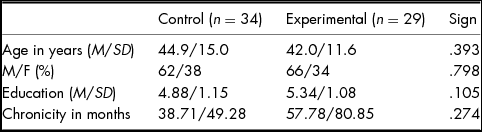
The present study included 63 patients who underwent treatment and post-training assessment, of whom 29 were in the experimental group and 34 in the control group. Table 1 shows the characteristics of both patient groups. These were well matched with regard to age, educational level, percentage of males and chronicity as no differences were found after statistical testing with T-tests and Chi-square tests.
Demographic Data of the Control Patient Group and Experimental Patient Group

Educational level was indicated on a seven-point scale, with 1 = < 6 years primary school and 7 = university education.
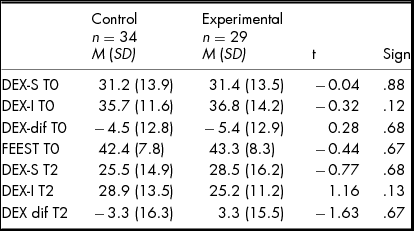
Table 2 shows the FEEST total scores of the two treatment groups at T0 and the DEX ratings, the DEX-S, DEX-I and the DEX-dif, at T0 and T2. There were no significant differences between both treatment groups for any of these variables.
Scores and Results of t-Tests of DEX and FEEST Total Scores in Control and Experimental Group at T0 and T2

DEX-S = DEX self, DEX-I = DEX independent professional, DEX-dif = DEX-S Minus DEX-I.
Subsequently, repeated measures analysis was performed to test whether DEX-dif changed over time, and to investigate, in particular, if there were differences across the two patients groups. We found a significant effect of time (F(1,61) = 8.114, p = .006), indicating that for both groups the discrepancy between self and professional rated executive functioning diminished, which can be interpreted as enhanced self-awareness. In addition, we found a significant interaction effect (F(1,61) = 4.695, p = .034) indicating that the improvement in self-awareness was significantly larger for the experimental patients who underwent the multifaceted executive treatment protocol.
Finally, we analysed to what extent emotion recognition was related to self-awareness before treatment as well as self-awareness post-treatment. A moderate but significant positive correlation (Pearson r = .32, p = .010) was found between the FEEST total score and the DEX-dif at T0. The relation between FEEST total score and DEX-dif at T2 was somewhat lower, but also significant (Pearson r = .28, p = .029). These findings indicate that patients who were worse in recognizing emotional expressions also had a lower level of self-awareness, both pre- and post-treatment. In addition, we analysed the correlations between the FEEST subscores and the DEX-dif score at T0 and at T2. A moderate, but significant positive correlation (Pearson r = .33, p = .008) was only found for FEEST-Disgust with the DEX dif score at T0. An even higher, but still moderate positive correlation was found for FEEST-Disgust with the DEX-dif score at T2 (Pearson r = .37. p = .003). This indicates that particularly patients who were impaired in the recognition of expressions of disgust had lower levels of self-awareness, both pre- and post-treatment.
Discussion
The results of this study show that a combination of psycho education and awareness exercises can improve self-awareness in patients with ABI and executive dysfunction, as indicated by ratings of professionals. This is very encouraging, because a lack of self-awareness may hamper rehabilitation treatment, in general. As recommended by Schmidt et al. (Reference Schmidt, Lannin, Fleming and Ownsworth2011), our awareness training took place in the context of a broader protocol in which awareness exercises were given throughout the whole treatment. We assumed that this broader context might contribute to the effectiveness of our self-awareness treatment, but this integration can also be seen as a limitation of the present study because this multi-faceted treatment design with integrated self-awareness training did not allow us to analyse whether the improvement on self-awareness was due to the specific awareness elements (the first module and consecutive exercises) or to other elements present in the protocol. A core feature of our treatment was that patients could directly put into use the information and knowledge from the first module of the treatment, on self-awareness, in the next two modules directed more broadly on executive functioning. In these second and third modules, the patients were still being monitored by their therapist and received feedback on their self-awareness. Hence, although we cannot analyse which element of the treatment was most effective, we consider it a strength of our treatment that it integrated self-awareness exercises in a broader perspective, making it more likely for patients to generalize what they learned to everyday life. Future controlled trials on this subject should also control for this social interaction between patients and therapists, as this was not controlled for in the study and should evaluate the impact of treatment of executive functions with and without the self-awareness training module to determine the specificity of treatment for improving self-awareness.
Another possible limitation is the improvement we found on the patient – independent professional rater contrast in the DEX scores. Although independent professional raters were blind to the treatment condition of the patient, we cannot be sure that patients did not reveal something about their treatment. Therefore, we cannot exclude a bias in our study. Even so, in this matter, we considered the DEX-I score as the most reliable judgement of the patients’ executive dysfunction. It is a matter of debate, whether the proxy is the most reliable significant other to give an accurate report of a patient's executive behaviour. In a study by Barker et al. (Reference Barker, Morton, Morrison and McGuire2011), the DEX-I inter-rater agreement was assessed. The authors’ conclusion was that professional carers were very adequate, in some cases even more competent, in judging the level of functioning of the patients when compared to family members. They recommended that someone ‘given training/guidance on measure completion’ should complete the DEX-I.
A surprising finding was that the treatment effect found in the experimental group occurred as a positive DEX discrepancy post-treatment, in other words, these patients rated their executive difficulties as worse than did the independent professional. This could indicate that following treatment patients experience a distorted, overly negative, view of their abilities, such as is associated with depressive mood. This cannot be ascertained as no measures of mood were taken before and after treatment. This possible effect on mood of self-awareness treatment should be taken into account in further research as there may be important clinical implications for these treatments if it is the case that self-awareness can become distorted in the opposite direction following intervention.
In a previous study, performed by our group in patients with moderate to severe TBI, a significant relationship between impaired emotion recognition and decreased self-awareness was found (Spikman et al., Reference Spikman, Milders, Visser-Keizer, Westerhof-Evers and Herben-Dekker2013b). The present group consisted of ABI patients with mixed aetiology: TBI, stroke and brain tumours. Nevertheless, we were able to replicate our previous findings in this group and found significant correlations between emotion recognition and self-awareness, both pre- and post-treatment. In addition, we found that particularly impairments in the recognition of disgust were significantly related to a lower level of self-awareness, also pre- and post-treatment. There is evidence that the recognition of 'negative' emotions (fear, sadness and disgust) is more impaired in TBI than positive emotions such as happiness (Croker & McDonald, Reference Croker and McDonald2005). Furthermore, disgust is related to specific neuroanatomical locations: mainly the insula (e.g., Sprengelmeyer, Rausch, Eysel, & Przuntek, Reference Sprengelmeyer, Rausch, Eysel and Przuntek1998; Woolley et al., Reference Woolley, Strobl, Sturm, Shany-Ur, Poorzand, Grossman and Rankin2015). Unfortunately neuro-imaging information was not available for our group to confirm this relationship. Research on the specific location of lesion in studies like this is therefore recommended. Another explanation might be found in the relation between morality and disgust (Horberg, Oveis, Keltner, & Cohen, Reference Horberg, Oveis, Keltner and Cohen2009): An important aspect of the ability to observe lack of purity lies in one's ability to recognise disgust. In our study, this could be translated to: Patients who are better in recognizing subtle signs of disgust in other's facial expressions in reaction to their own behaviour are better in interpreting negative nonverbal feedback of the therapist. That would then feed their self-awareness. All things considered, it is certainly worth exploring this finding.
Impaired emotion recognition, which can be measured objectively, may thus be used as an early marker for a lack of self-awareness. Moreover, intact emotion recognition is a relevant factor to take into consideration when administering a treatment heavily reliant on social interaction. In our multifaceted treatment for executive dysfunction, it was deemed essential for the patient to act following the feedback of the therapist, both verbal and nonverbal. It might be that patients with limited capacities in the recognition of nonverbal signals, like facial expressions, did not fully understand the feedback given, or perhaps misinterpreted subtle signals like raising an eyebrow on surprise or lightly frowning after the patient demonstrates behaviour that could be seen as inappropriate. This point is supported by what we found in a previous study in this group, namely that patients with impaired emotion recognition were less able to benefit from our treatment, regardless of their executive deficits (Spikman et al., Reference Spikman, Boelen, Pijnenborg, Timmerman, van der Naalt and Fasotti2013a).
Despite the limitations of the present study, we can reasonably conclude that a treatment incorporating elements fostering self-monitoring leads to a significant improvement of self-awareness. Hence, we would recommend that rehabilitation after ABI should start with a self-awareness training that is integrated in the total treatment and last at least as long as the total treatment. Furthermore, it is clinically relevant to assess social cognition before treatment by testing the patient's ability to recognize facial emotions. This is a crucial ability for patients who would be likely to benefit from treatment, as rehabilitation most often involves social interaction with the therapists. If facial emotion recognition is impaired, either facial emotion recognition has to be trained separately before starting the training of executive functions or the patient should be given much more verbal and more explicit cues during the treatment.
Funding
This work was supported by The Dutch Organization of Health Research and Development (ZON-MW), Rehabilitation Research Program (Grant No. 1435.0009).
Conflict of Interest
There were no conflicts of interest.
Ethical Standards
All procedures contributing to this work comply with the ethical standards of the relevant national and institutional committees on human experimentation and with the Helsinki Declaration of 1975, as revised in 2008.