


Introduction
In many contemporary jobs, success no longer depends on simply being innovative or efficient but on being both at once (Cunha & Clegg, Reference Cunha, Clegg, Farjoun, Smith, Langley and Tsoukas2018; Smith & Lewis, Reference Smith and Lewis2011). Software engineers are expected to experiment with new solutions while producing reliable codes on tight deadlines; nurses must follow strict protocols while adapting flexibly to changing patient needs; consultants are hired to challenge the status quo and simultaneously standardize processes for clients. In other words, employees are increasingly asked to be ambidextrous, which means that they need to explore new possibilities while exploiting what already works (March, Reference March1991).
Although organizations and research invest in understanding ambidexterity, surprisingly little is known about how concrete, everyday work conditions actually unlock or constrain individual ambidexterity. Is it enough to grant employees more autonomy in how they work to foster their ambidexterity? Do certain leadership styles simply make individuals more ambidextrous? Or does ambidexterity only emerge when multiple resources come together?
This study addresses these questions by examining whether and how individual ambidexterity can be enhanced through the systematic alteration of key workplace resources. Drawing on the conservation of resources (COR) theory (Hobfoll, Reference Hobfoll1989, Reference Hobfoll2001), we conduct an experiment in which participants complete an office task that entails task-related and relational resources that are varied. The relational resources are manipulated by systematically changing the leader for whom the participants work, whereas the task resources are manipulated through assigning varying levels of task autonomy. The findings indicate that individual ambidexterity is influenced only by the combination of relational and task resources. In contrast, its two facets – exploration and exploitation – are affected independently by these resource types. From a COR perspective, the results suggest that ambidexterity emerges only when relational and task resources cluster together and reinforce one another, forming so-called ‘resource caravans’ (Hobfoll, Reference Hobfoll2011).
This study contributes to the literature on ambidexterity in at least four ways. First, it shifts attention from organizational structures to individual ambidexterity, thus going beyond the commonly studied organizational level (Gibson & Birkinshaw, Reference Gibson and Birkinshaw2004; O’Reilly & Tushman, Reference O’Reilly and Tushman2013). Focusing on individuals is particularly important as knowing the drivers of individual ambidexterity enables the fostering of adaptivity and flexibility on a person level (Mom, Chang, Cholakova & Jansen, Reference Mom, Chang, Cholakova and Jansen2019; Schnellbächer, Heidenreich & Wald, Reference Schnellbächer, Heidenreich and Wald2019). Second, by employing an experimental design, we provide rare causal evidence on how task autonomy and leadership shape not only ambidexterity but also its underlying facets. Third, by explicitly drawing on COR and testing for interaction effects, we demonstrate that ambidexterity is not simply enhanced by more resources of the same but by specific configurations of task and relational resources that function as resource caravans. Finally, the practical implications provided by the study on how to foster individual exploration and exploitation can be easily transferred to diverse work settings.
Theory and hypotheses
Individual ambidexterity
Ambidexterity is the ability to combine two distinct behavior strategies that are referred to as ‘exploration’ and ‘exploitation’ (March, Reference March1991; Schnellbächer , Heidenreich & Wald Reference Schnellbächer, Heidenreich and Wald2019). Exploration builds on divergent behavior such as creative thinking, finding new ways to solve old problems, taking risks, or making mistakes to learn from (Rosing & Zacher, Reference Rosing and Zacher2017). In contrast, exploitation builds on convergent behavior – for example, optimizing task completion, following established rules and procedures, or strengthening routines when working on specific tasks (Rosing & Zacher, Reference Rosing and Zacher2017). The mere description of exploration and exploitation reveals that they rely on fundamentally different mindsets, behavior strategies, and investment efforts (Bledow, Frese, Anderson, Erez & Farr, Reference Bledow, Frese, Anderson, Erez and Farr2009). Thus, combining them in the context of ambidexterity is a paradox that describes the capacity to show both exploratory and exploitative behavior (Good & Michel, Reference Good and Michel2013; Melkić, Hernaus & Bakker, Reference Melkić, Hernaus and Bakker2026). Given the resource-intensive nature of managing this paradox, we propose that ambidexterity is unlocked only when employees have access to multiple, abundant workplace resources. To explain this relationship, we build on the COR theory (Hobfoll, Reference Hobfoll1989, Reference Hobfoll2001) and the broad definition of resources as ‘anything perceived by the individual to help attain his or her goals’ (Halbesleben, Neveu, Paustian-Underdahl & Westman, Reference Halbesleben, Neveu, Paustian-Underdahl and Westman2014: 1338).
According to COR, individuals aim to gather, maintain, and preserve resources to protect their well-being, motivation, and performance while fulfilling given tasks (Halbesleben et al., Reference Halbesleben, Neveu, Paustian-Underdahl and Westman2014; Hobfoll, Halbesleben, Neveu & Westman, Reference Hobfoll, Halbesleben, Neveu and Westman2018). Individuals differ in terms of their resource levels, which translates into their investment when fulfilling tasks. While resource-rich individuals are more willing to invest in demanding tasks, their resource-poor counterparts are less inclined to do so. Notably for this study, resources tend to interact leading to so-called ‘resource caravans’, whereby the presence of one resource facilitates the acquisition and effective use of others (Hobfoll et al., Reference Hobfoll, Halbesleben, Neveu and Westman2018). Consequently, individuals who are equipped with abundant resources are better positioned to cope with resource-intensive tasks than their less-equipped colleagues. Applying these principles of the COR theory to individual ambidexterity suggests that resource-rich employees are more likely to engage in ambidextrous behavior, as ambidexterity requires the simultaneous allocation of resources to two competing domains and is therefore inherently resource-intensive.
Interestingly, research exploring the link between ambidexterity and resources at work has largely focused on the organizational level with limited insights available at the individual level (Tarba, Jansen, Mom, Raisch & Lawton, Reference Tarba, Jansen, Mom, Raisch and Lawton2020). Existing evidence suggests that work-related resources influence individual ambidexterity as they directly affect its core dimensions: exploratory and exploitative behaviors. The work resources studied in relation to ambidexterity are largely grouped into either relationship- or task-specific resources. Relationship-specific resources include, among others, the bond with colleagues and the leadership style (Balzano, Bunjak & Bortoluzzi, Reference Balzano, Bunjak and Bortoluzzi2024; Kauppila & Tempelaar, Reference Kauppila and Tempelaar2016; Salas-Vallina, Moreno-Luzon & Gil-Marques, Reference Salas-Vallina, Moreno-Luzon and Gil-Marques2023). Task-specific resources refer to aspects such as task variety or task autonomy (Mom et al., Reference Mom, Chang, Cholakova and Jansen2019; Zhang, Wang, Liao, Qian & Parker, Reference Zhang, Wang, Liao, Qian and Parker2025). In this study, we examine both relationship- and task-specific resources. More specifically, we focus on leadership style and task autonomy because these are key resources in any work situation (Lauring & Kubovcikova, Reference Lauring and Kubovcikova2022), thus enabling our results to be transferable to numerous settings.
Leadership as a resource for individual ambidexterity, exploration, and exploitation
It is well established that leaders and their behavior or their behaviors’ evaluation influence employees (Bass & Bass, Reference Bass and Bass2009; Fischer, Hambrick, Sajons & Van Quaquebeke, Reference Fischer, Hambrick, Sajons and Van Quaquebeke2023). Among the many kinds of leadership behaviors, transformational leadership is probably the most extensively researched (Stock, Banks, Voss, Tonidandel & Woznyj, Reference Stock, Banks, Voss, Tonidandel and Woznyj2023) and describes a leadership approach that focuses on transcendent and superior goals (Antonakis & Day, Reference Antonakis, Day, Antonakis and Day2017). At its core, it creates positive change and transforms followers so that they ‘transcend their own self-interests for the good of the group, organization, or society’ (Bass, Reference Bass1990), resulting in followers doing ‘more than they intended and … even thought possible’ (Bass, Reference Bass1998). To instigate the intended follower transformation, leaders ought to create an attractive future vision (inspirational motivation), support followers (individualized consideration), set high ethical standards (idealized influence), and stimulate followers’ creative thinking (intellectual stimulation) (Bergner, Rybnicek & Koschutnig, Reference Bergner, Rybnicek and Koschutnig2022). According to various meta-analyses, transformational leaders are considered highly effective as they are known to enhance individual, group, and unit performance (Hoch, Bommer, Dulebohn & Wu, Reference Hoch, Bommer, Dulebohn and Wu2018; Wang, Oh, Courtright & Colbert, Reference Wang, Oh, Courtright and Colbert2011).
From a COR perspective, transformational leadership constitutes a relational resource (Lin, Scott & Matta, Reference Lin, Scott and Matta2019) by providing employees with support, encouragement, inspiration, and vision. Such resources enhance employees’ willingness to invest effort in demanding activities (Anzengruber, Bergner, Nold & Bumblauskas, Reference Anzengruber, Bergner, Nold and Bumblauskas2021). Given that ambidexterity is demanding, necessitating the simultaneous pursuit of exploration and exploitation (Gibson & Birkinshaw, Reference Gibson and Birkinshaw2004), employees supervised by transformational leaders should be better equipped to engage in ambidextrous behavior and therefore exhibit higher levels of ambidexterity.
Despite the fact that the COR theory offers a clear rationale for the link between individual ambidexterity and transformational leadership, research on this subject remains scarce. Some insights can be obtained from Yu, Patterson and de Ruyter (Reference Yu, Patterson and de Ruyter2013), who reported that sales employees show higher ambidexterity when having a transformational leader, or from Keller and Weibler (Reference Keller and Weibler2015), who revealed that middle managers report more ambidexterity when led by transformational CEOs. Similarly, it has been shown that employees become more ambidextrous when their leaders emphasize distinct faces of transformational behavior such as being inspirational (Salas Vallina, Moreno-Luzon & Ferrer-Franco, Reference Salas Vallina, Moreno-Luzon and Ferrer-Franco2019) or thinking outside the box (Zhang, Zhang & Law, Reference Zhang, Zhang and Law2022). Consequently, and in accordance with the COR theory, transformational leaders create a surplus of relationship-specific resources through support, encouragement, and inspiration, which is why their employees are expected to possess more resources for simultaneously pursuing exploratory and exploitative activities and thus show higher levels of ambidexterity. Therefore, we state the following hypothesis:
Hypothesis 1a: Individuals show more ambidexterity when supervised by a transformational leader.
Regarding the two facets of ambidexterity, we argue that engaging in either exploration or exploitation alone is less resource-intensive than balancing both simultaneously, although each still requires considerable effort. From a COR perspective, exploration is particularly demanding because it involves experimentation, problem-solving, and the processing of novel information under conditions of uncertainty and potential failure (Laureiro‐Martínez, Brusoni, Canessa & Zollo, Reference Laureiro‐Martínez, Brusoni, Canessa and Zollo2015). Transformational leaders can buffer these demands by providing encouragement and a compelling vision, thereby reducing the perceived risks associated with failure. At the same time, their intellectual stimulation may foster employees’ willingness to experiment and pursue novel approaches. Consequently, employees supervised by transformational leaders should be more willing to invest resources in exploratory activities.
Research supports this reasoning and shows that transformational leaders foster core aspects of employee exploration. For example, those supervised by transformational leaders are more creative (Lee, Legood, Hughes, Tian, Newman & Knight, Reference Lee, Legood, Hughes, Tian, Newman and Knight2020), report more innovative behavior (Hoch et al., Reference Hoch, Bommer, Dulebohn and Wu2018; Rosing, Frese & Bausch, Reference Rosing, Frese and Bausch2011; Zacher & Johnson, Reference Zacher and Johnson2015), and are more inclined to experiment, test the status quo, or explore new knowledge (Jansen, Vera & Crossan, Reference Jansen, Vera and Crossan2009; Zacher, Robinson & Rosing, Reference Zacher, Robinson and Rosing2016). Therefore, in our Hypothesis 1b we argue that by encouraging experimentation and reducing perceived risks, transformational leaders increase employees’ willingness to engage in exploration:
Hypothesis 1b: Individuals show more exploration when supervised by a transformational leader.
With regard to the exploitative facet of ambidexterity, it is expected to be less resource-demanding than exploration because employees can rely on familiar procedures and accumulated experience rather than investing resources in learning, experimentation, and managing uncertainty (Laureiro‐Martínez et al., Reference Laureiro‐Martínez, Brusoni, Canessa and Zollo2015). Nevertheless, based on the COR theory, exploitation also requires resources as employees need motivation, concentration, and persistence to refine existing processes and improve efficiency.
When it comes to the link between exploitation and transformational leadership, findings are mixed. On the one hand, previous research has shown a positive relationship between individual exploitation and transformational leadership (Nemanich & Vera, Reference Nemanich and Vera2009; Zuraik & Kelly, Reference Zuraik and Kelly2018), although it is weaker than the link between transformational leadership and exploration (Zacher, Robinson & Rosing Reference Zacher, Robinson and Rosing2016). On the other hand, empirical findings question this relationship as it does not seem to be consistent (e.g., Jansen, Vera & Crossan, Reference Jansen, Vera and Crossan2009). In this study, we argue that followers show slightly more exploitative behavior when led by transformational leaders. The reason for this again lies in the COR theory. Accordingly, transformational leaders work as a resource and enhance commitment and task engagement, providing motivational resources that facilitate efforts toward improvement and implementation activities. Moreover, transformational leaders set high expectations and articulate a compelling vision for success (Bass & Bass, Reference Bass and Bass2009), which might be an additional resource employed by followers in adopting exploitative strategies when these are perceived as effective means of meeting expectations. Consequently, we argue that transformational leaders provide motivational resources that enhance employees’ willingness to exploit, and thus propose the following:
Hypothesis 1c: Individuals show more exploitation when supervised by a transformational leader.
Task autonomy as a resource for individual ambidexterity, exploration, and exploitation
Task autonomy describes the level of freedom employees have in deciding how to carry out a specific task, choosing their work methods, setting their task focus, and scheduling their work (Hackman & Oldham, Reference Hackman and Oldham1976; Morgeson & Humphrey, Reference Morgeson and Humphrey2006). From the COR perspective, task autonomy is a valuable resource because it gives employees control over how they organize and perform their work (Muecke & Greenwald, Reference Muecke and Greenwald2026), helping them to manage time, energy, and attention more effectively, reducing strain while facilitating goal attainment and performance. Consequently, employees who experience greater autonomy also show higher work engagement, increased empowerment, and heightened performance (Roussillon Soyer, Balkin & Fall, Reference Roussillon Soyer, Balkin and Fall2022).
With respect to ambidexterity, autonomy is a resource that helps employees to manage a balance between exploration and exploitation, enabling them to select the optimum resource to achieve the highest performance results (Choi, Kim & Yang, Reference Choi, Kim and Yang2025). Essentially, the extent to which individuals can make a decision autonomously relates to their ambidexterity (Mom, Bosch & Volberda, Reference Mom, Bosch and Volberda2009). Further, individuals’ belief about having the autonomy to decide how to manage job activities also supports ambidextrous behavior (Yu, Patterson & de Ruyter Reference Yu, Patterson and de Ruyter2013), just as in a culture of empowerment in which employees experience autonomy in choosing their working methods (Caniëls, Neghina & Schaetsaert, Reference Caniëls, Neghina and Schaetsaert2017). Based on this, we anticipate that high autonomy gives employees discretion to allocate resources across exploration and exploitation activities, which consequently enhances their ambidexterity. Thus, we state:
Hypothesis 2a: Individuals show more ambidexterity when their task autonomy is higher.
As regards the ambidexterity facet of exploration, empirical findings appear to be straightforward and suggest that autonomy positively relates to persons’ exploratory behavior. For example, employees with higher task autonomy report more learning and innovative behavior (Bresman & Zellmer-Bruhn, Reference Bresman and Zellmer-Bruhn2013), show enhanced creative performance (Zhou, Reference Zhou1998), and solve job requirements more creatively as well as being more likely to search for and implement novel solutions (Amabile, Conti, Coon, Lazenby & Herron, Reference Amabile, Conti, Coon, Lazenby and Herron1996; Durcikova, Fadel, Butler & Galletta, Reference Durcikova, Fadel, Butler and Galletta2011). In essence, job autonomy serves as a resource that enables exploratory behavior (Gonzalez & de Melo, Reference Gonzalez and de Melo2018), which is why we state the following:
Hypothesis 2b: Individuals show more exploration when their task autonomy is higher.
When it comes to the exploitation facet of ambidexterity, the findings are less clear. For example, Durcikova et al. (Reference Durcikova, Fadel, Butler and Galletta2011) reported that those who experience more constraints on the job and are restricted to following established procedures – i.e., are afforded less autonomy – approach a given task in a more exploitative way. Conversely, Choi, Kim and Yang (Reference Choi, Kim and Yang2025) found exploitative behavior to be encouraged when more autonomy was provided to employees. Finally, Caniëls , Neghina and Schaetsaert (Reference Caniëls, Neghina and Schaetsaert2017) could not confirm that an autonomy-supporting culture enhances exploitation. Despite these conflicting results, we argue that individuals show more exploitation when given lower task autonomy. This rationale is based on the COR theory according to which individuals seek to conserve resources and minimize resource drain whenever possible. In low-autonomy situations, employees face fewer decisions regarding resource allocation as the situation is tighter with more rules and simply following these rules provides ideal ground for conserving resources. Doing so should help employees to channel their effort toward exploitation because they face fewer decisions in terms of resource allocation and can concentrate their resources on efficiency and routines (Langfred & Moye, Reference Langfred and Moye2004). Thus, those who experience less autonomy are supposed to follow established procedures, which results in more exploitative behavior (Sitar & Škerlavaj, Reference Sitar and Škerlavaj2018). This leads us to propose the following:
Hypothesis 2c: Individuals show more exploitation when their task autonomy is lower.
The mutual effect of task autonomy and leadership on individual ambidexterity, exploration, and exploitation
Task autonomy and transformational leadership rarely exist in isolation and most likely interact as resources. According to COR, resources that are available at the same time reinforce one another in forming so-called ‘resource caravans’ and are more impactful than either resource on its own (Hobfoll, Reference Hobfoll2011). Transferring the concept of resource caravans to this study suggests that independent resource autonomy combined with transformational leadership creates resource caravans, resulting in an interaction that generates stronger outcomes than either resource alone. Consequently, we expect high autonomy and transformational leadership to result in particularly high individual ambidexterity.
Research on the joint effect of autonomy and leadership on ambidexterity remains limited and has primarily focused on the organizational level. For instance, Chang (Reference Chang2016) demonstrated that the interaction between an organizational autonomy climate and transformational leadership enhances ambidexterity in high-performance work units. In a similar vein, Li, Lin and Tien (Reference Li, Lin and Tien2015) suggested that transformational leadership may foster a decentralized organizational structure, thereby granting employees the autonomy needed to engage in both exploration and exploitation. Transferring these insights to individual ambidexterity, to the best of our knowledge our study is the first to argue that task autonomy and transformational leadership have a joint effect in the sense of resource caravans. More specifically, we argue that those with higher autonomy who are supervised by a transformational leader are most inclined to behave in an ambidextrous manner:
Hypothesis 3a: Task autonomy and leadership style interact in shaping ambidexterity, such that individuals exhibit the highest levels of ambidexterity when granted high autonomy and at the same time are supervised by a transformational leader.
With respect to exploration, we again draw on the COR concept of resource caravans and on the findings outlined earlier. Accordingly, together autonomy and transformational leadership are expected to maximize both the motivation and capability to explore, translating into an interaction effect on exploration. Research supports this interaction in two ways. First, it shows that high levels of transformational leadership (Jansen, Vera & Crossan, Reference Jansen, Vera and Crossan2009; Zacher, Robinson & Rosing, Reference Zacher, Robinson and Rosing2016) and autonomy (Amabile et al., Reference Amabile, Conti, Coon, Lazenby and Herron1996) independently boost their followers’ tendency to explore, expecting this tendency to be particularly high when a situation offers both simultaneously. Second, Nordin, Kamil and Govindaraju (Reference Nordin, Kamil and Govindaraju2024) found that autonomy strengthens the positive impact of transformational leadership on innovative behavior – a behavior strongly related to exploration – further supporting an interaction effect. Thus, we hypothesize the following interaction:
Hypothesis 3b: Task autonomy and leadership style interact in shaping exploration, such that individuals exhibit the highest levels of exploration when granted high autonomy and at the same time are supervised by a transformational leader.
With regard to the exploitation facet of ambidexterity, we build on research suggesting that lower task autonomy leads individuals to stick to their routine and thus enhances the likelihood that they will exploit rather than explore (Durcikova et al., Reference Durcikova, Fadel, Butler and Galletta2011). As transformational leaders are expected to foster their followers’ strengths (Bass & Riggio, Reference Bass and Riggio2006), they might support them to further engage in the exploitative behaviors to which the followers are drawn when handling lower task autonomy. This reasoning reflects COR’s perspective, according to which resource investments become directed toward the most accessible behavioral pathway. Under leaders who support exploitative tendencies, followers tend to be drawn toward low-autonomy situations, which in turn leads down the pathway of exploitation. Thus, we argue that when individuals have to deal with low task autonomy and are guided by transformational leaders, they show particularly high levels of exploitation:
Hypothesis 3c: Task autonomy and leadership style interact in shaping exploitation, such that individuals exhibit the highest levels of exploitation when confronted with low autonomy and at the same time are supervised by a transformational leader.
Methods
Sample and data collection
This study’s sample consisted of 331 MBA students from Slovenia, Austria, and Kosovo. Participants were on average 24.28 years old (SD = 5.87); 203 were female and 128 were male. Forty-three percent reported that they also worked in addition to their management studies. With regard to the geographical distribution, 127 participants came from Slovenia, 101 from Austria, and 103 from Kosovo. The participants were equally distributed among the geographical areas and did not differ in terms of the gender distribution within each of the three countries (Χ 2 = 2.40, p = .662). However, participants from Kosovo were slightly younger than those from Slovenia and Austria (F (2,328) = 10.75, p = .001; M Kos = 22.31, SDKos = 3.54 vs. M Slo = 24.53, SDSlo = 5.02, M Aut = 25.98, SDAut = 7.88).
Data on the sample were collected through an online experiment programmed with the software www.unipark.de. The link to the experiment was e-mailed to students, and upon completion, participants received extra credits. Of the 427 students who opened the link, 362 (85%) completed it, of whom 331 passed the attention check; thus, these comprised the final sample. Participation was voluntary and data were obtained exclusively for research purposes. It was guaranteed that personal data would be treated anonymously without being passed on to a third party. All study participants provided informed consent for their participation and completed the experiment in their mother tongue.
Design and procedure
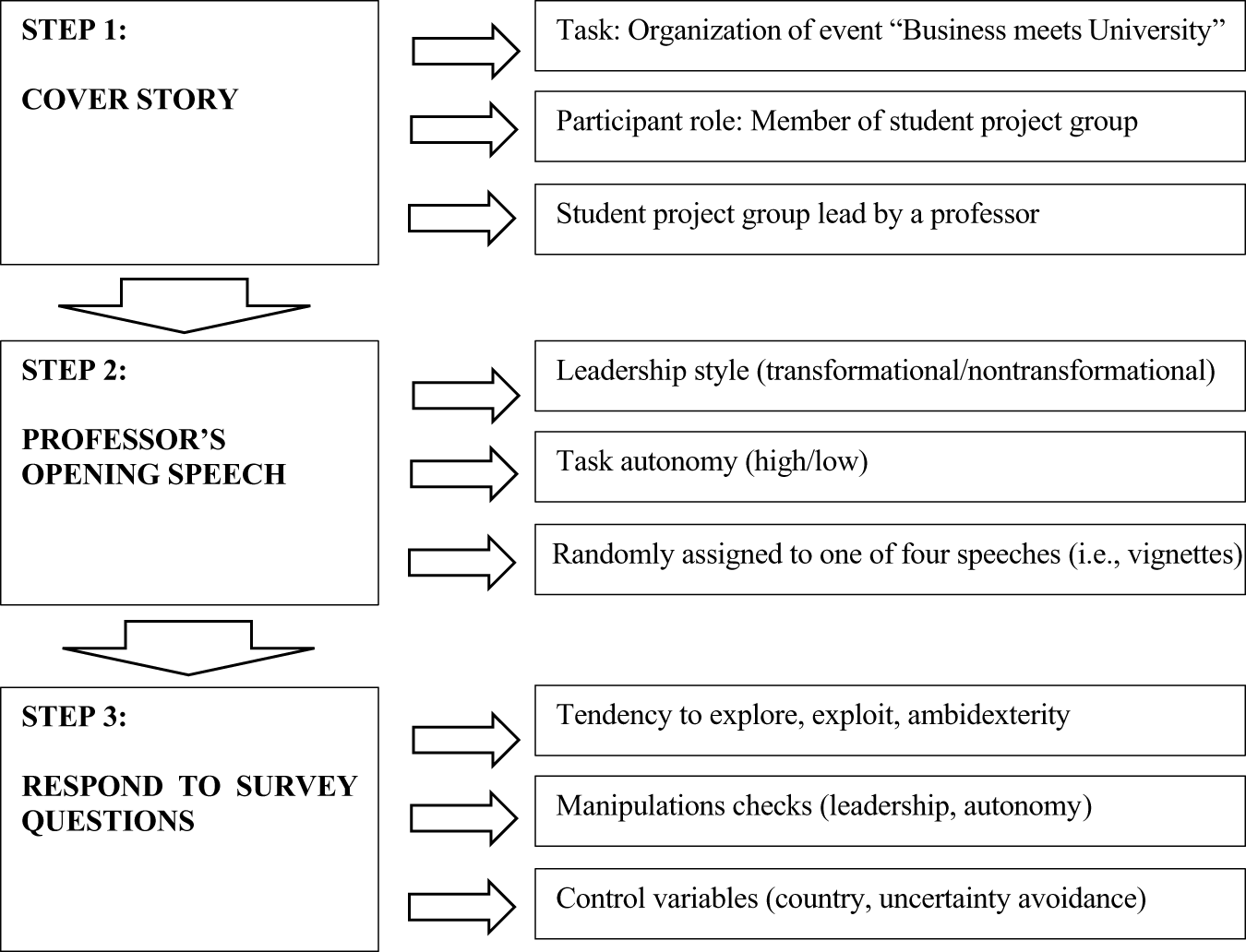
To study the impact of transformational leadership and task autonomy on exploratory, exploitative, and ambidextrous behavior, an experimental vignette design was chosen. As shown in Fig. 1, the experiment consisted of three steps. In Step 1, students were told a cover story, according to which they were members of a project group who were tasked with organizing an event entitled ‘Business meets University.’ This event was to be supervised by a new professor. In Step 2, the students read the professor’s speech given at the start of the project. This speech revealed the professor’s leadership style and the level of task autonomy to be given in organizing the event. It was written in the form of vignettes, which varied systematically regarding the professor’s leadership style and the level of task autonomy. The latter was either high or low and the leadership behavior shown by the professor in charge was either transformational or nontransformational, resulting in a 2 × 2 between-subjects design. Students were randomly assigned to the four possible conditions. In Step 3, their exploratory and exploitative behavioral intentions were measured based on their responses to questions on how they would organize the university event. Finally, they completed questions on control variables and, for the sake of a manipulation check, also answered questions on the perceived level of task autonomy and transformational behavior exhibited by the professor in charge. More information is available in the Supplementary material.
Experimental procedure.

Figure 1 Long description
The flowchart outlines a three-step experimental procedure. Step 1 is the cover story, where participants are tasked with organizing an event called ′Business meets University.′ Part icipants are members of a student project group led by a professor. Step 2 involves the professor′s opening speech, which varies in leadership style (transformational or nontransformational) and task autonomy (high or low). Part icipants are randomly assigned to one of four speeches, referred to as vignettes. Step 3 requires participants to respond to survey questions assessing their tendency to explore, exploit and exhibit ambidexterity. This step also includes manipulation checks for leadership and autonomy and control variables such as country and uncertainty avoidance.
Measures
Exploration, exploitation, and ambidexterity on an individual level (dependent variables)
To measure exploratory, exploitative, or ambidextrous behavioral intention, Mom, Bosch and Volberda (Reference Mom, Bosch and Volberda2009) scale for ambidexterity was used and adapted for the study context. It consists of 10 items. Items were measured on a 5-point Likert scale ranging from ‘completely disagree’ (1) to ‘completely agree’ (5), which was also used for all other variables in our study. A mean score of five items on exploratory behavior was used to measure this behavioral intention of individuals. Its internal consistency was good, showing a Cronbach’s alpha of α = .79. A sample item is: ‘I would do the activities that require me to learn new skills or knowledge.’ Likewise, a similar procedure was used to measure exploitative behavioral intention (α = .68). A sample item is: ‘I would preferably do the activities I have a lot of experience with.’ In line with Mom, Bosch and Volberda (Reference Mom, Bosch and Volberda2009), the score on ambidexterity was defined by calculating the product term of the mean exploration and exploitation scores. Thus, individuals scoring highest on ambidexterity intended to behave in a highly exploratory and exploitative manner whereas those with the lowest scores intended to exhibit minimal levels of both.
Country (control variable)
To determine the study participants’ country of origin, they selected their nationality from a predefined list. For the analysis, two dummy variables were created: Slovenia dummy (assigning value 1 to participants from Slovenia and 0 to participants from the other two countries) and Kosovo dummy (assigning value 1 to participants from Kosovo and 0 to participants from the other two countries).
Uncertainty avoidance (control variable)
Uncertainty avoidance is a cultural dimension that reflects the extent to which individuals in a society feel uncomfortable with ambiguity and uncertainty, leading them to prefer structured situations and clear rules. Since uncertainty avoidance relates to risk propensity (Sitkin & Weingart, Reference Sitkin and Weingart1995) and could thus affect ambidexterity and its facets, it was controlled for. Therefore, the uncertainty avoidance scale of Yoo, Donthu and Lenartowicz (Reference Yoo, Donthu and Lenartowicz2011) was used, consisting of five items (α = .87).
Manipulation checks
To test whether the transformational professor was in fact perceived as more transformational compared to the nontransformational one a manipulation check was performed, whereby participants completed a short version of the Multifactor Leadership Questionnaire (MLQ), consisting of 17 items (Bass & Avolio, Reference Bass and Avolio1994; Felfe & Goihl, Reference Felfe and Goihl2014), to assess the transformational leadership style of the professor (α = .94). One example of the adjusted items is: ‘The professor speaks enthusiastically about what needs to be accomplished.’
To test whether the condition with high task autonomy was perceived as such by the participants, they completed the 9-item scale of task autonomy (Morgeson & Humphrey, Reference Morgeson and Humphrey2006) (α = .94). A sample of the adjusted items is: ‘The organization of the event allows a lot of freedom in the way the work is done.’
Results
Manipulation check for transformational leadership and autonomy
A t-test for independent samples revealed a significant difference between the leadership style of the transformational and nontransformational professor (t 291.73 = 9.75; p < .001). Participants exposed to the transformational-leadership vignette rated the professor as more transformational (N = 163; M = 4.03; SD = 0.66) than those assigned to the nontransformational-professor condition (N = 168; M = 3.13; SD = 0.99). Together with a Cohen’s d of 1.07, which demonstrates a large difference, this finding supports the credibility of the leadership manipulation.
A t-test for independent samples also revealed a significant difference between the perceived task autonomy given to the study participants in the two different conditions (t 317.93 = 14.28; p < .001). In fact, individuals in the high autonomy condition perceived higher autonomy in performing the task (N = 161; M = 3.91; SD = 0.73) compared to those in the low autonomy condition (N = 170; M = 2.60; SD = 0.93). Together with a Cohen’s d of 1.56, which demonstrates a large difference, the effect of the autonomy manipulation is supported.
Descriptives and intercorrelations
Figure 2 provides an overview of all study variables, while Table 1 summarizes their means, SDs, Cronbach’s alphas, and intercorrelations. The Cronbach’s alpha values are considered good to very good and support the internal consistencies of the scales. The intercorrelations reveal that exploration and exploitation are not opposing poles of a single construct but are independent, yet negatively related.
Study variables of the 2 × 2 between-subjects design.

Means, SDs, Cronbach’s alphas, and intercorrelations between variables

Table 1 Long description
Variables listed are transformational leadership, task autonomy, exploration, exploitation, ambidexterity, Slovenia dummy, Kosovo dummy, and uncertainty avoidance, each with a mean, standard deviation, and intercorrelations. Transformational leadership has mean 3.58 and SD 0.95, with Cronbach alpha 0.94; it correlates with task autonomy at 0.36 with two asterisks, exploration at 0.34 with two asterisks, exploitation at 0.12 with one asterisk, ambidexterity at 0.38 with two asterisks, Slovenia dummy at minus 0.15 with two asterisks, Kosovo dummy at 0.35 with two asterisks, and uncertainty avoidance at 0.26 with two asterisks. Task autonomy has mean 3.24 and SD 1.06, alpha 0.94; it correlates with exploration at 0.34 with two asterisks, exploitation at minus 0.01, ambidexterity at 0.30 with two asterisks, Slovenia dummy at 0.06, Kosovo dummy at 0.11 with one asterisk, and uncertainty avoidance at 0.10. Exploration has mean 3.51 and SD 0.79, alpha 0.79; it correlates with exploitation at minus 0.17 with two asterisks, ambidexterity at 0.74 with two asterisks, Slovenia dummy at minus 0.06, Kosovo dummy at 0.48 with two asterisks, and uncertainty avoidance at 0.03. Exploitation has mean 3.78 and SD 0.66, alpha 0.68; it correlates with ambidexterity at 0.52 with two asterisks, Slovenia dummy at 0.23 with two asterisks, Kosovo dummy at minus 0.00, and uncertainty avoidance at 0.42 with two asterisks. Ambidexterity has mean 13.21 and SD 3.64, with no diagonal value shown; it correlates with Slovenia dummy at 0.10, Kosovo dummy at 0.41 with two asterisks, and uncertainty avoidance at 0.31 with two asterisks. Slovenia dummy has mean 0.38 and SD 0.49; it correlates with Kosovo dummy at minus 0.53 with two asterisks and uncertainty avoidance at minus 0.01. Kosovo dummy has mean 0.31 and SD 0.46; it correlates with uncertainty avoidance at 0.17 with two asterisks. Uncertainty avoidance has mean 4.09 and SD 0.64, with Cronbach alpha 0.87.
Note: Slovenia dummy: 1 = Slovenia, 0 = otherwise; Kosovo dummy: 1 = Kosovo, 0 = otherwise; Cronbach’s alpha values on diagonal in parentheses.
* p < .05, **p < .01.
Test of hypotheses
To test the hypotheses, we conducted analyses of variance in which leadership (transformational vs. nontransformational) and task autonomy (high vs. low) were the independent variables, while the dependent variables were individual ambidexterity, exploration, and exploitation. To enhance the transparency of the result, we conducted all analyses twice, first excluding the control variables and then considering them as covariates. Consequently, we first conducted a MANOVA, followed by a MANCOVA, which took study participants’ uncertainty avoidance and country of origin (‘Slovenia dummy’ and ‘Kosovo dummy’) into account. Table 2 summarizes the descriptive statistics for each experimental condition, while Table 3 provides the inferential statistics as a function of the experimental condition for the MANOVA and MANCOVA.
Means and SDs for each experimental condition

Table 2 Long description
Values are reported as means with standard deviations for three outcomes: Exploration, Exploitation, and Ambidexterity. Columns split results by task autonomy level, low task autonomy with N 170 and high task autonomy with N 161, each further divided into Trans. Leadership and Nontrans. Leadership, plus a total; a final set of columns gives overall Trans. Leadership, Nontrans. Leadership, and total for N 331. For Exploration, low task autonomy has 3.49 with 0.75 for Trans. Leadership, 3.30 with 0.81 for Nontrans. Leadership, and total 3.39 with 0.79; high task autonomy has 3.75 with 0.64, 3.54 with 0.87, and total 3.64 with 0.77; overall values are 3.61 with 0.71, 3.42 with 0.85, and total 3.51 with 0.79. For Exploitation, low task autonomy has 3.90 with 0.56, 3.81 with 0.64, and total 3.85 with 0.60; high task autonomy has 3.59 with 0.74, 3.81 with 0.66, and total 3.71 with 0.71; overall values are 3.75 with 0.67, 3.81 with 0.65, and total 3.78 with 0.66. For Ambidexterity, low task autonomy has 13.54 with 3.46, 12.43 with 3.37, and total 12.98 with 3.45; high task autonomy has 13.37 with 3.41, 13.52 with 4.22, and total 13.44 with 3.83; overall values are 13.46 with 3.43, 12.96 with 3.83, and total 13.21 with 3.64.
Note: SDs in parentheses.
Inferential statistics as a function of experimental condition

Table 3 Long description
Inferential statistics are reported as F values for three outcomes, Exploration, Exploitation, and Ambidexterity, across two sets of analyses: MANOVA and MANCOVA. Under MANOVA, Exploration has F 5.88 with two asterisks for Trans. Leadership, 8.02 with one asterisk for Task Autonomy and 0.00 for Interaction. Under MANOVA, Exploitation has F 1.54 for Trans. Leadership, 3.76 with one asterisk for Task Autonomy and 4.06 with one asterisk for Interaction. Under MANOVA, Ambidexterity has F 1.27 for Trans. Leadership, 1.42 for Task Autonomy and 2.56 for Interaction. Under MANCOVA, Exploration has F 2.23 for Uncertainty Avoidance, 26.32 with two asterisks for Slovenia dummy, 132.37 with two asterisks for Kosovo dummy, 4.95 with one asterisk for Trans. Leadership, 10.83 with two asterisks for Task Autonomy, and 0.01 for Interaction. Under MANCOVA, Exploitation has F 70.50 with two asterisks for Uncertainty Avoidance, 23.82 with two asterisks for Slovenia dummy, 1.95 for Kosovo dummy, 0.54 for Trans. Leadership, 6.52 with one asterisk for Task Autonomy, and 6.55 with one asterisk for Interaction, and Ambidexterity has F 22.71 with two asterisks for Uncertainty Avoidance, 62.14 with two asterisks for Slovenia dummy, 120.70 with two asterisks for Kosovo dummy, 1.86 for Trans. Leadership, 1.32 for Task Autonomy, and 4.37 with one asterisk for Interaction.
Note: * p < .05, ** p < .01.
In Hypothesis 1, we argued that individuals who are supervised by a transformational leader show more ambidexterity (Hypothesis 1a), exploration (Hypothesis 1b), and exploitation (Hypothesis 1c). The MANOVA results show a significant main effect of leadership on exploration (F 1, 331 = 5.88, p = .02), whereas the main effects on exploitation and ambidexterity are not significant (exploitation: F 1, 331 = 1.54, p = .22; ambidexterity: F 1, 331 = 1.27, p = .26). Notably, the results remain the same when controlling for study participants’ country of origin and uncertainty avoidance. In brief, the MANCOVA results also show a significant main effect of leadership on exploration (F 1, 324 = 4.95, p = .03, η 2 = .02), the main effects on exploitation and ambidexterity remain nonsignificant (exploitation: F 1, 324 = 0.54, p = .46, η 2 = .00; ambidexterity: F 1, 324 = 1.86, p = .17, η2 = .01). Thus, and with regard to the mean values in Table 2, Hypothesis 1b is supported, while Hypotheses 1a and 1c are not. Our results show that individuals who are supervised by a transformational leader intend to show more exploratory behavior (Hypothesis 1b) but do not intend to show more ambidexterity (Hypothesis 1a) nor exploitative behavior (Hypothesis 1c).
With regard to Hypothesis 2, it was anticipated that those who are given high compared to low task autonomy show more ambidexterity (Hypothesis 2a) and more exploration (Hypothesis 2b), whereas more exploitation show those who are given low task autonomy (Hypothesis 2c). The MANOVA results reveal a nonsignificant main effect for task autonomy on ambidexterity (F 1, 331 = 1.42, p = .23) but a significant main effect on exploration (F 1, 331 = 8.02, p = .01, η 2 = .02) and exploitation (F 1, 331 = 3.76, p = .05, η 2 = .01). The MANCOVA reveals the same results: a nonsignificant main effect for task autonomy on ambidexterity (F 1, 324 = 1.32, p = .25, η 2 = .00) and a significant effect on exploration and exploitation (exploration: F 1, 324 = 10.83, p = .00, η 2 = .03; exploitation: F 1, 324 = 6.52, p = .01, η 2 = .02). Consequently, Hypothesis 2a is not supported, while Hypotheses 2b and 2c are. Considering the mean values in Table 2, we state that individuals who are given high task autonomy show more intention for exploration (Hypothesis 2b), individuals who are given low task autonomy show more intention for exploitation (Hypothesis 2c), while the effect on ambidexterity is not significant (Hypothesis 2a).
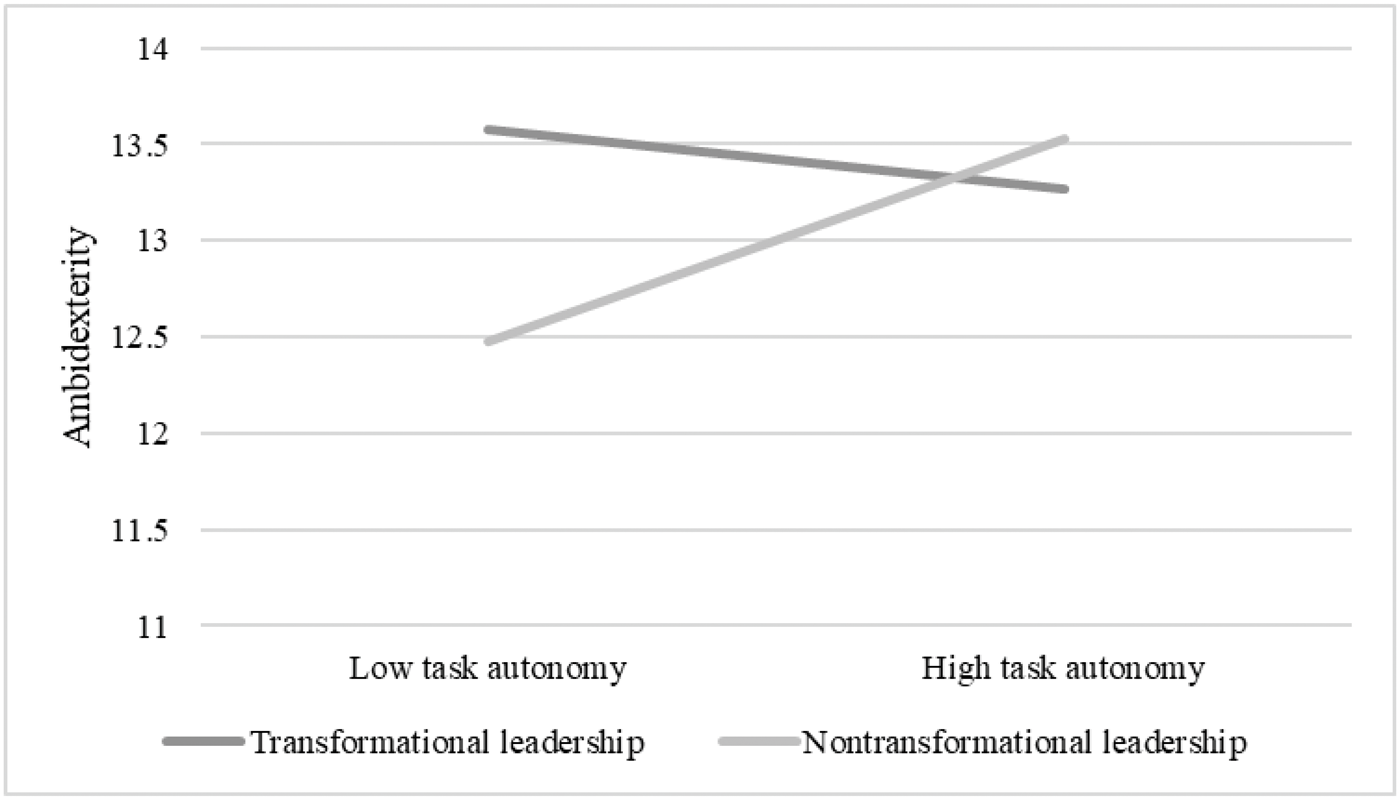
Hypothesis 3 tested the interaction effect of leadership and autonomy and assumed that when individuals are given high autonomy while at the same time being supervised by a transformational leader, they show more ambidexterity (Hypothesis 3a) and more exploration (Hypothesis 3b). When being led by a transformational leader and given low autonomy, individuals are expected to show more exploitation (Hypothesis 3c). Again, we performed one analysis excluding and another analysis including our covariates. The analysis reveals three important results. First, the interaction between task autonomy and leadership is significant on ambidexterity. The MANOVA reveals an interaction by trend (F 1, 331 = 2.56, p = .09), while the MANCOVA shows a significant interaction (F 1, 324 = 4.37, p = .04, η 2 = .01). Both Fig. 3 and Table 2 show that the leadership style did not affect individuals’ ambidexterity in high autonomy situations (univariate analysis MANOVA: F 1, 331 = 0.11, p = .74, η2 = .00; univariate analysis MANCOVA: F 1, 324 = 0.26, p = .61, η2 = .00). However, as soon as the study participants had to deal with low task autonomy, the leadership style became important and buffered the decline of ambidextrous behavior, which is known to show in low autonomy situations (univariate analysis MANOVA: F 1, 331 = 3.84, p = .05, η 2 = .01; univariate analysis MANCOVA: F 1, 324 = 6.13, p = .01, η 2 = .02). In conclusion, the interaction is significant; however, Hypothesis 3a is not supported as the direction of the effect is different from that expected. Figure 4 displays a drop in individual ambidexterity in the low task autonomy and nontransformational leadership condition.
Interaction effect between task autonomy and leadership style on individual ambidexterity.

Individual ambidexterity as a function of task autonomy and leadership style.

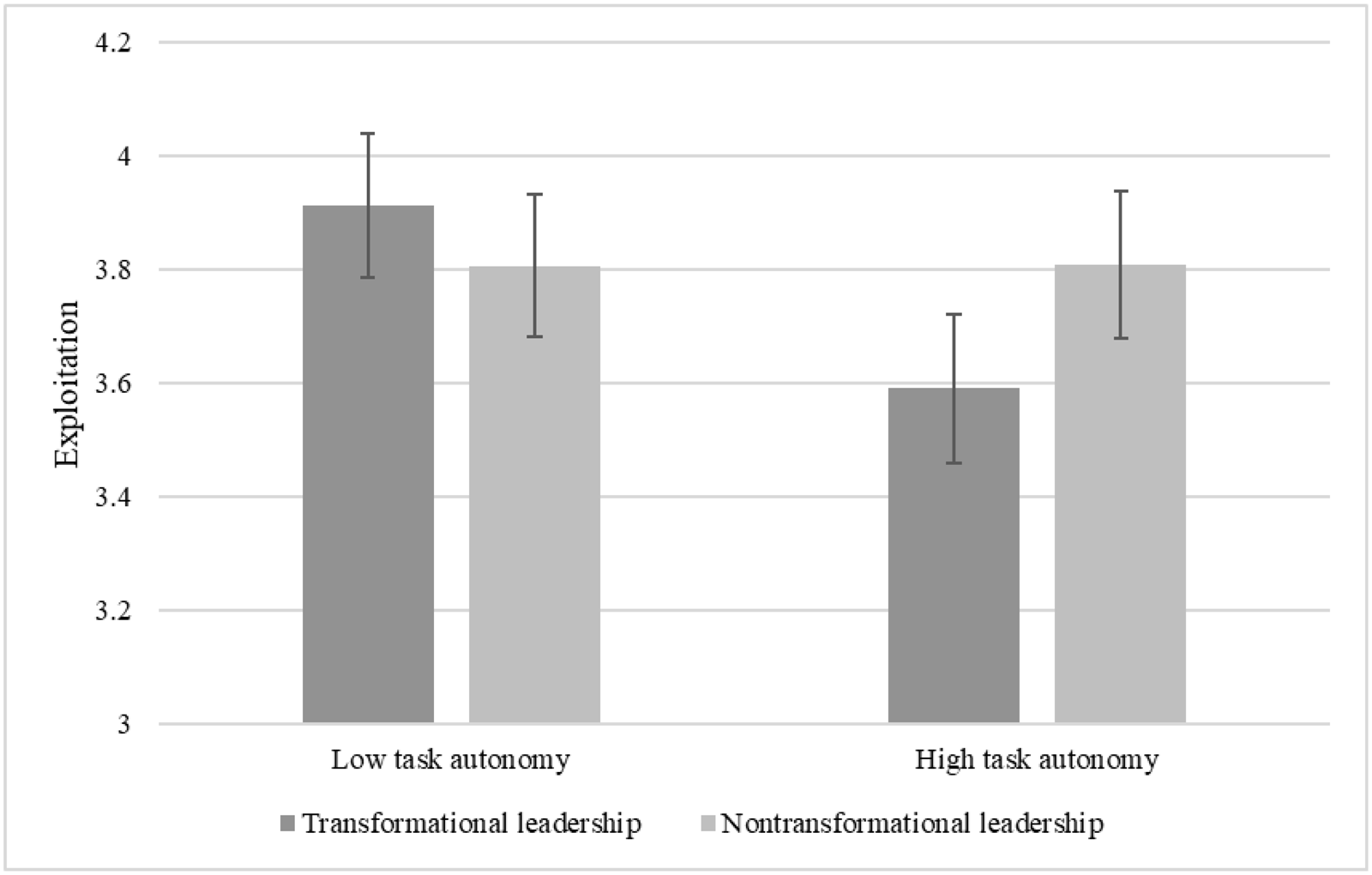
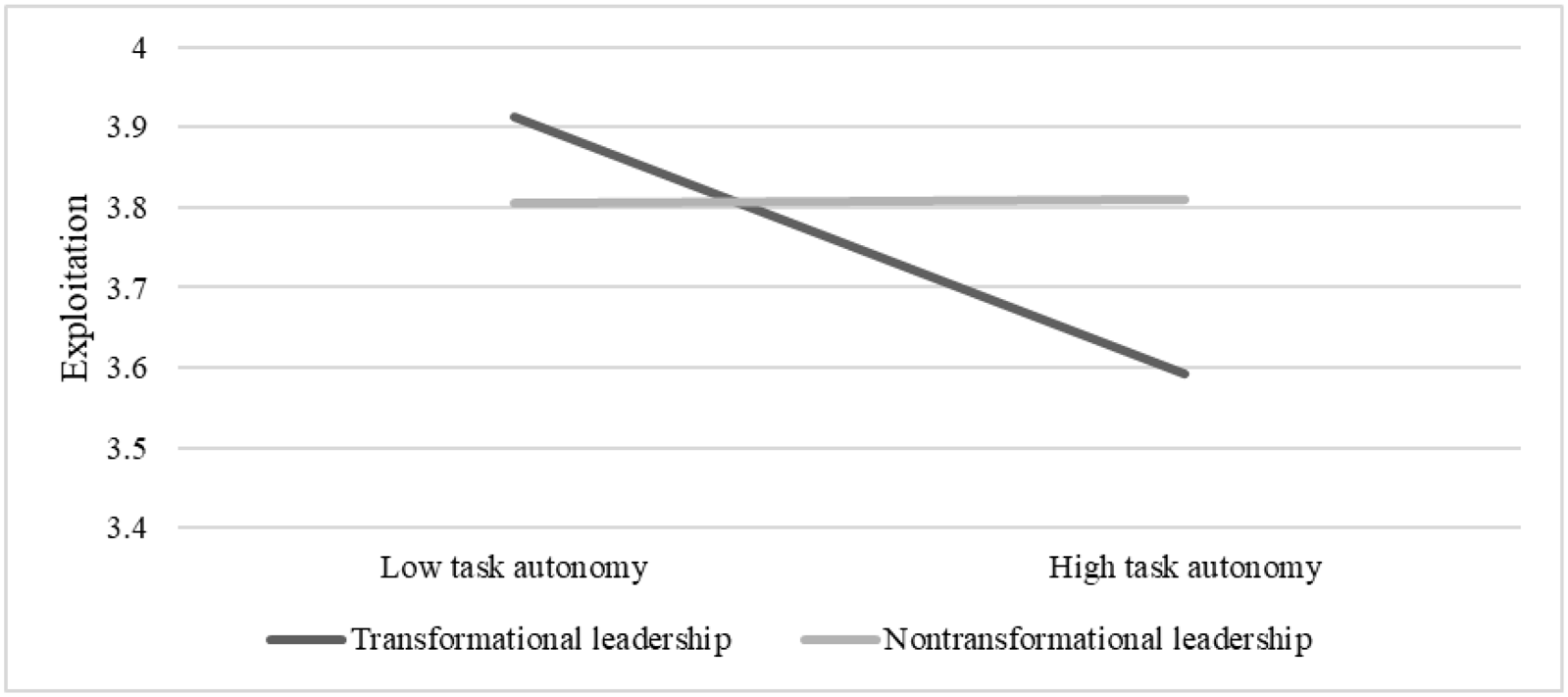
The second important interaction result is that leadership style and task autonomy do not conjointly affect exploration. This result is supported by the conducted MANOVA (F 1, 331 = 0.00, p = .98, η 2 = .00) and MANCOVA (F 1, 324 = 0.01, p = .94, η 2 = .00). Thus, Hypothesis 3b is not supported, meaning that leadership style does not affect a person’s exploratory behavioral tendency differently in either a high or low autonomy situation. However, as demonstrated by the main effects (see Table 3), leadership and task autonomy independently affect exploration. Finally, both the MANOVA and MANCOVA show a significant interaction between task autonomy and leadership in terms of exploitation (MANOVA: F 1, 331 = 4.06, p = .04, η 2 = .01; MANCOVA: F 1, 324 = 6.55, p = .01, η 2 = .02). Figure 5 and Table 2 clarify that the leadership style did not affect individual exploitation in low autonomy situations (univariate analysis MANOVA: F 1, 331 = 0.31, p = .58, η 2 = .00; univariate analysis MANCOVA: F 1, 324 = 1.70, p = .19, η 2 = .01). However, as soon as the study participants were given high task autonomy, the leadership style became important and caused a decline of exploitative behavior in presence of a transformational leader (univariate analysis MANOVA: F 1, 331 = 5.13, p = .02, η 2 = .02; univariate analysis MANCOVA: F 1, 324 = 5.28, p = .02, η 2 = .02). In conclusion, the expected interaction is significant; however, Hypothesis 3c is not supported as the direction of the effect is different from that anticipated. Figure 6 displays a drop in exploitative behavior when high task autonomy is accompanied by transformational leadership.
Interaction effect between task autonomy and leadership style on exploitative behavior.

Exploitative behavior as a function of task autonomy and leadership style.

Discussion
This study, grounded in the COR theory, demonstrates that highly desired and resource-intensive individual ambidexterity is likely to be activated by a combination of two workplace resources: task autonomy and transformational leadership, clustering together and forming resource caravans. The results highlight that individual ambidexterity is not likely to be activated by either of the two resources alone; in contrast, its two facets – exploration and exploitation – are. Our findings provide important implications for theory and practice.
Theoretical contributions
The findings of this study offer four theoretical contributions. First, we provide insights into individual ambidexterity, an area that has recently gained increasing attention (Schnellbächer et al., Reference Schnellbächer, Heidenreich and Wald2019; Tarba et al., Reference Tarba, Jansen, Mom, Raisch and Lawton2020), and thus go beyond the more frequently studied organizational level (Gibson & Birkinshaw, Reference Gibson and Birkinshaw2004; O’Reilly & Tushman, Reference O’Reilly and Tushman2013) to understand what enables adaptivity and flexibility on an individual level (Mom et al., Reference Mom, Chang, Cholakova and Jansen2019; van Assen, Reference van Assen2020). In our study, we apply the COR theory, which has been only rarely used in research on individual ambidexterity (Tuan, Reference Tuan2022), and recognize individual ambidexterity as a resource-intensive behavior. Despite its acknowledged paradoxical nature (Good & Michel, Reference Good and Michel2013; Melkić et al., Reference Melkić, Hernaus and Bakker2026), surprisingly little is known about ambidextrous behavior as resource-draining, with only a few studies having identified this issue. Laureiro‐Martínez et al. (Reference Laureiro‐Martínez, Brusoni, Canessa and Zollo2015) found in fMRI studies that exploration and exploitation activate different cognitive processes in different brain regions, and repeated switching causes a depletion of cognitive control. Some authors recently found that switching imposes significant costs on individuals by heavily consuming their finite cognitive resources (Bidmon & Boe-Lillegraven, Reference Bidmon and Boe-Lillegraven2020; Chang, Chapman, Hughes & Chang, Reference Chang, Chapman, Hughes and Chang2024). Recognizing that ambidexterity depletes valuable personal resources, and building on the principles of the COR theory that individuals want to guard and accumulate valuable resources (Hobfoll, Reference Hobfoll1989, Reference Hobfoll2001), this study helps us understand how workplace resources could support individuals when faced with the exploration/exploitation paradox at work (Pertusa-Ortega, Molina-Azorín, Tarí, Pereira-Moliner & López-Gamero, Reference Pertusa-Ortega, Molina-Azorín, Tarí, Pereira-Moliner and López-Gamero2021). Workplace resources can prevent resource loss when faced with resource-intensive work situations, like ambidexterity. Previous studies have suggested investigating job design and leadership and how they interact to enable individuals to be ambidextrous (Chang et al., Reference Chang, Chapman, Hughes and Chang2024; Schnellbächer et al., Reference Schnellbächer, Heidenreich and Wald2019). Our findings indicate that transformational leadership and task autonomy are important and interdependent workplace resources that shape the work context to foster ambidextrous, exploratory, and exploitative behavior.
Second, this study is among the first to examine ambidexterity and its subdimensions in an experimental setting. Therefore, it is one of the few to provide causal evidence on how to shape ambidexterity (Pertusa-Ortega et al., Reference Pertusa-Ortega, Molina-Azorín, Tarí, Pereira-Moliner and López-Gamero2021) and its exploration and exploitation facets (for examples of experimental studies on ambidextrous leadership, see Klonek, Gerpott & Parker, Reference Klonek, Gerpott and Parker2023; Xi, Zhou & Wang, Reference Xi, Zhou and Wang2025). Our findings support previous research (Jansen, Vera & Crossan, Reference Jansen, Vera and Crossan2009; Zacher, Robinson & Rosing, Reference Zacher, Robinson and Rosing2016) that finds transformational leadership style encourages exploratory behavior. Building on the COR theory, Lin et al. (Reference Lin, Scott and Matta2019) summarized that transformational leader behaviors may generate resource gains for employees in the form of meaningfulness of work and intrinsic motivation. Our findings confirm that such resource gains are relevant for exploration; however, they do not make a difference for exploitation. Provided with a transformational leader as a relational resource, individuals are willing to engage in explorative behavior, but not in less resource-consuming exploitative behavior. Our study further corroborates previous research on task autonomy that found it increases exploratory behavior and decreases exploitative behavior (Durcikova et al., Reference Durcikova, Fadel, Butler and Galletta2011). Perceiving job autonomy as a job resource is well established (Hackman & Oldham, Reference Hackman and Oldham1976); however, through applying the COR theory, Muecke and Greenwald (Reference Muecke and Greenwald2026) recently found that job autonomy can lead to potential resource gains (e.g., increased engagement) or losses (e.g., increased stressors). Our findings extend this research by showing that, when provided with task autonomy, individuals engage more with exploration and less with exploitation, potentially due to differences in the perceived gains or losses of each behavior.
Third, our research shows neither leadership nor task autonomy alone is sufficient as a resource for ambidextrous behavior. Thus, independently fostering them will not necessarily enhance ambidexterity (Bergner & Neubauer, Reference Bergner and Neubauer2011). Building on the COR theory (Hobfoll et al., Reference Hobfoll, Halbesleben, Neveu and Westman2018), we provide evidence that workplace resources jointly affect ambidexterity by forming resource caravans – i.e., a pool of collective, interdependent resources that are available to employees to help meet organizational goals (Halbesleben et al., Reference Halbesleben, Neveu, Paustian-Underdahl and Westman2014; Hobfoll, Reference Hobfoll2011). We demonstrate that ambidexterity cannot be enhanced by more of either task or relational resource independently, but rather by the specific configuration of the two. Our results show that when individuals are provided with limited task autonomy (low task resource) and are supported by a transformational leader (high relational resource), their ambidextrous behavior will increase. To the best of our knowledge, this interaction between task autonomy and transformational leadership for individual ambidexterity has not been identified in previous studies. Similarly, we observe resource caravan formation (Hobfoll et al., Reference Hobfoll, Halbesleben, Neveu and Westman2018) when leadership and autonomy interact in impacting exploitative behavior. We find that exploitation, the least resource-consuming work behavior of the three, decreases when both workplace resources are available. Such a work environment might stimulate alternative resource-intensive behaviors (e.g., ambidexterity).
Fourth, we reveal the relative contribution of two workplace resources, which define most work settings: task autonomy and leadership (Lauring & Kubovcikova, Reference Lauring and Kubovcikova2022). An overview of previous studies concerning the impact of different workplace resources on broader well-being and performance could not confirm differences between organizational (autonomy) resources and leadership in terms of how they impact employee outcomes (Nielsen et al., Reference Nielsen, Nielsen, Ogbonnaya, Känsälä, Saari and Isaksson2017). This study shows that both workplace resources increase exploratory behavior; however, the effect of leadership as a relational resource is smaller. This indicates resources that are an integral part of task design are likely to be more valued. With respect to exploitative and ambidextrous behavior, the results show that the two work characteristics interact, with task autonomy again having a stronger influence and leadership playing the supporting role. While exploitative behavior is not impacted by transformational leadership per se, it does, however, decrease when high task autonomy is accompanied by transformational leadership. Furthermore, task autonomy is more relevant for ambidextrous behavior. Only when task autonomy is low is leadership style likely to buffer the effect of low autonomy and prevent a decrease in ambidexterity. These findings demonstrate that relational resource plays a supportive role when task resources are limited. The stronger effect of task autonomy compared to transformational leadership aligns with COR theory principles, which suggest that individuals prioritize preventing resource depletion over the accumulation of additional resources (Hobfoll et al., Reference Hobfoll, Halbesleben, Neveu and Westman2018). This is because task autonomy helps save time, energy, and cognitive resources when employees are afforded the freedom to decide what to do, when to do it, and how to proceed, thus preventing resource loss. In contrast, transformational leadership motivates and inspires employees, encouraging the investment of resources in order to make further resource gains. Additionally, organizational (task) resources might be more stable compared to relational resources, which may vary over time (Halbesleben et al., Reference Halbesleben, Neveu, Paustian-Underdahl and Westman2014).
Practical implications
Our study offers practical implications for human resource (HR) managers and organization design (OD) specialists on how to design ambidextrous jobs. Ambidexterity as a desired behavior is complex and resource-consuming, because its exploratory and exploitative behavior dimensions require different – even contrasting – work methods and mindsets and switching between them can cause stress and strain (Gibson & Birkinshaw, Reference Gibson and Birkinshaw2004). By understanding the premises of the COR theory, namely that individuals want to preserve their own resources as well as obtain new ones (Hobfoll et al., Reference Hobfoll, Halbesleben, Neveu and Westman2018), managers can understand why individuals might avoid ambidextrous behavior to preserve valuable personal resources. HR managers are responsible for designing jobs that provide workplace resources to support ambidextrous behavior, which is further complicated by the fact that workplace resources influence exploration and exploitation in partly opposing ways, impeding the straightforward enhancement of ambidexterity. HR managers are also responsible for developing leaders so that they obtain the necessary skills to support ambidextrous employees. Failing to provide alternative workplace resources will create work conditions whereby, in order to avoid conflict inherent to ambidextrous behavior and the threat of personal resource loss, individuals continuously resort to less resource-intensive work behavior in the form of either exploitation or exploration.
Furthermore, managers should be aware that ambidextrous jobs benefit from the configurations of different workplace resources. Designing resource-rich jobs by providing diverse (task and relational) resources triggers resource caravans (Hobfoll, Reference Hobfoll1989, Reference Hobfoll2001), helping individuals to behave in an ambidextrous manner. Our research findings provide concrete guidelines for managers and leaders on how to adjust workplace resources for individuals in diverse work situations. If individuals are already good at exploration, to increase their ambidextrous orientation, exploitation is likely to be fostered by decreasing their task autonomy. When autonomy is provided on the job, less transformational leadership behavior will increase exploitation. If individuals are good at exploitation, to foster ambidexterity exploration is likely to be triggered by providing autonomy at task or transformational leadership support. In a situation where autonomy is limited, the support of a transformational leader will directly help stimulate ambidexterity.
Managers and leaders should also pay attention to the relative importance of workplace resources. First, they should provide workplace resources that prevent extensive resource loss, such as task autonomy, to respond to the powerful subconscious bias that makes resource loss more salient (Hobfoll et al., Reference Hobfoll, Halbesleben, Neveu and Westman2018). When designing autonomous tasks is limited, managers could resort to providing relational workplace resources in order to drive desired behavior by applying a supportive transformational leadership style. Understanding the importance of providing sufficient task and relational resources and adjusting job characteristics to concrete work situations will help design jobs that are better suited for an increasingly challenging contemporary work environment, consequently decreasing employee strain, improving their well-being and performance (Parker & Knight, Reference Parker and Knight2024).
Our practical implications can also be extended to universities. Simulating such experimental design and extracurricular businesslike activity in courses and discussing its implications with students would help them to learn about the inherent tension of ambidextrous capabilities. Furthermore, students would learn about workplace resource caravans impacting ambidexterity, exploration, and exploitation, and already be able to identify useful work design strategies during studies.
Limitations and future research
This study has some limitations, which provide avenues for future research to further advance our knowledge on individual ambidexterity. One of these is related to our student sample. Although participants in the study were MBA students with some work experience, which enabled us to draw general conclusions about how the perception of the abundance of workplace resources impacts ambidextrous behavioral intentions, and even offers broader implications for universities, the inclusion of employees in the experiment would make our findings even more relevant for managers in organizations. Therefore, for future research we suggest the experiment be repeated in organizational settings, on Prolific or similar platforms, inviting employees to participate in the study.
Another limitation is related to our measure of ambidextrous behavior. The experiment was designed to test behavioral intentions, as standardized measures for exploratory and exploitative behavior are not currently available (Balzano, Bunjak & Bortoluzzi, Reference Balzano, Bunjak and Bortoluzzi2024). The reason for this might lie in the substantial differences between professions that comprise exploratory and exploitative behaviors. Previous studies investigated ambidexterity as the exploration and exploitation of sales employees (quality service vs. sales targets; Yu, Patterson & de Ruyter Reference Yu, Patterson and de Ruyter2013), tourism employees (adaptive selling vs. attention to detail; Tuan, Reference Tuan2022), and bank employees (new services and markets vs. existing services and markets; Jyoti & Choudhary, Reference Jyoti and Choudhary2024). Future research could try to monitor actual ambidextrous behavior, taking into consideration specifics of different professions (e.g., nurses, software engineers, consultants, or university professors).
A further limitation is related to the experimental method we utilized. While a cross-sectional experimental design enabled us to test our hypotheses and realize our research goals, future studies should investigate longitudinally how individuals balance exploratory and exploitative behavior and how switching between the two takes place over time (Chang et al., Reference Chang, Chapman, Hughes and Chang2024). This design would fit particularly well with the ambidexterity construct, as individuals cannot be ambidextrous at any single point in time. A longitudinal design might help us further to better understand the resource loss experienced due to ambidexterity and associated costs (Chang et al., Reference Chang, Chapman, Hughes and Chang2024), explaining its resource-intensive nature.
One more important limitation to consider is related to measuring the relational resource of transformational leadership, the concept of which is only partly defined by observable leader behaviors because it also assumes that leaders create transformative effects in their followers as part of its operationalization. Similar approaches – where leadership constructs include expected outcomes in addition to behaviors – have also been proposed in the literature on ethical leadership, abusive supervision, and transformational leadership and might lead to a confounding of leader behavior and evaluation (Fischer et al., Reference Fischer, Hambrick, Sajons and Van Quaquebeke2023; Fischer & Sitkin, Reference Fischer and Sitkin2023). These confounding effects also transfer to the vignettes used in this study. Future research should use vignettes that clearly separate leader behaviors from their evaluation so as to provide a clearer picture of how leadership behavior affects ambidexterity and its facets. Further, a real actor performing introductory speeches or video recordings of these speeches, which could also be designed with the help of AI tools, could be used in future experiments to signal transformational leadership behaviors (Stock et al., Reference Stock, Banks, Voss, Tonidandel and Woznyj2023).
Although it applied the COR theory and a broad conceptualization of resources, our research design only included one task resource, task autonomy, and one relational resource, transformational leadership, which presents another relevant limitation. It would be valuable to see how individuals respond to other task resources, such as task variety, task significance, and feedback from job (Morgeson & Humphrey, Reference Morgeson and Humphrey2006). Additionally, the impact of other leadership styles could be observed – for example, ambidextrous leadership comprised of opening and closing behavior (Rosing, Frese & Bausch, Reference Rosing, Frese and Bausch2011). Including more workplace resources in the study would help reveal other resource caravans enabling individual ambidexterity. A further limitation that needs to be mentioned is that the task of organizing the event was exploitative in nature; thus, it would be better to design a task that is more broadly defined and that will also allow more creative and innovative behavior.
Finally, another limitation of our study is related to small effect sizes. Our research shows that the two work-related resources – task autonomy and leadership – impact individual ambidexterity; however, the small effect sizes indicate a limiting influence on triggering desired behavior. Other drivers, alongside work resources, might also be important, such as individual personality characteristics that represent personal resources (Kauppila & Tempelaar, Reference Kauppila and Tempelaar2016), an aspect that future research could also explore.
Conclusion
The present study offers a COR theory perspective on individual ambidexterity, highlighting workplace resources that unlock ambidextrous behavior and its facets. Using an experimental design, we found that transformational leadership encourages exploratory behavior and that task autonomy increases exploratory behavior while decreasing exploitative behavior; neither of these two resources were found to be sufficient for ambidextrous behavior to emerge. However, we were able to find evidence of an interaction effect, demonstrating a resource configuration that encourages ambidextrous behavior – transformational leadership support in a low task autonomy situation. Thus, we were able to demonstrate that different workplace resources form resource caravans to achieve ambidexterity. We also recognized the relative importance of the two workplace resources, with transformational leadership playing a secondary role in supporting ambidexterity when task autonomy is limited. Our study will particularly appeal to HR managers and OD specialists who should consider designing resource-rich jobs to support ambidextrous behavior to achieve organizational results.
Supplementary Material
The supplementary material for this article can be found at https://doi.org/10.1017/jmo.2026.10116.
Funding Statement
This study was supported by the Slovenian Research and Innovation Agency (ARIS) under grant BI-AT/23-24-033; the Austria’s Agency for Education and Internationalisation (OeAD) under the program ‘Scientific & Technological Cooperation (WTZ)’; the Slovenian Research and Innovation Agency, Core Project Funding P5-0364, P5-0161, P5-0441, P5-0128, and J5-60089; and the Austrian Development Agency (ADA) and the OeAD, Mobility Programmes and Cooperation (MPC), HERAS+ Post-doc research scholarship program Ref. No. MPC-2022-05428. The funders had no role in the study design, data collection and analysis, decision to publish, or manuscript preparation.
Conflicts of Interest
The authors declare none.
Ethical Standards
The study was approved by the Ethics Committee of School of Economics and Business, University of Ljubljana (Approval Number K-I/2.1), and was preregistered on the platform OSF (https://osf.io/t8f45).




 Open access

