If not properly terminated, cover crops can have negative impact on cash crops. Incomplete cover crop control can slow soil drying and warming in the spring and reduce corn (Zea Mays L.) or soybean [Glycine max (L.) Merr.] yield by inhibiting crop emergence. If allowed to produce viable seeds, cover crop plants have the potential to become weeds in the subsequent crop. Cover crops have the potential to decrease the early growth and vigor of cash crops by releasing allelopathic chemicals, removing soil moisture, and competing for nutrients. Improperly terminated cereal rye and cereal rye–legume mixtures have been reported to reduce corn and soybean yields by as much as 12% due to irregular or low final plant populations (Eckert Reference Eckert1988; Mitchell and Teel Reference Mitchell and Teel1977). Thelan et al. (Reference Thelen, Mutch and Martin2004) concluded that cereal rye growing with soybean reduced yield by as much as 27%, and attributed this yield loss to water stress caused by the cereal rye. For these reasons, cover crop users must be able to effectively terminate a cover crop prior to planting a cash crop. SARE (2014) asked 1,691 cover crop users what their termination methods were, and the top three responses were herbicides (48%), tillage (21%), and selection of a cover crop that winter kills (20%). However, there is currently a lack of research investigating the efficacy of various herbicide treatments for the termination of cover crops.
Several cover crop species, such as annual ryegrass, barley (Hordeum vulgare L.), winter oat (Avena sativa L.), cereal rye, winter wheat, hairy vetch, Austrian winter pea, and various clover species (Trifolium spp.) have been investigated for their utility as cover crops (Johnson et al. Reference Johnson, Kaspar, Kohler, Corak and Logsdon1998; Kuo et al. Reference Kuo, Sainju and Jellum1997; Teasdale and Mohler Reference Teasdale and Moehler1993; Weston Reference Weston1990). While specific interactions between cover crops, various soil properties, and cash crop yields have been thoroughly investigated within the literature, not as much research has been devoted to identifying herbicide treatments that will effectively control the diversity of cover crop species that are now available and promoted.
Several authors have reported consistent control of wheat and cereal rye with glyphosate-based herbicide treatments (O’Sullivan and O’Donovan Reference O’Sullivan and O’Donavan1980; Rainbolt et al. Reference Rainbolt, Thill and Young2004; Young et al. Reference Young, Whaley, Lawrence and Burke2016). However, few authors have evaluated the effectiveness of these treatments for other cover crop species, or for any of the possible cover crop species mixes. One commonly recommended cover crop that may require special attention when it comes to termination is annual ryegrass. In addition to its potential to reduce yields of a subsequently planted cash crop such as corn or soybean (Reddy Reference Reddy2001; Vyn et al. Reference Vyn, Janovicek, Miller and Beauchamp1999), annual ryegrass can be difficult to control and has resistance to several different herbicide families (Heap Reference Heap2017). Many spring preplant herbicide programs in the Midwest include glyphosate because of its broad-spectrum activity, short plant-back interval, and reasonable cost. Lins et al. (Reference Lins, Cole, Affeldt, Colquhoun, Mallory-Smith, Hines, Steckel and Hayes2007) evaluated three different rates of glyphosate (415, 830, and 1660 g ae ha−1) for the control of annual ryegrass at four different stages of growth and found that the highest rate, applied at the boot, or early flower growth stage, provided 70% to 99% control. Hoskins et al. (Reference Hoskins, Young, Krausz and Russin2005) reported that mid- to late-March applications of acetyl CoA carboxylase (ACCase)-inhibiting herbicides such as diclofop, clodinafop, and tralkoxydim provided 91% or greater control of annual ryegrass. Glyphosate-resistant populations of annual ryegrass have been identified in Arkansas, Mississippi, Oregon, and Tennessee (Heap Reference Heap2017). Across the United States, there are several multiple-resistant populations of annual ryegrass. Specifically, there is a population of annual ryegrass in Oregon that is resistant to both glyphosate and glufosinate, and several populations with resistance to ACCase- and acetolactate synthase (ALS)-inhibiting herbicides (Heap Reference Heap2017). It is important to understand what herbicide treatments are most effective at controlling each of the various species that are being recommended as cover crops, especially those that have proven difficult to control, like annual ryegrass. The objectives of this research were to determine the effects of different herbicide treatments and application timings on the termination of various cover crops in the spring.
Materials and Methods
General Trial Information
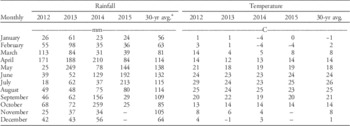
Two separate field experiments were initiated in 2013 and repeated in 2014 and 2015 in Boone County, Missouri, at the University of Missouri Bradford Research Center (38°53'N, 92°12'W). In both experiments, the soil was a Mexico silt loam (fine, smectic, mesic Aeric Vertic Epiaqualfs) with organic matter ranging from 2.1% to 2.3% and soil pH ranging from 6.3 to 6.5. Cover crops were planted on September 11, 10, and 12 in 2013, 2014, and 2015, respectively, using a no-till drill with rows spaced 19 cm apart. The previous crop was corn, and glyphosate plus ammonium sulfate was applied at 1.12 kgaeha−1+2.9 kgha−1 prior to planting the cover crops. Monthly rainfall totals and average monthly temperature for each year are presented in Table 1.
Monthly rainfall (mm) and average monthly temperatures (C) in comparison to the 30-yr average in 2012 through 2015 at the Bradford Research Center in Columbia, Missouri

a 30-yr averages (1981 to 2010) obtained from NCDC 2011
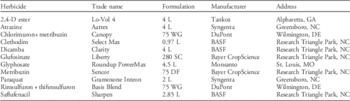
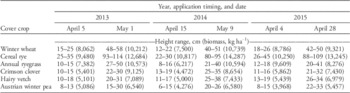
The first field experiment investigated three factors: cover crop species, herbicide treatment, and application timing. The cover crops investigated were winter wheat, cereal rye, annual ryegrass, crimson clover, Austrian winter pea, and hairy vetch. Oilseed radish (Raphanus sativus L.) was seeded each year, but data on oilseed radish were not collected because it did not overwinter in any year of the study. Nine herbicide treatments were evaluated (Table 2). The glyphosate-based treatments included glyphosate at 1,120 gaeha−1 alone and in combination with 2,4-D at 560 gaeha−1, dicamba at 560 gaeha−1, saflufenacil at 25 gaiha−1, atrazine at 1,120 gaiha−1, and chlorimuron at 23 gaiha−1 plus metribuzin at 140 gaiha−1. The paraquat-based treatments included paraquat at 1,120 gaiha−1 alone and in combination with 2,4-D at 560 gha−1 and atrazine at 1,120 gha−1. The height and biomass of each cover crop at the time of application was recorded (Table 3). The target dates for herbicide application were early April and early May (Table 4). The experimental design was a randomized complete block with a split-plot arrangement of treatments. Whole plots consisted of cover crop species and subplots were herbicide treatments. Individual plots were 3 by 5 m and each treatment was replicated three times.
Herbicides used in multispecies and annual ryegrass experiments at the Bradford Research Center in Columbia, Missouri

Cover crop height, biomass, and dates of herbicide application in 2013, 2014, and 2015

Dates of herbicide application and height and biomass of annual ryegrass at the three targeted timings in 2013, 2014, and 2015

The second field experiment evaluated the effectiveness of 18 different herbicide treatments in the termination of annual ryegrass at three application timings. All herbicide treatments were applied to 15-, 35-, or 75-cm-tall annual ryegrass (Tables 2 and 5). The experimental design was a randomized complete block and all herbicide treatments were replicated four times. In both experiments, herbicides were applied using a CO2-pressurized backpack sprayer equipped with XR 8002 flat-fan nozzle tips (TeeJet®, Spraying Systems Co., PO Box 7900, Wheaton, IL 60187) that delivered 140 Lha−1 at 117 kPa at a speed of 5 km/h.
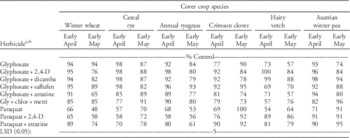
Influence of herbicide treatments on the visual estimates of control of various cover crop species 28 days after application in 2013, 2014, and 2015

a Abbreviations: saflufen, saflufenacil; gly, glyphosate; chlor, chlorimuron; metri, metribuzin.
b All glyphosate treatments included ammonium sulfate at 2.9 kgha−1; all paraquat treatments contained a nonionic surfactant at 0.25% (v/v).
Data Collection
In both experiments, visible estimates of control were recorded 28 days after application (DAA) on a scale of 0% to 100%, where 0% was equal to no control and 100% was equivalent to complete cover crop death. Cover crop biomass was determined by clipping all cover crop biomass within a 0.33-m2 quadrat in each plot 28 DAA. Fresh weights of the harvested plants were recorded immediately after clipping, and biomass reduction (BR) was calculated as a percentage of the nontreated control mean for that site and year.
Statistical Analysis
Visible control and biomass reduction data were analyzed using the PROC GLIMMIX procedure in SAS version 9.3 (SAS® Institute Inc., Cary, NC 27513). Year and replication (with replication nested within year) were considered random effects, and herbicide treatment, application timing, and cover crop species were considered fixed effects. Considering year as a random effect in the model allowed inferences about treatments over a wide range of environments (Blouin et al. Reference Blouin, Webster and Bond2011; Carmer et al. Reference Carmer, Nyuist and Walker1989). Individual treatment differences were separated using Fisher’s Protected LSD at P≤0.05.
Results and Discussion
Multispecies Experiment
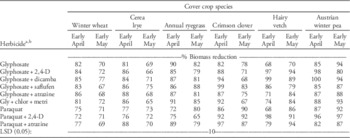
There were no significant year by treatment interactions; therefore, data were combined over years. There was a significant cover crop species by herbicide treatment by timing interaction for visual control (P=0.035) as well as BR (P=0.002) (Tables 5 and 6). When averaged across all herbicide treatments and cover crop species, the early April and early May application timings resulted in 83% and 80% visual control (P=0.005) and 86% and 78% BR (P=0.014), respectively (data not shown).
Influence of herbicide treatments on biomass reduction of various cover crop species 28 days after application in 2013, 2014, and 2015

a Abbreviations: saflufen, saflufenacil; gly, glyphosate; chlor, chlorimuron; metri, metribuzin.
b All glyphosate treatments included ammonium sulfate at 2.9 kgha−1; all paraquat treatments contained a nonionic surfactant at 0.25% (v/v).
In general, glyphosate-based herbicide treatments provided the most consistent control of winter wheat, cereal rye, and annual ryegrass (Table 5). Broadleaf cover crop termination was generally improved with the addition of 2,4-D or dicamba compared to glyphosate alone. With the exception of the glyphosate, glyphosate plus chlorimuron plus metribuzin, and paraquat-based treatments, all herbicide treatments provided statistically greater control at the early April application timing compared to the early May application timing. For the broadleaf cover crops treated with paraquat, the May application was generally more effective than was the April application.
At the early April timing, winter wheat control was 94% to 95% with glyphosate alone or in combination with 2,4-D, dicamba, or saflufenacil, and was 85% or greater for glyphosate plus atrazine, glyphosate plus chlorimuron plus metribuzin, and paraquat plus atrazine (Table 5). At the early May timing, glyphosate and glyphosate plus saflufenacil provided the highest levels of winter wheat control. These herbicide treatments provided similar winter wheat control for both timings. No paraquat-containing treatment provided over 74% control with the early May timing. These results are similar to those presented by Rainbolt et al. (Reference Rainbolt, Thill and Young2004) showing 95% control of winter wheat with glyphosate at 0.43 kgaeha−1 and 63% control with paraquat at 0.56 kgaiha−1. Although glyphosate alone provided a high level of control at the early May timing, tank-mixing 2,4-D and dicamba with glyphosate reduced winter wheat control to 76% and 82%, respectively. O’Sullivan and O’Donovan (Reference O’Sullivan and O’Donavan1980) reported that glyphosate at 0.07 kgha−1 provided 76% BR of winter wheat but that a tank mix of glyphosate plus 2,4-D (0.105 kgha−1) or dicamba (0.035 kgha−1) resulted in only 29% and 26% BR of winter wheat, respectively. In general, for winter wheat, less variation was observed in BR data than was for visual control ratings (Table 6). At the early April timing, glyphosate plus atrazine provided 86% BR of winter wheat, which was similar to that provided by all other herbicide treatments excluding paraquat and paraquat plus 2,4-D. In contrast, no differences between treatments were observed for winter wheat BR at the early May application timing.
Cereal rye control was at least 98% with most glyphosate-containing herbicides applied in early April, with the exception of glyphosate plus atrazine and glyphosate plus chlorimuron plus metribuzin (Table 5). All treatments containing paraquat provided ≤70% control at this application timing. When applied in early May, the glyphosate-containing treatments provided similar levels of control, ranging from 87% to 91%, except glyphosate plus saflufenacil, which provided 82% control. All paraquat-containing treatments provided better control when applied in early May than they did when applied in early April, but control was ≤78%. Biomass reduction ranged from 81% to 88% following applications of glyphosate, glyphosate plus 2,4-D, glyphosate plus dicamba, and glyphosate plus saflufenacil (Table 6). All glyphosate-based herbicide treatments, and paraquat plus atrazine, provided similar BR at the early April timing, and all herbicide treatments provided similar BR at the early May timing. With the exception of glyphosate plus chlorimuron plus metribuzin applied in early April, and glyphosate plus saflufenacil applied in early May, glyphosate-containing treatments provided greater control than did paraquat-containing treatments at either timing. For both timings, cereal rye control with paraquat treatments ranged from 57% to 78%. The effectiveness of glyphosate-based herbicide treatments for the control of cereal rye is supported by the findings of Young et al. (Reference Young, Whaley, Lawrence and Burke2016), who showed 98% control of cereal rye following glyphosate at 0.86 kgaeha−1. Cereal rye is often preferred as a cover crop due to its high biomass and allelopathic properties, which enable it to suppress summer annual weed emergence through the soybean growing season. Teasdale and Moehler (Reference Teasdale and Moehler1993) reported that a cover crop’s ability to suppress summer annual weed emergence increases as above ground biomass increases. Growers who seek more biomass and better summer annual weed suppression should consider herbicide treatments that provide high levels of control at the early May timing.
Annual ryegrass control was better with glyphosate-based treatments than it was with paraquat-based treatments (Table 5). The highest level of control was achieved with glyphosate tank-mixed with either 2,4-D or saflufenacil and applied in early April. All glyphosate-based treatments provide at least 89% control with early April timings. At the early May timing, glyphosate plus saflufenacil provided 93% control, while all other treatments provided less than 85% control. However, unlike winter wheat and cereal rye control, the treatments of glyphosate alone did not provide the highest level of annual ryegrass control at either timing. Paraquat plus atrazine applied in early April provided the highest level of annual ryegrass control among the paraquat-based treatments. These results are similar to those of Griffin et al. (Reference Griffin, Miller, Ellis and Clay2004), who reported inconsistent annual ryegrass control (32% to 80%) following an application of paraquat at 0.53 kgaiha−1. For all herbicide treatments, annual ryegrass BR was similar for the early April and early May application timings (Table 6). At the early April timing, annual ryegrass BR ranged from 85% to 91% for all glyphosate-containing treatments and paraquat plus atrazine. At the early May timing, all herbicide treatments except paraquat plus 2,4-D provided similar annual ryegrass BR (79% to 88%).
Crimson clover control varied based on herbicide treatment and application timing (Table 5). The early May application of paraquat alone or glyphosate plus saflufenacil provided the highest level of control. At the early April timing, glyphosate applied with 2,4-D, dicamba, or saflufenacil, and paraquat plus atrazine, provided 90% to 92% control of crimson clover. McCurdy et al. (Reference McCurdy, McElroy and Flessner2013) also observed 91% control of crimson clover following applications of 2,4-D at 1.58 kgaeha−1. At the early May timing, glyphosate, glyphosate plus saflufenacil, paraquat, paraquat plus 2,4-D, and paraquat plus atrazine all provided greater than 90% control of crimson clover, and these treatments also provided the highest levels of BR (Table 6). Glyphosate plus saflufenacil provided at least 92% control of crimson clover regardless of timing, but BR was 16% lower at the early May compared to the early April timing (Table 6). Paraquat-containing treatments and glyphosate provided a similar level of BR regardless of application timing, but all other herbicide treatments provided greater BR at the early April timing compared to early May timing. Crimson clover control options expand when application is delayed until early May, and this was not observed with any of the other cover crop species evaluated in this research. Effectiveness of glyphosate alone, paraquat alone, and paraquat plus 2,4-D improved with the later application date.
Hairy vetch had a greater response to treatments with 2,4-D or dicamba than did the other species included in this experiment (Table 5). At the early April timing, the addition of 2,4-D or dicamba to the glyphosate treatment increased control by 27% and 26%, respectively. Similarly, the addition of 2,4-D to paraquat increased hairy vetch control by 35% compared to paraquat alone. Herbicide treatments that contained 2,4-D or dicamba also provided the highest levels of hairy vetch control at the early May timing. Biomass reduction was also similar across application timings with all treatments that contained 2,4-D and dicamba (Table 6). These results are consistent with other reports in the literature. For example, Curran et al. (Reference Curran, Wallace, Mirsky and Crockett2015) found that 2,4-D or dicamba at 0.14 kgaeha−1 provided at least 90% control of hairy vetch when applied in the spring or fall.
Several herbicide treatments provided greater than 90% control of Austrian winter pea at both application timings (Table 5). At the early April timing, Austrian winter pea control was similar with glyphosate alone or combined with 2,4-D, dicamba, or atrazine, ranging from 93% to 98% control. At the early May timing, glyphosate plus dicamba, glyphosate plus chlorimuron plus metribuzin, paraquat, paraquat plus 2,4-D, and paraquat plus atrazine provided 91% to 96% control of Austrian winter pea. Glyphosate plus dicamba, glyphosate plus saflufenacil, paraquat plus 2,4-D, and paraquat plus atrazine provided similar control regardless of application timing. Biomass reduction was similar across timings for all treatments except glyphosate plus 2,4-D, which provided 18% less BR at the early May compared to the early April application timing (Table 6). As with hairy vetch, the most effective treatments for Austrian winter pea were those that contained 2,4-D or dicamba.
Annual Ryegrass Experiment
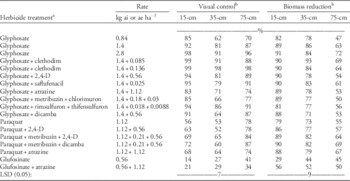
Annual ryegrass control varied greatly by herbicide treatment and application timing, and an herbicide by application timing interaction was present for visual estimate of control (P≤0.0001) and BR (P≤0.0001). When averaged across all herbicide treatments, annual ryegrass control in response to the 15-, 35-, and 75-cm timings was 77%, 68%, and 79%, respectively (data not shown). However, BR in response to the 15-, 35-, and 75-cm timings was 83%, 77%, and 58%, respectively (data not shown). This indicates that herbicide application timing can have a major impact on the amount of annual ryegrass biomass on the soil surface, and also on its effective termination.
Glyphosate at 1.4 and 2.8 kgha−1 provided at least 92% annual ryegrass control when applied to 15-cm-tall plants, but only the 2.8 kgha−1 rate provided 91% or more control at the 35- and 75-cm timings (Table 7). The 1.4 kgha−1 rate of glyphosate provided better annual ryegrass control than did 0.84 kg ha−1 glyphosate at the 35- and 75-cm application timings. Although glyphosate at 2.8 kg ha−1 provided the most consistent control of annual ryegrass (91% to 98%), a single application of glyphosate at this rate would exceed that allowed by the label (Anonymous 2007). Lins et al. (Reference Lins, Cole, Affeldt, Colquhoun, Mallory-Smith, Hines, Steckel and Hayes2007) also reported that a glyphosate rate of 1.6 kg ha−1 is needed to achieve consistent control of annual ryegrass when applied at the boot or early stage of growth.
Influence of herbicide treatments on annual ryegrass biomass reduction and visual control 28 days after application in 2013, 2014, and 2015

a All glyphosate treatments included ammonium sulfate at 2.9 kgha−1; all glufosinate treatments included ammonium sulfate at 3.4 kgha−1; all paraquat treatments contained a nonionic surfactant at 0.25% (v/v).
b Refers to the size of annual ryegrass at the time of application
The addition of clethodim at 0.136 kgha−1 to glyphosate at 1.4 kg ha−1 increased annual ryegrass control compared to the same rate of glyphosate alone when applied at the 35- and 75-cm application timing (Table 7). Glyphosate plus clethodim at 1.4 kgha−1+0.136 kgha−1 and glyphosate at 2.8 kgha−1 were the only two herbicide treatments to provide >90% control across all three timings. These results are similar to those of Nandula et al. (Reference Nandula, Poston, Eubank, Koger and Reddy2007), who showed at least 98% control of 8- to 20-cm annual ryegrass following clethodim at 0.14 kgha−1. At the 15- and 35-cm timings, glyphosate at 1.4 and 2.8 kgha−1 and glyphosate at 1.4 kgha−1 plus clethodim at 0.085 and 0.136 kgha−1 provided similar BR levels, ranging from 84% to 93% (Table 7). At the 1-cm timing, none of the herbicides that were added to glyphosate at 1.4 kg ha−1 increased annual ryegrass control compared to glyphosate at 1.4 kg ha−1 alone.
Paraquat-based herbicide treatments did not provide consistent control of annual ryegrass (Table 7). At the 15- and 35-cm timing, annual ryegrass control with paraquat-containing herbicide treatments was inconsistent, ranging from 52% to 72%. However, at the 75-cm timing, paraquat plus metribuzin plus 2,4-D and paraquat plus metribuzin plus dicamba provided 84% and 87% control, respectively. Nandula et al. (Reference Nandula, Poston, Eubank, Koger and Reddy2007) observed at least 98% control of 8- to 20-cm annual ryegrass with 0.70 and 0.98 kgha−1 paraquat. Glufosinate and glufosinate plus atrazine also did not provide consistent annual ryegrass control (Table 7). At all three timings, glufosinate and glufosinate plus atrazine provided between 14% and 41% control of annual ryegrass. In addition, BR did not exceed 52% at any timing following either herbicide treatment.
Terminating mixed-species cover crops can present challenges for farmers. The results from these experiments indicate that application timing and proper herbicide selection are essential for effective termination of various cover crop species. While glyphosate alone or combined with 2,4-D, dicamba, or saflufenacil often provided the highest level of cover crop control, there were noticeable exceptions. For instance, combining glyphosate with 2,4-D or dicamba improved hairy vetch control, but the combinations reduced winter wheat control with the later application timing. Also, the addition of chlorimuron plus metribuzin to glyphosate reduced control of winter wheat, but combining the herbicides improved control of Austrian winter pea when applied in early May. Herbicide application timing was important for achieving the highest levels of control, with few herbicide treatments providing over 90% control for both early April and early May applications. In general, there were more options that provided >90% of cover crop species control with early April applications, except in the case of crimson clover. Increasing the rate of glyphosate to 2.8 kgha−1 or tank-mixing glyphosate at 1.4 kgha−1 with clethodim at 0.135 kgha−1 proved to be the most effective herbicide treatments for termination of annual ryegrass, regardless of application timing. It is widely reported that increasing amounts of cover crop residues are directly correlated to greater reductions in weed emergence. Therefore, for practitioners who desire higher levels of cover crop biomass, these results indicate that adequate levels of cover crop control can still be achieved in the late spring with certain herbicide treatments. But it is important to consider cover crop termination well in advance to ensure that the most effective herbicide or herbicide combinations are used and that the products are applied at the appropriate stage.