INTRODUCTION
Traumatic brain injury (TBI) is a major public health concern for children 0–14 years, with an estimated annual incidence of 435,000 emergency department visits and 37,000 hospitalizations (Langlois, Rutland-Brown, & Thomas, Reference Langlois, Rutland-Brown and Thomas2006). Long-term neurobehavioral impairments are well documented following moderate to severe TBI in both younger and older children (Anderson & Catroppa, Reference Anderson and Catroppa2005; Anderson, Morse, Catroppa, Haritou, & Rosenfeld, Reference Anderson, Morse, Catroppa, Haritou and Rosenfeld2004; Anderson, Catroppa, Dudgeon, Morse, Haritou, & Rosenfeld, Reference Anderson, Catroppa, Dudgeon, Morse, Haritou and Rosenfeld2006; Chadwick, Rutter, Brown, Shaffer, & Traub, Reference Chadwick, Rutter, Brown, Shaffer and Traub1981; Ewing-Cobbs et al., 2004a; Keenan, Hooper, Wetherington, Nocera, & Runyan, Reference Keenan, Hooper, Wetherington, Nocera and Runyan2007; Yeates, Taylor, Wade, Drotar, Stancin, & Minich, Reference Yeates, Taylor, Wade, Drotar, Stancin and Minich2002). Ewing-Cobbs et al. (Reference Ewing-Cobbs, Prasad, Kramer, Cox, Baumgartner and Fletcher2006) found that children who sustained moderate to severe TBI between the ages of 4 and 71 months had impairments, relative to a community comparison group, in intelligence and academic skills that persisted across a 5-year follow-up period. Similarly, Catroppa, Anderson, Morse, Haritou, and Rosenfeld (Reference Catroppa, Anderson, Morse, Haritou and Rosenfeld2007) observed that children who sustained severe TBI during early childhood (2–7 years) performed more poorly than children with mild TBI on measures of attention and processing speed out to 5 years post-injury. Persistent post-injury cognitive, academic, and behavioral deficits have also been documented in children who sustained moderate to severe TBI during the school-age years (Anderson & Catroppa, Reference Anderson and Catroppa2005; Chadwick et al., Reference Chadwick, Rutter, Brown, Shaffer and Traub1981; Max et al., Reference Max, Lindgren, Robin, Smith, Sato and Mattheis1997; Taylor, Yeates, Wade, Drotar, Stancin, & Minich, Reference Taylor, Yeates, Wade, Drotar, Stancin and Minich2002; Yeates et al., Reference Yeates, Taylor, Wade, Drotar, Stancin and Minich2002).
Consistent with the vulnerability of the temporal and frontal lobes to blunt head injury, deficits in memory and executive function are especially prominent (Anderson & Catroppa, Reference Anderson and Catroppa2005; Anderson et al., Reference Anderson, Morse, Catroppa, Haritou and Rosenfeld2004, Reference Anderson, Catroppa, Dudgeon, Morse, Haritou and Rosenfeld2006; Barnes & Dennis, Reference Barnes and Dennis2001; Catroppa & Anderson, Reference Catroppa and Anderson2005; Dennis, Guger, Roncadin, Barnes, & Schachar, Reference Dennis, Guger, Roncadin, Barnes and Schachar2001; Donders & Giroux, Reference Donders and Giroux2005; Ewing-Cobbs et al., 2004b; Levin & Hanten, Reference Levin and Hanten2005; Yeates et al., Reference Yeates, Taylor, Wade, Drotar, Stancin and Minich2002). Although moderate to severe TBI has less pronounced effects on some language skills, at least in children injured during the school-age years, long-standing impairments in this domain are also well documented (Dennis et al., Reference Dennis, Guger, Roncadin, Barnes and Schachar2001; Ewing-Cobbs & Barnes, Reference Ewing-Cobbs and Barnes2002; Yeates et al., Reference Yeates, Taylor, Wade, Drotar, Stancin and Minich2002).
Factors related to worse outcomes of moderate to severe TBI in children include more severe TBI, younger age at injury, and greater environmental disadvantage (Anderson, Catroppa, Morse, Haaritou, & Rosenfeld, Reference Anderson, Catroppa, Morse, Haritou and Rosenfeld2000a, Reference Anderson, Catroppa, Morse, Haritou and Rosenfeld2005a, Reference Anderson, Catroppa, Morse, Haritou and Rosenfeld2005c; Anderson, Catroppa, Dudgeon, Morse, Haaritou, & Rosenfeld, Reference Anderson, Catroppa, Dudgeon, Morse, Haritou and Rosenfeld2006; Ewing-Cobbs, Fletcher, Levin, Francis, Davidson, & Miner, Reference Ewing-Cobbs, Fletcher, Levin, Francis, Davidson and Miner1997; Slomine et al., Reference Slomine, Gerring, Grados, Vasa, Brady and Christensen2002; Taylor, Yeates, Wade, Drotar, Stancin, & Klein, Reference Taylor, Yeates, Wade, Drotar, Stancin and Klein1999; Yeates et al., Reference Yeates, Taylor, Wade, Drotar, Stancin and Minich2002). Children injured in early childhood (before 7 or 8 years) are especially vulnerable to more generalized deficits, as evident in lower IQ scores and greater deficits in expressive language and reading compared with children injured at later ages (Barnes, Dennis, & Wilkinson, Reference Barnes, Dennis and Wilkinson1999; Ewing-Cobbs & Barnes, Reference Ewing-Cobbs and Barnes2002; Levin, Ewing-Cobbs, & Eisenberg, Reference Levin, Ewing-Cobbs, Eisenberg, Broman and Michel1995). Children who sustain TBI in early childhood also show little evidence for recovery of cognitive functions compared with children injured at later ages (Anderson et al., Reference Anderson, Catroppa, Morse, Haritou and Rosenfeld2000a, Reference Anderson, Morse, Catroppa, Haritou and Rosenfeld2004; Anderson, Catroppa, Morse, Haritou, & Rosenfeld, Reference Anderson, Catroppa, Morse, Haritou and Rosenfeld2005b; Ewing-Cobbs et al., Reference Ewing-Cobbs, Fletcher, Levin, Francis, Davidson and Miner1997, Reference Ewing-Cobbs, Prasad, Kramer, Cox, Baumgartner and Fletcher2006). With respect to environmental influences, Yeates et al. (Reference Yeates, Taylor, Drotar, Wade, Klein and Stancin1997) found that children with traumatic head or orthopedic injuries from families with higher family stressors made less progress over the first year post-injury on a measure of visual–motor skill. Associations of environmental disadvantage and non-optimal parenting characteristics with lower cognitive abilities and slower cognitive development have also been reported in studies of non–head-injured children (Burchinal, Roberts, Hooper, & Zeisel, Reference Burchinal, Roberts, Hooper and Zeisel2000; Bradley & Corwyn, Reference Bradley and Corwyn2002; McLoyd, Reference McLoyd1998; Breslau, Chilcoat, Susser, Matte, Liang, & Peterson, Reference Breslau, Chilcoat, Susser, Matte, Liang and Peterson2001; Espy, Molfese, & DiLalla, Reference Espy, Molfese and DiLalla2001; Landry, Chapaieski, Richardson, Palmer, & Hall, Reference Landry, Chapieski, Richardson, Palmer and Hall1990; Landry, Garner, Swank, & Baldwin, Reference Landry, Garner, Swank and Baldwin1996; Landry, Miller-Loncar, Smith, & Swank, Reference Landry, Miller-Loncar, Smith and Swank2002; Landry, Smith, Miller-Loncar, & Swank, Reference Landry, Smith, Miller-Loncar and Swank1997; Landry, Smith, & Swank, Reference Landry, Smith and Swank2006; Smith, Landry, & Swank, Reference Smith, Landry and Swank2000; Taylor, Schatschneider, & Minich, Reference Taylor, Schatschneider and Minich2000; Taylor, Minich, Klein, & Hack, Reference Taylor, Minich, Klein and Hack2004).
However, the few studies that have examined post-injury development in cognition following TBI in early childhood are subject to several limitations. First, by focusing largely on measures of IQ, these studies have not provided information on the nature of cognitive changes across multiple ability domains. Second, the effects of TBI on cognitive development in young children have often been evaluated by comparing children with more severe TBI to children who sustained mild TBI or to non-injured community controls. While comparison to children with mild TBI is useful in assessing injury severity effects, the utility of such a comparison is limited by the fact that mild TBI may itself have adverse effects in young children (Gronwall, Wrightson, & McGinn, Reference Gronwall, Wrightson and McGinn1997). Comparison with community controls is problematic because samples of children who sustain traumatic injuries may differ in pre-injury characteristics from uninjured groups (Goldstrohm & Arffa, Reference Goldstrohm and Arffa2005; Parslow, Morris, Tasker, Forsyth, & Hawley, Reference Parslow, Morris, Tasker, Forsyth and Hawley2005). To help control for risk for injury and for the experience of hospitalization, children hospitalized for other traumatic injuries may be a more appropriate comparison group. Finally, previous studies have failed to consider proximal family characteristics, such as the quality of the home environment or parenting styles, in evaluating the effects of TBI on cognitive development.
In an initial study of the present sample investigating the post-acute effects of TBI in early childhood (ages 3–6 years), Taylor, Swartwout, Yeates, Walz, Stancin, and Wade (Reference Taylor, Swartwout, Yeates, Walz, Stancin and Wade2008) assessed the effects of varying levels of TBI severity on several cognitive outcomes relative to an orthopedic injury (OI) comparison group. Results indicated that the severe TBI group had lower scores on measures of overall cognitive abilities, memory, spatial reasoning, and executive function, whereas the moderate TBI group had more selective deficits on measures of memory and executive function. Lower socioeconomic status (SES) was also associated with poorer cognitive outcomes for the sample as a whole.
The major aim of the current study was to examine subsequent post-injury cognitive development in the TBI and OI groups. A further aim was to determine if measures of the proximal family environment, as reflected in home and parenting characteristics conducive to cognitive development, would be positively related to outcomes. Research suggests that proximal features of the home environment account for variations in cognitive development not explained by SES and may even mediate some of the effects of SES on children’s competencies (Bradley & Corwyn, Reference Bradley and Corwyn2002; Bradley et al., Reference Bradley, Caldwell, Rock, Ramey, Barnard and Gray1989; Bradley, Corwyn, Caldwell, Whiteside-Mansell, Wasserm an, & Mink, Reference Bradley, Corwyn, Caldwell, Whiteside-Mansell, Wasserman and Mink2000; Espy et al., Reference Espy, Molfese and DiLalla2001). Based on the existing literature, we hypothesized that (1) cognitive outcomes would be worse and more generalized in children with more severe TBI; (2) little recovery in skills would be evident in the children with TBI relative to children with OI; and (3) home environments less conducive to children’s learning and parenting characterized by less warm responsiveness and less support of child development would be associated with poorer test performance and slower post-injury cognitive development. In light of data from our post-acute assessment showing that some outcomes of TBI were worse in children from less advantaged environments (Taylor et al., Reference Taylor, Swartwout, Yeates, Walz, Stancin and Wade2008), and similar evidence from a previous study of TBI in school-age children (Taylor et al., Reference Taylor, Yeates, Wade, Drotar, Stancin and Klein1999, Reference Taylor, Yeates, Wade, Drotar, Stancin and Minich2002; Yeates, et al., Reference Yeates, Taylor, Drotar, Wade, Klein and Stancin1997, Reference Yeates, Taylor, Wade, Drotar, Stancin and Minich2002), we also explored the possibility that the effects of TBI would be exacerbated by home environments that are less focused on child learning and by less supportive parenting.
METHODS
Sample
As described in our previous report (Taylor et al., Reference Taylor, Swartwout, Yeates, Walz, Stancin and Wade2008), children who sustained TBI or OI between the ages of 3 years, 0 months and 6 years, 11 months were recruited from three tertiary care children’s hospitals and a general hospital, all with Level 1 trauma centers. The study was approved by the ethics boards of all participating hospitals, and informed consent was obtained before participation.
Eligibility requirements for the TBI group included blunt trauma requiring overnight admission to the hospital and either a Glasgow Coma Scale (GCS; Teasdale & Jennett, Reference Teasdale and Jennett1974) score < 15, suggesting altered neurological status, or evidence for TBI-related brain abnormalities from computed tomography (CT) or magnetic resonance imaging (MRI). The TBI group was divided into severe, moderate, and complicated mild severity groups consistent with previous investigations (Anderson et al., Reference Anderson, Catroppa, Dudgeon, Morse, Haritou and Rosenfeld2006; Fletcher, Ewing-Cobbs, Miner, Levin, & Eisenberg, Reference Fletcher, Ewing-Cobbs, Miner, Levin and Eisenberg1990; Taylor et al., Reference Taylor, Yeates, Wade, Drotar, Stancin and Klein1999). Severe TBI was defined by a GCS score of 8 or less, moderate TBI by a GCS score of 9–12, and complicated mild TBI by a GCS score of 13–15 with neuroimaging abnormality. Justification for including children with mild complicated injuries includes adult and child findings showing greater cognitive impairments with this type of injury compared with uncomplicated mild TBI (Levin et al., Reference Levin, Hanten, Roberson, Li, Ewing-Cobbs and Dennis2008). The GCS score assigned to the child was the lowest one recorded. Inclusion in the OI group required a documented bone fracture in an area of the body other than the head that required an overnight hospital stay, and the absence of any evidence of loss of consciousness or other findings suggestive of brain injury. Children were excluded from the study if English was not the primary language spoken in the home or if they had histories of child abuse, autism, mental retardation, or a neurological disorder.
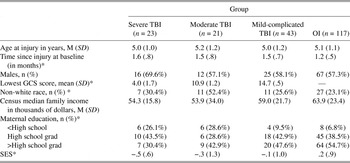
A total of 204 children and their caregivers were enrolled in the study. At least a portion of the test battery was administered to 201 children (98.5% of the sample) at the post-acute baseline assessment completed an average of 1.5 months after injury. Subsequent follow-up assessments were conducted at approximately 6, 12, and 18 months post-injury. The final sample comprised 87 children with TBI (23 severe, 21 moderate, and 43 complicated mild) and 117 with OI (see Table 1 for sample demographics). To be included in the sample, children had to have completed at least one post-injury assessment. Comparisons of participants in the TBI and OI groups with children from these groups who met age and injury severity criteria but were not recruited failed to reveal significant differences in census-based median income of the neighborhood of residence (using the Federal Financial Institutions Examinations Council Geocoding System, 2005).
Sample demographic characteristics

Note
TBI = traumatic brain injury (TBI); OI = orthopedic injury (OI); GCS = Glasgow Coma Scale; SES = socioeconomic status, defined as composite (z score average) of maternal education and median income for the census tract in which the family resided.
* Significant difference between groups, p < .05.
Because we extended the recruitment window slightly to enroll as many children with TBI as possible, the time between injury and the baseline assessment was somewhat longer for the TBI groups than for the OI group. The groups also differed in race, maternal education, and a composite SES measure defined as the average sample Z scores for maternal education and census-based median income. Only the severe TBI and OI groups differed significantly in SES. Attrition rates were relatively low, with follow-up of 179 (88%) of the sample at the 6-month assessment, 160 (78%) at the 12-month assessment, and 157 (77%) at the 18-month assessment. Attrition was not significantly related to group, sex, race, or SES.
Assessment Procedures
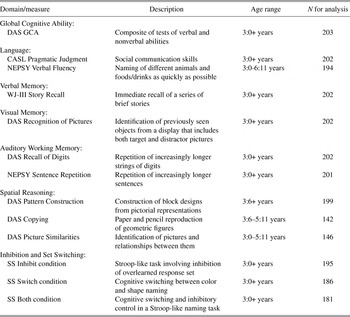
Child and family assessment at baseline included administration of a neuropsychological test battery to the child, a parent interview to obtain information on family SES and the home environment, and videotaped parent–child interactions. Children were administered neuropsychological tests in a fixed order with differing, but overlapping batteries tailored to the age ranges 3 years 0 months to 3 years 5 months, 3 years 6 months to 5 years, 11 months, and 6 years 0 months to 6 years 11 months (Taylor et al., Reference Taylor, Swartwout, Yeates, Walz, Stancin and Wade2008). Table 2 lists tests administered according to cognitive domain and indicates the age range and sample size for each measure. The rationale assessing these cognitive domains was our interest in measuring a range of skills while focusing on those considered most susceptible to injury effects (Yeates, Reference Yeates, Yeates, Ris and Taylor2000). Given that executive function is both highly vulnerable to injury and important for children’s ongoing development, special emphasis was placed on assessments of this domain (Taylor et al., Reference Taylor, Swartwout, Yeates, Walz, Stancin and Wade2008) The test battery for the baseline and 12-month assessments included all measures, but the global cognitive ability and spatial reasoning domains were not evaluated at the 6- and 18-month assessments. Most of the measures were applicable across the full age range over which children were assessed (i.e., out to maximum of 8 years 4 months at the final visit). Sample size reductions reflected the inapplicability of certain tests to younger or older children and inability of some younger children to meet test demands.
Neuropsychological test battery and ages of administration

Note
DAS = Differential Ability Scales (Elliott, Reference Elliott1990); GCA = General Conceptual Ability; WJ-III = Woodcock Johnson Tests of Achievement—Third Edition (Woodcock et al., Reference Woodcock, McGrew and Mather2001); CASL = Comprehensive Assessment of Spoken Language (Carrow-Woolfolk, Reference Carrow-Woolfolk2000); NEPSY = A Developmental Neuropsychological Assessment (Korkman et al., Reference Korkman, Kirk and Kemp1998); SS = Shape School (Espy, Reference Espy1997). Tests comprising the DAS GCA and spatial reasoning domains were administered only at baseline and 12 months post injury. Sample size for the DAS spatial reasoning tests was also reduced because of the more limited age ranges over which children are eligible for these procedures. DAS Verbal Fluency was only given to children younger than 6 years because older children receive a different version of the test.
The quality of the home environment was assessed by administering the Home Observation for Measurement of the Environment (HOME, Caldwell & Bradley, Reference Caldwell and Bradley2000). The HOME assesses parental stimulation and support to the child by observing the child’s home and discussing child-related activities with parents. Specifically, in the course of a home visit, the examiner gathered information regarding learning materials, developmental stimulation, physical environment, and parental supportiveness. The overall HOME score was the sum of the ratings across the eight domains, with higher scores reflecting greater structure, stimulation, and support within the home environment. The HOME has good reliability and is a valid predictor of children’s cognitive development (Caldwell & Bradley, Reference Caldwell and Bradley2000). The correlation between the HOME and SES for the total sample was moderately high (r = .53; p < .001), suggesting that these measures were related but nonequivalent.
The parent–child interactions consisted of two 10-min interaction sessions that were coded based on structured rating system validated by Landry and colleagues (Landry et al., Reference Landry, Chapieski, Richardson, Palmer and Hall1990, Reference Landry, Smith, Miller-Loncar and Swank1997, Reference Landry, Miller-Loncar, Smith and Swank2002; Landry, Smith, Swank, Assel, & Vellet, Reference Landry, Smith, Swank, Assel and Vellet2001). In the first or “free play” session, the parent was instructed to spend time with his/her child as if they were at home. Developmentally appropriate toys and parent magazines were available in the exam room. Parent behavior was rated on a 5-point scale (higher scores indicating more positive behavior) along the dimensions of parental warm responsiveness. Parental warmth was rated based on the presence and intensity of verbal and nonverbal warmth, affection, and positive regard toward the child. Contingent responsiveness ratings reflected the degree of the parent’s sensitivity and responsiveness to the child’s behavior. The interactions were divided into two 5-min segments that were coded independently and averaged to increase the stability of the measures. Because they were highly correlated, the warmth and contingent responsiveness scales were averaged to form a single “warm responsiveness” scale (Landry et al., Reference Landry, Smith and Swank2006). In the second “teaching” task, the parent was instructed to guide their child to completion of a developmentally challenging cognitive task (Landry et al., Reference Landry, Garner, Swank and Baldwin1996). Parental scaffolding was measured by the frequency with which parents provided verbal support for the child during this task. Ratings of 15% of the tapes by the entire rating team revealed a satisfactory level of inter-rater reliability, with intraclass correlation coefficients ≥ 0.8 for all codes. Procedures for maintaining reliability between blinded and un-blinded raters minimized any bias due to the awareness of some of the raters of the nature of the child’s injury (TBI vs. OI).
Data Analysis
General linear mixed-model analysis, also known as hierarchical linear or growth modeling, was used to examine changes in test performance across follow-up. With the exception of the standard score for General Conceptual Ability (GCA) from the Differential Ability Scales (DAS, Elliott, Reference Elliott1990), analysis was conducted on raw scores. Because of its equal-interval property, the W score equivalent of the raw score was examined for the Woodcock Johnson Tests of Achievement—Third Edition (Woodcock, McGrew, & Mather, Reference Woodcock, McGrew and Mather2001) Story Recall test. The rationale for examining raw scores is their potential to reveal changes in performance that may be obscured by transforming scores based on normative standards. A mixed-model approach enables utilization of data from all participants, even those not seen at every assessment, and does not require equal intervals between assessments (Francis, Fletcher, Stuebing, Davidson, & Thompson, Reference Francis, Fletcher, Stuebing, Davidson and Thompson1991). Analysis was conducted using SAS Proc Mixed (Singer, Reference Singer1998).
The first set of analyses was conducted to examine group differences across follow-up. The effects of each level of TBI severity were examined by including contrast terms comparing each TBI group with the OI group. The effect of time since injury was modeled as linear and quadratic change in scores across the follow-up assessments, with only linear change included in models for the GCA and tests of spatial reasoning. Covariates were baseline SES, race, sex, and age at injury. Three-way interactions were also included to investigate moderating effects of age at injury and SES on the group differences in change across follow-up. To evaluate potential bias due to attrition, we conducted additional analyses in which children who completed follow-up were compared with children who dropped out before the final assessment. Differences between these two subgroups were found for Story Recall, with lower scores in the children who dropped out. However, there were no other differences and results were not substantially changed for any outcome when completer versus non-completer status was included in the models. There was thus little reason to suspect bias due to incomplete longitudinal data.
A second series of mixed model analyses was carried out to investigate direct effects of the proximal home environment, as assessed by HOME and parent warm responsiveness and scaffolding, on the cognitive measures. We also examined potential moderating effects of these factors on group differences by adding each factor (considered separately), along with its interaction with group, time since injury, and group × time since injury, to the models obtained from the first series of analyses described above. Because of our interest in determining how the family environment at the beginning of follow-up predicted subsequent cognitive development, only baseline measures of the home environment were considered in analysis.
Models for both sets of analyses were trimmed by eliminating nonsignificant higher- and then lower-level interaction. A family-wise alpha level of .05 was used to determine statistical significance, with Bonferroni correction applied to individual tests within test domains (i.e., alpha for tests within 2- and 3-test domains of .025 and .0167, respectively). Effects sizes for significant TBI versus OI contrasts were estimated using Cohen’s d (Cohen, Reference Cohen1988).
RESULTS
Group Differences Across Follow-up
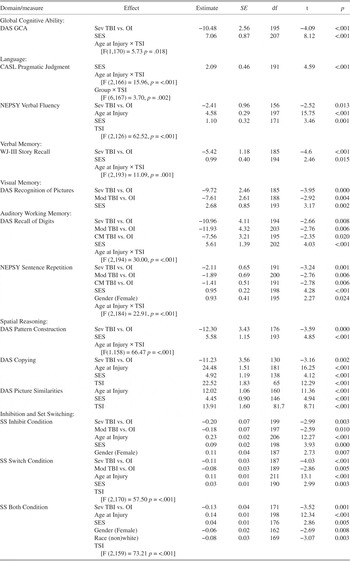
Findings from mixed-model analysis revealed group main effects for measures from multiple ability domains. As shown in Table 3, the severe TBI scored significantly lower than the OI group on most of the measures, with fewer deficits found in the moderate and complicated mild TBI groups. Effect sizes for the severe TBI versus OI contrasts were medium to large (.79 for GCA, .56 for Verbal Fluency, .91 for Story Recall, .78 for Recognition of Pictures, .52 for Recall of Digits, .63 for Sentence Repetition, .75 for Pattern Construction, .76 for Copying, and .51, .80, and .74, respectively, for the Shape School Inhibition, Switch, and Both conditions). Effect sizes were medium for the moderate TBI versus OI contrasts (.59 for Recognition of Pictures, .54 for Recall of Digits, .54 for Sentence Repetition, and .51 and .54, respectively, for the Shape School Inhibition and Switch conditions), and small for the complicated mild TBI versus OI contrasts (.38 for Recall of Digits and .46 for Sentence Repetition).
Results of mixed models analysis of cognitive measures

Note
Sev = severe; Mod = moderate; CM = complicated mild; OI = orthopedic injury; DAS: Differential Ability Scales; GCA = General Conceptual Ability; WJ-III: Woodcock Johnson Test of Achievement—Third Edition; CASL: Comprehensive Assessment of Spoken Language; NEPSY: NEPSY: A Developmental Neuropsychological Assessment; SS: Shape School. Only significant effects from each model are listed. Model estimates for group effects are group differences in raw scores for all measures except GCA Model estimates are not given for time since injury, as this represents the conjoint effects of linear and quadratic terms. SES = socioeconomic status. Metrics: premorbid (raw score), age at injury (years), SES (z-score).
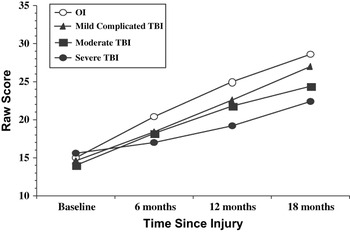
Analysis also revealed a group × time since injury interaction for Pragmatic Judgment. Estimated scores of the four groups across the four assessments are graphed in Figure 1. Follow-up tests to examine the sources of the interaction indicated emerging deficiencies over time post-injury in the severe and moderate TBI groups relative to the OI group, with significant deficits only at 12 and 18 months post-injury in the severe TBI group and at 18 months in the moderate TBI group.
Estimates from mixed model analysis of group mean scores on Pragmatic Judgment across follow-up. Analysis revealed significant differences between the severe traumatic brain injury (TBI) and orthopedic injury (OI) groups only at 12 and 18 months after injury, and between the moderate TBI and OI groups only at 18 months after injury.

Associations of Proximal Family Environment With Test Performance
In the second series of mixed models, three of the measures of the proximal home environment were related to outcomes, even with SES in the model. A higher HOME score was associated with higher GCA, F(1,194) = 9.00; p = .003; Pragmatic Judgment, F(1,188) = 10.89; p = .001; Verbal Fluency, F(1,190) = 11.87; p = .001; Recognition of Pictures, F(1,182) = 20.34; p = < .001; and Shape School Switch, F(1,180) = 9.29; p = .003. A HOME × time since injury (quadratic component) interaction for Sentence Repetition, F(1,186) = 6.23; p = .013, indicated that a higher HOME score was associated with more rapid growth from baseline to 12 months post-injury after which the HOME had a less pronounced effect. Higher warm responsiveness predicted higher GCA, F(1,187) = 5.21; p = .029, and Pragmatic Judgment, F(1,185) = 5.52; p = .020. Higher scaffolding predicted higher scores on Pragmatic Judgment, F(1,187) = 8.15; p = .005; Verbal Fluency, F(1,191) = 7.14; p = .008; Recognition of Pictures, F(1,176) = 5.80; p = .017; Recall of Digits, F(1,189) = 6.72; p = .010; Sentence Repetition, F(1,182) = 7.39, p = .007; and Shape School Switch, F(1,166) = 7.82; p = .006.
A group × scaffolding interaction, F(3,179) = 3.07; p = .029, provided the only evidence for a moderating effect of the home environment on the outcomes of TBI. To examine the source of this interaction, each TBI versus OI contrast was tested at levels of low and high scaffolding as defined by scaffolding counts that were 1 standard deviation (SD) below and above the sample mean, respectively. Results revealed that deficits were significant for the severe TBI at a low level of scaffolding and for the moderate TBI group at a high level of scaffolding.
DISCUSSION
In support of our first hypothesis, cognitive deficits in young children with severe TBI were more pronounced and generalized than those associated with moderate or complicated mild TBI. These results parallel findings from our previous report of baseline outcomes (Taylor et al., Reference Taylor, Swartwout, Yeates, Walz, Stancin and Wade2008), as well as those from past research on the cognitive sequelae of TBI in young children (Anderson et al., Reference Anderson, Catroppa, Morse, Haritou and Rosenfeld2000a, Reference Anderson, Morse, Catroppa, Haritou and Rosenfeld2004, Reference Anderson, Catroppa, Morse, Haritou and Rosenfeld2005a, Reference Anderson, Catroppa, Dudgeon, Morse, Haritou and Rosenfeld2006; Ewing-Cobbs et al., Reference Ewing-Cobbs, Fletcher, Levin, Francis, Davidson and Miner1997). Consistent with our second hypothesis, these consequences persisted across the 18-month follow-up interval. There were no indications of recovery and a deficit in Pragmatic Judgment was not evident until 12 months post-injury. Previous studies have observed limited recovery in children with TBI during early childhood (Anderson et al., Reference Anderson, Morse, Catroppa, Haritou and Rosenfeld2004; Catroppa et al., Reference Catroppa, Anderson, Morse, Haritou and Rosenfeld2007; Keenan et al., Reference Keenan, Hooper, Wetherington, Nocera and Runyan2007; Ewing-Cobbs et al., Reference Ewing-Cobbs, Fletcher, Levin, Francis, Davidson and Miner1997), but the present findings demonstrate that even children with complicated mild TBI have persistent weaknesses on tests of auditory working memory and inhibition. Anderson, Catroppa, Rosenfeld, Haritou, and Morse (Reference Anderson, Catroppa, Rosenfeld, Haritou and Morse2000b) found that memory deficits in young children with TBI emerged over the first year post-injury. To our knowledge, however, the present study is the first to indicate later-appearing deficits in pragmatic language.
The later appearing deficit in Pragmatic Judgment is subject to at least two interpretations. One explanation is that cognitive deficits that occur immediately after TBI or damage to underlying neural structures have a growth-limiting effect on the post-injury development of pragmatic language. In this instance, TBI would be expected to have increasingly adverse effects across follow-up independent of the age range over which the child is followed. A second possibility is that the effects of TBI on these abilities do not become manifest until later ages, due either to the insensitivity of the test to injury effects at earlier ages or to developmental factors. One developmental explanation is that pragmatic language skills are rapidly emerging during early school age, and that such skills are more susceptible to disruption following early brain injury (Dennis, Reference Dennis, Boll and Bryant1988). However, if the child’s age at assessment was the critical factor, one would expect deficits to become more pronounced at older ages more so than with increasing time post-injury. As the deficit in Pragmatic Judgment was related only to time post-injury and not to the age range across which follow-up took place, the findings are more consistent with the first interpretation. However, restrictions in the age range over which children were followed preclude any firm conclusions, and follow-up to later ages would provide a stronger test of age-related deficits.
One possible explanation for finding age-related increases in deficits in the severe TBI group only on Pragmatic Judgment is that the social use of language may be developing especially rapidly during this period of childhood, regardless of the exact age interval over which the child is followed (Ewing-Cobbs & Barnes, Reference Ewing-Cobbs and Barnes2002). The fact that Pragmatic Judgment draws on children’s abilities to make inferences about pictured social interactions, appreciate the intentions of the persons in the pictures, and use social discourse may also help account for this finding. The test thus taps into several of the skills that are most vulnerable to TBI (Dennis et al., Reference Dennis, Guger, Roncadin, Barnes and Schachar2001; Yeates et al., Reference Yeates, Bigler, Dennis, Gerhardt, Rubin and Stancin2007).
Our third hypothesis was confirmed by associations of cognitive outcomes with the HOME and with the parenting measures warm responsiveness and scaffolding. Specifically, we found that higher scores on one or more of these environmental measures were related to higher test scores on several tests. These results parallel findings showing that SES is related to diverse cognitive abilities (Farah et al., Reference Farah, Shera, Savage, Betancourt, Giannetta and Brodsky2006; Noble, Norman, & Farah, Reference Noble, Norman and Farah2005). In the present study, however, associations with proximal family factors were independent of the effects of SES. Our findings thus confirm previous data demonstrating that proximal family factors account for variability in cognition not explained by more distal measures such as SES (Bradley et al., Reference Bradley, Caldwell, Rock, Ramey, Barnard and Gray1989; Bradley, Corwyn, Caldwell, Whiteside-Mansell, Wasserman, & Mink. Reference Bradley, Corwyn, Caldwell, Whiteside-Mansell, Wasserman and Mink2000; Espy et al., 2001). A higher HOME score also predicted faster growth over the follow-up interval in Sentence Repetition, as is consistent with other evidence for family influences on cognitive development (Burchinal et al., Reference Burchinal, Roberts, Hooper and Zeisel2000; Espy et al., 2001; Landry et al., Reference Landry, Miller-Loncar, Smith and Swank2002, Reference Landry, Smith and Swank2006; Murray & Hornbaker, Reference Murray and Hornbaker1997; Smith et al., Reference Smith, Landry and Swank2000). Because most of these effects did not vary by group, the results suggest that more optimal family environments promote cognitive development similarly in children with TBI and in children without brain injuries.
The only evidence for environmental moderation of the consequences of TBI was provided by the differential effect of parental scaffolding on the GCA. Specifically, a deficit in GCA was significant for the severe TBI group only at a low level of scaffolding and for the moderate TBI group only at a high level of scaffolding. These two disparate findings are difficult to reconcile and suggest that the interaction may have been spurious. Nevertheless, results for the severe TBI group are consistent with evidence that higher family function buffers the adverse effects of later-childhood TBI on memory (Yeates et al., Reference Yeates, Taylor, Drotar, Wade, Klein and Stancin1997). This pattern of environmental moderation is also similar to that reported by Landry et al. (Reference Landry, Chapieski, Richardson, Palmer and Hall1990, Reference Landry, Smith, Miller-Loncar and Swank1997) and Landry, Smith, Miller-Loncar, and Swank (Reference Landry, Smith, Miller-Loncar and Swank1998), who found that supportive parenting was more strongly related to positive developmental outcomes of very low birth weight in children at higher neurological risk.
Although we did not examine the effects of early versus later childhood TBI in this study, the lack of recovery in cognitive abilities contrasts with results obtained in post-injury follow-up of children injured at older ages (Anderson & Catroppa, Reference Anderson and Catroppa2005; Anderson et al., Reference Anderson, Catroppa, Morse, Haritou and Rosenfeld2000a, Reference Anderson, Catroppa, Morse, Haritou and Rosenfeld2005b; Chadwick et al., Reference Chadwick, Rutter, Brown, Shaffer and Traub1981; Taylor et al., Reference Taylor, Yeates, Wade, Drotar, Stancin and Klein1999; Verger et al., Reference Verger, Junque, Jurado, Tresserras, Bartumeus and Nogues2000). Explanations for the lack of even short-term recovery in skills following TBI at younger ages include the greater vulnerability of the younger brain to diffuse insult, the potential for early insults to result in greater alterations in neural development, and a greater effect of cognitive deficits acquired at an earlier age on subsequent developmental progress (Anderson et al., 2000, Reference Anderson, Catroppa, Morse, Haritou and Rosenfeld2005b; Bittigau et al., Reference Bittigau, Sifringer, Pohl, Stadrhaus, Ishimaru and Shimizu1999; Ewing-Cobbs et al., Reference Ewing-Cobbs, Prasad, Landry, Kramer and DeLeon2004b; Taylor & Alden, Reference Taylor and Alden1997). As in our previous study, however, we failed to find moderating effects of age at injury on cognitive outcomes (Taylor et al., Reference Taylor, Swartwout, Yeates, Walz, Stancin and Wade2008). Variations in age at injury within the early childhood period (3–6 years) may be less important for outcome than differences between early and later childhood insults.
The associations of a higher quality home environment and more optimal parenting characteristics with higher test scores may be explained in terms of the positive effects of parental guidance and attention, cognitive stimulation, and learning resources on cognitive development (Bradley & Corwyn, Reference Bradley and Corwyn2002). Conversely, cognitive development may be hampered by less optimal family environments (McLoyd, Reference McLoyd1998). Associations between child outcomes and family factors also could have reflected bidirectional relationships between child and family characteristics or even genetically based similarities between parenting styles and children’s abilities (Collins, Maccoby, Steinberg, Hetherington, & Bornstein, Reference Collins, Maccoby, Steinberg, Hetherington and Bornstein2000; Rutter, Pickles, Murray, & Eaves, Reference Rutter, Pickles, Murray and Eaves2001; Taylor, Yeates, Wade, Drotar, Stancin, & Brunett, Reference Taylor, Yeates, Wade, Drotar, Stancin and Burant2001; Wade et al., Reference Wade, Taylor, Walz, Salisbury, Stancin and Bernard2008). Although the findings do not allow us to distinguish among these interpretations, they provide an impetus for further studies of mechanisms of effect. Consideration of multiple and interactive factors is needed for a fuller account of environmental influences on cognitive development, including peer and neighborhood effects, family stress, and family characteristics in addition to those measured in this study (Burchinal et al., Reference Burchinal, Roberts, Hooper and Zeisel2000; Conger & Donnellan, Reference Conger and Donnellan2007; Fiese, Reference Fiese, Sternberg and Grigorenko2001).
Several study limitations must be kept in mind in interpreting these findings. First, despite statistical control for background differences in SES and race and data suggesting that our sample was representative of children with TBI treated at the participating hospitals, we advise caution in generalizing findings to broader populations. Second, although we did not find systematic differences in background or outcomes between children who completed follow-up and those who did not, our estimates of longitudinal change may have been biased by unmeasured factors. A third concern relates to the lack of initial assessments of some skills in the youngest children in the sample. The vast majority of participants were assessed at all post-injury visits, and age at injury was taken into account in the analysis, but estimates of growth rates may have been less precise in this subset of our sample. A further limitation is that children with TBI were divided into severity categories based only on the GCS score and on findings from clinical neuroimaging. Imaging methods with greater sensitivity to TBI, such as more advanced MRI techniques, may have provided a more valid metric for assessing the type and degree of brain insult in relation to cognitive outcomes (Brenner, Freier, Holshouser, Burley, & Ashwal, Reference Brenner, Freier, Holshouser, Burley and Ashwal2003; Serra-Grabulosa, Junque, Verger, Salgado-Pineda, Maneru, & Mercader, Reference Serra-Grabulosa, Junque, Verger, Salgado-Pineda, Maneru and Mercader2005; Wilde et al., Reference Wilde, Chu, Bigler, Hunter, Fearing and Hanten2006).
Despite these limitations, the present study is one of only a few studies to assess the cognitive development in young children with TBI relative to an “other injury” comparison group. The results document both persisting and later appearing deficits following TBI, with persisting deficits in executive function found even in children with moderate and complicated mild TBI. We did not find evidence that any of the environmental factors facilitated cognitive recovery. Such recovery would be demonstrated by a “catch-up” in cognitive skills over time post-injury for children with TBI relative to children with OI under some environmental conditions. However, by demonstrating that more stimulating and supportive home environments are associated with better cognitive performance, our findings confirm the potential benefits of intensive family-based interventions targeting child-centered activities and positive parenting (Landry, Smith, & Swank, Reference Landry, Smith and Swank2003; Wade, Oberjohn, Burhardt, & Greenberg, Reference Wade, Oberjohn, Burhardt and Greenberg2009). In particular, positive parenting skills interventions that teach parental warm responsiveness through the use of specific praise, behavioral descriptions, and reflection of the child’s verbalizations, such as Parent–Child Interaction Therapy (Eyberg, Reference Eyberg1988), may facilitate cognitive recovery through both enhanced parent–child interactions and heightened verbal stimulation. Parents can be trained to provide critical environmental supports or scaffolding for the child’s behavior. From this perspective, parents can function as the interventionist as well as the target of the intervention (Braga, Da Paz, & Ylvisaker, Reference Braga, Da Paz and Ylvisaker2005).
Further follow-up of the sample is needed to investigate longer-term consequences of early childhood TBI. While neural reorganization may support partial recovery in some cognitive functions with advancing age (Stiles, Reilly, Paul, & Moses, Reference Stiles, Reilly, Paul and Moses2005), early cognitive weaknesses also increase risks for later-emerging deficits (Blair, Reference Blaire2006; Taylor, Reference Taylor2004). Longitudinal monitoring of outcomes in these and other children who have sustained TBI in early childhood is critical to ensure awareness of cognitive weaknesses and to recommend instructional approaches to facilitate their learning progress. Increasing deficits in pragmatic language among children with severe TBI are particularly concerning and underscore the importance of more in-depth analysis of the cognitive factors that contribute to such age-related changes and the need for interventions aimed at improving communication and social skills. Additional research will be useful to enhance knowledge of the longer-term consequences of early childhood TBI, identify risk factors, and elucidate the mechanisms responsible for environmental effects on cognition.
ACKNOWLEDGMENTS
Supported by grant R01 HD42729 to Dr. Wade from NICHD, in part by USPHS NIH grant no. M01 RR 08084, and by Trauma Research grants from the State of Ohio Emergency Medical Services. The authors wish to acknowledge the contributions of Christine Abraham, Andrea Beebe, Lori Bernard, Anne Birnbaum, Beth Bishop, Tammy Matecun, Karen Oberjohn, Elizabeth Roth, and Elizabeth Shaver in data collection and coding. The Cincinnati Children’s Medical Center Trauma Registry, Rainbow Pediatric Trauma Center at Rainbow Babies & Children’s Hospital, Nationwide Children’s Hospital Trauma Program, and MetroHealth Center Department of Pediatrics and Trauma Registry provided assistance with recruitment.