The therapeutic approach for young patients with complete atrioventricular block remains a difficult topic in the everyday practice of paediatric cardiologists and electrophysiologists. The two main causes for atrioventricular block in the young population are either congenital or post-surgical. Complete heart block can also occur spontaneously in patients with certain structural heart defects, particularly congenitally corrected transposition of the great arteries and rarely atrioventricular septal defects. Expert consensus is clear in terms of class I pacing indications;Reference Epstein, DiMarco and Ellenbogen 1 however, the specificities in relation to the surgical approach and pacing strategy remain controversial and dependent on each centre’s experience and preference.
The most frequent policy nowadays is to attempt to provide a dual-chamber system, either endocardial or epicardial; however, in the past, there has been a tendency to provide younger patients with a single-chamber ventricular epicardial system. This results in a group of older children, adolescents, and young adults with complete atrioventricular block who are still functioning with a non-synchronous, steady-rate ventricular pacing. In these cases, the question relates to the ideal timing and circumstances to upgrade the system. In many cases, the practical aspects of battery life span and the wire integrity fix the timing for converting to a dual-chamber system; however, the benefit of upgrading patients to a synchronous atrioventricular pacing even if there is no lead dysfunction remains controversial. With this question in mind, we investigated the exercise capacity of a group of children, adolescents, and young adults with complete atrioventricular block and DDD pacemakers with both single- and dual-chamber pacing modalities. We based our study on the fact that exercise performance provides relevant information about the health status and the ability to perform age-appropriate activities that are relevant to the social inclusion of human beings among peers.
Previous data on exercise capacity in complete atrioventricular block focussed mainly on comparing exercise capacity with different pacing modalities in an adult and less-active population.Reference Rediker, Eagle, Hommz, Gillam and Harthorne 2 The aim of this study was to assess exercise parameters in the younger group, self-comparing performance with synchronous and asynchronous pacing modalities.
Materials and methods
The study encompassed two consecutive cardiopulmonary exercise tests for each participant. The study was blinded as the patient was unaware of the pacemaker programme during each exercise test. The technicians were unaware of the pacing programme but followed the electrocardiogram monitor during the tests.
A total of 15 patients performed maximal exercise stress testing after programming the VVIR or DDD modes successively with a 2–3-hour interval between the two investigations. The choice of a VVIR setting versus a traditional VVI mode for the non-synchronous test had a purpose of giving the patient the optimal pacing capacity of a non-synchronous modality. The cardiopulmonary exercise tests were performed under the supervision of a blinded technician and a paediatric cardiologist, according to the guidelines for the paediatric age group.Reference Washington, Bricker and Alpert 3
The study was approved by the research committee of the institution. Patients and their families were given comprehensive and detailed information on the study protocol, after which consent was obtained.
Data collected included the patient’s age and sex, age at first pacemaker implantation, pacemaker location, and related interventions. Anthropometric measurements were taken of all the patients, including body mass (kg) and body weight (m).
A questionnaire was filled by the patients with the help of their parents when below the age of 13 years. A modified version of the “The Physical Activity Questionnaire for Older Children”Reference Bervoets, Van Noten and Van Roosbroeck 4 was used to suit our study purposes. The questionnaire focussed on self-perceived fitness and health, type of and number of hours spent on sports per week, participation in school gym classes, and leisure activities. In addition, perceived exertion during each test was assessed by a numerical grading system on a scale from 1 to 10, where 1 was considered as minimal intensity, 5 as moderate, and 10 as extremely high intensity.
Patient selection
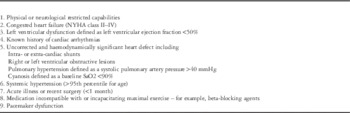
Patients with complete atrioventricular block and dual-chamber pacemakers, aged between 9 and 30 years were identified in the database of the departments of Cardiology and Paediatric Cardiology of our institution, irrespective of the cause of the atrioventricular block. The totality of patients was on a chronic DDD pacing modality before the study, to avoid any pre-study pacing difference that could interfere with performance on the exercise test. Selection was performed using the criteria listed in Table 1 to exclude those patients with conditions or medications prohibiting safe and effective exercise performance. The exclusion was carried out using the information recorded during the last clinical visit to the cardiologist.
Exclusion criteria.

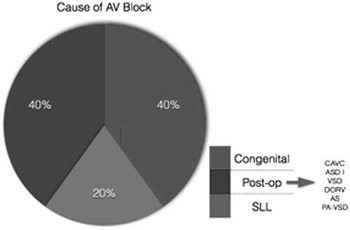
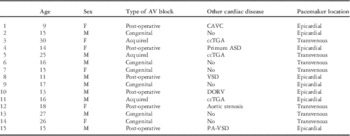
Initially 17 patients were identified, and 15 consented to participate in the study. Clinical details of the patients are listed in Table 2. Mean patient age was 17.8 years (range 9 to 30). Out of the 15 patients, six patients had post-surgical atrioventricular block for different structural heart defects, six patients had congenital atrioventricular block, and three patients had atrioventricular block secondary to congenitally corrected transposition of the great arteries (Fig 1). Among all, eight patients had an epicardial pacing system and seven patients had a transvenous system.
Cause of atrioventricular block. AS=aortic stenosis; AV=atrioventricular; ASDI=primum atrial septal defect; CAVC=complete atrioventricular canal; DORV=double-outlet right ventricle; PA-VSD=pulmonary atresia-ventricular septal defect; VSD=ventricular septal defect.

Patient population.

AV=atrioventricular; ASD=atrial septal defect; CAVC=complete atrioventricular canal; ccTGA=congenitally corrected transposition of great arteries; DORV=double-outlet right ventricle; F=female; M=male; PA-VSD=pulmonary atresia-ventricular septal defect; VSD=ventricular septal defect
Pacemaker interrogation and settings
An initial pacemaker interrogation was performed in a separate room to identify any possible dysfunction and set the device to DDD or VVIR modes, according to previous randomisation settings for the rate response programme. For the VVIR testing, a pacing rate of 80/minute was chosen. In a programmable “rate response” setting, the pacemaker identifies muscular activity by a piezo-ceramic sensor and activates an increase in the heart rate in the pulse generator. The activity threshold has three setting possibilities – low, medium, and high. A low threshold permits the device to respond to relative minor body movements, whereas a high threshold excludes recognition of low-amplitude vibrations and permits recognition of only more intense body activity.Reference Benditt, Mianulli and Fetter 5 The threshold was set to medium for all the patients. The programmable “rate response” also determines the relationship between detected body activity signals and the resulting pacing rate; the activity of daily living response determines the incremental increase or decrease in the sensor-driven rate for a given level of activity in the moderate range: the nominal setting is three and this setting was not changed for the exercise test. The exertion response determines the incremental increase or decrease in the sensor-driven rate for a given level of activity in the exertion rate range: the nominal setting is three and it was not changed for the test. The activity acceleration was set to 30 seconds. The authors acknowledge a possible difference in the rate response activation in patients with abdominal versus thoracic devices. As the main objective was to self-compare exercise performance in the two modes, this aspect did not seem to play a relevant role in the study results.
For the DDD setting, atrioventricular intervals and post-ventricular atrial refractory period were adjusted to allow 1:1 atrioventricular conduction up to sinus rates of 210 bpm and to avoid upper rate behaviour.
Exercise treadmill protocol
Exercise test studies were conducted in an environmentally controlled laboratory (temperature 20°C) with patients in a postprandial state (3–4 hours) on a treadmill (Mercury, Cosmos, Nussdorf-Traunstein, Germany). The effects of exercise on cardiopulmonary variables were measured using a computerised breath-by-breath technique (Master Screen CPX Metabolic Chart, Carefusion, San Diego, United States of America) and the software LabManager V5.22 (Philips Healthcare, Best, the Netherlands). Continuous 12-lead electrocardiogram recording was performed (Cardiosoft V6.51, Houston, Texas, United States of America).
At baseline, forced expiratory volume in 1 second and forced vital capacity were assessed using a standardised spirometric device. Age-, sex- and body size-adjusted reference values for the forced expiratory volume in 1 second and forced vital capacity were computed for each patient.Reference Zapletal, Samanek and Paul 6
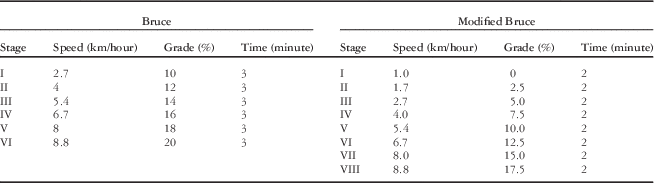
All the patients performed a maximal running test on a treadmill, adhering to a standardised modified Bruce protocol with progressive increase in the speed and inclination of the treadmill platform. The protocol consisted of 2-minute stages starting at grade 0%, with grade increments of 2.5% after completion of each stage (Table 3).
Test details for the Bruce and modified Bruce treadmill protocols.

Before each test, the gas analysing system was calibrated with fixed-volume pump and defined gas mixtures.
Before and during the test, subjects were strongly encouraged to do their best. The test was terminated whenever the maximal exertion was reached and disallowed the patient to pursue any furtherReference Binkhorst, Van’t Hof and Saris 7 and on the patient’s request even if the maximal exertion was not reached. There were no emergency situations warranting test termination. To ensure valid results, truly representative maximal effort in children had to meet a respiratory quotient >1.00, a levelling out of VO2, and a self-perceived exertion rating >8 on the Borg 10 scale.Reference Freedson and Goodman 8 Attainment of a maximal heart rate for age (formula used=220−age±10% beats/minute) was not used as the marker for maximal exercise as heart rate itself was a variable marker of the study.
Breath-by-breath gas analysis and 2-minute interval blood pressure measurements were performed before, throughout all the phases, and after finishing the test. Gas exchange parameters included continuous oxygen saturation, minute ventilation, oxygen uptake (VO2), carbon dioxide output (VCO2), respiratory exchange ratio, ventilatory equivalents for VO2 and VCO2, and end-tidal PO and PCO2 were calculated for these measurements. Peak values were defined as the highest mean value of any 30-second time interval during exercise.
The anaerobic threshold was determined non-invasively as the point at which the slope for the ventilator equivalent for VCO2 crossed and separated from the slope of the ventilator equivalent for VO2. The anaerobic threshold was expressed as a percentage of the predicted VO2 peak. Predicted values were ranged according to peak oxygen consumption in normal children as detailed by Freedson and Goodman.Reference Cumming, Everatt and Hastman 9
Continuous electrocardiogram recording was performed at a speed of 25 mm/second and a gain of 10 mV. Parameters including rhythm, QRS morphology and duration, and re-polarisation changes were closely monitored during the test. We could not identify any arrhythmias, changes in atrioventricular conduction, or pacemaker upper rate behaviour or dysfunction during the tests.
Results
All data are presented as mean±SD. The statistical significance of pacing mode-related changes in heart rate, blood pressure, exercise duration, and cardiopulmonary variables were determined using the non-parametric Wilcoxon signed-rank test for repeated measurement on a single variable. Statistical significance was set at p<0.05.
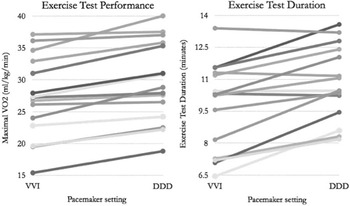
Compared with VVIR pacing, DDD pacing increased peak oxygen uptake in 14 patients as illustrated in Figure 2. Overall, mean VO2 peak increased by 8% from VVIR 27.28±6.40 ml O2/kg/minute to DDD 29.65±6.34 ml O2/kg/minute.
Comparison of exercise performance (measure in VO2 peak ml/minute) and exercise test duration (in minutes) in patients with VVI versus DDD pacing setting. VO2 peak increased in 14 patients with the DDD mode. Exercise test duration increased during the DDD mode in 12 patients.

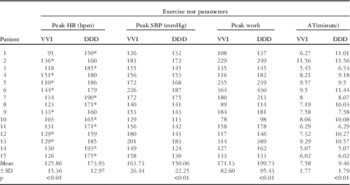
The anaerobic threshold was achieved in the totality of patients for both exercise test modes. The DDD test was associated with an increase of 10% in the anaerobic threshold timing from 7.58±1.77 minutes in the VVI mode to 9.46±1.79 minutes in the DDD mode (Table 4).
Exercise test parameters.

AT=anaerobic threshold; HR=heart rate; SBP=systolic blood pressure
* Indicates the pacing mode that was tested first for each patient
Systemic non-invasive arterial blood pressure measured at maximal exercise proved to be significantly higher during non-synchronous atrioventricular pacing, VVIR 163.73±26.44 mmHg compared with 150.06±22.25 mmHg.
The major predictable difference was in the increase in the heart rate achieved during each exercise stage, with a positive value of 24% in the DDD setting, VVIR 125.86±15.36 beats/minute and DDD 173.93±12.97 beats/minute. There was no significant difference perceived in the pattern of heart rate increase or peak heart rate achieved during VVIR pacing in the group with epicardial versus endocardial pacemakers, maximal heart rate of 124.75±19.14 beats/minute for the epicardial group and 127.71±10.96 beats/minute for the transvenous group.
The self-rate performance perception in each test, estimated by a numerical scale from 1 to 10, proved to be consistently higher (100% of patients) during the synchronous pacing mode, with a lower perceived exertion level for each stage.
Discussion
In this study, several exercise parameters where self-compared during VVIR and DDD pacing modes in a young population. The results of this study showed that a synchronous atrioventricular pacing contributes to reach higher heart rates at each exercise stage, extend exercise duration, achieve increased peak VO2, delay the onset of the anaerobic threshold to a higher level of oxygen consumption, and improve the overall feeling of better exercise performance.
The main contribution of dual-chamber systems, despite an epicardial or endocardial pacing position, seems to be based mostly on two independent parameters: (1) the addition of atrioventricular concordance with the related atrial contribution to the ventricular filling, and (2) preserving the intrinsic chronotropic response to the different metabolic demands of the organism. Probably, it is the latter that plays the major role in increasing exercise performance. Even with an optimal sensor-activated rate-response setting in the VVIR test, we noted a substantial difference in all the measured parameters when compared with a sequential pacing.
Our experience tends to favour upgrading patients’ systems to dual chamber before reaching the adolescent years, even if the centre policy is to prolong as long as possible the epicardial site in order to avoid long years of right ventricular pacing. It is difficult to give a unique response to the following question: “When should we electively upgrade asymptomatic patients living on a unicameral pacer to synchronous pacing mode?”. Our belief is that, in daily practice, this should be evaluated in each single case and discussed together with the patient to find the better response for the individual constellation.
Acknowledgements
We thank Bernardette Legros and Pascal Koepp for assistance with the exercise test.
Ethical Standards
The study was approved by the Ethical Commitee of the institution.
Conflicts of Interest
None.