Introduction
The World Health Organization identified coronavirus disease (COVID-19) as a “public health emergency of international concern” on January 30, 2020. First reported in Wuhan, China, this disease had spread to 113 countries outside of China. 1 On March 11, 2020, it was declared to be a pandemic. 2 The first cases of COVID-19 in Turkey were reported on March 11, 2020, and health services and public health authorities gave it urgent priority on their agenda as a situation that remains serious. 3 The SARS-CoV-2 virus that causes the COVID-19 pandemic has the typical features of the coronavirus family. 3 It has caused many more deaths and serious economic damage in all populations than other human coronavirus infections and pandemics such as Middle East respiratory syndrome coronavirus (MERS-CoV), severe acute respiratory syndrome (SARS), Spanish Flue, Smallpox, and Black Death. 4–Reference Patterson, McIntyre, Clough and Rushton7 While COVID-19 pandemic has lower mortality rate compared to other pandemics, it has affected larger population in the world than previous major pandemics. It is predicted that COVID-19 pandemic might reduce life expectancy, increase poverty, and reduce investments and global trade. Reference Patterson, McIntyre, Clough and Rushton7
While COVID-19 is a highly contagious disease, the individual’s immunity affects the course and severity of the disease. Reference Gökçay and Keskindemirci8 To prevent the spread of the coronavirus disease, new vaccines have been developed and the vaccination processes were started at international, national or local levels. Reference Dodd, Cvejic and Bonner9 Health authorities recommend the vaccine as an effective and cost-effective method to reduce or eliminate the possible damage caused by the target virus or bacteria by activating the body’s natural defense mechanism. 10 Recently, many life-threatening diseases have been prevented by vaccination. Moreover, today, many scientific authorities have identified COVID-19 disease as 1 of the vaccine-preventable diseases. Reference Patterson, McIntyre, Clough and Rushton7,10,11
Although vaccine hesitancy has been experienced among a limited number of people, Reference Toprak and Esen12–Reference Rozbroj, Lyons and Lucke15 the rate of routine immunization ranges between 97% and 99% thanks to longstanding large-scale vaccination programs in Turkey. Reference Bora Başara, Soytutan Çağlar and Aygün16 Vaccine hesitancy and willingness are associated with several conditions including history of vaccination, sociocultural dynamics, the healthcare system, socio-economic status, and health policy, as well as individuals’ perceptions of the effectiveness of inoculation. Reference MacDonald and SWGoV17,Reference Pugliese-Garcia, Heyerdahl and Mwamba18 Moreover, the perceived risk of a contagious disease is strongly related to the vaccine willingness as people may perceive it as a required precaution.
A population-based study found that risk perception of vaccine-preventable diseases affects more than 30% of the willingness to be vaccinated. Reference Baumgaertner, Ridenhour, Justwan, Carlisle and Miller19 Vaccination campaigns have tried to address vaccine hesitancy and refusal by taking into consideration the characteristics of the target population. It is predicted that individuals’ sociodemographic characteristics, previous vaccination experiences, level of information about the vaccine, accessibility of the vaccine, and other factors might shape the individuals’ decision regarding the COVID-19 vaccine. Reference García and Cerda20
To achieve herd immunity against COVID-19, at least 75% of the individuals in a country should be vaccinated. Reference Dodd, Cvejic and Bonner9,Reference Neumann-Böhme, Varghese and Sabat21 Otherwise, the aim of herd immunity may not be achievable. In this sense, recognizing key attitudes towards vaccines is critical to enhancing individuals’ willingness to get vaccinated. According to the results of COVID-19 vaccination programs in different countries, the willingness rate ranged between 60% and 86%. Reference Dodd, Cvejic and Bonner9,Reference Neumann-Böhme, Varghese and Sabat21–Reference Furman, Zgliczyński, Jankowski, Baran, Szumowski and Pinkas23 Moreover, the studies on acceptance of the COVID-19 vaccine illustrated that individuals tend to rely on physicians’ and scientists’ knowledge. Reference Furman, Zgliczyński, Jankowski, Baran, Szumowski and Pinkas23 For instance, male participants over 55 years old, Reference Neumann-Böhme, Varghese and Sabat21 were willing to get vaccinated. On the other hand, people who have a low level of health literacy and education have concerns that the symptoms of the coronavirus disease will be exacerbated if they get the vaccine. Reference Dodd, Cvejic and Bonner9 Similarly, concerns related to vaccine side effects, Reference Neumann-Böhme, Varghese and Sabat21 and belief in horoscopes, Reference Furman, Zgliczyński, Jankowski, Baran, Szumowski and Pinkas23 have been reported as important reasons for not getting the COVID-19 vaccination.
Although a sufficient proportion of the public must be vaccinated to reach herd immunity, it is still unclear whether the required coronavirus vaccination rate will be globally achieved. Reference Neumann-Böhme, Varghese and Sabat21 Considering previous pandemics that had low rates of vaccine acceptance [e.g., the novel influenza A (H1N1)], an understanding of factors affecting COVID-19 vaccine acceptance rates might contribute to achieving a sufficient vaccination rate. Low perceived risk of H1N1 was considered 1 of the main reasons for the low vaccine acceptance. Reference Blasi, Aliberti, Mantero and Centanni24 Studies showed that the public perceives the coronavirus disease to be a life-threatening disease. Reference Karlsson, Soveri and Lewandowsky25,Reference Dryhurst, Schneider and Kerr26 Therefore, the perceived risk of COVID-19 and other factors might be predictors of willingness to get the vaccine.
The aim of this study is to examine the factors associated with the decision of individuals aged 18 and older to get the coronavirus vaccine. The research questions are as follows:
-
1. What is the community acceptance rate of coronavirus vaccination?
-
2. Is there a relationship between sociodemographic characteristics and the rate of coronavirus vaccine acceptance?
-
3. Is there a relationship between previous vaccine experience and the rate of coronavirus vaccine acceptance?
-
4. Is there a relationship between the perceived risk of the coronavirus disease and the rate of coronavirus vaccine acceptance?
-
5. What is the strongest predictor of COVID-19 vaccination willingness?
Methods
Study design and population
This was a cross-sectional, anonymous online survey conducted in Turkey. Snowball sampling was used. The participants were recruited through conventional social media sites such as Facebook, Twitter, Instagram, and WhatsApp due to coronavirus restrictions. This online survey enabled physical distancing and prevented the risk of coronavirus infection. The online questionnaire form was shared with our connections and each of these participants subsequently shared the form with their own network. Participants aged 18 and older were recruited between December, 2020 and January, 2021. The data collection ended when no questionnaire form had been filled for 7 consecutive days. The eligibility criteria for participants were defined as individuals aged 18 and older and willing to participate in the study. Data was collected through an online form (Microsoft Office 365, Forms) that could be responded to using any electronic device having internet access (Mobile phone, personal computer, tablet, etc.).
Measurement tools
The questionnaire used in this study was designed by the research team based on the study aims and available related literature. Reference MacDonald and SWGoV17–Reference García and Cerda20 The questionnaire included 3 domains: (i) Demographics, (ii) Previous experience with vaccinations, and (iii) Perceived risk of coronavirus disease.
Demographics
This domain consisted of 7 questions related to age, gender, marital status, working status, educational status, parent status, and residential area.
Previous experience with vaccinations
This domain consisted of 6 questions concerning the vaccination experience of the individual and his / her child, and a Vaccine Hesitancy Scale.
The following questions were asked: (1) Have you had all your vaccines according to the vaccine schedule? (2) Has your child had all of the vaccines according to the vaccine schedule? (3) Have you had the seasonal flu vaccine? (4) Have you or your child experienced any vaccination side effects? (5) What sources about vaccines have you had access to? (6) Did you receive positive information about vaccines?
Vaccine Hesitancy Scale (VHS): VHS was developed by Larson et al. 27 to examine vaccine hesitancy and problems related to vaccination. The psychometric properties of the scale were tested by Shapiro et al. Reference Shapiro, Tatar and Dube28 with Cronbach’s alpha = 0.92 for lack of confidence, and 0.64 for risks. The Turkish version of the scale was tested by Yalniz Dilcen et al. Reference Yalnız Dilcen, Dolu and Turhan29 with Cronbach’s alpha = 0.90 for lack of confidence and 0.74 for risks. VHS consists of 9 items and 2 sub-scales: “lack of confidence” and “risks.” The sub-scale of “lack of confidence” includes the items numbered 1, 2, 3, 4, 6, and 7. The sub-scale of “risks” consisted of the items numbered 5, 8, and 9. The 5-point Likert type scale ranges between “strongly disagree (1)” and “strongly agree (5).” The items numbered 1, 2, 3, 4, 5, 6, and 7 were reverse coded. Total scores range from 9 to 45 for the whole scale. A higher score indicates higher vaccine hesitancy.
Perceived risk of coronavirus disease
This domain included 4 questions related to personal experience with coronavirus disease or with a person having COVID-19, the fear of COVID-19 Scale, and an index to define the perceived risk of coronavirus disease.
Although, perceived risk is not a concept that has the same meaning as anxiety, there is a strong relationship between perceived risk and the anxiety that occurs in uncertain and unpleasant situations. Reference Faour-Klingbeil, Osaili, Al-Nabulsi, Jemni and Todd30–Reference Bovbjerg, Keefe and Soo32 Likewise, fear is another factor of a strong relationship with anxiety. Reference Park, Lee and Lee33 In this study, the perceived risk of coronavirus disease was examined via both an index to define perceived risk of coronavirus disease and the fear of COVID-19 Scale.
The index used to define the perceived risk of COVID-19 consists of 6 items covering individuals’ perceived seriousness of the coronavirus pandemic, the possibility of getting infected and contact with an infected person, perceived life-threatening status of the virus and presence of anxiety. Reference Dryhurst, Schneider and Kerr26 The first 3 items of the index are on a 7-point Likert scale that is coded from 1 (not at all likely) to 7 (very likely). The remaining three items are on a 5-point Likert scale that is coded between 1 (strongly disagree) to 5 (strongly agree). The last item is coded reversely.
The Fear of COVID-19 Scale (FCV-19S): FCV-19S is a reliable and valid measurement tool used to evaluate fear of COVID-19 among the general population. This scale was developed by Ahorsu et al., Reference Ahorsu, Lin, Imani, Saffari, Griffiths and Pakpour34 and validated with a Cronbach’s alpha score of 0.82 by Bakioğlu et al. Reference Bakioğlu, Korkmaz and Ercan35 in the Turkish context. This 5-point Likert type scale consists of 7 items in total and scored between “strongly disagree (1)” and “strongly agree (5)”. Total scores range from 7 to 35 for the whole scale and a higher score indicates a higher fear of COVID-19.
Furthermore, participants were asked if they would like to be vaccinated against the coronavirus. In addition, participants were asked to give their preferences regarding which groups should be vaccinated first against COVID-19 and the reasons for their unwillingness to get COVID-19 vaccine.
Data collection
The data were collected anonymously. The data collection process was ended after a week of no participation, and then the data were downloaded in Excel format. In total, 1870 individuals took part in the study. 16 participants’ data were excluded because they were under 18 years old, and 1 participant responded to the questionnaire twice. As a result, the study was completed with 1853 participants aged 18 and older.
Data analysis
Descriptive statistics were calculated by number, percentages, means, and standard deviations (SD) using Statistical Package for the Social Sciences (SPSS) version 25.0 IBM Coop, Armonk, NY) and Microsoft Excel. Pearson’s chi-squared tests, t-test, and zero-order correlation were used to present crude factors associated with acceptance of COVID-19, which was coded dichotomously (1 = Yes, 0 = No). Getting seasonal flu was recorded combining the answers “Yes”, “No”, and “Yes, but not every year.” Getting the required vaccination was dichotomized into 2 categories (1 = Yes, 0 = No) combining the responses “No” and “Some/ not knowing.” Experiencing side effects was recoded (1 = Yes, 0 = No) combining the answers “No” and “Not remembering.” Hierarchical logistic regression analyses were performed to identify factors associated with acceptance of the COVID-19 vaccine. Beta (B), standard error (SE), explanation beta coefficients (Exp (B)), Cox and Snell R2, and Negelkerke R2 were presented. Statistical significance was evaluated by 2-tailed and P < 0.05. There was no missing data in the data set because it was mandatory to respond to all the questions in the online questionnaire.
Ethics statement
This study was approved by the research ethic committee (decree code: 2020-SBB-0270) by the University where the authors worked. Informed consents were obtained from participants at the beginning of the survey. The online questionnaire began with brief information about the study objective (highlighting the anonymity and confidentiality of the collected data), the research team and informed consent.
Results
Demographics
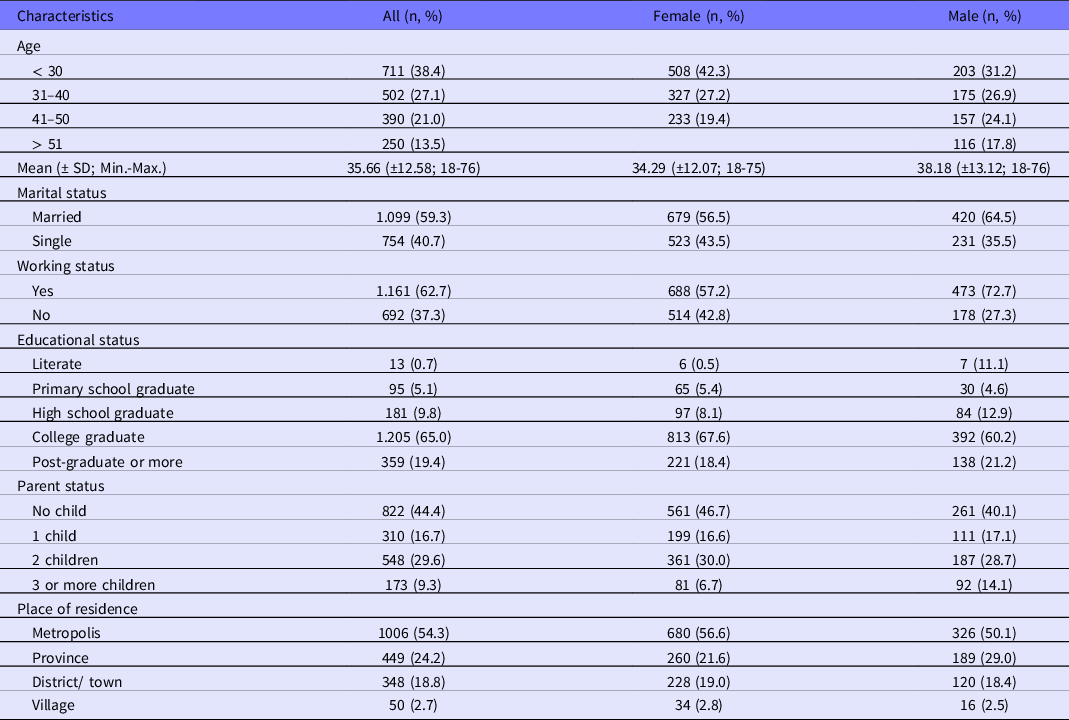
In total, 1.853 participants’ data were analyzed in this study. The mean age of the responders was 36 (34 for women, 38 for men). Almost 65% of the participants were female and nearly 60% of them were married. Nearly 63% of the responders were employees and the majority of the population had college or higher degrees (84.4%). Over 40% of the responders did not have any children and over 54.3% of them lived in a metropolis (Table 1).
Demographic characteristics of study participants (n = 1.853)

Acceptance of COVID-19 vaccine
Although it is not presented in a table, over 60% of our study population reported that they were not at risk in terms of catching the coronavirus disease. Around 20% of the participants defined their risk factor as being a health worker and 14% of them identified their chronic disease as a risk factor for catching the coronavirus disease (Table S1). Roughly 70% of our study population preferred to acquire information about the COVID-19 vaccine from health workers and almost 50% of them reported their sources as the Internet and social media (Figure S1, Table S2).
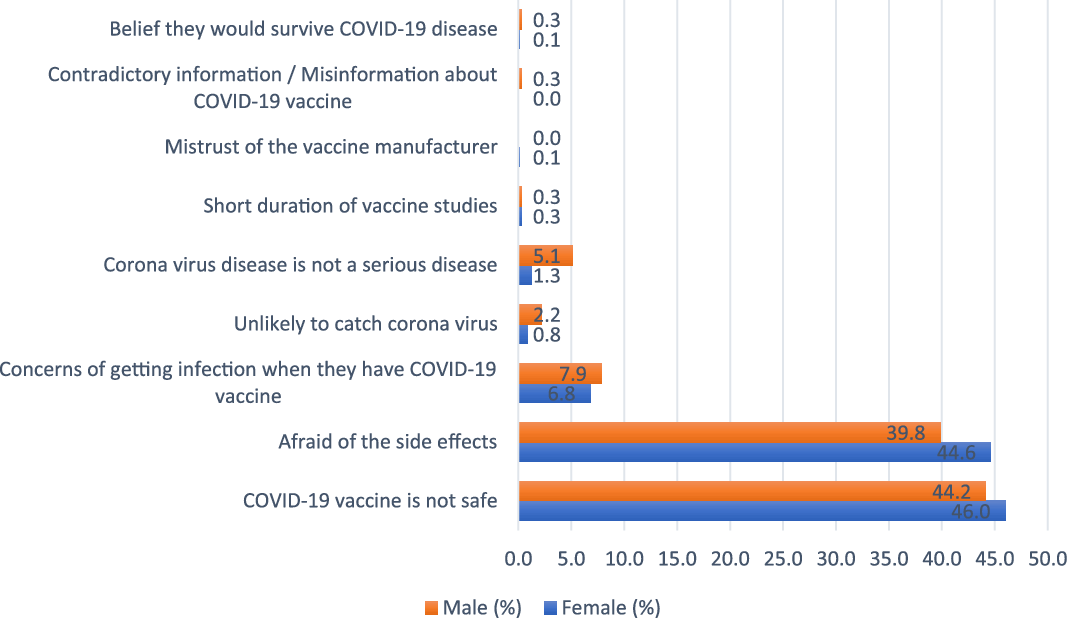
According to the results of the chi-square test, significant differences occurred between willingness to receive COVID-19 vaccine and certain demographics (P < 0.05) especially age, gender, marital status, working status, and educational status (Table S3). Although not presented in a table, the rate of acceptance of COVID-19 vaccine was 50% in this study population. Reasons for individuals’ refusal to get the COVID-19 vaccine are shown in Figure 1 and Table S4. The most reported reason for refusal to get the COVID-19 vaccine was that COVID-19 vaccine is not safe (65.1%). Women predominantly reported that the COVID-19 vaccine was unsafe (46.0%) and had side effects (44.6%). Participants’ choice regarding which groups should get priority for vaccination were high-risk healthcare professionals (64.1%), workers in high-risk-settings (61.7%), individuals having chronic diseases (59.2%) and older people living in nursing homes (39.1%). Women and men had similar opinions about which groups should get priority for vaccination (Table S5, Figure S2).
Reasons for vaccine refusal.

Individuals (68.7%) who had gotten required vaccinations and those who had their children get required vaccinations (96.1%) were more likely to get COVID-19 vaccine. On the other hand, the rate of rejection of COVID-19 vaccination was higher among people getting seasonal flu shot (90.4%). People who had previously had side effects related to vaccination (12.1%) were more unlikely to get COVID-19 vaccine compared to those who did not have any side effects (6.4%) (Table S6). Individuals who had a low level of vaccine hesitancy (t = 41.245; P < 0.001) and a high level of the fear of COVID-19 (t = 0.067; P = 0.005) were more likely to get the COVID-19 vaccine. There were no significant differences between those having experienced the coronavirus disease and those having contact with a person having coronavirus disease (Table S6). The mean score of vaccine hesitancy was 19.32 (SD = ± 5.83), the mean score of the fear of COVID-19 was 20.47 (SD = ± 5.18) (Table S7). According to the results of the chi-square test, significant differences occurred between vaccine hesitancy and demographics (P < 0.05) including age, gender, marital status, working status, educational status, and parent status (Table S8). Participants mainly stated that they were concerned about serious adverse effects of vaccines (Mean = 3.47; Standard deviation = ± 0.96) and thought that new vaccines carry more risks than older vaccines (Mean = 3.08; Standard deviation = ± 0.92) (Table S9). The fear of COVID-19 differed significantly according to gender and place of residence (P < 0.05) (Table S8). Participants pointed out that they (Mean = 4.76; Standard deviation = ± 1.56) and their friends or family (Mean = 5.12; Standard deviation = ± 1.42) have a high probability to be infected coronavirus disease within the next 6 months. Moreover, they stated that they were most afraid of getting coronavirus disease (Mean = 3.20; Standard deviation = ± 1.12) and feeling uncomfortable due to the coronavirus (Mean = 3.38; Standard deviation = ± 1.16) (Table S10).
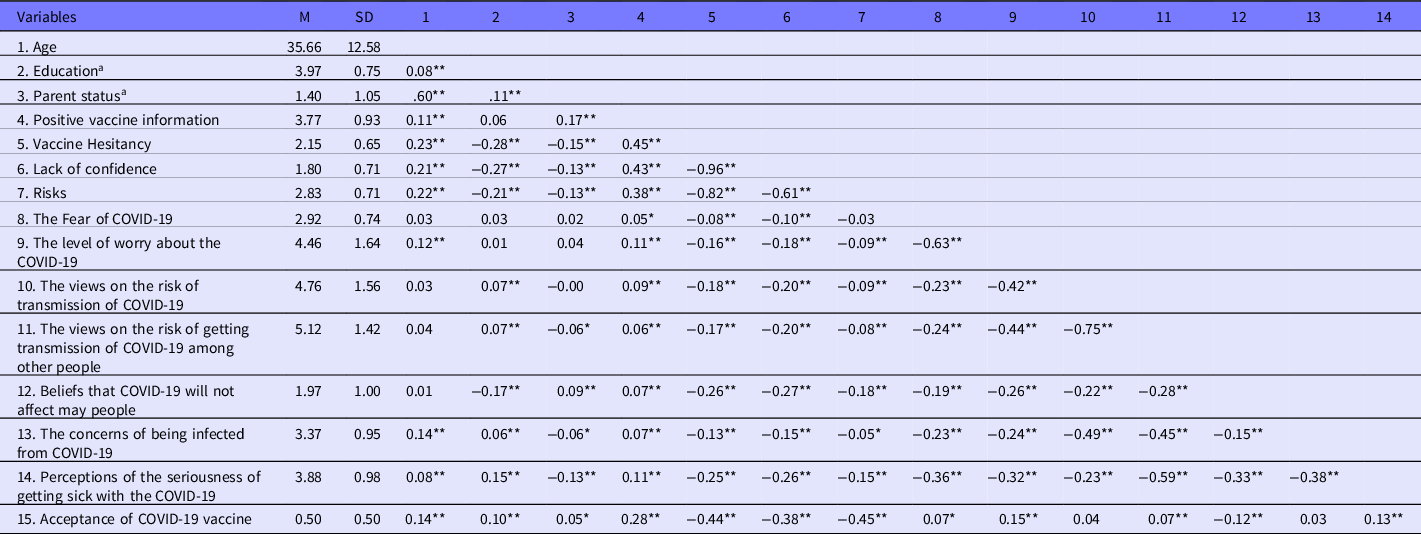
0-order correlation was performed to examine the relationship between acceptance of COVID-19 vaccination and other related variables (Table 2). It is obvious that acceptance of COVID-19 vaccination was moderately associated with vaccine hesitancy (r = -0.44, P < 0.001), lack of confidence (r = -0.38, P < 0.001), and risks (r -0.45, P < 0.001). Additionally, acceptance of COVID-19 vaccine was weakly correlated with other variables: the level of worry about the COVID-19 (r = 0.04, P > 0.05) and level of perceptions of the possibility of infecting the COVID-19 (r = 0.03, P > 0.05).
0-order correlation examining the relationship between acceptance of COVID-19 vaccination and other related variables

a = Spearman’s rho; **Pearson Correlation is significant at the 0.01 level (2-tailed); Strong correlation between ± 0.50 and ± 1; Medium correlation between ± 0.30 and ± 0.49; Small correlation below + 0.29.
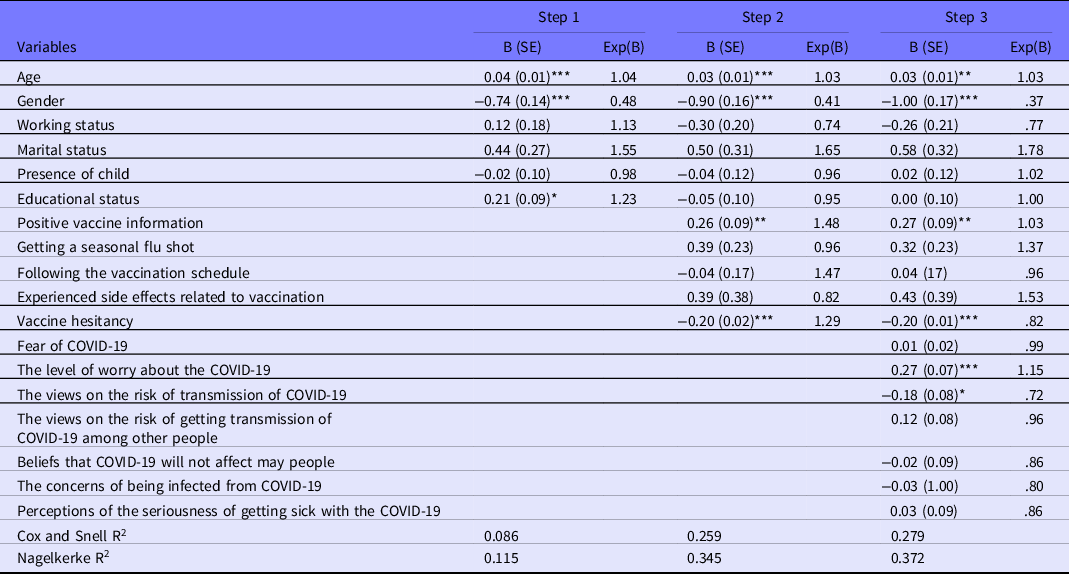
The results of the hierarchical logistic regression analyses are illustrated in Table 3. The outcome variable in the hierarchical logistic regression was the acceptance of COVID-19 vaccination. The predictors were included in 3 sequential steps. Demographic variables (age, gender, working status, marital status, existence of child and educational status) were entered in the first step. Variables regarding previous experience of vaccination including positive vaccine information, getting seasonal flu shot, getting required vaccinations and vaccine hesitancy were added in the second step. Finally, the fear of COVID-19 and perceived risk were entered in the third step of the model. Age, gender, and educational status were found to be strong predictors of acceptance of COVID-19 vaccine. Individuals who were older (B = 0.04, SE = 0.01, exp[B] = 1.04, P < 0.001), men (B = -0.74, SE = 0.14, exp[B] = 0.48, P < 0.001) and those who had a higher educational status (B = 0.21, SE = 0.09, exp[B] = 1.23, P = 0.022) were more likely to get COVID-19 vaccination. The first step of predictors explained 12% of the variance in the acceptance of COVID-19 vaccination outcome.
Hierarchical logistic regression analyses predicting acceptance of COVID-19 vaccination

*P < 0.05; **P < 0.01; ***P < 0.001. Step 1: Demographics factors; Step 2: Demographics factors + Previous experience with vaccinations; Step 3: Demographics factors + Previous experience with vaccinations + Perceived risk of coronavirus disease.
Among the variables regarding previous experience of vaccination, positive vaccine information and vaccine hesitancy were significant predictors of acceptance of COVID-19 vaccination. People who previously had positive vaccine information (B = 0.26, SE = 0.09, exp[B] = 1.48, P = 0.004) and a low level of vaccine hesitancy (B = -0.20, SE = 0.02, exp[B] = 1.29, P < 0.001) tended to get COVID-19 vaccinations. The first 2 steps of predictors explained 35% of the variance in the acceptance of COVID-19 vaccination outcome.
Some predictors in the third step, consisting of the level of worry about the COVID-19 and the level of perception of the possibility of being infected with COVID-19, significantly predicted acceptance of COVID-19 vaccination. Individuals who had a high level of concern about COVID-19 (B = 0.27, SE = 0.07, exp[B] = 1.15, P < 0.001) and who thought they had a low possibility of contracting COVID-19 (B = -0.18, SE = 0.08, exp[B] = 0.72, P = 0.026) were more likely to get COVID-19 vaccination. The whole model explained 37% of the variance in the acceptance of COVID-19 vaccination outcome. Although there was no exact result, vaccine hesitancy might be the main predictor of COVID-19 vaccination as 0-order correlations and regression coefficients were considered together.
Discussion
This research examined the multiple factors associated with the decision to get the SARS-CoV-2 vaccine among individuals aged 18 years and older in Turkey. To the best of our current knowledge, this is the first study that evaluated the association between vaccine acceptance and multiple factors (e.g. demographics, previous experience of vaccination, vaccine hesitancy, experience, fear, and perceived risk of COVID-19). The rate of acceptance of COVID-19 vaccination was 50% in this study population. Factors examined in the present study explained 37% of the variance in the acceptance of COVID-19 vaccination. This study showed that increasing age, being male, acquiring positive information about COVID-19 vaccine, having a lower level of vaccine hesitancy or a high level of worry about the COVID-19 and a low level of perceptions of the possibility of infecting the COVID-19 were the main predictors/conditions of COVID-19 vaccine acceptance.
The rate of COVID-19 vaccine acceptance in our study was slightly lower than the percentages reported in previous studies conducted in Turkey, Reference Salali and Uysal36,Reference Feleszko, Lewulis, Czarnecki and Waszkiewicz37 presumably because individuals’ concerns about transmission probability or secondary attack rate might have been increased. The acceptance rate varies between countries. For instance, a study conducted by Lazarus et al. 38 with 13.426 people in 19 countries showed that differences in the proportion of acceptance vary between 55% and 90%. Another study aiming to draw a global overview by examining the data of 21 countries noted that differences in acceptance rate between countries range from 41% to 89%. Reference Feleszko, Lewulis, Czarnecki and Waszkiewicz37 The upmost acceptance rate was recorded in China with 90%. Reference Lazarus, Ratzan and Palayew38,Reference Wang, Jing and Lai39 The acceptance rate calculated in this present study is closer to the results of those in Russia and the United States, 55%, Reference Lazarus, Ratzan and Palayew38 and 58%, Reference Fisher, Bloomstone, Walder, Crawford, Fouayzi and Mazor40 respectively.
This study pointed out that vaccine hesitancy was among the main predictors of COVID-19 vaccination and had moderate correlation with acceptance of COVID-19 vaccine. Vaccine hesitancy was moderate among our study population and women were more hesitant. However, previous studies showed that vaccine hesitancy in the context of COVID-19 was more prevalent in the Turkish population with a range between 31%, Reference Salali and Uysal36 and 44%, Reference Feleszko, Lewulis, Czarnecki and Waszkiewicz37 compared to other countries such as the UK and China. Additionally, Özceylan et al.’s study found a high hesitancy rate related to vaccine immunization schedules in women participants. Reference Toprak and Esen12 Although our result showed vaccine hesitancy related to vaccine immunization schedules, increased vaccine hesitancy was significantly associated with increased rejection of COVID-19 vaccination.
This present study demonstrated that individuals who are concerned about COVID-19 and do not think they will be affected by COVID-19 in the next 6 months were more likely to get the coronavirus vaccine. The fear of COVID-19 had a weak correlation with COVID-19 vaccine acceptance, but this study showed no association in the logistic regression analysis. Perceived risk was defined as 1 of the predictors of COVID-19 vaccine acceptance in the literature. Consistent with the results of this study, a higher perceived risk of COVID-19 was associated with higher vaccine acceptance. Reference Salali and Uysal36,Reference Harapan, Wagner and Yufika41 Furthermore, people who had previously been vaccinated for seasonal flu tended to get COVID-19 vaccine according to some studies, Reference Wang, Jing and Lai39,Reference Fisher, Bloomstone, Walder, Crawford, Fouayzi and Mazor40 contrary to this study’s result. Those people who were previously vaccinated against seasonal flu may have positive information that the seasonal flu vaccine also protects them against coronavirus disease. Reference Fink, Orlova-Fink and Schindler42 It is already known that positive information about vaccines positively affects the decision of vaccination. Reference Salali and Uysal36 Positive information about vaccines was 1 of the main predictors of vaccine acceptance in the present study.
This study found that some demographic factors strongly affect COVID-19 vaccine acceptance. Age, gender and educational status were among the main predictors of acceptance of COVID-19 vaccination. As age increases, the rate of acceptance rose according to our study results, similar to some previous studies. Reference Neumann-Böhme, Varghese and Sabat21,22,Reference Lazarus, Ratzan and Palayew38 Literature regarding COVID-19 vaccination stated that men and better educated people had a higher vaccine acceptance rate. Reference Neumann-Böhme, Varghese and Sabat21,Reference Salali and Uysal36,Reference Lazarus, Ratzan and Palayew38–Reference Fisher, Bloomstone, Walder, Crawford, Fouayzi and Mazor40,43 It is already known that women have a dubious attitude towards vaccines in general. Reference Smith and Graham44 Furthermore, no association between COVID-19 vaccine acceptance and living in a rural area was detected in this study, contradictory to earlier studies. Reference Fisher, Bloomstone, Walder, Crawford, Fouayzi and Mazor40 However, the reason for this result could be that the percentage of our study population living in rural areas was 2.7%. With regard to marital status, the present study identified that married women were more likely to get the COVID-19 vaccine similar to Wang et al.’s study. Reference Wang, Jing and Lai39
The present study also examined the individuals’ views about the reasons for the rejection of the COVID-19 vaccine and their preferences regarding the priority groups to be vaccinated against COVID-19. The most reported reasons for rejection of COVID-19 vaccine were related to the potential side effects and lack of safety. Reference Neumann-Böhme, Varghese and Sabat21 The most preferred groups reported by this study population were high-risk health workers, people working in settings with a high-risk of contacting COVID-19, individuals having chronic diseases, and older people living in nursing homes. These results were consistent with the recommended allocation of the COVID-19 vaccine. 45
There are several limitations of this study. First, participants of this study were not randomized, which might have caused bias. To make provision for this bias, the online form link was shared via social media sites to increase the likelihood that participation would represent the general population. Additionally, snowballing increased the possibility of selecting participants who had similar characteristics and tendencies. However, the large sample of the study may have reduced this probability. Second, requiring Internet access to respond to the online survey decreases the participation of people who do not have any devices. This might be 1 of the reasons why people with less education and those living in a rural area were limited. The major limitation of this study was that 84% of the study population had college degrees and using social media limits the representativeness of our study and the generalizability of the findings compared to the general Turkish population. Lastly, vaccine hesitancy was assessed in terms of vaccines in the immunization schedule. However, conducting this study during the pandemic and rolling the first COVID-19 vaccines out in some countries might have affected the participants’ vaccine hesitancy level. Despite the above limitations, this study provides invaluable information on key factors of COVID-19 vaccine acceptance in Turkey. More importantly, our findings can inform the development of strategies that will enhance vaccine acceptance to reduce and end the consequences of the COVID-19 pandemic.
Conclusion
The present study examined the key factors associated with the decision to get the coronavirus vaccine among individuals aged 18 years and older. The main factors examined in this study were vaccination-related demographics, previous vaccine experiences, and perceived risk of COVID-19. As a result, it was found that increasing age, being male, acquiring positive information about the COVID-19 vaccine, having a low level of vaccine hesitancy, having a high level of worry about the COVID-19, or perceiving a low possibility of being infected by COVID-19 were the main predictors of COVID-19 vaccine acceptance. The factors examined in the present study explained 37% of the variance in the acceptance of the COVID-19 vaccination. The ratio of acceptance of COVID-19 vaccination was 50% in this study population. This study’s findings highlighted the factors most affecting individuals’ decision to get vaccinated against COVID-19. Those factors comprised of vaccine-related demographics, previous vaccine experience, and perceived risk of COVID-19. It is suggested that decision-makers and practitioners should plan to take these factors into consideration in order to achieve the required rate for herd immunity.
Supplementary material
To view supplementary material for this article, please visit https://doi.org/10.1017/dmp.2021.370
Acknowledgements
The authors would like to thank the participants in the study.
Conflict of interest
The authors declare no conflict of interest.
Funding statement
These authors did not receive any financial support for research, authorship, and/or publication of this article.