The transfer of a structural feature such as a phonological rule from a source dialect to a receiving dialect is generally regarded to be more difficult than the transfer of lexical items (Chambers, Reference Chambers1992; Thomason & Kaufman, Reference Thomason and Kaufman1988). The current study deals with a case of phonological transfer resulting from dialect contact between Philadelphia African American English and Philadelphia white English, with white Philadelphians adopting a phonological feature of African American English (AAE). The adoption of AAE features into white speech ranges from lexical items (Matthias & Blake, Reference Matthias and Blake2015) to inaccurate adoption of phonological features by speakers with few or no ties to the black community (Bucholtz, Reference Bucholtz1999; Cutler Reference Cutler1997, Reference Cutler1999) to accurate structural transfer by speakers with strong social ties to the black community (Fix, Reference Fix2010). The appropriation of AAE features is often correlated with white speakers’ positive affiliation towards AAE and the cultural capital that is associated particularly with urban black masculinity (Bucholtz, Reference Bucholtz1999).
Linguistic alignment across socially distinct, or even hostile, groups has been investigated in previous work (Milroy & Milroy, Reference Milroy and Milroy1985), and the idea of linguistic transfer across specifically hostile boundaries has been hypothesized as early as Giles (Reference Giles1973). The current study adds to this literature by providing a case study of direct structural linguistic transfer by a group of speakers who exhibit hostile attitudes toward speakers of the source dialect. I argue that the adoption of the AAE phonological rule of (TH)-fronting by white speakers with overtly hostile attitudes toward speakers of AAE has occurred because the feature itself is underspecified for demographic membership and has instead become a more salient index of street or masculine identity. I follow the indexicality framework of Silverstein (Reference Silverstein2003) and Eckert (Reference Eckert2008), arguing that (TH)-fronting as a marker of masculinity for the white speakers has eclipsed the first-order social meaning of group membership in an AAE speaking community. Below, I argue that (TH)-fronting has most likely been borrowed as a second-order index of street identity via regular violent contact with African American neighbors. The comparison of (TH)-fronting in Philadelphia AAE to the (TH)-fronting found in the white speakers reveals that although (TH)-fronting has been adopted from the African American community, it has also been restricted and simplified in the speech of white speakers. Next, I discuss the social meaning of (TH)-fronting, arguing that its association with AAE has been eclipsed by the second-order index of street orientation for the white speakers. Finally, I consider the implications of this study for the diffusion of linguistic processes across unexpected and hostile lines.
BACKGROUND
Social Background
Grays Ferry is the nonanonymized name of a neighborhood in Philadelphia that has had several decades of publicly documented racial tensions between the white Irish-Italian and the African-American residents of the neighborhood, both in newspapers and online blogs. Throughout this article, I refer to publicly reported events and locations by their real names, but to individuals and privately collected events and locations by pseudonyms.
Since the 1969 Daily News publication of a photograph of the Philadelphia police commissioner Frank Rizzo leaving a black-tie event with a nightstick tucked in his cummerbund on his way to break up a racial fight in Grays Ferry, the neighborhood has been in the public eye as a hotbed for racial tensions. One of the major sources of racial tensions for the white residents in Grays Ferry is the Section 8 Housing Voucher program, which provides rental assistance to low-income families. When the program began in the late 1970s, a large number of Section 8 recipients moved into the area, with some sources claiming Grays Ferry contained up to ten times more Section 8 recipients than the neighborhood could handle (Newall, Reference Newall2005). White flight followed the introduction of Section 8 housing into Grays Ferry, with many of the more affluent Irish and Italian residents moving to other neighborhoods. This was followed by decreasing property values and increased drug use and cross-racial violence. Because many of the Section 8 recipients were black, many of the current white residents of Grays Ferry perceive the history of Section 8 housing to be a racial problem, as articulated by Jerry in (1).
(1) Yeah, ever since they come up with Section 8
then they start movin’ in these riffraff families.
But it used to all be predominately Irish around here.
And then the projects were over [a few blocks]
[…]
And it's just. It just you know when from bein’ real bad racial to drug infested.
And everybody gettin’ up
and so many kids, young kids, around here dyin’.
The ideology of Section 8 housing resulting in black residents ‘ruining the neighborhood’ is a dominant belief propagated within the white community studied here. While black and white residents both live in Grays Ferry, the individual street blocks contain primarily white or black residents, resulting in a checkerboard pattern of racial segregation. Individual members of the white community studied here hold varying attitudes toward racial integration, with some participants exhibiting overtly negative attitudes, as articulated by Tiny:
(2) You know and now like people bring them around,
they become friends.
Now all of a sudden they're messing with your sister.
What are you gonna do?
You're the one who brought him around.
“I thought he was a good guy”
You know?
Now you're an uncle to a – to a black kid or something.
Other members of the white community align more closely with the position of Barbara, who is the mother of a mixed-race child and voices her opposition to whites who are hostile towards racial integration:
(3) J-------- G-------, who, he deserved to get his ass kicked.
You know he made a remark to a black man who was associating himself with a white woman.
And yea, that guy beat him up and he deserved it.
While individual community members hold varying attitudes toward their black neighbors, the neighborhood as a whole has been the locus of racial tensions and violence since the late 1960s. Racial tensions in Grays Ferry became national news in 1997 through a few successive incidents. The first occurred at the ‘Beef ‘n’ Beer,’ a local fundraising event for the white Catholic parish. During the night, one of the white patrons of the fundraiser got into an altercation with two black teens outside the hosting bar. When he returned to the bar and reported being jumped by two black men, a group of white men left the bar to retaliate, resulting in the men following the teens back to their home and kicking down the door. This resulted in a high-profile legal case between Annette Williams, the mother of one of the teens, and the white men who kicked down the door (Latty, 1997). A few months later, a white teen was shot and killed by a black man during a robbery (Altman, Reference Altman1997). During the same time, and in response to the Beef ‘n’ Beer incident, the Nation of Islam organized a march through the streets of Grays Ferry, during which the white residents lined the streets, turning their backs to marchers. This series of events from 1997 remains a salient topic for white residents of the neighborhood today and underscores a history of racial tension that still simmers for many of the white residents who participated in this study.
Linguistic Background
In the midst of these racial tensions, the linguistic phenomenon under consideration is the adoption of a phonological feature of Philadelphia AAE by some of the white residents of Grays Ferry. (TH)-fronting is the substitution of the labiodental fricatives [f] or [v] for the interdental fricatives [θ] or [ð], as in the pronunciation [bof] for the word BOTH and [mʌvə] for the word MOTHER. This substitution in AAE retains the underlying voicing of the segment, and I will use the term (TH)-fronting to refer to both the voiced and voiceless variant.
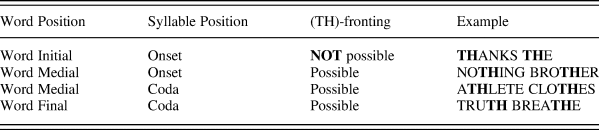
(TH)-fronting in varieties of AAE has been described as operating word-medially or word-finally (Green, Reference Green2002: 119; Labov, Cohen, Robins, & Lewis, Reference Labov, Cohen, Robins and Lewis1968; Thomas, Reference Thomas2007) or ‘at the ends of words or syllables’ (Labov, Alim, Bailey, Baugh, Charity, Green, Rickford, Weldon, & Wolfram, Reference Labov, Alim, Samy, Guy, John, Annem, Green, Rickford, Weldon and Wolfram2008). Wolfram (Reference Wolfram and Shuy1969: 83) argued that (TH)-fronting does not occur in morpheme-initial positions, making a fronted (TH) illicit in words like thought and everything but licit in words like both and nothing. I note, however, that this empirical pattern can be alternatively explained by appealing to syllable stress: thing contains secondary stress in everything but is unstressed in nothing. Sneller (Reference Sneller2015), using production and acceptability judgment data, determined that syllable stress played a role in the licensing of (TH)-fronting for Philadelphia AAE, highlighted in the striking result that participants accepted fronting in synthesize, where the /θ/ is in the onset position of an unstressed syllable but did not accept fronting in its sister word synthetic, where it is in the onset of a stressed syllable. Table 1 presents a paradigm of where (TH)-fronting is licit in Philadelphia AAE.
Word and syllable position constraints on (TH)-fronting in AAE

(TH)-FRONTING IN WHITE SPEAKERS
Fieldwork in Grays Ferry
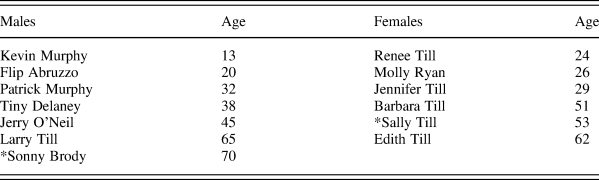
The data for this paper were collected over the course of a year in the pseudonymously named Donegal Street during 2012 and 2013 as part of the Study of the Speech Community project at the University of Pennsylvania. Sociolinguistic interviews (Labov, Reference Labov, Baugh and Sherzer1984) were conducted by four members of the research group, who identify and present as white. All but two interviews (indicated with an asterisk in Table 2) were conducted by myself and another member of the research group, two white women in their twenties who are not native to Philadelphia.Footnote 1 Six participants were recruited by members of the research team making initial contact on Donegal Street, seven were recruited as friends of those initial contacts. The speakers and their ages are listed in Table 2.
List of participants, grouped by gender and age

Note: The Tills are members of the same extended family.
These participants all lived within a three-block stretch of Donegal Street. This neighborhood is almost entirely comprised of Irish-American, Italian-American, and Polish-American residents, though residents most typically refer to themselves as ‘Irish-Italian.’ All participants identify as white, except Renee, who identifies as black-white biracial. Because many of the residents of Donegal Street belonged to the same extended family, interviewing the friends and family of our initial contacts resulted in quite a few interviews from the Tills.
Donegal Street, like many neighborhoods in South Philadelphia, has a culture centered about the sidewalk stoops. Most of the rowhomes have an open porch, and residents can often be found sitting outside on their porch and talking with neighbors walking by. The primary locus of fieldwork for this study was Barbara Till's front porch: members of the research group sat on her stoop and chatted with passersby for several hours in the afternoon one to two days a week during the year of fieldwork. On occasion, participants (Patrick, Tiny) would invite us into their houses to talk, but the majority of recorded interviews took place inside Barbara Till's house or on her porch. The research group also frequented the neighborhood hoagieFootnote 2 shop, owned and operated by Sonny, as well as the neighborhood bar to speak with patrons of both establishments throughout the year.
Most of the interactions with residents of Donegal Street did not result in a recorded interview, either due to the brief interaction or to residents not wanting to be recorded. The field notes of interactions with these community members as well as the contents of the recorded interviews factor into the analysis of the social landscape of Donegal Street. The data reported here include every speaker who agreed to be recorded for the study.
(TH)-Fronting as an Index of Hegemonic Masculinity
(TH) tokens were coded auditorily for word position (initial, medial, or final), syllable position (coda or non-coda), word in which it occurred, and for (TH) realization (interdental fricative, stopped, fronted, deleted, affricated). I focus here only on the rates of fronting, grouping realization into ‘fronted’ and ‘other.’ This binary coding reflects the fact that ‘fronted’ is a feature reported so far only in AAE Philadelphian speech. In other words, here I report on the variant of (TH) borrowed from AAE.
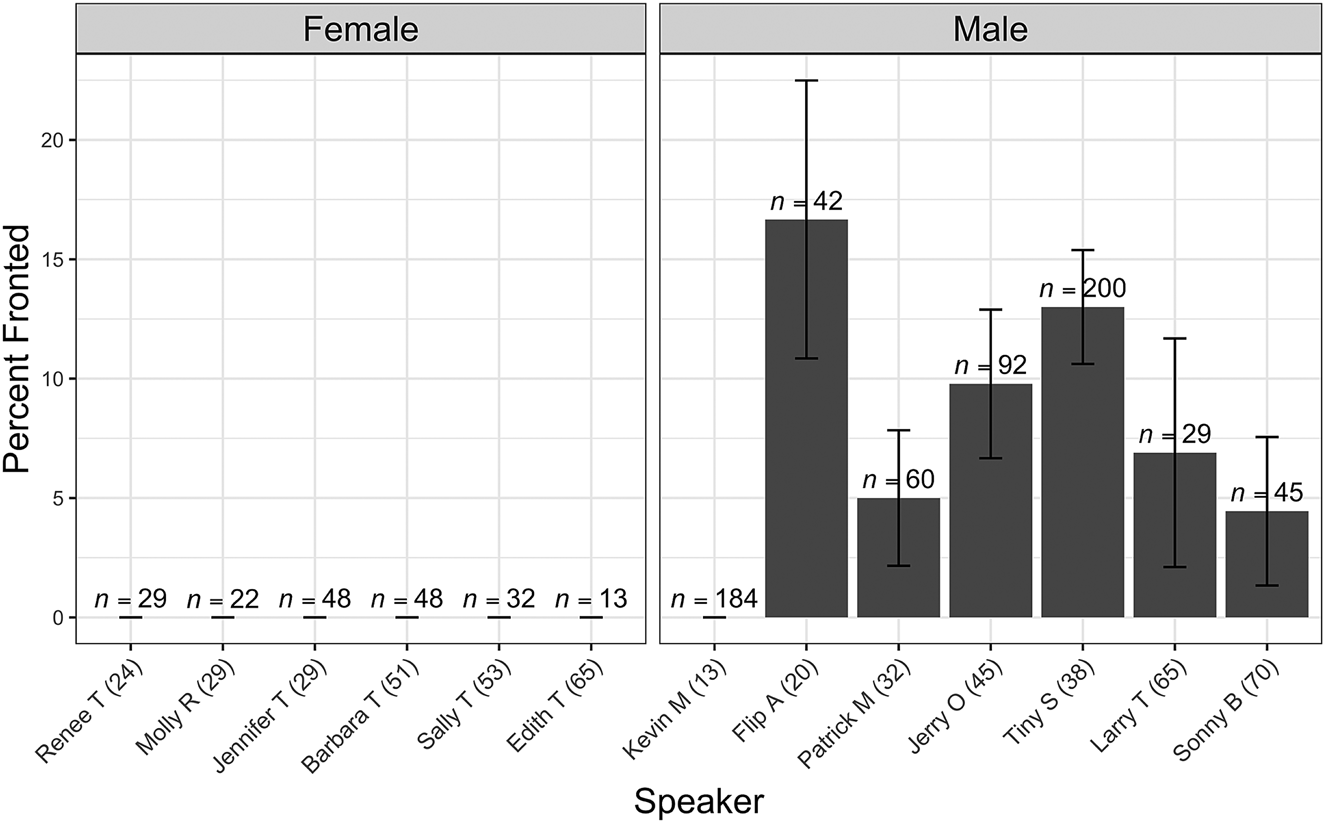
Figure 1 shows the results of (TH)-fronting in the voiceless /θ/ phoneme, broken down by participant gender. A clear gender pattern immediately emerges, with no women producing any fronted tokens of (TH) (lack of fronting is significant overall, Fisher's exact test p < 0.001, and for each of the two women with the highest token counts, p = 0.02). The result is a clear indication that (TH)-fronting is particularly favored by the male participants.
(TH)-fronting for /θ/ tokens for male and female participants. Bars indicate standard error.

There is additional evidence that (TH)-fronting holds explicit social meaning for participants. On hearing a token of the word BOTH produced as [bof]Footnote 3 Tiny identifies the fronted word as sounding ‘street.’ Tiny's use of street aligns with Anderson (Reference Anderson1998:80), who drew a distinction between ‘“decent” (as inner-city residents put it) famil[ies] committed to middle-class values [and] an oppositional culture, that “of the streets,” whose norms are often consciously opposed to those of mainstream society.’ In this case, street evokes toughness, defiance, and a physically dominant masculinity. In addition to the overt classification of (TH)-fronting as sounding street, Kevin reacted to this feature by saying ‘Oh yeah, a lot of the guys in my neighborhood try to act really masculine.’
The concept of hegemonic masculinity (Carrigan, Connell, & Lee, Reference Carrigan, Connell and Lee1985; Connell, Reference Connell2005) provides a framework for studying the way that masculinity is enacted through specific behaviors. Hegemonic masculinity ‘embodie[s] the currently most honored way of being a man, it require[s] all other men to position themselves in relation’ (Connell, Reference Connell2005:832). This is by necessity contextual and, therefore, subject to diachronic adjustment, but in dominant U.S. culture today, hegemonic masculinity can be seen embodied in the characters portrayed by John Wayne, whose dominance is held through a stoic and physically dangerous persona. In many working-class communities in Western society, the physicality of masculinity also holds practical economic importance: the physical labor performed by many working-class men turns their bodily capacities into their economic asset. The industrial decline in the late twentieth century coincided with an emerging working-class masculinity that particularly “emphasized toughness, physical strength, aggressiveness, and risk taking” (Baron, Reference Baron2006:146). An emphasis on physical prowess is also reified in community life, where social dominance may be asserted through socially managed violence (Connell, Reference Connell2005) and explicit value placed both on the ability to ‘stick up for yourself’ physically (Ellis, Reference Ellis2016: 60) and on the ability to signal a ‘hard’ ethos (Lawson, Reference Lawson and Milani2015; Parker, Reference Parker1996).
The men from Donegal Street in many ways uphold the hegemonic working-class masculinity just described. All of the adult men interviewed were union members, either performing physical labor or receiving disability benefits from the effects of difficult physical labor. Larry, Jerry, and Tiny each recount stories of their mothers forcing them to fight a bully after being picked on in an explicit expectation that they stick up for themselves physically. Flip articulates the value of gaining respect through successful fighting in the neighborhood:
(4) Yeah m- my nickname is Flip.
I had that nickname since I was eight years old.
‘Cause I was in the third grade and some eighth grader
kept fuckin’ with me. So.
I was in the third grade, yeah.
(What happened?)
Some eighth grader kept – kept fuckin’ with me,
so I just kicked his tee[f] in.
Flip's nickname is derived from ‘flip out’ meaning ‘lose control.’ In addition to the acceptable in-group violence described above, the Donegal Street men also relate the importance of cross-group dominance. In Donegal Street, peer groups are generally delineated along racial lines. Groups use violence both to assert their dominance over other groups and control of territory, and as a necessity for self-preservation. In the course of several harrowing stories of surviving violence, Larry states:
(5) Other people would say ‘you're a racist, violent asshole.’
I say I'm an effective human being who understands where violence works.
Same way as a soldier, or anybody else that uses violence effectively uses it.
I've used it in my life quite a lot, you know, since then.
I see it as a strength.
Other people see it as some kind of monstrosity you know, I guess.
The Donegal Street men align themselves with the physically dominant hegemonic masculinity described in Connell (Reference Connell2005). The social norms surrounding physical violence results in different expectations for in-group and out-group violence, with an expectation that in-group fights are fought ‘fair’ (with fists only) while out-group fights may involve weapons such as bottles and bats. An important aspect of physical dominance, however, is that it is not just violence but also the threat of violence that allows individuals to assert their dominance over others. Personal respect can also be “gained by negotiating with an antagonist. This is part of ‘standing your ground’ and is preferable to fighting” Willis (Reference Willis1990:105). This negotiation involves personal reputations as well as behavioral indicators of an individual's toughness, which is signaled through things like clothing choice, linguistic repertoire, and nonverbal cues (Eckert, Reference Eckert2008; Lawson, Reference Lawson and Milani2015). To this end, I argue that the use of (TH)-fronting by Donegal Street men works as one part of an overall enactment of speakers’ hegemonic masculinity, identified by the speakers themselves as street identity.
Kevin, the only male participant who does not produce (TH)-fronting, is an outlier in his community both linguistically and socially; he produces near-categorical standard forms of ING and attends a prestigious creative arts high school instead of the neighborhood parochial school. Most relevantly to the current discussion, Kevin also identifies and presents as gay. Hegemonic masculinity subordinates other types of masculinity by policing the behavior and language of other men (Connell, Reference Connell2005), ultimately restricting access to dominance and power for the subordinated group. For gay boys, common mechanisms of exclusion include teasing, violence, and explicitly excluding them from group activities or even jobs (Embrick, Walther, & Wickens, Reference Embrick, Walther and Wickens2007; Kimmel & Mahler, Reference Kimmel and Mahler2003; Messerschmidt, Reference Messerschmidt2000). In a conversation with Kevin four years after the initial fieldwork, he mentioned that being gay actually saved him the trouble of being physically bullied by the white boys in his neighborhood: “people would be like ‘Really? You picked Kevin to fight with?”’ In a community where dominance is asserted through enacting physical masculinity, the most social gain is made through picking fights with boys and men who are already seen as masculine. In line with this principle, Flip asserts that when encountering other groups of men, he always challenges the biggest one to a fight.
That (TH)-fronting, a feature of AAE, would carry the social meaning of toughness or hegemonic masculinity is not altogether surprising. AAE and other forms of black language are often associated with traits that are attributed to urban blackness: toughness, danger, street smarts, and coolness. Bucholtz (Reference Bucholtz1999:453) notes that the use of AAE by one of her white participants indexes “a broader cultural ideology of black masculinity as physically powerful and dangerous” (emphasis mine). Rampton argues that the use of Creole symbolized “assertiveness, verbal resourcefulness, and an opposition to authority” (Rampton, Reference Rampton2011:1243).
However, the adoption of (TH)-fronting by white heterosexual-presenting men in Grays Ferry stands out from previous accounts of whites adopting features of AAE in two important ways. First, the men who produce (TH)-fronting are not also adopting other features of AAE; instead, (TH)-fronting seems to have been selected piecemeal as a single feature indexing toughness. Second, the Donegal Street men who produce (TH)-fronting do not express solidarity with either the speakers of the source dialect (their black neighbors) or with black culture; instead, the same speakers who have adopted (TH)-fronting also exhibit overtly hostile attitudes toward their black neighbors.
(TH)-FRONTING BORROWED FROM AAE
Here, I argue that the (TH)-fronting exhibited by these white men from Donegal Street is best accounted for by an analysis of borrowing from their AAE-speaking neighbors. Asserting AAE as the source dialect for the (TH)-fronting in the Donegal Street speakers must address two potential problems. First, both /θ/ and /ð/ are unstable phonemes in many dialects of English: they are fronted in various dialects of British English (Holmes-Elliott, Reference Holmes-Elliott2016; Kerswill, Reference Kerswill, Britain and Cheshire2003; Stuart-Smith, Pryce, Timmins, & Gunter, Reference Stuart-Smith, Pryce, Timmins and Gunter2013) and New Zealand English (Wood, Reference Wood2003); the voiceless variable is stopped in Irish English (Hickey, Reference Hickey, Kortmann, Schneider, Burridge, Mesthrie and Upton2004); the voiced variable is stopped in many nonstandard dialects of American English (Labov, Reference Labov2006), and both variables are fronted in non-word-initial tokens in AAE (Green, Reference Green2002; Thomas, Reference Thomas2007; Wolfram, Reference Wolfram and Shuy1969). In addition to the cross-dialectal instability of /θ/ and /ð/, they are also marked forms cross-linguistically and are two of the last phonemes acquired by English-speaking children (Jakobson, Reference Jakobson1968). In light of the cross-linguistic instability of these phonemes, I must establish that (TH)-fronting in the Donegal Street speakers is indeed borrowed and not simply innovated within the white community. Second, the Donegal Street speakers who produce (TH)-fronting also espouse overtly hostile attitudes towards their black neighbors and toward black culture. In the face of overtly hostile attitudes and lack of strong social ties, I must establish a plausible route of contact through which (TH)-fronting may have been borrowed by the white speakers.
(TH)-Fronting Not Endogenous to Donegal Street Speakers
Despite being a marked variable that is the target of innovation for many dialects of English, there are several pieces of evidence that (TH)-fronting is not likely to be innovated by the white speakers in Grays Ferry. Firstly, if this feature were independently innovated in the Irish-Italian neighborhood of Donegal Street, then it is expected to also occur in speakers from similar neighborhoods in Philadelphia. The Philadelphia Neighborhood Corpus (henceforth: PNC, Labov & Rosenfelder, Reference Labov and Rosenfelder2013) comprises a large body of recorded data from such neighborhoods, conducted using similar research techniques used in the current study. Of the transcribed white speakers in the PNC, 43 identify as Irish-American or Italian-American. If (TH)-fronting is a feature independently innovated within Irish-Italian Philadelphia English, we may expect some of the 43 Irish-Italian speakers in the PNC to also display the innovated (TH)-fronting. However, an analysis of all 1742 tokens of coda /θ/ from these speakers revealed that zero are produced as fronted, suggesting that this feature was not independently innovated as a feature of Irish-Italian Philadelphia English.
In addition to there being no evidence of other Irish-Italian neighborhoods innovating (TH)-fronting, we also find no age pattern in the use of (TH)-fronting. That is, in the unlikely event that Donegal Street was the only Irish-Italian neighborhood to innovate (TH)-fronting, we would expect either all of the speakers to produce (TH)-fronting (if the variant is old enough), or only the youngest speakers to produce fronting (if the variant is new). However, the data from Donegal Street do not exhibit such an age-related pattern; both fronting and the absence of fronting are found in old and young speakers alike.
Finally, the data do show a clear correlation with gender, with fronting only produced by heterosexual-presenting men. Male-led sound change is typical in cases of covert prestige (Trudgill, Reference Trudgill1974), which are cases of borrowing and not of endogenous innovation. The social meaning of fronting as indexing a masculine or street identity aligns with the social meaning of other variants of covert prestige, supporting the claim that this feature is indeed a marker of covert prestige that was borrowed into the Donegal Street community.
(TH)-Fronting Adopted through Hostile Encounters with AAE Speakers
Given the evidence that (TH)-fronting has been borrowed into the Donegal Street community rather than innovated within it, the next question is: through what route? In contrast to many previous studies of white speakers adopting features of AAE (e.g., Bucholtz, Reference Bucholtz1999; Cutler, Reference Cutler1997; Fix, Reference Fix2010; Sweetland, Reference Sweetland2002), the Donegal Street men who exhibit (TH)-fronting do not report having a positive affiliation with their black neighbors or with black culture. In one extreme example, Tiny recounts being on trial for a racially charged incident. When his lawyer asked for a black friend to put on the stand who could vouch for his character, Tiny declared that he didn't have any black friends. The racial segregation discussed above extends to schools as well: Irish-Italian residents typically attend the local Catholic school, while African American residents in the neighborhood attend the local public school. In the face of hostile attitudes and de facto racial segregation, we are left with the question of what the plausible route for borrowing (TH)-fronting could be.
The Donegal Street fronters who were asked specifically about cross-racial contact point to violent interactions as the primary source of contact with their black neighbors. Both Jerry (6) and Flip (7) emphasize the importance of violence in asserting control over particular blocks, as well as the norm of racial solidarity in neighborhood violence. Flip specifically mentions that all the white people in the neighborhood ‘ride out’ for each other, meaning that they protect each other's backs.Footnote 4
(6) It's all racial ‘cause –
It used to be like I said it used to be predominately Irish here,
and then if a black guy walked by
he would, they'd, he would get his ass kicked.
Same thing if we walked by in the project,
we'd get our ass kicked.
So it was just like territorial I guess.
And then over the years, it stayed that way. […]
This is our neighborhood. […]
Sometimes bottles and bats might have came involved.
(7) My neighborhood, all the white people around here,
in this neighborhood,
they ride out for each other.
It's been like that for years.
[…]
Back in the day,
a n***** couldn't walk down the street
without getting smacked in the face with a glass bottle.
While walking down the wrong street was cited by nearly all the men in the study as one source of cross-racial violence (and I was often advised to avoid the predominately black blocks of Donegal Street on my walk home), the primary locus for cross-racial violence in Grays Ferry is Durand Park, a neighborhood park that serves as the unofficial boundary between white residents to the east and black residents to the west. The park holds intergenerational social importance for the white participants: Jerry (age 45), Patrick (age 32), and Patrick's father (age 66) each have a tattoo of the 3-letter monogram that represents the street intersection of one corner of the park, and it is this corner that participants identify as being ‘from,’ despite actually living several blocks away. Groups of whites have historically fought with groups of blacks over control of the park, both for who can play in it as well as who can socialize and control the drug trade on the corner. Both violent encounters and drug trade occur across racial lines, providing an important route for cross-racial linguistic encounters. Durand Park became known as the location where ‘race wars’ and ‘race riots’ took place, as Patrick explains:
(8) Durand Park […]
the projects are right on the other side
So that's kinda like the borderline
so where the projects and th- this neighborhood,
where they would meet
and they would fight and there would be race wars.
Sonny echoes Patrick's assertion that Durand Park has been the locus of cross-racial violence. The park has undergone a number of changes over the years: what used to be a baseball field was paved over and turned into a basketball court, a change which Sonny sees as racialized in its origin (as the white kids tended to play baseball and the black kids tended to play basketball) and a potential catalyst for further racial violence:
(9) They took it [baseball fields] all down now.
That park down there, they put basketball in.
They put a whole new thing in there for them.
Basketball.
And they took it all over […]
Then the battles will start, the riots will start.
With the exception of Sonny, whose interview was conducted by another member of the research group and did not explore cross-racial interactions, all of the Donegal Street fronters describe participating in a history of violence delineated along racial lines. Engaging in cross-group violence and turf disputes was one way of performing hegemonic masculinity for these men, and that these habitual violent encounters resulted in an avenue for borrowing (TH)-fronting as well as in the overtly hostile attitudes toward black neighbors espoused by participants. I note here that the overtly hostile statements I obtained during recorded interviews do not provide a holistic picture of participants’ racial attitudes overall, which are likely to be more nuanced. An example of this can be found in Patrick, who, in the middle of discussing cross-racial violence in his interview, calls out to an 8-year-old mixed-race boy who was walking by to encourage him to stick up for himself (10). Patrick goes on in the interview to distance himself from some of his neighbors, naming the racial norms of his childhood community as the reason for his participation in cross-racial violence as a young man (11).
(10) Yo, they call you ‘A-rab’Footnote 5 right?
Does that offend you? Cause you're not Arab.
You got a black dad and a white mom
and – and that makes you look like you're an Arab.
Does that offend you?
(nods)
Why don't you tell them to stop calling you Arab?
‘My name's Darius’ […]
I would tell ‘em – look Darius, I would tell ‘em
‘Yo, call me D.’
(11) This neighborhood is like white, Irish Catholic, you know what I mean […]
They're racist. […]
Like I – I grew up throwing bottles and fightin’ with blacks like all my life. […]
And like when you're kids like it's fun and all
but then when you get older
now see when I got older, um
I had to grow out of that because I went to jail
and when you go to jail, you're white and they're all black in jail.Footnote 6
The racial attitudes espoused by participants and their use of (TH)-fronting are both a result of speakers’ participation in the racial and masculinity norms of their community. Engaging in habitual cross-racial intimidation and violence provides a clear route for (TH)-fronting via regular weak-tie interactions with black neighbors (Granovetter, Reference Granovetter1973) as well as a clear source for the social meanings of street and masculinity that accompany the use of (TH)-fronting for the white speakers.
Media Influence Unlikely
A final source of possible influence to be ruled out is whether white (TH)-fronters from Donegal Street could have borrowed this feature from media exposure to AAE. While media has been shown to be a source for lexical items (Ibrahim, Reference Ibrahim1999) and to play a role in increasing the use of an already existing nonstandard phonological variant (Stuart-Smith et al., Reference Stuart-Smith, Pryce, Timmins and Gunter2013), I argue that AAE media remains an unlikely source of (TH)-fronting for the Donegal Street white speakers. Lexical items are more readily borrowed than phonological or morphosyntactic features (Bakker, Gomez Rendon, & Hekking, Reference Bakker, Gomez Rendon, Hekking, Stolz, Bakker and Palomo2008), and, as argued above, (TH)-fronting did not already exist as a feature of white Philadelphian English.
Because adoption of new features typically occurs in contact situations (Chambers, Reference Chambers1992), because media influence is an unlikely source for borrowing in the Donegal Street speakers, and because the Donegal Street speakers’ data is consistent with patterns of interpersonal contact via weak ties, I argue that the habitual negotiations and violence with black neighbors is the most parsimonious source for borrowing (TH)-fronting for the Donegal Street speakers.
RESTRICTION AND SIMPLIFICATION IN THE DONEGAL STREET SPEAKERS’ RULE
In the previous section, I demonstrated that (TH)-fronting in the Donegal Street speakers is best analyzed as adopted via street-oriented contact with their AAE speaking neighbors. Here, I address the accuracy of this adoption and show that fronting has been restricted in the speech of Donegal Street speakers to apply only to voiceless (TH) and simplified to apply only in coda position.
Restriction and Simplification in Donegal Street Speakers’ Rule
Data for Philadelphia AAE (TH)-fronting is drawn from sociolinguistic interviews with 17 black Philadelphians from the PNC collected by Wendell Harris as part of the project on Urban Minorities and Language Change (Labov & Harris, Reference Labov, Harris and Sankoff1986), as well as from nine black Philadelphians collected for the Influence of Higher Education on Local Phonology corpus (IHELP). Both the PNC and the IHELP data were collected by close friends or family members of the interviewees who also were members of the Philadelphia AAE-speaking community, maximizing the likelihood of participants using AAE phonology. There is no statistical difference in the rates of (TH)-fronting (Fisher's exact test, p = 0.19) or in the phonological contexts which allow (TH)-fronting between the older and the younger samples, confirming that (TH)-fronting is a stable feature in Philadelphia AAE. Because I find no difference between the two groups, I analyze both together, resulting in 2140 tokens of /θ/ and 835 tokens of /ð/.
Interviews were coded auditorily. Tokens were coded for underlying voicing (voiceless [θ] or voiced [ð]), for realization (fronted or not fronted), as well as for following word. Figure 2 displays the rates of fronting in Philadelphia AAE for both the voiceless and the voiced variables, broken down by word position and syllable position. It is clear from Figure 2 that Philadelphia AAE allows fronting in both [θ] and [ð], as well as in both onset and coda position, but not in word initial position. A Fisher's exact test confirms a true difference between the word initial onset tokens and word medial onset tokens for both [θ] (p < .001) and [ð] (p < .001). In other words, this variety of AAE includes a constraint against (TH)-fronting in word initial position for both /θ/ and /ð/. Finally, it is important to note that the 0% fronting found in the word medial coda position tokens of [ð] is most likely due to the low n’s of this category; a Fisher's exact test between these tokens and the word medial onset position tokens finds no difference (p = 1).
Percent fronted by underlying segment voicing, word position, and syllable position in the AAE speakers. Bars depict standard error.

This data supports the claim in Sneller (Reference Sneller2015) that fronting in the onset position tokens in Philadelphia AAE is licit only in the onset position of non-stressed syllables; of the 63 fronted tokens in onset position, all precede nonstressed syllables (e.g., nothin’, mother, brother, either). This variable rule can be represented as in (1), which shows that fronting in Philadelphia AAE can apply to either voiced or voiceless (TH) in two different contexts.
 $$\matrix{({\rm TH})\cr[+/-{\rm voice}]} \to \left[ { + {\rm front}} \right] \bigg/ \left\{\matrix{\hskip 1.3pc \mdash^\$ \quad \quad \cr [+{\rm sonorant}]_{\mdash}[+{\rm sonorant}-{\rm stress}]}\right\}$$
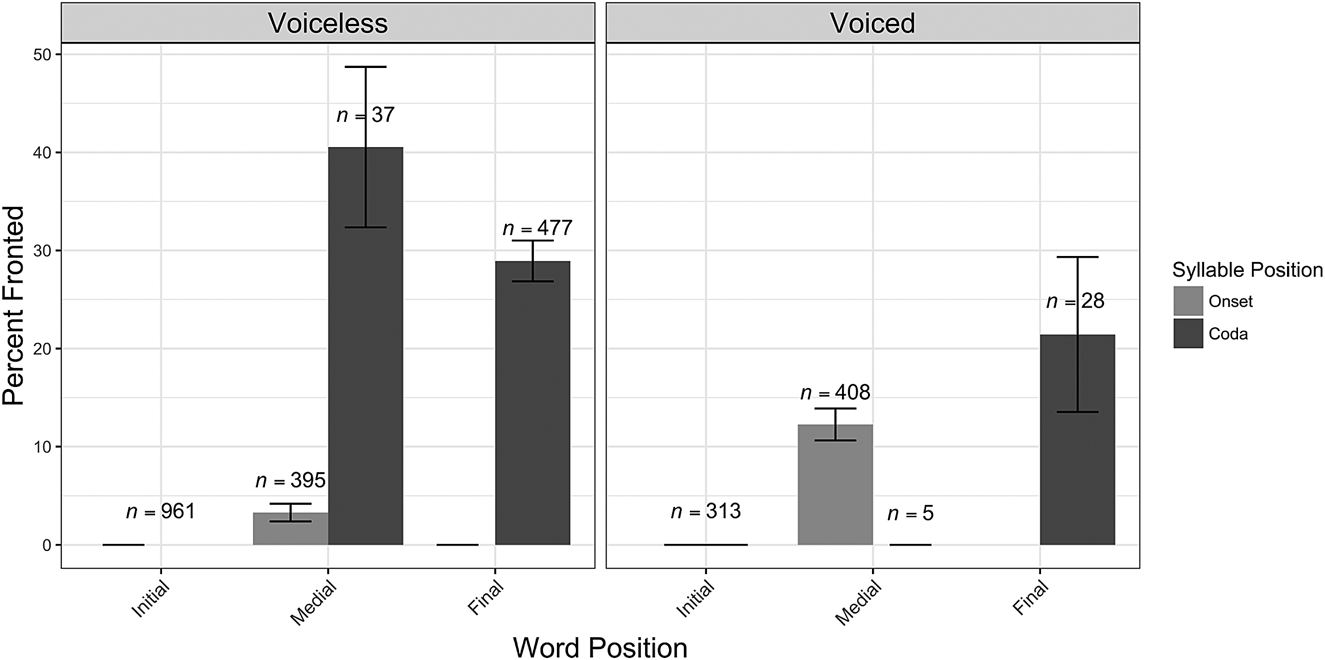
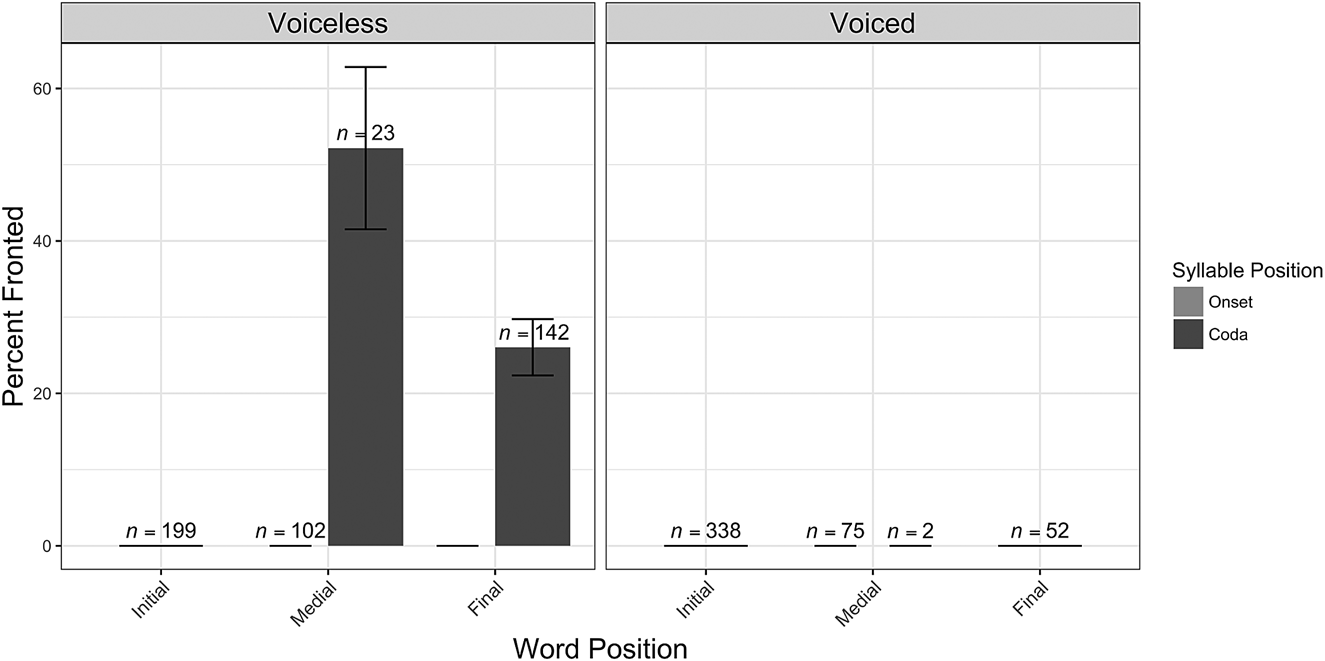
The Donegal speakers’ tokens of (TH) were coded in the same way as the Philadelphia AAE speakers: for underlying voicing (voiceless [θ] or voiced [ð]), for realization (fronted or not fronted), and for following word. Tokens followed by a labial segment (as in South Philly) were excluded from analysis, as the realization of (TH) may have been affected by assimilation. The results of this coding can be found in Figure 3.
Percent fronted in voiceless (left) and voiced (right) variables, by syllable position and word position for the variable Donegal speakers only. Bars depict standard error.

Figure 3 provides evidence of the Donegal speakers fronting only in coda position and only in the voiceless variable. This characterization holds up under statistical testing: for the /θ/ tokens in word-medial position, the Donegal speakers display a difference between onset and coda position tokens (Fisher's exact test, p < .001). A Fisher's exact test of only coda position tokens also finds a reliable difference between /θ/ and /ð/ (p < .001), suggesting that the 0% fronting of /ð/ in the Donegal speakers is a true lack of fronting.
We find, then, that the Donegal Street speakers have simplified the phonological fronting rule of AAE.Footnote 7 AAE speakers display fronting in both the voiced and voiceless (TH) tokens, in coda position and in the onset position of unstressed word-medial syllables. The Donegal Street pattern, on the other hand, may simply be described as allowing fronting in coda position and restricted to the phoneme /θ/. This rule is represented in (2) below, which shows that fronting has been restricted to apply only to voiceless (TH) and has been simplified by losing the intersonorant context.
 $$\matrix{({\rm TH})\cr[-{\rm voice}]} \to \left[ { + {\rm front}} \right]{ \Big/ } \mdash \$$$
DISCUSSION
Indexicality of (TH)-Fronting
Linguistic borrowing does not happen in a social vacuum, and I argue that it is precisely the social meaning of (TH)-fronting that promotes its usage by the Donegal Street fronters. I argued above that (TH)-fronting is one way for the Donegal Street men to perform their hegemonic masculinity, which is unsurprising given the long history of Black English varieties indexing toughness, street, and masculinity.
What is surprising in this case is that a feature of AAE has been adopted by speakers who display overtly hostile attitudes toward their black neighbors and towards black culture. In previous studies of white speakers adopting features of AAE, those features still hold a first-order indexicality with the speakers of the source dialect (Bucholtz, Reference Bucholtz1999; Fix, Reference Fix2010; Leung, Harris, & Rampton, Reference Leung, Harris and Rampton1997; Sweetland, Reference Sweetland2002). Here I follow the framework of indexicality proposed in Silverstein (Reference Silverstein2003) and Eckert (Reference Eckert2008) in which first-order features emerge as indexing group membership. Through usage and interaction, these features can become contextualized and may come to presuppose certain aspects of the context as relevant (Wortham & Reyes, Reference Wortham and Reyes2016:12). In other words, the usage of (TH)-fronting by AAE speakers may come to also presuppose aspects that are often ascribed to urban Blackness, including toughness and masculinity. Eckert (Reference Eckert2008) makes it clear that forms with indexical meaning are continuously open to a process of reinterpretation, allowing for forms to hold both first- and second-order indices with contextually specific meanings. In the studies of white speakers adopting AAE referenced above, the features adopted clearly hold both first- and second-order indices, allowing these speakers to index toughness while also recognized by the speakers themselves as still being features associated with Hip Hop Language or AAE.
The Donegal Street fronters, on the other hand, explicitly associate (TH)-fronting with street but not with AAE. These men also express overtly hostile attitudes toward their black neighbors and recount personal histories of habitually engaging in cross-racial intimidation and violence. For these speakers, the indexical meaning of (TH)-fronting has been reinterpreted to most saliently mean the second-order index of street or masculinity, eclipsing the first-order index of AAE. That a feature would change its social indexicality is not surprising; in fact, the contextual and reinterpretive nature of sociolinguistic indices is a major aspect of the indexicality framework and is ongoing for many features in many dialects. However, previous work investigating white speakers adopting features of AAE found speakers style-shifting into an overall AAE stance, signaling a joint indexicality with the first-order index of AAE and with the second-order index of tough. This work, on the other hand, provides an example of a feature adopted as a second-order index primarily. I argue that, given participants’ overtly hostile racial attitudes, the eclipsing of the first-order index of Blackness by the second-order index of tough allowed the Donegal Street participants to adopt (TH)-fronting as an index of hegemonic masculinity without also indexing a claim to membership in an AAE speaking community.
Adoption across Hostile Lines
In addition to providing an example of a feature's first order indexical meaning being eclipsed by the second-order meaning, the current study also provides a striking example of a linguistic feature adopted across hostile lines. The Donegal Street men who exhibit (TH)-fronting each recount instances of engaging in cross-racial violence and display varying degrees of overtly hostile attitudes toward their black neighbors.
Perhaps the most famous study of linguistic alignment across hostile lines is Milroy and Milroy (Reference Milroy and Milroy1985), who investigated two communities in Belfast that were separated both ideologically (catholic versus protestant) and physically (by the barbed-wire-topped ‘Peace Line’ put in place specifically to separate members of the two communities), and which exhibited hostility toward members of the other community. Milroy and Milroy (Reference Milroy and Milroy1985) found that, despite physical and social separation, speakers in both communities exhibited two features new to Irish English: /a/ retraction and /e/ raising. In this seminal study, Milroy and Milroy (Reference Milroy and Milroy1985) argued that the linguistic alignment is largely due to speakers with multiple weak ties to the opposition community through interaction in the shopping area that serves both catholics and protestants. These weak-tie speakers engage in numerous interactions with members of both communities and serve as a linguistic bridge between the two communities.
The ‘strength of weak ties’ (Granovetter, Reference Granovetter1973), in their ability to transfer linguistic features, apparent in the data from Milroy and Milroy (Reference Milroy and Milroy1985), carries over to the Donegal Street study as well. Operationalizing the strength of a network tie has taken many different forms, from collecting self-reported data about close friendships (Marsden, Reference Marsden1990; see also Eagle, Pentland, & Lazer, Reference Eagle, Pentland and Lazer2009) to the researcher analyzing similarities in belief system or personal characteristics (Mcpherson, Smith-lovin, & Cook, Reference McPherson, Smith-Lovin and Cook2001) and interaction frequency (Kossinets & Watts, Reference Kossinets and Watts2006; Labov, Reference Labov2001:ch. 12). I did not obtain targeted self-reports of network tie strength between the Donegal Street fronters and their black neighbors nor have the detailed access necessary to reliably quantify interaction frequency, so I cannot comment directly on the strength of their social ties with their black neighbors using conventional quantitative methods. However, I did obtain self-reports of habitual cross-racial violence from almost all of the Grays Ferry fronters, as highlighted above. In conjunction with the overall racial segregation of the neighborhood and the racial animus exhibited by participants, this habitual violence points to participants having weak but regular social ties with black neighbors, engaging in both negotiations and fights cross-racially. I argue that it is through this weak tie interaction that the Donegal Street fronters have adopted the use of (TH)-fronting as an index of street and tough identity.
The current study also provides perhaps a more extreme example of adoption across hostile lines. In the case of Belfast English in Milroy and Milroy (Reference Milroy and Milroy1985), both /a/ retraction and /e/ raising are already ‘changes associated with modern Central Scots’ (Milroy & Milroy, Reference Milroy and Milroy1985:357). That is to say, the use of either variant by the Belfast participants may not have indexed linguistic alignment with their opposition Belfast community, but rather a more general alignment with the geographically broader social identity of ‘Central Scots,’ a dialect area that encompasses both Ulster and Central Scotland. These features could even have been adopted independently in both Belfast communities from Modern Central Scots as a source dialect. The white (TH)-fronters of Donegal Street, on the other hand, have adopted a linguistic feature directly from the community towards which they are hostile.
(TH)-fronting as the only feature adopted
I return here to the curious fact that (TH)-fronting is the lone phonological feature of AAE recognizably adopted by the Donegal Street men. In previous work, AAE lexical items have been found to be borrowed piecemeal as ‘off-the-shelf’ (Milroy, Reference Milroy, Cain and Russom2008) items, subject to piecemeal adoption by speakers who have little or no interpersonal interaction with AAE speakers. When the borrowing involves phonological features, however, previous work found white speakers adopting several features of AAE phonology, suggesting an intention to mimic AAE generally rather than borrow a single form.
In contrast, the current study finds the Donegal Street fronters adopting only (TH)-fronting. These speakers produce 0/37 instances of schwa in prevocalic the and 0/312 instances of prevocalic /r/ derhoticization (as in [hə] instead of [hɚ] in her other); two features of AAE phonology produced by Mike in Cutler (Reference Cutler1997). All of the white speakers produce the traditional white Philadelphia /æ/ split (Labov, Reference Labov, Fasold and Schiffrin1989; Labov, Fisher, Gylfadottir, Henderson, & Sneller, Reference Labov, Fisher, Gylfadottir, Henderson and Sneller2016) instead of the traditional Philadelphia AAE single-target /æ/ pattern (Labov & Fisher, Reference Labov, Fisher, Bloomquist, Green and Lanehart2015). Furthermore, the recorded voices sound identifiably white. The fact that (TH)-fronting has been borrowed as an off-the-shelf feature by the Donegal Street speakers raises an important question about phonological borrowing: among all the borrowable features of AAE that could have indexed hegemonic masculinity, why was (TH)-fronting selected, and why was it the only feature selected?
Although British English varieties were not the source of (TH)-fronting in the Donegal Street speakers, this case nevertheless bears a striking similarity with studies of the spread of (TH)-fronting in other dialects of English. (TH)-fronting in the United Kingdom has diffused from London and is now found across the British Isles from south of London to Scotland (e.g., Holmes-Elliott, Reference Holmes-Elliott2016; Kerswill, Reference Kerswill2000; Stuart-Smith et al., Reference Stuart-Smith, Pryce, Timmins and Gunter2013; Schleef & Ramsammy, Reference Schleef and Ramsammy2013). It has also emerged in other world Englishes, with both Pakeha (white) and Pasifika (Pacific Islander) New Zealand English exhibiting (TH)-fronting since at least 1994 (Bell & Gibson, Reference Bell and Gibson2008; Wood, Reference Wood2003). In addition to being an off-the-shelf feature that seems to be adoptable without repeated exposure to the source dialect in these other English dialects, it is also socially a feature particularly “favoured by working-class adolescent males” in the UK (Clark & Trousdale, Reference Clark and Trousdale2009:34) and considered a marker of ‘tough’ identity (Lawson, Reference Lawson and Milani2015). This closely mirrors the findings here, in which Donegal Street working-class heterosexual presenting males adopt (TH)-fronting through weak social network ties to AAE speakers.
The ease with which (TH)-fronting has spread from disparate dialects of English as an off-the-shelf phonological feature suggests that there is something particularly about (TH) in dialects of English that makes it (1) susceptible to change and (2) susceptible for that change to be fronting. One possible reason for (TH)-fronting to be so common in dialects of English may be that (TH)-fronting may simply have an intrinsically high borrowing potential due to the combination of articulatory ease of /f/ and phonetic similarity of /f/ with /θ/.
Additionally, (TH) may already have been a likely candidate for a socially meaningful variable within the Donegal Street community. Stuart-Smith et al. (Reference Stuart-Smith, Pryce, Timmins and Gunter2013) argued that (TH)-fronting in Glasgow was added to speakers’ “existing array of local nonstandard variation” in /θ/ (Stuart-Smith et al., Reference Stuart-Smith, Pryce, Timmins and Gunter2013:527). In other words, the nonstandard form of fronting was diffused into a dialect where (TH) as a variable was already a locus for social meaning. Similarly, white Philadelphian English (and indeed, the Donegal Street speakers) already contains other nonstandard variants of (TH): stopped word-initially ([tɹi] for three) and glottalized word-finally ([wiʔ] for with). The existence of nonstandard variants may cause a variable to be more susceptible to adopting additional nonstandard variants; these speakers are not innovating a new social meaning on nonstandard (TH), just adopting a new way to signal that social meaning.
Restriction and simplification in borrowed (TH)-fronting
The Donegal Street fronters’ simplification of the AAE phonological constraints for (TH)-fronting is an expected outcome in a situation of dialect contact. The disjointed AAE pattern of allowing fronting in coda position or in onset position of an unstressed word-medial syllable in both voiceless and voiced (TH) has become the much simpler rule of allowing fronting in coda position of /θ/ for the Donegal Street speakers. That fronting has become simplified to apply only in coda position for the Donegal Street fronters is also an expected outcome for a new borrowing: neutralization phenomena such as (TH)-fronting tend to target segments in the coda position (Kiparsky, Reference Kiparsky2008).
CONCLUSION
This paper has demonstrated a case of phonological adoption from a hostile source dialect. I have argued that, while the use of features to represent indexical meaning is a “continuous process of reinterpretation” (Eckert, Reference Eckert2008:464), which allows some fluidity between whether a speaker is primarily indexing group membership or individual qualities (first- or second-order indexicality), this data suggests it is also possible for a second-order indexical meaning to eclipse the first-order meaning so fully that speakers with strongly negative attitudes toward the source group may still adopt it as a second-order index. Finally, this paper also provides a case study of speakers simplifying a phonological process borrowed from another dialect.