Introduction
Illicit psychoactive drug abuse (DA) is a worldwide public health problem of major importance (WHO, 2010). Because DA strongly aggregates within families (Bierut et al. Reference Bierut, Dinwiddie, Begleiter, Crowe, Hesselbrock, Nurnberger, Porjesz, Schuckit and Reich1998; Merikangas et al. Reference Merikangas, Stolar, Stevens, Goulet, Preisig, Fenton, Zhang, O'Malley and Rounsaville1998), substantial effort has gone into understanding the nature of these familial influences. Twin studies show that both genetic and environmental factors contribute to the familial aggregation of DA within generations with genetic factors playing a considerably stronger role (Tsuang et al. Reference Tsuang, Lyons, Eisen, Goldberg, True, Lin, Meyer, Toomey, Faraone and Eaves1996; Kendler et al. Reference Kendler, Karkowski, Neale and Prescott2000, Reference Kendler, Maes, Sundquist, Ohlsson and Sundquist2013; Lynskey et al. Reference Lynskey, Heath, Nelson, Bucholz, Madden, Slutske, Statham and Martin2002). We know less about the nature of the parent–offspring transmission of risk to DA. Numerous aspects of parental and family functioning correlate with risk for substance use and subsequent DA in offspring including low socioeconomic status, parental divorce or death, parental history of DA, parental criminal behavior (CB) and/or psychopathology, and disrupted family functioning [e.g. Hawkins et al. Reference Hawkins, Catalano and Miller1992; Steinberg et al. Reference Steinberg, Fletcher and Darling1994; van den Bree & Pickworth, Reference van den Bree and Pickworth2005). However, these studies were performed in intact families sharing both genes and environment, making it difficult to disentangle their effects. For example, the predisposition to divorce is partly heritable (McGue & Lykken, Reference McGue and Lykken1992) and related genetically to personality features that predispose to DA (low constraint and negative emotionality) (Jockin et al. Reference Jockin, McGue and Lykken1996) and would be transmitted to the offspring.
The single available large-scale adoption study of DA found a significant association for DA in biological parents and adoptees (Kendler et al. Reference Kendler, Sundquist, Ohlsson, Palmer, Maes, Winkleby and Sundquist2012). DA in adoptees was also significantly predicted by psychopathology, CB, divorce or death in the adoptive parents (Secretary of Health and Human Services, 1997) indicating that dysfunctional parents and familial disruption can also have a causal effect on DA. Recently, analyses in Sweden of triparental families and families with not-lived-with and step-parents also showed the importance of both genetic and rearing effects in the cross-generational transmission of DA (Kendler et al. Reference Kendler, Ohlsson, Sundquist and Sundquist2015a , Reference Kendler, Ohlsson, Sundquist and Sundquist b ). These results are consistent with findings from an earlier smaller adoption study of DA conducted by Cadoret and colleagues (Cadoret et al. Reference Cadoret, Troughton, O'Gorman and Heywood1986, Reference Cadoret, Yates, Troughton, Woodworth and Stewart1995, Reference Cadoret, Yates, Troughton, Woodworth and Stewart1996).
This paper seeks to clarify further the role of the rearing environment in the risk to DA. We take advantage of a natural experiment in which different offspring of the same high-risk biological parent were raised in distinct environments. We define genetically high-risk parents as having a history of DA, alcohol use disorders (AUD) and/or CB, because, in our prior adoption study (Kendler et al. Reference Kendler, Sundquist, Ohlsson, Palmer, Maes, Winkleby and Sundquist2012), a diagnosis of any one of these disorders in biological parents significantly increased the risk for DA in their adopted-away offspring. We first examine the risk for DA in high-risk full-sibling pairs one of whom has been adopted and the other was not. We then attempt to replicate our findings in a parallel sample of half-siblings. The strength of this natural experiment derives from two design features. First, the siblings are genetically matched allowing us to isolate the impact of environmental factors. Second, the environmental exposures are likely to be widely divergent. Adoptive parents in Sweden are carefully selected for low levels of psychiatric and substance use disorders, high educational status, economic security, and the ability to provide a high-quality and stable rearing environment (Bohman, Reference Bohman1970; Kendler et al. Reference Kendler, Sundquist, Ohlsson, Palmer, Maes, Winkleby and Sundquist2012). Compared to adoptive parents, biological parents of adoptees are at much higher risk for a wide range of psychopathology, are much younger, less well educated and have substantially higher divorce rates (Kendler et al. Reference Kendler, Sundquist, Ohlsson, Palmer, Maes, Winkleby and Sundquist2012).
Method
We used linked data from multiple Swedish nationwide registries and healthcare data using the unique individual Swedish 10-digit personal ID number assigned at birth or immigration to all Swedish residents. This ID number was replaced by a serial number to preserve confidentiality.
The following sources were used to create our database: the Total Population Register, containing annual data on family and geographical status; the Multi-Generation Register, providing information on family relations; the Swedish Hospital Discharge Register, containing all hospitalizations for all Swedish inhabitants from 1964 to 2010; the Swedish Prescribed Drug Register, containing all prescriptions in Sweden picked up by patients from 2005 to 2010; the Outpatient Care Register, containing information from all outpatient clinics from 2001 to 2010; the Primary Health Care Register, containing outpatient primary-care data on diagnoses and time for diagnoses 2001–2007 for 1 million patients from Stockholm and middle Sweden; the Swedish Crime Register that included national complete data on all convictions from 1973 to 2011; the Swedish Suspicion Register that included national complete data on all individuals strongly suspected of crime from 1998 to 2011; the Swedish Mortality Register, containing causes of death; the Population and Housing Censuses that provided information on household and geographical status in 1960, 1965, 1970, 1975, 1980, and 1985. Geographical status was defined as Small Areas for Market Statistics (SAMS) that are small geographical units defined by Statistics Sweden, the Swedish government-owned statistics bureau. There are approximately 9200 SAMS throughout Sweden, their average population being around 1000. We secured ethical approval for this study from the Regional Ethical Review Board of Lund University (No. 2008/409).
DA was identified in the Swedish medical registries by ICD codes [ICD-8: Drug dependence (304); ICD-9: Drug psychoses (292) and Drug dependence (304); ICD-10: Mental and behavioral disorders due to psychoactive substance use (F10–F19), except those due to alcohol (F10) or tobacco (F17)]; in the Suspicion Register by codes 3070, 5010, 5011, and 5012, that reflect crimes related to DA; and in the Crime Register by references to laws covering narcotics (law 1968:64, paragraph 1, point 6) and drug-related driving offenses (law 1951:649, paragraph 4, subsection 2 and paragraph 4A, subsection 2). DA was identified in individuals (excluding those suffering from cancer) in the Prescribed Drug Register who had retrieved (in average) more than four defined daily doses a day for 12 months from either of Hypnotics and Sedatives [Anatomical Therapeutic Chemical (ATC) Classification System N05C and N05BA] or Opioids (ATC: N02A).
CB was identified by registration in the Swedish Crime (or conviction) register which excluded convictions for minor crimes like traffic infractions. AUD was defined by ICD codes for main and secondary diagnoses from Swedish medical registries for the following diagnoses: ICD-9: alcohol-related psychiatric disorders (291), alcohol dependence (303), alcohol abuse (305A), alcohol-related polyneuropathy (357F), alcohol-related cardiomyopathy (425F), alcohol-related gastritis (535D), alcoholic fatty liver, alcohol hepatitis, alcoholic cirrhosis, unspecified liver damage caused by alcohol (571A-D), toxic effects of alcohol (980), alcoholism (V79B); ICD-10: alcohol-related psychiatric and behavioral disorders (F10, excluding acute alcohol intoxication: F10.0), rehabilitation of a person with alcohol abuse (Z50.2), guidance and medical advice to a person with alcohol abuse (Z71.4), alcohol-related pseudo-Cushing syndrome (E24.4), alcohol-related degeneration of the nervous system and brain (G31.2), alcohol-related polyneuropathy (G62.1), alcohol-related myopathy (G72.1), alcohol-related cardiomyopathy (I42.6), alcohol-related gastritis (K29.2), liver diseases caused by alcohol (K70.0–K70.9), acute pancreatitis caused by alcohol (K85.2), chronic pancreatitis caused by alcohol (K86.0), treatment of pregnant alcoholic woman (O35.4), toxic effects of alcohol (T51.0–T51.9), and based on ATC codes in the Prescribed Drug Register: disulfiram (N07BB01), acamprosate (N07BB03), or naltrexone (N07BB04). Additionally, we identified individuals with at least two convictions of drunk driving (law 1951:649) or drunk in charge of maritime vessel (law 1994:1009) in the Crime register. We used the Cause of Death Register to obtain data on alcohol-associated death and used the same codes as above.
Sample
The database was created by entering all full- and half-sibling sets born between 1955 and 1990, for which at least one of the siblings within the family was adopted prior to age 5 years, and at least one of the other siblings resided, for a minimum of 10 years, in the same household as their biological mother and/or father. We also required that one or both biological parents were high risk. Siblings adopted by biological relatives or by an adoptive parent living with a biological parent were excluded. Age at formal adoption was not available in national records until 1991. We therefore estimated age at first cohabitation with adoptive parents (AFCAP) from census data, including individual addresses, available every fifth year. AFCAP represents an upper limit of true age at adoption.
The full-sibling database included 2137 home-reared individuals, 1279 adopted-away individuals (into 1209 adoptive families) nested within 1161 biological parents. The corresponding figures for half-siblings were 7932 home-reared, 3396 adopted-away (into 2764 adoptive families) and 3085 biological parents.
The rates of DA in peers were calculated at age 15 and were based on the proportion of future DA in the SAMS area of individuals in an 11-year interval around the age of the individual. In these calculations, the individual and close biological relatives (twins, full- and half-siblings, and first cousins) were excluded. A more thorough description of the peer deviance measure can be found in Kendler et al. (Reference Kendler, Ohlsson, Sundquist and Sundquist2014). Disruption in adoptive family was defined if at least one of the adoptive parents died or the adoptive parents were divorced prior to age 16 of the child. Cohabitation with high-risk biological parent was defined based on the number of years the child and the parent resided in the same household prior to age 16 of the child. We used a limit of at least 5 years in the same household to define cohabitation. For half-sibling pairs, we controlled for a history of DA, AUD and CB for the non-common parent.
Statistical methods
DA in offspring was investigated in relation to the main predictor variable, adopted v. not adopted, by stratified Cox proportional hazards models with a separate stratum for each sibling set. Follow-up time in number of years was measured from age 15 of the child until year of first registration for DA, death or end of follow-up (year 2011), whichever came first. In all models we investigated the proportionality assumption, which was fulfilled. The key predictor variable in the models was adopted v. reared by biological parent(s); in the analysis the resulting hazard ratio (HR) would reflect the relative difference in hazard for DA when being adopted-away compared to residing with the biological parent(s). All statistical analyses were performed using SAS 9.3 (SAS Institute, 2011).
Results
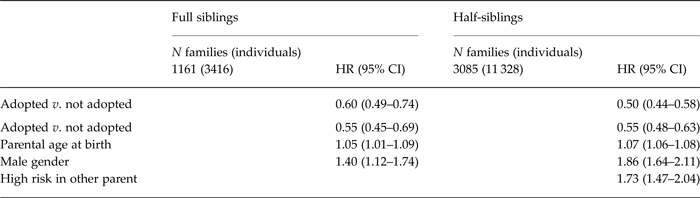
We identified 1161 full-sibships in which at least one sibling was home-reared by his or her biological parents and one reared by an adoptive family. The ages of the parents at the birth of the non-adopted (mean = 26.5, s.d. = 6.3) and adopted (mean = 28.1, s.d. = 6.7) sibling were similar. The raw rates for DA were 12.8% in the non-adopted siblings and 7.6% in the adopted siblings. As seen in Table 1, the raw HR and 95% confidence interval (CI) for DA for being an adopted v. non-adopted sibling was 0.60 (0.49–0.74) which became slightly stronger after controlling for parental age at birth and gender: 0.55 (0.45–0.69).
Hazard ratios and 95% confidence intervals for drug abuse registration as a function of adoption v. non-adoption in a high-risk co-sibling design with full and half-siblings

HR, Hazard ratio; CI, confidence interval.
We sought to replicate these results in a sample of 3085 half-sibships (sharing a single parent) from the same population where at least one half-sib was home-reared by biological parents and one reared by an adoptive family. In these pairs, parents were on average somewhat younger at the birth of the adopted sibling (mean = 25.0, s.d. = 6.4) than at the birth of the non-adopted sibling (mean = 28.2, s.d. = 6.9). Of these pairs, 48.5% were maternal and 51.5% paternal half-siblings. The raw rates for DA were 12.2% in the non-adopted and 8.3% in the adopted sibling. As seen in Table 1, the HR for DA for being an adopted v. a home-reared half-sibling was slightly stronger than that seen in full-siblings (HR 0.50, 95% CI 0.44–0.58). This became somewhat weaker and identical to that seen in full-siblings when controlling for parental age at birth, gender and the high-risk status of the non-shared parent (HR 0.55, 95% CI 0.48–0.63).
Effects of aspects of the adoptive environment
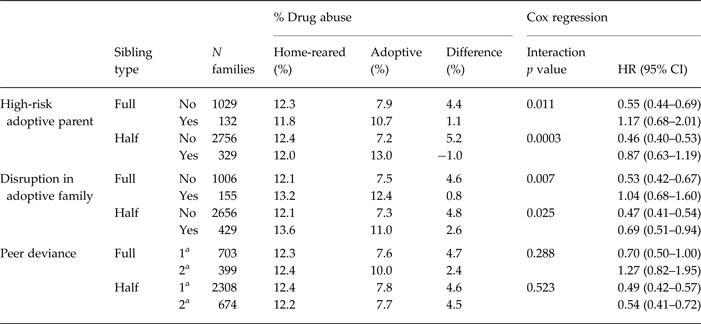
To clarify further the origin of the differences in risk for DA in the adopted and non-adopted siblings, we examined three aspects of the adoptive environment: (i) presence of a high-risk adoptive parent, (ii) disruption in the adoptive family and (iii) level of community peer deviance (Table 2). The difference in rates of DA in the adopted v. home-reared full-siblings was much greater when neither v. one or more of the adoptive parents were high risk. In a Cox regression, adoption was strongly protective of risk for DA when neither adoptive parents were high risk but this protective effect disappeared when one or both adoptive parents were high risk. This interaction was significant (p = 0.01). We repeated these analyses in the half-sibling sample and very similar results were obtained (interaction p = 0.0003) (Table 2).
Features of the adoptive environment that might moderate the impact in full and half-siblings of being reared in an adoptive v. a biological family

HR, Hazard ratio; CI, confidence interval.
a 1 = Adoptive family resides in a community with the same or lower levels of peer deviance v. the biological family; 2 = adoptive family resides in a community with higher peer deviance than the biological family.
Disruption of the adoptive family also substantially reduced the difference in rates of DA in the adopted v. home-reared full-siblings (Table 2). In a Cox regression analysis, adoption was substantially protective of risk for DA when there was no disruption in the adoptive family but this protective effect was absent when the adoptive family was broken by parental divorce or death. This interaction was significant (p = 0.007). The same analysis applied to the half-siblings produced very similar results (interaction p = 0.03) (Table 2).
Difference in rates of DA in the adopted v. home-reared full-siblings was somewhat greater when the adoptive family lived in a community which, compared to the community of the biological family, had lower or equal v. higher peer deviance (Table 2). While Cox models confirmed a stronger effect of adoption if the former than the latter case, the interaction term was not significant. The results were similar and the interaction also non-significant in the half-siblings.
Effects of aspects of the biological parents and their home environment
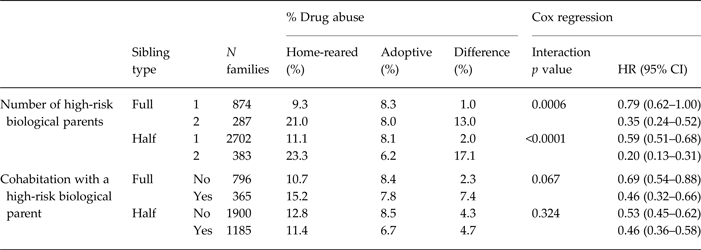
To further understand the sources of differences in risk for DA in the adopted and non-adopted siblings, we examined aspects of the biological parents and their home environment. As seen in Table 3, in full-siblings, the difference in rates of DA in those adopted-away v. home-reared were much greater when both v. only one of the biological parents were high risk. In a Cox model, the protective effect of adoption was substantially stronger (HR 0.35, 95% CI 0.24–0.52) when both biological parents were high risk compared to only one (HR 0.79, 95% CI 0.62–1.00) and this difference was significant (p = 0.0006). In half-siblings, this effect was even stronger (Table 3). In both of these analyses, these results appeared to be driven by the very high rates of DA in the home-reared offspring of families where both biological parents were high risk (21–23%).
Features of the biological parents and the biological home environment that might moderate the impact in full and half-siblings of being reared in an adoptive v. a biological family

HR, Hazard ratio; CI, confidence interval.
Finally, in full-siblings, the difference in rates of DA in those adopted-away v. home-reared were somewhat greater when the home-reared sibling cohabitated with their high-risk parent(s) v. when they did not (Table 3). These results were reflected in the Cox model where adoption was more strongly protective of DA risk when the home-reared sib lived with the high-risk parent but the interaction term was only at a trend level (p = 0.067). However, these trend effects did not replicate in the half-siblings (Table 3).
Discussion
We sought to elucidate the role of the rearing environment in risk for DA by utilizing a natural experiment wherein matched offspring of a high-risk biological parent were reared in substantially different environments. In matched full-sibling pairs, being raised by an adoptive family was associated with a 45% decreased risk for DA registration. In an independent sample of high-risk half-sibling pairs, we replicated these findings. Controlling for the high-risk status in the parent not shared by the half-siblings, the adopted half-sibling also had a 45% decrease in risk for DA compared to his or her non-adopted half-sib.
The rearing environment provided by an adoptive family might reduce risk for DA in a number of ways. Adoptive parents are screened carefully in Sweden for their ability to provide a high-quality rearing environment (Bohman, Reference Bohman1970; Bjorklund et al. Reference Bjorklund, Lindahl and Plug2006). Because the number of children available for adoption has been considerably smaller than the demand, the selection process is rigorous. Bohman notes that this process in Sweden was designed to ‘assess the general health, personality, and mutual relationship of the presumptive adoptive parents’ with the goal of forecasting ‘the durability of their marriage … [and] place the child in an harmonious, stable environment’ (Bohman, Reference Bohman1970, p. 87).
Many aspects of parental and family functioning assessed in intact families correlate with risk for offspring substance use and subsequent DA including low socioeconomic status, young parental age, parental divorce or death, a parental history of DA, CB and/or psychopathology, and disrupted family functioning (e.g. Hawkins et al. Reference Hawkins, Catalano and Miller1992; Steinberg et al. Reference Steinberg, Fletcher and Darling1994; van den Bree & Pickworth, Reference van den Bree and Pickworth2005). We therefore conducted follow-up analyses to see if we could determine some specific aspects of the adoptive home that could explain the differences in risk for DA in the home-reared and adopted-away sibling. We found that the protective effect of adoption was significantly weaker when the adoptive family was broken by death or divorce, or when one of the adoptive parents themselves had DA, AUD or CB. These results strongly suggest that the adoption associated decrease in risk for DA is directly related to the quality of the home environment provided by the adoptive family. Our findings are therefore consistent with the large prior literature in intact families which demonstrates an association between poor family functioning and risk for offspring substance use and abuse. However, our design permits us to determine that the parental behavior impacts directly on DA risk rather than reflecting personality or other vulnerability traits in the parents that are passed on to the children genetically. Our results are consistent both with findings from our prior classical adoption study of DA in Sweden (Kendler et al. Reference Kendler, Sundquist, Ohlsson, Palmer, Maes, Winkleby and Sundquist2012) as well as results from Cadoret and colleagues, who, in a smaller American adoption study, showed that environmental factors of divorce and psychiatric disturbance in the adoptive family were associated with increased DA in the adoptee (Cadoret et al. Reference Cadoret, Troughton, O'Gorman and Heywood1986).
A further important result emerged when we divided our full-sibling pairs on the basis of whether one or both parents were high risk. The reduction in risk for DA associated with adoption was significantly stronger in the offspring of two high-risk parents than in the offspring of one high-risk parent. Consistent with our prior full adoption study of DA in Sweden (Kendler et al. Reference Kendler, Sundquist, Ohlsson, Palmer, Maes, Winkleby and Sundquist2012), the benefits of being reared in a high-quality home environment are greatest in offspring at high genetic risk for DA.
The only human trait of which we are aware that has been examined utilizing the design we implement here has been IQ. Several prior investigations, including one study of the males in this sample (Kendler et al. Reference Kendler, Turkheimer, Ohlsson, Sundquist and Sundquist2015c ), have shown substantial gains in IQ or improvements in school performance in adopted v. non-adopted siblings (Schiff et al. Reference Schiff, Duyme, Dumaret, Stewart, Tomkiewicz and Feingold1978; Capron & Duyme, Reference Capron and Duyme1989; Duyme et al. Reference Duyme, Dumaret and Tomkiewicz1999; van Ijzendoorn et al. Reference van Ijzendoorn, Juffer and Poelhuis2005).
In our prior adoption study (Kendler et al. Reference Kendler, Sundquist, Ohlsson, Palmer, Maes, Winkleby and Sundquist2012), we calculated an aggregate measure of rearing environmental risk for DA from features of the adoptive parents, siblings and important environmental events including parental divorce and death. Dividing this measure of adoptive environment into deciles, each decile increased the risk for DA by 1.10. Assume the increased risk for DA for being a non-adopted v. adopted high-risk sibling is approximately 2-fold. Given that 1.17~2.0, we might estimate that the mean difference in risk for DA from the rearing environment provided to the average non-adopted v. average adopted sibling was similar to that provided by two adoptive families differing in their environmental risk index by ~7 deciles (e.g. 20th v. 90th percentile).
The differences in environmental risk for those reared by their biological v. adoptive parents might also likely include the community level. Exposure to high peer deviance in childhood and adolescence is among the strongest known risk factors for range of externalizing behaviors including drug use and DA (Hawkins et al. Reference Hawkins, Herrenkohl, Farrington, Brewer, Catalano, Harachi, Loeber and Farrington1998; Petraitis et al. Reference Petraitis, Flay, Miller, Torpy and Greiner1998; Andrews et al. Reference Andrews, Tildesley, Hops and Li2002). Peer deviance is likely to be higher in communities in which biological parents reside compared to the communities where the adoptive parents live. To verify this in our sample, we examined the frequency of future DA in close-aged peers living in the same small geographical area in Sweden as our full- and half-sib pairs when they were 15. The peers of the full- and half-sibs reared by their biological parents had a future risk for DA 49% and 55% higher, respectively, than the peers of the full- and half-sibs reared in adoptive homes. However, the level of peer-group exposure between the home-reared and adopted-away siblings did not explain the differences in their risk for DA. These results suggest that the protective effect of adoption is better explained by features of the home environment rather than at the community level.
Our findings should be interpreted in the context of three methodological limitations. First, we detected subjects with DA from medical, legal and pharmacy records. This method does not require accurate respondent recall and reporting and its validity is supported by the very high odds ratios [mean of 52.2 (Kendler et al. Reference Kendler, Sundquist, Ohlsson, Palmer, Maes, Winkleby and Sundquist2012)] for registration for DA across our different sources.
However, this method surely produces both false-positive and false-negative diagnoses. While we cannot precisely estimate these biases as no large epidemiological study of DA has been done in Sweden, such a survey was conducted in neighboring Norway, with similar rates of DA (Kraus et al. Reference Kraus, Augustin, Frischer, Kummler, Uhl and Wiessing2003; Hibell et al. Reference Hibell, Guttormsson, Ahlstrom, Balakireva, Bjarnason, Kokkevi and Kraus2007). The lifetime prevalence rates of DSM-III-R (APA, 1987) DA and dependence in Norway were estimated at 3.4% (Kringlen et al. Reference Kringlen, Torgersen and Cramer2001), close to the 2.7% we detected in all of Sweden. It is likely that our sample of subjects were on average more severely affected that subjects identified with DA from population-based interview surveys.
Second, could ascertainment of DA be more complete in biological than adoptive families, especially for DA assessed from the criminal registry where local police practices might vary by community or socioeconomic status level? We repeated our analyses removing cases found solely through the criminal registry which constituted 22% and 33% of the high-risk full- and half-sib samples, respectively. Controlling for gender and parental age at birth, the effect of adoptive v. biological parent rearing was similar (HR 0.58, 95% CI 0.46–0.74) compared to the original sample (HR 0.55, 95% CI 0.45–0.69). Among half-siblings, controlling for parental age at birth, gender and high-risk status of the other parent, the effect also remained (HR 0.63, 95% CI 0.53–0.73) compared to the original sample (HR 0.55, 95% CI 0.48–0.63).
Third, bias can also arise in the adopted-away siblings from extensive contact between the adoptee and biological parents prior to adoption. We know during the years of our study, adoptees were typically removed shortly after birth from the biological mother and placed in a special nursery home (Bohman, Reference Bohman1970; Bjorklund et al. Reference Bjorklund, Lindahl and Plug2006). We previously assessed the possible impact of such a bias (Wickrama et al. Reference Wickrama, Conger, Lorenz and Martin2012) in our adoptive samples and found little evidence for concern. For example, if sustained contact with biological parents occurred and increased risk for DA in the adoptee, then age at documented placement with the adoptive family AFCAP should be significant and positively associated with DA. Instead, the correlation was negative (Wickrama et al. Reference Wickrama, Conger, Lorenz and Martin2012).
Conclusions
Using Swedish registry data, we evaluated a natural experiment in which siblings pairs matched for high genetic risk for DA were exposed to different rearing environments. DA was detected using objective measures which did not require subject cooperation or accurate reporting. Results did not vary appreciably if we dropped cases of DA solely detected through criminal registration which might be sensitive to social class bias. Using full- and half-sibling pairs matched for genetic background, we found replicated evidence that siblings reared in adoptive homes, chosen for the high quality of the provided rearing environment, had a substantially reduced risk for DA compared to their non-adopted siblings. The protective effect of adoption on risk for DA was significantly stronger in adopted/non-adopted full-sibling pairs with very high familial liability (having two high-risk parents) than in pairs at moderately high familial liability (having one high-risk parent) and significantly weaker when the adoptive family was broken by death or divorce or contained a high-risk parent. High-quality rearing environments can substantively reduce risk for DA in those at high genetic risk.
Acknowledgements
This project was supported by grant RO1 DA030005 from the National Institute of Drug Abuse, the Swedish Research Council to Kristina Sundquist (K2012-70X-15428-08-3), the Swedish Research Council for Health, Working Life and Welfare (In Swedish: Forte; Reg. nr: 2013-1836) to Kristina Sundquist, the Swedish Research Council to Jan Sundquist (2012-2378) as well as ALF funding from Region Skåne awarded to Jan Sundquist and Kristina Sundquist.
Declaration of Interest
None.