Rheumatic fever is a disease with worldwide distribution, and in developing countries such as Brazil it remains the major cause of acquired cardiac disease among school-aged children and adolescents. The neglect of the recommended prophylaxis with benzathine penicillin can lead to cardiac valve lesions, caused mainly by severe carditis or recurring outbreaks of disease.Reference Herdy1 Data for chronic rheumatic cardiac disease from the Brazilian Secretary of Health, acquired through hospitalisation authorisation records, identified 8006 admissions for rheumatic fever during 1 year – from March, 2009 to March, 2010 – with a total cost of 37 million dollars.2
The authors have previously reported the results of treatment of rheumatic carditis with high-dose intravenous methylprednisolone pulse therapy, in 70 children.Reference Herdy, Pinto, Olivaes, Herdy, Carvalho and Tchou3 We now present the follow-up of this study, with the addition of children admitted in another children's hospital in the same city.
Materials and methods
A retrospective study was conducted of the long-term follow-up of the cases admitted to the paediatric ward at two public hospitals in the same city. Among the 242 cases of rheumatic carditis – 106 from Antonio Pedro University Hospital and 136 from Getulio Vargas Filho Hospital – we selected 118 (48.7%) patients who were treated with corticosteroids and followed up for 4 years or more. Exclusion criteria for this study included patients lost to follow-up or whose treatment was not followed up for at least 4 years.
The modified Jones criteria were used for diagnosis of rheumatic fever,4, 5 whereas the World Health Organization and American Heart Association guidelines were used for treatment of acute rheumatic fever and secondary prophylaxis.5–7 In cases of moderate-to-severe acute carditis, immunosuppression was performed with oral prednisone or intravenous methylprednisolone.Reference Herdy, Pinto, Olivaes, Herdy, Carvalho and Tchou3, 5, 7
Patients were divided into two groups – one group comprising 40 cases received intravenous methylprednisolone, and another group comprising 78 cases treated with oral prednisone.
The choice of intravenous methylprednisolone versus oral prednisone was based on the severity of carditis. Intravenous corticosteroids were preferred in the case of cardiac failure class IV. The drug was administered intravenously (30 milligrams per kilogram per day) with dextrose solution in a 2-hour infusion up to three courses per week. Depending on the severity of the disease, two to five courses were delivered. Prednisone, on the other hand, was used at a dosage of 2 milligrams per kilogram per day orally, during fasting, for 3 to 4 weeks followed by weekly dosage tapering. Before steroid immunosuppression was started, all children were evaluated with tuberculin skin test and treated for superimposed infections, including dental foci and intestinal parasites.
The statistical analysis between the two groups was based on the chi-square test. From these data, we calculated the survival rate using a Kaplan–Meier curve analysis.
Results
The patients ranged in age from 3 to 19 years (on admission). The average age was 9.06 years, with a standard deviation of 3.10 and a 95% confidence interval of 8.50–9.62. From 1986 to 2006, 242 patients with rheumatic carditis were admitted to two hospitals, including 121 male patients (50%). Many patients – that is, 124 (51%) – failed to return to the outpatient clinic for long-term follow-up, including 22 patients with severe lesions who abandoned treatment or were lost to follow-up after surgery was recommended. From the data obtained until the final follow-up, the calculated survival rates were 98%, 96%, 91%, and 84% at 4, 5, 10, and 12 years, respectively (Fig 1). Nonetheless, 118 patients were followed up for 4 years or more – meaning a loss of more than 50% of patients. There were 62 male patients (52.5%); 60 patients (59%) presented with their first severe carditis attack – including 12 children between 3 and 6 years of age, 42 children between 7 and 10 years of age, and six children between 11 and 13 years of age. A total of 19 patients (16%) had a family history of rheumatic fever.
Kaplan–Meier survival curve of the entire cohort of patients with rheumatic carditis.

The follow-up duration ranged from 4 to 15 years, with an average of 7.7 years, a standard deviation of 3.2, and 95% confidence interval of 7.1–8.3. The most recent cases – with an observation period less than 4 years – have developed no severe complications so far, and therefore were not included in this study.
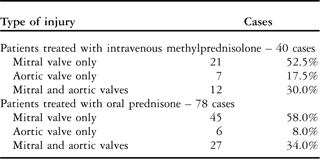
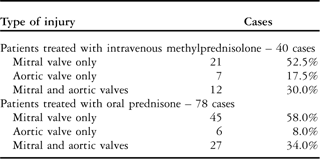
The 118 cases included in this study were categorised as having cardiac failure classes III or IV – according to the New York Heart Association classification – during hospital admission and were classified according to the type of cardiac valve lesion using Doppler echocardiogram. In the intravenous methylprednisolone group – 40 patients – 21 patients (52.5%) had isolated mitral valve insufficiency, seven (17.5%) had aortic valve insufficiency only, and 12 (30%) had associated mitral–aortic valve insufficiency. Among patients in the oral prednisone group – 78 patients – 45 (58%) had isolated mitral valve insufficiency, six (8%) had aortic insufficiency only, and 27 (34%) had associated mitral–aortic valve insufficiency (Table 1).
Initial cardiac injury as assessed by echocardiography for each treatment group – 118 cases.
In the intravenous methylprednisolone group, 18 children (45%) presented with their first episode of carditis; of these, 10 (55%) showed signs of ruptured chordae tendineae on echocardiography, among which eight were of the anterior chordae and two of the posterior chordae. There was a recurrence of carditis after discontinuation of secondary prophylaxis in the other 22 (55%) cases, resulting in hospitalisation. In the oral prednisone group, 42 children (54%) presented with their first episode of carditis; in addition, there were signs of rupture of anterior mitral chordae in 21% of these children. The remaining 36 (46%) children had recurrent disease. There was recurrence of carditis in 58 cases (49%), and many patients reported a family history of rheumatic fever.
With regard to treatment, all children received benzathine or procaine penicillin to eradicate streptococci, except for three – with a history of allergy to this antibiotic – who were administered cephalosporin or erythromycin. Signs and symptoms of cardiac failure, arthritis, or Sydenham's chorea were treated as recommended by the World Health Organization and American Heart Association guidelines.4, 5
Oral or intravenous steroids resulted in satisfactory remission of clinical and laboratory findings of the disease. Only one patient showed no suppression of rheumatic activity and required mitral valve replacement, even in the acute phase. There were no serious complications due to immunosuppressive therapy.
Secondary prophylaxis was started on the 11th day after streptococcal eradication and consisted of the administration of benzathine penicillin every 21 days. There were three allergic patients who received sulfadiazine. This orientation was maintained throughout follow-up.
Among the 31 cases (26%) that were referred to other hospitals for surgery, only 19 (16%) underwent valve replacement surgery or valvuloplasty.
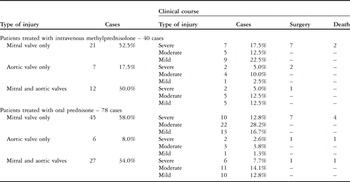
During the clinical course of patients treated with intravenous methylprednisolone, development of valve lesions was as follows: among 21 cases (52.5%) with isolated severe mitral regurgitation, seven remained affected despite all medical treatment and therefore underwent surgery. Surgery complications included two deaths due to endocarditis. The others received only medical therapy – five patients with moderate severity and nine with mild severity. Among seven cases with severe aortic regurgitation, only two underwent surgery – mechanical valve replacement – whereas five, after corticosteroids, showed mild or moderate regurgitation and remained stable under medical treatment. Of the 12 children who had mitral–aortic involvement, only one had mitral valve replacement. The others were treated clinically (Table 2).
Echocardiographic findings and clinical course analysed by treatment group – 118 cases.

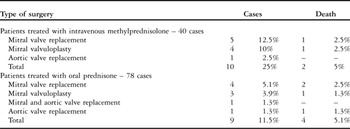
Follow-up of patients in the oral prednisone group – 78 cases – showed that among 45 patients with isolated severe mitral valve regurgitation (58%), 10 remained with serious lesion and seven of these underwent cardiac surgery, that is, four had mechanical valve replacement and three had valvuloplasty. The 22 cases classified as of moderate severity and 13 cases of mild severity received medical therapy. Among six cases (8%) with isolated aortic lesion, two had no improvement of symptoms and only one received surgical treatment. The others remained in outpatient care. Of the 27 cases (34%) with severe mitral–aortic lesion, six cases remained with serious lesions, but only one underwent surgery. The other five and those classified as having mild or moderate severity received medical therapy. Accordingly, among patients in the oral prednisone group, nine (11.5%) were referred for surgery, four patients substituting a mechanical prosthesis for the mitral valve, and three cases of mitral valvuloplasty. One case substituted both mitral and aortic valves, whereas another had aortic valve replacement; there were two homograft surgeries in the aortic position – Ross surgery. There were six deaths, two due to endocarditis, two in the immediate post-operative period, and two several months later (Table 3).
Surgical interventions and fatal outcome according to treatment groups – 19 cases.

Two of the aortic valve surgeries in the oral prednisone group were homografts. In two cases in the intravenous methylprednisolone group and two cases in the oral prednisone group, the cause of death was infectious endocarditis.
During follow-up, 11 cases (27.5%) from the intravenous methylprednisolone group and 18 (23%) from the oral prednisone group showed severe valve regurgitation – mitral valve regurgitation in 16 cases and aortic valve regurgitation in three cases – and two patients (0.8%) had severe mitral and aortic regurgitation. A total of 39 cases (33%) from both groups became asymptomatic or were left with minimal lesions.
The overall mortality of patients following the treatment protocol was eight (6.8%), six after surgery – two from the intravenous methylprednisolone group and four from the oral prednisone group – and two due to rheumatic activity after discontinuation of secondary prophylaxis, as shown by the pathology report.
The pathological study of myocardium fragments or valves removed from three patients revealed chronic inflammatory infiltrate and calcium deposition, altered fibromatous tissue, and fibrous proliferation. The two removed valves showed findings of chronic rheumatic carditis. In both cases of death due to acute carditis, there were signs of disease activity, inflammatory Aschoff nodules outlining the valve, as well as signs of fibrinoid necrosis, fibrin deposits, inflammatory infiltrate of mononuclear cells, macrophages, and Anitschkow cells in the mitral valve. In the myocardium, there were anisocytosis, focal fibrosis, polymorphonuclear leukocyte infiltration areas, and Aschoff bodies, whereas the pericardium displayed fibrin deposition with granulation tissue and thickening. Autopsy was not performed in four deaths.
Statistical analysis between the two groups using the chi-square test showed no significant difference in the recurrence of carditis or surgical indication. A significant increase in mortality rate after surgery was found in the oral prednisone group (χ2 = 5.619, p = 0.018).
Discussion
The average age of patients at the first attack was 9.06 years, and is the same as described by other authors. In developing countries, the first outbreak rarely occurs in adolescence.Reference Sampaio, Fae and Demarchi8–Reference Majeed, Youseof, Khuffash, Yusuf, Fawana and Khan11
The dropout rate was very high, with a loss of more than 50% of the cases, and among those hospitalised with carditis the majority had a previous history of the disease. Many patients who were referred for surgery (18%) never returned for a clinic visit. Patient compliance to treatment has been problematic and is the major cause of chronic carditis or recurrent disease.Reference Herdy1 From the study of Pelajo et al,Reference Pelajo, Lopez-Benitez, Torres and Oliveira12 in Rio de Janeiro, Brazil, 33.5% were lost to follow-up. The World Health Organization recognises that in countries where prevention (prophylaxis) has been implemented, there is marked reduction of disease.7 In Brazil, the incidence of acute rheumatic fever decreased by 75% over the past 10 years because of better access to medical care, as well as prevention programmes such as PREFERE, established in 2003 in Rio de Janeiro.2, 13
The most frequently affected valve in all patient populations is the mitral valve, with or without aortic and tricuspid lesions. In the present series, more than 50% had isolated mitral regurgitation. In some series, it is present in all (100%) patients.Reference Sampaio, Fae and Demarchi8, Reference Velloso, Mansur and Grinberg14
Many of the cases in this study exhibited severe carditis in the first rheumatic fever episode, with the echocardiographic finding of ruptured mitral valve chordae tendineae. In a previous report, we showed that many rheumatic fever cases suffered rupture of anterior chordae.Reference Herdy, Pinto, Olivaes, Herdy, Carvalho and Tchou3 Fatal cases may occur in the first outbreak, as reported by Veloso et al.Reference Velloso, Mansur and Grinberg14
Our cases were treated with penicillin to eradicate group-A Streptococcus, except in allergic patients. Penicillin is the choice for antimicrobial treatment – microbial eradication. Streptococcal resistance to penicillin has not been documented – classification of recommendation I and level of evidence B.Reference Gerber, Baltimore and Eaton15 In individuals with a history of penicillin allergy, oral cephalosporin or oral erythromycin are acceptable alternatives.Reference Baltimore16, Reference Dajani, Taubert, Ferrieri, Peter and Shulman17
Prevention of recurrent attacks requires continuous antimicrobial prophylaxis. In patients with persistent valve disease, it is recommended for at least 10 years and after valve surgery for 40 years or lifelong – class I level of evidence B.Reference Gerber, Baltimore and Eaton15 In our cases, secondary prophylaxis was recommended until the age of 40 years to all patients who were left with severe cardiac lesions, and those who underwent surgical treatment were committed to lifelong prophylaxis.
As recommended, all our patients were treated with corticosteroids to control severe carditis.Reference Steer and Carapetis18 There was no significant statistical difference between the two groups – oral or intravenous steroid – with regard to the resolution of activity indicators. According to the Cochrane Database, there is no benefit from the use of steroids in treatment of mild-to-moderate carditis.Reference Cillers, Manyemba and Saloojee19 However, it is recommended for severe cases because of their more potent anti-inflammatory effect, and therefore it can be used to hasten resolution of cardiac failure – classification of recommendation class II, level of evidence B.Reference Steer and Carapetis18 It is recognised that this recommendation is not based on evidence that corticosteroids will reduce the risk of developing cardiac valve lesions in severe carditis, but that such effect was not based on studies in the post-echocardiography era or on the use of modern corticosteroids.Reference Cillers, Manyemba and Saloojee19, Reference Cillers20
During follow-up, 11 cases (27.5%) from the intravenous methylprednisolone group and 18 (23%) from the oral prednisone group showed severe valve – mitral or aortic – regurgitation, probably because of poor compliance to secondary prophylaxis. However, 15 patients (37.5%) of the intravenous methylprednisolone group and 24 patients (30%) of the oral prednisone group became asymptomatic – with minor regurgitation – because they kept their medical appointments and consistently used antibiotic therapy. Medical advice and prolonged hospital admission with intravenous medications were not enough to convince patients and family members about the importance of antibiotic protection. Pelajo et alReference Pelajo, Lopez-Benitez, Torres and Oliveira12 found non-compliance in 35% of patients during follow-up. Bittar et alReference Bittar, Hayek, Obeid, Gharzeddine, Mikati and Dbaibo21 showed that 45% of hospitalised patients with rheumatic fever had had previous disease episodes.
The severity and chronicity of rheumatic carditis can be explained by the presence of T cells and production of pro-inflammatory cytokines, such as interleukins, tumour necrosis factor-alpha, and gamma-interferon. Antigen-activated T helper cells polarise type-1 or type-2 T helper cell or T helper 17 cell subsets depending on cytokine secretion. T helper 17 cells have been more recently described in a type of pro-inflammatory response mediated by interleukin-17.Reference Guilherme, Fae, Oshiro and Kalil22 Guilherme et al described the role of interleukin-4 regulating the inflammatory process in cardiac tissue lesions from rheumatic patients. According to those authors, interleukin-4 was positive in more than 10% of mononuclear cells in 78% of myocardium tissue fragments analysed from 14 patients, whereas only 18% of patients had a similar percentage of interleukin-4-positive mononuclear cells in valve tissues. The pattern of cytokine production in cardiac lesions favours a type-1 T helper cell-mediated disease.Reference Guilherme and Kalil23
Surgery was indicated in 31 patients, but many of them refused and quit follow-up; of these, 12 patients underwent valve replacement – the majority with mechanical valve – and seven had mitral valve repair. Surgical repair of mitral valve has been in practice in Brazil for many years with favourable results. In a previous publication, we showed that among 40 patients with moderate-to-severe mitral valve regurgitation treated with mitral valve repair, only 19% needed subsequent valve replacement within 4 years.Reference Rocha e Silva, Herdy, Vieira and Simões24 Other authors reported even better results of mitral valve repair – Pomerantzeff et alReference Pomerantzeff, Brandão and Faber25 described that 70% of patients were free of re-operation after 17 years and Gilinov et alReference Gilinov, Cosgrove and Lytle26 showed excellent follow-up in 93% of patients after 10 years. Travancas et alReference Travancas, Dorigo, Simôes, Fonseca, Block and Herdy27 compared valve replacement between mechanical and biological prostheses in patients under 18 years of age and found that with the mechanical type the mortality and re-operation rates were lower.
We indicated mitral valve replacement during rheumatic activity in a patient who was in his second attack with severe cardiac failure, and surgery was successful. Among the 25 cases of Sampaio et alReference Sampaio, Fae and Demarchi8 who underwent surgery, 10 of them were operated on during the acute episode of rheumatic carditis associated with severe cardiac failure.
In our series, eight (6.8%) of 118 patients died during the study period, six after surgery. In a study from São Paulo, the autopsy of 13 fatal rheumatic carditis cases revealed that endocarditis was the main cause of death in 46% of the patients. Among those patients, 53.8% were in their first attack of the disease.Reference Velloso, Mansur and Grinberg14 In the study by Veloso et alReference Velloso, Mansur and Grinberg14 on 25 surgically treated cases, including 12 who received biological prosthesis implants, three of them died during long-term follow-up and one of them from infective endocarditis.
The pathologic study of valve fragments from our cases showed the typical findings of chronic rheumatic disease. In patients who were in disease activity, findings were consistent with acute rheumatic activity. Sparse inflammatory infiltrates are seen in chronic disease, but a fibrin deposit – verrucae – on the endocardial surface implies rheumatic activity. These data are similar to those described by several authors.Reference Velloso, Mansur and Grinberg14, Reference Decourt28, Reference Edwards, Peterson and Edwards29 Some patients presented with rupture of chordae tendineae in the first rheumatic fever attack. These findings were previously reported, and chordae tendineae rupture is explained by the inflammatory reaction, Aschoff nodules consisting of central fibrinoid degeneration, and Anitschkow cells.Reference Hwang and Lam30, Reference Sauders, Austen and Harthorme31
From those 242 initial cases, the rate of abandonment was 51%, and possibly the follow-up of the total cases would be different and more patients could have undergone surgery.
Finally, we conclude that many critically ill patients who complied with secondary prophylaxis were left with minor injuries, whereas others who neglected it developed serious sequelae, because of the recurrence of carditis with the need for hospital readmission. The rate of abandonment and loss to follow-up was very high.