Introduction
The acute effects of exercise on the nasal airway are well established: vasoconstriction of the capacitance vessels results in increased nasal cavity volume and increased absolute nasal ventilation.Reference Dallimore and Eccles1 However, the long-term effects of exercise on the nose are less well understood. Previous literature has reported on the prevalence of rhinitis in the athletic population, largely as a secondary outcome in the study of exercise-induced asthma. Prevalence of rhinitis in these studies has varied widely, from 15 to 47 per cent.Reference Bonini, Gramiccioni, Fioretti, Ruckert, Rinaldi and Akdis2–Reference Kurowski, Jurczyk, Krysztofiak and Kowalski4
Disparities in rhinitis definitions, study methodology and the athlete populations studied may account for this wide range of prevalence. For example, some studies comprised mixed populations of athletes who exercised on land, in water or in cold air environments. However, both cold air and chlorine are irritative to the nasal mucosa, and athletes who exercise in these environments (skiers or swimmers) may be more prone to non-allergic rhinitis phenotypes.Reference Bougault, Turmel and Boulet5, Reference Bonadonna, Senna, Zanon, Cocco, Dorizzi and Dani6 The definition of rhinitis also varies between studies, and may be based on self-reported symptoms,Reference Katelaris, Carrozzi, Burke and Byth3 previous physician diagnosis,Reference Thomas, Wolfarth, Wittmer, Nowak and Radon7 or direct clinical confirmation with positive objective evidence of allergy.Reference Bonini, Gramiccioni, Fioretti, Ruckert, Rinaldi and Akdis2, Reference Kurowski, Jurczyk, Krysztofiak and Kowalski4 Although direct clinical confirmation of rhinitis remains the ‘gold standard’ for confirmation of correct diagnosis, a pragmatic balance must be struck when studying large numbers of subjects; in these cases, self-reporting of symptoms is a useful way of screening the study population.
Rhinitis has been defined for epidemiological purposes as the presence of one or more major nasal symptom (blockage, congestion, rhinorrhoea or sneezing paroxysms) on most days of the last year.Reference Wallace, Dykewicz, Bernstein, Blessing-Moore, Cox and Khan8 This was the definition used in our study, which sought to establish the frequency of these nasal symptoms using a simple, easily administered self-report tool to directly compare athletes with sedentary control participants. The study also investigated the association of these nasal symptoms with co-existing allergic symptoms and upper respiratory tract infections (URTIs), and examined the impact of nasal symptoms on quality of life using the 22-item Sino-Nasal Outcome Test-22 (SNOT-22).Reference Hopkins, Gillett, Slack, Lund and Browne9
Materials and methods
This was a prospective, survey-based study. Ethical approval was sought from the St George's Hospital University of London Ethics Committee and was deemed to not be required.
‘Active’ athletes were defined as individuals undertaking regular participation in 4 hours or more of exercise per week, whilst ‘sedentary’ controls were defined as those partaking in less than 4 hours of aerobic activity per week. Exclusion criteria were: age of less than 16 years, current URTI and those with significant cardiorespiratory co-morbidity (e.g. uncontrolled hypertension, previous myocardial infarction or chronic obstructive pulmonary disease).
Athletes were identified through local sports clubs, and contacted with an invitation to participate (n = 246). A group of sedentary controls was identified from students attended a number of different universities (n = 50). Participants were invited to participate anonymously, via either a paper-based survey or the online questionnaire tool SurveyMonkey. Each participant provided written, informed consent for their anonymous data to be used for research purposes.
Participants were asked to provide basic demographic data (e.g. age, gender and smoking status), and details of their weekly training load and environment (e.g. hours of aerobic exercise, and indoor, outdoor or mixed environment exercise).
Participants were then asked to provide specific information regarding their nasal health. Specifically, they were asked if they suffered with blocked nose, runny nose, itchy nose or sneezing fits on most days of the year. Further information was sought regarding the use of topical and systemic medications, previous injuries or surgical procedures to the nose, and symptoms of URTI.
Finally, all participants were asked to complete the SNOT-22, as described by Hopkins et al.Reference Hopkins, Gillett, Slack, Lund and Browne9 This quality-of-life instrument examines dimensions of nasal health, sleep, mood, energy and concentration.
Statistical analysis was performed using Microsoft Excel and SPSS® software. A p-value of less than 0.05 was used to deem significance.
Results
A total of 296 participants completed the study (246 active individuals and 50 sedentary controls). The mean age of the active group was 26.2 years (range, 16–66 years). The student's t-test revealed that the active group were significantly older than the control group (mean age of 22.8 years; p < 0.05), but the groups were well matched in terms of gender. There were three smokers in the control group and five in the active group. Analysis of the frequency of smokers using the chi-square test (degrees of freedom = 2) revealed this to be a non-significant difference. Analyses of prevalence data and SNOT-22 scores were conducted with and without smokers, with no change in statistical findings. Smokers were therefore included in the analysis.
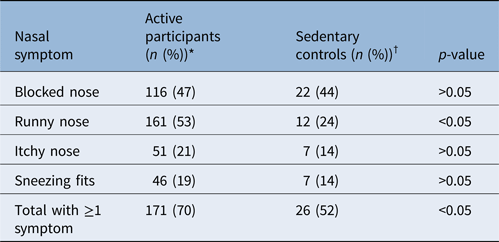
The presence of individual symptoms and number of symptoms per individual in the active and sedentary groups were recorded. Prevalence in each group was compared using the chi-square test (degrees of freedom = 2). These data are reported in Table 1.
Frequency of nasal symptoms in active and sedentary populations

*n = 246; †n = 50
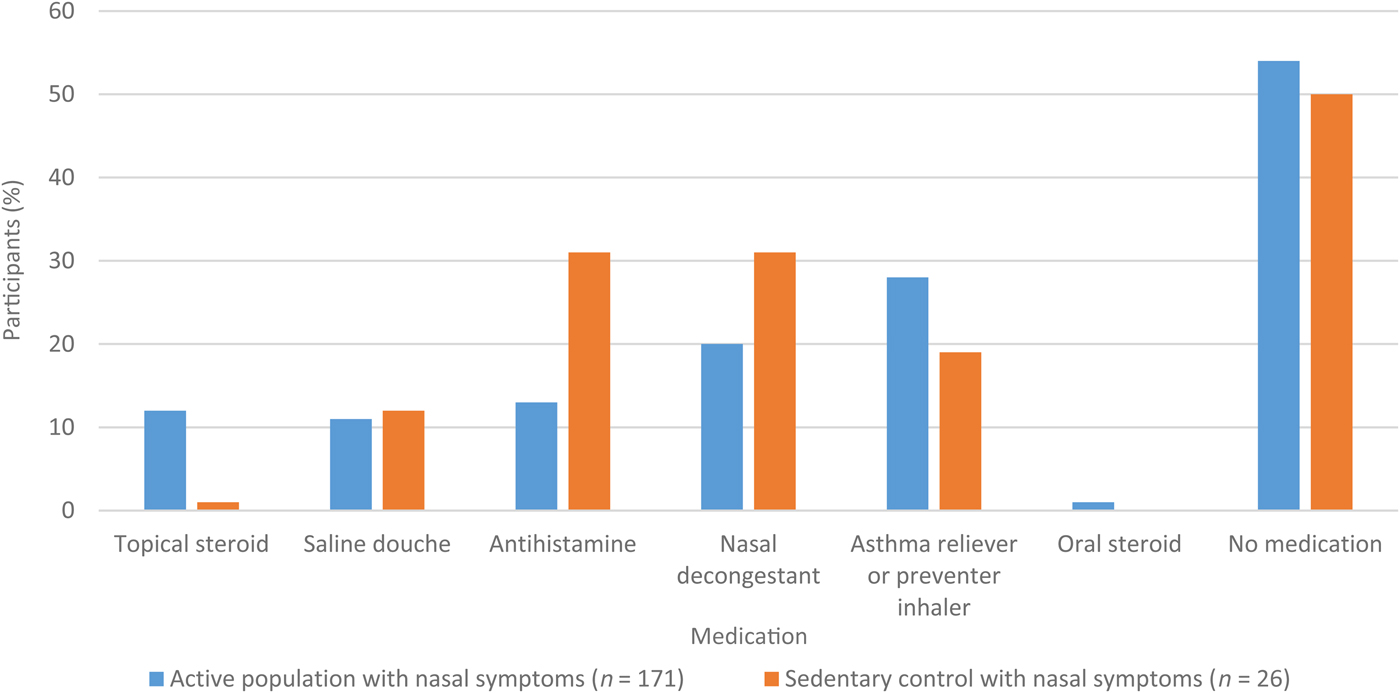
The percentages of those with more than one nasal symptom, in the active and sedentary populations, who use medical treatments for nasal disease or asthma are presented in Figure 1.
Proportion of participants with regular nasal symptoms who use medications for rhinitis or asthma.

Participants were asked if they were currently suffering with URTI symptoms (e.g. malaise, fever, cough, sore throat). Fifty-two athletes with more than one regular nasal symptom reported URTI, compared to only 12 athletes without nasal symptoms. Chi-square analysis confirmed that this represented a significant increase in the frequency of URTI in athletes with regular nasal symptoms compared to those athletes without nasal symptoms. There were more URTIs reported in sedentary controls with nasal symptoms (n = 7) than in those without such symptoms (n = 1), but this difference did not reach significance.
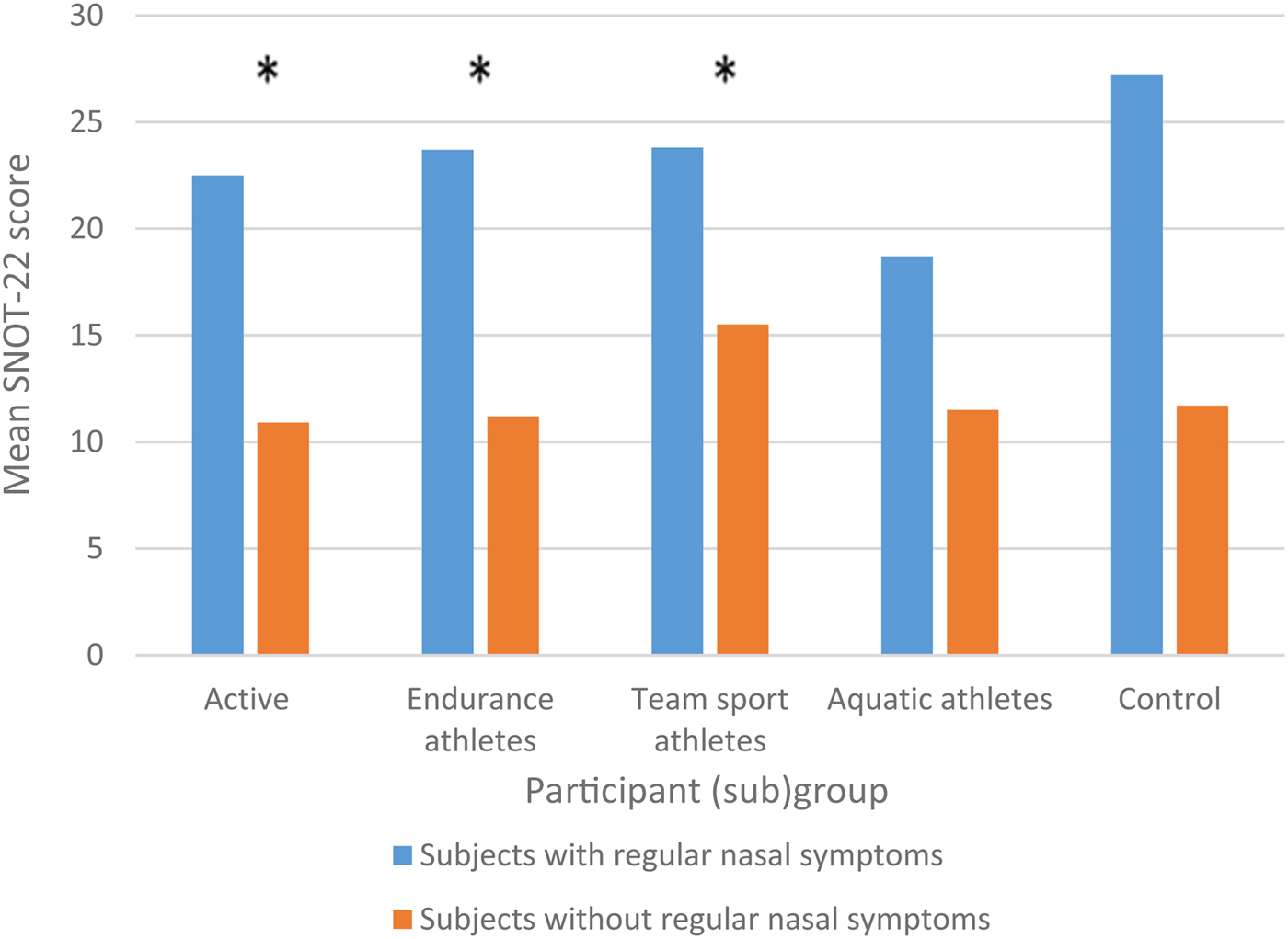
Complete SNOT-22 data were provided by 229 participants (186 athletes and 43 controls). Analysis of mean SNOT-22 scores for participants with and without nasal symptoms was performed, using a student's t-test, in the active and sedentary groups, and in each of the three active subgroups. This confirmed a significantly higher mean SNOT-22 score for participants with nasal symptoms in both the active and sedentary groups, and in the active subgroups of team sport and endurance athletes. These data are presented in Figure 2.
Mean 22-item Sino-Nasal Outcome Test (SNOT-22) scores for participants with and without nasal symptoms. *p < 0.05

Discussion
This study is the first to directly compare the frequency of nasal symptoms in regular exercisers and a sedentary population. It offers compelling evidence that athletes are more likely to suffer regular nasal symptoms than their sedentary counterparts. In addition, there was the novel finding that active participants with nasal symptoms were significantly more likely to suffer from URTIs and a significantly reduced quality of life than athletes who do not suffer from regular nasal symptoms.
Using the epidemiological definition of rhinitis (i.e. one or more nasal symptoms present on most days of the year), rates of nasal disease in our sedentary participants was higher than in some previous reports, which estimate prevalence to be in the range of 20–25 per cent.Reference Bauchau and Durham10, Reference Jones, Smith, Carney and Davis11 There are two possible reasons for this. Firstly, there may have been selection bias in our control population, resulting in a sample that is not representative of the wider population. Secondly, the relative youth of our population may be relevant in the study of a condition that increases in prevalence over time, with increases of 13 per cent in 12 years reported in a comparison of two birth cohorts.Reference Patil, Kurukulaaratchy, Venter, Grundy, Roberts and Dean12
The frequency of nasal symptoms in our population of athletes was also at the top end of the range quoted in previous reports. This may be attributable to differences in methodology. The only other study using a similar self-reporting of symptoms methodology found that 56 per cent of Australian Olympians reported symptoms of rhinitis,Reference Katelaris, Carrozzi, Burke and Byth3 a result consistent with our findings. By contrast, studies that relied upon a pre-existing diagnosis of rhinitis made by a sports physician tended to demonstrate much lower prevalence rates: 25 per cent in German elite athletes,Reference Thomas, Wolfarth, Wittmer, Nowak and Radon7 26.2 per cent in an Italian studyReference Bonini, Gramiccioni, Fioretti, Ruckert, Rinaldi and Akdis2 and 27 per cent in Polish Olympians.Reference Kurowski, Jurczyk, Krysztofiak and Kowalski4 Studies using self-reports of rhinitis rather than a pre-existing physician diagnosis may have higher prevalence rates as a result of individual subject factors; for instance, an athlete may not feel their symptoms are severe enough to justify consulting a doctor, or they may receive sufficient relief from self-medication. However, it also may reflect the fact that rhinitis is an underappreciated diagnosis in primary care.Reference Scadding, Kariyawasam, Scadding, Mirakian, Buckley and Dixon13
Seventy per cent of our active participants described suffering one or more nasal symptoms on most days of the year, potentially illustrating a huge body of disease within the active population. Despite this, there was little use of medication, with over half of the active participants with regular nasal symptoms using no medication at all. The most commonly used nasal medication by athletes was a decongestant. Resorting to over-the-counter decongestants to relieve symptoms may be a latent indicator of self-medication of rhinitis by athletes. This may in part be because of a fear of using prescription medications that may fall foul of anti-doping regulations. Although, interestingly, the current World Anti-Doping Agency's list of prohibited medications makes no specific reference to corticosteroids that are delivered intranasally.14 Data regarding the frequency and duration of nasal decongestant use were not collected. This would be a fruitful avenue for future study, to determine whether there is a high prevalence of rhinitis medicamentosa amongst active participants using regular decongestants. This tendency of regular decongestant use to cause rebound nasal congestion cannot be excluded as a possible confounder, and we acknowledge this as a limitation of our study. Asthma relievers and inhalers were overall the most frequent medication reported, and were used by 30 per cent of athletes with regular nasal symptoms. Taken together, these findings suggest there is an avenue to optimise treatment of the unified airway in this active population, with better education regarding appropriate treatment strategies for those who regularly experience nasal symptoms.
Upper respiratory tract infections were significantly more common in the active group with regular nasal symptoms than in those without. This is a novel finding not previously reported in the literature. Upper respiratory tract infections are the most prevalent illness in athletes,Reference Nieman15 representing the most common reason for missing days of training, and for seeking medical attention during both winter and summer Olympic Games.Reference Reeser, Willick and Elstad16, Reference Engebretsen, Soligard, Steffen, Alonso, Aubry and Budgett17 Despite this, an infectious agent is captured in only one-third of cases of athlete ‘URTI’, even when directly studied.Reference Spence, Brown, Pyne, Nissen, Sloots and McCormack18 The lack of consistent evidence for an infectious agent has led some investigators to question whether symptoms that are classically considered as reflecting URTI, such as blocked nose, rhinorrhoea, low grade fever and cough, are in fact caused by exercise-induced inflammation of the upper airway.Reference Robson-Ansley, Howatson, Tallent, Mitcheson, Walshe and Toms19 Investigation of the causality of these symptoms is not within the remit of this study; however, the frequency of these URTI-type symptoms in athletes with nasal symptoms in this study – nearly one-third of this subgroup – suggests that this hypothesis may be a fruitful line of further investigation.
Active individuals with nasal symptoms suffer a considerable detriment to overall quality of life, as demonstrated by our findings of significantly higher SNOT-22 scores. Left untreated, nasal disease represents a significant burden to these individuals and could potentially limit performance in competitive athletes. One observational trial that measured the impact of daily intranasal budesonide in athletes with rhinitis demonstrated significantly improved self-assessed performance scores after just eight weeks of treatment.Reference Katelaris, Carrozzi, Burke and Byth20 It is not known whether these improvements translate into an objective competitive gain, but they nonetheless highlight the utility of diagnosing and treating nasal disease in this population.
One of the key limitations of this self-report study is the inability to further investigate the aetiology of nasal disease in individuals and population subgroups. The advantage of a survey-based study is the ability to obtain large population samples and to draw conclusions based on robust statistical analyses. However, such survey studies are not able to ascertain rhinitis aetiology, or to detect whether the nasal symptoms suffered by athletes tend to be allergic or irritative in origin. Direct study by clinical examination, skin prick testing and serum immunoglobulin E would be useful future lines of investigation. Significant resources would be required to conduct such a clinical study of sufficient power, but the preliminary evidence from this study suggests it would be a valuable addition to the knowledge base.
• Nasal symptoms are common in the athletic population and cause significant detriment to quality of life
• Athletes avoid medications more than the sedentary population; counsel regarding benefits of appropriate medications may be needed
• Nearly one-third of athletes with nasal symptoms regularly use asthma medication
• Sports physicians should strongly consider treating co-existing nasal disease for optimal asthma control
• Upper respiratory tract symptoms attributed to infections are more common in those with nasal disease
• Upper respiratory tract symptoms may in fact represent airway inflammation secondary to intense exercise
In summary, this study is the first of its kind to directly compare the frequency of nasal symptoms reported by active and sedentary populations. It demonstrated that regular exercise is associated with a significant increase in these symptoms. Furthermore, the presence of nasal symptoms was associated with increased prevalence of URTI in the active population and caused significant detriment to quality of life. Additionally, there was evidence of inadequate and inappropriate treatment, with decongestants being the most commonly used nasal agent. Further clinical studies are required to inform conclusions regarding the aetiology of these upper respiratory tract symptoms; these would provide valuable insights in this emerging field of athlete welfare.
Competing interests
None declared