Introduction
Neurodevelopmental impairments represent the most prevalent morbidity for children with CHD. To minimise the impact of possible developmental delays, behavioural dysregulation, and deficits in executive function and social cognition, the 2024 American Heart Association Scientific Statement recommends routine assessments and interventions for individuals with complex CHD. Reference Sood, Newburger and Anixt1 Despite recommendations, only a small percentage of individuals at risk return to their surgical centre’s neurodevelopmental programme for recommended assessments, with those that live farther from their surgical centre less likely to return. Reference Ortinau, Wypij and Ilardi2 We have previously shown that in the rural state of Maine, when including other developmental and psychosocial clinicians beyond the surgical centre, rurality and distance from an academic centre are no longer associated with the likelihood of a child with complex CHD having an encounter. Reference Bohnhoff, Cutler and Price3 Additional locations provide opportunities for guideline-concordant neurodevelopmental and psychosocial follow-up in an individualised, patient-centred manner. To determine if our previous findings were unique to the state of Maine, we undertook parallel analyses with a cohort from Vermont.
Methods
We conducted a retrospective cohort study using the Vermont Health Care Uniform Reporting and Evaluation System, which is Vermont’s all-payer claims database that regularly aggregates data from both private and public payers. 4 We identified all individuals 0–18 years old with any claim between 1/1/2017 and 12/31/2019 as well as a CHD diagnosis code indicative of surgery within the first year of life, as previously described. Reference Bohnhoff, Cutler and Price3 The receipt of 7 discrete neurodevelopmental and psychosocial services was assessed. For each encounter, we determined the age of the patient on the encounter date, the insurance type associated with the encounter, and the on-road distance from the patient’s home zip code to the address affiliated with the encounter in the 2019 National Plan and Provider Enumeration System. 5 Analyses were similar to our previous report. Briefly, we tested the association between patient-level characteristics and receipt of any neurodevelopmental and psychosocial service using chi-squared tests and T-tests. We calculated the receipt of each of the 7 services by patient-level characteristic. Analyses were performed using Rv4.2.1. The nearest paediatric regional centre location for the children of Vermont included Burlington, VT; Albany, NY; Lebanon, NH; and Boston, MA.
Results
Patient-level characteristics
Among the 406 children with complex CHD who met inclusion criteria, 43% were 0–5 years old as of 2019. Eighty-four percent of children lived in rural areas, and 59% were publicly insured. Most children (60%) had biventricular anatomy without arch obstruction. About half of the children (55%) were located more than 300 km from the nearest congenital cardiac surgical centre.
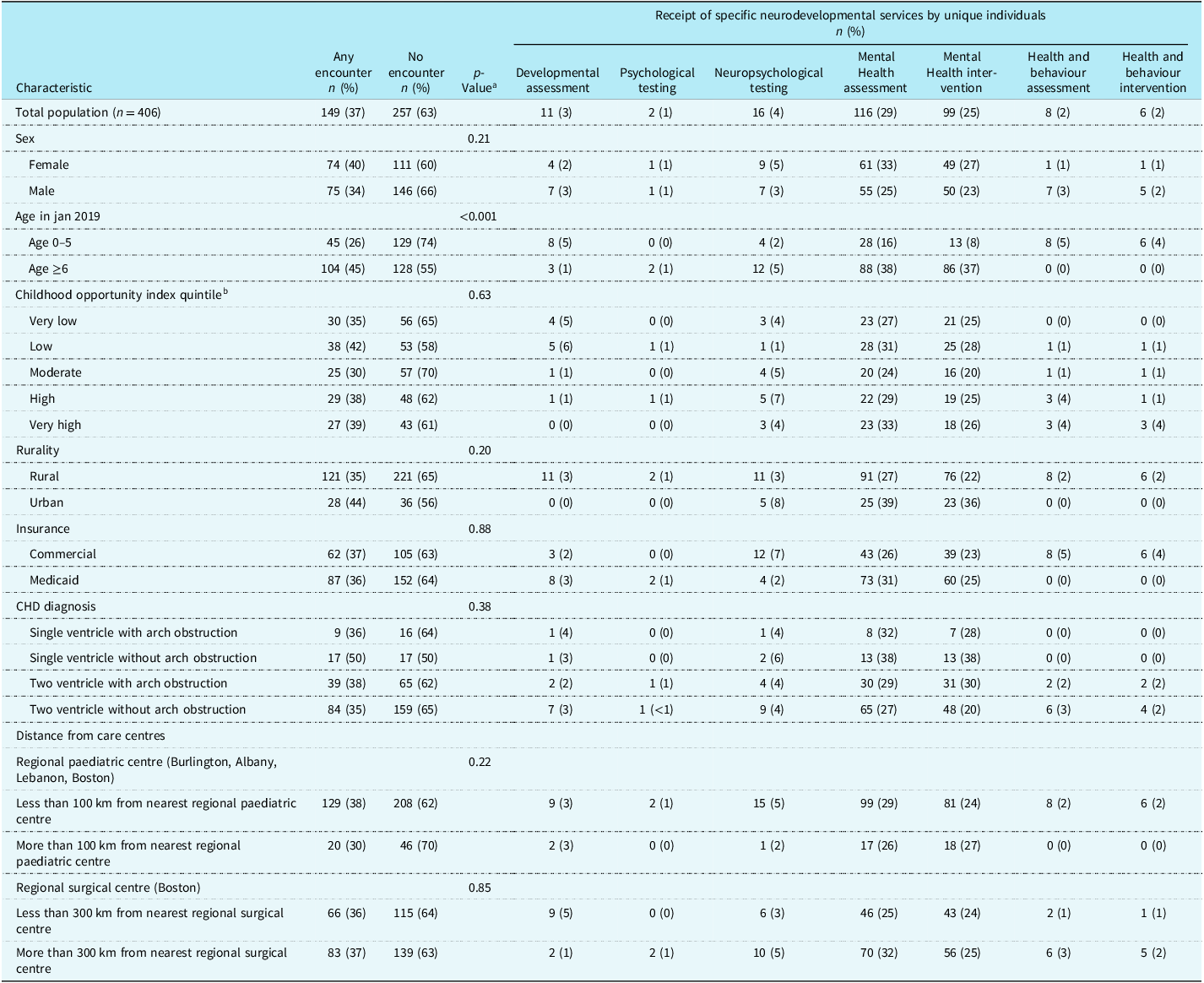
Approximately 37% (149) of children with complex CHD had at least one identified encounter during the study period (Table 1). The most frequently received services were mental health assessments and interventions.
Characteristics of children with CHD associated with neurodevelopmental services

Table 1. Long description
A table comparing the receipt of specific neurodevelopmental services by unique individuals with CHD. The table has 12 columns and 24 rows, including headers and grouped rows. Column headers include characteristics, any encounter, no encounter, developmental assessment, psychological testing, neuropsychological assessment, mental health intervention, mental health assessment, health and behavior intervention, and health and behavior assessment. Row labels include total population, sex, age in January 2013, childhood opportunity index quintile, rurality, insurance, CHD diagnosis, and distance from care centers. Each row provides percentages for each service received. Notable trends include higher service receipt in older age groups, specific CHD diagnoses, and closer proximity to care centers.
aPerson’s Chi-Squared Test.
bChildhood Opportunity Index v2.0, normalised by state.
The only patient-level characteristic associated with identification of at least one encounter was age ≥6 years old, driven by higher rates of mental health encounters. There was no association between sex, Childhood Opportunity Index 2.0 quintile, rurality, insurance type, type of CHD, or distance from the nearest regional or surgical centre and identification of an encounter.
Encounter-level characteristics
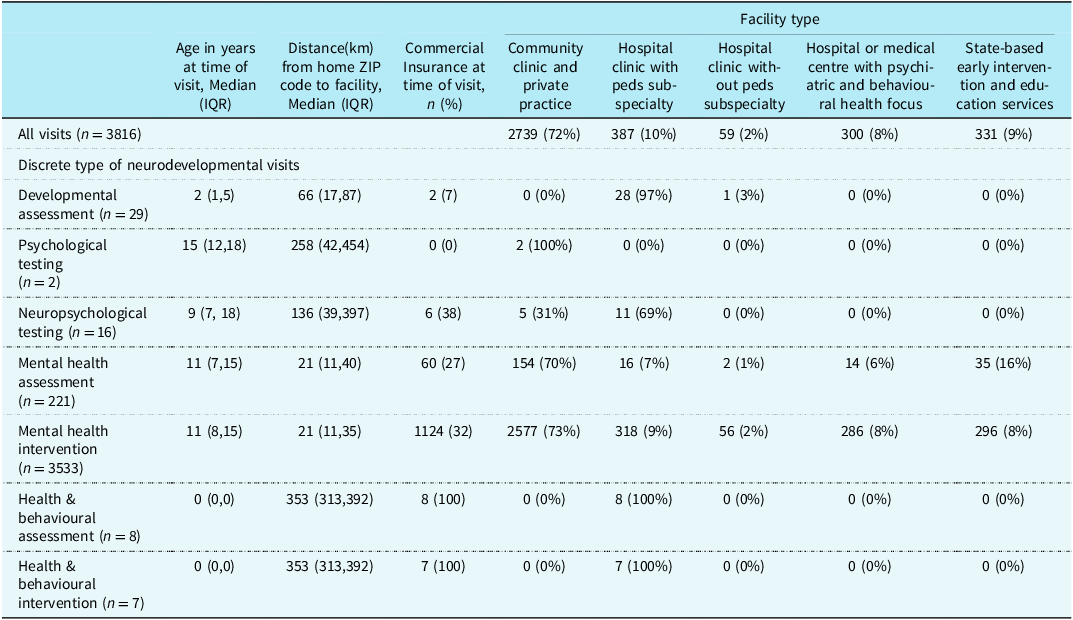
We identified 3816 unique neurodevelopmental and psychosocial service encounters among 149 children (Table 2). The most frequent type of encounter was mental health intervention (n = 3533). Both mental health assessment and intervention encounters occurred a median of 21 km (IQR 11–40 and 11–35) from the home zip code, whereas children travelled a median of 353 km (IQR 313–392) for health and behavioural assessments and 258 km (IQR 42–454) for psychological testing. A total of 70% and 73% of mental health assessments and interventions occurred at community clinics/private practice while 97% to 100% of developmental assessments and health and behavioural assessments, respectively, occurred at hospital clinics with paediatric subspecialists.
Characteristics of neurodevelopmental visits attended by children with CHD

Table 2. Long description
A table comparing characteristics of neurodevelopmental visits for children with CHD. The table has 10 rows and 8 columns. Column headers are Age in years at time of visit, Distance(km) from home ZIP code to facility, Commercial Insurance at time of visit, Community clinic and private practice, Hospital clinic with peds subspecialty, Hospital clinic without peds subspecialty, Hospital or medical centre with psychiatric and behavioural health focus, and State-based early intervention and education services. Row labels include All visits, Developmental assessment, Psychological testing, Neuropsychological testing, Mental health assessment, Mental health intervention, Health & behavioural assessment, and Health & behavioural intervention. Row 1: Age in years at time of visit, Median (IQR), 2 (1,5); Distance(km) from home ZIP code to facility, Median (IQR), 66 (17,87); Commercial Insurance at time of visit, n (%), 2 (7%); Community clinic and private practice, 0 (0%); Hospital clinic with peds subspecialty, 28 (97%); Hospital clinic without peds subspecialty, 1 (3%); Hospital or medical centre with psychiatric and behavioural health focus, 0 (0%); State-based early intervention and education services, 0 (0%). Row 2: Age in years at time of visit, Median (IQR), 15 (12,18); Distance(km) from home ZIP code to facility, Median (IQR), 258 (42,454); Commercial Insurance at time of visit, n (%), 0 (0%); Community clinic and private practice, 2 (100%); Hospital clinic with peds subspecialty, 0 (0%); Hospital clinic without peds subspecialty, 0 (0%); Hospital or medical centre with psychiatric and behavioural health focus, 0 (0%); State-based early intervention and education services, 0 (0%). Row 3: Age in years at time of visit, Median (IQR), 9 (7, 18); Distance(km) from home ZIP code to facility, Median (IQR), 136 (39,397); Commercial Insurance at time of visit, n (%), 6 (38%); Community clinic and private practice, 5 (31%); Hospital clinic with peds subspecialty, 11 (69%); Hospital clinic without peds subspecialty, 0 (0%); Hospital or medical centre with psychiatric and behavioural health focus, 0 (0%); State-based early intervention and education services, 0 (0%). Row 4: Age in years at time of visit, Median (IQR), 11 (7,15); Distance(km) from home ZIP code to facility, Median (IQR), 21 (11,40); Commercial Insurance at time of visit, n (%), 60 (27%); Community clinic and private practice, 154 (70%); Hospital clinic with peds subspecialty, 16 (7%); Hospital clinic without peds subspecialty, 2 (1%); Hospital or medical centre with psychiatric and behavioural health focus, 14 (6%); State-based early intervention and education services, 35 (16%). Row 5: Age in years at time of visit, Median (IQR), 11 (8,15); Distance(km) from home ZIP code to facility, Median (IQR), 21 (11,35); Commercial Insurance at time of visit, n (%), 1124 (32%); Community clinic and private practice, 2577 (73%); Hospital clinic with peds subspecialty, 318 (9%); Hospital clinic without peds subspecialty, 56 (2%); Hospital or medical centre with psychiatric and behavioural health focus, 286 (8%); State-based early intervention and education services, 296 (8%). Row 6: Age in years at time of visit, Median (IQR), 0 (0,0); Distance(km) from home ZIP code to facility, Median (IQR), 353 (313,392); Commercial Insurance at time of visit, n (%), 8 (100%); Community clinic and private practice, 0 (0%); Hospital clinic with peds subspecialty, 8 (100%); Hospital clinic without peds subspecialty, 0 (0%); Hospital or medical centre with psychiatric and behavioural health focus, 0 (0%); State-based early intervention and education services, 0 (0%). Row 7: Age in years at time of visit, Median (IQR), 0 (0,0); Distance(km) from home ZIP code to facility, Median (IQR), 353 (313,392); Commercial Insurance at time of visit, n (%), 7 (100%); Community clinic and private practice, 0 (0%); Hospital clinic with peds subspecialty, 7 (100%); Hospital clinic without peds subspecialty, 0 (0%); Hospital or medical centre with psychiatric and behavioural health focus, 0 (0%); State-based early intervention and education services, 0 (0%).
Discussion
In this validation cohort of children with complex CHD in Vermont all-payer claims data, we found similar patterns of healthcare utilisation for neurodevelopmental and psychosocial services as children in Maine. The additional cohort validates that in northern New England, most children over 5 years are accessing resources outside of the reach of their surgical centre’s neurodevelopmental programme. The Vermont cohort had a higher percentage of rurality than the Maine cohort but similar insurance distribution and cardiac anatomy. While a higher percentage of the Vermont cohort had any encounter (37% versus 23%), the encounter rates were driven primarily by mental health assessments and interventions in the older age group, similar to the findings in Maine.
Mental health encounters in both cohorts occurred predominately in community clinics and private practice, relatively close to the children’s home zip code. The encounters may also be an underestimation given that claims data would not capture families paying out of pocket for mental health services. While the engagement in mental health interventions is encouraging, a knowledge gap in the field of cardiac neurodevelopment continues to be whether rates of appropriate engagement for those at risk are higher than the general paediatrics population. Higher prevalence of mental health conditions in individuals with complex CHD compared to sibling-and age-matched cohorts has been described, Reference Miles, Farkas, Laugesen, Sorensen, Kasparian and Madsen6 but it remains unclear if those with CHD access services at higher rates and if established cardiac neurodevelopmental programmes impact the successful receipt of those services. Previous descriptions of neurodevelopmental programme engagement are typically focused on neurodevelopmental or neuropsychological assessment and not inclusive of mental health assessment and intervention. Rates of neurodevelopmental and neuropsychological assessment are remarkably lower in both the Maine and Vermont cohorts than previously published reports. Reference Ortinau, Wypij and Ilardi2
One difference between the two cohorts was the median distance travelled for different types of encounters. Children in Vermont travelled farther for psychological as well as health and behavioural assessments, although the numbers are small and should be interpreted with caution. We have previously shown that in New England, many academic paediatric centres have the infrastructure to support neuropsychological assessments but typically defer the assessment of children with complex CHD to the surgical centre’s neurodevelopmental programme. Reference Duncan, Davey and Flyer7
The pattern of encounters in Vermont and Maine cohorts, combined with the findings of large cardiac neurodevelopmental programmes Reference Ortinau, Wypij and Ilardi2 and proposed alternative approaches, Reference Kasparian, Sadhwani and Sananes8,Reference Abell, Rodwell and Eagleson9 reinforces that optimising neurodevelopmental and psychosocial outcomes for at-risk children with complex CHD requires a multifaceted, longitudinal approach. Children with CHD live in complex medical and educational environments beyond the scope of their surgical teams. Supporting, strengthening, and collaborating with community-based providers has the potential to minimise the impact of neurodevelopmental and psychosocial morbidity and provide more equitable healthcare delivery in children with complex CHD.
Acknowledgements
The authors would like to thank Michael DeSarno for his contributions to data cleaning and analysis as well as the members of the New England Congenital Cardiology Association Health Disparities Working Group for their contributions to this project.
Financial support
This work was supported by a grant from the New England Congenital Cardiology Research Foundation.
Competing interests
The authors confirm that they have no conflicts of interest to report.