Introduction
For scholars of the history of commerce, one of the most fundamental challenges is to define the form and to determine the permissible extent of the accumulation of wealth. The answer to this wealth issue, which varies among societies, is not only crucial in determining how wealth is retained and transferred, but also how businesses are established and sustained.Footnote 2 For decades historians have believed that the ‘corporation,’ with shares owned and traded in an open market, symbolizes the evolutionary peak of business organizations in Europe. Its organizational stability enhances its ability to participate in economic transactions. In this environment, commercial enterprises, in principle, are protected by commercial and statutory rules for partnerships, for limited liability, and for the operation of stock exchanges. This system offers increased flexibility to individuals to incorporate into legal entities and in transferring business interests. Based on the highly abstract concept of a ‘legal personality,’ the birth of the corporation has opened up convenient doors for market interaction and economic growth.Footnote 3 In this historical environment, individuals can utilize the idea of joint-stock companies for the accumulation of wealth; but what about those societies where there is no such concept of company law?
Through a reconstruction of historical legal disputes, particularly those surrounding two conflicting traditions of property-holding and business practices (highlighted by the ideas of Chinese ‘tong’ and British ‘trust’) found in urban Hong Kong, this paper discusses how British and Chinese business traditions interacted with each other during the late nineteenth and early twentieth centuries. It will also explore whether the institution of tong can be accommodated into British law, before assessing the historical implications and consequences of these legal decisions.
Business Customs in Traditional Chinese Society
Over the last decade, the study of business practices has experienced a major transformation, with the recognition that, in addition to technological and cultural factors, institutional factors also play a major role in shaping the structure of business. The first generation of new institutional economists took institutions as a given and studied their effect on the market and on the performance of the economy. They dealt with questions such as what types of institutions facilitated both the economic growth of the West, and the rise of that geographical area.Footnote 4 In the second generation of studies, the primary focus was shifted and adjusted as researchers came to question how institutions developed. Scholars generally believed that legal-economic institutions were not supplied automatically by the state upon demand, rather they were shaped by elements in the historical environment.Footnote 5 The following contextual discussion on the evolvement of social institutions, therefore, helps formulate a better view of what is inside the institutional black box, thereby, offering us a clearer basis from which to trace the migration of institutions between cultures.
To appreciate the diversity of business traditions in different civilizations, let us start with a brief survey of business practices in traditional Chinese society. In imperial China, government officials always had ambiguous attitudes toward trading activities. As the accumulation of wealth always invited intervention by rulers, it was very common that wealth was held and retained in the form of religious endowments, and in the names of deceased ancestors or patron deities. Economic activities are closely entwined with political and religious forces under the protective coverage of such social institutions as temples, lineages and guilds. In these environments, business was often conducted through webs of kinship, religious obligations, and personal relations.Footnote 6 David Faure's works on Chinese business history, for example, have revealed that in China, collective ritual provided the social glue that provided by the law in the West. Well before the importation of western business ideologies to China, the Chinese people had been engaged in business activities based on lines of descent, communal or religious links. During the Ming and Qing periods, the family lineage provided the basic foundation for commercial enterprise. The lineage mobilized capital, established commercial ties, and sought patronage to protect business activities. In a society where company law was practically non-existent, the application of kinship-related instruments to the enforcement of economic cooperation and the holding of property was of paramount importance.Footnote 7
The ability of the lineage to provide a sense of membership gave it the character of a corporation. For instance, Huizhou (Shanxi Province) merchants’ emphasis on honesty and filial piety is understood by historians as a strategy to define liability commitments of the family businesses (native banks and remittance houses). By emphasizing filial piety and repaying loans contracted by their fathers, the Huizhou merchants were consolidating their creditability as bankers.Footnote 8 Madeleine Zelin, in tracing the history of the Zigong Salt Yard in Sichuan, also found that in the salt-field operations, ‘lineage estates’ [pronounced ‘tang’ in Mandarin, and ‘tong’ in Cantonese] allowed families to build complex corporate land ownership structures, but discussion of the practice remained couched in the language of filiality. She documented that lineage estates, with diverse investment portfolios, allowed the incorporation of a variety of assets. Lineage estates were employed as a way to amass property for business investment, even though the language of formation was always that of ritual and ancestral veneration. Zelin makes the point that Chinese notions of individual private property were different from their Western counterparts. For instance, the unit of ownership is always the household and seldom the individual.Footnote 9 Recent studies of Chinese merchants in South China and Southeast Asia have also revealed the lineage estate [tong] was founded not only for financing ancestral worship, but for performing various economic functions. Tong was a unit of shareholding in businesses. It was common for Chinese merchants to adopt one or several tong names to represent their interests in different business ventures.Footnote 10
Historian Liu Zhiwei, through his extensive fieldwork and literature reviews, traced the history of these lineage trusts. He explained that literally, the tong is a ‘hall’. The Chinese character denoting it is exactly the same character that is used for an ancestral hall, or a hall in a temple complex. The tong stands for a physical building, even though no building is necessarily implied in its business application. By the sixteenth century, it was standard practice in government household registration to carry a household name (often as family tong) on the tax books, even long after the person so registered passed away. These tongs often held property on the understanding that they were held for the maintenance of ancestral worships or religious sacrifices. It was also common for fictitious tong names to be registered for tax collection. In this manner, the property held was understood as belonging to the deceased person or the patron deities to whom the sacrifice was dedicated. Many of these tongs performed communal or business duties.Footnote 11 Scholars generally believe that while business practices in the West depended on a legal structure that accepted individualism, incorporation was made possible in China by collective ritual practices. In imperial China, many lineages owned irrigated lands or other immovable properties that generated regular rent to the lineage. They used the rents to construct and maintain their ancestral hall and to educate members of the lineage for civil service examinations. By the late nineteenth and early twentieth centuries, some lineages also ventured into more sophisticated businesses, including mechanized mining and manufacturing.Footnote 12
For centuries, the developments of tong, as an institution, were closely linked to the fate of the political entities within which they functioned. Under different political regimes, it experienced ups and downs. In the age of European colonial expansion in Asia during the nineteenth and twentieth centuries, western colonial regimes were one of the major forces shaping the development of these institutions. The British, for instance, had built up powerful colonial regimes and reshaped the political landscape of the globe. The British Rule Against Perpetuities, for example, has been and continues to be a major force shaping business practices in Modern Asia.
The British ‘Rule Against Perpetuities’ and its Transplantation into Asia
For decades, scholars have believed that the publicly held corporation symbolizes the evolutionary apex of business organizations in the West. The idea of corporation can be traced to Roman society.Footnote 13 But in medieval times, the state of land being held by the ‘dead hand’ (‘mort main’ in French) of a corporation caused suspicions among feudal lords. As the corporation (for example, the Church) was never under age, and never died, the land was held in perpetuity. In Western Europe, as feudal rulers needed to avoid alienation of landed property and evasion of feudal duties, a ‘Rule Against Perpetuities’ gradually took hold in Europe. Its basic tenet was that no property might be held in trust for an indefinite period of time, thus preventing the loss of tenure to any perpetual trusts. In England, the Statutes of Mortmain were enacted by King Edward I, in 1279, and again in 1290, to circumscribe the Church's holding of property.Footnote 14 The Statutes provided that no estate should be granted to a corporation without royal assent. Nevertheless, exceptions were allowed if the property was held in a charitable trust. This status of corporation was later granted to institutions of learning, merchant guilds and municipal cities. In the mid-sixteenth century, the concept of corporation was extended to the formation of business organizations by privilege, for example, a Royal Charter granted by the monarch to groups of merchants engaged in long-distance trade, such as the British East India Company.Footnote 15 By the nineteenth century, the British Parliament gave legal approval for the incorporation of domestic businesses. With the passing of the Companies Act in 1844, business entities were given legitimate channels by which to incorporate themselves as companies without a Royal Charter. In 1855, the limited liability law was introduced. New and old company statutes were consolidated into the English Companies Act of 1862. With legislation, incorporating companies into new business enterprises became accessible to the general public. Companies could be incorporated not only by charter or a special act of Parliament, but also by registration under the Company Law. With the incorporation of companies, doing business with guaranteed legal protection became a right for all, and no longer a privilege granted by the monarch to a few.Footnote 16
Parallel to these developments, the statutes related to the idea of ‘mortmain’ also evolved over time. The modern version of it was contained in the Mortmain and Charitable Uses acts of 1888 and 1891. Accordingly, an unauthorized conveyance into mortmain made the land liable to forfeiture to the crown. In 1960, the law of mortmain was formally abolished in Britain. Today, although statutes prohibiting mortmain have been abolished in most countries, the principle still subsists to a certain extent in relation to trust law in the form of the Rule Against Perpetuities.Footnote 17 Mortmain legislation still exists in some jurisdictions in the Commonwealth (for example, in urban Hong Kong).Footnote 18 This paradox, among other issues, will be addressed in the second part of this paper.
After the founding of the British East India Company in 1600, tens of thousands of British traders set sail for the Far East. With British colonial rule in Calcutta, Malacca, Penang and Hong Kong, a commercial corridor slowly developed in maritime Asia. By the nineteenth century, British corporate laws had been transplanted to the British colonies with varying degrees of vigour. In colonies with substantial white settlements, as in America and Australia, this transplantation met with little difficulty. In Asia, however, these laws often clashed with native customs. English ownership, as a rule, is single and independent. It may be joint as granted by law (for example, by incorporation), but the presumption will be to the contrary. In Asia, joint ownership is very common. Wealth was very frequently held and protected in the names of different ancestors or patron deities.Footnote 19 These practices clashed with the British legal tradition, in particular, the Rule Against Perpetuities.
From the nineteenth century, the British courts passed down as legal precedents that these perpetual trusts violated the British Rule Against Perpetuities. But during the long process of legal negotiations, the Hindu religious endowment and the Chinese tong had different fates—while the Hindu religious endowment (regarded as parts of the indigenous religious practices in India) was granted exemption to the Rule, the Chinese tong was not granted such status.Footnote 20 At this point it may be instructive to look at the best known case, the Choa Cheow Neoh vs. Spottiswoode case (1869) in Penang, and observe how the British court came to deal with the Chinese Tong. The British court in Malaya passed down verdicts affirming that endowments held in the name of tong did not meet the test of being religious or charitable. Choa Chong Long was born in 1788 in Malacca. He went to Macau in 1838 and was murdered by some burglars. Mr Spottiswoode was the executor of his will, which contained a clause allocating certain of Choa's properties for the formation of a tong for the purpose of financing the sinchew (literally, spirit ruler) ceremony (this involved engraving Choa's name on a wooden tablet). Male, but not female, descendants were required to visit the tablet frequently and put food on the table in front of it. Choa's son challenged this clause. He filed a lawsuit in the British court in Malaya, and the nature of sinchew ceremony was called into question. The judge in charge of the case made history when he delivered the verdict. The British court had to rule whether accumulating properties for the purpose of the sinchew ceremony was an infringement on the Rule Against Perpetuities.Footnote 21 The argument was about whether the bequest could be considered charitable. The English judge believed it could not. He believed that the sinchew ceremony involved no deities and thus should not be regarded as a religion. Moreover, the ceremony did not have a lot to do with ‘general public utility’. Therefore it was not considered to be a charity. The judge spelled out the rationale of his verdict:
the food [for the sinchew ceremony] is . . . removed, and eaten or otherwise disposed of by the relatives, but there is no distribution of it in charity or among the poor. Indeed, the Chinese have a repugnance to food which has been offered in this way, except when they are members of the family. The [offering] papers which are burnt supply the spirit with money and clothing, the gold and silver tinsel turning into precious metal. No prayers are offered to the spirit; the person who makes the offering of food asks for nothing whatever. The primary object of the ceremony is to show respect and reverence to the deceased, to preserve his memory in this world, and to supply its wants in the other.Footnote 22
As the British judge saw no element of religion or charity in the sinchew ceremony, the court declared that money and property maintained for the purpose of sinchew was not exempt to the Rule Against Perpetuities. This verdict was re-affirmed in Yeap Cheah Neo v Ong Chen Neo in 1875.Footnote 23 As will be seen, these two precedents had significant implications for the native customs of other Chinese communities under British rule.
Chinese Tong versus British ‘Rule Against Perpetuities’
In British Hong Kong, the issue of whether the Chinese tong could be regarded as a legal person was called in question. As will be seen, the above two precedents in Penang were always cited by the British court to justify its decision. This verdict was detrimental to traditional Chinese business practices, as tong, being a common unit of share-holding in business investments, was not entitled to accumulate, transfer and inherit business shares. These issues switch the discussion from the realm of law into that of history particularly the realm of Hong Kong's colonial history.
The Companies Ordinance of 1865 enacted in British Hong Kong, was the first company law for regulating businesses in China. This law was used by a small number of Western companies, operating both in Hong Kong and China. However, the law made little impact on Chinese business circles. Many Chinese enterprises, without registration, preferred to operate under a business name (referred to as a hang or a hao). This business name appears in accounts books as a transacting party, but the holding of property, including the business, rested with the corporate body that was often known as the tong. This business name provided no indication of the nature of the ownership, which created difficulties for enforcement of contracts.Footnote 24 The oddity of these practices rested especially in the mobilizing of capital in the name of tong. The tong's flexible nature allowed for a variety of uses in the business environment, and this flexibility created confusion for law enforcement. As a result, the legal character of tong was questioned by the British court. The following lawsuit citations illustrate these conflicts.
In the first case, the legal character of the tong was questioned by the Chief Justice in a judgment he made in 1909. The British court had to decide whether a Chinese tong was entitled to sue and to file a lawsuit in the British court. In 1909, a Chinese business, the Tung Sang Wing Firm, sued to recover the sum of HK$13,000 from one of its managers who had embezzled company funds. The manager admitted that he had misappropriated funds but also alleged that the plaintiff firm had not been registered under the Companies Ordinance of 1865, thereby making it an illegal association. According to this logic, the firm was not entitled to sue him. Responding to the accusation, the plaintiff firm provided the court with a list of partners which consisted of 33 names, and stated that some of the shares which were in tong names in reality belonged to one individual. The judge commented that even accepting the submitted evidence, the firm could not be regarded as a legal person.Footnote 25 Neither could it be regarded as a legal entity that had the right to sue and to file a lawsuit in a British court.
The second case, Reuters, Brocklmann & Co. v. Tung Lok Tong, illustrates how the legal status of a tong led to conflict between the Chinese and foreign mercantile communities. In 1906, the Cheong Loong sugar firm had reached a deal with Messrs Reuters, Brockelmann, a German firm in the Colony. The sugar firm was not able to fulfill the contract, and the German firm demanded compensation. The two partners, however, returned to Canton without paying any compensation. The German firm sent their compradore to Canton where he tracked down Leung Lai Sang, described as a proprietor of the sugar firm. In addition, the comprodore reported that Mr Leung was also known to be a partner of Kwong Hing Cheong silk store in Canton. Failing to obtain payment, the German firm, with the help of the German Consulate and the Chinese District Magistrate at Canton, forced the silk store to close down. In 1917, twelve Chinese individuals, who claimed to be partners of the silk store, filed a law suit in the Hong Kong court against the German firm. They intended to sue the German firm for trespass. However the British judge noted that the point requiring decision was not whether there had been a trespass, but rather the legal status of the plaintiffs.Footnote 26 The judge documented in great detail how he perceived the Chinese customs of tong formation. Through his eyes, the British perception of this Chinese institution was vividly recorded:
A T'ong name is a compound expression or phrase composed of two or more words, each of them usually a Chinese ‘lucky character’ and ending with the Chinese word T'ong (literally Hall). Referring to that standard work Dr. Giles’ Chinese Dictionary, p. 1064, I find ‘t'ong meng’—‘T'ong name’ thus translated and explained.
The family hall name, usually consisting of two characters followed by T'ong (Hall) thus ‘Mo Tak T'ong Chin.’
Mo-Military
Tak-Valour
T'ong-Hall
Chin-(family surname of the individual)
In Hong Kong, apparently, the family surname usually comes at the beginning of the t'ong name thus:-
‘Li Tak T'ong’ (where Li is the surname), and not at the end as in Dr. Giles’ example. I have had the 12 t'ong names from the books of the [Kwong Hing Cheong] silk firm which appear in the Statement of Claim literally rendered into English by the Court translator, his list giving the Chinese characters, the sound in romanized letters, and the meaning in English, in each case as follows.
1. Tung Lok Tong: Mutual Rejoice Hall
2. Sing Fuk Tong: Receive Happiness Hall
3. King Sze Tong: Respectfully Thinking Hall
4. Kim Yu Tong: To be frugal Abundance Hall
5. Tsun Ip Tong: Great Property Hall
6. Kai Shut Tong: Continue Relate Hall
7. Wing Kwai Tong: Splendid Cinnamon Hall (or Cassia)
8. Wan Tik Tong: Sincerely Pursuing Hall (with right path)
9. Li Shu Tong: He who Forgives Hall
10. Luen Kwai Tong: Connected Cassia Hall
11. Pun Lap Tong: Foundation Make all
12. Fuk Lai Tong: Return to Property Hall.
It will be seen that these 12 t'ong names are purely fanciful disguises, they are not personal names in the ordinary sense and no surname is attached; each is really an arbitrary symbol conveying nothing to a person not in the secret, the real meaning must be found elsewhere. A t'ong name is, in fact, an alias used by Chinese for a variety of purposes, either in partnership business, or in holding property. The entries in these books were, on the face of them ambiguous, the shares were held in 12 fancy names, and evidence was necessary aliunde to discover the persons those names denoted.Footnote 27
As a result, the burden of proof shifted to the plaintiffs, who were required to prove that they were the true proprietors of the silk store. They were also expected to prove before the British court that they had the right to sue. The 12 tong holders from Canton learned a lesson the hard way. No further record of this dispute can be found in the British law reports. Legal precedents in urban Hong Kong had challenged not only the legal validity of tong as a shareholder in business investment, as will be discussed below, but also had challenged the traditional Chinese custom of inheritance.
On the issues of inheritance and the transfer of shares, the arguments in another case were cited in Li Chok Hung v. Li Pui Choi in 1910. The plaintiff, Li Chok Hung, was a resident of Hong Kong. He claimed that he was suing in his capacity as administrator of the estates of his father and his grandfather against his uncle. The plaintiff stated that he was the legal heir of all the investments made in the name of Li Mau Shing Tong (the tong name of Li's grandfather) and Li Wing Shing Tong (the tong name of Li's father). He insisted that the two tongs were family tongs, and the present administrator of the tongs (his uncle) was liable to account collectively to the descendants of Li Ka Shing (the grandfather), of which the plaintiff was one. The defendant, on the contrary, denied that the tongs were family investments. He claimed that all transactions concerning the tongs were personal to himself, and that the family or his father had no interest in them.Footnote 28
The judge found the idea of tong confusing. Before proceeding to discuss the case, he personally undertook to provide a definition of tong. He stated that according to his understanding, Chinese tongs could be divided into two categories: 1), hereditary tong name representing a man and his descendants; and 2), a personal tong name which related to the individual. The dispute was centered mainly on whether the tongs involved in the case were familial or personal. The resolution would determine whether business transactions done under the two tongs counted as family business or personal business. After cross-referencing the information submitted by the plaintiff and the defendant, the judge made the following decision. He said that although he found the defendant's evidence not fully reliable, he could not grant a favourable decision to the plaintiff. In an action to recover property the claimant could only succeed by the strength of his own title. He summarized it as follows:
If there is a law in China by which property in its successive devolution retains the character of ‘ancestral property’, it must be proved by the party alleging it. There is no rule of English law which enables the estate of a deceased person to retain that character and to accumulate without distribution; and the fact that no letters of administration have been granted will not give it that character.Footnote 29
As burden of proof rested on the plaintiff and not on the defendant, the judge declared that, according to British law, the investment made in the names of the two tongs could only be regarded as the personal property of the defendant. A tong was not a legal person. It could not enjoy legal recognition in urban Hong Kong. It was not a legal entity with a right to sue or to be sued. Nor was a tong entitled to accumulate wealth or transfer and inherit company shares.Footnote 30
The ‘Tong-Trust’ Analogy
As illustrated by the above cases, the courts in the urban area of Hong Kong constructed an analogy between Chinese tong property and British trust property. This analogy reflects the mentality of the common-law courts. In Britain, the trust was a popular device among the Victorian middle classes to preserve their private property for the benefit of their families. Whether this ‘Tong-Trust’ analogy in urban Hong Kong is historically justifiable is beyond the scope of this paper. But it is interesting to read the analogy from a wider historical perspective.
We learn from the above legal conflicts that the holding of religious and ancestral estates was not unique to China. The practices were, and still are, very common in different Chinese communities in Southeast Asia. Nevertheless, the British presence in Asia's coastal cities created a legal grey area between indigenous customs and British law. In India, British Malaya and Hong Kong, the British constructed an analogy between ancestral/religious property and trust property. Once established, it was an issue of deciding whether ‘the trust’ was charitable, as that was the legal way for a trust to become exempt from the Rule Against Perpetuities.Footnote 31 As illustrated by the above cases, the British courts have passed down as legal precedents that the Chinese tong violated the British ‘Rule Against Perpetuities’ and should be voided. This verdict has significant consequences in Asia as tong property-holding was an important social institution in traditional Chinese communities.
In British colonial history, one of the popular methods to preserve ingredients of the native society would have been to provide the needed rules of governance through legislation. However, the Hong Kong government, by constructing a tong-trust analogy, has ruled out this option in urban Hong Kong. The British encounter with Chinese ancestral estates was not unique. Goto Takehide's study of Taiwan, for instance, indicates that the Japanese colonial administrators had adopted different tactics to resolve similar legal conflicts in Taiwan. The Japanese regarded Taiwan's Jisi gongyue (ancestral estates) as a unique institution and made an effort to introduce a ‘Regulation on Jisi Gonye’, whereby the estate properties involved were allowed to be sustained, in accordance with custom, with the possibility of their being registered as corporations.Footnote 32 However, the British courts in the urban area of Hong Kong did not find tong a unique institution in need of a legislation to accommodate it into the British legal system. As a result, the ambiguous relationship between tong and corporations continues. To understand how this ‘tong-trust’ analogy continued in the British legal system, consider the following court case and what it reveals.
In the early 1980s, a dispute was brought to the Hong Kong High Court regarding claims to three pieces of property in urban Hong Kong. In this case, Ip Cheong-kwok versus Ip Siu-bun and Others, the British Court was asked to decide if property held in the name of two tongs was tenable in terms of English trust law. The story goes back to the late nineteenth century. In 1875, an Ip Koo-chi of Guangdong brought a piece of land, namely numbers 152, 154 and 156 Queen's Road Central, in colonial Hong Kong. With the property, two separate tongs were established. The tongs were governed by written rules set out by the Ips and were to be controlled by managers elected from among the members of the Ip clan. Accordingly, an Ip Tun Sheen Tong was established in respect of number 152 and the income derived from the investments made by the managers on behalf of the tong was to ‘supplement any shortfall in the ancestral worshipping fund’ in Mr Ip's home village (Gut Tai village in Xiangshan County). A Tung Yan Sheen Tong was also established against numbers 154 and 156 and the income derived was to assist in the ‘common welfare of the village’.Footnote 33 By 1987, the value of the above properties had skyrocketed to HK$210 million, as Queen's Road Central became the Central Business District.
It is remarkable that the judge, the plaintiff and the defendant all chose to equate the Chinese concept of tong with the western definition of ‘trust’. The plaintiff, Ip Koo-chi's grandson, claimed that the properties held by the two tongs were indeed in violation of the Rule Against Perpetuities, and that they should be returned to the settler's estate. On the other hand, the defendants argued that ancestral sacrifice and common welfare in the village were charitable purposes, and that tong properties should be exempt from the Rule Against Perpetuities.
The judge, referred to Lau Leung Shi v. Lau Po Tsun (1911), and decided that what he believed to be a trust in this case was indeed illegal. On Tun Sheen Tong, whose property was wholly or partly held for the purpose of ancestral worship, the judge concluded that the court could not ‘uphold a trust of indefinite duration for . . . ancestral worship’.Footnote 34 On Tung Yan Sheen Tong, the judge found that it was too exclusive in nature to be regarded as charitable. He elaborated his rationale as follows:
Gifts in general terms for the benefit of a local community have sometimes been held to be charitable . . . . But, . . ., the court must construe the words ‘to assist in the common welfare of the village’ with reference to the context in which they appear. At this point, the ‘local charity’ argument starts to run into difficulties . . . . The settlor's intention was to benefit his clan in the village, and not the inhabitants of the village as such whoever they might be. If that conclusion is correct, the trust assumes the character of one for the welfare of relations rather than one for welfare of a particular locality. And a trust for the welfare of relations . . . is not charitable because there is not sufficient of an element of public benefit about it.Footnote 35
The verdict was important. In the final days of its rule, the British Empire had reaffirmed in colonial Hong Kong a legal precedent that was previously rendered in 1911. The rationale behind this precedent in 1911 (Lau Leung Shi versus Lau Po Tsun), remarkably, followed the earlier verdict passed down by the British court in Malaya in 1869 (Choa Choon Neoh versus Spottiswoode).
In the course of British expansion, a well-developed strategy to absorb elements of the indigenous society was to introduce the rules of governance through legislation. By constructing a tong-trust analogy, the British court had ruled out this possibility. The effect of this decision was strongly felt in urban Hong Kong. What occurred was an institutional collision, between the Chinese tong and the British trust which lasted for more than a century and a half. The appropriate legally-approved option that was left for the Chinese business enterprise to gain corporation status was to register itself with the government in accordance with the Companies Ordinance. On paper, this seemed to be reasonable and straightforward. However, company registration records left behind by the Hong Kong government reveal a more complicated reality.
Legal Ambiguity: Chinese Tong as a British Company
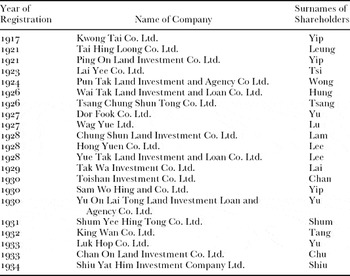
Since the introduction of company law in Hong Kong in 1865, most registered companies were foreign owned and managed. Existing archives indicate that about ten Chinese firms were registered in Hong Kong before 1910 (see Appendix 1). Six of these were engaged in the life, fire, and marine insurance business, two in the steamship transport business, and the remaining two in real estate.Footnote 36 Many Chinese shareholders were from the same business circle—merchants engaged in maritime trade and in the Nam Pak Hong business (literally, the North-South Company, engaged in re-export trade between mainland China and Southeast Asia). The British law had little impact on the wider Chinese business community before 1910. However from 1920 to 1937, the number of Chinese-owned businesses registered in Hong Kong quickly increased. According to existing archives, more than 60 Chinese firms were registered under the British company law in Hong Kong during this period. Of the 66 joint-stock companies identified in the records, at least 45 were engaged in banking, insurance and land investment. Of these 45 registered companies, 21 had the following three features in common. First, directors and shareholders of the same company shared the same surnames and the same places of origin; some even shared the same registered addresses. Second, although the shareholders’ places of residence varied among Hong Kong, south China, and Southeast Asia, all the registered directors were Hong Kong residents. Third, all these companies engaged in land investment and mortgages. A review of the available genealogies, wills, and records of regional associations found in south China indicates that many of these companies might be closely related to Chinese tongs organized along familial and regional lines.Footnote 37 These companies are listed in Table 1.
Major Chinese Businesses Registered in Hong Kong, 1917–1934

Source: Hong Kong Record Series 121, 122, 124, 144, Hong Kong Public Record Office.
To understand how these companies operated, we need to consider the following registration materials and what they reveal. The Toishan Investment Co. Ltd., for example, was registered in 1930. The articles of association claimed that its major businesses were mortgages and real estate. The capital of the company was HK$30,200, which was divided into 6,040 shares, each valued at HK$5. The list of shareholders showed that the company had 40 shareholders, all sharing the same place of origin (i.e., Toishan). Seven resided in Toishan, and 28 in Hong Kong. All seven directors resided in Hong Kong and shared the same surname (i.e., Chan).
A second example is the Tsang Chung Shum Tong Co. Ltd.. It was registered in 1926 with a capital of HK$500,000. The capital was divided into 500 shares, each valued at HK$1,000. This company also engaged in mortgages and property development. The company had 26 shareholders, all of whom shared the same surname and the same place of origin.
Even more examples illustrate the tong ownership. The Yu On Lai Tong Land Investment Loan and Agency Co. Ltd. was founded in 1930 by 39 men of Toishan origin, who shared the same surname of Yu. The Sam Wo Hing Co. Ltd. was also founded in 1930 with 33 men of Toishan origin with the surname of Ip. The Shum Yee Hing Tong Co. Ltd. was founded in 1931 by 19 men having the surname of Shum. The Pun Tak Land Investment Agency Co. Ltd. was founded in 1924 by 29 men with the surname of Wong. Wai Tak Land Investment and Loan Co. Ltd. was founded in 1926 by eight men of Foshan origin all with the surname of Hung.
All the companies mentioned above had one common feature: the shareholders of the same company shared the same surnames and the same places of origin. In other words, the shareholders of these companies had well-defined regional and familial links. A survey of the available genealogies, testaments found in south China, suggests that the shareholders of these registered companies were members of tongs. Footnote 38
An example of how the above companies originated is discussed below. The Kwong Tai Co. Ltd. (1917) can trace its beginnings from the Yip Kwong Tai Tong, which was an ancestral tong of the Yip family of Kushan, Guangdong, origin. The company was founded in 1917 by 15 senior members of the Yip lineage, 11 of whom lived in Hong Kong and four in Foshan. The founder of the Yip Kwong Tai Tong was Yip Ching-chuan, who inherited from his ancestral tong two native banks and one enterprise engaging in Nam Pak Hong business. Fleeing from the Taiping Rebellion in the Yangze Valley and Delta, Yip brought with him HK$30,000 to Hong Kong and started a business enterprise, which dealt with goods traded from his native county. He believed in the potential of the property market in Hong Kong and set up a real estate company, Yip Kwong Tai Tong. With the passage of time, the tong and the Yip lineage expanded and subdivided into four different branches (fang). The tong owned several parcels of land in the colony. In 1917, Yip's grandson, Yip Lan-cheun, reorganized the tong into a private, registered company. The capital of the company was HK$500,000 and was divided into 5,000 shares. The shareholders in Hong Kong and Foshan had 2,140, and 1,800 shares respectively. All three directors of the company resided in Hong Kong. Yip Lan-chuen also drafted and published a Manual for the Preservation of the Yip Kwong Tai Tong, which contained 271 articles detailing the manner and procedures of how the ancestral property would be managed. From 1900 to 1938 the male members of the tong had grown from 12 to 109, while its cash flow also grew from HK$22,000 to HK$256,000. The company held several valuable pieces of property in urban Hong Kong.Footnote 39
The founder of the Kwong Tai Company, Yip Lan-chuen, also explained in the manual the reasons for reorganizing the tong into a registered company. First, the heads of the four tong branches (fangzhang) had managed the tong. But internal disputes always occurred among family members whenever the senior head passed away. Second, the political disintegration of China, along with the chaotic social and economic situation in Guangdong, posed a threat to the investments made by the Yip Kwong Tai Tong in southern China. By registering the tong as a British company, Yip Lan-chuen showed that he regarded Hong Kong as a safe haven, from which his family property would be protected by British law against the political chaos in South China.Footnote 40
What can be seen from the Kwong Tai Company records (i.e., the Yip Kwong Tai Tong) is that the British presence in Hong Kong was largely responsible for providing a legal safe haven for Chinese merchants living in south China. The political instability of China had driven Chinese merchants to look for alternative venues for protecting their business ventures. The business laws in Hong Kong seemed to provide one option for these tong holders. By registering their investments under British company law in Hong Kong, the merchants sought to shield their business ventures from political instability in China.
Tong Properties in South China
The above record highlighted that the British presence in Hong Kong created a legal grey area between Chinese customs and British law. The mixing of Chinese and British institutions (as symbolized by the merging of Chinese tong with British company) was an important development in the evolution of business practices in Hong Kong. The narrative below illustrates how acute political instability in southern China accelerated this mixing process in the early twentieth century. As indicated by the registration record, the trend was closely linked to political upheavals in South China in the 1920s and 1930s.
In 1911, the Qing court collapsed and China disintegrated politically. After 1911 the discord between the Peking and the Canton governments worsened. In the north, unity was maintained only by the efforts of Yuan Shikai, the leader of the northern military clique. Following Yuan's death in 1916, competing military cliques emerged in different parts of China. In the south the Canton government was a loose coalition of militarists from neighbouring provinces. By expressing apparent allegiance to Sun Yat-sen, these regional troops occupied Guangdong and divided that province into spheres of influence. To sustain this regime and control its armies, the Canton government regularly bribed military leaders. But the Canton government could not always make these payments, and army leaders resorted to looting to obtain revenue. Tong properties were among the most obvious targets of these lootings. The following public notice, extracted from a popular Chinese newspaper, Huazi ribao, dated 10 November, 1925, graphically reveals the destruction of tong properties.
At the 5th of the month, when the ‘Fuk army’ [troops under local military leader Li Fuk-lam] and the [self-styled] ‘People's Army’ [troops organized by local groups] were fighting each other, our tong was unexpectedly stormed by these soldiers who crossed over our walls, forced open our doors, robbed us of our belongings, and burnt our houses. The looting, from the 5th to the 7th, continued for three consecutive days and nights. All our jewellery, money, clothing, furniture, totalling about ten thousand dollars, were all stolen. Together with business contracts, property deeds, account books, and documents were either robbed or burnt. These also included the following common properties placed under the control of our tong:
Liang Ji Yi Tong
Liang Miao Guang Zu
Liang Li Zhuang Zu
Liang Yan Chu Zu
Liang De Chang Tong
Liang Ge Shan Tong
Liang Ji Shu Tong
Liang Shou Shen Tong
Liang Chui Huo Tong
Liang Chui Xia Tong
Liang You Gu Tong
Liang You Yuan Tong
Liang Shen An Tong
Liang You Gu Tong
Liang Die Sheng Tong
Liang You Cheng Tong
Gu Jiao She
Gu Jiao Fu Xing Hui
Liang Ji Yuan Tong
All the account books, contracts and deeds of the above tongs were robbed, if the robbers produced the above documents for loan and mortgage, please do not be fooled by them. All the jewellery, clothing, contracts and deeds of our friends and relatives were all robbed, we are innocent and our loss is huge. The properties of the tongs and Shes, together with the saving of our friends and relatives were also stolen. With this notice, please inform the general public (my translation).Footnote 41
Other than the looting of tong properties by unruly armies, a new government policy also threatened the material well-being of many Chinese tongs. In 1923 the Canton government was in desperate straits, and its officials introduced an unprecedented land registration ordinance in the city of Canton. All common properties controlled by lineages, temples, and guild halls (many of them held in tong names) were declared public property (gongchan) or government property (guanchan) unless ‘red deeds’ (sealed deeds such as land deeds endorsed by the Qing government) were produced. These deeds had to be submitted to the newly formed Guangzhou Registration Bureau of Government Properties (Guangzhou guanchan gengjiju) for review and acceptance. The bureau tried to track down these contracts for land and buildings. Most of the land and buildings in Canton only had private contracts (those contracts signed by seller and buyer, without government endorsement) to justify their legal status.Footnote 42 Before the 1920s it was rare for ‘property owners’ (itself a modern concept) to obtain government endorsement or to register a property transfer. By decreeing that much land and many buildings held in tong names were public property, the government hoped to confiscate them and increase its revenue by rewarding any informants who reported to a public bureau any unknown ‘government property’ and ‘public property’ then held in private hands, especially that occupied by temples, or held by guilds, and regional associations. The banks, fearing unfair expropriation under this new legislation, no longer accepted immovable assets as a guarantee for their loans.Footnote 43
By subjecting properties in Canton to inspection, registration and confiscation, the Canton government operated a profitable business. But it also caused great resentment among Cantonese merchants, many of whom tried to hide their assets. Many tong property owners also tried to liquidate their immoveable wealth and take the proceeds to Hong Kong. The looting of tong properties by local unruly armies, and the confiscation of tong properties by the Canton government, drove many tong owners to move their bases to Hong Kong (as illustrated by Table 1 above), a haven where British laws offered them some legal protection. It was British rule in Hong Kong that provided immunity for tong properties from the predatory military leaders in southern China.
Conclusion
Through a reconstruction of the legal disputes surrounding two conflicting traditions of property-holding and business practices found in colonial Hong Kong (highlighted by the ideas of Chinese ‘tong’ and British ‘trust’), this paper suggests that different cultures have developed different institutions to amass ‘wealth’ (what we now call ‘capital’) and to facilitate business interactions. With the advance of British colonial activities, and by this process of legal negotiations, Chinese tong was held void by the British court in urban Hong Kong. However, the Chinese tong has not disappeared overnight. Some of them gradually merged themselves with British institutions. As indicated by company registration records available in Hong Kong, this process is most obvious in the 1920s and 1930s when political instability in southern China increased. The records have also revealed that institutions can indeed migrate between environments. During these migrations, British institutions (such as ‘company’) and Chinese institution (such as ‘tong’) have merged and evolved into new types of institution so as to conform better to the indigenous environment. Chinese businesses, therefore, entered the modern period equipped with a highly flexible repertoire of institutions born of both China's lineage property regime, and of those institutions borrowed from the West. All these institutions, both indigenous and foreign, have become building blocks for Hong Kong's economic order. Upon this foundation, Hong Kong would become one of the most important global financial centres in modern history.
In 2000, a study comparing business enterprises in nine East Asian countries found Hong Kong business enterprises high on a ranking of majority control exercised by families and by the cross-holding of shares among the core shareholders.Footnote 44 These findings suggest that more than a century after the adoption of British company law, a tight degree of familial networking continues to be a feature of corporate control in Chinese enterprises founded in Hong Kong. This development does not come as a surprise, if we consider the historical path of colonial Hong Kong as a frontier society bridging two huge empires (the British Empire and the Chinese Empire). As an economic buffer zone between the East and the West, colonial Hong Kong was a ‘mixing vessel’ for the business institutions of East and West.