Introduction
The shallow-marine Eocene deposits in the Biga Peninsula and the southern part of the Thrace Basin (northwest Turkey) are well known for the diverse occurrence of larger benthic foraminifers (LBF) after extensive research in the last decade (Okay et al., Reference Okay, Özcan, Cavazza, Okay and Less2010, Reference Okay, Özcan, Hakyemez, Siyako, Sunal and Kylander-Clark2019; Özcan et al., Reference Özcan, Less, Okay, Báldi-Beke, Kollányi and Yılmaz2010, Reference Özcan, Okay, Bürkan, Yücel and Özcan2018a; Less et al., Reference Less, Özcan and Okay2011; Sirel et al., Reference Sirel, Ayyıldız and Deveciler2020; Yücel et al., Reference Yücel, Özcan and Erbil2020). The LBF assemblages mainly consist of hyaline forms such as nummulitids, orthophragminids, and rotaliids, and rare porcelaneous taxa (Özcan et al., Reference Özcan, Less, Okay, Báldi-Beke, Kollányi and Yılmaz2010, Reference Özcan, Okay, Bürkan, Yücel and Özcan2018a; Less et al., Reference Less, Özcan and Okay2011; Sirel et al., Reference Sirel, Ayyıldız and Deveciler2020; Yücel et al., Reference Yücel, Özcan and Erbil2020). Although some slight compositional differences in orthophragminid assemblages in the Thrace Basin have been recognized when compared with well-known European assemblages (e.g, Orbitoclypeus haynesi (Samanta and Lahiri, Reference Samanta and Lahiri1985) lineage not occurring in Europe), taxa present from these groups typically show a Western Tethyan affinity (Özcan et al., Reference Özcan, Less, Okay, Báldi-Beke, Kollányi and Yılmaz2010, Reference Özcan, Saraswati, Yücel, Ali and Hanif2018b, Reference Özcan, Yücel, Erkızan, Gültekin, Kayğılı and Yurtsever2022a; Less et al., Reference Less, Özcan and Okay2011). Some of the most common lineages of heterosteginids and orthophragminids from the Eocene of the Thrace Basin form the backbone for a revised biostratigraphy and correlation of geographically widespread region, as well as establishing their phylogenetic histories within Tethys (Less et al., Reference Less, Özcan, Papazzoni and Stockar2008; Özcan et al., Reference Özcan, Less, Okay, Báldi-Beke, Kollányi and Yılmaz2010, Reference Özcan, Yücel, Erkızan, Gültekin, Kayğılı and Yurtsever2022a; Less and Özcan, Reference Less and Özcan2012). The information gathered from the aforementioned groups also served for the development of shallow-marine biostratigraphic scheme of Serra-Kiel et al. (Reference Serra-Kiel, Hottinger, Caus, Drobne and Ferràndez1998) for the Bartonian–Priabonian interval in Tethys by describing new subzones in Shallow Benthic Zones (SBZ) 18 and 19 (Less and Özcan, Reference Less and Özcan2012).
Although the assemblage shows a strong Tethyan affinity, there are several taxa present that were previously thought to be restricted to the Americas. Several sections in the Thrace Basin yielded moderately common Caudriella Haman and Huddleston, Reference Haman and Huddleston1984, originally described from the lower Bartonian of Margarita Island, Venezuela (Caudri, Reference Caudri1974) (Özcan et al., Reference Özcan, Yücel, Mitchell, Pignatti, Simmons, Okay, Erkızan and Gültekin2022b). This genus and its type-species, Margaritella ospinae Caudri, Reference Caudri1974, are poorly known from the American/Caribbean bioprovince (Loeblich and Tappan, Reference Loeblich and Tappan1987; Ferràndez-Cañadell and Serra-Kiel, Reference Ferràndez-Cañadell and Serra-Kiel1999; Andjić et al., Reference Andjić, Baumgartner-Mora, Baumgartner and Petrizzo2018; BouDagher-Fadel, Reference BouDagher-Fadel2018; Cornée et al., Reference Cornée, BouDagher-Fadel, Philippon, Léticée, Legendre, Maincent and Lebrun2020; Özcan et al., Reference Özcan, Yücel, Mitchell, Pignatti, Simmons, Okay, Erkızan and Gültekin2022b). The genus Caudriella also was reported from Carter Seamount, eastern equatorial Atlantic (Jones et al., Reference Jones, BouDagher-Fadel and Thirlwall2002), and recently from Iran (Hadi et al., Reference Hadi, Less and Vahidinia2019), either without any illustrations or with poor illustrations that do not convincingly prove the presence of the genus (see discussion in Özcan et al., Reference Özcan, Yücel, Mitchell, Pignatti, Simmons, Okay, Erkızan and Gültekin2022b). Additionally, some forms have been discovered that can be assigned to the genus Epiannularia Caudri, Reference Caudri1974, which is poorly known from the Tethys (Sirel, Reference Sirel1976). Its type species, Epiannularia pollonaisae Caudri, Reference Caudri1974, also was first described from the same locality as Caudriella—Margarita Island in Venezuela (Caudri, Reference Caudri1974). We also discovered disc-shaped specimens in the Eocene succession of the Thrace Basin that display a typical ‘orbitoidiform’ test structure and cannot be assigned to any of the above genera. These specimens show an unusual and complex chamber formation in the equatorial layer, with poorly developed lateral chambers and chamberlets. They differ from all other foraminifera with orbitoidal/annular test structure so far described in having a distinctive embryonic-nepionic development. Herein, a detailed description of these specimens, which are assigned to a new genus and species, Bigaella orbitoidiformis Özcan, Mitchell, Pignatti, Simmons, and Yücel, n. gen. n. sp., is given. The new taxon occurs at two different stratigraphic levels: upper Bartonian–transitional upper Bartonian–Priabonian and lower Priabonian beds in the Biga Peninsula. Comparisons of the new genus with the probably related genera Linderina Schlumberger, Reference Schlumberger1893, Caudriella, and Epiannularia are given, as well as with the American taxa Eulinderina Barker and Grimsdale, Reference Barker and Grimsdale1936, and Eolepidina Tan, Reference Tan1939, due to their superficial similarities externally and in their axial sections.
Geological setting, stratigraphic and paleontological context
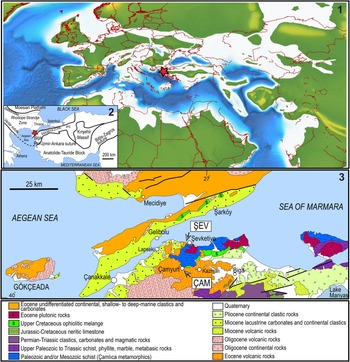
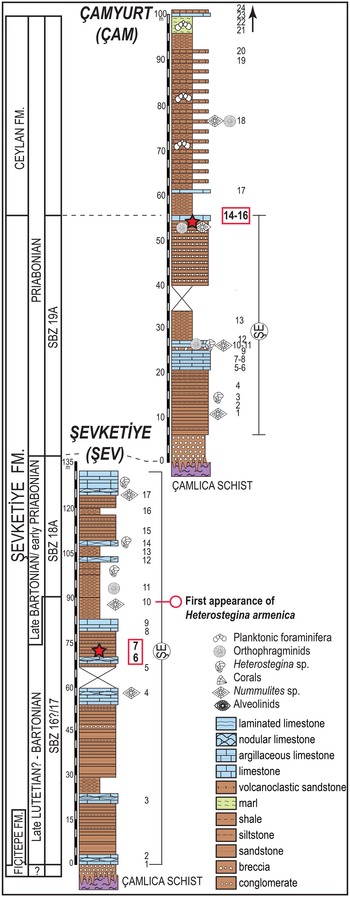
The Cenozoic marine deposits of the Biga Peninsula, NW Turkey, represent deposition on the margins of Tethys (Fig. 1.1, 1.2). The Biga Peninsula lies to the north of the İzmir-Ankara Suture Zone, which separates the Sakarya Zone to the north from Anatolide-Tauride Block to the south (Fig. 1.3). Basement between Lapseki and Biga is represented by metamorphic rocks (Çamlıca micaschist, Figs. 1.3, 2) (Okay et al., Reference Okay, Siyako and Bürkan1991). The overlying succession consists of widespread Eocene to Oligocene–Miocene volcanoplutonic complexes, and continental to shallow- to deep-marine Eocene deposits (Fig. 1.3) (Siyako et al., Reference Siyako, Bürkan and Okay1989; Genç et al., Reference Genç, Dönmez, Akçay, Altunkaynak, Eyüpoğlu, Ilgar, Yüzer and Tunay2012; Ilgar et al., Reference Ilgar, Demirci-Sezen, Demirci, Yüzer and Tunay2012; Ersoy et al., Reference Ersoy, Akal, Genç, Candan, Palmer, Prelević, Uysal and Mertz-Kraus2017). Volcanic activity started in the Lutetian and lasted until the Miocene (Altunkaynak and Genç, Reference Altunkaynak and Genç2008; Ersoy et al., Reference Ersoy, Akal, Genç, Candan, Palmer, Prelević, Uysal and Mertz-Kraus2017). The middle to upper Eocene Fıçıtepe Formation is a thick unit composed of conglomerate, sandstone, siltstone, and mudstone, and is interpreted as a deltaic depositional system (Ilgar et al., Reference Ilgar, Demirci-Sezen, Demirci, Yüzer and Tunay2012). The Fıçıtepe Formation is overlain either by the predominantly clastic deposits of the Şevketiye Formation, comprising fossiliferous sandstone, siltstone, shale, limestone, and some conglomerate beds (Fig. 2), or by the Soğucak Formation, comprising fossiliferous limestone and sandy/clayey limestone with rare sandstone and mudstone inter-beds. The Şevketiye Formation, with a limited geographic distribution only in the northern part of the Biga Peninsula, is ~135 m thick, previously dated as late Lutetian?–early Priabonian based on the alveolinids, heterosteginids, and orthophragminids (Özcan et al., Reference Özcan, Okay, Bürkan, Yücel and Özcan2018a; Fig. 3). The unit was interpreted to have been deposited in a shallow marine depositional environment. Bigaella Özcan, Mitchell, Pignatti, Simmons, and Yücel, n. gen., occurs in the middle and upper part of the formation (Fig. 2). The Soğucak Formation, ~40 m thick in the Biga Peninsula, is characterized by coral-bearing carbonates with abundant larger benthic foraminifers, cropping out extensively in the Thrace Basin (Siyako and Huvaz, Reference Siyako and Huvaz2007; Özcan et al., Reference Özcan, Less, Okay, Báldi-Beke, Kollányi and Yılmaz2010, Reference Özcan, Okay, Bürkan, Yücel and Özcan2018a; Less et al., Reference Less, Özcan and Okay2011). LBFs belonging to nummulitids and orthophragminids suggest that the age of the unit ranges from late Lutetian to Priabonian (Özcan et al., Reference Özcan, Less, Okay, Báldi-Beke, Kollányi and Yılmaz2010). The unit was interpreted to have been deposited in various settings ranging from middle shelf (back-bank facies) to outer shelf (fore-bank facies) (Less et al., Reference Less, Özcan and Okay2011). The Şevketiye Formation was interpreted as passing laterally into the Soğucak Formation in the Biga Peninsula (Özcan et al., Reference Özcan, Okay, Bürkan, Yücel and Özcan2018a).
(1) Paleogeographic location of the Biga Peninsula during late middle Eocene paleogeography (reconstruction kindly provided by Halliburton and created from various sources, notably Stampfli and Borel, Reference Stampfli, Borel, Cavazza, Roure, Spakman, Stampfli and Ziegler2004). The star denotes the location of Biga Peninsula where the Şevketiye Formation crops out in NW Turkey. (2) Tectonic map of the northeastern Mediterranean region showing the major sutures and continental blocks (simplified from Okay and Tüysüz, Reference Okay and Tüysüz1999). (3) Geological map of the northern segment of the Biga Peninsula and the southern part of the Thrace Basin with locations of the Şevketiye and Çamyurt sections in the Biga Peninsula (slightly modified from Akbaş et al., Reference Akbaş, Akdeniz, Aksay, Altun and Balcı2011, Duru et al., Reference Duru, Dönmez, Ilgar, Pehlivan, Akçay, Yüzer and Tunay2012). IPS = Intra-Pontide suture, IZ = İstanbul Zone.

Stratigraphic columns of the Şevketiye Formation in the Şevketiye and Çamyurt sections and position of the samples ŞEV6, ŞEV 7, and ÇAM14-17 with Bigaella orbitoidiformis Özcan, Mitchell, Pignatti, Simmons, and Yücel, n. gen. n. sp. SBZ = Shallow Benthic Zones by Serra-Kiel et al. (Reference Serra-Kiel, Hottinger, Caus, Drobne and Ferràndez1998), updated by Less and Özcan (Reference Less and Özcan2012) for the Bartonian and the Priabonian. ŞE = Şevketiye Formation. Stratigraphy of both sections after Özcan et al. (Reference Özcan, Okay, Bürkan, Yücel and Özcan2018a).

Materials and methods
Specimens of Bigaella orbitoidiformis Özcan, Mitchell, Pignatti, Simmons, and Yücel, n. gen. n. sp., were collected from the Şevketiye Formation at the Şevketiye and Çamyurt sections in the Biga Peninsula in NW Turkey (Figs. 3, 4).
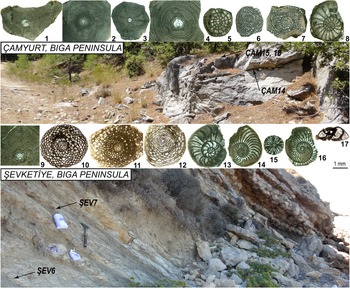
Field photographs of the upper part of the Şevketiye Formation near Çamyurt and Şevketiye villages in the Biga Peninsula and locations of the samples with Bigaella orbitoidiformis Özcan, Mitchell, Pignatti, Simmons, and Yücel, n. gen. n. sp. Characteristic LBFs at both localities are shown alongside. (1–8) From the Çamyurt and (9–17) from the Şevketiye section. (1) Asterocyclina alticostata (Nuttall, Reference Nuttall1926), ÇAM14-24. (2) Nemkovella daguini (Neumann), ÇAM14-25. (3) Orbitoclypeus varians scalaris (Schlumberger, Reference Schlumberger1903), ÇAM14-28. (4) Discocyclina pratti pratti (Michelin), ÇAM14-37. (5) Nummulites fabianii (Prever), ÇAM14-21. (6, 7) Heterostegina reticulata mossanensis Less, Özcan, Papazzoni, and Stockar, (6) ÇAM14-32, (7) ÇAM14-14. (8) Operculina ex gr. alpina Douvillé, ÇAM14-22. (9) Asterocyclina stellata (d'Archiac), ŞEV8-10. (10) Linderina brugesi Schlumberger, ŞEV7-9. (11) Caudriella ospinae (Caudri), ŞEV7-127b. (12) Epiannularia pollonaisae Caudri, ŞEV7-111. (13) Operculina ex gr. alpina Douvillé, ŞEV6-5. (14) Operculina ex gr. gomezi Colom and Bauzá, ŞEV8-3. (15) Sphaerogypsina globulus (Reuss, Reference Reuss1848), ŞEV6-3. (16) Heterostegina armenica (Grigoryan), ŞEV11-35. (17) Schlosserina asterites (Gümbel), ŞEV8-103.

Şevketiye section, Biga Peninsula
The Şevketiye section is located west of Şevketiye village along the shores of the Sea of Marmara (Figs. 1.3, 3). Samples ŞEV6 and 7 from the Şevketiye Formation (40°23′59.15″N; 26°50′14.91″E; Figs. 2, 3) contain common specimens of some forms, such as, Bigaella Özcan, Mitchell, Pignatti, Simmons, and Yücel, n. gen., Caudriella ospinae (Caudri, Reference Caudri1974), Linderina brugesi Schlumberger, Reference Schlumberger1893, and Epiannularia pollonaisae. These samples also contain Operculina ex gr. alpina Douvillé, Reference Douvillé1916; Operculina ex gr. gomezi Colom and Bauzá, Reference Colom and Bauzà1950; Heterostegina cf. H. armenica Grigoryan, Reference Grigoryan1986; Orbitoclypeus varians (Kaufmann, Reference Kaufmann1867); Asterocyclina stellata (d’Archiac, Reference Archiac1864); Schlosserina asterites (Gümbel, Reference Gümbel1870); and Asterigerina sp. (Fig. 3.9–3.17). Samples ŞEV10 and 11, ~10 m above the samples yielding Bigaella n. gen., contain Heterostegina armenica (Fig. 3.16), which is a key species that first appears close to the Bartonian-Priabonian boundary (SBZ 18A) (Less et al., Reference Less, Özcan, Papazzoni and Stockar2008; Özcan et al., Reference Özcan, Less, Jovane, Catanzariti and Frontalini2019). Therefore, the studied samples can be attributed to either the late Bartonian or the late Bartonian–early Priabonian transition.
Çamyurt section, Biga Peninsula
The Çamyurt section is situated in the vicinity of Çamyurt village, 14.3 km south of the Şevketiye section (Figs. 1.3, 3). Sample ÇAM14-16 was collected from a limestone bed in the uppermost part of the Şevketiye Formation (40°16′36.21″N, 26°50′47.29″E) (Özcan et al., Reference Özcan, Okay, Bürkan, Yücel and Özcan2018a). The LBF assemblage in sample ÇAM14 is diverse and contains Heterostegina reticulata mossanensis Less et al., Reference Less, Özcan, Papazzoni and Stockar2008; Operculina ex gr. alpina Douvillé; Nummulites fabianii (Prever in Fabiani, Reference Fabiani1905); Discocyclina pratti pratti (Michelin, Reference Michelin1846); Orbitoclypeus varians varians (Kaufmann, Reference Kaufmann1867); Nemkovella daguini (Neumann, Reference Neumann1958); Asterocyclina stellata stellaris (Brünner in Rütimeyer, Reference Rütimeyer1850); Asterocyclina kecskemetii Less, Reference Less1987; Linderina brugesi, and Spiroclypeus sp. (Fig. 3.1–3.8), along with Bigaella Özcan, Mitchell, Pignatti, Simmons, and Yücel, n. gen. This assemblage corresponds to Zone SBZ 19A (based on the biostratigraphic scheme by Less and Özcan, Reference Less and Özcan2012, after Serra-Kiel et al., Reference Serra-Kiel, Hottinger, Caus, Drobne and Ferràndez1998), suggesting a Priabonian age.
The material consists of matrix-free specimens, collected from soft sediments. Specimens were processed in the lab by preparing their axial and equatorial sections by grinding the test with an abrasive paper until the preferred orientation of the test was obtained. Several specimens were studied from random petrological thin sections. Morphometric measurements and counts (Table 1) were carried out on axial and equatorial sections of the megalospheric specimens. Measurements of the embryonic apparatus and the following (third) chamber are illustrated in Figure 5.4.
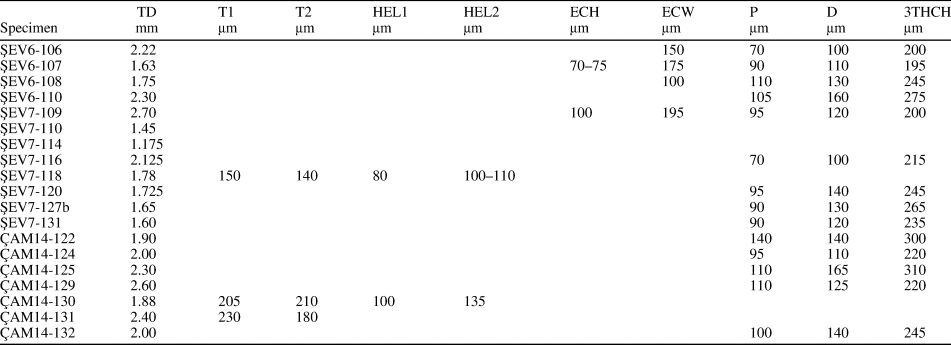
Statistical data of Bigaella orbitoidiformis Özcan, Mitchell, Pignatti, Simmons, and Yücel, n. gen. n. sp. TD = Test diameter, T1 = thickness of test at the central part of test, T2 = thickness of test at the peripheral part of test, HEL1 = thickness of the equatorial layer in the nepionic stage, HEL2 = thickness of the equatorial layer at the peripheral part of the test, ECH = height of the chamberlets in the equatorial layer in nepionic stage (as measured in the equatorial section), ECW = width of the chamberlets in the equatorial layer in nepionic stage (as measured in the equatorial section), P = diameter of proloculus, D = diameter of second chamber, 3THCH = diameter of the third chamber.

Repository and institutional abbreviation
All specimens are deposited in the paleontological collections of the Geological Engineering Department of İstanbul Technical University and prefixed EO/. The studied specimens from samples ŞEV6, ŞEV7, and ÇAM14 include EO/ŞEV6-106, EO/ŞEV6-107, EO/ŞEV6-108, EO/ŞEV6-110, EO/ŞEV7-108, EO/ŞEV7-109, EO/ŞEV7-110, EO/ŞEV7-113, EO/ŞEV7-114, EO/ŞEV7-116, EO/ŞEV7-118, EO/ŞEV7-119, EO/ŞEV7-120, EO/ŞEV7-121, EO/ŞEV7-124, EO/ŞEV7-127, EO/ŞEV7-131, EO/ÇAM14-122, EO/ÇAM14-124, EO/ÇAM14-125, EO/ÇAM14-129, EO/ÇAM14-130, EO/ÇAM14-131, EO/ÇAM14-132, and EO/ÇAM14-135.
Systematic paleontology
Bigaella Özcan, Mitchell, Pignatti, Simmons, and Yücel, n. gen. is placed in the superfamily Orbitoidoidea based on its orbitoidiform test structure (i.e., a disc-shaped test with an equatorial layer consisting of cyclical chamberlets and lateral layers with chamberlets). The new genus is assigned to the family Eoannulariidae, which was established by Ferràndez-Cañadell and Serra-Kiel (Reference Ferràndez-Cañadell and Serra-Kiel1999) as characterized by a bilocular embryonic apparatus and initial orbitoidal growth followed by annular chambers.
Superfamily Orbitoidoidea Schwager, Reference Schwager1876
Family Eoannulariidae Ferràndez-Cañadell and Serra-Kiel, Reference Ferràndez-Cañadell and Serra-Kiel1999
(emended herein, ex Eoannularidae Ferràndez-Cañadell and Serra-Kiel, Reference Ferràndez-Cañadell and Serra-Kiel1999)
Genus Bigaella Özcan, Mitchell, Pignatti, Simmons, and Yücel, new genus
Type species
Bigaella orbitoidiformis Özcan, Mitchell, Pignatti, Simmons, and Yücel, n. sp., from the Şevketiye Formation at Biga Peninsula, NW Turkey, by original designation. The genus is currently monotypic.
Diagnosis
Hyaline, coarsely perforate, delicate discoidal test with circular outline and a sharp margin, with a main equatorial layer of early arcuate chamberlets arranged in cycles in the early stage, then progressively passing to incomplete and complete annular chambers with complex subdivision of the annular spaces. Lateral chamberlets poorly developed on both sides of the test. Megalospheric specimens with bilocular embryonic apparatus followed by a large third chamber with lobate outline, depressed at its margins where the chamberlets of the next growth step directly arise from it or from the junction of the walls with the proloculus and the second chamber. Cyclic growth starts with the formation of several small chamberlets around the third chamber and the junction of the third chamber and the embryonic chambers. The early arcuate chamberlets are connected by basal stolons, whereas the annular chambers are connected by numerous radial stolons.
Etymology
After the Biga Peninsula, located between the Sea of Marmara and the Aegean Sea in NW Turkey, from where the studied samples were collected.
Remarks
In the Cretaceous and Paleogene, various groups of discoidal, hyaline LBF evolved that possess a discrete layer of equatorial chambers and two layers of lateral chamberlets. These foraminifers display a wide spectrum of chamber arrangements in the formation of embryonic apparatus, and nepionic and neanic chambers and chamberlets (size, shape, and their relationship) with various stolon systems connecting them (Hottinger, Reference Hottinger1966, Reference Hottinger2005, Reference Hottinger2006; Less, Reference Less1987; Loeblich and Tappan, Reference Loeblich and Tappan1987; Drooger, Reference Drooger1993; Ferràndez-Cañadell, Reference Ferràndez-Cañadell1998, Reference Ferràndez-Cañadell2002; BouDagher-Fadel, Reference BouDagher-Fadel2018). In the Eocene, several hyaline discoidal genera, such as Epiannularia, Linderina, Eulinderina, and Eoannularia, also built relatively simple tests with only a main layer of chambers (and chamberlets) following a bilocular or trilocular embryonic apparatus (Loeblich and Tappan, Reference Loeblich and Tappan1987; Ferràndez-Cañadell and Serra-Kiel, Reference Ferràndez-Cañadell and Serra-Kiel1999). These genera lack lateral chamberlets; some instead possess rather thick lateral walls (e.g., Linderina). The aforementioned genera developed various types of equatorial chambers/chamberlets, showing either cyclical growth (e.g., Linderina with a trilocular embryonic apparatus), or early cyclical chamberlets followed by unsubdivided annular chambers (e.g., Epiannularia with a bilocular embryonic apparatus), or cyclical chamberlets followed by subdivided annular chambers (e.g., Eoannularia with a bilocular embryonic apparatus). The bilocular embryonic apparatus in Eulinderina is followed a series of spiral chambers that pass to cyclical growth in the later stages.
The bilocular embryonic apparatus of Bigaella Özcan, Mitchell, Pignatti, Simmons, and Yücel, n. gen., is followed by a notably larger third chamber that, in fact, forms an auxiliary chamber. This chamber possesses both basal stolons and radial stolons leading to the formation of multiple chamberlets that form cyclical series in the later stages and finally annular chambers with complex subdivision. Piles are not observed. These features differentiate the new genus from the aforementioned taxa.
Bigaella orbitoidiformis Özcan, Mitchell, Pignatti, Simmons, and Yücel new species
Figures 4–9, 10.1–10.6
Holotype
Specimen ŞEV6-106, megalospheric specimen from the Şevketiye section (Figs. 4.6, 5.1). Collection number ŞEV6-106 in the Department of Geological Engineering, İTÜ, İstanbul. Test diameter of the holotype is 2.22 mm.
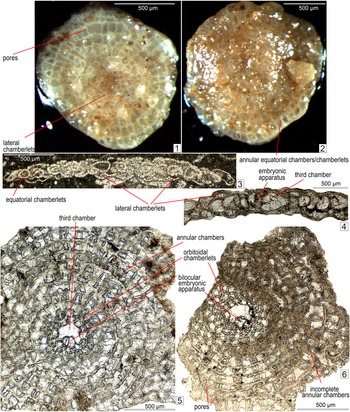
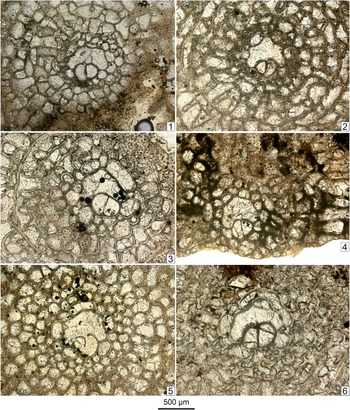
(1, 2) External views, (3) sub-axial, (4) axial, and (5, 6) equatorial sections of Bigaella orbitoidiformis Özcan, Mitchell, Pignatti, Simmons, and Yücel, n. gen. n. sp., from the Şevketiye Formation. (1, 2, 4, 6) SBZ 17 or 18A, Bartonian or late Bartonian–early Priabonian; (3, 5) SBZ 19A, Priabonian. (1) Paratype ŞEV7-114, (2) ŞEV7-127, (3) paratype ÇAM16, (4) paratype ŞEV7-118, (5) paratype ÇAM14-135, (6) holotype ŞEV6-106.

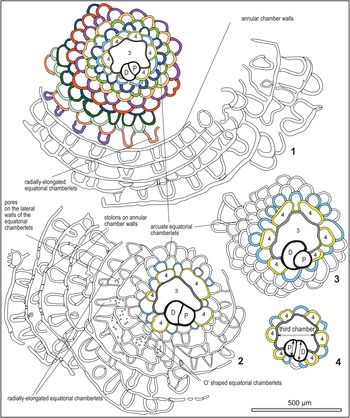
Line drawings of the embryonic and peri-embryonic chambers/chamberlets of Bigaella orbitoidiformis Özcan, Mitchell, Pignatti, Simmons, and Yücel, n. gen. n. sp. from the Şevketiye Formation. (1–3) Şevketiye Section, SBZ 17/18A, Bartonian or late Bartonian-early Priabonian. (4) Çamyurt Section, SBZ 19A, Priabonian. Numbers in the chambers and chamberlets denote growth stages. Chamberlets formed at the same budding stage are shown by the same color. Note the radially enlarged equatorial chamberlets at the transition from cyclical to annular growth. Large pores in the equatorial chamberlet walls are shown in (2). Measurement system of the embryonic apparatus and third chamber is shown in (4) (see Table 1). (1) Holotype ŞEV6-106, (2) paratype ŞEV6-108, (3) ŞEV6-110, (4) paratype ÇAM14-135. P = proloculus; D = second embryonic chamber (deuteroconch)

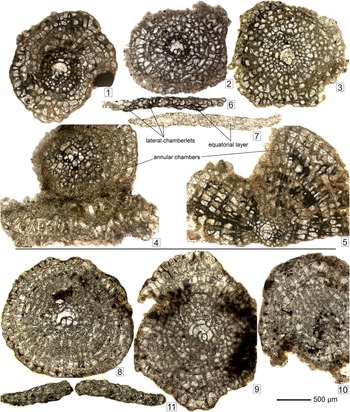
(1–5, 8–10) Equatorial (6, 7) axial, and (11) sub-axial sections of Bigaella orbitoidiformis Özcan, Mitchell, Pignatti, Simmons, and Yücel, n. gen. n. sp., from the Şevketiye Formation. (1–6) Şevketiye Section; SBZ 17/18A, Bartonian or late Bartonian–early Priabonian. (7–11) Çamyurt Section; SBZ 19A, Priabonian. (1) ŞEV7-127, (2) ŞEV6-107, (3) paratype ŞEV7-120, (4) paratype ŞEV6-108, (5) paratype ŞEV7-109, (6) paratype ŞEV7-118, (7) ÇAM15, (8) paratype ÇAM14-122, (9) ÇAM14-125, (10) ÇAM14-124, (11) paratype ÇAM14-131.

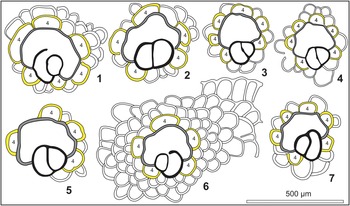
Line drawings of the embryonic and peri-embryonic chambers/chamberlets of Bigaella orbitoidiformis Özcan, Mitchell, Pignatti, Simmons, and Yücel, n. gen. n. sp., from the Şevketiye Formation. (1, 2, 5, 7) Çamyurt Section, SBZ 19A, Priabonian; (3, 4, 6) Şevketiye Section; SBZ 17/18A, Bartonian or late Bartonian–early Priabonian. (1) ÇAM14-125, (2) paratype ÇAM14-122, (3) ŞEV7-110, (4) paratype ŞEV7-109, (5) ÇAM14-129, (6) paratype ŞEV7-120, (7) ÇAM14-124.

Equatorial sections of Bigaella orbitoidiformis Özcan, Mitchell, Pignatti, Simmons, and Yücel, n. gen. n. sp., from the Şevketiye Formation showing its embryonic-nepionic stages. Note the lobate outline of the third chamber, which is a very characteristic feature. (1–5) Şevketiye Section; SBZ 17/18A, Bartonian or late Bartonian–early Priabonian; (6) Çamyurt Section; SBZ 19A, Priabonian. (1) ŞEV7-131, (2) ŞEV6-107, (3) paratype ŞEV6-108, (4) paratype ŞEV7-109, (5) paratype ŞEV7-120, (6) paratype ÇAM14-122.

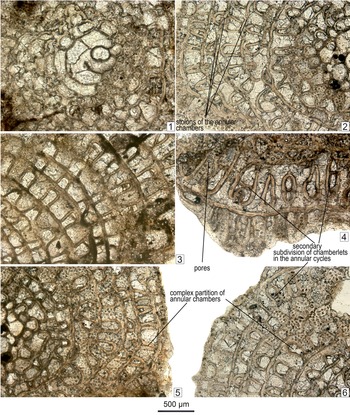
Equatorial sections of Bigaella orbitoidiformis Özcan, Mitchell, Pignatti, Simmons, and Yücel, n. gen. n. sp., from the Şevketiye Formation showing the transition from cyclical chamberlets to annular chambers with complex internal structures. The stolons of annular chambers are visible in (2) (line drawing of this specimen is illustrated in Fig. 5.2). (1) Çamyurt Section, SBZ 19A, Priabonian; (2–6) Şevketiye Section, SBZ 17/18A, Bartonian or late Bartonian–early Priabonian. (1) ÇAM14-125, (2, 4–6) paratype ŞEV6-108, (3) ŞEV7-119.

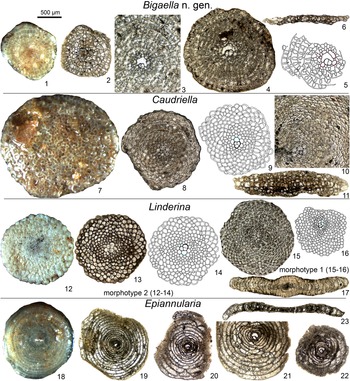
(1–6) Comparison of the external views, equatorial, and axial sections of Bigaella Özcan, Mitchell, Pignatti, Simmons, and Yücel, n. gen., (7–11) Caudriella, (12–17) Linderina, and (18–23) Epiannularia occurring in the Bartonian–Priabonian deposits of the Biga Peninsula and southern part of the Thrace Basin. (15, 16) Sample ZP from latest Lutetian?–early Bartonian Zinda Pir section in the Sulaiman Range, Pakistan, is also illustrated for Linderina morphotype 1. Sample DER, from the early Bartonian Dereköy section in Gökçeada (Aegean Sea northwest Turkey); sample ÇEL, from Çeltik Section in southern Thrace Basin. (1, 2) paratype ŞEV7-114, (3) paratype ÇAM14-135, (4) paratype ÇAM14-122, (5) paratype ŞEV6-108, (6) paratype ŞEV7-118, (7) ŞEV7-121, (8, 9) ÇEL13-9, (10) ÇEL13-105, (11) ŞEV7-108, (12–14) ŞEV8-131, (15, 16) ZP1-17, (17) DER10-4, (18, 19) ŞEV7-127, (20) ŞEV7-124, (21) ŞEV8-127, (22) ŞEV7-113, (23) ŞEV8-140.

Paratypes
ŞEV7-114, megalospheric form (Figs. 4.1, 10.1, 10.2); ÇAM14-135, megalospheric form (Figs. 4.5, 5.4, 10.3); ŞEV6-108, megalospheric form (Figs. 5.2, 6.4, 8.3, 9.2, 9.4–9.6, 10.5); ŞEV7-109, megalospheric form (Figs. 6.5, 7.4, 8.4); ÇAM14-122, megalospheric form (Figs. 6.8, 7.2, 8.6, 10.4); ÇAM16, possibly a megalospheric form (Fig. 4.3); ŞEV7-118, possibly a megalospheric form (Figs. 4.4, 6.6, 10.6); ÇAM14-131, possibly a megalospheric form (Fig. 6.11); ŞEV7-120, megalospheric form (Figs. 6.3, 7.6, 8.5).
Diagnosis
Hyaline, coarsely perforate (pores 6–12 μm in diameter), discoidal test with a circular outline. Megalospheric specimens with relatively small bilocular embryonic apparatus followed by a large third chamber with lobate outline, depressed at its margins where the chamberlets of the next growth step directly arise from it or from the junction of the walls with the proloculus and the second chamber. The third chamber is about one and one-half or two times larger than the first and second chambers of the embryonic apparatus, respectively. Equatorial early chamberlets are arcuate in shape, arranged in cycles, progressively transforming to incomplete and complete annular chambers with complex subdivision of the annular spaces. Cyclic growth starts following the formation of several small chamberlets around the third chamber and simultaneous formation of two chambers at the junctions of the third chamber and embryonic chambers. The early arcuate chamberlets are connected by basal stolons, and the annular chambers, by numerous radial stolons. Lateral chamberlets are poorly developed on both sides of the test, and only form one or two layers. Piles are not present. Microspheric forms are unknown.
Occurrence
As yet, only known from levels close to the Bartonian-Priabonian boundary (SBZ 18A) in the Şevketiye section and lower Priabonian (SBZ 19A) beds of the Çamyurt section in the Biga Peninsula, NW Turkey.
Description
Test delicate, disc-shaped, flat and circular in outline (Figs. 4.1–4.4; 6.6, 6.7, 6.11). Externally, the test surface is smooth without any granules (piles) with equatorial chambers/chamberlets of the median layer easily seen in wet specimens (Fig. 4.1, 4.2). Based on 20 specimens, the test diameter 1.17–2.7 mm, with an average of 1.98 mm (Table 1). The thickness of the test ranges between 150–230 μm in the central part and 140–210 μm at the periphery, without any remarkable change (Table 1). The megalospheric embryonic apparatus is bilocular with a subcircular first chamber (proloculus) and a slightly larger second chamber (deuteroloculus) displaying a semi-isolepidine or nephrolepidine configuration (Fig. 7). These chambers have a slightly curved to almost flat common wall.
The diameter of the proloculus ranges between 70–110 μm, with an average of 90.7 μm, in the Şevketiye samples (ŞEV6 and ŞEV7 combined) and 90–140 μm, with an average of 105.0 μm, in the Çamyurt sample (ÇAM14). The second chamber is slightly larger than the proloculus with a diameter ranging between 100–160 μm, with an average of 122.8 μm in the samples ŞEV6 and ŞEV7 and between 110–165 μm, with an average of 131.2 μm in sample ÇAM14. Stolons connecting the embryonic chambers were not observed. The third chamber is notably large, being the largest chamber among all equatorial chambers in the nepionic stage, and displays a distinctive lobate outline (Figs. 4.5, 4.6, 5.1–5.4, 7, 8). This chamber covers almost half of the bilocular embryonic apparatus such that in equatorial plane its wall rests both on the proloculus and the second chamber.
The diameter of the third chamber, measured parallel to the common axis of the proloculus and the second chamber, varies between 195–275 μm with an average of 225.0 μm in ŞEV6 and ŞEV7, and is 255.6 μm in sample ÇAM14. The third chamber possesses a number of radial stolons from which several chamberlets are formed simultaneously on its wall at the fourth budding step, as well as two basal stolons as at its junction with the proloculus and the second chamber. The chamberlets directly arising from the third chamber are positioned always in the depressed parts of the lobate wall, and their number varies from 3 to 4 (Figs. 5, 7). These chamberlets of the fourth budding step are typically arcuate in shape as the other peri-embryonic chamberlets or slightly extended in the opposite direction to growth so that they look larger than the adjoining chamberlets (Fig. 7). Two chamberlets also are formed at the junctions of the wall of the third chamber with the proloculus and the second chamber during the fourth budding step. Thus, 5–6 equatorial chamberlets are formed at the fourth growth step. The nepionic chamberlets are typically low-arcuate in shape, and progressively enlarge in radial directions (Figs. 5.1, 7.6) so that they appear U- or V-shaped in equatorial sections (Fig. 5.2). These chambers communicate with each other by barely observable basal stolons (Fig. 5.2). Annular chambers are formed progressively, but they are usually incomplete in the early stages. The height of these chambers ranges between 100–120 μm. These chambers are subdivided into chamberlets in a complex pattern and some ‘O’-shaped chamberlets are seen in the annular spaces. These chamberlets may be subdivided further into secondary compartments in the peripheral part of the equatorial chambers (Figs. 4.6, 9.4, 9.6).
The lateral chamberlets occur on both sides of the equatorial layer, but there are only one or two rows (Figs. 4.3, 4.4, 6.6, 6.7, 6.11). Based on measurements of two specimens, the thickness of the equatorial layer in the center and periphery of the test ranges between 80–100 μm and 100–135 μm, respectively.
Etymology
The species name refers to the general ‘orbitoidiform’ test structure with an equatorial layer and lateral chamberlets on either side of the test.
Materials
Twelve free specimens from the Şevketiye section, 7 free specimens from the Çamyurt section, and several random thin sections from both stratigraphic sections.
Remarks
Among the closely associated foraminifera from the Şevketiye Formation in the Biga Peninsula and its time-equivalent shallow-marine deposits in the Thrace Basin, Bigaella Özcan, Mitchell, Pignatti, Simmons, and Yücel, n. gen., superficially shows some similarities only to the genus Caudriella in having an ‘orbitoidiform’ test structure. Nevertheless, these genera possess completely different embryonic-nepionic chamber arrangements and a different style of chamber formation in the neanic stage as observed in equatorial sections. They also differ in their axial sections. Externally, Caudriella is easily differentiated from the new genus by having a thick and robust test displaying a vermicular network of lateral chamberlets (Fig. 10.7). Caudriella possesses numerous, well-developed, lateral chamberlets with piles so that a thick lateral layer is formed on either side of the test, resulting in the formation of a thick robust test (Caudri, Reference Caudri1974). The lateral chamberlets in Bigaella n. gen. occur only in a single or at most double row, and their recognition externally is not straightforward. Due to their thin hyaline walls, the internal annular chambers are easily seen in wet specimens from the exterior (Fig. 10.1).
More significantly, Bigaella Özcan, Mitchell, Pignatti, Simmons, and Yücel, n. gen., and Caudriella have a completely different embryonic apparatus and early chamber arrangement as revealed in equatorial sections. In Caudriella, the embryonic apparatus possesses three small chambers (a triconch) followed by a notably large auxiliary chamberlet (the fourth chamber) with basal stolons from which nepionic growth starts with the formation of two arcuate chamberlets in the fifth budding step (Fig. 10.8–10.10). A cyclical growth pattern is achieved (usually at the eighth budding step), and numerous arcuate chamberlets are formed onwards radially at each growth stage. The orbitoidal growth pattern is maintained through ontogenetic development. The embryonic-nepionic chamber arrangement in Caudriella is very similar to morphotype 1 in Linderina (Fig. 10.15, 10.16). The early chamber arrangement in Bigaella n. gen. is somewhat unusual in that the bilocular embryon is followed by a large chamber (‘auxiliary’ chamber formed at the third growth stage) that gives rise to 5–6 chamberlets that are formed simultaneously in the next growth stage. This type of embryonic-nepionic stage is not known in any foraminifer described previously in the literature and it appears to be a unique case in chamber formation in orbitoidal foraminifers. Moreover, unlike Caudriella and Linderina, arcuate equatorial chamberlets in Bigaella n. gen. pass into the annular chambers with a complex irregular subdivision of the annular spaces. Our data show that the specimens from the Çamyurt section (stratigraphically younger than the specimens from the Şevketiye section) have slightly larger proloculus and deuteroloculus diameters than those of the specimens from Şevketiye section. The number of specimens from the Çamyurt section, however, is not satisfactory to conclude that size increase is an evolutionary character in Bigaella n. gen.
Bigaella Özcan, Mitchell, Pignatti, Simmons, and Yücel, n. gen., is closely associated with Epiannularia, possessing a cup-shaped, thin, fragile, and coarsely porous test with a single layer, which thickens towards its periphery (Fig. 10.18–10.23). Epiannularia is represented by three morphotypes in the studied material, which are described for the first time here. These specimens possess a bilocular nephrolepidine-type embryonic apparatus, which is followed either by a complete or an incomplete third annular chamber that is not subdivided into chamberlets (Fig. 10.19–10.22). The cyclical chamber arrangement, typical for the early chamber development in Bigaella n. gen., is not observed. The following chambers/chamberlets display three different morphotypes: (1) they are either arcuate in shape and appear as large ‘cyclical chamberlets’ throughout ontogenetic development (Fig. 10.22); or (2) they are represented by some kind of ‘cyclical chamberlets’ transforming to the annular chambers (Fig. 10.20, 10.21); or (3) all chambers appear to be invariably annular, although some of them are incomplete (Fig. 10.19). Externally, these specimens display some radial structures suggesting partition of the (annular) chambers (Fig. 10.18), which are considered as ‘superficial pseudochamberlets’ in the specimens of E. pollonaisae, as illustrated by Caudri (Reference Caudri1974). In our specimens, some indentations may occur in the equatorial sections, but annular spaces are not completely subdivided into chamberlets (Fig. 10.19). Bigaella n. gen. differs from these specimens in having a much smaller embryon, and cyclical chamberlets in its early stage. Moreover, the annular chambers in Epiannularia are not subdivided into true chamberlets.
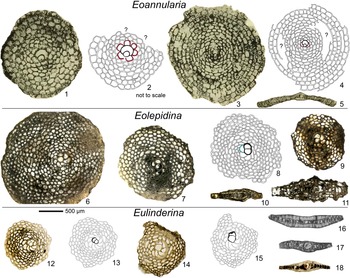
Bigaella orbitoidiformis Özcan, Mitchell, Pignatti, Simmons, and Yücel, n. gen. n. sp., shows some similarities to the genus Eoannularia and its species E. eocenica Cole and Bermúdez, Reference Cole and Bermúdez1944, and E. conica Sirel, Reference Sirel1976, that possess early cyclical chamberlets in their nepionic stage and annular chambers and chamberlets in their neanic stage (Fig. 11). The embryonic apparatus of Eoannularia is clearly bilocular, as in Epiannularia, with a proloculus and a larger second chamber that barely encompasses more than half of the periphery of the former (Cole and Bermúdez, Reference Cole and Bermúdez1944, pl. 1, figs. 13–15). The chamber arrangement of the peri-embryonic stage in two specimens, however, appears completely different. In one of the specimens, two auxiliary chambers are formed at the third budding step, whereas no chambers are formed on the wall of the second chamber (Fig. 11.3, 11.4). In the other specimen, which has much larger embryonic chambers, a number of cyclic orbitoidal chamberlets are formed around the embryonic apparatus immediately after the second chamber (Fig. 11.1, 11.2). These chambers, formed at the third growth step, suggest that orbitoidal growth starts just after the second chamber. This suggests that chamber arrangement in the early stage of Eoannularia may actually show a wide variation. The configuration of the embryonic apparatus and the third chamber in Bigaella n. gen. is quite different from these chamber arrangements. The early arcuate cyclic chamberlets of Eoannularia pass to well-developed incomplete or complete annular chambers with numerous square-shaped chamberlets (Fig. 11.2, 11.4). The chamberlets are slightly convex distally. The walls separating the chamberlets are straight and the complicated subdivisions of the annular chambers of Bigaella n. gen. are not seen here. Bigaella n. gen. also differs from Eoannularia in having fewer lateral chamberlets.
(1–5) Equatorial and axial sections of Eoannularia, (6–11) Eolepidina, and (12–18) Eulinderina and interpretation of the chamber arrangement in their equatorial sections. (1) Specimen illustrated in Cole and Bermúdez (Reference Cole and Bermúdez1944, pl. 1, fig. 13) and our interpretation of chamber arrangement in (2); (3) specimen illustrated in Cole and Bermúdez (Reference Cole and Bermúdez1944, pl. 1, figs. 14, 15), and our interpretation of chamber arrangement (4); (5) axial section illustrated in Cole and Bermúdez (Reference Cole and Bermúdez1944, pl. 1, fig. 12). (6–11) Specimens of Eolepidina from the Yellow Limestone of Lilyfield, Jamaica, Hill Formation (see Robinson and Mitchell, Reference Robinson, Mitchell and Mitchell1999) of Jamaica. (6, 7, 9) equatorial sections; (8) our interpretation of chamber arrangement of (7); (10, 11) axial sections. (12–18) Specimens of Eulinderina from the Guayabal Formation of Veracruz, Mexico; (12, 14) equatorial sections with our interpretation of chamber arrangement (13, 15, respectively); (16–18) axial sections, (17, 18) reproduced from Barker and Grimsdale (Reference Barker and Grimsdale1936).

Bigaella Özcan, Mitchell, Pignatti, Simmons, and Yücel, n. gen., differs from Eolepidina Tan (Fig. 11.6–11.11) and Eulinderina Barker and Grimsdale (Fig. 11.12–11.18), two genera that are restricted to the American bioprovince, mainly in its completely different nepionic chamber arrangement and in having annular chambers in addition to cyclical chamberlets. In both genera, a bilocular embryonic apparatus is followed by a diagnostic spiral stage and arcuate cyclical chamberlets (Fig. 11.6–11.9, 11.12–11.15). Eolepidina possesses weakly developed lateral chamberlets (Fig. 11.10, 11.11), whereas Eulinderina lacks such chamberlets (Fig. 11.16–11.18).
Conclusions
Bigaella orbitoidiformis Özcan, Mitchell, Pignatti, Simmons, and Yücel, n. gen. n. sp., presents a complex ‘orbitoidiform’ test architecture with a unique embryonic stage displaying a bilocular embryonic apparatus and a notably much larger and irregular next chamber (the third chamber) that gives rise to the formation of several simultaneously formed cyclical chamberlets. The onset of a cyclical development just after the bilocular embryonic apparatus or in a very early stage of ontogenetic development is known in many ‘orbitoidiform’ foraminifers, such as, the Late Cretaceous genera Lepidorbitoides Silvestri and Orbitoides d'Orbigny, the Paleocene–Eocene orthophragminids, and the Eocene–Miocene lepidocyclinids (van Gorsel, Reference Van Gorsel, Hedley and Adams1978; Less, Reference Less1987; Loeblich and Tappan, Reference Loeblich and Tappan1987; Drooger, Reference Drooger1993). However, no orbitoidal foraminifers are known to present the embryonic-nepionic chamber configuration of Bigaella n. gen., a chamber formation displaying cyclical and annular chambers/chamberlets, which are further complicated by subdivision of the annular spaces. In addition, the subdivision of annular chambers is very complicated because the irregularity of subdivision increases along the peripheral annular chambers. The stolon systems connecting both the cyclical chamberlets to each other and the annular chamberlets are poorly known and require further work. The available thin-section data suggest that the annular chambers are connected by numerous radial stolons, while those connecting the chamberlets communicate through the basal stolons. Bigaella n. gen. is tentatively placed in the family Eoannulariidae Ferràndez-Cañadell and Serra-Kiel, Reference Ferràndez-Cañadell and Serra-Kiel1999, in consideration of its embryonic apparatus, and the cyclical and annular chambers. A phylogenetic connection with the genus Eoannularia is highly possible.
Acknowledgments
Material from the Şevketiye Formation was collected within an İstanbul Technical University BAP project (Stratigraphy, foraminiferal taxonomy, biostratigraphy, and palaeobiogeography of Palaeogene shallow-marine units in Biga Peninsula: delineation of the southern margin of Thrace Basin, Project no: 34768). We warmly thank K.A. Bürkan (Turkish Petroleum Corporation) for introducing the senior author the Şevketiye and Çamyurt sections and his help and guidance in fieldwork. We thank S. Stukins (Natural History Museum, London) for allowing SFM and NR to examine and photograph specimens in its collections. We are indebted to G. Less (Miskolc) and an anonymous reviewer for their helpful comments.