Introduction
Dysphagia and factors directly associated with it have important implications for older people. We first outline some of these implications before proceeding to a review of recent work on the nature, assessment and management of dysphagia in older people. In preparing the review we consulted search engines Web of Knowledge, Scopus, MEDLINE and Ovid using terms dysphagia, swallow(ing) (disorders); combined with older people, stroke, neurological (disorder), pneumonia, dementia; head and neck, oral, pharyngeal, laryngeal cancer; assessment, rehabilitation. The term dysphagia elicits >50,000 references since 2009, and >8000 for dysphagia and older persons/people. This review focuses on works from predominantly 2009 onwards that answer or address key issues and updates in the clinical assessment and management of older people (65+ years) with a diagnosis or risk of swallowing disorder.
Dysphagia represents a central cause of, or significant sequel to, many conditions faced by older individuals. Severe dysphagia poses an immediate risk for choking and possible death. Chronic dysphagia is independently associated with a range of other negative factors, including:
• poor(er) prognosis for survival;Reference Cichero, Altman, Cichero and Clave1, Reference Altman, Yu and Schaefer2
• increased co-morbidities;Reference Cabre, Serra-Prat, Palomera, Almirall, Pallares and Clavé3–Reference van der Maarel-Wierink, Vanobbergen, Bronkhorst, Schols and de Baat9
• risk of short- and long-term undernourishment, weight loss, malnutrition and dehydration;Reference Crary, Humphrey, Carnaby-Mann, Sambandam, Miller and Silliman10, Reference Serra-Prat, Palomera, Gomez, Sar-Shalom, Saiz and Montoya11
• less positive rehabilitation outcomes, later discharge from acute care, less chance of returning home on discharge and increased likelihood of re-admission.
Eating and drinking ability is strongly associated with quality of life. Dysphagia results in a significant social and psychological burden for both patients and their families.Reference Patterson, Rapley, Carding, Wilson and McColl12–Reference Klinke, Wilosn, Hafsteinsdottir and Jonsdottir15 Some patients report being fearful and not wanting to eat alone in case they choke and consequently avoid eating, reduce or alter their overall oral intake. For others, embarrassment can lead to unwillingness to eat within a social context, severely restricting lifestyle. Depression and frustration at restricted food choices and changes to eating routines is common. In addition, the impact on partners caring for a dysphagic patient can be profound, from additional time spent planning, preparing and selecting food for a special diet, acquiring new skills in caring for a feeding tube and a restriction in their own social activities and interactions. Perceptions of psychological issues around impact can evolve from acute to chronic phases.Reference Martino, Beaton and Diamant14
Dysphagia constitutes a significant economic burden to health care services.Reference Cichero, Altman, Cichero and Clave1, Reference Semenov, Starmer and Gourin16, Reference Tian, Abouzaid, Sabbagh, Chen, Gabriel and Kahler17 The American National Hospital Discharge Survey (2005–2006)Reference Altman, Yu and Schaefer2 of over 77 million admissions found the median number of hospital days for patients without dysphagia was 2.4 compared with 4.04 days for those with dysphagia. Furthermore, the incidence of dysphagia-associated admissions amongst the elderly (>75 years) was twice that of all other age groups. There was a 40% increase in length of hospital stay when a patient is admitted with dysphagia. These patients had a significantly higher risk (RR 9.1) of developing aspiration pneumonia.
What is dysphagia?
Dysphagia in its narrow sense indicates a disorder of the triggering of the patterned response that propels a bolus from the oral cavity into the oropharynx and/or of the subsequent train of automatic events that transport the bolus to the stomach whilst simultaneously guarding the airway. This pharyngeal-oesophageal dysphagia may arise from delay, reduction or absence of triggering of any or all of the patterned responses; inefficiencies or failure in transport due to altered muscle tone, power and co-ordination; inefficiencies or anatomical blockage from altered tissue status or narrowing of the food passage.
More often a broader definition is applied. Triggering of responses and whether reduced or delayed operation of automatic stages become a problem or not are intricately bound up with the ability of an individual to form a bolus in the mouth and voluntarily direct this posteriorly to initiate the automatic sequence. This in turn is influenced by bolus viscosity and volume.Reference Lee, Yoo, Kim and Ryu18, Reference Choi, Ryu, Kim, Kang and Yoo19 These problems (generally labelled oral dysphagia) can arise from reduced tongue mobility,Reference Umemoto, Tsuboi, Kitashima, Furuya and Kikuta20, Reference Hirota, Konaka, Ono, Tamine, Kondo and Hori21 misco-ordination of breathing and swallowing,Reference Gross, Atwood, Ross, Eichhorn, Olszewski and Doyle22–Reference Troche, Huebner, Rosenbek, Okun and Sapienza24 altered oral sensation,Reference Hammer, Murphy and Abrams25 poor lip seal, particularly for fluids; poor dentition,Reference Fukai, Takiguchi, Ando, Aoyama, Miyakawa and Ito26, Reference Furuta, Komiya-Nonaka, Akifusa, Shimazaki, Adachi and Kinoshita27 and oral pathology.Reference Pace and McCullough28, Reference Tada and Miura29 Problems may also be associated with cognitive changes,30 given that successfully delivering food or drink to the mouth, forming a bolus and initiating swallowing depends on intact attention, awareness of material in the mouth, persistence with chewing and clearing of debris. Being unaware of or not acknowledging the presence of dysphagia exposes the individual to possible harmful practices around swallowing and impairs ability to exploit possible compensatory tactics.
As drooling is generally associated with reduced clearing of saliva and foodstuffsReference Nobrega, Rodrigues, Torres, Scarpel, Neves and Melo31 some include sialorrhoea as part of the dysphagic complex. Several works differentiate between anterior drooling (loss of secretions and food through the lips) versus posterior drooling (uncontrolled escape of secretions, food and drink into the oropharynx).
The basic anatomy, physiology and neurology of swallowing are covered in most standard textbooks. Recent developments have sought a deeper understanding of dysphagia, to go beyond mere description of what is seen in order to build explanatory models incorporating sensory as well as motor and cross-modal variables in swallowing control. The effects of taste, aroma and texture are not neutral factors in the patterned sensorimotor control.Reference Steele, Cichero and Clave32–36
Cause and course of dysphagia
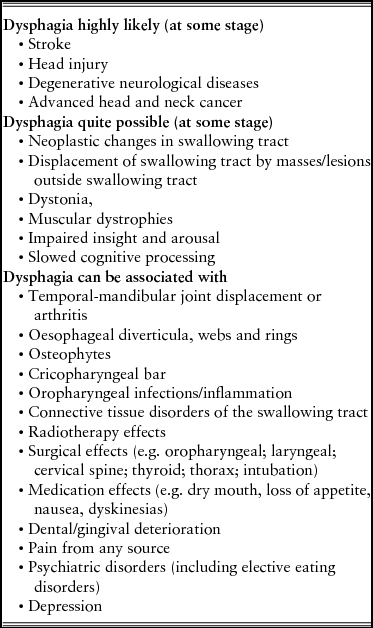
Table 1 lists conditions with which dysphagia is commonly associated, though it is by no means exhaustive for all possible causes and associations.
More common conditions associated with dysphagia in older people

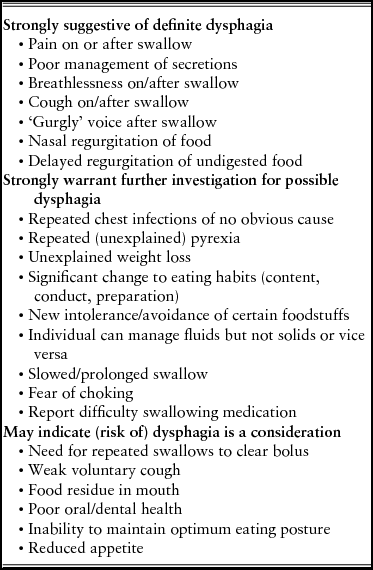
Likelihood and prognosis of dysphagia vary markedly by aetiology. Irrespective of origin, dysphagia should be suspected when particular signs and symptoms are observed. Table 2 summarizes the salient ones.
Indications for possible presence of dysphagia
In certain conditions, dysphagia may be transitory (e.g. post-extubation post-operatively though there is a less favourable prognosis post-extubation after mechanical ventilation in critical illness,Reference Macht, Wimbish, Clark, Benson, Burnham and Williams37 transient ischaemic attack, recovered upper gastrointestinal ulceration), and some mechanical and anatomical causes, e.g. cricopharyngeal web, may be correctable. In other conditions, full or partial recovery to functionally viable swallowing may be a reasonable expectation (e.g. mild stroke, spinal surgeryReference Siska, Ponnappan, Hohl, Lee, Kang and Donaldson38–Reference Danto, DiCapua, Nardi, Pekmezaris, Moise and Lesser40). In some circumstances dysphagia may be slowly or more rapidly progressiveReference Ruoppolo, Schettino, Frasca, Giacomelli, Prosperini and Cambieri41–Reference O'Sullivan, Massey, Williams, Silveira-Moriyama, Kempster and Holton43 and result in significant morbidity or mortality.
Swallowing safety may alter rapidly in the presence of secondary morbidities, even those not directly associated with dysphagia. For instance, in an individual with previously undiagnosed dysphagia or where a relatively mild dysphagia was well compensated, onset of delirium, infections, clouding of consciousness, respiratory disorder or pain may be linked to appearance of significant swallowing problems.
In progressive disorders, patients may reach a threshold where hitherto consciously or non-consciously applied compensatory strategies to manage their inefficient or mildly dysphagic swallow are no longer effective. When severity or multiplicity of other impairments, including the stage of underlying degeneration, reaches a critical level, rapid deterioration in swallowing status can ensue.Reference Suntrup, Teismann, Bejer, Suttrup, Winkels and Mehler44
Dysphagia is noted as a common and serious problem for individuals with mental illness.Reference Aldridge and Taylor45 Estimates indicate they may be up to forty-three times more likely to die of choking asphyxiation than the general population. Presence of dysphagia in dementia is well documented.Reference Alagiakrishnan, Bhanji and Kurian46 Even where cognitive changes are not profound, effects of divided attention on chewing and swallow initiation may exacerbate a dysphagic condition.Reference Brodsky, Abbott, McNeil, Palmer, Grayhack and Martin-Harris47
Depression may be a sequel to the psychosocial impact of having a swallowing disorder. People with disorders such as stroke, head injury and Parkinson's typically also present with depression. The cause–effect direction or relationship between depression, swallowing and underlying disorder remains a topic of investigation. Nevertheless, depression is strongly associated with dysphagia.Reference Miller, Allcock, Hildreth, Jones, Noble and Burn42, Reference Han, Ohnishi, Nonaka, Yamauchi, Hozuki and Hayashi48, Reference Holland, Jayasekeran, Pendleton, Horan, Jones and Hamdy49
Advancing age brings changes to the swallowing process, including slower transit times, possible loss of muscle mass and tissue elasticity, and possible reduction in strength of muscles. There is debate as to whether these alterations are an independent cause of dysphagia or whether dysphagia, if present in otherwise healthy individuals, represents a manifestation of other conditions associated with older age, or with undiagnosed conditions – e.g. ‘silent’ stroke, prodromal phase of a degenerative condition, cognitive or mood disorder (see below regarding dysphagia in healthy community-dwelling elders).
Prevalence of dysphagia
Given the variable causes and courses of dysphagia, a definitive statement on overall prevalence is problematic. Comparison across studies is further complicated by the variety of assessment techniques employed and divergent operational definitions of variables applied.Reference Daniels, Schroeder, DeGeorge, Corey, Foundas and Rosenbek50 Swallowing changes (e.g. delayed transit time, diminished reflexes) can be detected instrumentally at onset in up to 100% of people with some disorders, but this does not necessarily indicate an individual has dysphagia in the sense that there exists an immediate threat of airway compromise or consequences for hydration and nutrition (though identifying such changes does oblige careful monitoring).
Where self-report measures are employed, an additional factor concerns awareness. Individuals may either be unaware, for a variety of reasons, that they have dysphagia,Reference Miller, Allcock, Hildreth, Jones, Noble and Burn42, Reference Ding and Logemann51, Reference Bayés-Rusiñol, Forjaz, Ayala, Crespo, Prats and Valles52 or they mention behaviours suggestive to clinicians of dysphagia but attribute these to other factors unrelated to swallowingReference Cheon, Ha, Park and Kim53 and therefore do not admit to swallowing problems. This implies that asking in assessment or at review only ‘do you have any swallowing problems’ may elicit an inaccurate answer. Keener insights are gained from questioning around possible changes to types and consistencies of food that an individual may now avoid or experience difficulty with, or has made changes to their preparation (puree, mash, crush), time to eat food; fear of choking; and observation for behaviours (e.g. Table 2) may also be suggestive of dysphagia.
This underlines the need for a broad approach to assessment. It emphasizes the need for studies of prevalence to ideally chart changes over the course of an illness and offer longer term follow-up, not just on instrumental assessments but on functional, nutritional, respiratory health and swallowing-related quality of life measures, to judge whether or when demonstrated changes to swallowing patterns indeed represent a daily living or health-related problem.
Estimates of prevalence of dysphagia in generally healthy, community-dwelling older people range from around 11% to around 40%. Differences reflect population biases, assessment techniques and operational cut-offs for presence or not of dysphagia. Holland et al.Reference Holland, Jayasekeran, Pendleton, Horan, Jones and Hamdy49 analysed self-report responses to a postal questionnaire from 634 respondents, with 11% indicating presence of symptoms suggestive of dysphagia. Increasing age correlated directly with dysphagia severity. Serra-Prat et al.Reference Serra-Prat, Palomera, Gomez, Sar-Shalom, Saiz and Montoya11, Reference Serra-Prat, Hinojosa, Lopez, Juan, Fabre and Voss54 examined 254 community-dwelling people >70 years for swallowing efficiency and safety and aspiration. They employed a screen involving swallowing different viscosities and volumes, alongside checklists for possible signs of dysphagia (cough on swallow, etc.) and pulse oximetry. Dysphagia was present over the whole sample in 27%, impaired efficacy in 20.5% and impaired safety in 15%, with signs of aspiration in 6.7%. Likelihood increased steeply after 80+ years, with dysphagia prevalence of 17% in 70–79 years versus 33% in 80+ years. Roy et al.Reference Roy, Stemple, Merrill and Thomas55 interviewed 117 independently living elders and found 38% reported swallowing disorder at some stage, with 33% indicating a current problem. Estimates for undiagnosed dysphagia in residential and nursing care facilities are correspondingly higher, falling in the range of 30–68%.Reference Nogueira and Reis56
Assessment of swallowing
The imperative of assessing for dysphagia in at-risk conditions and populations is recommended in key guideline publications.57, 58 Assessment preferably involves instrumental assessments, but at a minimum should entail clinical assessment of swallowing status as well as psychosocial impact and related risk factors. NICE guidelines stipulate, in acute stroke, a swallowing screening test by a trained healthcare professional before administrating any food, fluid or medication. If a problem is identified, a specialist swallowing assessment should follow within 72 hours. Head and neck cancer patients planned for treatment that will affect swallowing, should be assessed (in UK by a speech and language therapist) and a plan for method of feeding devised.59 Consideration must be given to risk factors that may result in dysphagia (Tables 1 and 2). For instance, not all tracheostomized patients will have dysphagia, but a referral for swallowing assessment would be indicated if there is co-occurring neurological involvement following head and neck surgery, or there are signs of a swallowing problem such as evidence of secretions or ingested material on suctioning.60 As discussed above, dysphagia may not always be as a result of specific medical conditions. In addition to this, the person may not be aware of a swallowing difficulty, or may attribute their problem to other sources. Therefore, ongoing vigilance is required by health care staff for signs and symptoms of dysphagia, including more covert features, with a view to timely referral for specialist swallowing assessment.
Instrumental assessments
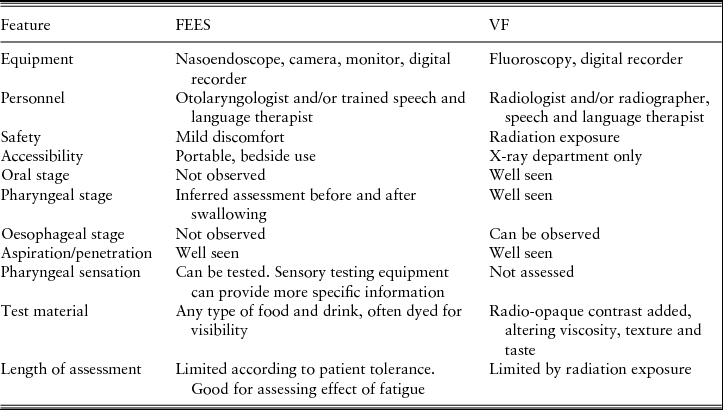
Instrumental assessments provide detailed information about the anatomy and physiology of the oropharyngeal swallow as well as evaluating risk factors such as the presence, amount and response to pooled or aspirated material. Two main clinical procedures provide complementary but differing information: videofluoroscopy (VF) and Fibreoptic Endoscopic Evaluation of Swallowing (FEES). A summary comparison between the two assessments is given in Table 3.
A comparison of features of VF vs FEES instrumental assessment
Table adapted from Hirst.170
The selection of procedure depends on patient suitability and which questions need answering. Both assessments are difficult to conduct with patients who have attention and behavioural difficulties and where there are likely to be movement artefacts. VF uses a modified barium swallow, providing a dynamic X-ray image of the three (oral, pharyngeal, oesophageal) stages of swallowing, enabling visualization of the swallowing process from the lips through to the upper oesophageal area. FEES provides an endoscopic view of the laryngopharynx, giving information on secretion management, altered anatomy, laryngeal sensation and vocal fold motility. The introduction of a swallow trial is usually preceded by a functional assessment of laryngeal pharyngeal movements, e.g. pharyngeal squeeze test. FEES does not directly view the oral stage nor cricopharyngeal opening. However, it is ideal for patients who are unable to attend the radiology department and it is highly repeatable. The reliability and validity for the interpretation of both of these assessments has been published.Reference Bryant, Finnegan and Berbaum61–Reference Takahashi, Kikutani, Tamura, Groher and Kuboki63 Reliability improves when raters routinely use scales such as the MBSImps or the penetration/aspiration scale.Reference Martin-Harris, Brodsky, Michel, Castell, Schleicher and Sandidge64–Reference Hind, Gensler, Brandt, Gardner, Blumenthal and Gramigna66
Instrumental assessments may be conducted for diagnostic purposes. Some of the compensatory interventions listed below (e.g. chin-tuck, effortful swallow, altered consistency) may be tested for their effectiveness during instrumental assessment.
Clinical assessment
Practices vary across services and countries.Reference Hibberd, Fraser, Chapman, McQueen and Wilson5, Reference Macht, Wimbish, Clark, Benson, Burnham and Williams67–Reference Archer, Wellwood, Smith and Newham70 Some services routinely refer all patients with suspected or risk of dysphagia for VF or FEES assessment. More often, initial evaluation is conducted using a clinical or bedside screen that aims to gauge swallowing efficiency and safety and identify candidates with possible penetration or aspiration for more objective examination.Reference Bours, Speyer, Lemmens, Limburg and De Wit71–Reference Patterson, Hildreth, McColl, Carding, Hamilton and Wilson73 There are many published procedures.Reference Clavé, Arreola, Romea, Medina, Palomera and Serra-Prat74–Reference Leder, Suiter, Warner, Acton and Siegel78
Typically patients are asked to swallow liquids and solids graded for viscosity, constituency/texture and volume. The examiner checks time taken and number of swallows to clear, and observes for signs said to be indicative of aspiration or penetration, such as cough on swallow, oxygen desaturation, altered voice quality or altered swallow sounds on cervical auscultation. None of these methods or observed behaviours has strong support as an isolated indicator of dysphagia, or more specifically risk for aspiration. There are ongoing issues around the sensitivity and specificity achieved with clinical examinations and the validity and reliability of claimed signs of penetration and aspiration.
A review of thirty-five protocols for screening post-stroke dysphagiaReference Schepp, Tirschwell, Miller and Longstreth79 found that only fourReference Martino, Silver, Teasell, Bayley, Nicholson and Streiner75, Reference Antonios, Carnaby-Mann, Crary, Miller, Hubbard and Hood76, Reference Turner-Lawrence, Peebles, Price, Singh and Asimos80, Reference Edmiaston, Connor, Loehr and Nassief81 met basic psychometric criteria and delivered acceptable levels of sensitivity (>87%) and negative predictive values (>91%). All were considered to need further development. A similar reviewReference Wilkinson, Burns and Witham82 of bedside swallow screens as predictors of post-stroke pneumonia came to less optimistic conclusions. They highlighted the lack of validation and standardization on unpreselected populations (a criticism shared by othersReference Daniels83). For them the diagnostic accuracy of bedside swallow tests remains unclear and the evidence is insufficient to support their use in a general older population, and consequently, the predictive value for pneumonia remains unknown – again a conclusion reached by others.Reference Osawa, Maeshima and Tanahashi84
A systematic review of screening items for dysphagia risk post-strokeReference Daniels, Anderson and Willson85 found many items associated with dysphagia, with water swallow testsReference Leder, Suiter, Warner, Acton and Siegel78, Reference Osawa, Maeshima and Tanahashi84 performing an important role, especially in combination with monitoring for ‘wet’ voice quality. However, in their opinion, the optimum combination of non-swallowing and swallowing items and the most valid protocol remains to be determined. Use of single measures or single liquid volumes do not distinguish healthy individuals from those with stoke with or without dysphagia.Reference Daniels, Schroeder, DeGeorge, Corey, Foundas and Rosenbek50 Recent investigations confirm earlier cautions expressed for practices such as cervical auscultation of swallow sounds, cough on swallow and wet voice.
Specificity of perceived ‘wetness’ of voice quality was found to have acceptable levels (>86% for dysphagia, 94% for penetration-aspiration) but unacceptably low sensitivity (8 and 14%, respectively).Reference Waito, Bailey, Molfenter, Zoratto and Steele86 Values for overall voice quality were lower still. Standard acoustic voice perturbation measures (pitch and amplitude perturbation and harmonics to noise ratio) also fared poorly as discriminators. The authors concluded that the presence of abnormalities in voice samples associated with swallowing, detected either perceptually or acoustically, can easily be misinterpreted and is not a valid means of determining a patient's swallowing status.
A similar study with individuals treated for oral or oropharyngeal cancer arrived at like findings.Reference Bruijn, Rinkel, Cnossen, Witte, Langendijk and Leemans87 By contrast, they established that alterations to voice intensity were significantly associated with penetration and aspiration, whilst raised fundamental frequency (higher pitch) was strongly linked to swallow inefficiency. Chang et al.Reference Chang, Torng, Wang and Chang88 found no differences in voice perturbation measures between aspirators and non-aspirators. However, they did not find any alteration to fundamental frequency in their patients either.
A further studyReference Malandraki, Hind, Gangnon, Logemann and Robbins89 had participants attempt to raise their voice pitch after a barium swallow. In this pilot study perceived and acoustically measured pitch elevation independently predicted penetration-aspiration on thin liquid swallows, but vocal range (average to falsetto) did not. Encouraging findings also point to the possibility of detecting aspiration non-invasively utilizing acoustic analysis of breath sound changes.Reference Sarraf Shirazi, Buchel, Daun, Lenton and Moussavi90
Cough on swallow has long been considered an indicator of possible aspiration-penetration and for referral for more objective testing.Reference Sato, Tohara, Iida, Wada, Inoue and Ueda91 Inter and intra-rater reliability at recognizing and agreeing on coughs after citric acid inhalation of experienced speech language pathologists who employ cough monitoring in assessment and inexperienced ones has been shown to be only fair to moderate.Reference Miles and Huckabee92 The same research groupReference Miles, Zeng, McLauchlan and Huckabee93 investigated whether decisions around cough reflex testing enhanced accuracy and outcomes in relation to prediction and occurrence of pneumonia. Presence of cough on swallow influenced diet recommendations and referral for instrumental assessment, but had no bearing on rate of pneumonia and mortality at 3 months post-evaluation.
Using objective airflow measures on voluntary coughs in people with Parkinson'sReference Pitts, Troche, Mann, Rosenbek, Okun and Sapienza94 and cough peak flow (as part of a suit of pulmonary function tests),Reference Bianchi, Baiardi, Khirani and Cantarella95 accurate predictions of respiratory prognosis and risk level in aspiration were achieved. It may therefore be that cough on swallow evaluation needs to be combined with objective measures rather than rely on naked ear perceptual decisions.
However, the key issue may not be so much the presence or not of aspiration. From instrumental studies, it is apparent that many people with dysphagia who aspirate do not cough on swallow,Reference Garon, Sierzant and Ormiston96 and many known aspirators do not develop aspiration pneumonia. Reports indicate that, in certain populations, even when individuals are known aspirators, oral water intake may not adversely affect outcomes.Reference Frey and Ramsberger97–Reference Carlaw, Finlayson, Beggs, Visser, Marcoux and Coney99 This has led several to argue that maybe the key issue is not the presence or degree of aspiration, but whether there is aspiration or not in relation to other risk factors, in particular oral health, as a source of pathogens.Reference Altman, Cichero and Clave36, Reference Ewan, Perry, Mawson, McCracken, Brown and Newton100 Ideally then, screening encompasses oral health.
Oral health
Presence of oral pathologies may be a direct cause of swallowing difficulties, or exacerbate an underlying dysphagia where they interfere with chewing, bolus formation or passage. Dental status can affect preparation of the bolus and turn a borderline inefficient swallow or mild dysphagia into a major problem.Reference Fukai, Takiguchi, Ando, Aoyama, Miyakawa and Ito26, Reference Furuta, Komiya-Nonaka, Akifusa, Shimazaki, Adachi and Kinoshita27 Poor oral health alongside dysphagia significantly increases the risk of pneumonia and other complications.Reference Tada and Miura29, Reference Pace and McCullough101–Reference Abe, Ishihara, Adachi and Okuda103
Meal time observation
Eating represents not solely a mechanical event but also a social process. Eating-related problems can extend well beyond dysphagia. Important information on eating and swallowing can be derived from systematic observation of mealtime behaviours. This is particularly useful where the patient is unable to engage in an instrumental assessment or swallow trial during a bedside assessment. Observations may include specific eating problems such as drooling or food pocketing, ability to self-feed, caregiver feeding skills, body and head positioning, behavioural issues such as agitation, sensory problems such as visual perceptual disorders, and distraction by other stimuli. A recent systematic review of assessment tools used to record observations during a natural meal activityReference Hansen, Kjaersgaard and Faber104 identified two assessments with reported acceptable psychometric properties, the Minimal-Eating Observation Form-version IIReference Westergren, Lindholm, Mattsson and Ulander105 and the McGill Ingestive Skills Assessment.Reference Lambert, Gisel, Groher, Abrahamowicz and Wood-Dauphinee106
Quality of life and the psychosocial impact of dysphagia
Swallowing difficulties can have a major impact on the quality of life of individuals and their families. Therefore, a comprehensive assessment includes attention to the psychosocial impact of dysphagia. A number of validated swallowing-specific quality of life questionnaires are available.Reference Silbergleit, Schultz, Jacobson, Beardsley and Johnson107 More established ones include SWAL-QOL and SWAL-CARE;Reference McHorney, Robbins, Lomax, Rosenbek, Chignell and Kramer108 the MD Anderson Dysphagia Inventory,Reference Chen, Frankowski, Bishop-Leone, Hebert, Leyk and Lewin109 a 20-item questionnaire validated on head and neck cancer patients, but which has also been reported with other elderly groups;Reference Cichero, Altman, Cichero and Clave1, Reference Chen, Golub, Hapner and Johns110 and EAT-10,Reference Belafsky, Mouadeb, Rees, Pryor, Postma and Allen111 validated on a mixed dysphagia group of oropharyngeal and oesophageal origin. A number of published head and neck cancer studies have reported on outcomes using these questionnaires, and there is a growing body of papers on neurological conditions.Reference Leow, Huckabee, Anderson and Beckert112, Reference Wilson, Carding and Patterson113
Longer term swallowing monitoring
A disadvantage of instrumental and clinical assessments as described above is that they deliver a snapshot in time of swallowing status. Swallowing ability and efficiency may vary significantly over time (e.g. stage in drug cycle; diurnal variation) and place (e.g. quiet clinic one-to-one situation vs eating and talking, eating under time pressure), as well as in association with different meal consistencies. Deeper insights into overall swallowing status and possible risks would be improved if this variability could be captured. Several attempts have been made recently to develop devices that enable ambulant longer term monitoring of swallowing frequency and efficiency through acoustic analysis of swallow sounds, accelerometry or measurement of surface electromyographic activity.Reference Crary, Sura and Carnaby114–Reference Vaiman and Eviatar116 Promising preliminary results have been attained and the field represents a definite area of fruitful development.
Importance of protocols and systematic screening
Whatever the pathway to assessment, findings stress the importance of employing an agreed protocol for screening and management of dysphagia.57, 58, Reference Altman117 Use of protocols has been shown to add accuracy in predicting pneumoniaReference Lakshminarayan, Tsai, Tong, Vazquez, Peacock and George118 and reduce the incidence of pneumonia in an intensive care unitReference Yeh, Huang, Wang, Chen, Chen and Tang119 and on a stroke unit.Reference Ickenstein, Riecker, Höhlig, Müller, Becker and Reichmann120 The latter demonstrated advantages not just in reduced mortality and morbidity but in cost savings on drugs. Wilson et al.Reference Wilson and Howe121 found that routine VF screening (rather than bedside screening, or combined VF and bedside screen) enabled timely recognition of dysphagia in acute stroke and instigation of effective treatment. Cost benefits of reduced pneumonia and reduced impairment of quality of life outweighed costs of VF assessment.
Interventions
Management of dysphagia aims to address swallowing function, to impact on nutritional status, reduce risk of chest infections and other medical complications and enhance quality of life. It often requires a combination of interventions and a team approach, including from professionals such as speech-language therapists, dietitians, geriatricians, care home staff, and general practitioners. Management may include a combination of direct work on swallowing, compensatory interventions, environmental modification, and surgical and radiological procedures. Typically, compensatory strategies are applied to effect immediate advances where possible, alongside environmental modifications that might also afford gains. Direct interventions on oral aspects of feeding and swallowing may be instigated to bring about longer term underlying improvement or maintenance. Patient participation in therapy is an issue, with reports of non-compliance varying from 0 to 80%.Reference King and Ligman122 Common reasons are denial of a swallowing problem and finding texture modifications unpleasant. Accordingly, patient engagement must be a consideration.
The quality of investigations into swallowing therapy has improved over the past few years. However, carefully controlled, large-scale studies are still lacking. Information on critical dose size and intensity remains patchy.Reference Foley, Teasell, Salter, Kruger and Martino123 Many investigations report outcomes for objective measures such as diameter of upper oesophageal sphincter opening or hyoid bone excursion, but fail to include whether differences are maintained and crucially whether such changes translate into improvements in swallow safety and amelioration of secondary complications. Even where recommendations are available, it is not always apparent that full awareness of them is reflected in practiceReference Sharp and Shega68, Reference Vitale, Berkman, Monteleoni and Ahronheim124 or that they are followed in clinical situations.Reference Archer, Wellwood, Smith and Newham70 The following lists more common approaches to therapy that have had some evaluation.
Compensatory interventions address changes to behaviours that can influence swallow safety and/or compensate by altering food content and presentation:Reference Butler, Pelletier, Steele, Shaker, Easterling, Belafsky and Postma125–Reference Wheeler-Hegland, Ashford, Frymark, McCabe, Mullen and Musson128
• Seating modification and physical therapy to improve trunk and head control and arm-and hand co-ordination. The optimal posture for most is an upright position.
• Certain head positions, e.g. a chin-tuck or head turn may facilitate swallowing efficiency and safety.Reference Baylow, Goldfarb, Taveira and Steinberg129
• Swallowing manoeuvres that introduce an airway protection technique or a more effortful swallow.Reference Huckabee, Macrae, Shaker, Easterling, Belafsky and Postma130
• Feeding equipment such as adapted cups, shallow based spoons, non-slip table mats.
• Texture modification. Food and drink may be softened (mashed, pureed, liquidized), thickenedReference Leder, Judson, Sliwinski and Madson131 or presented in smaller bites. Content is adjusted to maintain nutritional balance and calorific value. Standardized dysphagia diet food texture descriptors have been published by the Patient Safety Agency.Reference Agency132 There can be issues around acceptability of pureed diets and added burden on carers.Reference Patterson, Rapley, Carding, Wilson and McColl12, Reference King and Ligman122 Some modifications may improve taste or texture tolerability but not affect swallow parameters.Reference Sdravou, Walshe and Dagdilelis133 Reviews of nutritional programmes for undernourished older people (not necessarily diagnosed with dysphagia) support their use for improved nutritional and health outcomes, even though further evidence is required.Reference Beck, Holst and Rasmussen134–Reference Geeganage, Beavan, Ellender and Bath136
Environmental modifications have proved successful in improving nutrition in residential care settingsReference Abbott, Whear, Thompson-Coon, Ukoumunne, Rogers and Bethel137 and are adaptable to other settings. They cover such strategies as:
• Increase concentration for swallowing by reducing distractions such as the television or attempting to eat and talk simultaneously.
• Allowing more time for meals. A little and often approach may be useful with the addition of snacks.
• Heat-retaining plates to keep hot foods at a more palatable temperature.
• Optimal food presentation, such as moulds for puree textures.
• Verbal prompts, especially where cognitive, attentional or consciousness level variables impact on swallowing.
• Staff/carer training in feeding assistance and techniques.
Swallowing therapy directly targeting the mechanics of swallowing has taken several forms, including:
• Physical therapy to increase range, force and sustainability of movements of lips and tongue; to increase upper oesophageal opening; and to reduce misco-ordination of swallowing and breathing has some support.Reference Logemann, Rademaker, Pauloski, Kelly, Stangl-McBreen and Antinoja138–Reference Hind, Robbins, Shaker, Easterling, Belafsky and Postma143 These may or may not be combined with other techniques such as electrical or sensory stimulation.Reference Regan, Walshe and Tobin144–Reference Humbert, Michou, MacRae and Crujido148
• Use of varying techniques based on transcranial magnetic stimulation has demonstrated growing evidence for lasting effects on swallowing in different groups.Reference Michou, Mistry, Rothwell and Hamdy149–Reference Shigematsu, Fujishima and Ohno151
Surgery/radiological procedures
• Cricopharyngeal dysfunction may be treated with a surgical myotomy, botulinum toxin injection or balloon dilatation
• Vocal fold injection to increase glottis closure for patients with a vocal fold paralysis
• Stenting to maintain or dilate narrowed passageReference Repici, Hassan, Sharma, Conio and Siersema152
Oral health
Dysphagia combined with poor oral hygiene increases the risk of aspiration pneumonia. In addition, certain medications can reduce salivary flow, creating a more favourable environment for growth of bacteria as well as lack of lubrication for bolus formation and transport. Regular dental examination combined with good oral care has been shown to reduce these risks.Reference Tada and Miura29, Reference Pace and McCullough101, Reference van der Maarel-Wierink, Vanobbergen, Bronkhorst, Schols and de Baat102 Artificial saliva sprays can be used to aid lubrication.
Medications
Patients with dysphagia are also likely to be taking a number of medications. Drugs that create a dry mouth, bring about motor fluctuations, reduce alertness, depress reflexes, increase reflux or induce nausea may negatively impact on swallowing and require review to optimize the balance between benefits for co-morbidities and side-effects for swallowing.Reference Stegemann, Gosch and Breitkreutz153
The greater the number of medications, the higher the risk of aspiration pneumonia. Altering the medication such as crushing tablets or discontinuation of medication is relatively common practice in dysphagic individuals.Reference Stegemann, Gosch and Breitkreutz153 Furthermore, dysphagia may be induced or exacerbated by tissue injury resulting from unswallowed medication. Certain formulations such as multiparticulates, orodispersible tablets, skin patches and syrups may facilitate delivery of medication.Reference Stegemann, Gosch and Breitkreutz153
Feeding tubes
Use of nasogastric tubes or insertion of PEG (percutaneous endoscopic gastrostomy) feeding may be employed as short or longer term solutions to dysphagia.Reference Leder, Lazarus, Suiter and Acton154–Reference Beavan, Conroy, Harwood, Gladman, Leonardi-Bee and Sach156 However, placement is not without controversy and further, whilst tube feeding may solve problems around nutritional intake, it does not eliminate problems around aspiration and infection. Pathogens may still enter the lungs from oral-nasal secretions and gastric reflux.
European Society of Clinical Nutrition and Metabolism guidelinesReference Sobotka, Schneider, Berner, Cederholm, Krznaric and Shenkin157 recommend tube feeding in patients with severe neurological dysphagia, but not in final disease state, including end-stage dementia. Use of enteral feeding in end-stage condition remains controversial (see below, ethical issues), not least because of the uncertainty in predicting or confirming end-stage state. Reservations around enteral feeding in such situations centre on failure to lengthen survival, and increased mortality in hospital, particularly for frail elderly people. However, as highlighted below, the evidence base awaits further development.
PEG tubes may be placed in patients where nutrition is an issue and for prevention of associated problems such as pressure sore, though PEG use itself also carries risks and is not beneficial in late dementia.Reference Gomes, Lustosa, Matos, Andriolo, Waisberg and Waisberg155, Reference Kurien, McAlindon, Westaby and Sanders158 There appears to be no survival advantage to insertion in nursing home residents. Further, tube feeding exacerbates social isolation and is implicated in depression and reduced quality of life.
Prognosis
Aside from the more general effects of the underlying physical or neurological aetiology, prognosis for dysphagia is poor where there is insufficient insight, critically low levels of attention and awareness, lack of motivation, limited comprehension, severe memory impairment or rapidly degenerating physical condition. Compliance with interventions is negatively affected amongst other things by non-awareness or denial of a problem, underplaying the severity of a problem, assuming a calculated risk for non-compliance, dissatisfaction with food preparations, and perception of social stigma.
Many patients have limited ability to follow swallowing recommendations or adhere to a therapy programme due to language, cognitive or other physical impairment. They are therefore often reliant on their family or care home staff for feeding. The corollary is that prognosis is better if the skills and needs of carers are attended to. Education and ongoing support for families on discharge is vital.Reference Patterson, Rapley, Carding, Wilson and McColl12, Reference Penner, McClement, Lobchuk and Daeninck13 Support in how to cope with real or perceived social stigma because of altered eating habits is essential to ensuring that the individual's and carers’ roles within the family and social circle are maintained.Reference Johansson and Johansson159 A high level of non-adherence with swallowing advice has been recorded, which significantly improves with the introduction of education and training of care staff about how feeding and swallowing needs can be incorporated into daily routines of patient and carer alike.
Ethical considerations
Decisions around swallowing management raise considerable ethical and legal issues, especially in relation to end of life care, and especially where capacity for consent is impaired or absent. Decisions around nasogastric or PEG feeding and withdrawal of feeding support are particularly fraught areas. Issues also arise in non-terminally ill patients, for instance where individuals or families decide not to follow recommendations. Detailed coverage of issues and potential solutions is not possible here. Guideline documents and discussions are available around palliative care and people with dementia.Reference Sobotka, Schneider, Berner, Cederholm, Krznaric and Shenkin157, Reference Kurien, McAlindon, Westaby and Sanders158, Reference Smith, Kindell, Baldwin, Waterman and Makin160–166
The direction of discussions in this literature is that there remains much to do in clarifying the evidence base around decisions that need to be made – for instance extensive literature is available in relation to outcomes around PEG placement,Reference Kurien, McAlindon, Westaby and Sanders158, Reference Sampson, Candy and Jones164 but how this is applied to specific populations or individuals (imminent vs non-imminent death; lacking capacity or not; different medical aetiologies; different co-morbidities present) awaits definitive answers.Reference Regnard, Leslie, Crawford, Matthews and Gibson161, Reference Chen, Shih, Bair, Lin and Wu162 There is also evidence suggesting, that, for some professional groups at least, deeper education is necessary.Reference Sharp and Shega68, Reference Vitale, Berkman, Monteleoni and Ahronheim124
Different groupsReference Sandman, Bolmsjo and Westergren167, Reference Kaizer, Spiridigliozzi and Hunt168 have attempted to formulate algorithms for decision making when patients or family decline to follow recommended treatments. These emphasize the educational and explanation role of clinicians, in assuring that information has not just been heard but also understood and focuses on shared responsibility and close monitoring of outcomes. All guidelines and discussions stress the importance of holistic assessment, shared decision making across all parties, with the autonomy and best interests of the affected individual placed at the centre. This may involve, on occasions, apparently counterintuitive decisions such as continuation of oral feeding despite tube placement or continuation of thin liquids despite demonstration of aspiration.Reference Frey and Ramsberger97–Reference Carlaw, Finlayson, Beggs, Visser, Marcoux and Coney99, Reference Becker, Nieczaj, Egge, Moll, Meinhardt and Schulz169 Careful charting and outcome measurement in such instances helps to further the evidence base around decision making and management.
Conflicts of interest
There are no conflicts of interest to declare.