1 Introduction
Although Quechua is the most widely spoken indigenous language in the Americas, and Ethnologue (Gordon Reference Gordon2005) estimates that there are 2.7 million speakers of the variety South Bolivian Quechua (ISO 639-3: quh) alone, the properties of this variety's vowels are still relatively sparsely documented. South Bolivian Quechua has typically been described as a trivocalic system with high vowel lowering in the presence of uvular consonants, but there has been little formal acoustic study of the properties of its vowels (Cerrón-Palomino Reference Cerrón-Palomino1987, Adelaar Reference Adelaar2004, Laime Ajacopa, Cazazola & Pairumani Reference Ajacopa, Cazazola and Pairumani2007). The current study aims to quantify previous observations and provide a description of the phonetic properties of the vowels in this variety, with a special focus on high vowels and potential allophonic relationships.
The paper addresses the following questions:
1. Do Quechua high vowels undergo systematic lowering in the presence of uvulars, as has been described in previous literature?
2. If lowering does occur, what are the acoustic properties of these lowered vowels and does the lowering appear to be categorical and temporally stable, or gradient and potentially coarticulatory in nature?
3. Do the allophonic mid-vowels in Quechua have the same formant characteristics as the phonemic mid vowels in Spanish for bilingual speakers, implying a merged vowel system for bilinguals?
1.1 Quechua vowel system and high vowel lowering
The variety of interest in the current study is Cochabamba Quechua, which is a subvariety of Southern Bolivian Quechua. Data on the consonantal and vocalic inventories of this variety is taken from Bills et al. (Reference Bills, Troike and Vallejo1969), Laime Ajacopa et al. (Reference Ajacopa, Cazazola and Pairumani2007), Gallagher (Reference Gallagher2013), and the first author's fieldwork in Cochabamba. Typical representation of the South Bolivian Quechua consonant inventory is as follows (adapted from Gallagher Reference Gallagher2013):

Typical representation of the vowel inventory is as follows:
Quechua phonemic vowels

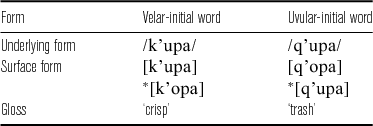
In contrast to Quechua's three-phonemic vowel inventory presented above, Bolivian Spanish, like other varieties of Latin American Spanish, is described as having five phonemic vowels (Lipski Reference Lipski1994). Although Bolivian Quechua reportedly has only three phonemic vowel categories (/a i u/), Quechua uvular stop consonants are said to promote high vowel lowering, effectively lowering high vowels towards the space that would otherwise be occupied by mid vowels in these contexts, resulting in a system with five surface vowels [i u e o a] (Bills et al. Reference Bills, Troike and Vallejo1969, Cerrón-Palomino Reference Cerrón-Palomino1987, Laime Ajacopa et al. Reference Ajacopa, Cazazola and Pairumani2007, Gallagher Reference Gallagher2016).Footnote 1 These mid-vowels reportedly occur only in the presence of uvular consonants, and high vowels occur elsewhere.Footnote 2 Table 1 shows a minimal pair example from the current experiment's stimulus set that illustrates this system.
Minimal pair illustrating context for high and mid vowels, and allophonic lowering.

It is also notable that there is some controversy over the acoustic properties of the three phonemic vowels in other varieties of Quechua, both in the literature and among laypeople interested in establishing prescriptive norms. Among others, Guion (Reference Guion2003) transcribes the vowels of monolingual Ecuadorian Quechua speakers as [a ɪ ʊ], indicating that high vowels may be described as lax for monolingual speakers, but otherwise considered tense for bilingualsFootnote 3. For clarity's sake, this paper will continue to refer to the Quechua phonemic vowels as /a i u/, but it is important to keep in mind that the precise qualities of the phonemic vowels in this variety have also not previously been well-documented. Adelaar (Reference Adelaar2004) observes that there are some scholars and native speakers who argue that some varieties of Quechua have a phonemic five vowel system, with mid vowels appearing in native words in non-uvular contexts, though the evidence for this is limited. Reyburn (Reference Reyburn1954) and Cerrón-Palomino (Reference Cerrón-Palomino1994), have also claimed that although the Quechua phonemic vowels are /a i u/, the high vowels occur in free variation with their mid vowel counterparts, though to date, no acoustic study has supported this hypothesis.
One of the chief aims of the current study is to determine whether observed vowel lowering in the presence of uvulars appears to be primarily motivated by coarticulatory processes that may apply to vowels in uvular contexts or rather the result of a phonological process of allophonic lowering. As a three-vowel system with systematic lowering of high vowels in the presence of uvulars, South Bolivian Quechua is typologically similar to languages such as Aleut (Taff et al. Reference Taff, Rozelle, Cho, Ladefoged, Dirks and Wegelin2001), Nuu-chah-nulth (Wilson Reference Wilson2007), and West Greenlandic (Rischel Reference Rischel1974). The literature indicates that there may be a general tendency for high vowels in this type of system to lower partially as a result of coarticulation, though Wilson's (Reference Wilson2007) paper shows that, in Nuu-chah-nulth, this type of coarticulatory lowering primarily affects the initial portion of the high front vowel. Wilson's findings demonstrate that purely coarticulatory effects tend to influence the vowel's characteristics closer to its onset, with the vowel's formants returning closer to their canonical positions as they move away from the uvular consonant. The current study will examine formats at different points in the vowel duration to test whether these vowels are stable or rather dynamic over the course of their productions. If the formants are stable throughout the vowel duration, this would provide some evidence for phonologization, and if they change over the course of the vowel, this would provide stronger evidence of a coarticulatory process like the one observed by Wilson in Nuu-chah-nulth.
1.2 Quechua–Spanish bilingual vowel systems
As well as describing whether the observed high vowel-lowering in South Bolivia Quechua may be allophonic or coarticulatory, this paper also addresses the issue of bilingual vowel systems more generally. One of the most comprehensive studies to date to discuss questions of the characteristics of a vowel system of a variety of Quechua is Guion (Reference Guion2003), which specifically examines age of acquisition effects on differences between Quechua and Spanish vowel productions, in order to describe the nature of the phonological systems of bilingual speakers. Guion analyzes data from a set of 20 bilinguals from Otavalo, Ecuador, where the variety of Quechua spoken is classified by Ethnologue as the Imbabura Highland version (ISO 639-3: qvi). It is important to note that the variety studied by Guion does not contain uvular consonants, therefore she does not explicitly address the question of potential allophonic vowel lowering, which is of particular interest in the current study. Guion finds that age of acquisition of Spanish and Quechua does affect productions in both Spanish and Quechua, such that simultaneous bilinguals maintain greater separation between high front vowels in the two languages than later bilinguals. In a parallel result, these speakers also tend to maintain greater separation between high back vowels in Spanish and Quechua. Guion interprets these results to mean that simultaneous bilinguals maintain separate vowel systems for each language as a result of having attenuated their systems based on both Quechua and Spanish input at the same time. Importantly, she finds that this distinction is maintained by raising the basic Quechua vowel space in order to accommodate the larger inventory of the Spanish vowel system. Guion attributes this upward transformation to a potentially different base of articulation between Spanish and Quechua (following Bradlow Reference Bradlow1995). She also hypothesizes a potential community change in progress as a result of greater levels of simultaneous and early Spanish/Quechua bilingualism, such that speakers’ Quechua high vowels may be moving upward in order to allow for easier discrimination between Spanish high and mid vowels. These results are especially of interest to the current study since they demonstrate that Spanish/Quechua bilinguals may maintain a separation between their different vowel systems and that this may result from the languages having different bases of articulation, or rather articulatory settings that determine aspects of vowel height and frontness/backness.
In addition to its use in Guion's study of Spanish/Quechua bilinguals in Ecuador, Bradlow's (Reference Bradlow1995) discussion of the base of articulation theory is also relevant to the current study because it provides a broader framework through which to consider potential vowel category differences in the speech of bilinguals. Building on earlier work by Lindau & Wood (Reference Lindau and Wood1977) and Disner (Reference Disner1983), Bradlow (Reference Bradlow1995) provides evidence from a comparative analysis of English and Spanish vowels to demonstrate that languages may have language-specific base of articulation properties. She analyzes the speech of four General American English monolinguals and four Madrid Spanish monolinguals in order to compare the characteristics of the vowel space organizations between the two languages. Bradlow finds that for four of the vowel categories occurring in both languages (/i e o u/), the English vowels demonstrate a higher F2 than the Spanish vowels, indicating that the English vowels are produced with a more fronted tongue position as part of their base of articulation. In order to rule out effects primarily due to differences in vowel inventory, she also compares her Spanish data to data from Jongman, Fourakis & Sereno (Reference Jongman, Fourakis and Sereno1989) which focuses on another five-vowel system, that of Modern Greek. She finds that the vowels of Spanish are generally higher in F2 and lower in F1 than the Modern Greek vowels, and posits that Madrid Spanish has a more fronted tongue position than Modern Greek, though it has a less fronted tongue position than American English. Bradlow argues that this result provides further evidence for the base of articulation theory and its independence from vowel inventory quantity. These works are especially applicable to the current study because Cochabamba Quechua and Spanish may theoretically have different bases of articulation for their vowel systems, and evidence of this phenomenon would challenge a purely articulatory account of high vowel lowering.
As a result of widespread bilingualism and consistent long-term language contact, comparing both the five surface vowel system of Cochabamba Quechua and the five phonemic vowel system of Spanish for bilingual speakers is the most appropriate way to gain a broader picture of these speakers’ vowel systems (Guion Reference Guion2003). For bilingual speakers, one hypothesis is that high vowel lowering in uvular contexts actually causes the F1 values of Quechua high vowels to lower to match the F1 values of Spanish mid vowels suggesting that bilingual speakers may have an entirely merged system, of the type described by Flege (Reference Flege and Strange1995). Alternatively, the lowering is at least partially coarticulatory, and therefore may not match the F1 values of the Spanish mid vowels throughout the duration of the vowel, a pattern previously described in Nuu-chah-nulth by Wilson (Reference Wilson2007). Finally, given the results of Guion (Reference Guion2003) as well as Bradlow's (Reference Bradlow1995) theory of base of articulation, a third potential hypothesis is that the vowels of Spanish and Bolivian Quechua for these speakers are distinct and independent from one another. This study aims to quantify and explore the potential phonological and/or coarticulatory reasons for the amount of Quechua high vowel lowering (if any) that occurs in uvular contexts, and to discover whether the bilinguals observed here appear to have distinct vowel systems for each of their languages.
2 Methodology
2.1 Participants
Data was collected from 11 Quechua–Spanish bilinguals (five male, six female) all originally from the Cochabamba department in Bolivia, as well as still living there at the time of the study. All of the participants spoke Quechua natively and all began to acquire Spanish either in the home or in early primary school, before the age of seven. Of the 11 participants, 10 were students or faculty at an indigenous university in the Cochabamba department, Universidad Indígena de Bolivia Quechua (UNIBOL Quechua), where they reported that they use both Spanish and Quechua on a daily basis. All participants either had some level of university education or held a bachelor's degree, and all were between the ages of 18–37 years old. Participants were recruited via a local research assistant and compensated for their time. The individuals participated in a Spanish to Quechua oral translation task and also read aloud a word list in Spanish, in addition to completing a short demographic questionnaire designed to confirm their level of bilingualism. The demographic questionnaire asked about participant age, gender, level of education, and self-reported level of fluency in both Spanish and Quechua (all participants reported themselves to be fluent bilinguals). Participants were recorded in the speech tasks using a Marantz PMD 560 recorder and an Audio Technica 831b lapel microphone.
2.2 Quechua translation task
The translation task consisted of the 11 subjects translating 135 words from Spanish to Quechua. The interviewer read aloud a word or short description in Spanish, and the subjects were instructed to produce a Quechua translation aloud and to repeat the translation three times. The experiment was designed to cause the speaker to produce a specific target word in Quechua based on the Spanish input they received, so if the participant produced a translation other than the target item, they were asked to provide an alternate translation until the target item could be recorded. The following is an example of a dialogue in which the subject had to be reprompted to produce the target item:
Interviewer: Caliente?
[‘Hot’?]
Participant: Rupha
Interviewer: Hay también un otro . . . q'uñi?
[‘Is there also another . . . q'uñi]?
Participant: Sí. Q'uñi, q'uñi, q'uñi
In the case that the speaker did not produce the target item after reprompting, it was simply excluded from the analysis for that participant. When possible, the interviewer (the first author) avoided producing the Quechua target unless absolutely necessary to mitigate potential priming effects. Additionally, the interviewer was an American whose L1 was English, and who learned Peruvian Spanish as an adolescent, and who had conversational-level proficiency in Cochabamba Quechua at the time of interview.
The second two repetitions of each target item were used for analysis, resulting in a potential 270 tokens for analysis from each speaker, though there were two female speakers with data sets in which only one repetition could be analyzed, and their data is also considered here.Footnote 4 The mean number of tokens for analysis for each speaker was 247. The target items all contained a word-initial velar (45 items) or uvular (44 items) consonant, followed by a vowel, which was then followed by a nasal, fricative, or stop consonant when possible, for ease of segmentation. There were also 46 filler items included in order to contribute to variety in the task and to partially obscure the focus on velar and uvular consonants. Additionally, the majority of the target stimuli (75/89 words) consisted of two-syllable words in order to partially mitigate potential effects caused by stress patterns. Stress in bisyllabic words in Quechua is generally penultimate, and stress on words with more than two syllables is generally initial, so all of the vowels of interest to this study are stressed (Bills et al. Reference Bills, Troike and Vallejo1969, Hintz Reference Hintz2006). In total, 1575 tokens of Quechua vowels following uvular or velar consonants were analyzed.
For this portion of the experiment, a translation task was chosen instead of a word-list task due to practical limitations, though this does have the effect that the Quechua and Spanish data were elicited in different manners. In general, speakers of Bolivian Quechua do not have extensive experience reading Quechua, and thus may not have a high level of comfort nor would they produce naturalistic pronunciations in a Quechua reading task. It is also the case that bilingual speakers may especially be affected by prescriptive norms of pronunciation, and these norms may differ from speaker to speaker, depending on their level and type of education. Quechua orthography is also not standardized across dialects, and therefore there is also some controversy over which vowels are written following which orthographic convention (Cerrón-Palomino Reference Cerrón-Palomino1987).Footnote 5 In particular, some prescriptive grammars promote writing with three vowels,Footnote 6 while others promote using five vowels, and it is difficult to know in advance which system a speaker uses and how orthographic conventions could influence production. The manner in which speakers read Quechua words aloud may also be influenced by their exposure to other prescriptive norms, academic training and personal writing preferences. For these reasons, it was more practical to use a translation task in collecting the Quechua data.
The study design included five target lexical items for each consonant–vowel pairing (six consonants, three vowels), which would produce a total of 90 targets. Ultimately, only four items could be found for the pairing of /qu/, thus resulting in a final total of 89 targets. Table 2 shows the relevant points of comparison with example targets; the formant values of vowels following velar stops (a–c) will later be compared to the same vowels following uvular stops (d–f).
2.3 Spanish word-list task
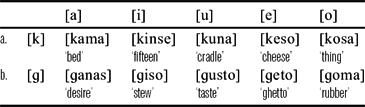
The participants were also asked to read a word list containing 60 Spanish words, each of which began with a consonant, followed by one of the five Spanish vowels (/a e i o u/), which was then followed by a nasal or stop consonant. For this Spanish word-list experiment, there were 60 items, 15 that began with the voiced velar target [g] and 15 that began with the voiceless velar target [k], and 30 filler items. Of the 30 target items, 26 were two syllable words with initial stress, in order to partially control for stress effects and to make the stimuli comparable to the Quechua target words. The target list ultimately consisted of three items for each possible CV combination, which yielded a potential maximum of 330 tokens, 11 of which were excluded from analysis due to recording noise. In total, 319 tokens of Spanish vowels following velar consonants were included in the analysis. This does have the result that the Spanish data set is smaller than the Quechua data set, but this was a necessary limitation due to practical constraints on the duration of the experiment.
Tables 2 and 3 show the relevant comparisons with example targets; the entire vowel space for both languages will be explored, but a special focus will be on comparing mid vowels following Spanish velars (Table 3) and lowered ‘high’ vowels following Quechua uvulars (previously presented in Table 2). A full list of Spanish targets can be found in Appendix A and a full list of Quechua targets can be found in Appendix B.
Quechua vowel targets following velar and uvular consonants. Note that for (d–f), the phonemic vowels are /a i u/, but because of potential lowering, the high vowels are transcribed in their hypothesized surface forms.

Examples of target words from Spanish word-list task.

2.4 Analysis
In order to address the research questions posed at the outset, several methods of analysis were employed to treat each question in turn. To determine whether Quechua vowels are lower following uvular consonants than following velar consonants, we measured F1 and F2 values of all Quechua vowels following a word-initial uvular or velar consonant at multiple points. To compare the formant characteristics of the speakers’ Quechua vowels with their Spanish vowels, F1 and F2 measurements were also taken for the Spanish vowels.
Target items from the Quechua elicitation task and Spanish word list were isolated from the filler items. Vowel boundaries were labeled and aligned by hand in a Praat textgrid (Boersma & Weenink Reference Boersma and Weenink2014). A Praat script was then created to extract measurements for F1, F2, and F3 at 20% and 50% of duration for each vowel, as well as information about the preceding and following consonants and the identity of the target word. The formant values for each vowel were then plotted, and outliers were manually checked for accuracy in Praat and discarded in cases of incorrect readings.
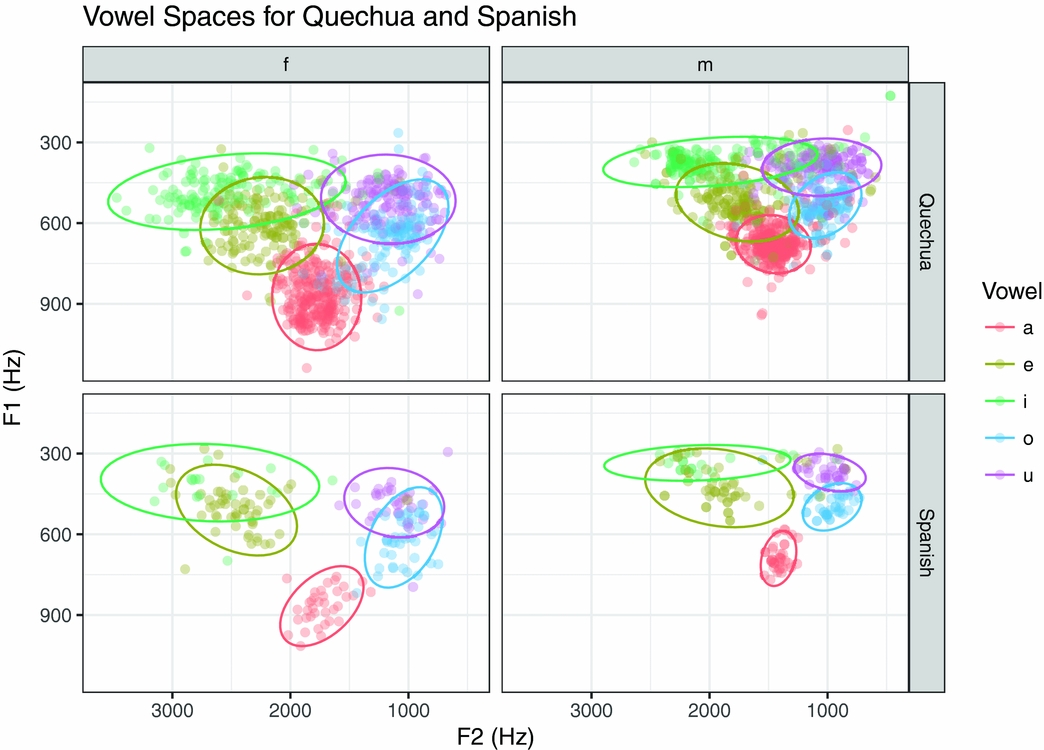
Figure 1 plots the F1 and F2 measurements for all vowels produced in the Quechua and Spanish production tasks, with the columns differentiated by gender, and the rows by language so that the reader can observe the range of values.
Quechua and Spanish vowel spaces, based on measurements taken at 50% of vowel duration, with ellipses, split by gender (vertically) and language (horizontally). These are labeled by surface realization, each dot represents one token.
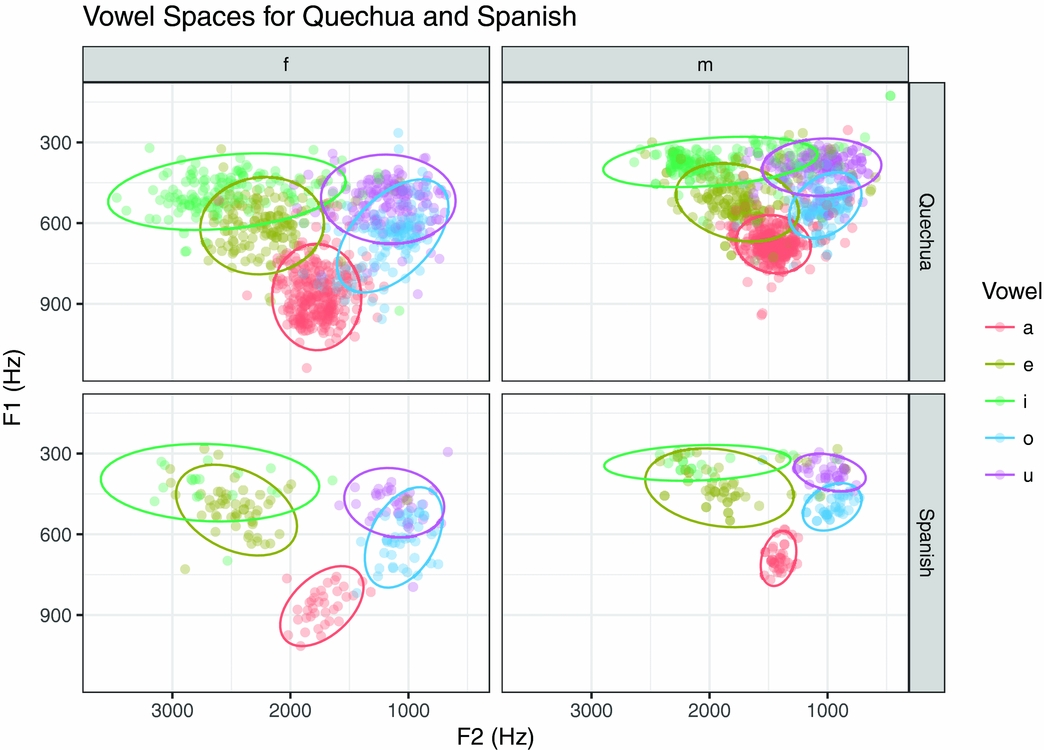
Figure 1 does show what appear to be differences in vowels due to gender, which were controlled for in the models conducted throughout the analysis. In addition, Quechua has a three-way distinction in laryngeal feature distinction in stops (Ejective, Aspirate, Plain). While this was not of primary interest, it does have the potential to affect vowel quality, therefore stop type was also included in the initial models of Quechua vowels, though it was ultimately found to have no significant effects.
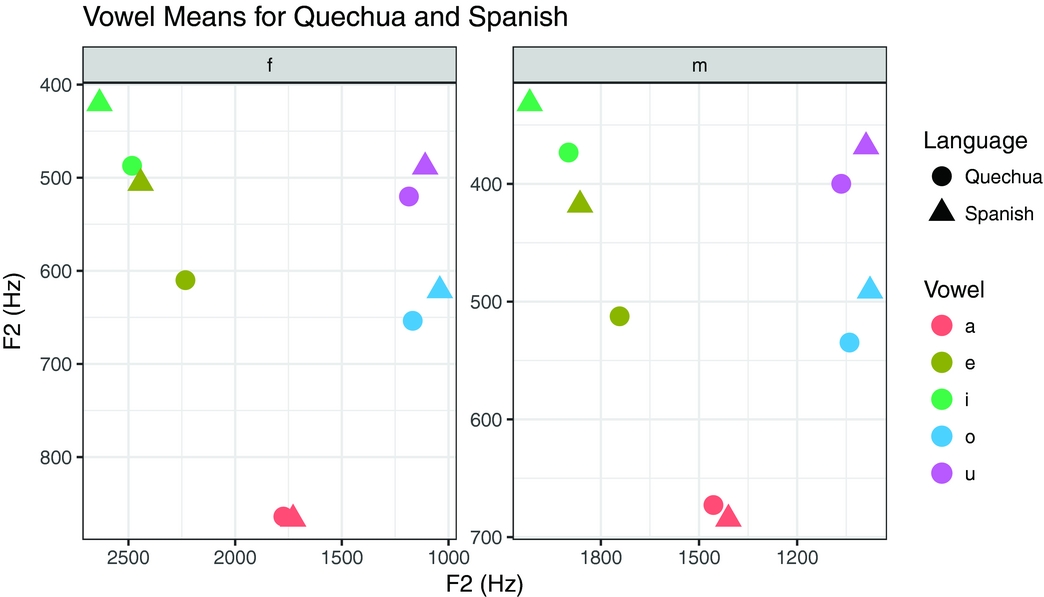
Figure 2 below compares vowel realizations between languages more directly, plotting the average formant values for Quechua and Spanish productions against each other, again split by speaker gender.
Quechua and Spanish vowel means, based on measurements taken at 50% of vowel duration, labeled by surface realization.
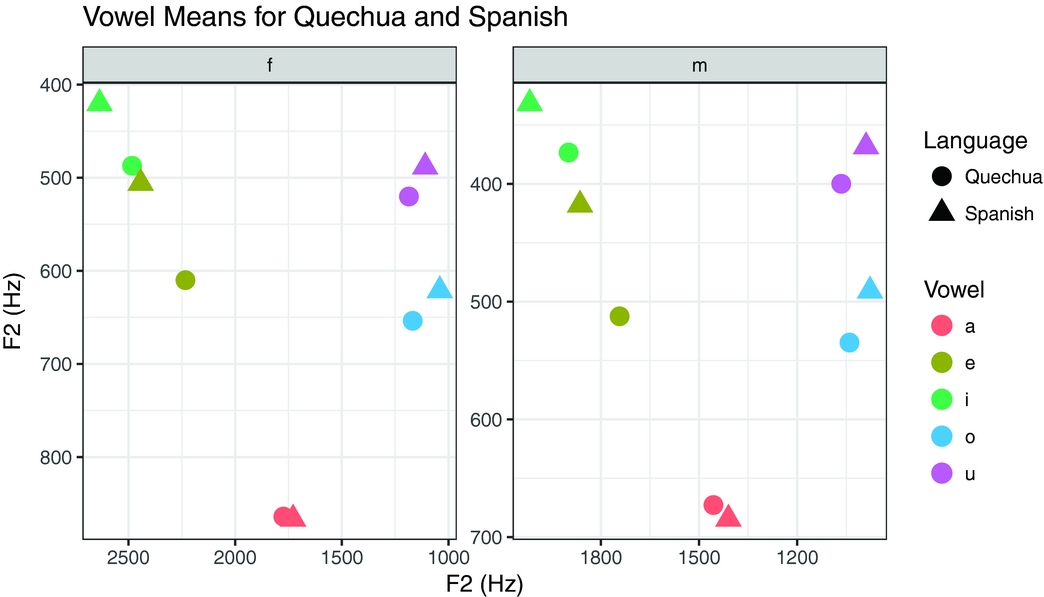
Here we can see that while the overall shapes of the vowel spaces are similar between the two languages, the specific locations of the vowels differ, with the average realizations of the Quechua vowels being typically lower and more centralized than their Spanish counterparts.
2.5 Statistical analysis
The data from the production studies was analyzed using a series of linear mixed effects models. Rather than normalize for speaker variability prior to modeling, we have chosen instead to directly include speaker variability in our statistical models in the form of by-subject random effects included in the model specification. These allow us to model the inherent between-speaker variability in terms of variance components for model terms, which can also be interpreted as adding individual adjustments to the effects of interest during the modeling rather than adjusting the data prior to modeling (see e.g. Kruschke Reference Kruschke2015: Chapter 9). Models were implemented using the RStan-Arm package in R (Stan Development Team 2017). The models described here were fit using a Bayesian inference procedure based on Markov Chain Monte Carlo methods.
These methods result in a distribution over the model parameters of interest rather than a single point estimate. P-values are not defined for these models and we summarize our inferences based on these distributions in terms of the mean/expected value of the distribution and summarize our uncertainty about these values in credible intervals (when discussing parameters of the regression model e.g. the effect of occurring in a uvular context on F1) and posterior predictive intervals (when discussing the outcomes we're modeling directly e.g. the expected F1 value for /i/). If a 95% credible interval for a particular parameter does not contain 0, this can be loosely interpreted in the same way as a standard (frequentist) confidence interval not containing 0 suggesting a significant effect. Predictive intervals differ from the credible intervals in that they also incorporate our estimates of the variability of the process we are modeling, so they represent our additional uncertainty about future realizations (here productions of a given vowel), in addition to the uncertainty in the parameters estimated based on our current set of observations. For a more in-depth introduction to Bayesian inference, which provides comparisons to frequentist methods, see e.g. Kruschke (Reference Kruschke2015).
3. Results
3.1 Quechua lowering in uvular contexts
To address the question of whether Quechua high vowels lower to mid vowels in uvular contexts, we fit mixed-effects regression models with F1 and F2 as the dependent variables. The fixed effects of interest were vowel label (/i u a/), and a contrast for uvular vs non-uvular context, along with their interaction terms. To control for potential confounding factors, additional fixed effects were included for laryngeal type (aspirate, ejective, plain), and speaker gender, along with vowel–laryngeal, and vowel–gender interaction terms. The model also included random intercepts and random slopes for the uvular effect by speaker (this was the maximum convergent random effects structure).
3.1.1 F1
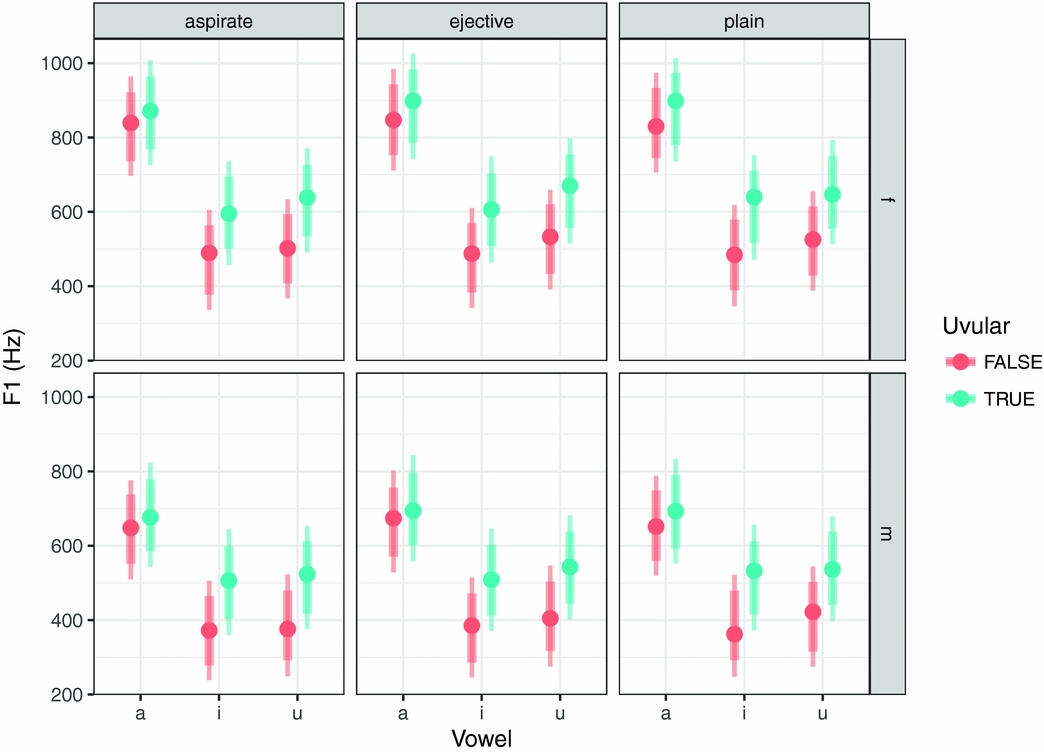
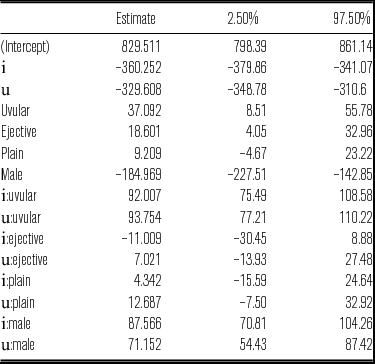
For F1, we find a positive effect of uvular context (mean 37 Hz, 95% credible interval (CI) (18.51,55.78)), indicating lowering for all vowels in uvular contexts, but additionally we find positive interactions of uvular with the vowels /i/ (mean 92 Hz, 95% CI (75,108)), and /u/ (mean 93 Hz, 95% CI (77,110)), indicating that these two vowels undergo additional lowering. This indicates that Quechua high vowels do undergo significant systematic lowering when they are preceded by uvular consonants. A visual summary of these results can be seen in Figure 3, with columns separated by laryngeal feature and rows by speaker gender, though the results are similar for all three laryngeal contexts and both genders observed here.
Posterior predictive intervals of midpoint F1 formant values for Quechua vowels by preceding consonant, considering laryngeal features of stop consonant.
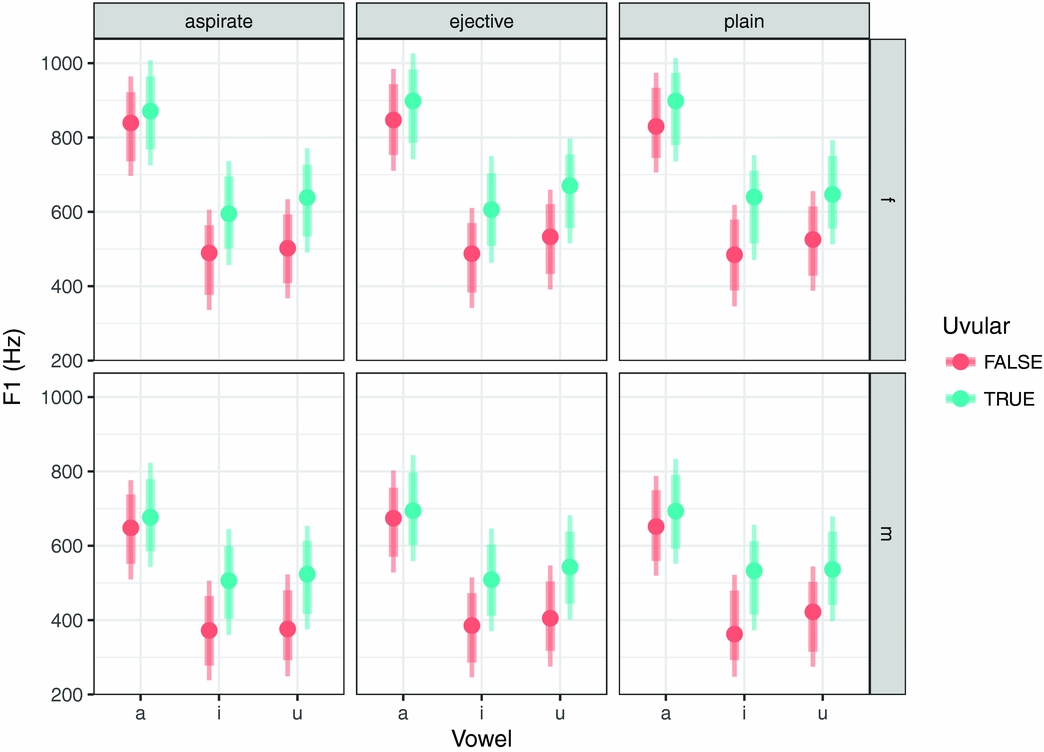
Figure 3 shows the plot of the predicted mean formant values for vowels in the relevant contexts, along with posterior predictive intervals. We see few differences dependent on laryngeal features, however, for /i/ and /u/, there are notable differences between the Quechua uvular and velar contexts, with uvular contexts showing lowering (higher F1) that does not occur in velar contexts. There is still some degree of overlap, but these can be compared with the values for /a/, for example, which show no differences based on laryngeal setting of proceeding consonant.
In addition to the results of interest discussed above, Table 4 gives a more complete summary of the output of the statistical modeling procedure in terms of the estimated model coefficient (mean value) for each fixed effect, along with the upper and lower bounds of a 95% credible interval for the effect, showing the degree of uncertainty of the estimate.
(for Figure 3) Estimates for fixed-effects model testing Quechua preceding consonant laryngeal contrast, with 95% credible intervals. Because of how factors were coded, /a/ is represented by the intercept, with contrasts for /i/ and /u/. Similarly, female speakers were the baseline, with a contrast for male speakers. Interaction terms are indicated with x:y.

3.1.2 F2
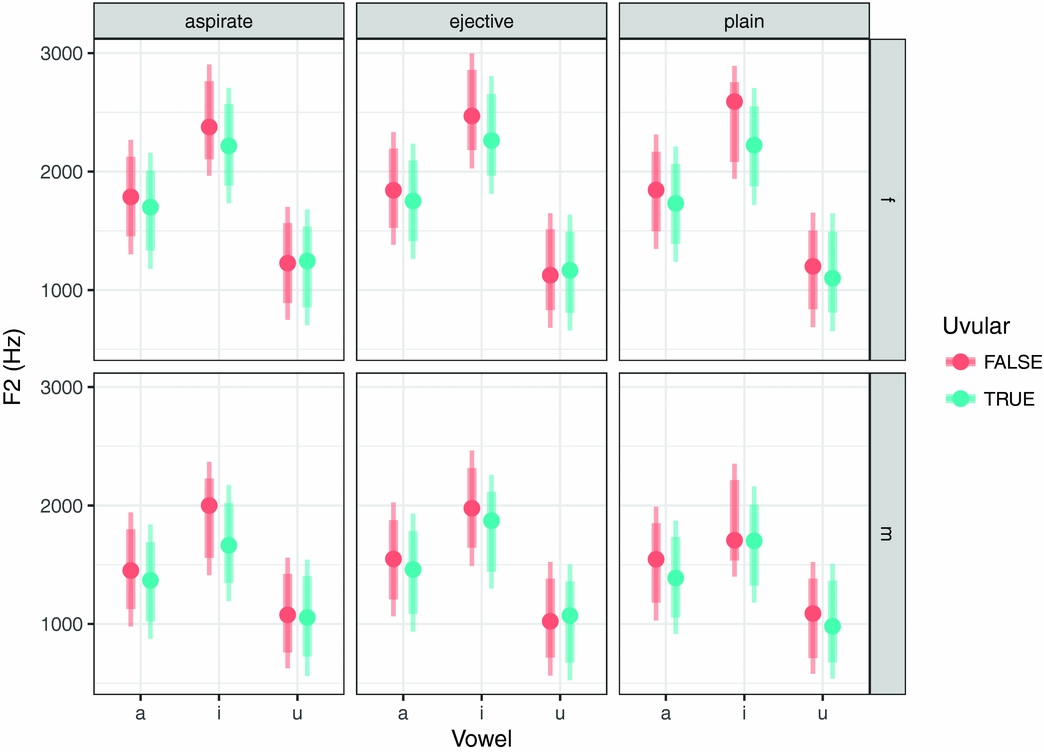
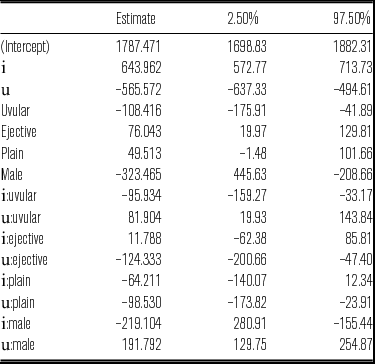
For the comparison between F2 values, the main effect of uvular context is a lower F2 value (–108 Hz, 95% CI (–175,–41)). There is also a negative interaction of uvular context and vowel that results in a lower F2 for /i/ (mean –95 Hz, 95% CI (–159,–33)), corresponding to a more centralized production. The results also show a positive interaction of uvular and /u/ (mean 81 Hz, 95% CI (19,143)), indicating that /u/ does not undergo the same changes in the uvular context as /i/ and /a/. Figure 4 plots these results with columns separated by laryngeal feature and rows by speaker gender, though the results are similar for all three laryngeal contexts and both genders observed here.
Posterior predictive intervals of midpoint F2 formant values for Quechua vowels by preceding consonant, considering laryngeal features of stop consonant.
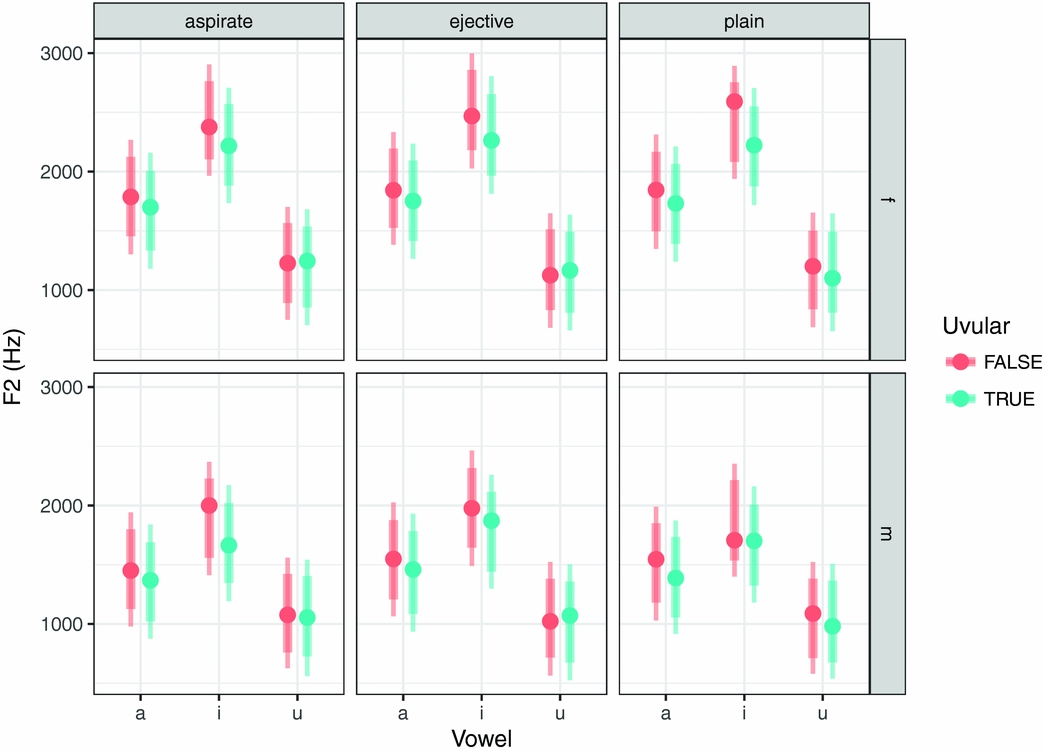
Again, examining a visual summary of the results presented in Figure 4, we observe fewer obvious differences than for F1, although the estimated coefficients do show a slight but significant degree of centralization for both /i/ and /u/. We found what appear to be lowered and centralized realizations of /i/ and /u/ in uvular contexts, suggesting that these vowels are indeed being realized in a lowered and centralized manner, which may be more similar to [e] and [o]. The lowered variants of /i/ and /u/ will continue to be labeled as [e] and [o] for clarity.
A complete summary of fixed-effects estimates for the F2 model is given in Table 5. As with the F1 model, /a/ was the reference level for vowels and female for gender and so these are represented by the intercept term.
(for Figure 4) Estimates for fixed-effects model testing Quechua preceding consonant laryngeal contrast on F2 values, with 95% credible intervals. Interaction terms are indicated with x:y.

3.2 Comparing vowel formants in Spanish and in Quechua
To further address whether the pattern of lowering in uvular contexts results in a set of vowels that is truly similar to the Spanish five-vowel system, we fit an additional pair of mixed-effects linear regression models for vowel formants to examine the differences between the two languages. As before, the dependent variable in each model was F1 or F2. The fixed effects of interest were language and vowel label (here a five-vowel labeling with [i], [e], [a], [o], and [u], reflecting surface realizations as argued in the previous section), along with language–vowel interaction terms. Additional fixed effects were included to control for speaker gender, along with a language–gender interaction term. A random intercept and random slope for language by speaker were included as random effects.
3.2.1 F1
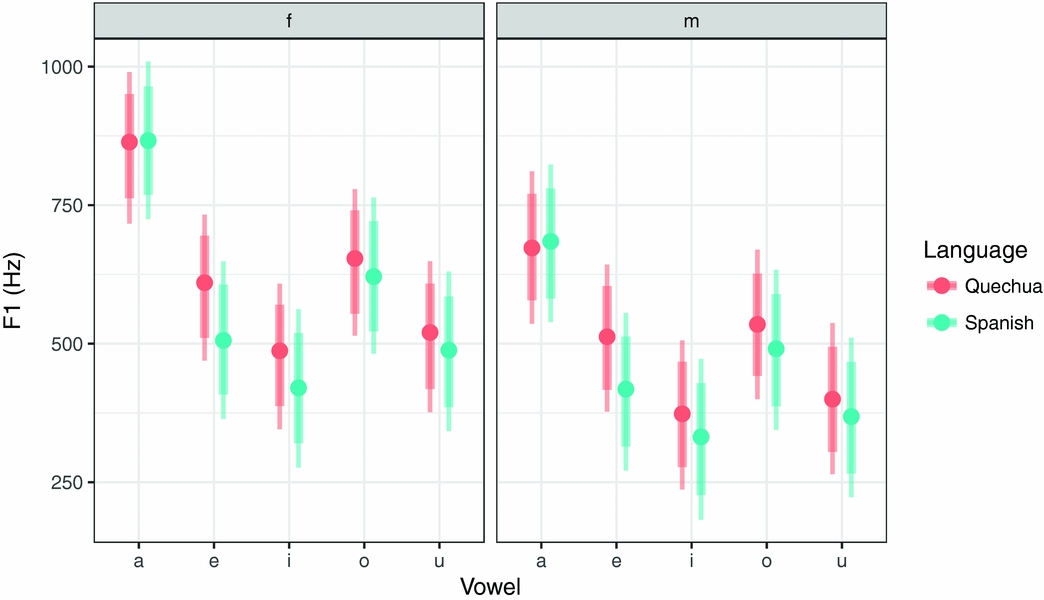
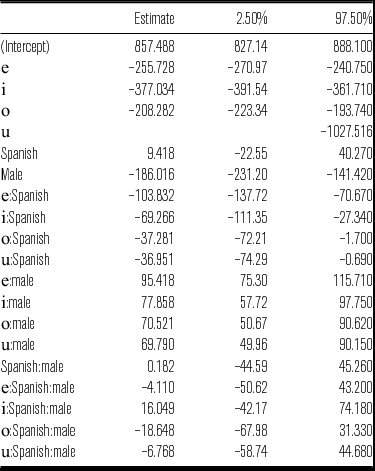
We found that some vowel formants showed little or no consistent difference in their F1 midpoint values (/a/ m: 9 Hz 95% CI (–22,40), /u/ m: –37 Hz (–74,–0.7), /o/ vs [o] m: –37 (–72,–1.7)), while others showed potentially more substantial differences (/i/ m: –69 (–111,–27), /e/ vs [e] –104 (–137,71)). These results are plotted in Figure 5.
Side-by-side comparisons by language of midpoint F1 values for Spanish and Quechua vowels, with female subjects plotted on the left, and male subjects on the right.
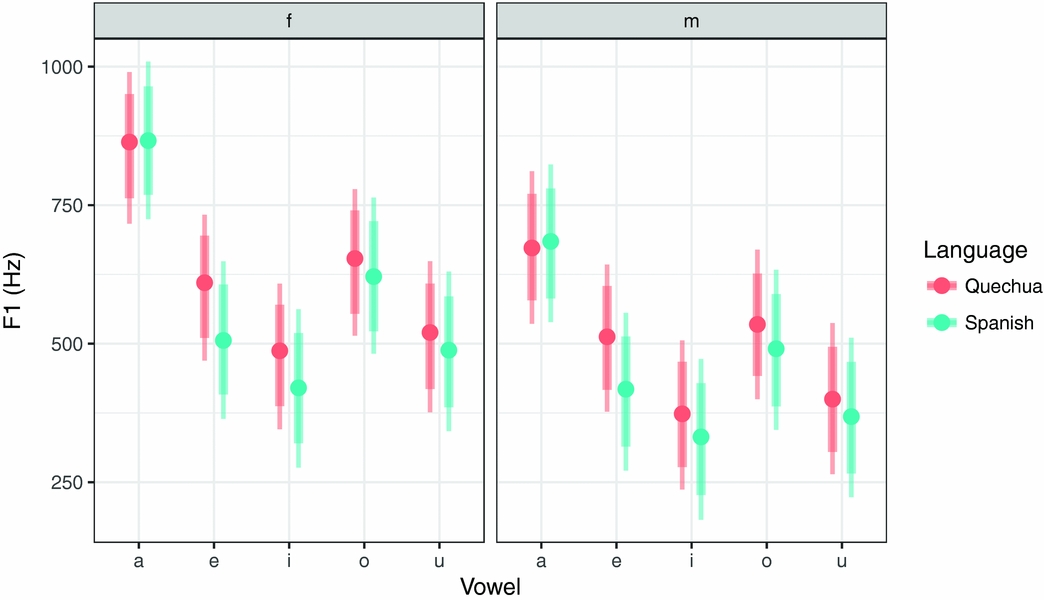
As can be observed from Figure 5, there are minor but consistent differences between steady-state values of F1 for each language, indicating that speakers may not be aiming for the same values across languages. Generally, the F1 values for the Quechua vowels are higher than those for the Spanish vowels, and this is especially the case for the mid and high vowels.
A complete summary of fixed-effects estimates for the F1 language comparison model is given in Table 6. As before, /a/ was the reference level for vowels and female for gender. Here, Quechua is the reference level for language.
3.2.2 F2
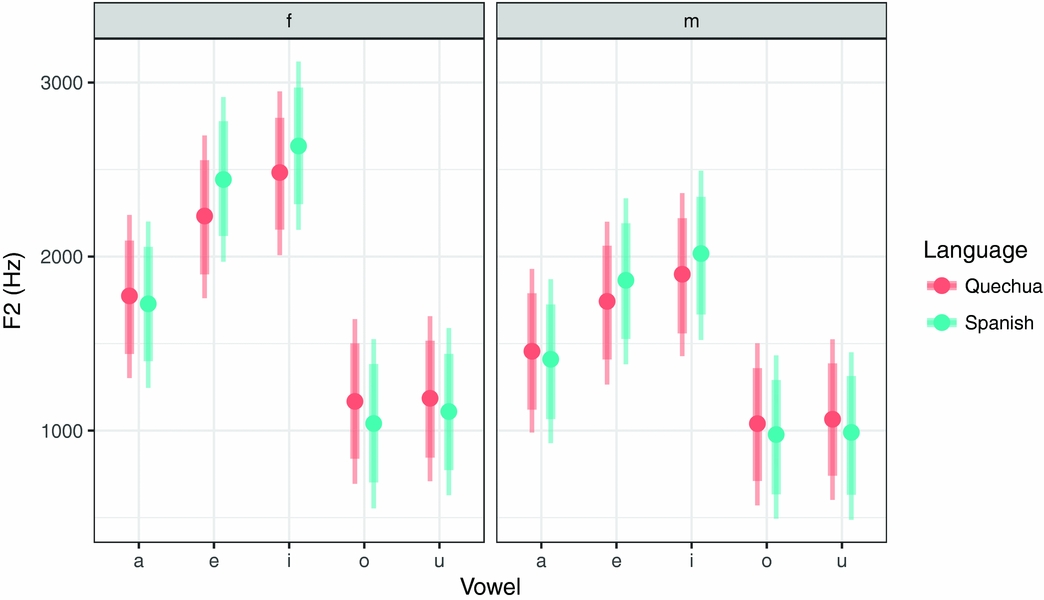
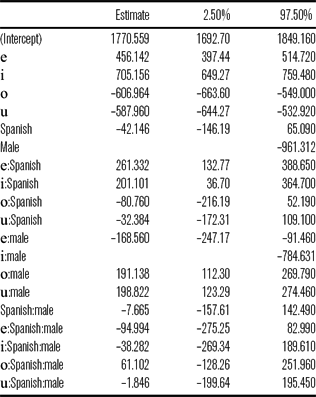
Comparing the F2 patterns for Spanish and Quechua using the same model structure described above, we find a similar pattern of qualitative similarity between the two languages. The vowels /a/ (m: –42 Hz (–146,65)), /o/ vs [o] (m: –81 (–216,52)), and /u/ (m: –32 (–172,109)) show no consistent statistically significant pattern of differences between the languages. Meanwhile, /i/ (m: 201 (37,364)) and /e/ or [e] (m: 261 (133,389)) do show significant differences. These results are plotted in Figure 6.
Side-by-side comparisons by language of midpoint F2 values for Spanish and Quechua vowels, with female subjects plotted on the left, and male subjects on the right.
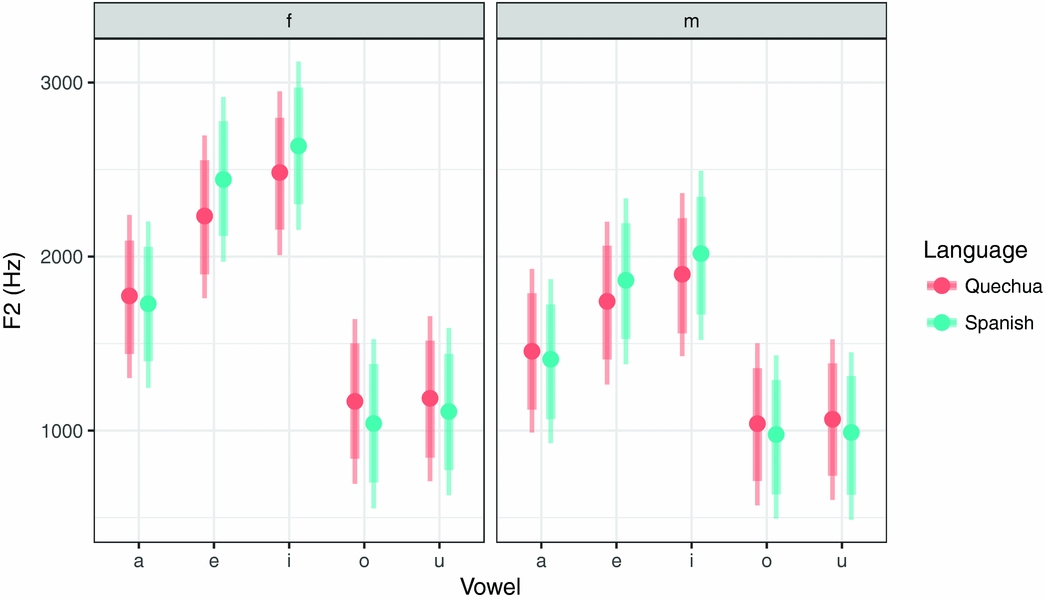
We can see that the vowels fall into similar overall patterns for F2 values. But again, comparing vowels we see differences which suggest that speakers are not necessarily using identical formants in both languages. In general, for the front vowels, the Spanish F2 values appear to be higher than the Quechua F2 targets, but this pattern is reversed for back vowels, indicating that the Quechua system may be generally more centralized than the Spanish system.
A complete summary of fixed-effects estimates for the F2 language comparison model is given in Table 7. This model uses the same structure and so has the same reference levels for categorical independent variables as the F1 model (/a/, female, and Quechua).
(for Figure 5) Estimates for fixed-effects model comparing F1 formant values between Spanish and Quechua vowels. Interaction terms are indicated with x:y.

(for Figure 6) Estimates for fixed-effects model comparing F2 formant values between Spanish and Quechua vowels. Interaction terms are indicated with x:y.

3.3 Gradient versus categorical lowering
As we have found evidence that Quechua high vowels in uvular contexts are consistently and substantially different in realization than those in velar contexts, and showing a pattern that is potentially distinct from the five-vowel system of Spanish, we next examine whether the mid-vowel realizations of /i/ and /u/ show behavior more consistent with gradient, coarticulation-driven lowering or a more categorical pattern. Following the patterns described by Wilson (Reference Wilson2007), in the case of a coarticulatory pattern, we would expect significant differences between the 20% and 50% measurements, with substantially higher formant values at the onset. As a point of comparison, here we contrast the data from the Spanish tasks, where speakers are producing a known categorical distinction, to Quechua, to see whether the speakers’ behavior in the two languages differs.
We examined the transition patterns in Quechua and Spanish using a mixed-effects regression model. The dependent variable was the difference between F1 measured at 50% and at F1 measured at 20% of the vowel duration (F150–F120). The fixed effects of interest here were vowel label, language, and their interactions. In addition we included a fixed effect for gender as a control variable, along with the two- and three-way interactions of gender, vowel, and language. We also included random intercepts and random slopes for language by speaker in the model. An identical model, other than the dependent variable, was used for F2.
3.3.1 F1
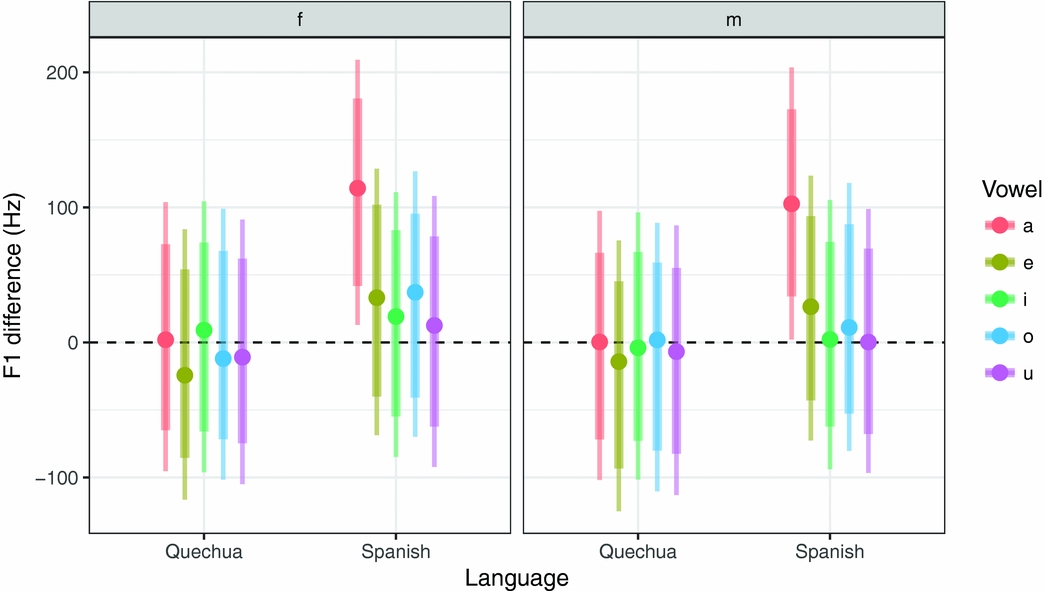
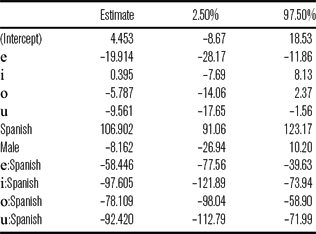
For our F1 model, the magnitude of the F1 transition estimates for each Quechua vowel were small (/a/ m: 4.5 Hz (–9,19), /i/ m: 0.4 (–8,8), /u/ m: –10 (–18,–1.5), [e] m: –19 (–28,–11.9), [o]: –5.8 (–14,2.4)). Notably the credible intervals for /a/, /i/, and /o/ included values on both sides of 0 while the range of credible values for /u/ and /e/, while consistent in direction, still suggest fairly flat transitions. These can be contrasted with somewhat larger estimated magnitudes of Spanish vowel transitions (/a/ m: 112 Hz (96,129), /i/ m: –96 (–120,–74), /u/ m: –102 (–123,91), /e/ m: –78 (–96,–61).
These are visually summarized, again with predictive intervals in Figure 7, which shows that the predictive intervals for all vowels other than the Spanish /a/ encompass 0, showing a lack of a significant distinction between formant measurements at 20% and 50% of vowel duration. These results indicate that the formant transitions are highly variable and we find no clear pattern of formant transitions for each vowel.
Posterior predictive intervals for F1 formant transitions, comparing Quechua and Spanish vowels at 20% and 50% durations, with 95% credible intervals.
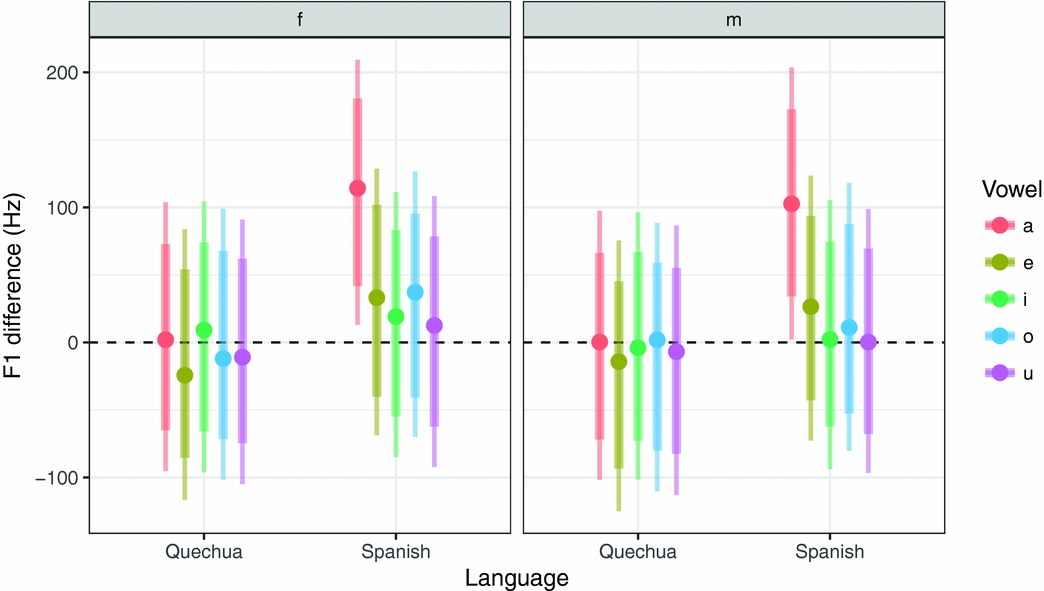
A full summary of the fixed effects included in the F1 vowel transition model is given in Table 8.
(for Figure 7) Estimates for fixed-effects model testing F1 values of Quechua and Spanish vowels at 20% and 50% of vowel duration, with 95% credible intervals. Interaction terms are indicated with x:y.

3.3.2 F2
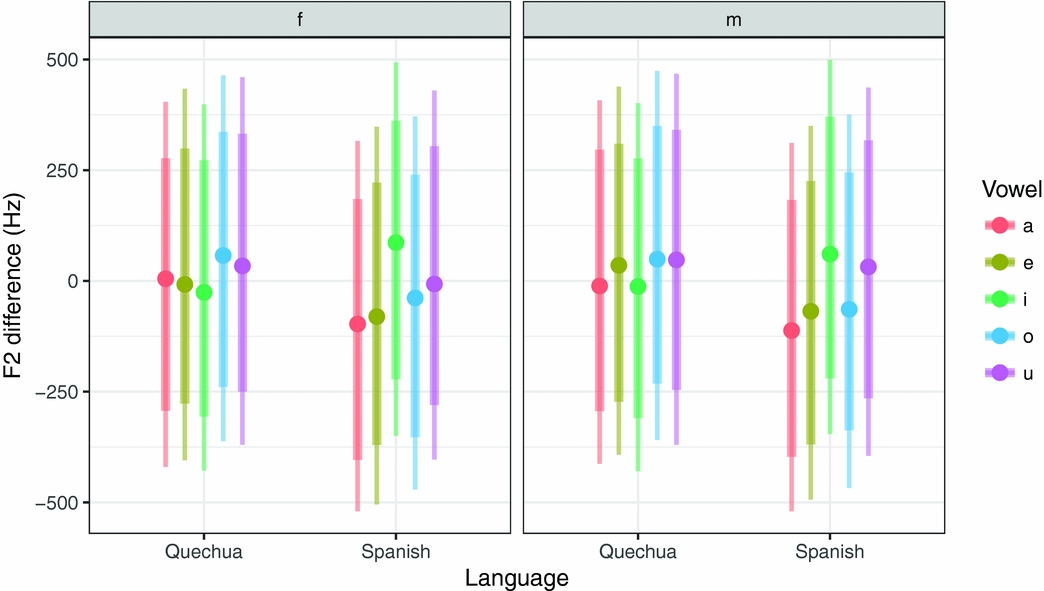
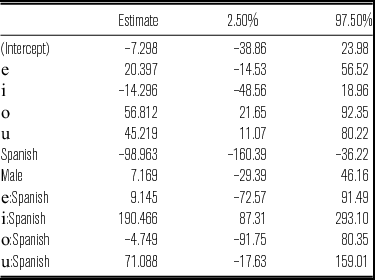
Fitting a model with the same structure for F2, the estimated formant transition magnitudes for Quechua were again comparatively small, with credible intervals including both positive and negative values for /a/ (m: –7 Hz (–39,24)), /i/ (m: –14 (–49,19)), and [e] (m: 20 (–15,57)), while /u/ (m: 45 (11,80)) and [o] (m: 56 (21,92)) showed more consistent but still relatively small estimated F2 transitions. These can again be contrasted with the pattern for Spanish, where /e/ (m: 29 (–44,104)) and /o/ (m: 52 (–27,130)) showed a lack of consistent transition direction, while /a/ (m: 107 (–169,–44)), /i/ (m: 177 (78,275)), and /u/ (m: 117 (35,199)) showed more substantial F2 transitions. Again when examining the predicted vowel realizations + posterior predictive intervals, we find that the small trends observed are overshadowed by the overall variability of formant transitions in general. This result also seems to indicate no reliable differences in F2 values at 20% and 50% of the Quechua productions, which can be observed in Figure 8.
Posterior predictive intervals for F2 formant transitions, comparing Quechua and Spanish vowels at 20% and 50% durations, with 95% credible intervals.
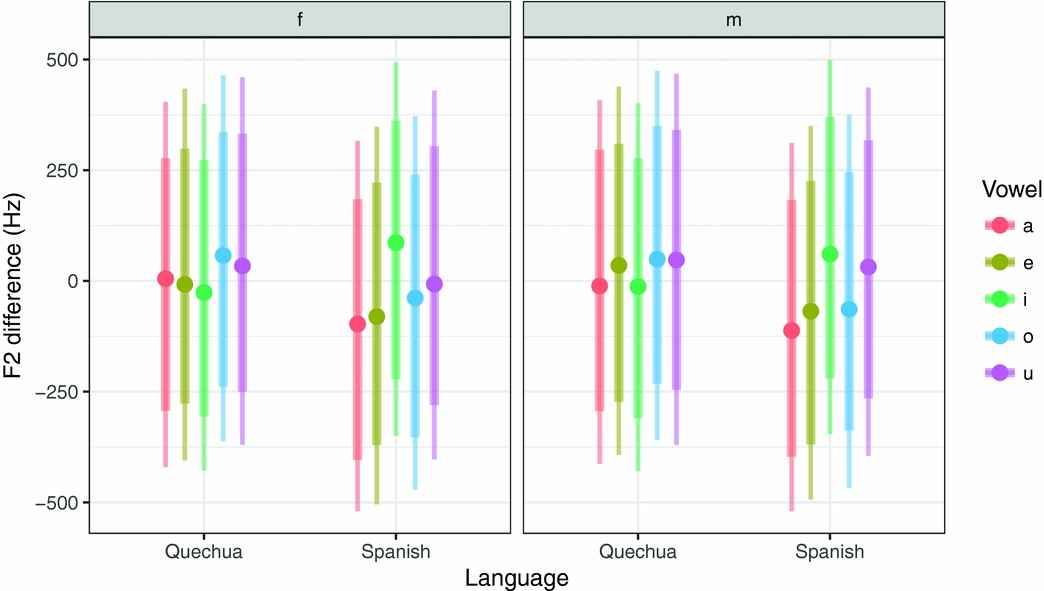
A full summary of the fixed effects included in the F2 vowel transition model is given in Table 9.
(for Figure 8) Estimates for fixed-effects model comparing F2 formant values for vowels at 20% and 50% durations. Interaction terms are indicated with x:y.

4 Discussion
The results reported above have shown that South Bolivian Quechua high vowels /i/ and /u/ do undergo systematic lowering following uvular consonants and that productions of /i/ and /u/ in uvular contexts also appear to be more centralized than their counterparts that occur following velars. In the contexts where this pattern of lowering and centralization occurs, it also appears to be categorical rather than purely coarticulatory, as significant differences in formant values were not generally found between 20% and 50% of vowel durations.
Finally, a comparison of the Quechua and Spanish productions of mid and high vowels reveals that the speakers appear to have different formant values for each of the vowels in each language. In terms of F1, Quechua high vowels do appear to lower in the presence of uvular consonants, although they may not necessarily target the same F1 values as the Spanish phonemic mid vowels. In terms of F2, Quechua front vowels /i/ and /e/ also appear to have different values than their Spanish counterparts. These results provide some evidence for the hypothesis that bilingual speakers may have separate vowel systems for each of their languages. Section 4.1 further discusses the observed allophony and Section 4.2 addresses potential additional implications for bilingual speech.
4.1 Allophony
The results of the current study indicate that high vowels in the presence of uvulars do undergo systematic lowering that does not occur following velar consonants, providing evidence for the claim that the observed lowering is the result of an allophonic process. Additionally, as the results indicate no significant differences between formants at 20% and 50% of vowel duration for /i/ or /u/ in the presence of uvular consonants, this pattern appears to be truly allophonic as opposed to articulatory. This stands in contrast to Wilson's (Reference Wilson2007) findings for the pattern observed in Nuu-chah-nulth, in which F1 is lower initially than at the midpoint, a fact that he attributes to a primarily coarticulatory effect. The current study's findings demonstrate that a three-vowel system with lowering in the presence of uvulars may also demonstrate allophonic production effects as opposed to pure coarticulatory ones.
4.2 Bilingualism
The results of this study also raise issues related to how bilinguals organize their vowel systems. In the current sample, Quechua mid and high vowel formants appear in different locations in the vowel space than their Spanish counterparts. This result indicates that Cochabamba Spanish/Quechua bilinguals may maintain two separate vowel systems.
These apparent differences in vowel formants for Spanish and Quechua are also especially of interest in light of the base of articulation theory as discussed by Bradlow (Reference Bradlow1995), and later applied to Ecuadorian Quechua by Guion (Reference Guion2003). Though Spanish is a five phonemic vowel system and Quechua is a three-phonemic-vowel system with allophonic lowering of /i/ and /u/ in the presence of uvulars, these bilingual speakers do not appear to employ the same formant values for the Spanish and Quechua vowels with corresponding places in their vowel spaces. The Quechua vowel system is generally more centralized, with higher F1 values for high and mid vowels than the Spanish systems of the same speakers. Additionally, we observe a higher F2 value for back vowels and a lower F2 value for front vowels in the Quechua system than in the Spanish system, further supporting the claim that the Quechua system is generally more centralized. This stands in contrast to the findings by Guion (Reference Guion2003) for Ecuadorian Quechua, which found that Ecuadorian Quechua high vowels were generally higher than Spanish vowels for bilingual speakers, though this difference may be influenced by the fact that Ecuadorian Quechua does not have a pattern of allophonic lowering because its inventory does not contain uvular consonants. Guion (Reference Guion2003) uses Bradlow's base of articulation theory to explain the pattern observed in Ecuadorian Quechua, though the results of the current study do not necessarily support the same claims. As the Quechua system appears to be a more-centralized subset of the Spanish system observed for these same speakers, it is difficult to claim that these differences are necessarily due to the languages having different bases of articulation.
However, the differences between the Quechua and Spanish vowel systems of these bilingual speakers do support the finding that speakers may simply have different vowel categories for each of their languages, a claim that is also supported in Guion (Reference Guion2003). If this were not the case, we may expect to see evidence that the mid vowels in Spanish and Quechua are the same. The fact that the F1 and F2 values for the allophonic mid vowels in Quechua are different than the F1 and F2 for the phonemic mid vowels Spanish for these bilinguals seems to indicate that their Spanish productions are independent of their Quechua productions. Additionally, the F1 and F2 values for the phonemic high vowels /i/ and /u/ are also different in Spanish versus Quechua, indicating that even for phonemic vowels, speakers do not appear to be relying on their productions in one language to influence their productions in the other.
This study has shown that Spanish/Quechua bilinguals in Cochabamba do appear to have a pattern of allophonic lowering of high vowels /i/ and /u/ in the presence of uvular consonants, but that this lowering does not appear to target the values that these speakers employ for their Spanish mid vowels [e] and [o]. Also, via a comparison of the Spanish and Quechua vowel spaces of these speakers, we have also observed that the spaces appear to have generally different vowel formants, with the Quechua vowel space more centralized than the Spanish vowel space. This provides further evidence that the languages may have different bases of articulation supporting the findings of Guion (Reference Guion2003) for a different Quechua variety. Finally, these differences appear to be maintained in the vowel systems of bilingual speakers despite high levels of community bilingualism as well as long-term sustained language contact.
Acknowledgements
The authors would like to express their gratitude to Gillian Gallagher for her assistance and advice on this study. They would also like to acknowledge the audiences of OSU CHiLL 2014, the 168th Acoustical Society of America Meeting, and anonymous reviewers for their helpful feedback. Finally, they would like to thank Greg Guy, Lisa Davidson, Zack Jaggers, James Whang, Gladys Camacho Rios, Elvia Andia, UNIBOL Quechua, and the study's participants. This research was also supported by NSF BCS Grant 1222700 to Gillian Gallagher.
Appendix A. Spanish word-list target items

Appendix B. Quechua oral translation task items