Introduction
Junglerice [Echinochloa colona (L.) Link], a C4 species, is a problematic weed in mungbean [Vigna radiata (L.) R. Wilczek] crops in the northern grain region (Queensland and New South Wales) of Australia. It is native to tropical and subtropical Asia and is widespread in Asia, Africa, and Australia (Holm et al. Reference Holm, Holm, Holm, Pancho and Herberger1997; Michael Reference Michael1983). Echinochloa colona can emerge in several flushes during spring and summer in subtropical regions of Australia (McGillion and Storrie Reference McGillion and Storrie2006). In terms of management costs incurred due to herbicide-resistant weeds in Australia, E. colona ranked fifth in cereals and second in sorghum [Sorghum bicolor (L.) Moench]. In Australia, E. colona infestation results in a yield loss of 800 million kg annually in grain crops, amounting to a revenue loss of A$14.7 million (Llewellyn et al. Reference Llewellyn, Ronning, Clarke, Mayfield, Walker and Ouzman2016). Echinochloa colona germination is strongly stimulated by light, and seedling emergence is optimal at 0- to 0.2-cm depths, suggesting that this species is likely to be favored as a weed in no-till systems (Chauhan and Johnson Reference Chauhan and Johnson2009). However, E. colona’s emergence and growth can be substantially reduced by using crop residues as mulches in conservation agriculture systems (Chauhan and Abugho Reference Chauhan and Abugho2013).
Mungbean is the main summer pulse crop in the northern grain region of Australia and makes an important contribution to the Australian economy. More than 90% of mungbean produced in Australia is exported to countries like India, the Philippines, China, and Vietnam (Rachaputi et al. Reference Rachaputi, Chauhan, Douglas, Martin, Krosch, Agius and King2015). This crop is grown at very wide spacings in Australia, which leads to heavy weed infestation. Weed control with herbicides becomes difficult when a crop is infested with herbicide-resistant weeds, which are becoming increasingly common worldwide. About 92 weeds have developed herbicide resistance in 90 countries (Heap Reference Heap2018). In Australia, overdependence on glyphosate for control of E. colona led to the problem of glyphosate-resistant E. colona (Beckie Reference Beckie2011). The incidence of glyphosate resistance in E. colona was first reported in 2007 in New South Wales, Australia (Preston Reference Preston2010) and after that in 2009 in Queensland (Heap Reference Heap2018). In addition, E. colona developed resistance against atrazine (Heap Reference Heap2018).
With the advent of herbicide resistance in E. colona, it is important to develop alternative strategies that can smother the weed flora and reduce the weed seedbank. Adoption of integrated weed management practices can help in reducing dependence on herbicides. Crop competition, for example, can be effective for managing weeds. The canopy architecture of crops can be exploited to provide weed control by altering row spacing, planting density, and the orientation of rows (Bajwa et al. Reference Bajwa, Mahajan and Chauhan2015). Recently, it was found that mungbean yields increased at narrow row spacings (25 and 50 cm) compared with wider rows (75 cm) due to a smothering effect on weeds (Chauhan et al. Reference Chauhan, Florentine, Ferguson and Chechetto2017). This research supports the concept of early canopy closure for outcompeting weeds in mungbean crops.
Previous studies have shown that with increasing rice (Oryza sativa L.) density, there was a reduction in the growth and biomass of barnyardgrass [Echinochloa crus-galli (L.) P. Beauv.] and rice flatsedge (Cyperus iria L.) (Chauhan and Johnson Reference Chauhan and Johnson2010a). In another study, the growth of E. colona was negatively affected by a limited supply of nitrogen and increased rice planting density (Awan et al. Reference Awan, Chauhan and Sta Cruz2014). However, these studies were conducted using a rice crop, and there is no information available on the interference of mungbean on the growth and seed production of E. colona. The previous studies were conducted in Asia, and there is very limited information available on this weed in Australia. It is pertinent to mention here that Australia and Asia have different environmental conditions.
Cultural practices that shift competition in favor of the crop are effective tools for integrated weed management; therefore, crop interference that targets weed growth and reproduction is an important method of weed control. The suppression of weeds by increasing sowing density in cereals has been observed in many Australian studies (Lemerle et al. Reference Lemerle, Cousens, Gill, Peltzer, Moerkerk, Murphy, Collins and Cullis2004; Walker et al. Reference Walker, Medd, Robinson and Cullis2002; Walsh et al. Reference Walsh, Maguire and Powles2009), but such information is scarce on pulse crops. As E. colona produces a large number of seeds, reduction of its seed production using crop interference is a good approach for effective integrated weed management. As mentioned earlier, several E. colona biotypes have developed resistance to glyphosate. Very little information is available on the impact of increasing mungbean density on the behavior of glyphosate-resistant (GR) and glyphosate-susceptible (GS) biotypes of E. colona. Our hypothesis for the study was that GR and GS biotypes of E. colona may have different competitive ability in response to mungbean interference. This experiment was designed to study the effect of mungbean interference on the growth and seed production of GR and GS biotypes of E. colona.
Material and methods
Development of GR and GS biotypes
Seeds of E. colona were collected from a field at Gatton, QLD, Australia, in February 2017. The collected seeds were grown in 200 plastic pots (two sets of 100 pots each) in a screenhouse at the Gatton Research Farm of the University of Queensland and cloned. One set of clones was treated with 720 g ae ha−1 (1X rate) of glyphosate. Based on the survivors and dead plants in that set, corresponding GR and GS plants were selected from the other set of clones. The second set of selected GR and GS clones was grown to maturity, and seeds were collected. Offspring were grown in the screenhouse and tested with glyphosate dose to confirm GR and GS status. All GR plants survived 1X and 2X rates of glyphosate, while GS plants failed to survive at the 1X rate. Seeds from the cloned plants were subsequently used for this pot experiment.
Experimental design
The experiment was conducted in 2017 and 2018 with six replications in each year, and it was arranged in a randomized complete block design. The experiments were conducted in the screenhouse at the Gatton Research Farm of the University of Queensland, Australia. A potting mixture medium (Centenary Landscaping, Mount Ommaney, Queensland 4074, Australia) was used for growing the plants. Both populations (GR and GS) of E. colona were sown (3 to 4 seeds) in the centers of pots (25-cm height and 25-cm diameter). Mungbean ‘Jade AU’ seeds were sown in a circular arrangement surrounding E. colona seeds (10 cm away) at 0, 4, and 8 plants pot−1 to determine the effect of mungbean interference on the growth and development of E. colona. Immediately after emergence, E. colona seedlings were thinned, and only one plant in the center of each pot was maintained. Pots were subirrigated throughout the study period. No fertilizer was added to the pots.
Parameters recorded
Data were recorded at weekly intervals starting at 21 d after planting. Plant height was measured from the base of the plant to the tip of the uppermost portion of the plant. Leaf, tiller, and inflorescence numbers were counted at regular intervals. At E. colona maturity, plant height and leaf, tiller, and inflorescence numbers per plant were measured. At harvest, plants of E. colona were divided into leaves and stems, and biomass was measured separately after drying in an oven at 70 C for 72 h. Specific stem length (SSL; plant height per unit of stem biomass, cm g−1) and leaf weight ratio (LWR; leaf dry weight per total plant dry weight) were also calculated. The total number of seeds was calculated by multiplying the inflorescence number with the average seed number for five randomly collected inflorescences per plant.
Statistical analyses
Data from both experiments were subjected to analysis of variance (ANOVA) using Genstat 18. Because transformation did not improve homogeneity, ANOVA was performed on original values. Data were pooled over years when significant interactions were not observed between years and treatments. Regression analysis was used where appropriate; otherwise a protected LSD test at the 5% probability level was used to evaluate differences between the treatments. The weekly data for E. colona height and leaf, tiller, and inflorescence numbers per plant were analyzed using nonlinear regression analysis (SigmaPlot v. 13.0). A three-parameter sigmoid model was used:
 $$ y = a/\left[ {1 + {\rm{exp}}\left( { - {{x - t_{50}} \over b}} \right)} \right] $$
where y is the estimated height and leaf, tiller, and inflorescence numbers per plant, a is the maximum of the parameter, t 50 is the time taken to reach 50% of the final height and leaf, tiller, and inflorescence numbers per plant, and b is the slope, which provides information about the rate of plant height, tiller number, inflorescence number, and leaf number. Estimated parameters were compared using their standard errors. The fitness of the selected model was determined using R2 values.
Results and discussion
Plant height
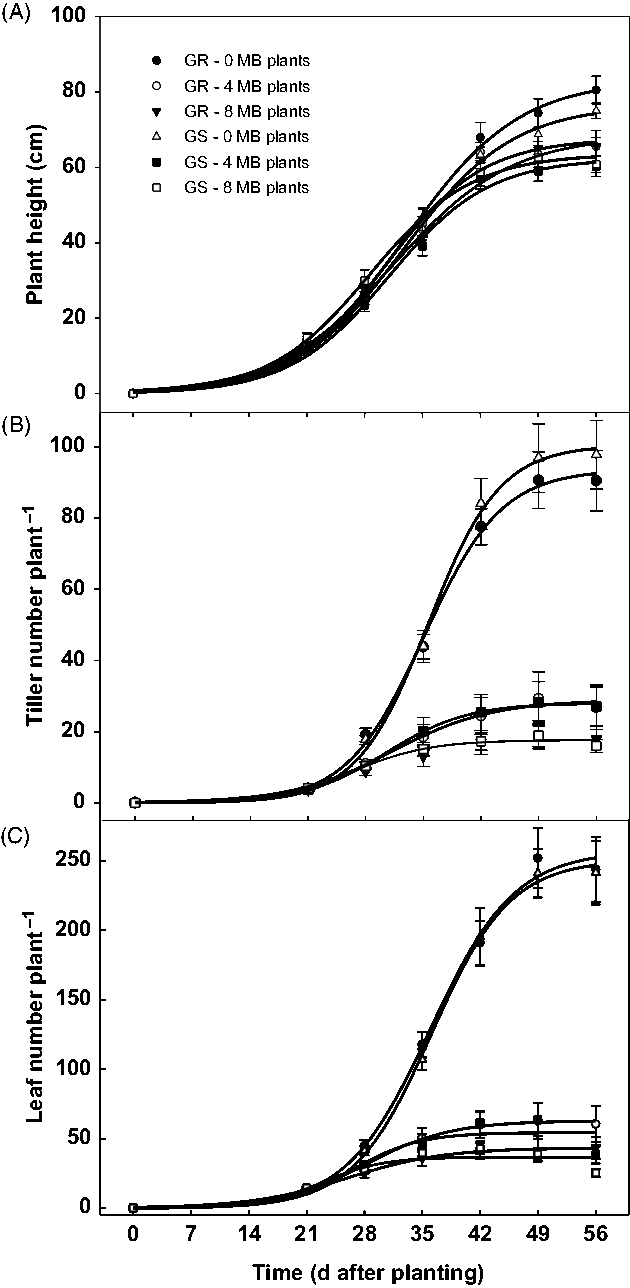
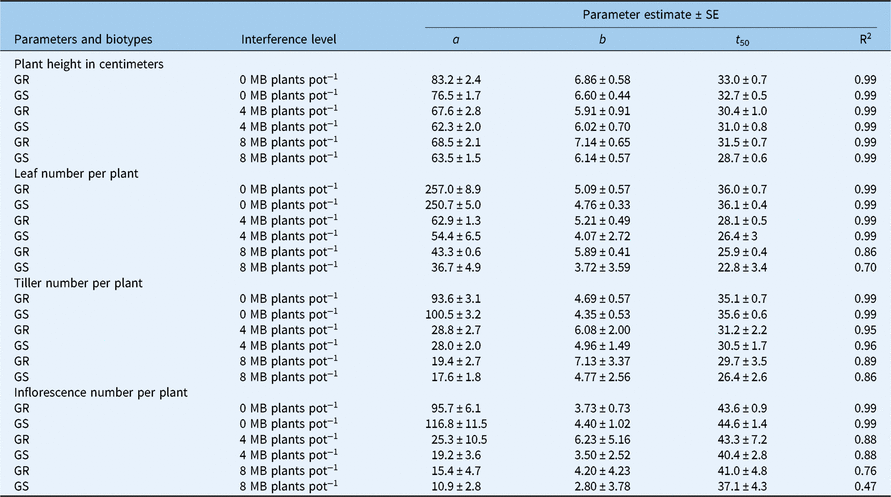
A sigmoidal response was observed for plant height of E. colona over time in days after planting (Figure 1A). Regression estimates indicate increasing mungbean density from 0 to 8 plants pot−1 reduced the final height of GR and GS biotypes by 18% and 17%, respectively. The height of E. colona grown alone was 8% higher for the GR biotypes compared with the GS biotype. Heights were 67.6 and 68.5 cm for the GR biotype and 62.3 and 63.5 cm for the GS biotype when grown in competition with 4 and 8 mungbean plants, respectively. When grown in competition with 8 mungbean plants, the GR biotype took longer, 31.5 d, to attain 50% of its final height compared with 28.7 d for the GS biotype (Table 1).
(A) Plant height (cm), (B) tiller number per plant, and (C) leaf number per plant of resistant (GR) and susceptible (GS) biotypes of Echinochloa colona when grown alone (0 MB) or in competition with 4 and 8 mungbean (MB) plants. The lines represent a three-parameter sigmoid model (y = a/{1 +exp[−(x − t 50)/b]}) fit to plant height, leaf number per plant, and tiller number per plant. The vertical bars represent the standard error of the mean. Parameter estimates of the model are given in Table 1

Parameter estimates (±SE) of a three-parameter sigmoid model, y = a/{1 + exp[−(x − t 50)/b]} (a is maximum plant height, tiller number, leaf number, or inflorescence number; t 50 is the time needed to attain 50% of the maximum parameter; and b is slope), fit to Echinochloa colona plant height and leaf, tiller, and inflorescence number per plant when grown with different mungbean planting densities

aAbbreviations: MB, mungbean; GR, glyphosate resistant; GS, glyphosate susceptible.
Crop interference had a negative effect on the height of E. colona, probably due to shading and canopy closure. In a previous study, compared with E. colona grown alone, the plant height of E. colona was reduced by 15% to 35% with increasing rice density from 100 to 400 plants m−2 (Awan et al. Reference Awan, Chauhan and Sta Cruz2014). In contrast, the height of late watergrass [Echinochloa phyllopogon (Stapf) Koss.] increased with increasing rice plant density (Gibson et al. Reference Gibson, Fischer and Foin2004). These results suggest that E. phyllopogon can overcome the effect of shade by increasing its height, but E. colona may not have shade-avoiding characteristics. It is quite possible that under favorable environmental conditions, the extensive foliage and root systems of mungbean might have smothered the growth of E. colona.
Tiller number
The number of E. colona tillers per plant was reduced by 79% in the GR biotype and by 82% in the GS biotype with an increase in mungbean interference from 0 to 8 plants pot−1 (Figure 1B). The tiller number was similar for GR and GS biotypes grown with 0, 4, and 8 mungbean plants pot−1. The slope (b) increased with higher mungbean density for both GR and GS biotypes (Table 1). The GS biotype grown with 8 mungbean plants took the shortest time (26.4 d) to reach t 50 (50% tillers), followed by the GR biotype (29.7 d) grown at the same mungbean planting density.
The reduction in E. colona tiller number with the increase in mungbean planting density could be due to greater competition for light, space, and nutrients at the early stages of crop–weed competition, because mungbean plants have a spreading growth habit, which might have reduced light transmittance, leading to reduced tiller production in E. colona.
Leaf number
Increased mungbean planting densities significantly reduced the leaf number of both GR and GS biotypes (Figure 1C). Compared with the leaf number of E. colona grown without competition, mungbean interference of 4 and 8 plants pot−1 reduced the leaf number by 75% and 83% in the GR biotype and by 78% and 85% in the GS biotype, respectively.
There was no significant difference in the leaf number of GR and GS biotypes grown without mungbean competition. However, the GR biotype grown with 4 and 8 mungbean plants had 13% and 15% more leaves, respectively, in comparison with the GS biotype. In another study, interference from rice reduced leaf number in E.colona by 61% to 85% compared with E.colona grown without competition (Awan et al. Reference Awan, Chauhan and Sta Cruz2014). In velvetleaf (Abutilon theophrasti Medik.), a 76% shade treatment led to a reduction in the number of leaves (Iliya et al. Reference Iliya, Micheal and Harlene1995). With an increase in corn (Zea mays L.) planting density, the ability of weeds to compete for light was reduced due to an increase in the leaf area index of corn and reduction in photosynthetic photon flux density transmittance (Tollenaar et al. Reference Tollenaar, Dibo, Aguilara, Weise and Swanton1994).
Inflorescence number
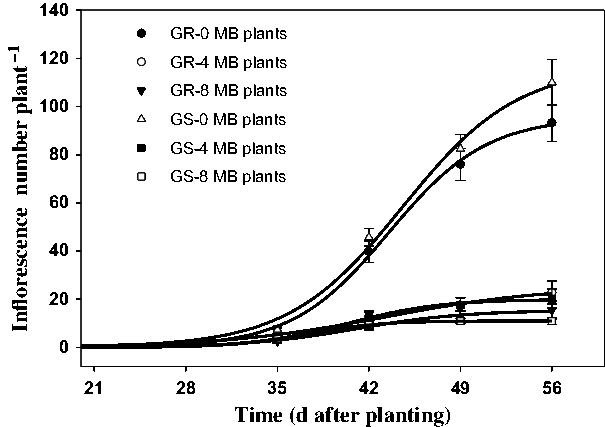
Interference from mungbean plants reduced the inflorescence number of both GR and GS biotypes of E. colona. When grown without competition, the GS biotype produced 22% more inflorescences compared with the GR biotype (Figure 2). The GR biotype produced 73% and 84% fewer inflorescences when grown with 4 and 8 mungbean plants, respectively, compared with E. colona grown alone. Similarly, for the GS biotype, the inflorescence number per plant was 83% and 91% less compared with inflorescences produced when E. colona was grown alone. Growing plants in close proximity to other plants results in the depletion of resources, which leads to further change in the growth rate. The reduction in inflorescence numbers suggests that E. colona may not compete effectively with mungbean plants. Mungbean is a strong competitor, possibly a result of its high growth rate, wide leaves, and ability to produce several branches that shade the weed. Moreover, mungbean plants have a strong and extensive root system and can compete effectively for soil resources, which may be a factor that results in reduced weed growth. The reproductive success of plants is directly influenced by the inflorescence number (Kirchoff and Claßen-Bockhoff Reference Kirchoff and Claßen-Bockhoff2013). Hence, a reduction in the number of inflorescences can result in a reduction in the population density of E. colona in the next season.
Inflorescence number per plant of resistant (GR) and susceptible (GS) populations of Echinochloa colona when grown alone (0 MB) or in competition with 4 and 8 mungbean (MB) plants. The lines represent a three-parameter sigmoid model (y= a/{1 +exp[−(x − t 50)/b]}) fit to inflorescence number per plant. The vertical bars represent the standard error of the mean. Parameter estimates of the model are given in Table 1.

Total shoot biomass
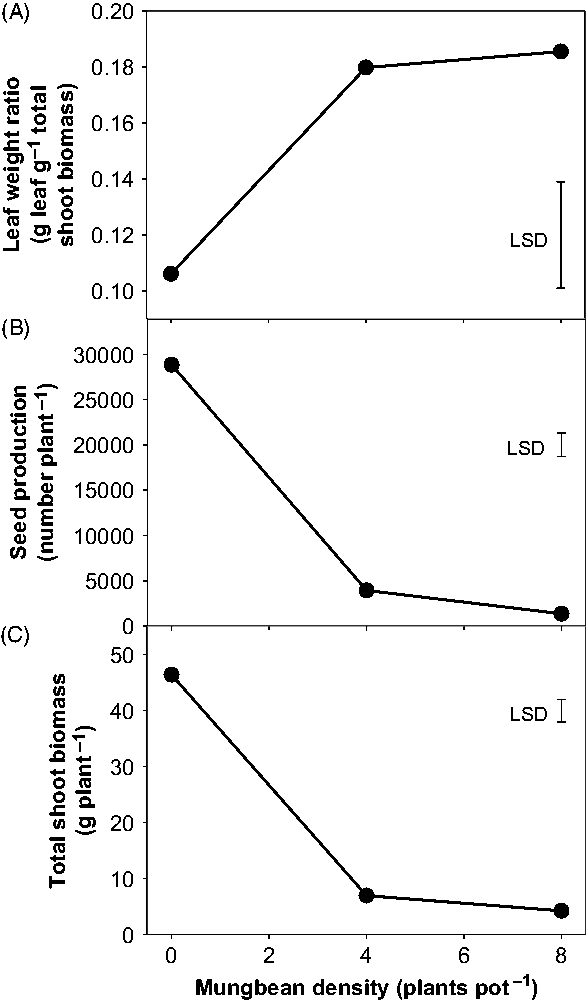
Total shoot biomass of E. colona was similar for both biotypes; hence, the data were pooled across biotypes. Densities of 4 and 8 mungbean plants pot−1 reduced the biomass of E. colona by 85% and 91% compared with the plants grown alone (Figure 3C). In a previous study in the Philippines, continuous shade of 50% and 75% reduced total E. colona shoot biomass by 42% and 84%, respectively, compared with plants grown in full sunlight (Chauhan Reference Chauhan2013). In Australia, stem biomass in wild radish (Raphanus raphanistrum L.) was reduced with an increase in interference from wheat (Triticum aestivum L.) plants (Walsh et al. Reference Walsh, Maguire and Powles2009). A linear reduction in weed biomass was found with an increasing crop density of direct-seeded rice (Chauhan et al. Reference Chauhan, Singh, Kumar and Johnson2011) and soybean [Glycine max (L.) Merr.] (Arce et al. Reference Arce, Pedersen and Hartzler2009). In a similar study, the stem biomass of E. colona was reduced by 70% to 92% when grown with rice at densities ranging from 100 to 400 plants m−2 (Awan et al. Reference Awan, Chauhan and Sta Cruz2014).
Effect of mungbean density (0, 4, and 8 plants pot−1) on (A) leaf weight ratio (g leaf g−1), (B) seed production (no. plant−1), and (C) total shoot biomass (g plant−1) of Echinochloa colona. Each point of the graph represents a mean value of E. colona pooled across biotypes (n = 24).

High mungbean planting density helps in increasing its tolerance to weeds and may reduce reliance on herbicides. For effective use of solar radiation and other resources, optimum crop density plays an important role (Krall et al. Reference Krall, Esechie, Raney, Clark, Teneyck, Lundquist, Humburg, Axthelm, Dayton and Vanderlip1977; Sangoi Reference Sangoi2001). Weeds establish more quickly if the crop density is less than optimal. Crop microclimate and canopy structure are modified by changes in crop density, and an adjustment in crop density can help to increase crop competitiveness and reduce weed biomass. When Ammannia spp. were grown in competition with rice, there was a reduction in the dry weight of Ammannia spp. due to competition for light (Caton et al. Reference Caton, Foin and Hill1997). The results of the present study demonstrate that increased mungbean planting density has a negative effect on shoot biomass of both GR and GS biotypes of E. colona.
Specific stem length
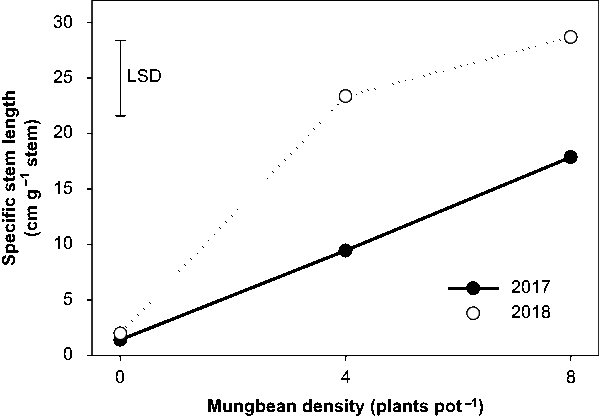
A significant interaction was observed between years and mungbean interference for SSL (Figure 4). With the increasing competition (4 to 8 mungbean plants pot−1), the SSL of E. colona increased significantly. SSL ranged from 1.4 to 17.9 cm g−1 in 2017 and from 2.0 to 28.7 cm g−1 in 2018. An increase in the SSL of Powell amaranth (Amaranthus powellii S. Watson) was reported due to canopy shade, and this increase was associated with a reduction in solar radiation and the red:far red light ratio (Brainard et al. Reference Brainard, Bellinder and Ditommaso2005). The reduction in stem biomass was mainly related to increased SSL in competition, and this response of enhancing SSL in competition could be a survival strategy for weeds growing in a competitive environment (Caton et al. Reference Caton, Foin and Hill1997). Therefore, the increase in SSL of E. colona in response to interference from mungbean plants suggests that resource allocation in the weed is shifted to stem elongation, whereas stem biomass was reduced in response to the shade created by high crop-planting density.
Effect of mungbean density (0, 4, and 8 plants pot−1) on specific stem length (cm g−1 stem) of Echinochloa colona. Each point of the graph represents a mean value of E. colona pooled across biotypes (n = 12).

Leaf weight ratio
With increasing mungbean planting density, LWR increased by 41% and 43% compared with the no-competition treatment (Figure 3A). These results suggest that E. colona reduced the effects of shade by increasing LWR. In general, plants respond to shade by increasing partitioning of biomass from stems to leaves (Patterson Reference Patterson1979). In a previous study, E. crus-galli grown with 8 rice plants had 34% greater LWR than E. crus-galli grown alone (Chauhan and Johnson Reference Chauhan and Johnson2010a). Similarly, redstem (Ammannia coccinea Rottb.) increased LWR in response to shade (Gibson et al. Reference Gibson, Fischer and Foin2001).
Seed production
Seed production was not influenced by years and biotypes; therefore, the data were pooled across years and biotypes. There was an 86% reduction in the seed number of E. colona plants grown with 4 mungbean plants pot−1 in comparison to E. colona grown alone (29,000 seeds plant−1) (Figure 3B). Increasing competition to 8 mungbean plants pot−1 reduced seed numbers by 95%.
With increasing competition, other growth parameters of E. colona like height, leaf number, tiller number, and inflorescence numbers were also reduced, and would in turn contribute to reduced seed production. The vigorous growth of mungbean plants might have suppressed the vegetative growth of E. colona, which in turn reduced its seed production. In the rice ecosystems of the Philippines, 50% and 75% shade treatments reduced seed production of E. colona by 64% and 92%, respectively, compared with the full-sunlight treatment (Chauhan Reference Chauhan2013). Seed production in common cocklebur (Xanthium strumarium L.) grown in competition with soybean was seven times less compared with X. strumarium. grown without crop competition (Senseman and Oliver Reference Senseman and Oliver1993). Similarly, in A. theophrasti, soybean competition reduced seed production by 82% (Lindquist et al. Reference Lindquist, Maxwell, Buhler and Gunsolus1995).
Seed production was markedly reduced by mungbean competition; however, even a small amount of weed seed can cause severe weed infestation in future crops. The number of seeds produced per plant was greater than 800 when E. colona was grown in competition with 8 mungbean plants. The sustainability of any weed management practice is affected by the addition of weed seeds to the soil seedbank (Cousens and Mortimer Reference Cousens and Mortimer1995; Norris Reference Norris2003). Practices that reduce weed seedbanks should be considered an important component of sustainable weed management (Buhler et al. Reference Buhler, Robert and Forcella1997; Chauhan and Johnson Reference Chauhan and Johnson2010b). Both GR and GS biotypes showed a similar capacity to produce seeds in the present study, indicating that there is no fitness penalty in the GR biotype (Vila-Aiub et al. Reference Vila-Aiub, Neve and Powles2009, Reference Vila-Aiub, Gundel and Preston2015), and this biotype could become a serious issue in Australian agriculture. Contrary to this study, a fitness penalty was found in resistant rigid ryegrass (Lolium rigidum Gaudin), as GS biotypes produced more seeds compared with GR biotypes when grown in competition with wheat (Pedersen et al. Reference Pedersen, Neve, Andreasen and Powles2007). Similarly, in another study, tall morningglory [Ipomoea purpurea (L.) Roth] showed fitness costs associated with glyphosate tolerance, producing 35% fewer seeds compared with the susceptible line (Baucom and Mauricio Reference Baucom and Mauricio2004).
Although increasing planting density of cereals as part of an integrated weed management strategy has been discussed in many studies, there is little information on this strategy for mungbean. The effect of increasing mungbean density in reducing weed growth and seed production has been generally overlooked in Australian agriculture due to the availability of effective herbicide options. With the advent of glyphosate resistance in E. colona populations (glyphosate used in fallows and glyphosate-tolerant cotton [Gossypium hirsutum L.]) and proportionally high input costs for its chemical control in mungbean crops, there is a dire need to develop alternative strategies to suppress weed growth.
The results of the present study showed that crop competition is effective in suppressing the growth of E. colona in mungbean. However, the GR and GS biotypes showed similar ability to grow and produce seeds either with or without competition, which indicates that no fitness penalty exists for the GR biotype. In this study, we used only one population, and results may differ for populations collected from different regions of Australia. Therefore, there is a need to include several GR and GS biotypes in future studies. High planting density of mungbean can be effectively used for E. colona management regardless of resistance status. As E. colona is a prolific seed producer, reducing its seed production using high crop density is an important tool for integrated weed management. Although this study highlights the importance of increasing crop density for reducing the seedbank of E. colona, it should be noted that increased crop density can incur additional costs. There may be a greater risk of pests and diseases with increased planting density. Therefore, field studies need to be conducted in collaboration with entomologists and plant pathologists.
Combining knowledge about mungbean management (density) and E. colona biology could effectively improve the sustainability of cropping systems, with reduced use of herbicides and lower chemical loads on agroecosystems. Echinochloa colona’s high seed production in fallow may create a serious problem in Australian agriculture in the future. Seed production was low under competition with mungbean plants, but the weed was still capable of adding seeds to the seedbank, which could create a problem for future crops. To better understand the seedbank of E. colona, systematic competition studies are needed under field conditions.
Author ORCIDs
Bhagirath S. Chauhan https://orcid.org/0000-0003-1540-4668
Acknowledgments
No conflicts of interest have been declared. This research received no specific grant from any funding agency or the commercial or not-for-profit sectors.