If one were to examine the career of Ronald Harry Coase circa 1959, one would find little hint that he would one day be awarded the Nobel Memorial Prize in economics. Then in his forty-ninth year, Coase had recently arrived at the University of Virginia after a fifteen-year stint at the London School of Economics and seven years at the University of Buffalo. While he had a very respectable record of scholarly publication, he was by no means a giant in the field. “The Nature of the Firm” (1937), one of the two major contributions for which he would be awarded the Prize some thirty-two years later, did not yet even fit the “much cited but little used” label that he was to put on it in 1972. The other major work for which he would be awarded the Nobel, “The Problem of Social Cost,” had yet to be written, or even envisioned. Most of Coase’s work over the past decade had focused on the economics of the broadcasting industry—a fairly small niche area. In a field increasingly dominated by mathematical analysis—at least at the cutting edge—Coase’s work was strictly intuitive, often the product of case studies of the sort becoming increasingly unfashionable in the field.
Within two years, however, this economist of no major repute was to publish an article that had an enormous transformative effect on economics and on law—one that was to become one of the most cited articles in both literatures. While the Nobel Committee lauded both “The Problem of Social Cost” and “The Nature of the Firm” in awarding Coase the prize, there can be little question that there would have been no Nobel sans “The Problem of Social Cost” and a very good chance that Coase would have received a Nobel had “The Nature of the Firm” never been written. It fact, it may not be going too far to say that Coase received the Nobel for writing two sentences:
It is necessary to know whether the damaging business is liable or not for damage caused since without the establishment of this initial delimitation of rights there can be no market transactions to transfer and recombine them. But the ultimate result (which maximises the value of production) is independent of the legal position if the pricing system is assumed to work without cost (1960, p. 8).
This, of course, is the idea that came to be known as the “Coase theorem,” and it is this that drew the attention of a legion of scholars to “The Problem of Social Cost.”
Yet, if we fast-forward two decades to the 1980s, we find Coase effectively disassociating himself from this idea and its import, arguing that “The Problem of Social Cost” had been misunderstood by economists and legal scholars alike, that the challenge he posed to economists in that article had not been seriously taken up, and that his supposed greatest legacy—the development of the economic analysis of law—had nothing to do with his intended message in “The Problem of Social Cost” and was of “no interest” to him whatsoever (Kitch Reference Kitch1983, p. 192).Footnote 1
I will not rehearse here Coase’s arguments in “The Problem of Social Cost.” What I wish to focus on this evening is the Coase theorem itself, considered as an episode in the history of economic ideas. This topic is highly appropriate for my HES Presidential Address, for several reasons. It is no secret that I have spent a reasonable amount of my career writing on Coase, the Coase theorem, and the history of law and economics. This alone would lead the audience to expect that my address would focus on some aspect of this work. But I must also admit to a twenty-year fascination with the Coase theorem. This is the topic that motivated me to write my intellectual biography of Coase (Medema Reference Medema1994), a project I embarked upon exactly twenty years ago as a relatively fresh-faced PhD—though at that point I regarded the theorem as little more than an absurd idea that had for some reason attracted a great deal of attention. My interest in the theorem and the intellectual challenge it has posed has only increased since that time—to the point where I am now writing an intellectual history of the theorem. And my attitude toward the theorem has changed 180 degrees: from critic to unabashed devotee.Footnote 2
I give you this small bit of personal biography not because I am here to educate you about Medema—for then Professor Evensky would surely be obliged to refund your conference registration fees—but rather because my own experience with the theorem is a microcosm of that of the economics profession. The theorem’s allure—and I mean both through repulsion and attraction—has been as powerful as that of any other idea promulgated in the economics arena over the past fifty years. And the fact that the year 2010 marks the fiftieth anniversary of the publication of “The Problem of Social Cost” makes this topic just that much more fitting as my subject for this evening’s talk.
But the Coase theorem is important for a further reason, one that relates directly to the study of the history of economics and thus to an audience made up of the leading scholars in the field. I will make here the bold—perhaps even heretical—claim that the Coase theorem is one of the two most fascinating concepts in the history of economic ideas, the other being the concept of the invisible hand. Both the Coase theorem and the invisible hand were arguably minor points in the works in which they originally appeared, yet they took on a life of their own in hands of subsequent commentators. Each speaks to the ostensible power of the market mechanism and has been in equal parts hailed and reviled, violently attacked and vociferously defended. Both concepts remain at the center of ongoing controversies that likely will never be settled, simply because there is so much at stake for each side—both theoretically (or paradigmatically) and ideologically.
This link between the Coase theorem and the invisible-hand proposition is particularly important for me personally, given that my teacher, sometimes co-author, and dear friend, Warren Samuels, has devoted the last several decades to tracing the use of the concept of the invisible hand—a topic that is almost too massive to contemplate, unless you are Warren, whose book on the subject is now nearly completed. Were it not for Warren, I would not be standing before you today, and it is thus both right and good that this talk is dedicated to Warren, to whom so many of us owe so much.
But I want to do more here than simply talk about the intellectual history of the Coase theorem. Yes, it is a fascinating topic for the historian of economics. But I would argue that this history also offers important lessons for scholarship in the history of economics, and that all this derives from the fact that the theorem is a remarkable example of the vagaries that sometimes attend the diffusion of ideas. Let me note just a few of the unusual aspects of this history here. There is no singular statement of the Coase theorem; there are literally dozens of different statements of it, many of which are inconsistent with the others. The Coase theorem has never been proven, yet it has been the subject of dozens attempts to “disprove” it—all of them arguably incorrect (Medema and Zerbe Reference Medema, Zerbe, Bouckaert and Geest2000)—in a stream of analysis and debate that continues to this day in the journal literature. The theorem has been discussed in well over 1000 economics journal articles since it made its appearance in the literature in the 1960s (JSTOR) and in nearly 2000 law review articles just since 1983 (LexisNexis)—as well as in journals spanning fields from philosophy to literature to biology. The nature of its underlying assumptions makes the theorem’s domain of direct applicability practically (and likely totally) nil; yet, it has become a part of the fabric of economics and of how economists and others contemplate externality policy, and it is in many respects the cornerstone of the economic analysis of law (Medema Reference Medema, Zerbe, Bouckaert and Geest2000). It has been more or less disowned by its ostensible author, and yet is so firmly established in the literature that it is treated in economics textbooks from the introductory to the graduate levels. Though it is a positive statement without direct normative implications, it was both used and seen as an early salvo in the neoliberal turn of economics. It has been derided by liberals as conservative ideology and by some conservatives as liberal ideology. And as I mentioned a few moments ago, like Adam Smith’s “invisible hand,” it was arguably a rather minor point in the author’s work but took on a life of its own in the hands of subsequent commentators.
Tracing the intellectual history of the Coase theorem is a complex enterprise, one that requires a broad-based historiographic approach, utilizing tools ranging from the mathematization of old ideas, à la Samuelson, to the use of the currently more fashionable techniques of the history of science. I raise this issue because we are working in an age of significant historiographic tension—collision between older and newer ways of doing history—and I believe strongly that this tension is utterly misplaced: it is only through an open and pluralistic approach to the study of the history of economic ideas that we can come to grips with the complexity endemic to the evolution of economics.
WHAT IS THE COASE THEOREM?
So, what is the Coase theorem? I am sure that most of you know—or at least believe that you do. Perhaps you believe that it is this, courtesy of Coase himself:
It is necessary to know whether the damaging business is liable or not for damage caused since without the establishment of this initial delimitation of rights there can be no market transactions to transfer and recombine them. But the ultimate result (which maximises the value of production) is independent of the legal position if the pricing system is assumed to work without cost
(Coase Reference Coase1960, p. 8).Or perhaps you favor George Stigler’s version:
The Coase theorem … asserts that under perfect competition private and social costs will be equal
(Stigler Reference Stigler1966, p. 113).Or maybe you fancy this one, courtesy of a legal scholar:
if one assumes rationality, no transaction costs, and no legal impediments to bargaining, all misallocations of resources would be fully cured in the market by bargains
(Calabresi Reference Calabresi1968, p. 68, emphasis in original).No? How about this rather redundant one, by a legal scholar–philosopher?
in a world of perfect competition, perfect information, and zero transaction costs, the allocation of resources in the economy will be efficient and will be unaffected by legal rules regarding the initial impact of costs resulting from externalities
(Regan Reference Regan1972, p. 427).Or this, for those among you who are partial to the view that institutions do not matter:
If transaction costs are zero the structure of the law does not matter because efficiency will result in any case
(Polinsky Reference Polinsky1974, p. 1665).Maybe the zero-transaction-costs assumption is a bit much for your tastes:
In sum, the Coase theorem states the following: if the property rights to any resource are assigned rather than unassigned, and if exchange costs are sufficiently low, the ultimate use of the resource is independent of the initial assignment of the rights to the resource (although the initial assignment of rights does affect the wealth of the transactors involved)
(Baird Reference Baird1975, p. 222, emphasis added).Or that “relatively costless” is better than “low” cost and that theorems should be seen as tendency statements:
We can predict that whenever contracting and/or enforcement of such agreements becomes exceedingly expensive or difficult, social and private costs will diverge. Whenever contracting and enforcement of property rights are relatively costless, social costs and private costs will tend to be one and the same
(Miller Reference Miller1978, p. 461, emphasis added).Or perhaps wealth effects concern you:
if there were (a) no wealth effects on demand, (b) no transaction costs and (c) rights to pollute or control pollution, the allocative solution would be invariant and optimal, regardless of the initial assignment of rights
(Frech Reference Frech1979, p. 254).Or maybe income effects:
In a world of zero transaction costs, the allocation of resources will be efficient, and invariant with respect to legal rules of liability, income effects aside
(Zerbe Reference Zerbe1980, p. 84).Here’s a unique one, particularly if you are not disposed to Stigler:
in the presence of transaction costs the location of a pollution tax or of other liability for damages does matter for efficiency
(McCloskey Reference McCloskey1982, p. 354).Perhaps you prefer your theorems more extensively laid out:
[A] change in a liability rule will leave the agents’ production and consumption decisions both unchanged and economically efficient within the following (implicit) framework: (a) two agents to each externality bargain, (b) perfect knowledge of one another’s (convex) production and profit or utility functions, (c) competitive markets, (d) zero transactions costs, (e) costless court system, (f) profit-maximizing producers and expected utility maximizing consumers, (g) no wealth effects, (h) agents will strike mutually advantageous bargains in the absence of transactions costs
(Hoffman and Spitzer Reference Hoffman and Spitzer1982, p. 73).Then again, you may be a minimalist as regards the assumptions:
when parties can bargain together and settle their disagreements by cooperation, their behavior will be efficient regardless of the underlying rule of law
(Cooter and Ulen Reference Cooter and Ulen1988, p. 105).Or you are of the mind that both allocation and distribution are unaffected:
a change in [law] affects neither the efficiency of contracts nor the distribution of wealth between the parties
(Schwab Reference Schwab1988, p. 242).No doubt you have grasped my point by now: there are many Coase theorems. Or, perhaps, there is no Coase theorem.
What is an historian of ideas to make of all this? Can you think of a “theorem” that has been stated in this many different ways? But it is not just that there are many Coase theorems. A number of these statements of the theorem are, variously, mutually inconsistent, redundant, or wrong. Notice also the level of disconnect between Coase’s statement and those that followed. Of course, the problem of multiple interpretations is not new to the history of economics, as anyone with a nodding acquaintance with the literatures on Smith, Ricardo, and Keynes will be only too glad to attest.
To begin to make some sense out of this proposition, let us break it down into its assumptions and results. The basic common assumptions, owing to Coase and largely (but obviously not consistently) carried through in the literature, are two. First, that legal rights are fully specified over the relevant resources. Second, that the costs of transacting are zero. There are also two results generally claimed for the theorem: that the ultimate allocation of resources will be efficient; and that this allocation will be invariant under alternative assignments of rights.
But the assumptions stated and claims made for the theorem vary widely in the above statements. Some assume rationality, the absence of income or wealth effects, and perfect competition. Others assume none of these things. Some claim the outcome results in efficiency but not invariance. At least one claims that the distribution of wealth will be unaffected. How did these authors arrive at these widely varying statements, and what are their implications? The answers go to the theoretical and contextual complexity that surrounds the history of the Coase theorem.
WHOSE THEOREM IS IT?
I would hope it would come as a surprise to no one in the audience that Coase never stated a “theorem,” either in his article on “The Federal Communications Commission” in which this idea first appeared or in “The Problem of Social Cost.” The term “Coase theorem” was coined by George Stigler and first appeared in the literature in the 1966 edition of his textbook, The Theory of Price, in the passage quoted above. Though the theorem bears his name and is, in fact, often referred to as “Coase’s theorem,” Coase took up this idea only twice over the next twenty-eight years: once in a chapter in a 1970 edited volume that more or less summarized his 1960 article (and gave the unnamed Coase theorem idea only passing attention), and then in a brief note in 1981, responding to a game-theoretic challenge to the theorem. In the latter article, Coase closed his discussion by waving aside the whole Coase theorem issue, comparing the study of a world of zero transaction costs to “divining the future by the minute inspection of the entrails of a goose” (1981, p. 187)—an attitude he expressed repeatedly, though less graphically, over the next fifteen years. Meanwhile, Stigler discussed the theorem with some regularity in his own published work, even making it a centerpiece of his Nobel lecture.Footnote 3
We clearly have a labeling issue here. It is certainly not “Coase’s theorem,” though it is referred to as such many dozens of times in the literature, and perhaps not even the “Coase theorem.” A more apt label might be “Stigler’s theorem,” or, more expressively (but perhaps less elegantly), “Stigler’s Coase theorem.” This may seem like just so much trite minutia, but it actually goes to a very important issue: the interpretation and use made of Coase’s analysis in “The Problem of Social Cost.” One could argue with some justice that McCloskey’s somewhat tongue-in-cheek statement of the theorem comes closer by far than the others to a statement that reflects the message of “The Problem of Social Cost,” though it is not “the Coase theorem.”
THE CONTROVERSY OVER THE COASE THEOREM
The controversy and debate over the correctness of the Coase theorem actually predates the idea’s naming by Stigler and has now been going on for nearly five decades. Indeed, I refereed yet another paper attempting to refute a supposed disproof of the theorem just three weeks ago and have myself been an occasional participant in these battles over the last fifteen years or so. There are two aspects of this long-running controversy that are of particular interest for the history of economics and its study: (i) the nature and details of the “correctness” debates themselves; and (ii) the question of why so much effort has been expended on an exercise whose theological equivalent is the question of how many angels can dance on the head of a pin.
The first of these issues takes us into a realm that is going out of fashion in certain quarters of our field today: the history of theory and the attendant efforts at careful textual exegesis—and, with all this, the need for a reasonably sophisticated training in economic theory to effectively write certain aspects of the history of economics. At the core of this issue is whether it is the place of historians to evaluate the correctness of an idea. I do not mean this in the sense of evaluating whether Winston Churchill was correct in pushing the Dardanelles strategy in one’s telling the history of the Great War, or whether Milton Friedman was correct in advocating the abolition of professional licensure requirements for various occupations. These are issues on which people of various persuasions can reasonably disagree. I am speaking, instead, of a theoretical proposition and its logical validity, and of the validity of challenges to it. Does it matter whether the Coase theorem or some of the challenges to it are correct? Or, more close to our community’s own purposes, does it matter for writing the history of economics? I would argue that it does. At some risk to my own reputation, as least in certain quarters of our field, I will stand with Paul Samuelson and others in arguing that this is an important component of the study of certain portions of the history of economic ideas, and those who would dismiss this as whiggish both misapprehend what it is to do Whig history and deflect us from that task of comprehending certain significant moments in the history of ideas.
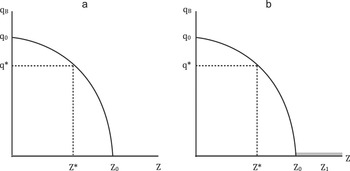
The simple fact of the matter is that the Coase theorem is correct. I know that there are many in the audience who would wish for me to run through a litany of the dozens of supposed disproofs and refutations of the Coase theorem and the appropriate counter-arguments, but we must exercise forbearance. Let me instead give you just a single example. Perhaps the one seemingly insurmountable criticism of the invariance proposition comes from the recognition by David Starrett (Reference Starrett1972) that externalities will cause nonconvexities to exist in the production sets of victim firms.Footnote 4 In graphical terms, rather than generating a convex production set, such as in Panel (a) of Figure 1, below, the externality causes nonconvexities of the form illustrated in (b).
Non-Convexities and the Coase Theorem

Here, q B is the output of firm B, the victim, and Z is the level of the externality. The analysis turns on the effect of increasing pollution damage on the victim’s output. Panel (b) illustrates a situation of increasing marginal damage from pollution (given by the reduction in the victim’s output due to the externality) with the recognition that, beyond some point (Z 0), marginal damage will be zero (Starrett, Reference Starrett1972, pp. 189–190).
The import of this for the Coase Theorem is as follows. Suppose that the polluter’s (A’s) profit-maximizing level of pollution in the absence of the legal rule is some level Z 1 > Z 0. With this level of pollution, B will produce no output. If the A has the right to pollute, the point Z = Z 1, q B = 0 is the starting point for negotiation over the level of pollution. The minimum payment that the polluter is willing to accept to reduce pollution is the reduction in profits that would accompany the reduction in pollution. However, at (and around) Z 1, there is no benefit to the victim from a one-unit reduction in pollution; the victim’s output (q B) would remain at zero with this one-unit reduction. Thus, the victim would not be willing to offer a bribe payment to induce the polluter to reduce its pollution by one unit (to Z 1 – 1 units)—it is a cost with no attending benefit. Thus, the equilibrium when the polluter has the right to pollute will be at a pollution level Z = Z 1 and an output level for the victim of q B = 0, a result that is due to the nonconvexity.
On the other hand, if the victim has the right to be free from pollution, the baseline from which negotiation begins is Z = 0. The victim will be willing to accept any bribe to allow positive levels of the pollution if that bribe is in excess of the lost profits due to pollution damage (or reduction in q B). Thus, the parties will be able to negotiate to an efficient result along standard Coasean lines, but the final result will not (except by accident) be Z = Z 1 and q B = 0. Thus, the invariance proposition does not hold in the presence of nonconvexities if the starting point for negotiation when the polluter has the right to pollute falls within the non-convex region of the victim’s production set. However, if the initial level of pollution is some level Z ≤ Z 0, the invariance proposition holds.
The force of this critique was sufficiently powerful that the editors of the Journal of Economic Theory said that Starrett’s demonstration that nonconvexities are inherent in externality problems “destroy[s] the validity of the Coase Theorem” (“Editorial Addendum” 1977, p. 222). However, this judgment fails to apprehend the true nature of a zero-transaction-costs world. There is a Pareto-better point available here, but the nonconvexity means that the parties will fail to reach it because the immediate marginal adjustments are not Pareto-better. Essentially, the point is that the victim will not be able to spend $15 for a change that will make it $20 better off because the first step along this path would involve spending a dollar to get a zero improvement in welfare, and the victim, not being willing to take this first step, will never know that better things are on the horizon. The problem here is one of information: it is certainly the case that the victim would take this first, welfare-reducing step if it was certain that, in the end, it would be better off. If both victim and polluter knew of the existence of a superior position, they could also merge to achieve it. Thus, the nonconvexities argument introduces imperfect information into the model. But the presence of information costs violates the zero-transaction-costs assumption of the Coase theorem, and thus does not go to the theorem’s correctness. That is, in a zero-transaction-costs world, fundamental non-convexities do not produce inefficiency.
Starrett’s critique and the refutation of it have numerous parallels in the Coase theorem literature, and all of them have a common underlying theme: the difficulty that economists have had in coming to grips with the nature and role of transaction costs—or, differently said, with life in a zero-transaction-costs world. And, lacking an understanding of this crucial point—a knowledge of which can come only from careful textual exegesis accompanied by a measure of economic sophistication—one cannot fully grasp the nature and import of the controversy over the Coase theorem, the extent to which the challenges to the theorem have a measure of validity to them, and why economists came to believe in the validity of certain of these challenges. To simply describe the debate without working through an evaluation of the competing claims leaves us with a very incomplete history.
But the debate over the theorem is also important for what it tells us about economists, their ways of being, and the sociology of the profession. In fact, these things are both inputs and outputs in historical analysis. My junior-high-school religion teacher was fond of saying, “A text without a context is a pretext for trouble.” And too often, historians of economics find exactly this trouble. To know that X said this and Y said that is all very interesting, but often incomplete. How did we get here? What were the background conditions that influenced this work or help to explain divergent treatments and positions? Some do not care for such things. Paul Samuelson, for one, has referred to such history as “antiquarianism” and even “gossip.” And, if care is not taken in the analysis—if the claims are not grounded in fact, archival or otherwise—it is indeed little more than gossip, and equally irresponsible as history. But it is no less true that we cannot understand ideas, their development, their evolution, their impact, and the reasons underlying all these, without taking into account the many contextual elements that are as much a part of the history of ideas as the ideas themselves. Lacking this, the historian can describe the debate over the Coase theorem but leaves us with little insight into why the debate took place and the rationale for certain of the arguments posed.
So while the specifics of the debate over the Coase theorem are incredibly interesting and important, no less so is the question of why the Coase theorem gave rise to such an intense and long-running controversy. At least three factors can be identified. The first is the interesting intellectual puzzle posed by the theorem—the “it cannot possibly be true” aspect—and the attraction such puzzles have for many economists. Part of this derives from the fact that the theorem stood on its head a half-century of received thinking about externalities and market failure. And Coase’s statement of a simple intuitive proposition certainly left the door open for others to have a go at it, using more sophisticated tools of analysis—perhaps all the more so when Stigler saw fit to call this a “theorem.” Indeed, the theorem is an interesting puzzle that lends itself to the application of all manner of tools and frameworks—in no small part because of the simplicity and generality of Coase’s own statement. Differently put, the Coase theorem resonated with economists’ fascination with what Coase called the “world of the blackboard,” regardless of how far removed from reality this blackboard economics may be. A related bit of history is that many of the articles attempting to refute or overturn refutations of the theorem were of the one-off variety, written by players who had no particular stake in the debate. This certainly speaks to the “intellectual puzzle” explanation, but a further factor may be the rising pressure for scholarly publication during this period. The Coase theorem provided fertile territory to make a hit in a highly topical area—not unlike what we are witnessing today with the explosion of applied econometric articles in the “freakonomics” genre, where the link between authors and subjects often demonstrates little continuity over time.
A second factor is the challenge the theorem posed to neoclassical economics generally and to Pigovian thinking in particular. Coase had argued—or, in the minds of some, shown—that market-like mechanisms can efficiently resolve externalities in a neoclassical/Pigovian world, a world in which government intervention was thought to be the only possible means for the efficient resolution of externality problems. To accept the validity of the Coase theorem thus meant accepting that the Pigovian approach was incorrect, and that private mechanisms could also do the job. (I should also note here that some took the theorem as negating the Pigovian approach, but this is not correct. The theorem does not demonstrate that Pigovian remedies are non-optimal—only that market-like mechanisms, too, can generate efficient outcomes.) Another alternative would have been to wave aside the theorem as irrelevant, on the grounds that transaction costs are always positive in the real world. The problem here, though, is that to do so would have been to wave aside the larger neoclassical theory of markets, since it and the Coase theorem are grounded in the same set of underlying assumptions—in particular, that the costs of transacting are zero. And, of course, once one begins to allow that coordination costs are positive, the costs of government coordination come into play. But these, too, had no place in the neoclassical theory of the day, which simply assumed that government could costlessly nudge the market to an efficient position through an appropriate scheme of regulation, taxation, or subsidization. And so, faced with these two alternatives, economists—being economists—chose a third option: attack the validity of the theorem.
The third factor that may explain the long-running controversy over the theorem is the most difficult: the role of ideology. And it is here that the historian of economics must take special care—and perhaps too often does not.
It is surely no secret that the Coase theorem has been associated with right-wing ideology, but it has also been assailed as left-wing ideology by some disposed to natural rights theory, who cannot countenance an idea that suggests there are multiple options for the assignment of legal rights. Of course, the Coase theorem, as Coase stated the idea, has no normative implications whatsoever. It simply states that under certain assumed conditions, a particular result will follow. Nor does the theorem support any particular ideological position as against others. It simply says that the same efficient outcome will obtain regardless of how rights are initially assigned. This means that socialist and natural rights theorist alike can indulge their distributional or other preferences from the bench without any concern for adverse efficiency consequences. If you look hard enough for ideology, you are bound to find it. But it may be that what you are seeing is a mirage—or, worse yet, your own reflection.
But this ideological aspect has a second dimension: the search by the historian for ideologically influenced arguments in the history of ideas. There can be no question that ideology hangs in the air like a dark cloud over the Coase theorem literature—perhaps even more in law than in economics. But the recognition of such is a different thing from the attribution of ideological motives to the protagonists, whether Coase and supporters of the theorem or the critics.
It would be easy, for example, to explain Stigler’s fascination with the Coase theorem through the lens of ideology. It is no secret that Stigler was an enthusiast of the market and, to say the least, hesitant about various forms of government intervention. And he is on record as stating that the study of economics tends to make one more politically conservative (Stigler Reference Stigler1959). But Stigler never trumpets the theorem as providing the key to externality policy. In fact, his textbook treatment continued to emphasize the need for Pigovian remedies both in 1966, when he enthusiastically first presented the Coase theorem, and in the final edition of 1987. His treatment of the theorem in various journal articles is perhaps even more enlightening, showing that Stigler, perhaps to a greater extent than any other commentator, recognized the unrealism of the Coase theorem at the deepest level: “The world of zero transaction costs turns out to be as strange as the physical world would be with zero friction. Monopolies would be compensated to act like competitors, and insurance companies and banks would not exist” (1972, p. 12).
For Stigler, the message of the Coase theorem was that economics needs a theory of transaction costs, that it needs a theory of how law has an impact on the nature and magnitude of these costs (and thus economic outcomes), and that an economic analysis of legal rules (as found in the work of Richard Posner, Gary Becker, and others) could help us to unlock all the above. Of course, Stigler’s work on the economics of information is of a piece with such analysis. The story of Stigler as an ideologue who sees the world as one filled with perfectly competitive markets to which the Coase theorem can be easily applied simply does not stand up against the weight of the evidence.Footnote 5
Historians inside and outside economics have become too quick to assert claims of ideologically motivated argument without sufficient—and at times seemingly without any—documentary support. It may be useful to know that X was involved in the founding of URPE or that Y attended several Mont Pelerin Society meetings. That certainly gives us a lens through which to think about their views. But it provides precisely zero evidence that X’s or Y’s theoretical or empirical analysis was motivated, or even tinged, by ideology. To ignore this is to fall victim to one of the worst excesses of the postmodern turn. It is, to use Samuelson’s term, gossip, not history.
Note that I am not suggesting that historians of economics avoid issues of ideology: they are at times an incredibly important facet of the creation and diffusion of ideas. But it is also a road loaded with potential pitfalls and missteps; attributions of ideological influence call for detachment and circumspection, attention to balance, and careful consideration of what the evidence actually supports. This is particularly true when it comes to issues of motivation, where the subject’s very character and integrity come into play. Of course, the integrity of the historian of ideas is in play as well.
THE TEXTBOOKS AS RESOURCES FOR THE STUDY OF THE HISTORY OF ECONOMICS
Another of the many interesting aspects of the history of the Coase theorem is its diffusion in the textbook literature in economics. The traditional approach to examining the history of ideas is via the scholarly literature, and little attention has been paid by historians of economics to the diffusion of ideas in the textbooks.Footnote 6 There is an important case to be made, though, for focusing some attention on the textbooks and, in particular, on the diffusion and treatment of “new ideas” within their pages. For example, those ideas that do make their way into the textbooks can often be considered “normal science” in the profession. Moreover, the textbook literature serves as a useful proxy for the dissemination of ideas to students and thus for what is considered important for the training both of those who go on to become economists and of those who become part of the educated public.
The Coase theorem provides us with an interesting illustration of what the textbook literature can tell us about the diffusion of ideas, and this for several reasons. Most obviously, it involves the introduction of a new idea into economics education. Secondly, it is an idea that challenges a received view—here, the Pigovian approach to externalities, dominant in both the scholarly and textbook literatures—as opposed to being an extension of the received paradigm, such as adding imperfect information to the existing model or introducing a new model of oligopoly behavior. A third factor is the potential policy relevance of the theorem and how all this is handled in the texts. Finally, there is the tension between the theorem and the larger message of “The Problem of Social Cost,” and how, if at all, this is reflected in the textbooks.
I have recently made a study of the treatment of the Coase theorem in the intermediate microeconomics textbook literature—a study I plan to extend to a much wider range of texts in economics and in law. Though the theorem made its first appearance in the textbook literature in 1966, it was not until the middle third of the 1970s that it began to make serious inroads into this literature—a pattern that parallels quite closely the discussion of the theorem in the scholarly literature. The relationship between the textbook and scholarly treatments evidences some divergences that are worth remarking upon. First, the theorem was by no means a settled result in the scholarly literature at this time. In fact, this was the period during which the debate over the theorem was at its height. As such, it is curious that the textbook authors began to treat the theorem at this stage, given the propensity of the texts to deal with topics that are relatively settled and to reflect what is generally considered to be “normal science” in the profession. We also find that the textbooks treat the theorem as a settled result. There is no mention of the controversy over the theorem in the textbooks, and the only question raised was the domain of its applicability—some applicability being consistently allowed. This divergence between the scholarly and textbook literatures cries out for an explanation, but at this point I cannot give you more than an hypothesis, which I shall do momentarily.
You might surmise that this has something to do with the authors of the texts—that a pattern (such as a connection with Chicago, Virginia, or UCLA) would emerge to explain who had treated the theorem and why the controversy over it was ignored. But such is not the case. It is true that those authors who had such a connection did discuss the theorem, but so did authors who had no such connection and whose affiliations, training, and records of scholarly publication would not suggest any particular predisposition to include a discussion of the theorem—particularly when set against the backgrounds of those who chose not to discuss it.
Another interesting aspect of these textbook discussions is how the theorem was handled. After all, the theorem is a fiction, pointed to a world without friction. The model of perfect competition is of a similar nature, but it is generally presented as an ideal type against which to evaluate other, more realistic market structures, rather than as a model with a reasonable measure of descriptive accuracy. The highly restrictive or unrealistic nature of the theorem seems to have given rise to an interesting tension for the textbook authors, who were presenting the theorem in the context of externality theory and policy. The theorem assumes that there are no costs associated with the bargaining process. Yet, this is so obviously untrue that it would make little sense to suggest that the theorem actually provides a mechanism for dealing with real-world externalities. Strangely enough—or perhaps not—the tactic adopted by the majority of the textbook authors in the 1970s was to state a Coase theorem that allowed for non-zero transaction costs, a couple of examples of which were quoted in the litany of theorems earlier in this talk. Thus, the students were treated to statements of the Coase theorem that assumed transaction costs are “low,” “not high,” “less than the gains from exchange,” etc. These subtle changes of wording were necessary to make the Coase theorem operational and thereby opened the door to the possibility of negotiated solutions in the real world—perfectly sensible for textbook discussions of externality policy. But there are two problems here. First, this is not the Coase theorem, nor is it the Coase theorem that was being discussed in the scholarly literature, which continued to deal with the theorem on its own terms—assuming zero transaction costs—even though often unknowingly violating it in the particulars. In short, the students were being taught something that was factually incorrect: the Coase theorem does not say what these textbook authors claimed it said. Second, these positive transaction costs versions of the Coase theorem are false. The invariance proposition does not hold unless the externality is binary, and efficiency is generated only in the Paretian sense, not in the wealth-maximization sense (Coase’s original formulation).
My hypothesis regarding the divergence between the scholarly literature and the textbook treatments is that the textbook authors felt compelled to make the theorem applicable to the real world, and so loosened the zero-transaction-costs assumption when presenting it. While it makes sense that the textbook authors would discuss an applicable negotiation process, one wonders why they did not present the theorem on its own terms and then simply point out that this is unrealistic but suggestive of the fact that negotiation can take place if the costs of transacting are such that there remain net benefits from exchange, and, based on this, proceed to analyze the possibility of negotiation from that vantage point. For whatever reason, the authors felt compelled to couch the negotiation solution in terms of the Coase theorem.
This whole matter is of significant historical interest and import, but one would never be aware of it if one ignored the textbook literature as an important data source for the history of economics.
THE COASE THEOREM AND THE INVISIBLE HAND
We now come to the subject of the invisible hand and its relationship to the Coase theorem. For all my fascination with the Coase theorem, I am not going to stand before you today and claim that it has had the same impact on the history of economic ideas as has the invisible-hand proposition. What I will claim, though, is that it occupies a similar place in the history of economics and offers similar lessons for the study of the history of economic ideas.
There are, of course, a number of common elements in these two ideas and their respective histories. Both suggest that the pursuit of individual self-interest will redound to the best interests of society. In fact, one could argue that the Coase theorem is a special case of the invisible-hand proposition. Both also assume a particular institutional framework for the proposition to be true: in the case of the invisible hand, an appropriate legal and moral framework for the market; in the case of the Coase theorem, an assignment of legal rights over the resources in question and zero transaction costs. And both proponents and critics of each of these propositions have a strong propensity to ignore these qualifications. Both propositions collide violently with reality. There are a plethora of exceptions to the invisible-hand result—public goods, externalities, monopoly power, and the like—and the Coase theorem does not apply when transaction costs are positive, as they always are in reality. Both have been greatly abused in the hands of subsequent commentators—by advocates and critics alike. The Smith/invisible-hand abuse has been much in evidence during the current economic crisis, which has seen both man and idea pilloried with regularity by politicians, pundits, and even economists (the last of whom, at least, should know better). Both were simple, intuitive propositions that were later probed and formalized using modern tools (such as the rationality postulate) that had the effect of pushing the arguments away from their original simplicity (and, one might argue, elegance). And of course, both were arguably relatively minor points in the hands of their authors but took on a life of their own, out of all proportion to their original use. Both, then, are exceptional grist for the mill of the historian of economic ideas.
One of the many mysteries surrounding both the invisible hand and the Coase theorem is the authors’ attitude toward their respective propositions. Smith, of course, did nothing to elaborate the invisible-hand proposition in his revisions of The Wealth of Nations, and he was no longer among the living when the real fun got started in the nineteenth century. It is impossible to know what Smith would have said had he been greeted with the use of his ideas in the hands of champions and opponents of laissez-faire or with the mathematics of the First Fundamental Theorem of Welfare Economics (this impossibility reinforced by the fact that the several Smith scholars in the audience would give at least two or three different answers to this!). It is all too easy to cast Smith as a proto-general equilibrium theorist, an exercise with which I have little sympathy. But it is also too easy, and equally wrong-headed, to say that we cannot use certain modern tools to help us understand the possibilities and limitations of the invisible-hand proposition—whatever it might have been. The same can be said of the Coase theorem, as I have already noted. Economics may or may not be a progressive science, but to understand the evolution of ideas, we must deal both with how those ideas appeared to and were used by subsequent commentators, and what the ideas of the present tell us about the ideas of the past. Differently put, the present is part of the context of the past.
As for Coase, he remained completely silent about the Coase theorem and the interpretation of “The Problem of Social Cost” for more than two decades, before writing at length in 1988 and on multiple occasions afterwards that he had been misunderstood, and that the theorem is not the central message of “The Problem of Social Cost.” But if Coase was being misunderstood by so many for so long, why did he not speak up? And why did he, as editor of the Journal of Law and Economics, publish a number of articles dealing with the theorem during his two decades as editor? Coase taught a course at the University of Chicago Law School during the 1960s that has been referred to as “Ronald’s ‘Coase Theorem’ course” (Priest 2009, p. 5). If Coase attached only minimal import to the Coase theorem, why did the course have this moniker associated with it?
At this stage, I do not have answers to these questions—though an article that Warren Samuels and I authored back in 1997 offers a series of conjectures on aspects of some of them. Upon reading a draft of that article, Coase remarked to me that he kept silent simply because he had nothing more to say on the matter following the publication of his 1960 article. This may well be true, though it does not completely dispense with the issues that I have just raised, and, as such, may point to certain of the hazards associated with history as told by the players themselves.
The relationship between ideas and their originators—including, but not limited to, authorial intent—is central to the study of the history of economics. But the fact is that these ideas are often the creation of communities of economists and others; this is certainly true for the invisible hand and the Coase theorem. While the underlying ideas were first formulated by Adam Smith and Ronald Coase, the fact that the “invisible hand” and the “Coase theorem” came to be invoked regularly in scholarly, textbook, and other literatures is an artifact of the decision by members of these communities to further develop, use, attack, and otherwise talk about them. The motives that prompted scholars to treat the them are many, and they go well beyond what is revealed by the study of the history of theory and the analysis of texts. Issues such as these are integral to writing the history of either the invisible hand or the Coase theorem, and they can be discovered only via the methods of intellectual history and the history of science.
CONCLUSION
Twelve years ago last weekend, the Executive Committee of the History of Economics Society asked me to serve as the next editor of the Journal of the History of Economic Thought. One of the unintended consequences of accepting this position was that I ended up in the middle of the historiography wars. When I say, “in the middle,” I mean this in two senses. The obvious one is that an editor of a history of economics journal of necessity must deal—hopefully judiciously—with how the differing positions in this battle affect everything from the selection of referees to what is published in the journal to perceptions of the journal. But I also ended up, quite literally, in the middle. Though I have very good friends on both poles (and everywhere in-between) in these historiographic debates, I find myself occupying a position squarely in the middle—utterly convinced that “good history” is a question entirely separate from historiographic approach. I will admit to having an intrinsic disposal toward pluralism—or “horses for courses,” as the old adage goes—and this disposition was undoubtedly nurtured by my mentor, Warren Samuels, who is perhaps the very embodiment of pluralism. But editing JHET, and thereby being forced to read so much good work on so many topics and grounded in such a variety of historiographic approaches, only further reinforced my commitment to the middle ground. For this and other reasons, I believe that I emerged from my ten years as editor a much better historian than I was going in.
In once again taking up the subject of the Coase theorem and thinking, after nearly two decades of on-and-off writing on the subject, about how to write an intellectual history of the theorem, the wisdom of my standing on this middle ground has been only further reinforced. As I read and learn from the recent work of Elodie Bertrand and her careful textual exegesis of Coase’s work and of aspects of the literature on the Coase theorem, and as I study and learn from the efforts by colleagues such as Phil Mirowski, Ross Emmett, and Rob Van Horn to shine the light of the history of science on various facets of the Chicago tradition, I cannot avoid the conclusion that the history of the Coase theorem can be told only with the historiographic breadth that comes from embracing the best of these and other approaches to the study of the history of economics.
Both Ronald Coase and Dr. Pangloss have told us that “all is for the best in the best of all possible worlds.” May the history of economics community soon find its way there.