Introduction
The links between positive health behaviours and sporting activities have been well documented (Pate etal. Reference Pate, Heath, Dowda and Trost1996; Gmel etal. Reference Gmel, Kuendig and Daeppen2009; O'Brien etal. Reference O'Brien, Kolt, Webber and Hunter2010). However, with respect to alcohol and sport, studies have led to contradictory findings. Recent studies have found that individuals who participate in sport, drink alcohol in a hazardous way (O'Brien & Kypri, 2008; Diehl etal. Reference Diehl, Thiel, Zipfel, Mayer and Schneider2012) A study in New Zealand on sportspeople showed that hazardous drinking behaviours differed across different levels of sports participation with elite-provincial sports players having the highest level of hazardous drinking, followed by club/social players; elite-international players had the lowest levels of hazardous drinking (O'Brien etal. Reference O'Brien, Ali, Cotter, O'Shea and Stannard2007). An Australian study of college-level sports involvement demonstrated that rates of alcohol consumption were higher in sportspeople than non-sportspeople (O'Brien etal. Reference O'Brien, Kolt, Martens, Ruffman, Miller and Lynott2012). An Australian study examining the patterns of alcohol consumption among professional Australian Football League (AFL) players found that risky drinking was related to the time of the year (Dietze etal. Reference Dietze, Fitzgerald and Jenkinson2008). For example, during the playing season, the level of risky consumption in AFL players was typically lower than in age-matched Australian men in the general population. However, risky consumption was higher in AFL players during the end-of-season period and holiday period than in age-matched Australian men. Similarly, a recent study in the United Kingdom assessing the prevalence of risky drinking in professional footballers in the Premier League Football clubs found that 40% of respondents consumed high levels of alcohol (Pringle etal. Reference Pringle, Zwolinsky, Smith, Robertson, McKenna and White2011).
Athletes and spectators have long marked winning and losing of matches with alcohol. The sponsorship of sports events by the alcohol industry is common in many countries including Ireland. As noted by Babor etal. (Reference Babor, Caetano, Casswell, Edwards, Giesbrecht, Graham, Grube, Gruenewald, Hill, Holder, Homel, Osterberg, Rehm and Room2003), alcohol sports sponsorship links masculinity, alcohol and sport. A study in New Zealand found that alcohol industry sponsorship was associated with increased hazardous drinking, particularly when received at multiple levels (individual, team and club) (O'Brien & Kypri, Reference O'Brien and Kypri2008).
By international standards, Irish young people in general drink large quantities of alcohol (Palmer & O'Reilly, Reference Palmer and O'Reilly2008) and encounter high rates of alcohol-related harm (Department of Justice Equality and Law Reform, 2003; Mongan etal. Reference Mongan, Reynolds, Fanagan and Long2007). Binge drinking (i.e. the consumption of six or more standard drinks on any one occasion) is common practice among young Irish people aged 16–29 years (Mongan etal. Reference Mongan, Reynolds, Fanagan and Long2007).
In view of the prevalence of heavy alcohol consumption among young Irish people and, more specifically, the association between alcohol and sport in Ireland, the Irish Strategic Taskforce on Alcohol recommended the promotion of alcohol-free sporting environments by all national sporting organisations (Department of Health and Children, 2002). The Gaelic Athletic Association (GAA) is the largest amateur sporting organisation in Ireland. It has over 2300 clubs, with an estimated 800 000 paid-up members, 3200 of whom are playing members (personal communication). In 2003, the Economic and Social Research Institute found that 13% of the male population participate in GAA sport (Lunn etal. Reference Lunn, Layte and Watson2008). The GAA, recognising the association between alcohol and sport in Ireland and concerned about subjective reports of high levels of alcohol use among their players, set up a task force to examine the issues of alcohol misuse and sport, and subsequently established a comprehensive educational programme to tackle these issues (GAA Taskforce, 2004).
However, an earlier meta-analysis (Botvin & Botvin, Reference Botvin and Botvin1992) found that interventions that are solely education based, although they have been shown to increase knowledge and change attitudes towards alcohol, generally produced minimal effects on behaviour change. Community mobilisation is a capacity-building process through which community, individuals, groups and organisations plan, carry out and evaluate activities on a participatory and sustained basis to achieve an agreed goal, either on their own initiative or stimulated by others (Katz etal. Reference Katz, Brown, Schwartz, O'Grady, King and Gandhi2011). Holder etal. (Reference Holder, Gruenewald, Ponicki, Treno, Grube, Saltz, Voas, Reynolds, Davis, Sanchez, Gaumont and Roeper2000) suggest that a community mobilisation approach incorporating several inter-linked methods can significantly reduce alcohol consumption and related problems. Unlike education-based interventions where the focus is on changing the behaviour of the individual, the mobilisation approach attempts to change the environment, which in turn should impact on the behaviour of the individual (Holder, Reference Holder2002). Moreover, the Community Reinforcement Approach (CRA) is founded on the belief that ‘environmental contingencies’ can play a powerful role in encouraging or discouraging alcohol consumption. As a result, it makes use of social, recreational, familial and vocational reinforcers to assist with reducing consumption (Meyers & Miller, Reference Meyers and Miller2001).
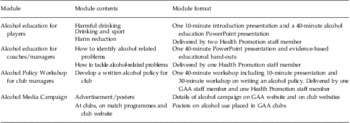
In response to GAA and national concerns, a cluster randomised study was conducted to examine drinking patterns in GAA players (O'Farrell etal. Reference O'Farrell, Allwright, Kenny, Roddy and Eldin2010) and to evaluate the impact of a multi-level community-based intervention designed and implemented by the regional Health Promotion Department of the Health Service Executive (see Appendix A), a quantitative evaluation of the impact of this intervention is in preparation.
The aim of the current qualitative study was to examine the perceived impact of this community mobilisation intervention programme to reduce alcohol consumption among amateur sportsmen aged 16–34 years.
Methods
Design
A qualitative focus group approach was used to identify potentially important themes relating to players’ and coaches’ experiences of the intervention. Focus groups discussed participants’ views on other aspects of the intervention, as well as alcohol, but only the alcohol aspects are presented here (the other aspects included are listed in Appendix A).
Participants
All 12 clubs that participated in the intervention were invited to take part and five clubs agreed to provide players for the focus groups. Each participating club received €500 towards their players’ health fund. Participants were selected using purposive sampling, which is designed to identify specific groups of people who possess characteristics relevant to the social phenomenon being studied (Mays & Pope, Reference Mays and Pope1995). The two key characteristics in this research relating to the selection of participants were that all participants must have been in the club for a number of years and have received the intervention. The club coaches were provided with instructions from two of the authors (C.D.D. and R.D.) to invite players to attend the focus groups if they fulfilled the above-mentioned criteria. In total, six focus groups were conducted, five with players and one with coaches, to elicit participants’ experiences of the intervention. Thirty players took part in five separate focus groups (four to seven participants per group). All of the participants were male and with an average age of 21.6 years (s.d. 4.8), which reflects the age of the players who received the intervention (O'Farrell etal. Reference O'Farrell, Allwright, Kenny, Roddy and Eldin2010). Six coaches took part in one separate focus group. The results presented below reflect views held by the majority of participants attending the focus groups.
Intervention
The multi-level intervention included: (1) alcohol education for the players, (2) alcohol policy training for club managers and coaches and (3) local media alcohol awareness campaign. In order to make the intervention more attractive to the GAA, a nutrition education programme for players was also included in the intervention. Further information about the intervention can be found in Appendix A.
Setting
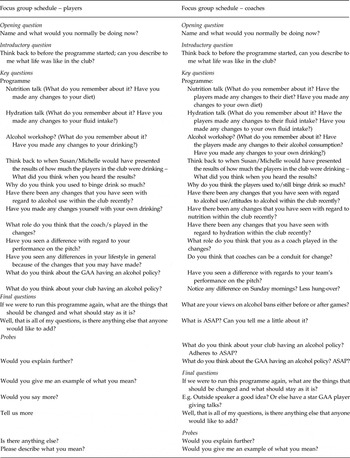
The players’ focus groups were conducted in the clubhouses of the participating teams. No coaches or managers were present in the room during the players’ focus group sessions to allow for a free flow of discussion. The coaches’ focus group was conducted in a clubhouse that was centrally located. Each session was attended by two of the authors (C.D.D. and R.D.), one acting as a facilitator and the other as an observer who took hand-written notes. All focus groups were tape-recorded. A full explanation of the purpose of the focus group was given to the participants at the beginning of the sessions and confidentiality was assured. A semi-structured interview schedule guided the sessions (see Appendix B). This interview schedule provided a framework that allowed for focused, conversational, two-way communication between the facilitator of the focus groups (C.D.D.) and the participants. There was flexibility within the focus group discussions to probe for details or discuss issues as they arose. The focus groups were conducted between January and March 2009.
Data analysis
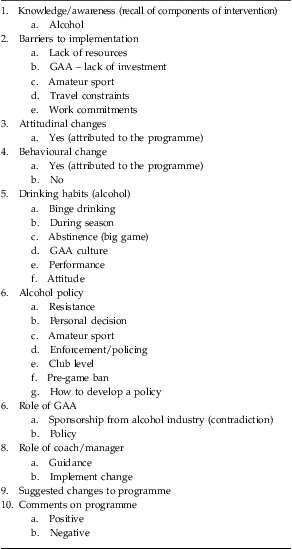
The recordings of all focus groups were transcribed verbatim (R.D.). Each focus group lasted ∼45 minutes. To enhance validity, a summary of the main points was given at the end of each focus group and participants were asked whether it was an accurate portrayal of what had been discussed. An idiographic approach to analysis was adopted, and each transcript was examined in detail. Rigorous line-by-line coding was applied, with a focus on experiential claims and concerns (Larkin etal. Reference Larkin, Watts and Clifton2006). Patterns in the data were then clustered into a thematic structure. Content thematic analysis was utilised to identify and categorise major themes and sub-themes. The themes were then reviewed and refined to ensure they formed a coherent pattern and to recode where necessary. The texts and emerging themes were reviewed by three researchers all of whom had varying levels of immersion in the project. Author (C.D.D.) carried out the focus groups and with the second author (J.H.I.) conducted the detailed coding and theme development. A third researcher (a non-author) who had not been involved in either the study design or data collection but is familiar with qualitative methodologies reviewed the coding frame and original text independently. Any differences in interpretation by the researchers were resolved through discussion (see Appendix C for coding frame). In reporting the results, the identities of the participants have been anonymised. Both players and coaches have been given pseudonyms in order to protect their identity and are referred to as follows ‘Player, Patrick’; ‘Coach, Donal’, etc.
Results
The dynamics of a focus group play an important role in how information is shared during a discussion and subsequently in interpreting the results. The participants actively engaged in conversation, leading to a free flow of discussion. Three major themes emerged from the analyses: patterns of and factors associated with alcohol consumption; the perceived impact of the community mobilisation intervention; and suggested changes to the community mobilisation intervention. Each key theme is listed below with relevant sub-themes.
Patterns of and factors associated with alcohol consumption
Heavy alcohol consumption among the players emerged as an important theme; participants spoke of this in terms of binge drinking (six or more standard drinks on one drinking occasion), drinking habits both on- and off-season, and abstaining from alcohol before an important game.
Binge drinking
Binge drinking appeared to be common practice among the players, with players indicating that they would consume large amounts of alcohol on a typical night out.
(Player; Gerard): I'd say we are very heavy drinkers.
(Player; Francis): I'd have 15 or 20 drinks by the end of the night. 10 bottles [of beer] and then maybe 10 vodkas [shots of vodka].
(Player; Adam): I don't know? I'd have about twelve or thirteen total drinks – three or four pints and nine or ten shorts [spirits].
(Player; Colin): Six or seven pints of Bulmers [cider] and then I'd have eh…eight or nine vodka and Lucozades on top of that, a few shots and then game bombs [cocktail of sprits and soft drinks].
(Player; Ross): Ah, I'd probably…I'd have seven or eight bottles [of beer].
Alcohol drinking habits during the playing season
Drinking habits appeared to be different during the competitive playing season, with players reporting less alcohol being consumed.
(Player; Peter): Well over the Christmas it [drinking alcohol] would have been fairly regular, but since the training came back I'd kind of hold off, ‘cause you are trying to get back fit and stuff and you know it slows you down and…. And it affects you every way you can think of but still if there is a special occasion you would miss it [miss drinking].
Abstaining from alcohol prior to an important game appeared to be the norm.
(Player; Robert): We will all decide to not go out, we'll decide before the Championship we are not going to drink.
(Player; Peter): Sometimes the manager says to us “Right lads, two week drinking ban”, I don't think anybody drinks…. I think a lot of lads would [comply], because everyone is in the same boat then.
Sporting culture as a factor associated with heavy drinking
Participants perceived their drinking patterns to be part of the culture within the GAA, which may inadvertently facilitate heavy drinking.
(Coach; Aidan): Drinking is part of the culture. Like you go back years ago in the GAA and people have always drank heavily.
(Player; Daragh): Especially the circle we are involved in, in the GAA circle. We are all in the club, friends, our family are all involved in the GAA. You are always going to get someone to go out with. Whereas others that might not be as well connected, then they might stay in.
(Player; Richie): I mean it would be very strange for us, after playing a Championship game to go home. But it would be very very strange to go into the pub and have two pints of water before you get a pint. It should happen but it does not.
Perceived impact of the community mobilisation intervention
Increased knowledge of units of alcohol and awareness of harms associated with alcohol consumption
Participants spoke of the knowledge that they had gained from taking part in the education element of the intervention and an increase in awareness of the impact of alcohol on performance.
(Coach; Ethan): I think after the talk, lads are more conscious of it [effects of alcohol on performance]. They are trying their best [to reduce alcohol consumption].
(Player; Patrick): I tell you it opened my eyes to the units [of alcohol]…. I didn't realise the units. You'd think that if you are going out for maybe three or four pints you mightn't be doing too bad, but you'd be doing more damage that you'd actually think you were.
(Player; Francis): And eh…probably since this programme I'd probably thought about it a little bit more you know. Even pre-hydrating myself before a game, I never would have drank a bottle of water or a pint of water before a game.
Participants spoke of the direct effects that alcohol has on their performance.
(Player; Francis): When I drink vodka and Red Bull my heart would be racing. At the end of the game now, I'd be struggling, I'd be looking to go off. Even my muscles would get tired and everything…now I know [as a result of the intervention] that that is because of the drink.
No changes in behaviour reported as a result of the intervention
Players reported that the intervention made no difference to their actual alcohol consumption itself.
(Coach; Donal): One of the key elements [of the intervention] was less alcohol, and they used the national definition that three pints was a binge. It was at that stage that I think they lost most of our players. I don't think the Irishman takes that on board. They regard that as a social drink. So that message didn't get through.
(Player; Patrick): There are certain nights you do it [drink alcohol] and certain nights you don't and that's not going to change because of hearing something from the people like you or anyone else. It all depends on what kind of drinker you are.
(Player; Brian): I didn't notice anything really. I didn't change at all.
Alcohol policy
A key element of the intervention was to develop and implement an alcohol policy within the clubs. There was strong resistance from team members to the concept of a formal alcohol policy.
Resistance to alcohol policy
(Player; Richie): There would be no problem developing one (alcohol policy) but…whether fellas would stick to it is another story.
(Player; Cillian): I'd say that there would be people who wouldn't do it. Like if someone said to you, there is a policy on board as regards alcohol during the year, I'd turn around, I'd be disgusted. I'd be stubborn too.
The factors that contributed to this resistance were players perceiving alcohol consumption as a personal decision, the GAA being an amateur sporting association with little rights to intervene in a player's personal life and the perceived contradictory role of alcohol sponsorship in games.
Personal decision
(Player; John): Plus, like the club does not want to be forcing lads not to drink . They don't want it to be like back at school. Like it's on your own back – it should be your decision. You should be able to control yourself and that's what…the club is about.
(Player: Mark): Like it's up to ourselves as an individual, to be strong.
Amateur sport
(Player; Aiden): Well if it was a professional sport, they would be able to say it, but it's not. As an amateur sport you can't do it. It's as simple as that.
(Player; Eamonn): It's only junior football, intermediate hurling, it's hard to expect guys, I think, to go along with it [alcohol policy]. I think it should be good enough to have an agreement between ourselves.
(Player; Eamonn): No, like it's all fine and well to say we should have an alcohol policy, [but] we are amateurs.
Role of alcohol sponsorship
Sponsorship of games by the alcohol industry was perceived by the participants as contradictory to the ethos of any alcohol policy that the GAA may wish to implement.
(Player; Andrew): Well the GAA are sponsored by Budweiser or Guinness and when you see that you would wonder – why are they trying to preach to us? They are contradicting themselves.
Suggested changes to community mobilisation intervention
Participants suggested changes to the structure, content and delivery of the intervention overall and to the development and implementation of an alcohol policy.
(Player; Geoff): A lot of people just walk away. It's the same, as you say there, you just throw it away, it's at the bottom of the bag, that's it like and you mightn't…. Like it's up to yourself obviously to do it. If you want to do it, but if someone is just constantly reminding you, you know, if we know you are coming again in four weeks time, you might say, “well I'll try it for four weeks” and then when you'd come back, you'd know where you stand with it. If you don't come back for six months or a year, sure what's the point, if you don't come back, like that's it like.
(Player; Cillian): It's easy to forget something when it's in the bottom of the bag, but if it's out on the table, constantly reminding you, if they are coming back in four weeks or six week, and they are coming with a progress report. Yeah. Like when you've never done this as a youngster so you are trying to learn like. You know it's hard to get someone into a new routine.
(Player; Stuart): They should be hitting the minor teams, like sixteen up.
How to develop and implement a successful alcohol policy
The coaches reported that in order for a policy attempting to instigate a reduction in alcohol consumption to be accepted by players it would need to be a ‘bottom-up’ approach rather than a ‘top-down’ approach. Developing a policy in this way would also aid in enforcing the implementation of it.
Develop the policy from the grass roots
(Coach; Kyle): I think it would be better to call it guidelines rather than a policy. Like a ‘policy’, people would see it as coming from up high. Whereas, ‘guideline’ sounds less threatening.
(Coach; Fionn): In order for you to have a working alcohol policy in the club, it has to be the players that really bring it in. Because if they bring it in, and one of them breaks it, then they have to admit it at the Players Meeting, “well I broke the ban last night and I had a drink”. Whereas if the coach brings it in, it's not as easy to punish.
Enforcing the policy from within the team
(Coach; Aidan): Definitely an executive of the club really can't police it either. It's a private thing at the back of it all. It has to come from within. You can have your policy there, but you can't tell people to do it.
(Coach; Mark): We always try to get our first team captain to do that job [broach the topic of modifying alcohol consumption]. We'd say to him ‘this is part of your job now too – to keep an eye on lads and to keep them on the straight and narrow. It's part and parcel of your job off the field’.
(Coach; Kyle): Unless it comes from the players itself, they are not going to respect it as much.
(Coach; Declan): It is easier for the players to police themselves.
Role of coach as an important facilitative factor to implementation of an alcohol policy
The guiding role of the coach was seen as paramount when attempting to implement a policy aimed at reducing alcohol consumption.
(Player; Mark): You'd respect him [the coach]. You'd listen to every word he says.
(Player; Eric): The coach would have to implement it, at least we listen to him, we don't listen to committees, we play for him, so that's it at end of the day.
Discussion
The aim of this qualitative study was to examine the perceived impact of a community mobilisation intervention programme to reduce alcohol consumption among amateur sportsmen aged 16–34 years. As a result of the intervention, there appeared to be a sound understanding of the effects of alcohol consumption on performance. However, the players believed that the intervention had little effect on players’ actual alcohol consumption. This finding is in line with the findings of the quantitative evaluation (Reference O'Farrell, Allwright, Kenny and EldinO'Farrell etal. submitted).
Binge drinking appeared to be common practice among these players, echoing the findings of the baseline survey associated with this research (O'Farrell etal. Reference O'Farrell, Allwright, Kenny, Roddy and Eldin2010) and a broader review of alcohol use among young Irish people of a similar age (Mongan etal. Reference Mongan, Reynolds, Fanagan and Long2007). Moreover, players in the current study reported engaging in regular drinking sessions for the purpose of post-game commiseration or celebration with teammates, which also corresponds to previous research on the association between alcohol and football (Maughan, Reference Maughan2006). The drinking pattern within the current study was perceived as part of the culture within the GAA, which may enable heavy drinking to take place. This echoes a recent finding by O'Brien etal. (Reference O'Brien, Kolt, Webber and Hunter2010). The authors examined normative drinking practices in sportspeople, and found that post-match drinking was an integral part of sports, a ‘tradition or duty’ to be upheld rather than an individual's desire to drink per se (O'Brien etal. Reference O'Brien, Kolt, Webber and Hunter2010). The players acknowledged the damaging effects that binge drinking can have on performance.
Several barriers to implementing change emerged, particularly regarding alcohol consumption. The amateur nature of the sport was noted by a number of players. The players believed that because they were not competing at a professional level, alcohol consumption was a personal decision rather than a matter for the club or organisation. This finding is supported in the Community Approach Literature (CRA). According to Meyers & Squires (Reference Meyers and Squires1999), the most important mechanism for changing consumption is the individual's own set of reinforcers. The second mechanism of change that is central to CRA is its non-confrontational strategy. At no time should the consumer be told that they are required to quit drinking. The choice to change is always up to the individual. Essentially, the most influential mechanism of change, whether accessed through CRA or an alternative approach, is the ‘natural consequences of positive behaviour’ (Meyers & Squires, Reference Meyers and Squires1999).
It was clear from the focus groups that players value the role of the coach, a role that is seen as fundamental for instigating future behavioural change. Resistance to the introduction of an alcohol policy was evident among both the players and the coaches. If an alcohol policy were to be accepted and adopted by players, the following aspects need to be considered: first, a grass-roots ‘bottom-up’ approach involving the players in discussions in the early stages of the policy development; second, support from the coaches would have to be garnered for both the development and implementation of an alcohol policy. In this regard, it should be noted that before this research and in response to the GAA Task Force recommendations from 2004, the GAA have in fact set up an Alcohol and Substance Abuse Prevention (ASAP) programme in 2005, the aim of which is to reduce the harm caused by alcohol and other drugs (www.gaa.ie/asap). To ensure a ‘top-down’ while encouraging a ‘bottom-up’ approach (Butler, Reference Butler2002), the ASAP programme was developed after consultation at grass-roots level and ASAP officers have now been appointed within 1500 clubs (out of 2300), as well as at provincial and county level. ASAP Officers will be responsible for promoting and implementing club drug and alcohol policies and organising prevention/education initiatives in conjunction with professional drug and alcohol agencies. (In order not to contaminate the evaluation of this mobilisation intervention programme, implementation of the ASAP programme in the two study counties was delayed until after the evaluations had been completed.)
The ASAP programme recently conducted a survey of 500 GAA coaches to assess their experience of alcohol misuse among players and reported that 82% of respondents (n = 364) were interested in receiving training in brief interventions. As a result, the ASAP programme are currently developing a brief intervention training programme for coaches.
The contradictory duality of the GAA eliciting sponsorship for sporting events from alcohol companies on the one hand, while endorsing a lowering of the emphasis on alcohol in club life on the other, was seen as another barrier to acceptance by the players. It is important for the GAA to portray one clear message. An earlier international study found that the banning of alcohol advertising during major sporting events significantly reduced alcohol consumption (Saffer, Reference Saffer1996). It has been noted that the public association of alcohol and sports obscures the connection between alcohol and mental and physical harms (Department of Health and Children, 2010).
It is noteworthy that players equated the adoption of an alcohol policy with a total ban on alcohol in spite of the emphasis of the intervention having been on reducing consumption. Although the idea of ‘being told’ what to drink was met with great resistance, interestingly the suggestion of a pre-game ban on alcohol consumption when players are given a rationale around performance was well accepted. The notion of training coaches to deliver alcohol interventions may not be justified because of the relationship that they have with the players. However, coaches could participate effectively in a systematic alcohol prevention programme by promoting clear and consistent team-based policies on alcohol use. It would be important for coaches to explain the rationale for such a policy (i.e. reducing negative health consequences and impact on performance) and to involve team leaders in the development of an alcohol use policy or ‘guidelines’ to enlist their assistance in promoting these expectations. Although a team policy forbidding or discouraging heavy alcohol consumption would certainly not be a universal remedy for high-risk drinking among all players, it is plausible that many players who might otherwise engage in heavy drinking would by and large conform to the expectations of their coach when alcohol guidelines are presented clearly, consistently and with a logical rationale.
The findings presented here were based on content thematic analyses. Content thematic analysis is gaining popularity in the sports and exercise literature as an analytic tool to describe the process of an intervention from the participants’ point of view (Biddle etal. Reference Biddle, Markland, Gilbourne, Chatzisarantis and Sparkes2001). It is not the aim of any qualitative study to achieve a representative sample in terms of either population or probability. Statistical representativeness is not a prime requirement when the objective is to understand social processes (Mays & Pope, Reference Mays and Pope1995). However, future research should aim to establish whether the concerns and issues identified here apply more generally to a wider selection of members of the GAA. Also the results of this current study could be used to provide guidance to future research in the area of promoting a safe alcohol and sporting environment.
In conclusion, in line with the quantitative evaluation (manuscript in preparation) the findings of these focus groups suggest that the community mobilisation programme had only limited success in changing players’ behaviours or attitudes towards alcohol consumption. Excessive drinking was common among players. Although the direct effects of excessive consumption on performance were acknowledged, the notion of an alcohol policy was met with great resistance. If the GAA or similar amateur sports clubs are to achieve an ‘alcohol-free sporting environment’ as set out by the Strategic Task Force on Alcohol (2004), it is clear that a grass-roots approach to alcohol consumption needs to be adopted. Such a strategy should include all players and involve a process that is guided by the coach and enforced by the players.
Acknowledgements
The authors thank the Health Research Board of Ireland for funding the evaluation of the community-based intervention trial; the Health Service Executive North-East for implementing the intervention programme; Susan Kenny (National Office for Suicide Prevention, Health Service Executive, Dublin) for design and delivery of the intervention programme; Brendan Murphy, national co-ordinator ASAP Programme, the national GAA organisation and the County Boards for facilitating the study; and the club managers, coaches and players for taking part.
Conflict of interest
None.
Community mobilisation intervention components

Schedules for focus groups

Coding frame