In many African countries, religious authorities mediate their followers' relationships with the secular state by brokering electoral participation, fostering involvement in contentious politics (e.g. protests and demonstrations), and lobbying for specific legislation. Studies of Muslim-majority states in the Sahel, including Senegal, Niger and Nigeria, have demonstrated these links to be particularly salient (Sklar Reference Sklar, Bates, Mudimbe and O'Barr1993; Villalón Reference Villalón1995; Schaffer Reference Schaffer2000; Beck Reference Beck2008; Idrissa Reference Idrissa2009). In much of Muslim Africa, democratic transitions have facilitated greater religious discussion and debate; and the collapse of state-sponsored religious monopolies has enhanced possibilities for freedom of religious association.Footnote 1 While political candidates and parties remain predominantly elite and secular,Footnote 2 religious communities have engaged in non-electoral channels including vociferous debates over policies such as Family Code reform (Villalón Reference Villalón1996; Soares Reference Soares2009; Wing Reference Wing, Lust Okar and Ndegwa2012), state-sponsored activities viewed as anti-Islamic (Idrissa Reference Idrissa2009) and in the case of Nigeria, the place of sharia law (Kendhammer Reference Kendhammer2013). However, political science knows very little about the effect of religious association on individual citizens' political behaviour in Muslim-majority countries in sub-Saharan Africa. Citizens in the Sahel consistently rank religion as very important in their lives, which makes it difficult to measure variation in religiosity/religious adherence using existing survey data.Footnote 3
This article examines parents' school selection and consumption in order to better understand religious communities' political behaviour. Do parents who send their children to Islamic schools participate in politics differently than those whose children attend Francophone schools? An emerging comparative literature suggests that exposure to social services provided by politically or ideologically motivated actors may influence political behaviour (Cammet & MacLean Reference MacLean2011). For instance, Thachil (Reference Thachil2011) has demonstrated the Hindu nationalist BJP's (Bharatiya Janata Party) use of schooling in India as a successful strategy for courting voters from outside of its traditional base. Similarly, Cammet & Issar (Reference Cammet and Issar2010) have revealed the use of schooling as a recruitment strategy for electoral and non-electoral politics in Lebanon. Moreover, rebel groups have consistently used social service provision to win the support of host communities as well as their recruits (Weinstein Reference Weinstein2007; Keister Reference Keister2013). Finally, drawing upon the American policy feedback literature (e.g. Pierson Reference Pierson1993; Soss Reference Soss2002; Campbell Reference Campbell2003; Mettler & Soss Reference Mettler and Soss2004), MacLean's (Reference MacLean2011) analysis of Cote d'Ivoire and Ghana shows that citizens' consumption of public social services is correlated with greater political participation. Social service provision, especially in weak states, provides a venue for political authorities to connect with constituencies. What happens when states forgo this opportunity to forge connections with citizens, instead delegating this responsibility to private providers?
Concurrent with transitions to democracy and donor-led efforts to expand access to education, including the Millennium Development Goals and the Education for all Campaign, nascent African democratic states sought partnerships with religious providers and other private schools in order to increase enrolment. This liberalisation of the educational sector has facilitated expanded access to schooling opportunities. However, educational expansion has, in turn, precipitated what many refer to as a ‘schooling crisis’, or a tangible decline in the educational quality of public schools. The diversity of schooling providers, which include public schools, madrasas, and private secular schools, raises interesting questions about how different schooling providers might generate and/or cater to communities with distinct political preferences and patterns of political behaviour.
This question regarding Islamic schooling communitiesFootnote 4 is particularly salient considering their historic marginalisation by West African states. Fluency in the former colonial language remains a necessary condition for entry into the government bureaucracy, but Islamic schools continue to use Arabic as the dominant language of pedagogy. Given the traditional juxtaposition of political and traditional/religious authority, the rapprochement between the state and Islamic schools provides an interesting possibility for better integration of more pious religious constituencies into formal democratic politics. However, it is possible that participation in different schooling trajectories – French, Arabic-language based, secular or Islamic – could exacerbate the existence of what Idrissa describes as ‘competing modernities’ – one tied to the West and the other to the Muslim world (2009). By sending their children to madrasas, parents have less contact with the state in its role as a public service provider.
This article explores these questions in Mali, which was once considered a leading democracy in West Africa due to its history of relatively peaceful elections and two executive alternations of power. Since the survey was conducted in 2009, there have been dramatic political changes in Mali: a military coup disrupted nearly 20 years of democratic rule, and rebels seized three northern regional capitals (Timbuktu, Gao and Kidal), eventually leading France to intervene to liberate the North of the country. The involvement of actors purporting a hardline sharia agenda makes the question of religious communities' participation with the secular, bureaucratic Malian state particularly pressing. As Mali prepares for a new round of elections, these data offer important evidence regarding the integration of different schooling communities into the previous democratic system.
Mali has followed liberalisation and expansion strategies consistent with those described above. Further, gross primary enrolment rose from less than 30% before the democratic transition in 1991 to nearly 80% in 2009. In an environment of unprecedented access to public and private Francophone education, there has been a consistent increase in the percentage of parents enrolling their children in madrasas. In the 2009–2010 school year, 13% of Malian primary students were enrolled in madrasas, modern Islamic schools that use Arabic as the language of instruction.Footnote 5 In Mali, where Muslim constituencies have expressed their most cohesive political action through contentious channels such as protest, we know little about religious constituencies' participation in the electoral realm or about their broader engagement with the state.
This analysis leverages an original survey of 1,000 Malian citizens hailing from five regions, interviews with educators and university students, and exit poll data from the 2009 municipal elections, to highlight the differences in political participation between religious and state-sponsored schooling communities. The survey data capture respondents' schooling decisions, as well as their political attitudes and reported behaviours using closed-ended survey questions, and citizens' qualitative justifications for their beliefs and actions. These unique data allow us to probe the mechanisms behind statistical correlations. To test and confirm the survey results, I use exit poll observations of voter characteristics. Additionally, I use a focus group of university students from rural areas to further probe one of the posited mechanisms linking public schooling consumption to increased political engagement: linguistic brokerage.
The article makes two contributions. First, it demonstrates that madrasa-schooling consumers are reluctant to participate in electoral channels. Drawing on more than a year of fieldwork, I demonstrate that Malian citizens who enrol their children in madrasas are less likely to report that they participate in electoral politics than citizens who do not have children enrolled in school. Secondly, the data reveal that parents who send their children to public schools are more likely to indicate that they campaigned and voted than citizens who do not have children in school. Evidence from exit polling in the 2009 municipal elections confirms these general trends. These findings suggest a need to broaden our conceptualisation of political constituencies beyond the narrow realm of regional and ethnic politics that is typically applied to Africa. It also raises important questions concerning the inclusion and representation of Islamic schooling communities in Mali. Finally, it offers evidence to further support MacLean's claim that public services link parents to political – particularly electoral – participation (2011).
The article proceeds as follows: it begins with a brief discussion of participation in the Malian context and describes pervasive scepticism around electoral politics in Mali. It then offers a brief history of the tension between Islamic schooling and secular authority in the colonial and post-independence state in Mali. Next, it introduces survey data from 10 school districts in Mali to demonstrate the variance in reported political behaviour of two types of schooling consumers: parents who send their children to madrasas and those who send their children to public schools. I complement the regression analysis with exit-polling and focus group data before discussing potential causal mechanisms. The article concludes with a discussion of the implications of my findings for democratic deepening in Mali and Muslim-majority countries on the continent.
POLITIKI MAN ɲI: DEMOCRATIC POLITICS IN PRE-COUP MALI
In order to probe the relationship between schooling consumption and political engagement, it is important to first contextualise political participation in Mali where, like many countries in Africa, elected officials operate parallel to the authority of religious and traditional elites. In ‘democratic’ Mali, there was widespread scepticism about politics and elections. The Bamana word for politics and elections, politiki, is often coupled with man ɲi – meaning bad. Perhaps the most telling piece of evidence was public apathy regarding the coup d’état: more than 60% of Bamakois surveyed supported the junta's seizure of power (Guindo Reference Guindo2012). Malian scepticism toward parties and politics was further evidenced by paltry voting rates —a mere 40% of the population— which are among the lowest on the continent. One female respondent from Kayes, Kadiatou explained her disinclination to embrace any political party, ‘We have tried a lot of different paths in vain (K55). When asked if they were close to any political party, other respondents would say: ‘they [parties] are all the same’.Footnote 6
However, voting, campaigning and affiliation with parties were not the only ways for Malians to participate in politics. Many Malians participated through the mediation of a religious or traditional leader. Interviews with Malian citizens revealed a juxtaposition of ‘legitimate’ and clean religious leadership with dishonest and ‘dirty’ electoral politics. These conversations are consistent with Afrobarometer findings that most Malians prefer to consult with traditional or religious leaders rather than contact elected officials (Coulibaly & Diarra Reference Coulibaly and Diarra2004: 17). Respondents often described relationships with parties as inconsistent and temporal in contrast to organic and continual relationships with religious leaders. Like many others, Djeneba, a 30-something year old mother living in a rural area of Kayes, noted the discrepancy between elected officials' behaviour before the electoral cycle and after it: ‘Officials only come to visit during elections (K52)’. Traditional or religious leaders' lives are entwined with those of their constituents, and they are typically viewed as more accountable. Djeneba explained that ‘[y]ou can count more on [religious leaders] to help you resolve your problems’, as opposed to the president or other elected officials where ‘the situation never changes, they are comfortable (K52)’.
Participation in politics is also perceived as corrupting traditional elites. Boubacar, a 60-something Songhai respondent from Timbuktu, complained: ‘Religious authorities can act like those in political power. [Religion/religious practice] should be different than politics’ (T39). In rating his confidence in religious authorities, Abdoulaye, a 40-something Tuareg respondent from Timbuktu, gave a zero vote of confidence: ‘They are ruined now; even [religious and traditional leaders] – they take part in politics (T6)’. It should be noted that the typical Malian understanding of ‘politics’ or politiki refers exclusively to the electoral realm. Most respondents compartmentalised voting and campaigning from more general activities related to governance and policy. For instance, it is common for Malians to distinguish between kalata wati, or the campaigning period, and normal time.
Religious movements can mobilise constituents to the polls, as evidenced by the Mourides in Senegal; however, in Mali, these groups have been most successful using protests or other contentious tactics to accomplish political goals. In recent years, public protests led by major religious groups, such as the High Islamic Council, have overturned an amendment to annul the death penalty, gender quotas for political parties, and most recently, the 2009 Family Code.Footnote 7 Therefore, citizens do not merely choose between participating electorally and not participating. Rather, they also have the option of engaging in a wide range of contentious activities.Footnote 8
However, while contentious participation can generate favourable policy outcomes, it does not solidify relationships between formal state institutions and citizens. As Hirschman (Reference Hirschman1970) argues, democratic institutions require engagement to be made accountable to populations and to be prevented from falling into a cycle of slack. Therefore, in an environment of pervasive scepticism about electoral participation, a major question becomes who is willing to engage in elections and other ‘formal’ institutional channels. This article posits that state-led welfare activity can generate such participation and that Islamic schooling is less likely to be associated with participation in elections. The next section describes reasons why different respective schooling consumers might engage in different types of political behaviour: ideological determinants and a social service effect.
THE STATE AND SCHOOLING IN MALI
In the Sahel, madrasas and Quranic schools are tied to a specific history of contestation with the secular state. When the Europeans arrived in West Africa, Quranic schools were already widespread (Johnson Reference Johnson, Brown and Hiskett1975; Sanankoua Reference Sanankoua1985; Brenner Reference Brenner2001). Originally established by Muslim traders and intellectuals, Quranic schools indoctrinate students into the Islamic religion through the memorisation and repetition of texts. Quranic schools are generally decentralised; students work under the apprenticeship of their teacher, or marabout, and slowly gain access to the more esoteric elements of Islamic knowledge (Soares Reference Soares2005). Madrasas arrived in the first half of the 20th century as Malians with a cosmopolitan vision of a pan-Muslim community returned from education in Islamic universities abroad (Brenner Reference Brenner2001: 54). Madrasas offer a modern curriculum, in addition to religious studies, and use Arabic as the language of instruction. Initially, many of their founders identified with an emerging ‘reformist’ version of Islam that aimed to align Malian religious practice with that of the broader Muslim world.Footnote 9 For religiously minded parents, madrasas offered an attractive option, mixing ‘modern’ pedagogy, as well as their Islamic values (Villalón Reference Villalón, Lust Okar and Ndegwa2012; Villalón et al. Reference Villalón, Idrissa and Bodian2012).
Historically, Islamic education faced resistance by the French colonial authorities. The French feared ‘Islamic fanaticism’ and saw it as a significant challenge to the ‘mission civilisatrice’.Footnote 10 The French built their own Franco-Arab schools in an attempt to co-opt local populations (Brenner Reference Brenner2001: 4). Madrasas were particularly threatening as they offered a ‘modern’ brand of formal education, which potentially linked students to a worldwide network of Muslims (Amselle Reference Amselle1985; Sanankoua & Brenner Reference Sanankoua and Brenner1991; Brenner Reference Brenner, Hefner and Zaman2007). The colonial administration restricted the curriculum that some madrasas could legally offer by classifying them as ‘Quranic schools’ and attempting to prohibit them from teaching in Arabic or French (Brenner Reference Brenner2001: 15, 82; Brenner Reference Brenner, Hefner and Zaman2007: 213). The French government refused to grant licences that would qualify these schools for state aid, such as that which was received by the Catholic schools. Ironically, as the French built infrastructure, Islam and Islamic education spread rapidly through the rest of the country (Launay & Soares Reference Launay and Soares1999; Soares Reference Soares, Salvatore and Eickelman2004).
When the French built the first French-language schools in the late 1800s, they faced resistance and distrust from local populations (Gérard Reference Gérard1997; Brenner Reference Brenner2001; Ba Reference Ba2009). Many Malians, suspicious of colonial rule, refused to send their children to French schools – preferring instead to send them to Islamic schools. The French authorities courted the sons and relatives of chiefs and notables, but village chiefs would often send children of lower-caste village members to the European school, while keeping their own children far from French control (Gérard Reference Gérard1997: 99). The population's suspicion of French education, as well as the limited penetration of colonial infrastructure into Malian territory, begot one of the lowest literacy rates of any African nation. At independence, only 7% of the Malian population was literate in the former colonial language, compared with an African average of 39%.Footnote 11
Post-independence governments did little to accommodate the needs and desires of Islamic-schooling communities. Keita's Marxist government was strongly secular and nationalised one of the largest madrasas in Bamako as well as the French, colonial era madrasas. The schools were required to teach in French and Arabic but were stripped of their religious curriculum. Keita planned to do the same with other madrasas in Mali before succumbing to a military coup in 1968 led by Moussa Traoré (Brenner Reference Brenner2001: 212). Similarly, efforts by Islamic associations (e.g. the Muslim Cultural Union) to integrate into the political sphere were thwarted post-independence and then later under Moussa Traoré (Amselle Reference Amselle1985).
Following the 1968 coup, the education system foundered under the Traoré dictatorship. A World Bank report estimates that the gross enrolment ratio had dropped to 20% in 1973 (Bender et al. Reference Bender, Diarra, Edoh and Ziegler2007; Lange & Diarra Reference Lange and Diarra1999). Under the Traoré dictatorship, there was only one recognised Islamic organisation – AMUPI (Malian Association for the Unity and Progress of Islam). Even without state assistance or recognition, madrasas flourished, particularly during the 1970s with the influx of petrol-dollars from the Middle East. Brenner estimates that enrolment in madrasas outstripped enrolment in public schools in the 1980s (Brenner Reference Brenner2001).Footnote 12 Madrasas educated 6% of primary learners in 1960, but they represented a full 25% of all primary enrolment by the 1980s (Brenner Reference Brenner2001: 170, 172). Traoré reluctantly integrated madrasas into the Ministry of Education in 1985; however many schools viewed the attempt as ‘domestication’ reminiscent of French efforts to control Islamic schooling at the turn of the century.Footnote 13 Gross primary school enrolment rates remained dismally low, estimated at approximately 26%, leading up to the democratic transition in 1991.
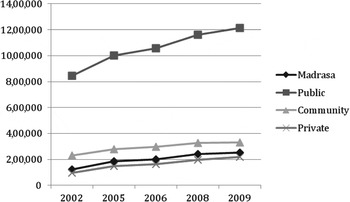
The transition to democracy constituted a break from past policy and a dramatic opening for Islamic civic society, including advocates for madrasa schooling.Footnote 14 Following democratisation, Mali witnessed a vast proliferation of religious associations and public discourse surrounding Islamic principles and practices (Launay & Soares Reference Lange and Diarra1999; Soares Reference Soares2005; Villalón Reference Villalón2010). Democratisation opened the door for the creation of a multitude of diverse religious organisations and Islamic self-help associations. In addition, democracy facilitated the unprecedented growth of schooling opportunities as the state and other donors increased funding for basic education and the private schooling sector blossomed. Gross primary enrolment increased more than 300% in the 20 years following the transition.Footnote 15 A greater number of Malian children were now able to attend primary school – at both state schools and new private secular and Islamic schools – than ever before. While the gains in enrolment were most dramatic in the 1990s, a lack of consistent data makes it difficult to assess growth by school type in that period. However, Figure 1 shows continued enrolment by school type from 2002–2009. It reveals increased enrolment in all schooling types: public, private Francophone schools,Footnote 16 madrasas and NGO-run community schools.Footnote 17
Primary enrolment over time by school type. Graph calculated using Brenner (Reference Brenner2001), The Annual Ministry of Education Reports for 2004–2009. There are no available data on Quranic schools.

Following the 1992 transition to democracy, President Alpha Omar Konaré invited Islamic schooling communities to join the National Education Conference. For the first time, supporters of Islamic education were allowed to provide input into government education policy. Members of diverse groups of newly flourishing Muslim voluntary associations, including the Muslim Cultural Union and Shubban al-muslimin, were staunch advocates of the modernisation of Islamic schooling (Brenner Reference Brenner, Hefner and Zaman2007: 201). These proponents of Islamic education were very vocal and demanded more schools and government resources (Brenner Reference Brenner2001: 281). Unlike forced integration of the Traoré era, this conference represented a victory for Islamic interest-groups. In the late 1990s, the Malian government officially accredited madrasas. Currently, there are more students enrolled in madrasas than in secular, Francophone private schools. In 2007, the Malian government began to offer the baccalaureate exam in Arabic. It is important to note that enrolment in madrasas continues to grow, despite unprecedented French-language schooling options. Parents pay more for madrasa education than public schools, despite the fact that the primary language of instruction, Arabic, is different from that of the bureaucratic state.Footnote 18
State accreditation should not be read as the state's systematic control over curriculum or state subsidies to these schools. Parents who enrol their children in private schools, secular and Islamic, pay more than ten times what public school parents pay for their children's education. Government monitoring, especially of madrasas, is limited by budgetary constraints.Footnote 19
In the current educational landscape, Quranic schools and madrasas serve very different constituencies. While some Sufi brotherhoods are explicitly tied to forms of Quranic schooling, and many associate more reformist communities with madrasa schooling, there are also Sufi madrasas and a broader constituency of parents who send their children to Quranic schools to supplement their secular education. These two forms of Islamic schooling are better distinguished by their scope and cost. Quranic schools are less expensive than other school types since the children generate the fees by begging. Many of the parents who send their children to Quranic schools are from rural areas that do not have access to other types of educational infrastructure and/or the means to pursue other types of education. Madrasa tuition is comparable to low-end Francophone private schools, with fees ranging from $3–5 a month.Footnote 20 Parents who enrol their children in madrasas come from a wider socioeconomic spectrum. They cite quality or religious reasons, rather than pragmatic reasons such as cost or proximity, for enrolling their children in madrasas. Madrasas use Arabic as the primary language of pedagogy.
Historically, Malian society has critiqued madrasas for limiting the employment opportunities of their graduates, but they do offer access to social mobility that Quranic schools do not (Sanankoua & Brenner Reference Sanankoua and Brenner1991: 8). The state's recognition of madrasas, as well as the rising popularity of Arabic as a language of cosmopolitan trade, increased trade with the non-Western world, and the spread of Islam, has helped to placate fears that graduates of madrasas have few job opportunities.Footnote 21 Arabic teachers in Bamako explained that there has been a substantial increase in demand for their services in recent years. Many of them teach part-time at Francophone private schools, which increasingly offer Arabic classes, in addition to their full-time work at madrasas.Footnote 22
BUILDING HYPOTHESES: SCHOOLING AS A POLITICAL CLEAVAGE?
Islamic associations were less successful at inserting themselves into the democratic political system.Footnote 23 During the National Conference held immediately before the transition to democracy, Islamic groups expressed a desire for the creation of an Islamic state and to allow the formation of Islamic political parties, but both attempts failed (Brenner Reference Brenner2001: 294; Soares Reference Soares2006: 282; Künkler & Leininger Reference Künkler and Leininger2009: 1073). A 2002 attempt by the Collective of Islamic Associations of Mali to identify and back a presidential candidate also failed.Footnote 24
However, Islamic groups have been immensely active in politics outside of the formal electoral arena. Religious leaders have chosen to advise or critique secular authorities through a range of ‘contentious politics’, including protests, rallies and sensitisation campaigns. In 2009, the High Islamic Council made international headlines when it organised protests, which ultimately blocked the Family Code reform efforts. Religious organisations have showed their capacity for mobilisation by filling the national soccer stadium with supporters during the Family Code protests, or more recently, in rallies leading up to the defunct 2012 Malian elections.Footnote 25 While religious leaders and associations have been very vocal in political debates, they have been unwilling to develop parties or to field their own candidates.
Given the history of tension described above, Islamic-schooling consumers might be less willing to interact with the state because they view these institutions as less legitimate than other types of authority and/or because they are not the recipients of its welfare services. We could imagine a similar scenario where Islamic schools pull constituents into contentious politics rather than electoral participation. It is also possible that by attending a madrasa a student or parent could become integrated into an alternative community that values concentration on one's personal moral improvement and relationship with God. Religious leaders might discourage direct participation in ‘dirty politics’ unless it is mediated by their mosque or religious leaders. It is also possible that those citizens who are ideologically motivated and choose to enrol their children in madrasas are also less likely to participate in formal secular politics. For these reasons, I hypothesise that parents who send their children to madrasas will be less likely to participate in politics than other citizens.
Public schools may serve as a vehicle for parents to overcome widespread scepticism regarding the Malian state and to become engaged with electoral politics. Those citizens who secured a Western education reaped political dividends in the colonial and post-independence era.Footnote 26 While the utility of a state education is less apparent than during earlier regimes (Ba 2009) and many parents are sceptical about the quality of public schools (Diakité Reference Diakité2000; Bleck & Guindo Reference Bleck2013), public school consumption could still benefit parents through a ‘policy feedback effect’ (Pierson Reference Pierson1993; Mettler Reference Mettler2005; MacLean Reference MacLean2011). Parents who send their children to public schools benefit from increased interactions with the state, which may lead them to assess the government as more credible, to raise their level of internal efficacy, and promote greater political participation. The American politics literature demonstrates that experience with certain social services can induce citizens' participation in politics (Landy Reference Landy, Ingram and Smith1993; Gordon Reference Gordon1994; Soss Reference Soss2002; Campbell Reference Campbell2003; Mettler and Stonecash Reference Mettler and Stonecash2008). Lauren MacLean's (Reference MacLean2011) analysis of Afrobarometer data demonstrates that citizens who have contact with either public schools or public health clinics are more likely to vote, contact political leaders, attend community meetings, join with others to make their voices heard, and protest than citizens who did not have such contact. Those citizens who had no experience with public schools or clinics used non-state channels of representation more frequently (2011: 25). However, MacLean's measure of ‘non-users’ remains unclear, as it could include private service users, citizens who use religious or NGO services, as well as the most marginalised citizens who have access to no services.Footnote 27 This study builds on her work by disaggregating the reference categories to generate more specific comparisons.
On a practical level, parents who send their children to public schools benefit from French language instruction as well as increased contact with a state institution. During the elections, public schools literally transform into voting booths. In addition, since less than 30% of the adult population is literate in French, the language of bureaucracy, parents who educate their children in French-language schools can also leverage their child's linguistic skills to facilitate interaction with government bureaucracy.Footnote 28 Alternatively, parents who seek enrolment in public schools might also be civically minded and participate more often, despite widespread pessimism concerning politics. For these reasons, I hypothesise that parents who send their children to public school will participate more than other citizens.
THE POLITICAL PERCEPTIONS AND BEHAVIOUR OF ISLAMIC SCHOOLING COMMUNITIES
I draw on an original survey of 1,000 individuals to evaluate the behaviour of different schooling consumers. This survey used a stratified, area probability samplingFootnote 29 within ten school districts in five regions in Mali: Bamako, Kayes, Sikasso, Mopti and Timbuktu. Because I wanted to compare the experience of citizens sending their children to different schools, I selected districts using Ministry of Education data on education provision to maximise potential variation on my independent variable: type of school.Footnote 30 For instance in Bamako to maximise the likelihood of interviewing parents with children at different school types: Bamako Coura was selected due to high public school enrolments, Banconi had high madrasa enrolments, and Faladie because of high private, secular enrolments. Since there are few schooling options in rural areas, I purposefully targeted zones with different types of schools; and as a result, my sample has a strong urban/peri-urban bias: only 20% of respondents live in rural zones. Therefore, the percentage of respondents enrolling their children in community schools and of parents not enrolling a child in any school is below the national average.Footnote 31 Once school districts were selected, I used an online randomiser to select specific zones or villages where we would conduct the survey. We used Afrobarometer protocol at the household level to select respondents from each household who were permanent residents 18 years of age or older.Footnote 32
I conducted the survey with four Malian research assistants and personally coded 190 of the surveys during a year of fieldwork in 2009. Two-person teams administered the survey, so that one person would pose questions while the coder captured responses as well as qualitative justifications for the responses. All respondents were asked if they had children who were at least 7 years of age.Footnote 33 If respondents had children, they were asked if their children had ever been enrolled in school, and if so, what type (s) of school. Each respondent was asked their reason(s) for enrolling their child(ren) in each relevant school, evaluations of schools, and their general attitudes toward the Malian education system.
I disaggregate citizens' responses along my primary variable of interest: where they send/sent their children to school. I create dummy variables for people with children at public schools, private schools, community schools, Christian schools, madrasas, Quranic schools, as well as parents and other citizens without children enrolled at any school. More than half of parents who enrol their children in Islamic schools also enrol their children in a secular, state school. Since I theoretically expect those school types to have opposite effects on political behaviour, I create two additional dummies for those parents who send their children to both public schools and madrasas and public schools and Quranic schools.
In the sample, 694 respondents reported having at least one child 7 years of age or older.Footnote 34 Of parents with children who attend/attended school:Footnote 35 362 respondents had children who attend/attended public school, 169 had children who attend/attended private, secular school, 38 had children who attend/attended exclusively madrasa, 51 had children at community schools, 31 parents had children at Quranic school,Footnote 36 7 parents had children at Quranic and public schools, and 46 had children at madrasas and public schools. The sample includes those parents who benefit from a state service, but also those parents who previously benefited from state services.Footnote 37 These data enable me to compare the behaviour of parents who send their children to madrasas and those who send their children to public schools with other Malian citizens.
I include control variables for factors that might obscure or inflate the relationship between social service consumption and participation: gender, age, rural/urban, school district and poverty. In Mali, men typically determine the educational trajectory of their children and report being more active in politics, thus it is important to separate gender effects out from education.Footnote 38 Afrobarometer data also reveal that older citizens are more likely to vote and less likely to identify with a party.Footnote 39 In Mali, primary school enrolment has increased dramatically in the last 20 years; therefore older respondents will have been less likely to have their children enrolled in any school and less likely to be exposed to schools which blossomed post-liberalisation: private schools, madrasas or community schools. In addition, due to the perceived decline in schooling quality over time, it is important to isolate the period of time when respondents' children attended school.
MacLean found poverty to be correlated with higher rates of reporting contact with a politician (2011: 1251); and, household wealth constrains educational choices, so I include a proxy for poverty to try to separate these effects. I code all respondents as urban or rural, since I anticipate distinct patterns of mobilisation and participation in those zones and since there is greater availability of schooling options in urban zones.Footnote 40 I include level of education, as it is likely to influence a parent's decision to enrol his or her child as well as the parent's participation (MacLean Reference MacLean2011). I include controls for membership in a secular organisation and membership in a religious organisation, since scholars of West Africa have found that as ‘agencies of mobilisation’, societal organisations play an important role in mobilising turnout. They could also affect school choice.Footnote 41
I assess formal participation through a series of measures, including whether the respondent identifies with a party, reports campaigning or voting during the 2007 presidential elections, has a voting card, and contacted a government official. Each variable is coded dichotomously and evaluated independently. I include a wide range of participation variables, knowing that different forms of participation are classified differently. As explained earlier, those activities associated with voting and campaigning during kalata wati, or the campaign period, are most likely to be associated with the idea of politiki man ɲi meaning politics is bad.
In my first analysis, I use logistic regression analysis to compare the formal participation of parents who send their children to different school types to citizens who do/did not have a child enrolled in school.Footnote 42 This strategy allows me to compare different types of schooling consumers with a neutral category of non-consumers, in order to simultaneously compare the different types of schooling on parents' participation.Footnote 43 I regress each variable measuring political participation (party identification, campaigning, voting, having a voting card, willingness to run for office, and contacting a government official) on each schooling dummy variable and the socioeconomic controls: age, educational level, gender, urban/rural, school district, associational membership(s) and poverty.Footnote 44 This strategy allows me to compare the relationship between schooling providers and each type of participation independently, while also making sure that other characteristics of the respondents, such as their age or gender, are not driving the results.
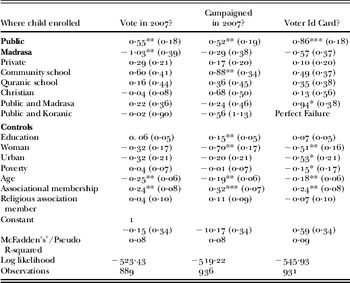
The results largely confirm the hypotheses as related to voting. As demonstrated in Table 1, having a child attend a madrasa is correlated with a lower predicted likelihood (p <0·01) that a citizen reports voting as compared with other respondents, while having a child enrolled in public school creates a higher predicted likelihood (p<0·01) that the respondent will report voting.Footnote 45 According to the data, having a child in public school increases your predicted probability of voting by 12%, while having a child in a madrasa decreases the probability of voting by 25%.Footnote 46 No other category, including the mixed schooling or Quranic education, has a significant effect on voting compared with the population with no exposure to schooling for their children. Two controls, age (p<0·001) and associational memberships (p<0·01), are positively correlated with voting.
Schooling consumers' participation as compared with citizens without children enrolled (*p<0·05, **p<0·01, ***p<0·001).

In addition, enrolling your child in public school or community school (p<0·05) increases the likelihood of a respondent stating that she or he campaigned in the 2007 presidential elections, as compared with respondents without children enrolled in school.Footnote 47 Having at least one child enrolled in public school increases the likelihood of stating that you campaigned by 10%, while having a child in a community school increases the probability of proclaimed campaigning by 20%. It is important to remember that community schools are found predominantly in rural zones and, thus, the dynamics of campaigning and mobilisation are likely to differ from urban zones. At a minimum, attending an NGO-run community school does not dissuade people from campaigning. Education (p<0·01) and associational membership (p<0·001) are positively associated with campaigning, while age and being a woman are negatively associated with voting (p<0·01).
Parents who enrol their children in public schools (p<0·001) as well as parents who enrol their children in both madrasas and public schools (p<0·05) were more likely than people in the reference category to report having a voting card. Enrolling your child in a public school increases the predicted probability of having a voting card by 17%, while having a child enrolled in public school as well as a madrasa increases the probability by 15%.Footnote 48 This suggests that proximity and access to public school facilitates the process of procuring or being targeted to receive a voter identification card.
We see a strong correlation between sending your child to public school and electoral participation in terms of voting, campaigning and having a voter identification card. These results largely confirm the hypothesised relationship between public schooling consumption and political participation in the electoral realm. There is also evidence that parents who have children in madrasas are less likely to report voting. However, there are no comparable findings for Quranic education, which raises interesting questions about the specific relationship between constituencies that use madrasas and broader populations who enrol their children in Islamic schools.
The negative, significant correlation between parents who send their children to madrasas and voting did not hold for other types of political participation, including party identification, willingness to run for office, or contacting a government official. In addition, the control variable, religious membership, had no significant relationship to participation. These findings suggest that the negative relationship between enrolling a child in a madrasa and participation is restricted to the narrow electoral realm, rather than being representative of a broader, more diffuse disengagement with the state.
LEVERAGING ADDITIONAL DATA: FOCUS GROUP INTERVIEWS AND EXIT POLLING
Since all participation data from surveys are self-reported, we have no way of knowing whether correlations with participation represent actual behaviour or merely how respondents wish to represent themselves. If public school parents know that ‘good citizens vote’, then they might want to over-represent that behaviour. Similarly, if there is a stigma against voting for members of certain religious communities, they might want to downplay their electoral participation. In order to generate more data to evaluate the proposition that parents have different types of political behaviours – and the mechanisms behind these behaviours – I introduce two additional types of data: exit polling conducted during the community elections of 2009 and a focus group I conducted with current university students in spring 2011.
Observations from the municipal election polls 2009
I collected exit poll data on the school enrolment choices of voters during the 2009 municipal elections in three Bamako school districts. All school districts were located in zones near where we conducted our surveys to capture potential variation on schooling experiences. I organised three teams to stand outside a large polling station (usually a public school) in each of the districts. Each team was composed of three members, primarily university students and recent graduates, who were tasked with interviewing every third person who exited from the polls to see if they had children and to determine what school, if any, those children were enrolled in. The teams all conducted their polling from the time when polls opened at 8 am until they had collected 150 total responses.Footnote 49 Of those 457 voters responding, 261, or 57%, claimed to have school-aged children, and 92% of those parents enrolled their children in school.
These data were taken during the municipal elections, while the survey references the presidential elections of 2007. Municipal elections, often described as ‘elections of proximity’, might offer greater incentives for madrasa consumers to be involved in that a family member or neighbour, rather than an elite politician, might be running and encourage him or her to come out to the poll. In presidential elections, where contenders are generally secular, Western-educated elites, madrasa consumers would have a lower likelihood of an allegiance that would overcome societal stigma about voting. In this sense, municipal elections are a harder test of non-turnout since they may be less stigmatised.
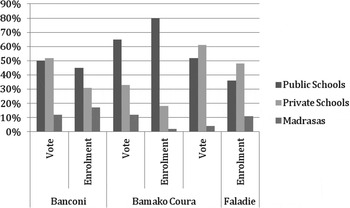
I restrict the data to those parents who enrol their children in different primary school types to examine their voter turnout relative to the percentage of children who are enrolled in that particular school type.Footnote 50 To do so, I draw on the 2009–2010 Ministry of Education Annual Report, which I secured from the Ministry. If the survey data are correct, we should see a large number of public school parents at the polls as compared with a much smaller percentage of parents who enrol their children in madrasas. We should see public school parents over-participating relative to district enrolment and, similarly, we should see madrasa parents under-participating. Figure 2 shows the percentage of voters who claimed to enrol their children in each of three main primary school types: public, private and madrasas.
Percentage of voters in with children in each school type as compared with percentage enrolment in district.

As predicted, we see the largest turnout from those who have children in public and private school. Many fewer voters reported sending their children to madrasas. Between 29% and 65% of voters at the polling stations reported that they had children at public schools, compared with only 4–12% who had children enrolled in madrasas. When we look at turnout by school type, as compared with general enrolment in each district, parents of private school students comprise a higher percentage of voters than they do for total district enrolment; public school parents ‘over-perform’ in two of three districts, Banconi and Faldie, while parents who send their children to madrasas ‘underperform’ in all cases except Bamako Coura.Footnote 51 These findings mirror the results from the regression analysis of survey results, except that private school parents vote at higher rates than expected. The exit poll data suggest at a minimum that in Bamako, private school parents are still engaging with the electoral process.
It is also important to remember that Bamako, the national capital, might not be representative of larger national trends. For instance, while age is generally positively correlated with people stating that they have voted, the large number of respondents from the exit polls claiming that they do not have children suggests that many young people came out to vote. It may be that mobilisation in Bamako targets youth at a higher rate than in other regions.
Earlier, I noted that 33% of all parents in our sample had children enrolled in Francophone secondary school. Given that net attendance in secondary schools in Bamako is only 31%, this number seems extremely high, considering that the denominator – ‘parents’ – includes anyone who has a school-aged child, not necessarily a child who is old enough to attend secondary school. The data suggest that those parents with children enrolled in tertiary education are overrepresented at the polls. This finding lends support to the two mechanisms linking public education to higher turnout, which will be discussed later: linguistic brokers and the possibly of a policy feedback effect.
Linguistic brokerage: focus group with university students
As mentioned earlier, Francophone education, in a public or private school, could endow a family with a child who is a qualified linguistic broker to engage with formal government including political parties and campaigns. A child who has received secondary or university education could help his or her family – especially those families who are illiterate and living in rural zones away from the capital – to interpret and understand parties' electoral promises. In order to probe the linguistic mechanism directly,Footnote 52 I conducted a small focus group in Bamako during the spring of 2011 with a group of university students from regions outside the capital to determine how their grandmothers, uncles, parents and neighbours in their villages access political information and/or become involved in politics.Footnote 53 Student responses were nearly unanimous: they (the educated children) tell their parents and grandparents how to vote. More concretely, students and former-students in Bamako participate in campaigns as brokers for political parties. They act as guides – introducing candidates and party representatives to the traditional leadership in the village. The students stressed their French-language skills as legitimising their role as party-brokers. They had connections to the community and could therefore be trusted to apply their education to decipher the intricacies of party politics and to lobby for the local community. Even when students were not actively involved in travelling to villages to campaign for parties, they noted that their relatives often called their cell phones to get their opinions on who they should vote for.
These findings suggest that, at least in rural areas, educated children play a role in bringing their parents into the political arena through linguistic brokerage. However, this mechanism would benefit not only public school parents, but any parent whose child receives a French language education. My experience of trying to recruit university students as research assistants for exit polling during community elections also confirms active student participation on election day. In trying to recruit six extra pollsters to complement my team of three research assistants, I had to pay more than the political parties were offering students to mobilise voters to go to the polls. This wage, higher than what I would typically pay a temporary research assistant for a half-day's work, was generated by the demand for young students to mobilise communities to vote.
CAUSATION: SOCIAL SERVICE EFFECT OR IDEOLOGICAL POLARISATION?
As outlined earlier, there are multiple causal paths that might lead to the correlation between different schooling consumers' increased or decreased political behaviour. First, parents' political attitudes could determine both enrolment and political behaviour. Secondly, the schooling experience itself might drive participation/non-participation through a policy feedback mechanism, as MacLean (Reference MacLean2011) has suggested, or through the acquisition of linguistic skills for the entire family, in the case of Francophone schools. I first review factors driving the correlation between public schooling consumption and reported rates of voting and campaigning. Then, I turn to the negative relationship between sending a child to a madrasa and voting.
There is little evidence that parents who are more civic minded purposefully enrol their children in public schools and are simultaneously more active in politics. Few parents interviewed claimed to enrol children in public school because it was their first preference. The majority of parents enrolled their children in public schools due to reasons of practicality: 63% claimed to have enrolled their child in a public school due to proximity and 14% due to affordability.Footnote 54 The qualitative data on citizens' justifications for decisions demonstrated that many parents enrol their children in public schools for non-ideological or non-strategic reasons such as cost, friend's recommendation or proximity. These justifications are coupled with the fact that many Malians expressed a desire to enrol their children in private school if they had the means to do so. The majority of choices appear to be driven by external constraints rather than a desire for state education, suggesting little evidence that parents' preferences drive both school choice and participation.Footnote 55 It is possible that parents who are interested in government affairs and democratic institutions would be more invested in ensuring that their children learn French and, consequently, in enrolling their children in a public or private Francophone school. If this were the case, we would find private enrolment to be correlated with higher reported rates of voting; yet the regression analysis demonstrated that private Francophone schooling is not significantly associated with reported voter turnout.
Turning to the schooling experience itself, evidence suggests that causation could work through a policy feedback mechanism and/or through educated children as political brokers. In either case, having a child enrolled in school longer is more likely to have an effect on citizen participation than if having a child who attends school for only a few years. Greater exposure would mean greater policy feedback, as having a child enrolled in higher grades increases their likelihood of French acquisition and their probability of working as an electoral broker.Footnote 56 As mentioned above, a high percentage (almost 20%) of respondents in the exit poll sample had children enrolled in secondary school. Given that only 31% of children attend secondary school and the fact that the sample included non-parents as well as parents without secondary school-aged children, the turnout of secondary school parents seems particularly high. Additionally, the qualitative data from the focus group provide evidence of the schooling experience mechanism, as the students themselves dictate relatives' political action, not vice versa.
I ran an additional test to see whether parents' positive evaluationFootnote 57 of their children's experience is correlated with higher reported turnout at the polls. I restricted the analysis to parents with children who attend/have attended public school. During the survey, parents were asked to evaluate each child's experience in each relevant school type on a scale of 0 (no quality) to 5 (very good). Surprisingly, despite the criticism of declining public school quality,Footnote 58 the modal respondent rated her [or his] public school experience as a 4, indicating ‘very good’. I include a public school rating variable in the logistic regression with the expectation that people who give public schools the highest rating will be particularly likely to vote. However, a high rating of a child's educational experience is not significantly correlated with a higher predicted likelihood of voting.
Mali has rapidly expanded access to basic education – in part through the construction of new schools. There is the possibility that parents view the act of school construction or their child's educational success, rather than the quality of academic content, a primary proxy for quality education. In this sense, if the state builds schools and children pass on the next grade, the government is perceived as a capable actor doing its best, regardless of the skills children acquire at school. In most instances, parents would justify their evaluation based on their child's relative rank in the classroom and/or if he or she was able to pass to the next level. Parents may be less aware of the actual content of what is being taught at school and, therefore, more likely to use visible infrastructure criteria than the content of curriculum or quality of teacher performance. This is consistent with the emphasis on visibility in the literature on policy feedback (Pierson Reference Pierson1993; Soss & Schram Reference Soss and Schram2007; Harding & Stasavage Reference Harding and Stasavage2013).
Puzzle of Islamic schooling
It is harder to disentangle the reasons for weaker participation among Islamic schooling consumers. Fifty-four per cent of parents report enrolling their children in madrasas for religious reasons. This suggests that madrasa parents are more likely to have ideological beliefs that dictate schooling and participation. We do not know if patterns of participation are an actual result of the receipt of schooling or an underlying characteristic that determines parents' school preference and their non-participation. The statistical evidence presented earlier suggests that Islamic schooling communities might be drawn into the electoral process after they enrol their children in public schools, as they were significantly more likely to have a voter identification card. However, some might argue that these parents are less ideologically committed to religious education and thus, that their willingness to diversify their education portfolio is simply an expression of underlying ideology.
In order to assess the impact of ideology, I create dummy variables for the two types of justifications that parents gave for enrolling their children in madrasas: practical or religious. I run a regression with a population of madrasa consumers – those parents with children exclusively at madrasas and those with children who are also at public school. If religious reasons drive schooling and behaviour simultaneously, then those respondents with religious reasons for enrolment should be less likely to participate than peers with more pragmatic justifications. However, interviews with parents indicated that, at least in certain cases, economic circumstances drove parents to forsake madrasas for cheaper public education.Footnote 59 I regress the variables on voting in the population of madrasa consumers using different justifications for enrolment, but I do not find those with ‘religious’ justifications to be significantly less likely to report voting than their peers who gave pragmatic justifications.
Sex of the respondent might also be used as a tool to leverage clues about causality. Conversations with survey respondents revealed that men typically make schooling choices for the household. If ideological predispositions determine both schooling choices and political behaviour, we would expect the correlation between male respondents' stated behaviour and Islamic schooling preference to be more exaggerated than it is for the regular population. Therefore, within the subpopulation, women should be more likely to vote.
I do find women to be significantly more likely to say they voted: being a woman resulted in a 43% higher predicted probability of reporting voting. However, these results should be interpreted with caution, as women's responses may be subject to higher levels of social desirability bias. In conducting surveys myself, I noted that many of the least educated and shyest female respondents would overstate their participation in hopes of pleasing the enumerator. In sum, I find mixed evidence for ideology as a determinant of enrolment and behaviour. Further research will have to be done to assess the exact reasons why Islamic schooling consumers are less likely to vote.
DISCUSSION
I find evidence that public service provision represents one way to induce citizens to participate in electoral channels through two different mechanisms: a policy feedback mechanism (as suggested by MacLean Reference MacLean2011), and also through linguistic brokerage provided by educated students. Public education and other social services provide the state with a tool to connect with their citizenry and to encourage participation in electoral institutions. Furthermore, by increasing the number of children who make it into secondary or university schooling, policy changes endow families with linguistic brokers: family members who can speak the bureaucratic language.
Future research should further explore the linkages between public provision and democratic participation, paying particular attention to the policy feedback mechanism. Stasavage (Reference Stasavage2005) and Harding & Stasavage (Reference Harding and Stasavage2013) have already demonstrated ways in which the state responds to electoral constituencies' demands. This study suggests that public social service expansion might create a feedback loop, strengthening participation and accountability between the state and constituencies. Alternatively, the linguistic broker mechanism highlights French fluency as better linking citizens to the state; students' fluency becomes a club good for the entire family or village, rather than simply a private skill for the educated student. In this scenario, any schooling that contributes to French fluency increases a family's potential participation.
The other major contribution that this article makes is demonstrating that Islamic-schooling consumers are less likely to vote, but not much different than other Malian citizens in terms of their broader relationship with the state. These results suggest that there is not a divisive counter-culture emerging that might prove sympathetic to the radical goals of the Islamist rebels who overran the north of the country in 2012, but rather that the receipt of social service has a particular correlation with electoral participation.
The evidence presented here cannot determine whether the schooling experience itself, or self-selection by parents into madrasas, reduces the likelihood of voting. However, the descriptive finding that sending a child to a madrasa is negatively correlated with voting is an important contribution on its own. Whether the choice to abstain from voting reflects prior values or values cultivated within the schooling community, it is revealing that these constituencies choose to forgo electoral participation. Until now, Western-educated elites have held a monopoly over national-level politics. Parents sending their children to Islamic schools might be willing to participate in elections if the electoral landscape included some of ‘their candidates', who reflect their values and backgrounds.
The Malian state's accreditation of madrasas creates the possibility of the emergence of ‘Islamic’ candidates with state diplomas. Elsewhere I have argued (Bleck Reference Bleck2013) that those students who attend madrasas or Quranic schools know just as much about secular politics as their peers in state-sponsored schools who have comparable levels of education and that they are just as likely to participate in politics.Footnote 60 A growing number of students in state-accredited madrasas could potentially run as candidates, which raises the possibility that constituencies who send their children to madrasas might get involved in electoral politics if there were a candidate aligned with their values. The 2012 rebellion and subsequent application of sharia in Northern Mali has reduced the probability of the emergence of a conservative candidate in the near future, but the hypothetical scenario raises interesting questions about political representation in Mali. Other states, such as Gambia, Senegal and Niger have adopted similar policies to integrate madrasas into national education system as an effort to expand enrolment. By expanding the range of citizens who exercise their ‘political voice’, this policy change has the potential to increase the representativeness of African democracies; but it also could also change the elite, secular values currently associated with West African politics.
These findings remind us about a central question of political representation and the importance of disaggregating the political behaviour of particular constituencies – especially those who have been historically marginalised by the state. We often view African politics through the lens of ethnic (Mozafar et al. Reference Mozafar, Scarrit and Galaich2003; Posner Reference Posner2005), urban or rural constituencies (Bates Reference Bates1981; Harding Reference Harding2012), but few efforts have been made to understand distinct patterns of political participation among religious communities.Footnote 61 Afrobarometer data reveal that religious and traditional authorities continue to represent the most respected authorities in African states. Political science should have a better understanding of how they nurture, discourage or influence participation. In many countries where the government has not consolidated control as the exclusive authority, the existence of traditional or religious communities that do not engage with the state – or that do so in a distinct or limited capacity – raises important questions about the level and scope of representative and inclusive democratic participation.