Parenting a Child with Cerebral Palsy
Cerebral palsy (CP) is the most common physical disability in childhood (Rosenbaum, Reference Rosenbaum2003) with a total of 2.0–2.5 of every 1000 live-born children being diagnosed with CP (Australian and New Zealand Perinatal Societies, 1995) and approximately 600–700 infants born with CP in Australia each year at a cost of A$40.5 million annually to provide health care, and further costs of A$128.6 million in informal care, including parental care (Access Economics, 2007). The clinical hallmark of CP is abnormal motor control and muscle tone in the absence of an underlying progressive disease, and there is an increased risk of other disabilities, such as intellectual impairments, sensory impairments and epilepsy (Hincliffe, Reference Hincliffe2007). It is well understood that parenting a child with CP brings additional challenges to the parenting experience, such as increased burden of care (Sawyer et al., Reference Sawyer, Bittman, La Greca, Crettenden, Borojevic, Raghavendra and Russo2011) and grief (Eakes, Burke, & Hainsworth, Reference Eakes, Burke and Hainsworth1998; Whittingham, Wee, Sanders, & Boyd, Reference Whittingham, Wee, Sanders and Boyd2013). Mothers of children with CP experience greater parental stress than mothers of typically developing children (Rentinck, Ketelaar, Jongmans, & Gorter, Reference Rentinck, Ketelaar, Jongmans and Gorter2007) and more anxious and depressive symptoms than female norms (Barlow, Cullen-Powell, & Cheshire, Reference Barlow, Cullen-Powell and Cheshire2006). In addition, children with CP, in common with children with disabilities generally, are more likely to experience behavioural and emotional problems than their typically developing peers (Carlsson, Olsson, Hagberg, & Beckung, Reference Carlsson, Olsson, Hagberg and Beckung2008; Einfeld & Tonge, Reference Einfeld and Tonge1996; Parkes, White-Koning, McCullough, & Colver, Reference Parkes, White-Koning, McCullough and Colver2009b; Parkes et al., Reference Parkes, White-Koning, O'Dickinson, Thyen, Arnaud, Beckung and Colver2008); these behavioural problems are related to increased parental stress (Ketelaar, Volman, Gorter, & Vermeer, Reference Ketelaar, Volman, Gorter and Vermeer2008; Parkes, McCullough, Madden, & McCahey, Reference Parkes, McCullough, Madden and McCahey2009a) Clearly, parents of children with CP would benefit from further support in meeting significant parenting challenges.
It is well understood that parenting practices impact dramatically upon a variety of child outcomes (Landry, Smith, & Swank, Reference Landry, Smith and Swank2006). For children with CP, the optimisation of parenting practices is likely to optimise a range of child outcomes, including school performance, development and psychological adjustment. It is known that parenting style significantly predicts physical aspects of quality of life for children with CP, and parenting style is the only known factor to predict psychosocial aspects of quality of life for children with CP (Aran, Shalev, Biran, & Gross-Tsur, Reference Aran, Shalev, Biran and Gross-Tsur2007).
Parenting Interventions
Parenting interventions have the therapeutic aim of improving the adjustment and behaviour of children through altering the family environment, in particular, through altering parenting practices (Sanders & Dadds, Reference Sanders and Dadds1993). The rationale is that focusing on parenting practices gives a strong position from which to achieve adaptive behaviour change within the family system and hence to benefit the child (Dishion, Patterson, & Kavanagh, Reference Dishion, Patterson, Kavanagh and Joan1992). The theoretical basis of parenting intervention includes developmental theory, operant theory, social learning theory and coercion theory (research into how parent discipline strategies influence child aggressive behaviour) (Patterson, Reference Patterson1982). Parenting intervention is well supported empirically with dramatic changes in child behaviour demonstrated after changes in parent behaviour (Kazdin, Reference Kazdin1997; O'Dell, Reference O'Dell1974; Patterson, Reference Patterson1982). Parenting intervention was originally implemented with typically developing children with significant behaviour problems, including diagnoses of conduct disorder and oppositional defiant disorder; however, it has also been implemented with parents of children with disabilities (Roberts, Mazzucchelli, Studman, & Sanders, Reference Roberts, Mazzucchelli, Studman and Sanders2006). The extension of parenting intervention to families of children with disabilities is logical because it is well understood that children with disabilities are 2–3 times more likely to experience behavioural and emotional problems than their typically developing peers (Carlsson et al., Reference Carlsson, Olsson, Hagberg and Beckung2008; Einfeld & Tonge, Reference Einfeld and Tonge1996; Parkes et al., Reference Parkes, White-Koning, O'Dickinson, Thyen, Arnaud, Beckung and Colver2008, Reference Parkes, White-Koning, McCullough and Colver2009b). Research efforts have included establishing the efficacy of parenting intervention in parents of children with disabilities broadly, that is, recruiting a mixed group of parents of children with diverse disabilities (Roberts et al., Reference Roberts, Mazzucchelli, Studman and Sanders2006), as well as efforts to establish the effectiveness of parenting intervention with parents of children with a specific disability, such as autism spectrum disorders (ASD) (Whittingham, Sofronoff, Sheffield, & Sanders, Reference Whittingham, Sofronoff, Sheffield and Sanders2009). Despite the well-documented parenting challenges that parents of children with CP face, in a systematic review of the literature we were unable to identify any clinical trials of parenting interventions specifically with parents of children with CP (Whittingham, Wee, & Boyd, Reference Whittingham, Wee and Boyd2011a). The current literature is limited to pre-post design studies of targeted parenting interventions (e.g., targeting communication); with the studies reviewed suggesting that parenting intervention may be effective with families of children with CP. Research to establish the efficacy of parenting intervention with this population is urgently required to make an evidence-based, effective form of family intervention available for these children and parents.
Stepping Stones Triple P: A Parenting Intervention for Parents of Children with Disabilities
Stepping Stones Triple P (SSTP) is a variant of the parenting intervention Triple P (Positive Parenting Programme) that targets families of children with disabilities. Triple P has been evaluated extensively over the past 30 years and is implemented in Australia and 19 other countries. The results of three independent meta-analyses using 55 evaluation studies confirm that Triple P has significant positive effects on child behaviour and parenting style (de Graaf, Speetjens, Smit, de Wolff, & Tavecchio, Reference de Graaf, Speetjens, Smit, de Wolff and Tavecchio2008a, Reference de Graaf, Speetjens, Smit, de Wolff and Tavecchio2008b; Nowak & Heinrichs, Reference Nowak and Heinrichs2008; Thomas & Zimmer-Gembeck, Reference Thomas and Zimmer-Gembeck2007) with small–moderate effect sizes when universal and low-intensity treatments are included (d = .35) (Nowak & Heinrichs, Reference Nowak and Heinrichs2008) and large effect sizes for high-intensity interventions with high-risk populations (d = .88) (de Graaf et al., Reference de Graaf, Speetjens, Smit, de Wolff and Tavecchio2008a). SSTP was associated with significant reductions in child problem behaviours (η2 = .22) as well as significant reductions in dysfunctional parenting styles, including laxness (fathers η2 = .34), over-reactivity (mothers η2 = .29) and verbosity (fathers η2 = .50) in a mixed group of parents of children with diverse disabilities (N = 50, n = 5 with CP) (Roberts et al., Reference Roberts, Mazzucchelli, Studman and Sanders2006). Furthermore, SSTP has been shown to be efficacious with families of children with ASD, producing significant reductions in child problem behaviours (η2 = .27) and dysfunctional parenting (η2 = .35) (Whittingham et al., Reference Whittingham, Sofronoff, Sheffield and Sanders2009). There is a need to establish the efficacy of SSTP for parents of children with CP through a randomised controlled trial for this specific population.
Stress Management for Parents: An Acceptance and Commitment Therapy approach
It is well understood that parents of children with CP experience additional parental stress (Rentinck et al., Reference Rentinck, Ketelaar, Jongmans and Gorter2007), anxious/depressive symptoms (Barlow et al., Reference Barlow, Cullen-Powell and Cheshire2006) and grief (Eakes et al., Reference Eakes, Burke and Hainsworth1998; Whittingham et al., Reference Whittingham, Wee, Sanders and Boyd2013). They must cope with additional parenting challenges and utilise positive parenting skills within this emotional context (Whittingham, Wee, Sanders, & Boyd, Reference Whittingham, Wee, Sanders and Boyd2011b). Acceptance and Commitment Therapy (ACT) is a new cognitive behavioural intervention model that incorporates mindfulness (psychological contact with the present moment) and acceptance (of emotional and cognitive responses) (Hayes, Strosal, & Wilson, Reference Hayes, Strosal and Wilson2003) and has the potential to address the emotional context of parenting. The goal of ACT is to increase psychological flexibility; the ability to persist or change in the service of chosen values. In the area of parenting, increased psychological flexibility is the ability to persist in acting in accordance with one's own positive parenting values and to flexibly respond to one's child even in the presence of significant emotional distress. In a cross-sectional, correlational study with 94 parents of children (aged 2–12 years) with CP we demonstrated that decreased psychological flexibility (or increased experiential avoidance) predicts parental psychological symptoms (including depressive, anxious and stress symptoms), parental grief and parent experienced parenting burden (experiential avoidance predicted 17.47%, 13.76% and 8.24% of the variance in the outcomes, respectively) (Whittingham et al., Reference Whittingham, Wee, Sanders and Boyd2013). A brief stress management intervention based on ACT therefore has the potential to assist parents of children with CP in managing parental stress, decreasing depressive/anxious symptoms and improving management of grief reactions. Mindfulness and acceptance-based interventions are associated with decreased parental distress in parents of children with disabilities (Lloyd & Hastings, Reference Lloyd and Hastings2008; Singh et al., Reference Singh, Lancioni, Winton, Fisher, McAleaney and Sabaawi2006, Reference Singh, Lancioni, Winton, Singh, Curtis, Wahler and McAleaney2007). In addition, by addressing the emotional context of parenting a child with CP, ACT has the potential to boost the effectiveness of parenting intervention by increasing the ability of parents to use positive parenting skills in an emotional context, which may include stress, guilt or grief. The enhancing of parental coping would also enable parents to respond to their child's emotions with validation and acceptance, fostering positive emotional development (Katz, Wilson, & Gottman, Reference Katz, Wilson, Gottman, Katz, Wilson, Gottman and Cox1999). The potential additive benefit of an ACT-based parental stress management intervention to parenting intervention remains untested.
Study Aims
This project aims to optimise outcomes for children with cerebral palsy (CP) and their families by testing the efficacy of two complementary interventions novel to the CP population: (1) parenting intervention (Stepping Stones Triple P, SSTP); and (2) stress management tailored for parents of children with CP (Acceptance and Commitment Therapy, ACT).
Specific Hypotheses
It is hypothesised that Stepping Stones Triple P (SSTP) will lead to improvements in the following child outcomes: (1) decreases in externalising behaviour (primary child outcome); (2) increases in functional performance; and (3) increases in parent-reported child quality of life. In addition, it is predicted that there will be improvements in the following parent outcomes: (1) decreases in dysfunctional parenting styles (primary parent outcome); (2) increases in parental confidence in performing disability-related parenting practices (e.g., keeping medical appointments, ensuring child compliance with therapy exercises, etc.); and (3) decreases in degree of problems in performing disability-related parenting practices (e.g., keeping medical appointments, ensuring child compliance with therapist exercises, etc.). The additive effects of the ACT-based parenting stress intervention on those variables will also be explored. Further, it is predicted that the ACT-based stress management intervention will lead to additional improvements in (1) parental adjustment, (2) psychological flexibility, and (3) parental attitude to child emotions.
Design
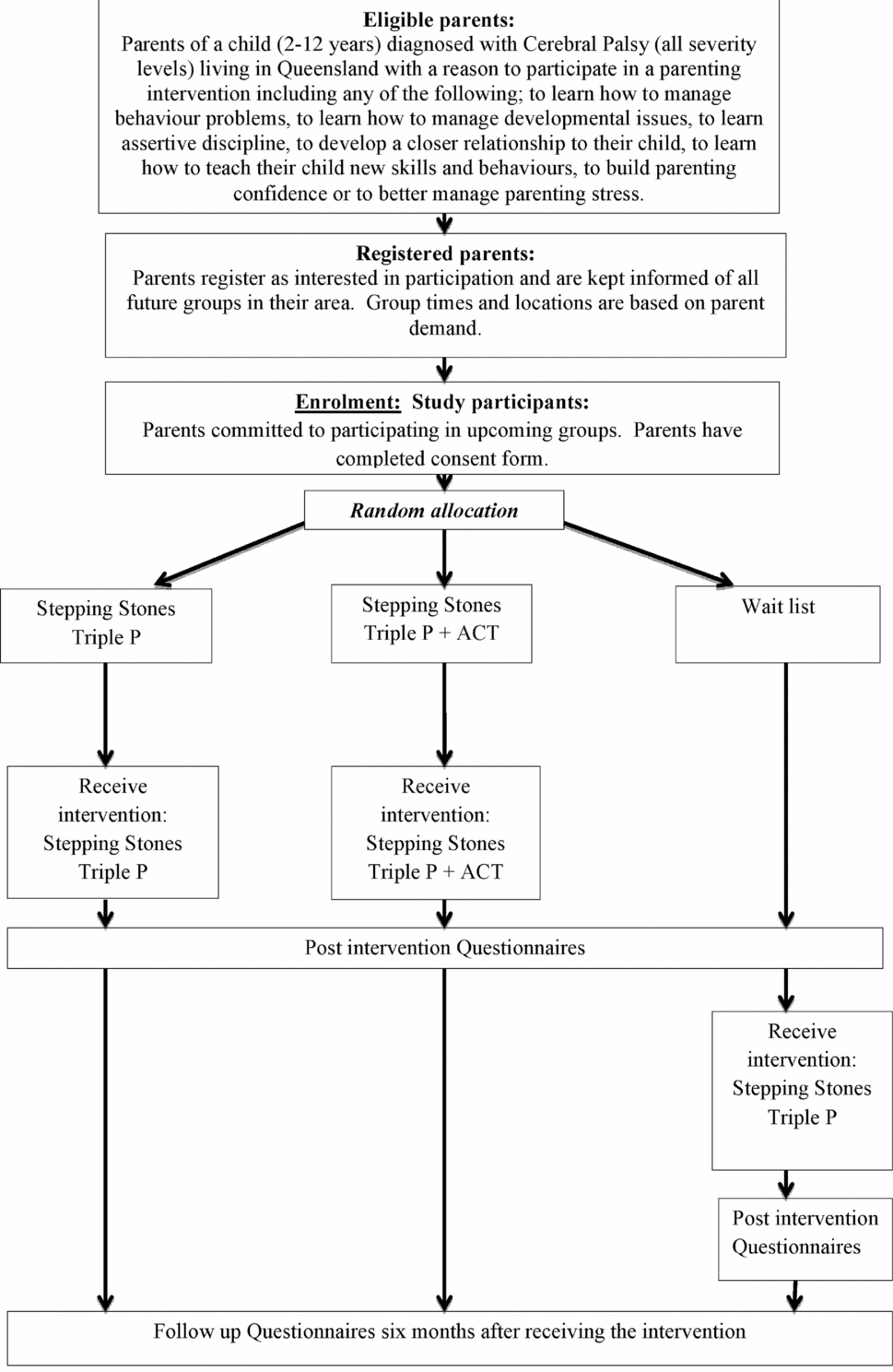
The efficacy of SSTP and the additive benefit of ACT will be tested in a randomised controlled trial (N = 110) with two intervention groups (SSTP and SSTP + ACT) compared to a wait-list control group receiving standard care (parenting interventions are not a current part of standard care). This enables all participating families to receive the intervention in a timely manner, maximising participant recruitment and retention and fulfilling ethical obligations to participating families. Outcomes will be assessed immediately post-intervention and at 6-month follow up. The experiential design as a Consolidated Standards of Reporting Trials (CONSORT) flowchart is depicted in Figure 1.
The experimental design.

Ethics
Ethical clearance has been obtained from the Queensland Children's Health Services Human Research Ethics Committee (HREC/09/QRCH/125), the University of Queensland Behavioural and Social Sciences Ethical Review Committee (2009001871) and the Cerebral Palsy League Research Ethics Committee (CPLQ-2010/11/1033).
Participants
Selection Criteria
Participants are parents of children (aged between 2 and 12 years at point of recruitment) with a diagnosis of CP (all severity levels). ‘Parents’ includes anyone who has adopted a long-term parenting role, including biological parents, step- and adoptive parents, or foster parents. Families where the parental role is only temporary (e.g., short-term foster placements) are excluded. In addition, families where the CP diagnosis is still being sought are excluded until the diagnosis is confirmed. Children with diagnoses additional to CP are still considered as meeting the inclusion criteria, as such children are a genuine part of the CP population. Parents must self-identify as having the potential to benefit from a parenting intervention. Any of the following are considered good reasons to participate in a parenting intervention: (1) to learn how to manage behaviour problems, (2) to learn how to manage developmental issues, (3) to learn assertive discipline, (4) to develop a closer relationship to their child, (5) to learn how to teach their child new skills and behaviours, (6) to build parenting confidence, or (7) to better manage parenting stress.
Sample Size
Sample size calculations were based on the primary child outcome of child behaviour. An effect size of .25 was assumed because it is consistent with a clinically important difference of .5 SD and is comparable to the effect size for SSTP obtained with families of children with ASD, η2 = .27 (Whittingham et al., Reference Whittingham, Sofronoff, Sheffield and Sanders2009). This leads, for a multivariate analysis, to a total sample size of 98 (power .8, two-tailed, p = .05). If a retention rate of 90% is assumed, this leads to a total of 110 families to be recruited.
Recruitment
Recruitment will draw upon the databases of the Queensland Cerebral Palsy and Rehabilitation Research Centre (QCPRRC), the Cerebral Palsy League and the Queensland Cerebral Palsy Register. All parents of a child aged between 2 and 12 years of age with a diagnosis of CP listed on one of the three databases listed above will be mailed a study flyer and invited to register their interest in participating. In addition, information on the study will be placed in the waiting room at the Queensland Cerebral Palsy Health Service at the Royal Children's Hospital to allow parents to self-refer and referrals will be accepted from clinicians working within the Cerebral Palsy Health Service. Parents can register their interest in the study by phone, email or on the study website. Interested parents will be assessed for eligibility and enrolled in the study by the study coordinator. Interested parents will be kept informed about upcoming groups in their area and their preference for group times and locations will be taken into account in planning the upcoming groups.
Randomisation
Once an interested parent has committed to participation in an upcoming group and has consented to study participation they are enrolled in the study as a participant. Each study participant is randomised to one of three groups; SSTP, SSTP + ACT and wait-list control.
The randomisation process was completed by computerised sequence generation with block randomisation to ensure equal (or near equal) allocation of participants to groups. The individual treatment allocations were recorded on pieces of paper and placed inside sealed, opaque and numbered enveloped by a staff member not involved in the study. Envelopes will be opened by the study coordinator in order as each participant enrols in the study.
Intervention Content and Delivery
Format
The interventions will be delivered in a group format (3–10 families per group). In two-parent families, both parents will be welcome to attend the intervention sessions. However, only one parent is required.
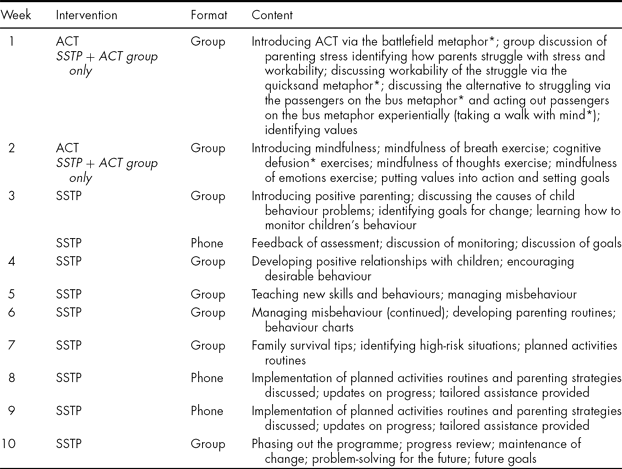
Parents allocated to receive the ACT stress management intervention will receive two (2 h) group sessions of ACT before beginning SSTP. SSTP will consist of six (2 h) group sessions plus three (30 min) telephone consultations. Additional telephone consultations may be offered for an individual family if necessary or desired. One format change in the SSTP delivery from the manual (Sanders, Mazzucchelli, & Studman, Reference Sanders, Mazzucchelli and Studman2009) is that parents in this study are offered their first phone consultation (focusing on feedback of assessment data and checking on monitoring) after the first group session. This means that parents will receive both a group session and a short phone consultation in that week. Giving the phone consultation focusing on feedback of assessment data and monitoring at this time allows the therapist to ensure that the parent is monitoring correctly and for the parent to receive feedback early on in the programme. If families miss individual sessions due to family circumstances or illness, every effort will be made to schedule a make-up session with that family.
This standard intervention format of weekly sessions may be modified to a weekend workshop format to allow for intervention delivery as an outreach programme in locations such as Cairns and Townsville if there is sufficient parent demand. In the case of weekend workshop format, the group sessions will be run back to back over a full weekend with four (30 min) telephone consultations in the weeks after the workshop.
Location and Timing
The location and timing of the groups will be determined by parent demand. This will include running groups across Queensland in locations such as Sunshine Coast, Gold Coast, Cairns or Townsville.
Therapists
All therapists delivering the intervention are psychologists or provisionally registered psychologists with accreditation in SSTP. The majority of the intervention sessions are being delivered by the study coordinator (first author) who is accredited in SSTP and registered as a clinical and developmental psychologist. Intervention delivery by persons other than the study coordinator will be supervised by the study coordinator to ensure consistency of approach. All therapists will complete intervention protocol checklists after every session which will be examined to ascertain treatment fidelity.
Intervention Content
Acceptance and Commitment Therapy stress management for parents
Acceptance and Commitment Therapy (ACT) is a new cognitive behavioural intervention model that incorporates mindfulness (psychological contact with the present moment) and acceptance (of emotional and cognitive responses) (Hayes et al., Reference Hayes, Strosal and Wilson2003). The goal of ACT is to increase psychological flexibility. The ACT-based parenting stress intervention for parents of children with disabilities was developed (Whittingham, Sheffield, & Sofronoff, Reference Whittingham, Sheffield and Sofronoff2010) drawing upon metaphors and exercises within Hayes et al. (Reference Hayes, Strosal and Wilson2003). In the first session, ACT is introduced as a novel approach to stress, the workability of struggling with stress is discussed and an alternative to struggling with stress is introduced. In doing so, the following ACT metaphors/exercises are used; battlefield metaphor, quicksand metaphor, passengers on the bus metaphor, taking a walk with mind exercise. In addition, the first ACT session introduces the concept of values (long-term desired qualities of life, e.g., being a loving parent). In the second ACT session the concept of mindfulness (non-judgmental awareness of the present moment) is introduced and the parents are guided in mindfulness of breathing, mindfulness of thoughts and mindfulness of emotions exercises. Cognitive defusion exercises (exercises to create distance from one's thoughts) are also introduced, for example, saying the thought in the voice of a cartoon character. The second session ends with creating goals for acting on values, particularly in the area of parenting.
Stepping Stones Triple P
Stepping Stones Triple P (SSTP) is an adapted variant of the parenting intervention Triple P (Positive Parenting Program) that targets families of children with disabilities (Sanders et al., Reference Sanders, Mazzucchelli and Studman2009). SSTP incorporates both standard Triple P parenting strategies, such as descriptive praise and planned ignoring, and additional strategies arising from the disabilities literature, developed especially for this population (Sanders, Mazzucchelli, & Studman, Reference Sanders, Mazzucchelli and Studman2004). This includes strategies focusing upon skill acquisition, such as teaching the child to communicate what they want. As in standard Triple P, the parent sets specific goals for change and the therapist assists the parent in meeting these goals within the context of the programme. A summary of the content of the interventions, session by session, is provided in Table 1.
Summary of the Intervention Format and Content
*Details of metaphors and cognitive defusion techniques can be found in Hayes et al. (Reference Hayes, Strosal and Wilson2003).
Assessment
The unit of analysis is the family and thus only one parent per family is required to complete the questionnaires. If only one parent is participating in the intervention, then that parent will complete the questionnaires. If both parents are participating in the intervention, then we advise the primary caregiver to complete the questionnaires. In addition, the family is advised that the same parent should complete the questionnaires at every assessment point. Parents are able to complete all of the questionnaires online using a unique study ID as a password or to complete written versions if that is preferable.
Assessment of Sample Characteristics
Family Background Questionnaire
A measure of family factors and demographic variables such as socio-economic status (SES), parental education, diagnoses and family's use of health services (Sanders et al., Reference Sanders, Mazzucchelli and Studman2009).
The Gross Motor Function Classification System (GMFCS)
A five-level system to classify children into their age-specific gross motor ability (Palisano, Reference Palisano1997). It is valid and reliable and frequently used to classify functional abilities of children with physical disability. Within this study the parent-report version was used.
Outcome Measures
Eyberg Child Behaviour Inventory (ECBI; Eyberg & Pincus, Reference Eyberg and Pincus1999)
This is a 36-item parent-report measure of child behaviour. Two scale scores are computed for the ECBI: (1) the intensity score (α = .95), a measure of the frequency of problem behaviours (range 36–252); and (2) the problem score (α = .94), a measure of the number of problem behaviours (range 0–36). Scores of 131 or greater on the intensity scale and 15 or greater on the problem scale are considered to be in the clinical range. The intensity and the problem scales both have good test–retest reliability (r = .88 and .86 respectively) (Robinson, Eyberg, & Ross, Reference Robinson, Eyberg and Ross1980) and the ECBI has good discriminant and concurrent validity (Boggs, Eyberg, & Reynolds, Reference Boggs, Eyberg and Reynolds1990; Eyberg & Ross, Reference Eyberg and Ross1978). The ECBI is sensitive to changes during SSTP (Whittingham et al., Reference Whittingham, Sofronoff, Sheffield and Sanders2009).
Strengths and Difficulties Questionnaire (SDQ; Goodman, Reference Goodman1997)
A 25-item parent-report measure of child behaviour and adjustment in which the frequency of behaviours is rated on a three-point Likert scale. The SDQ produces five subscales: emotional symptoms, conduct problems, inattention/hyperactivity, peer problems and prosocial behaviour (each ranging from 0 to 10). In addition it produces a total difficulties score (ranging from 0 to 40) which has been found to have adequate internal reliability (α = .76) and test–retest reliability (r = .86) as well as discriminant and concurrent validity (Goodman & Scott, Reference Goodman and Scott1999). The SDQ is widely used in CP research (Parkes et al., Reference Parkes, White-Koning, O'Dickinson, Thyen, Arnaud, Beckung and Colver2008, Reference Parkes, White-Koning, McCullough and Colver2009b).
Pediatric Evaluation of Disability Inventory (PEDI; Haley, Coster, Ludlow, Haltiwanger, & Andrellos, Reference Haley, Coster, Ludlow, Haltiwanger and Andrellos1992)
This is a 227-item measure of functional capability and performance across domains of self-care, mobility and social function, with good validity and reliability. For each item the respondent answers whether the child is or is not capable of performing the task.
CP QOL-Child (Waters et al., Reference Waters, Davies, Mackinnon, Boyd, Graham, Kai Lo and Reddihough2007)
A 66-item parent-report measure of child quality of life that is specifically developed for measuring quality of life in children with CP. The CP QOL measures quality of life across several aspects of the child's life, including physical wellbeing, social wellbeing, emotional wellbeing, school, service access and social acceptance. It has good concurrent validity, internal consistency (α = .76–.89) and test–retest reliability (r = .80–.90).
Parenting Scale (Arnold, O'Leary, Wolff, & Acker, Reference Arnold, O'Leary, Wolff and Acker1993)
A 30-item measure of three dysfunctional discipline styles in parents: (1) laxness (α = .83); (2) over-reactivity (α = .82); and (3) verbosity (α = .63). Parents rate each item on a seven-point Likert scale. Overall reliability is strong (α = .84) with strong discriminant validity between parents of clinic/non-clinic children.
Cerebral Palsy Daily Parenting Tasks Checklist
This is a 21-item parent-report questionnaire developed specifically for this project in preliminary research in which parents rate health- and disability-related parenting tasks on two five-point Likert scales for confidence and for how problematic the task is (Whittingham et al., Reference Whittingham, Wee, Sanders and Boyd2011b). It produces two scales; the confidence scale measures parental confidence in performing specific daily parenting tasks relating to child health and disability (e.g., keeping medical appointments, ensuring child compliance with therapy exercises) and the problems scale measures how problematic those parenting tasks are for the parent.
Depression Anxiety Stress Scale (DASS; Lovibond & Lovibond, Reference Lovibond and Lovibond1995)
A 42-item questionnaire that assesses symptoms of depression, anxiety and stress in adults. Respondents rate items on a four-point Likert scale reflecting how much the statement applied to them in the past week. The DASS produces three subscales, each with good internal consistency; the depression (α = .91), anxiety (α = .84) and stress (α = .90) scales. The DASS also has good discriminant and concurrent validity (Brown, Chorpita, Korotitsch, & Barlow, Reference Brown, Chorpita, Korotitsch and Barlow1997; Lovibond & Lovibond, Reference Lovibond and Lovibond1995).
The Parent Beliefs about Negative Emotions Questionnaire (PBANE; Halberstadt, Dunsmore, McElwain, Eaton, & McCool, Reference Halberstadt, Dunsmore, McElwain, Eaton and McCool2001; Halberstadt, Thompson, Parker, & Dunsmore, Reference Halberstadt, Thompson, Parker and Dunsmore2008)
A questionnaire that assesses parental attitudes towards children's emotions. In this study the emotions are dangerous and the negative emotions are valuable subscales were used, producing a measure with a total of 25 items. It has been shown to have good concurrent validity and internal consistency (α = .80–.90).
Acceptance and Action Questionnaire (AAQ), Child Disability Version
This is an 18-item questionnaire that assesses psychological flexibility around parenting of children with disabilities. It is an adaptation of the Acceptance and Action Questionnaire (AAQ) (Hayes et al., Reference Hayes, Strosal and Wilson2003) which has been shown to have good concurrent validity and adequate test–retest reliability (r = .64). It requires parents to rate the truth of each statement as it applies to them on a seven-point Likert scale.
Observational Task
Where possible, parents will also be asked to participate in a 20-minute observation of parent–child interaction before and after receiving Stepping Stones Triple P. If the parents are unable or unwilling to participate in the observation, but are still willing to complete the questionnaires, then they are still able to participate in the project. The observation involves a number of tasks, including parent and child free play, parent managing interruptions while engaging in a 5-minute discussion with the therapist, and two compliance tasks. The first compliance task involves the parent instructing the child to complete a standardised boring task based on the cancellation teddy bears task. The second compliance task involves the parent instructing the child to tidy up the play room. Coding for the observations will be based on Family Observation Schedule Revised III (FOS; Sanders & Christensen, Reference Sanders and Christensen1985; Sanders, Waugh, Tully, & Hynes, Reference Sanders, Waugh, Tully and Hynes1996) in which parent and child behaviour are coded in 10-second time intervals. The FOS has demonstrated reliability and validity and is sensitive to the effects of intervention.
Analysis
Analysis will follow standard methods for randomised controlled trials using comparisons between the three groups (SSTP, SSTP + ACT and wait-list control). The protocol of intention-to-treat analysis will be followed in order to minimise inflation of treatment effects consistent with CONSORT guidelines. The experimental unit will be the family. Attrition analysis will be conducted. Data will be analysed using SPSS. The hypotheses relating to intervention efficacy will be tested using general linear models. In addition, predictors of treatment outcome will be explored using regression analyses. Where continuous data exhibit substantial skewness not overcome by transformation, non-parametric methods will be used for simple comparisons.
Discussion
This project, registered with the Australian New Zealand Clinical Trials Registry (trial ID number ACTRN12611000003976), aims to optimise outcomes for children with cerebral palsy (CP) and their families by testing the efficacy of two complementary interventions novel to the CP population: (1) parenting intervention (Stepping Stones Triple P, SSTP); and (2) stress management tailored for parents of children with CP (Acceptance and Commitment Therapy, ACT). To the authors’ knowledge this is the first randomized controlled trial (RCT) of a parenting intervention for parents of children with CP, as well as the first RCT to test the additive benefits of ACT to an existing parenting intervention. Recruitment began in 2010 and recruitment and intervention delivery were completed in December 2012 with a total of 67 participants proceeding to random assignment. Data collection (follow-up data) is now completed.
Acknowledgements
This work was supported by a National Health and Medical Research Council postdoctoral fellowship (K.W., grant number 631712); a National Health and Medical Research Council Career Development Fellowship (R.B., grant number 473840) and a Smart State Fellowship (R.B).
Declaration of Interest
None.