Uncertainty surrounding the frequency and scale of disasters makes planning for them extremely challenging. Emergency managers and others engaged in disaster preparedness activities face the daunting challenge of convincing executives and policy leaders to expend resources preparing for potentially high-consequence, but frequently low-probability, events. This challenge is further compounded in the United States health care sector where a more collaborative population-based model required for effective disaster preparedness is often at odds with competitive individual market models of health care provision.Reference Pines, Pinlkington and Seabury 1 , Reference Errett, Frattaroli and Resnick 2
To achieve short-term cost savings and to protect diminishing revenue margins, hospitals and health systems may decide to forego comprehensive investment in disaster preparedness activities. The federal government has implemented various mechanisms that support health care preparedness and protect the critical health care infrastructure. For example, the US Department of Health and Human Services (HHS) Assistant Secretary for Preparedness and Response (ASPR) administers the Hospital Preparedness Program (HPP), a cooperative agreement that provides funds for health care and hospital disaster preparedness activities. These cooperative agreements are designed to develop 8 capabilities deemed essential to health care system resilience by HHS/ASPR standards: (1) health care system preparedness, (2) health care system recovery, (3) emergency operations coordination, (4) fatality management, (5) information sharing, (6) medical surge management, (7) responder safety and health, and (8) volunteer management. 3
The HPP recently required cooperative agreement recipients to develop and sustain regional health care coalitions in an effort to build locally based communities of support for disaster preparedness activities. The ASPR defines health care coalitions as “formal collaboration among health care organizations and public and private sector partners...organized to prepare for and respond to an emergency, mass casualty or catastrophic health event.” 3 Health care coalitions vary from region to region but can include a wide variety of stakeholders, including hospitals, community health centers, health departments, emergency management agencies, emergency medical services, and other types of health care organizations.Reference Courtney, Toner and Waldhorn 4 , Reference Walsh, Craddock and Gulley 5
HPP funding has decreased dramatically in the past 10 years. This is despite recurrent calls for increased health care system disaster preparedness following significant failures of critical health care infrastructure and management during and after major disaster events such as Hurricanes Katrina and Sandy. One possible reason for the disconnect between the stated need for sustained preparedness funding and decisions by federal, state, and local appropriators and private-sector leaders to decrease or not invest in preparedness activities is the difficulty in articulating a clear return on investment of preparedness funds compared to other competing funding priorities.
To assist in understanding total return on investment from HPP funding, we divide that return into 2 categories: direct and indirect. Direct benefits of HPP are defined as those disaster-related outcomes anticipated as a result of grant funding. These include patient outcomes such as reduction in mortality and morbidity or systematic outcomes such as sustainment of services or operational efficiency from care coordination. HPP uses program measures and health care coalition development assessment factors as surrogate measures of the direct benefits of preparedness funding. 3
Grant recipients and emergency managers have historically maintained that health care preparedness grant funding from HPP and other federal sources has significant value and confers benefits above and beyond the direct outcomes and surrogate measures developed by the federal government.Reference Walsh, Craddock and Gulley 5 , Reference Hanfling 6 These are the indirect benefits of grant funding.
There has been no systematic effort to identify indirect benefits of federal emergency preparedness grant funding on day-to-day health care operations nor to determine their economic value. By focusing only on direct benefits, the true value of grant-funded preparedness activities is likely underestimated. The purpose of this study was to identify the indirect benefits of health care preparedness funding as perceived by current or former recipients of ASPR HPP funding. A greater understanding of the indirect benefits will provide the necessary foundation for future quantification of benefits by use of economic valuation methods.
Methods
Design
The 62 HPP awardees are the public health departments of all 50 states; Washington, DC; Chicago; Los Angeles County; New York City; and all US territories and freely associated states. HPP funds awardees that in turn fund health care coalitions. The 62 HPP awardees have 496 health care coalitions total. This was a qualitative inductive content analysis of telephone interviews conducted with 14 representatives from 13 health care coalitions to identify their perceptions of indirect benefits of preparedness funding. Inductive content analysis is a useful tool for developing a condensed and broad view of a phenomenon, particularly when there are no previous studies exploring the phenomenon.Reference Elo and Kyngäs 7
Procedure
After approval from the Institutional Review Board, participants who were members and stakeholders of mature health care coalitions, and recipients of ASPR HPP funding, were recruited by e-mail invitations. An initial list of potential interview subjects was created from the authors’ networks of health care emergency preparedness coalition leaders and in consultation with state public health officials. Additionally, federal HPP field project officers announced the study in regional meetings of HPP awardees and referred interested persons to the authors. Snowball sampling techniques were also used, whereby participants were asked to identify colleagues who might be interested in participating in the study.
All potential participants were screened for eligibility, and none were excluded. Inclusion criteria were (1) an individual within an organization who was a recipient of federal health care preparedness funding or (2) an organizational representative or consultant to a health care coalition who received federal health care preparedness funding.
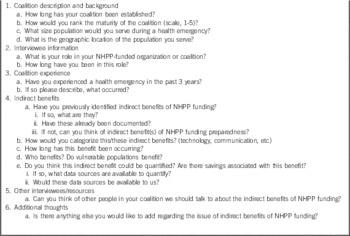
Each participant was interviewed once and with the participation of at least 2 investigators. All interviews were audio-recorded and subsequently transcribed to facilitate analysis. A standard format was used for all calls following a semi-structured interview guide. Interviews began with introductions and documentation of informed consent, followed by a scripted narrative explaining the concepts of direct versus indirect benefits from HPP funding. Next, the participants were asked questions to obtain contextual information: (1) coalition description and background, (2) participant background information, and (3) coalition emergency response experience. Finally, the participants were asked open-ended questions from the interview guide to elicit their perceptions of the indirect benefits resulting from federal health care preparedness funding. For more detailed information about the semi-structured interview guide, see Table 1.

As the study progressed, transcriptions were reviewed for accuracy and initial coding. Transcriptions averaged 30 minutes in length. Recruitment continued until data saturation was reached, meaning no new information was identified.Reference Sandelowski 8
Data Analysis
Using an inductive content analysis approach adapted from Elo and Kyngas,Reference Elo and Kyngäs 7 we analyzed the transcripts for participants’ perceptions of indirect benefits of federal health care preparedness funding. Phrases and sentences, rather than single words, were considered the units of analysis because they were more representative of the concepts of interest. Iteratively, data were then condensed into categories and subcategories with similar meaning as follows.
Independently, transcripts were reviewed by each of the 2 investigators (CP, BS), who were content experts, to gain a broad understanding of the data. Then the 2 team investigators independently developed subcategories and then categories from the initial concepts. Results were compared and contrasted, and the process was repeated iteratively, until final agreement was reached. Labels and exemplars from the data were used to support face validity. Frequency counts were performed to more fully describe the findings. For reliability, a qualitative methods expert (SM) also reviewed the concepts, subcategories, and categories and served as a third and independent reviewer. The final categories and subcategories were determined to represent the perceptions of the participants about the indirect benefits of health care preparedness funding.
Results
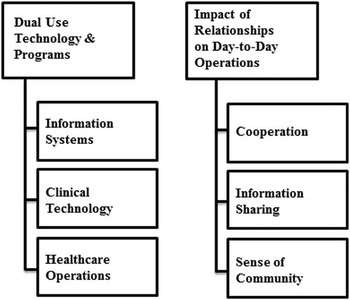
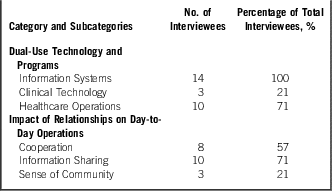
Figure 1 provides a representation of the study findings. Content analysis of coalition interviewee responses resulted in 2 main categories of indirect benefits of federal health care preparedness funding: (1) dual-use technology and programs and (2) impact of relationships on day-to-day operations. Within the dual-use technology and programs category, 3 subcategories were identified: (1) information systems, (2) clinical technology, and (3) health care operations. Similarly, 3 subcategories relating to the indirect benefits in impact of relationships on day-to-day operations category were identified: (1) cooperation, (2) information sharing, and (3) sense of community. Table 2 provides a frequency distribution of these findings by interviewees.
Categories and Subcategories of Indirect Benefits of Preparedness Funding.

Distribution of Categories and Subcategories of Indirect Benefits of Preparedness Funding

Dual-Use Technology and Programs
The first main category, dual-use technology and programs, refers to the acquisition of a resource, or the development of a program or service line, for the purpose of any preparedness activity and the subsequent use of that resource or program for activities other than the original intended purpose. Respondents reported many instances of technology or other acquisitions being used for a wide range of day-to-day functions in the health care environment.
Information Systems
Virtually all interviewees cited examples of how communications technology purchased by using federal disaster preparedness grant funds, such as computer networks or radio communications systems, were also used during planned events or other nondisaster interruptions in daily health care operations. Examples included planned public mass gathering events such as marathons, major health care infrastructure upgrades (eg, moving a hospital or installing new elevators), and routine emergency medical services activities requiring coordination.
Examples of using information system technology during routine health care operations included the daily use of computerized hospital emergency department diversion management systems, the use of computer databases and directories to facilitate person-finding and collaboration around nondisaster matters, leveraging inventory management software to track nondisaster supplies, the electronic facilitation of resource requests during normal business operations among coalition partners, and the provision of situational awareness among coalition members through dashboards and other computer systems.
One interviewee described how a web-based resource and asset tracking program purchased through federal grant funds and designed to provide situational awareness about hospital capacity during a disaster was adapted for nonemergency use to track the status of a range of hospital services. The system was used daily by the hospitals and the county emergency medical services agency to monitor the diversion status of emergency departments in the region, a dual-use approach cited by many interviewees. The system was also modified to track nonemergency services that impacted the entire region, including the availability of sexual assault nurse examiners (SANEs) at each area hospital.
“There is a [SANE] service [at our major hospitals]…and because those examinations take up to about 4 hours and there’s usually only one [SANE] in each emergency department, they’ll turn that service on and off [in our computer system] to basically allow pre-hospital providers and [police department] personnel to know whether an exam is taking place, whether or not they’re open for an examination.…Pre-hospital and police providers use to ascertain whether a particular service is available at a hospital.”
Another interviewee stated that “our emergency management Internet information-sharing system was designed to be used for alert notification and information sharing during a disaster. That disaster designed system now is used, on a near weekly basis, to deal with non-disaster needs and to share information.”
At least 2 interviewees stated that they used computerized weather programs purchased with federal funds and designed to help track and predict severe weather on a daily basis to help aeromedical evacuation programs determine whether they would be able to fly.
The use of computerized information systems designed for disaster preparedness for daily health care operations also extends to health care provider education. One interviewee described using a learning management system purchased by federal funds to improve access to disaster education to provide routine health care provider education to over 40,000 health care workers widely dispersed throughout the state.
Another frequently cited example of dual-use information system technology is the daily use of 800-MHz radio communication systems originally purchased for use during disasters. Hospitals and coalitions cited the near daily use of these communication systems for a range of activities. Given the significant cost of these radio systems, and their importance in a range of public safety activities, this dual use likely represents a highly valuable indirect benefit of federal funding.
“HPP allowed us to create radio communications between our facilities….we’ve built an 800 MHz digital communication system… and the devices and technology are partially HPP funded and are used to communicate with ambulances and hospitals on a day-to-day basis…about things that are not always associated with disasters or emergencies. We leverage them to improve communication on behalf of our communities.”
Clinical Technology
Several interviewees described how coalitions and hospitals utilized clinical care technology purchased for disaster response to provide patient care services. Such dual use provided the benefit of allowing health care providers to utilize the devices and become familiar with their operation before any emergency event. In one case, the federal preparedness funding allowed an emergency department to experiment with new treatment modalities.
“[We] bought the first point-of-care test devices and the first miniature ultrasounds for use in an emergency department under grant funding…and essentially this led to the formal adoption of policies, both the laboratory as well as the department of radiology to allow those tools and devices to be used in the emergency department. So, you know that’s a fairly dramatic but important example of how the application of grant funds actually allowed us to improve [health care].”
Another coalition used telemedicine equipment purchased in part with federal preparedness funds and specifically designed to provide remote medical expertise to rural areas in the event that trauma systems degraded after a disaster to improve the pediatric care.
Health Care Operations
Dual-use indirect benefits under the health care operations subcategory include a range of activities that impact operational aspects of hospitals and health care systems. Several interviewees reported cycling grant-funded resource caches (containing items such as durable medical equipment or intravenous solutions) through routine use in hospitals in order to avoid expiration of items, and replacing these items with newer products purchased by the coalition or hospitals. Interviewees indicated that this rotation system not only prevented expiration of critical items, but provided an opportunity to mitigate against normal shortages in specific products.
“About a year ago, there was a fairly significant shortage of an IV fluid…some hospitals were actually having a difficult time getting IV fluid that they needed. We were able to leverage the disaster cache collaboratively to supply a hospital or two or three…so…our assets could help to offset the impact of that service.”
Several interviewees described examples of equipment purchases and large infrastructure projects that were partially funded by preparedness grants and used to bolster health care operations. One interviewee stated that a portable air flow machine that could turn a positive pressure environment into a negative pressure environment (originally purchased to ensure that space could rapidly be made available to care for highly infectious patients in a pandemic) was used on a routine basis to “protect patients, staff and visitors from the effects of construction.” According to the interviewee, as a result of the investment in the air handling system, “today we’ve got systems down where we can close the door of a room and cover supply and return, and we can tear up carpet, again non-disaster model, without exposing the surrounding people to the dust and such that it creates.”
Impact of Relationships on Day-to-Day Operations
The second main indirect benefit category identified was the value and impact of relationship-building and sustainment on daily health care operations resulting from personal and system-level interaction during coalition preparedness activities. Interviewees reported that preparedness funding enabled opportunities for day-to-day communication and relationship building that would have otherwise never occurred. These relationships have multiple downstream impacts and spillover effects for nonpreparedness activities. The importance of relationships in daily operations, and the role of the health care coalition in building and sustaining them, was a nearly universal theme resulting from our interviews. As one interviewee stated, “there is something powerful about the convening role of health care coalitions…to work together and trust each other [just by] virtue of having been spending time together.”
Cooperation
Many interviewees highlighted cooperation among health care providers through the coalition as an important indirect benefit resulting from relationship building and sustainment. Cooperation in disaster preparedness and response makes intuitive sense, as disaster events have the potential to impact an entire community and few organizations are individually capable of managing all aspects of a response. However, in the context of the US health care industry, where competition can be fierce and system thinking between and among competitors is rare, cooperation is often elusive.
Cooperation among constituent members of a health care coalition also provides a leveling effect, where “by being part of a coalition, the voice of the coalition was louder and stronger than any of the individual voices in the individual health systems.”
Several interviewees suggested that cooperation among health care industry competitors around disaster preparedness through federally funded coalition activities had led to a culture of cooperation around other daily activities. One interviewee stated, “I moved from a community where…health care executives, you couldn’t get them in the same room together. Here it’s much different and they’ve coalesced around preparedness, they’ve coalesced around quality and safety, coalesced around some sort of data management things.” In one example of how cooperation led to additional partnering opportunities, one interviewee stated:
“There’s the actual mere fact of being in a coalition that sparks other opportunities to collaborate outside of preparedness…Senior executives [on my board] from those [health systems in the coalition]… would meet every month at the [coalition] board meetings and they started getting coffee after the board meetings and talking, and that grew into them actually going to do a merger.”
Information Sharing
A frequently reported significant downstream outcome of relationships in coalitions’ day-to-day operations was the resulting trust from the sharing of information. The information sharing subcategory includes a range of activities such as sharing of tactical health care “intelligence,” providing routine announcements such as notification of upcoming events, and disclosing more strategic information in order to benchmark performance among coalition members. Although occasionally information sharing was accomplished through the information systems described under the dual-use technology category, interviewees were clear that the process of information sharing was ultimately facilitated by relationships.
The importance of information sharing among coalition constituents has broad implications for patient safety. In the United States, health care is frequently fragmented and communication between systems to create “systems of systems” is seen as highly valued. One interviewee stated that due to the coalition, “[we have the ability] to pick up the phone—and know the phone number—of our counterparts at other hospitals. I think [communicating] normal [emergency department] diversion of patients is probably the easiest example [of how] we can let our counterparts know that something may impact them.”
Several interviewees described how health care “intelligence” was collected on a daily basis and shared among coalition members, leading to greater community situational awareness and the ability to better respond to patient needs. The value of such information sharing to coalition members, according to one interviewee was “in the opportunities we create for them to have connection to information that they might not otherwise as easily have their hands on, as well as the ability to tap into resource-sharing across organizations.”
Coalition members frequently exchange “best practices” for dealing with emergency issues and other operational matters. In a prototypical example, one interviewee described how a fellow executive from another health system experiencing a simple water leak called him to ask about how they handled a similar event years earlier. The hospitals then connected their engineers to share best practices to resolve the leak. Reinforcing the value of relationships to this process, the interviewee stated, “if you don’t know that person from spending time together you never make that call and you try to figure it out yourself.”
Some information sharing is intentionally strategic, such as a program of results benchmarking established by a large coalition to improve day-to-day health care operations. A coalition member interviewed stated that “[we used] benchmarking data points…[to] track response rates, compliance rates, and response time. We would allow our facilities to benchmark with each other on those. But I could see it going to something that’s far more inclusive…to make the data anonymous so that you could benchmark your scores [on other sort of measures] …there would be a ton of benefit to that.”
A Sense of Community
The process of cooperating and sharing information among coalition partners creates a strong sense of community and common purpose among the members. Interviewees stated that this sense of community provides motivation to continue the partnership and grow and develop programs and initiatives. The sense of community also propels members to help each succeed in preparedness goals. In this way, community is a catalyst of several critical coalition functions. This is consistent with findings from Walsh and colleagues,Reference Walsh, Craddock and Gulley 5 who discovered that “the most commonly shared value-add of [health care coalitions] was community and regional partnership-building.”
This analysis suggests that coalition leaders who focus on community building are likely to find success in all aspects of daily coalition activities. According to one interviewee, “what’s sustaining us is the common fear or common interest and the common sense of purpose.”
Discussion
This study identified indirect benefits of federal investment in hospital and health care preparedness in 2 major categories: (1) dual-use technology and programs and (2) impact of relationship on day-to-day operations. The analysis found that coalition members place a high value on these benefits as they apply to daily health care operations. Indeed, some interviewees suggested that indirect benefits resulting from federal investments were more valuable than the outcomes the grant programs were designed to achieve.
A significant finding of this analysis is that coalition members throughout the United States have leveraged federal direct investment in health care disaster preparedness to support processes and structures that improve daily health care operations, bolstering the resiliency of these systems while simultaneously improving human health.
The emphasis on relationship building and sustainment is also notable. Responses from interviewees suggest that health care coalitions may effectuate their missions in part by using networks of relationships to achieve preparedness and response objectives in highly complex health care systems. Coalitions are leveraging these relationships to share information and build learning organizations that promote resilience through networked knowledge. This resilience-building process is not only cost-effective, it is self-reinforcing. The more the constituent members share information, the more value they find in the process, leading to more information sharing in the future, leading to improved resilience.
The indirect benefits of federal grant programs identified in this analysis have not been considered in the overall measurement of the impact of health care coalitions or the grant funding used to develop them. The results of this study suggest that the valuation of total return on investment from HPP funding should take into account both direct and indirect benefits.
Further research is needed to quantify the economic value of these indirect benefits. The method used for quantifying indirect benefits will depend on a multitude of factors including the benefit itself, information regarding resources used, and data availability. The benefits identified in this study are mostly difficult to evaluate and will require modeling or surveys. One possible method to value these indirect benefits is through the use of shadow pricing. Shadow pricing is a method to assign monetary values to unknowable or difficult-to-measure benefits.Reference Freeman, Myrick, Herriges and Kling 9 A shadow price can be used to measure the opportunity cost of a preparedness activity where opportunity cost is the difference between the value of the chosen investment and the value of the best alternative forgone. Opportunity cost represents the net indirect benefit of the investment in preparedness.Reference Stryckman, Grace, Schwarz and Marcozzi 10 Another method that could be used is contingent valuation. This method assigns monetary value to indirect benefits via surveys by establishing individual preferences and how much they are willing to pay for the indirect benefit. Contingent valuation is a shadow pricing technique that is used for a nonmarket resource or when health care resources usage information is not available. Preferences can be measured as stated or revealed. Stated preferences assign value based on given tradeoffs, whereby revealed preferences assign value based on actual behavior.Reference Carson 11
Limitations
In general, qualitative results are not necessarily generalizable and thus may not reflect the perceptions of the population of federal health care preparedness grantees.Reference Elo, Kääriäinen and Kanste 12 The perceptions of this relatively homogeneous sample may not fully reflect the experiences of all health care preparedness providers. Any quotes provided in the text were not intended as recommendations for future action but rather were provided as exemplars of the categories and subcategories.
Conclusions
This study identified indirect benefits of federal investment in hospital and health care preparedness. The major categories of these benefits were (1) dual-use technology and programs and (2) impact of relationships on day-to-day operations. The analysis found that coalition members place a high value on these benefits, even though they are not specific outcomes of grant programs. Further research is needed to quantify the economic value of these indirect benefits in order to more accurately measure the total return on investment from federal grant funding.
Acknowledgments
The research for the study was financially supported by the Indiana University School of Nursing and the Assistant Secretary for Preparedness and Response of the US Department of Health and Human Services. The authors acknowledge Dr. Susan McLennon, PhD, RN, Assistant Chair and Associate Professor at Indiana University School of Nursing, for her guidance and consultation regarding the qualitative methods used in this study.
Disclaimer
The findings and conclusions in this report are those of the authors and do not necessarily represent the view of Indiana University School of Medicine or the Department of Health and Human Services or its components.