INTRODUCTION
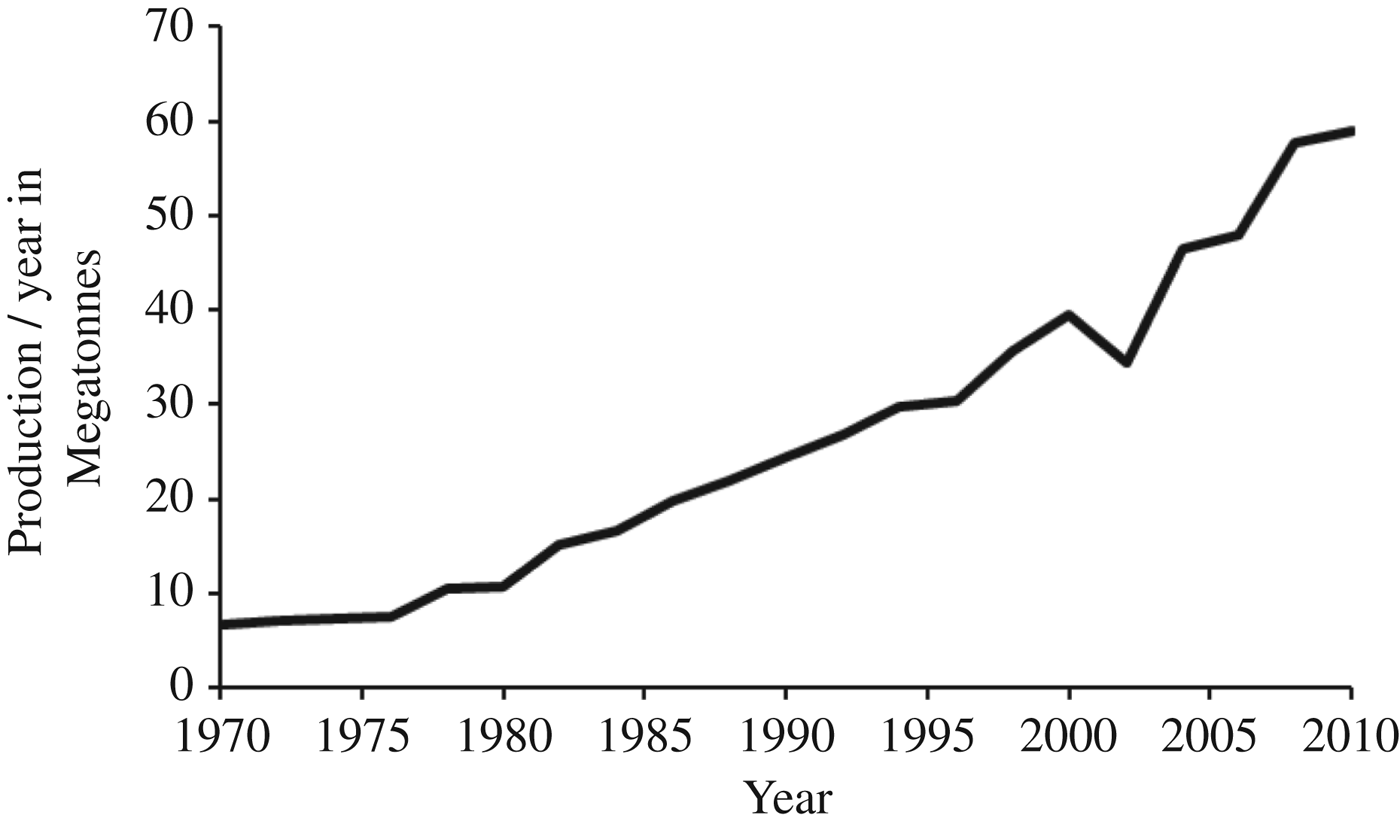
Winter oilseed rape (also referred to as rapeseed or canola) (Brassica napus L.) is one of the world's most important annual oil crop species and is used for human consumption, animal feed and biofuel production (FAO 2012). Production increased 8·8-fold worldwide from 1970 to 2010, with China being the largest producer followed by Canada (FAO 2012). One reason for this increase is the importance of winter oilseed rape as a renewable resource for biofuel production (Van der Velde et al. Reference Van der Velde, Bouraoui and Aloe2008).
Winter oilseed rape is a cross between Brassica campestris L. and Brassica oleracea L. (Cramer Reference Cramer1990). Oilseed rape is described as a self-pollinated species with similar yield after self- or cross-pollination (Williams et al. Reference Williams, Martin and White1986). Oilseed rape produces sticky pollen which remains adhered to the anthers even under strong wind conditions (Eisikowitch Reference Eisikowitch1981). The sticky pollen, the yellow colour and the bilateral symmetry of rapeseed flowers indicate adaptations for pollen dispersal by insects rather than by wind, although wind pollination is conceivable (Creswell et al. Reference Cresswell, Davies, Patrick, Russell, Pennel, Vicot and Lahoubi2004). The flower morphology and the mass flowering nature of the crop make rapeseed flowers an attractive pollen and nectar source for insects (Westcott & Nelson Reference Westcott and Nelson2001). Many studies have shown a higher rapeseed yield (usually measured as total seed weight per plant) when flowers were visited by insects compared with unvisited flowers (Kołtowski Reference Kołtowski2005; Sabbahi et al. Reference Sabbahi, De Oliveira and Marceau2005; Bommarco et al. Reference Bommarco, Marini and Vaissière2012; Jauker et al. Reference Jauker, Bondarenko, Becker and Steffan-Dewenter2012). However, Williams et al. (Reference Williams, Martin and White1986) did not find that insect pollination increased yield significantly. Similarly, other studies suggest that the resource allocation into fewer, heavier seeds under self-pollination compared with cross-pollination outbalances differences in the actual yield (Westcott & Nelson Reference Westcott and Nelson2001; Steffan-Dewenter Reference Steffan-Dewenter2003). One potential reason for the observed differences regarding the response variables may be the use of different rapeseed varieties in the studies.
Seed companies breed rapeseed varieties with new characteristics continuously. New varieties are bred to be better adapted to specific environmental conditions and to be resistant to pests and diseases. Some characteristics of these new rapeseed varieties are little known, such as whether insect pollination is required for optimum yield. Given the concerns about pollinator decline (Biesmeijer et al. Reference Biesmeijer, Roberts, Reemer, Ohlemüller, Edwards, Peeters, Schaffers, Potts, Kleukers, Thomas, Settele and Kunin2006; Potts et al. Reference Potts, Biesmeijer, Kremen, Neumann, Schweiger and Kunin2010), the increasing amount of land cultivated with pollinator-dependent crop species (Aizen et al. Reference Aizen, Garibaldi, Cunningham and Klein2008) and the high annual increase in oilseed rape production (Fig. A.1), rapeseed varieties that do not depend on insect pollination for optimum yield may be economically beneficial for farmers. This information is valuable for farmers in order to choose the rapeseed variety most suitable for their pollinator availability.
In the present study, four aspects of crop yield were compared in relation to different pollination treatments (wind, open, self- and supplementary hand-pollination). It was investigated whether supplementary hand-cross and open pollination increase fruit sets, the number of seeds per pod and yield compared with self- and wind pollination. Furthermore, it was assessed if rapeseed plant individuals receiving less cross-pollen can compensate for a reduced fruit set by increasing the allocation of resources into seed growth and hence increased seed weight. The present study provides important information on whether the impact of insect pollination differs among crop varieties, which is greatly overlooked in the crop pollination literature (Klein et al. Reference Klein, Vaissiere, Cane, Steffan-Dewenter, Cunningham, Kremen and Tscharntke2007).
METHODS AND MATERIALS
Rapeseed varieties
Four different winter oilseed rape varieties were selected: Traviata, Sherlock, Treffer (bred by KWS Saat AG, Germany) and Visby (bred by Norddeutsche Pflanzenzucht Hans George Lembke KG, Germany), as they are either commonly grown or were introduced to Germany recently. Rapeseed varieties can be hybrids or ‘bred’. A bred variety is the sexually reproduced offspring (through self-fertilization) of one plant individual with desired plant growth and performance traits that are then specifically selected for the breeding process. Hybrids are crosses of two different parental varieties with known characteristics, e.g. high pest or drought resistance. Hybrids are produced by pollination of a sterile plant individual with the help of a fertile individual via hand cross-pollination (Kristen Reference Kristen2008). Sherlock is a bred variety and characterized by early growing, flowering and ripening of fruits and by a high number of branches (KWS 2012). Traviata, Treffer and Visby are hybrid varieties. According to information provided by the seed company Rapool, Visby is particularly stress-resistant and performs well on sandy soils with high yield security. Treffer is a variety for regions with late frost, because it starts growing and flowering later (KWS 2012). Traviata has early ripening fruits and achieves a high yield and oil content (KWS 2012).
Pollination experiment
The present study took place at the experimental field of the Leuphana University in Lüneburg, Germany (53°13′N, 10°24′E, 17 m asl). The four selected winter oilseed rape varieties were sown on the 16 August, 2011 in a field near Reinstorf, a small village east of Lüneburg. In March 2012, 40 individuals per rapeseed variety were removed from the field, potted in plant pots (11×11×11 cm) using the same commercial soil for all plant individuals and then transported to the experimental field site. At this time the juvenile plants were at BBCH growth stage 23–25 (3–5 side shoots detectable; Lancashire et al. Reference Lancashire, Bleiholder, Boom, Langelüddeke, Stauss, Weber and Witzenberger1991), c. 20 cm in height and buds had not yet developed. At the beginning of April, the individual plants were transplanted to deeper pots (11×11×21 cm), using the same soil type for all individuals, to allow sufficient rooting space and placed randomly in the experimental field. Plants were not treated with pesticides or fertilizer during the experiment.
Ten plants of each of the four varieties were used for each of the following pollination treatments:
(1) Self-pollination
Each of the ten plants was completely covered with pollen-proof bags (Crispacs, Baumann Saatzuchtbedarf, Waldenburg, Germany) before flowering. These bags exclude pollinators but allow air exchange through small breathing pores (0·5 mm openings). Pollen of another individual (hereafter cross-pollen) cannot enter the bag and bagged plants are therefore pollinated autonomously.
(2) Wind pollination
Each of the ten plants was completely covered with bags of fine mesh gauze with 0·8 mm openings (out of Rantai S-48 gauze, Kammlott, Erfurt, Germany). The mesh openings are large enough to enable pollen to pass through the bag but too small for insects to access the flowers (Klein et al. Reference Klein, Steffan-Dewenter and Tscharntke2003), allowing only wind and self-pollination.
(3) Open pollination
Each of the ten plants remained uncovered, so that their flowers could be pollinated either by wind or by insects with self- and cross-pollen. During the whole flowering period, these plants were frequently visited by honey bees, wild bees and syrphid flies.
(4) Supplementary hand-pollination
Each of the ten plants remained uncovered to allow insect- and wind pollination. Every second day, supplementary hand cross-pollination was carried out on all open flowers, using pollen from other plants of the same variety. Pollen was collected shortly before hand pollination and placed on top of the stigma of all open flowers with a brush. This treatment is assumed to serve as a control for optimum pollination (Williams et al. Reference Williams, Martin and White1986).
After four weeks, at the end of flowering, the pollen-proof bags and mesh bags were removed. The plants were harvested in the middle of June when fruiting was complete, but before ripe pods started to split and disperse their seeds.
The aim was to estimate the effect of different pollination treatments on fruit set, number of developed seeds per pod, seed weight and yield (weight of all seeds) per plant individual.
Data collection
After harvesting, the number of flower stalks (virgin flowers of rapeseed not developing pods) and pods produced by each plant individual were counted. The pods were dried in a drying cabinet (Heraeus; Jürgens, Germany) for three days at 45 °C. After drying was completed the seeds were removed from the pods. A seed counter (Contador; Pfeuffer GmbH, Germany) was used for counting the number of seeds per plant. After counting, seeds were dried for two days at 45 °C and then all seeds were weighed to obtain the seed weight per plant in grams (yield).
Four yield variables served as response variables: mean fruit set, mean number of seeds per pod, mean weight of 1000 seeds (g) and the yield (g) per plant. Fruit set was calculated as the proportion of produced pods in relation to the number of produced flowers per plant.
The number of seeds per pod was achieved by dividing the total number of seeds per plant by the number of pods per plant. To calculate the seed weight, the mean weight of one seed per plant was calculated and then multiplied by 1000 to achieve values that are comparable with the literature. The weight of all seeds per plant served as yield per plant.
Statistical analyses
The fruit set, number of seeds per pod, seed weight (g) and yield (g) were used as response variables and the rapeseed variety, pollination treatment and their interaction as categorical explanatory variables in Generalized Linear Models (GLMs).
For fruit set per plant individual, a binomial distribution for proportional data was used. The response variables number of seeds per pod, seed weight (g) and yield (g) were normally distributed. Those models were fitted using a Gaussian distribution.
All statistical analyses were conducted using the software R 2.15.1. for windows (R Development Core Team 2012).
RESULTS
Number of produced flowers and fruit set
The number of produced flowers per plant differed significantly between pollination treatments (P⩽0·001) and between rapeseed varieties (P⩽0·001). The highest mean number of flowers was produced by plants under wind pollination (440) followed by open (405), supplementary hand- (353) and self-pollination treatment (351). Traviata plants produced most flowers (464), followed by Treffer (389), Visby (352) and Sherlock plants (340).
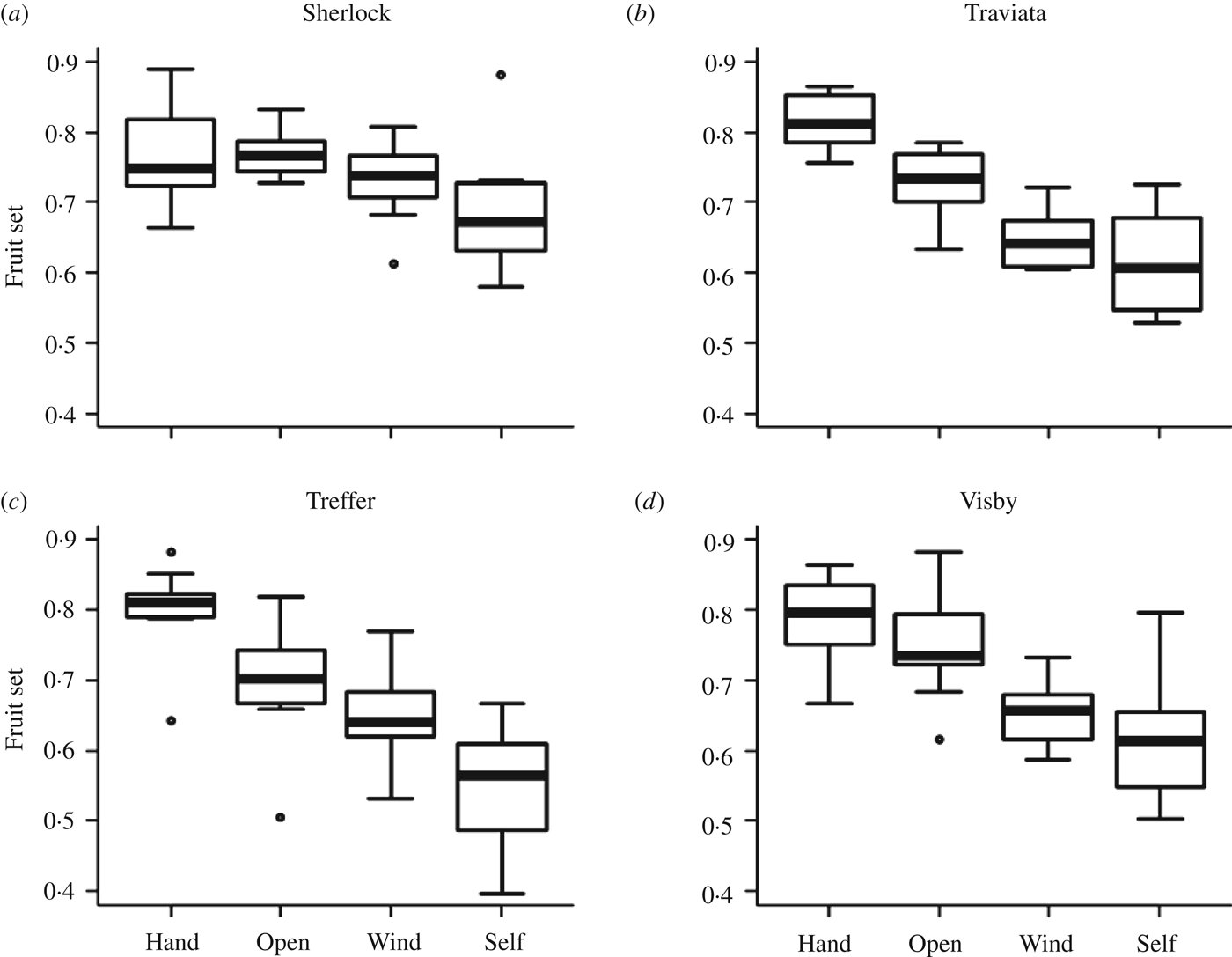
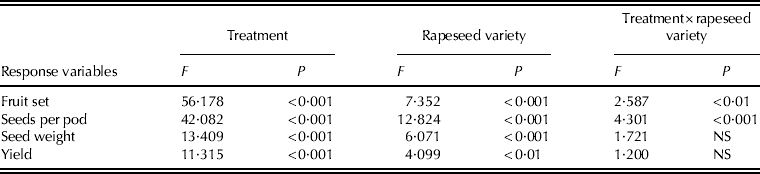
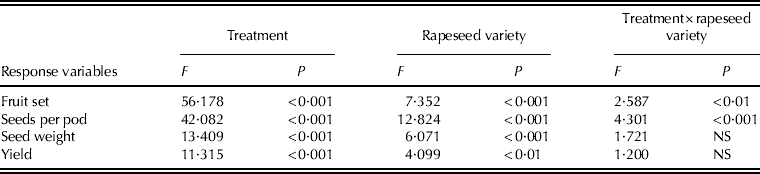
Pollination treatment and rapeseed variety as well as their interaction had a significant effect (P⩽0·001) on the fruit set per plant individual (Table 1). The highest fruit set was achieved when plants received supplementary hand-pollination, followed by open pollination, wind pollination and self-pollination (Fig. 1). Sherlock produced the highest fruit set and varied little among the four pollination treatments (Fig. 1). The fruit set of Visby and Traviata reached intermediate values and both rapeseed varieties showed higher differences among pollination treatments (Fig. 1). Treffer produced the lowest fruit set and differed markedly among pollination treatments (Fig. 1).
Boxplot showing the mean fruit set as proportion under different pollination treatments of four tested rapeseed varieties: (a) Sherlock, (b) Traviata, (c) Treffer and (d) Visby.

Fruit set, number of seeds per pod, seed weight and yield for the different pollination treatments and rapeseed varieties and the interaction between treatment and variety. Results are from generalized linear models
NS, not significant.
Number of seeds per pod
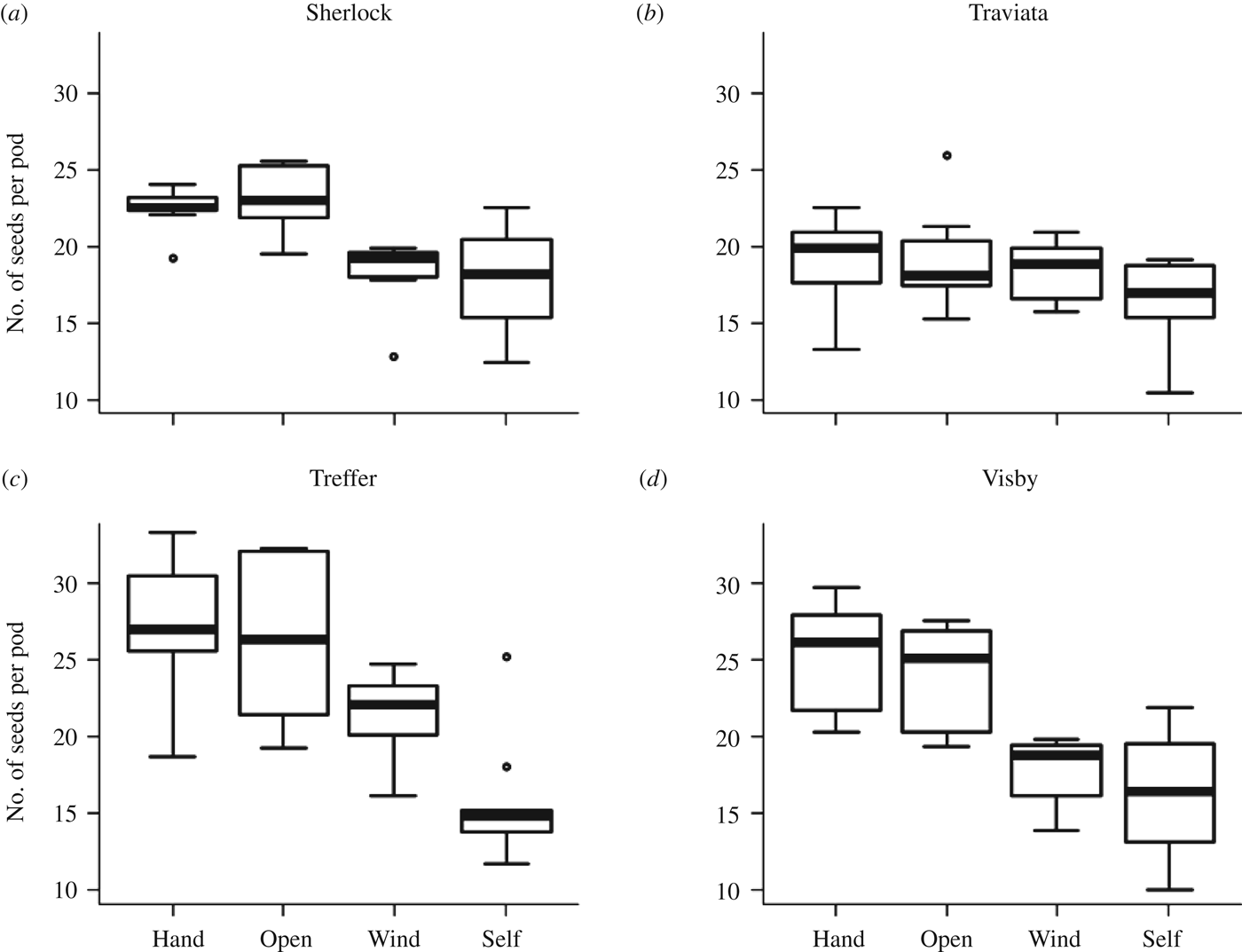
The pollination treatment, the rapeseed variety and the interaction of both influenced the number of seeds per pod significantly (P⩽0·001, Table 1). When comparing the number of seeds per pod among the treatments, supplementary hand-pollination and open pollination showed no difference (Fig. 2), but individual plants from the open and supplementary hand-pollination treatments produced more seeds per pod in all rapeseed varieties than those that were wind or self-pollinated (Fig. 2).
Boxplot showing the mean number of seeds per pod under different pollination treatments of four tested rapeseed varieties: (a) Sherlock, (b) Traviata, (c) Treffer and (d) Visby.
Traviata showed the lowest number of seeds per pod and also the lowest differences among pollination treatments (Fig. 2). Sherlock and Visby produced intermediate numbers of seeds per pod and showed higher variation among pollination treatments (Fig. 2). The highest number of seeds per pod and the highest differences among pollination treatments were achieved by the rapeseed variety Treffer (Fig. 2). The number of seeds per pod was correlated with fruit set (Table A.1).
Seed weight
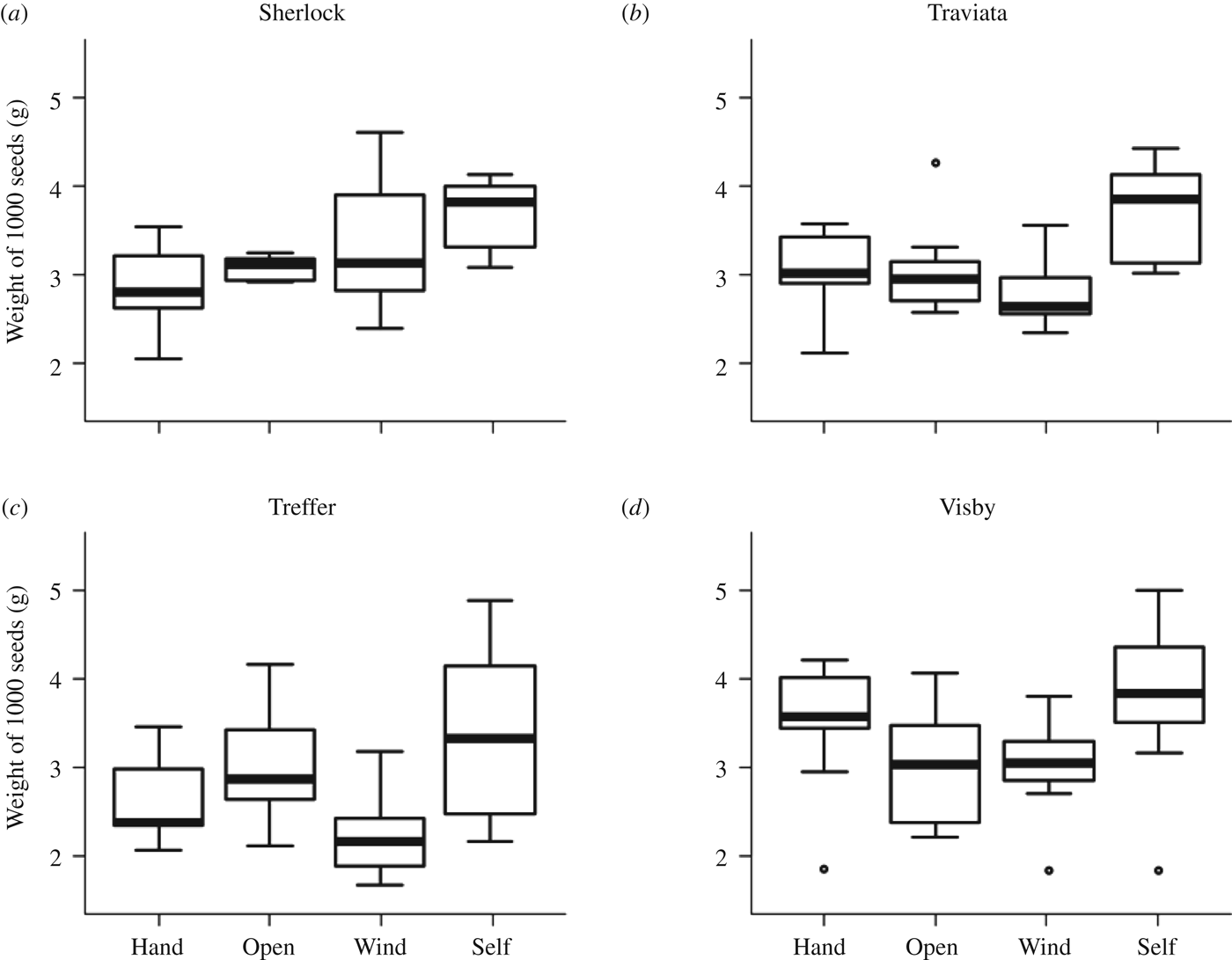
The pollination treatment and the rapeseed variety influenced the seed weight significantly (P⩽0·001, Table 1). The interaction of pollination treatment and rapeseed variety had no significant influence on seed weight (Table 1). In all rapeseed varieties, seed weight was highest in the self-pollination treatment (Fig. A.2). Comparing rapeseed varieties, Visby had the highest seed weight followed by Sherlock, Traviata and Treffer (Fig. A.2). Seed weight was negatively correlated with the number of produced flowers per plant (Table A.1).
Yield
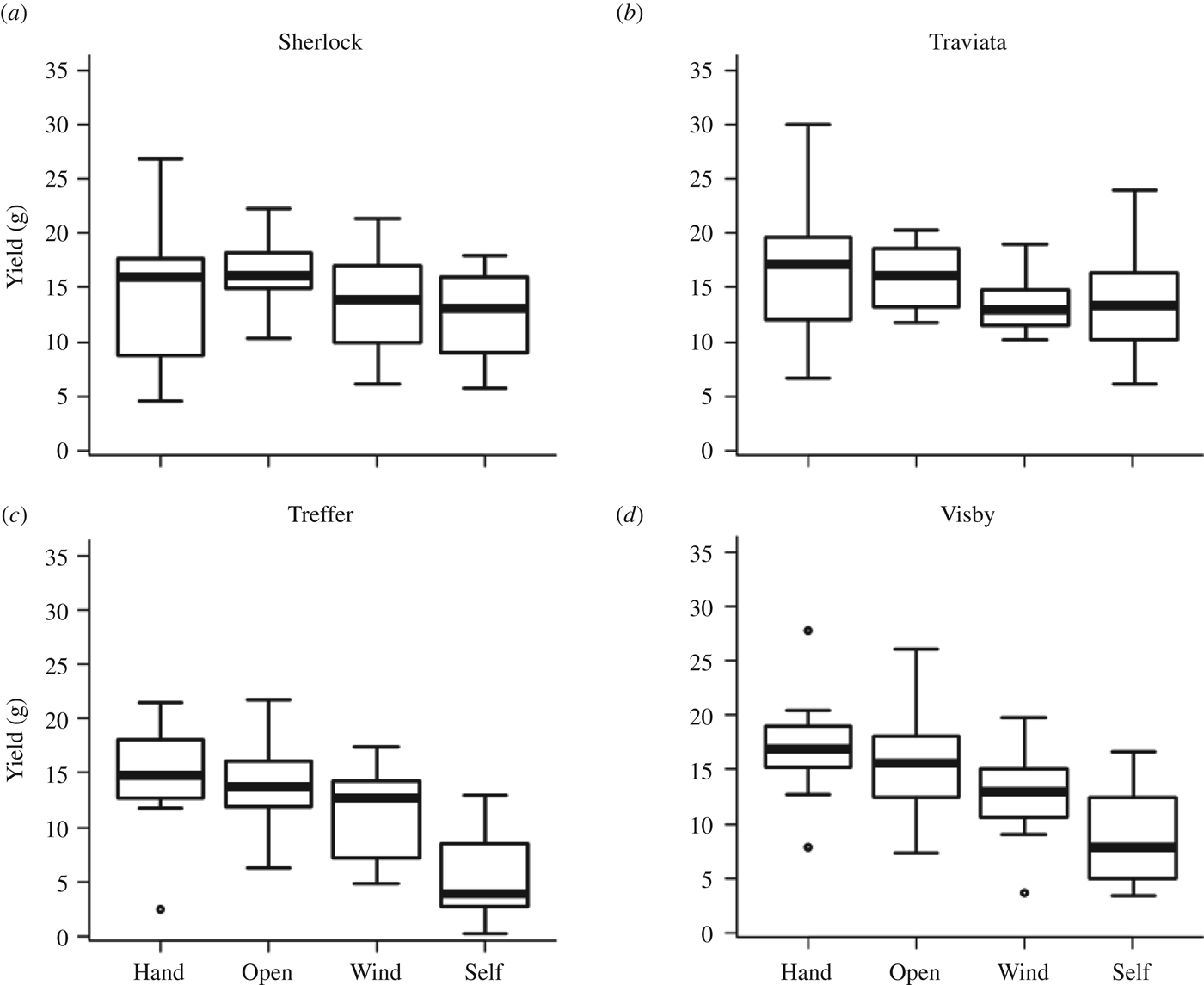
The pollination treatment (P<0·001) and the rapeseed variety (P<0·01) had a significant effect on yield (Table 1, Fig. A.3). Open pollination and supplementary hand-pollination resulted in higher yield than wind and self-pollination (Table 1, Fig. A.3). Yield differed significantly between rapeseed varieties (Table 1, Fig. A.3) with Traviata achieving highest yield followed by Sherlock and Visby and with Treffer achieving lowest yields (Fig. A.3). Yield was significantly correlated with the number of flowers produced per plant (r=0·43, P<0·001), fruit set (r=0·46, P<0·001), number of seeds per pod (r=0·54, P<0·001) and seed weight (r=0·24, P<0·01, Table A.1).
DISCUSSION
The present study shows that all yield variables of different rapeseed varieties were significantly affected by pollination treatment. Plants in supplementary hand- or in open-pollination treatments showed higher fruit set and number of seeds per pod compared with wind and self-pollinated plants. The degree of these differences was dependent on the tested rapeseed variety. In contrast, the weight of seeds was highest in the self-pollination treatment independent of the tested rapeseed variety. However, plants from the open and supplementary hand-pollination treatments generally achieved higher yields compared with self-pollinated plants, indicating that insects increase the yield of the tested rapeseed varieties; although the cross- and open-pollination benefits are more obvious in Treffer (50·9% compared with autonomous self-pollination) and Visby (42·7%) compared with Sherlock (13·7%) and Traviata (21·8%). Most previous studies on pollination of rapeseed confirm that insect pollination increases fruit set (Williams et al. Reference Williams, Martin and White1986; Sabbahi et al. Reference Sabbahi, De Oliveira and Marceau2005; Munawar et al. Reference Munawar, Raja, Siddique, Niaz and Amjad2009; Jauker et al. Reference Jauker, Bondarenko, Becker and Steffan-Dewenter2012), the number of seeds per pod (Steffan-Dewenter Reference Steffan-Dewenter2003; Kołtowski Reference Kołtowski2005; Sabbahi et al. Reference Sabbahi, De Oliveira and Marceau2005; Kristen Reference Kristen2008; Munawar et al. Reference Munawar, Raja, Siddique, Niaz and Amjad2009) and yield (Kołtowski Reference Kołtowski2005; Sabbahi et al. Reference Sabbahi, De Oliveira and Marceau2005; Bommarco et al. Reference Bommarco, Marini and Vaissière2012). Sabbahi et al. (Reference Sabbahi, De Oliveira and Marceau2005) found that pollination by insects can increase yield by 46%, whereas Bommarco et al. (Reference Bommarco, Marini and Vaissière2012) concluded that insect pollination contributes an increase of 18% to the yield of oilseed rape. Williams et al. (Reference Williams, Martin and White1986) show contrasting results, finding no differences in the yield of self-pollinated or cross-pollinated individuals.
Contrary to fruit set, number of seeds per pod and yield, the seed weight was highest when plants were self-pollinated. Additionally, seed weight was negatively correlated with the number of flowers. This observation may be explained by the compensatory capacity of the plant for low fruit and seed setting, which implies that a pollination deficit can be compensated by the development of larger and heavier seeds (Westcott & Nelson Reference Westcott and Nelson2001; Steffan-Dewenter Reference Steffan-Dewenter2003; Durán et al. Reference Durán, Ulloa, Carrillo, Contreras and Bastidas2010). One reason might be resource allocation; when a plant produces less seeds, more resources can be allocated to each individual seed and this may increase their weight significantly. However, in the studies by Jauker et al. (Reference Jauker, Bondarenko, Becker and Steffan-Dewenter2012) and Kołtowski (Reference Kołtowski2005), differences in seed weights among pollination treatments were not observed. These contrasting results might be explained by the use of different rapeseed varieties.
The varieties Treffer and Visby depended more on pollination by insects. This indicates that the pollinator dependency of a rapeseed variety is not determined by the heritage of the variety (hybrid or bred variety). Rather, it is a varietal-specific characteristic.
Comparing the tested rapeseed varieties, Sherlock showed a lower variance of the different response variables among the different pollination treatments. In contrast to Sherlock, which is a bred variety, Traviata, Treffer and Visby are hybrids. Hybrids are known to sometimes have a reduced pollen supply and may therefore be more dependent on pollinators than bred varieties (Kristen Reference Kristen2008). This is supported by the significant difference found between the supplementary hand- and open-pollination treatments compared with the self-pollination treatment in Treffer and Visby.
Yield was positively correlated with the number of produced flowers, fruit set, number of seeds per pod and seed weight showing that these variables directly or indirectly influenced yield. Yield differed among rapeseed varieties, corresponding to differences in fruit set. The different rapeseed varieties showed distinct responses to different pollination treatments regarding their dependence of the different plant sexual reproduction variables on supplementary hand- and insect pollination. For example, Traviata showed the lowest number of seeds per pod, but this was compensated by a high number of flowers produced and a higher fruit set, leading to highest yield compared with the other rapeseed varieties tested. Furthermore, Traviata showed a high pollinator dependence regarding fruit set. Treffer produced the lowest fruit set, seed weight and yield and intermediate numbers of flowers but also displayed the highest dependence on insect pollination. The seeds of Visby had the highest weight, while the other yield variables and the number of produced flowers achieved intermediate values. The pollinator dependence of Visby was generally high. Sherlock had the highest fruit set of all varieties but only intermediate numbers of seeds per pod, seed weight and yield and the lowest number of produced flowers. The dependence on pollination treatment was low in Sherlock plants.
SUMMARY AND CONCLUSION
Providing farmers with information about the pollinator dependence of the different varieties will aid their decision to cultivate certain rapeseed varieties that are best suited for their local conditions without compromising on yield. The present study demonstrates that insect pollination increases yield of the tested rapeseed varieties differently. The results suggest that experiments to investigate the dependence on insects of certain varieties are important for general information on rapeseed varieties. This will help farmers in their decision whether or not to invest in pollination management to maximize yield.
We acknowledge Heinrich Lübbecke for providing the rapeseed plants. We thank all people from the Institute of Ecology of the Leuphana University of Lüneburg who helped with pod opening and sorting. Claire Brittain and two anonymous reviewers are gratefully acknowledged for valuable comments. A. H. is financed by the Deutsche Bundesstiftung Umwelt (DBU) and G. P. by the Pro Science programme of the Leuphana University.
APPENDIX A
Correlation matrix of all response variables and additionally of the number of produced flowers. Correlation coefficients (ρ) and their significance (in parentheses) are presented.

Global production of oilseed rape per year from 1970 to 2010 (FAO 2012).
Boxplot showing the seed weight in grams under different pollination treatments of four tested rapeseed varieties: (a) Sherlock, (b) Traviata, (c) Treffer and (d) Visby.
Boxplot showing the yield in grams under different pollination treatments of four tested rapeseed varieties: (a) Sherlock, (b) Traviata, (c) Treffer and (d) Visby.