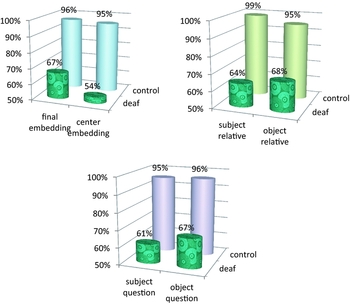
The ability to understand and produce sentences with syntactic movement such as relative clauses and wh-questions (questions that start with who, what, etc.) is a crucial language ability: children and adults hear and read these types of sentences and produce them very frequently. This research tested whether, in the absence of sufficient exposure to language at an early age, individuals with hearing impairment can still understand these sentences. Using various tasks, we tested this question in adolescents and young adults with hearing impairment who speak Palestinian Arabic, a language that had not been tested previously in this context, and explored the comprehension of syntactic structures that had not been tested previously in hearing impaired individuals.
Previous studies have indicated that hearing impaired speakers of English and Hebrew have difficulty understanding and producing sentences that are derived by syntactic movement. Specifically, passive sentences (Power & Quigley, Reference Power and Quigley1973; Schmitt, Reference Schmitt1968), wh-questions (Berent, Reference Berent1996; de Villiers, de Villiers, & Hoban, Reference de Villiers, de Villiers, Hoban and Tager-Flusberg1994; Friedmann & Szterman, Reference Friedmann and Szterman2011; Geers & Moog, Reference Geers and Moog1978; Quigley, Wilbur, & Montanelli, Reference Quigley, Wilbur and Montanelli1974), topicalization sentences (Friedmann & Szterman, Reference Friedmann and Szterman2006), and object relative sentences (Berent, Reference Berent and Strong1988; de Villiers, Reference de Villiers1988; Friedmann & Szterman, Reference Friedmann and Szterman2006, Reference Friedmann and Szterman2011; Geis, Reference Geis1973; Quigley, Smith, & Wilbur, Reference Quigley, Smith and Wilbur1974; Volpato, Reference Volpato2010; Volpato & Adani, Reference Volpato and Adani2009), which are all derived by syntactic movement, have been found to be impaired, at least for those individuals with hearing impairment who were not sufficiently exposed to language during the critical period for the acquisition of syntax of a first language, most probably during the first year of life (Calderon & Naidu, Reference Calderon and Naidu2000; Friedmann & Szterman, Reference Friedmann and Szterman2006; Mayberry & Lock, Reference Mayberry and Lock2003; Szterman & Friedmann, Reference Szterman and Friedmann2003; Yoshinaga-Itano, Reference Yoshinaga-Itano2003; Yoshinaga-Itano & Apuzzo, Reference Yoshinaga-Itano and Apuzzo1998a, Reference Yoshinaga-Itano and Apuzzo1998b).
In the current study, we tested several types of sentences derived by movement in Palestinian Arabic and Standard Arabic. We focused on wh-movement, which is a movement of a phrase to the beginning of a clause (in syntactic terms, to the specifier position of the complementizer phrase [spec-CP]). Whereas the basic word order in Palestinian Arabic, as in English, is subject–verb–object (SVO), other orders can be derived by movement of one of the constituents to another position in the sentence. Sentences (1) to (5) are derived by such movement. In all of these structures, a noun phrase (NP) moves from its original position to the beginning of the clause. In Examples (1) to (5), this movement is depicted by an arrow; and the original position, the position of the trace/copy of the moved element (Chomsky, Reference Chomsky1981, Reference Chomsky1995; Chomsky & Lasnik, Reference Chomsky, Lasnik, Jacobs, von Stechow, Sternefeld and Vennemann1993), is marked with an underscore.Footnote 1
- (1)


- (2)

- (3)

- (4)

- (5)

Topicalization structures like the sentence in (3) are derived by movement of the object to the beginning of the clause. Wh-questions and relative clauses are derived by movement from either the subject or the object position. A movement from the subject position creates subject questions and subject relatives (Examples (2) and (5)), and a movement from the object position creates object questions and object relatives (Examples (1) and (4)).
In every sentence, the verb assigns the NPs in the sentence their (thematic) roles. The verb typically assigns the role of the agent to the first NP (the NP before it in the basic structure), and the role of theme to the second NP (the NP that follows it in the basic structure). For example, in the sentence the grandmother kissed the girl, the verb kiss assigns the thematic role of agent to the grandmother, and the thematic role of theme to the girl. When one of these NPs moves, the process of thematic role assignment becomes more complex: the verb assigns the thematic role to the original position of the moved NP (to the trace/copy), and the thematic role is then transferred via a chain to the NP in its new position. For example, in Sentence (3), the theme role is assigned to the original position of the object, and this role is transferred via a chain to the object, girl, which is now located at the beginning of the sentence. Thus, in order to understand a sentence derived by wh-movement, and to understand the role of the NP that has moved to a new position in the sentence, the listener has to know that there is movement in the sentence, to identify the original position of the moved phrase, and then to assign the correct thematic role from the verb to the original position, and to link the original position to the moved constituent via a chain. A deficit in either of these processes would lead to difficulty in understanding the thematic roles in the sentence and consequently to difficulty in determining “who did what to whom” in the sentence.
This difficulty would manifest itself mainly in sentences in which the arguments do not keep their canonical agent-theme order. Sentences in which the argument order is canonical, with the agent before the theme, as in (2) and (5), might still be comprehended correctly on the basis of the canonical order even if the processing of syntactic movement is impaired (as is the case in individuals with agrammatic aphasia; Grodzinsky, Reference Grodzinsky2000; Friedmann & Shapiro, Reference Friedmann and Shapiro2003; and in children with syntactic specific language impairment; Friedmann & Novogrodsky, Reference Friedmann and Novogrodsky2004, Reference Friedmann and Novogrodsky2011). In contrast, sentences such as (1), (3), and (5), in which the theme precedes the agent, would yield poor performance if any of the processes responsible for thematic role assignment in sentences derived by movement is impaired.
Do individuals with hearing impairment master these delicate processes of comprehension of sentences derived by wh-movement? As noted before, English and Hebrew-speaking children with hearing impairment show deficits in the comprehension and production of such sentences. In the current study, we tested Palestinian Arabic speakers with hearing impairment also with syntactic structures that have not been tested before and also used several new experimental techniques. The wh-movement structures that we tested are structures that are typically acquired by hearing children by the time they enter elementary school, at around the age of 6 (Correa, Reference Correa1995; de Villiers et al., Reference de Villiers, de Villiers, Hoban and Tager-Flusberg1994; Kidd & Bavin, Reference Kidd and Bavin2002; McKee, McDaniel, & Snedeker, Reference McKee, McDaniel and Snedeker1998; Roth, Reference Roth1984; Sheldon, Reference Sheldon1974; Tavakolian, Reference Tavakolian and Tavakolian1981). The comprehension of relative clauses and wh-questions in Hebrew, a language structurally similar to Palestinian Arabic, is also reported to be mastered around the age of 6 (Friedmann, Aram, & Novogrodsky, Reference Friedmann, Aram and Novogrodsky2011; Friedmann & Novogrodsky, Reference Friedmann and Novogrodsky2004, Reference Friedmann and Novogrodsky2007, Reference Friedmann and Novogrodsky2011; Friedmann & Szterman, Reference Friedmann and Szterman2006; Günzberg-Kerbel, Shvimer, & Friedmann, Reference Günzberg-Kerbel, Shvimer and Friedmann2008; Nave, Szterman, & Friedmann, Reference Nave, Szterman and Friedmann2009). The participants with hearing impairment in the current study were tested at a much older age of between 9 years, 6 months (9;6) and 21;0.
In addition to the main research question regarding wh-movement, two special aspects of Arabic were tested in this study: the effect of the availability of two orders of the subject and the verb on the comprehension of simple sentences and sentences derived by wh-movement, and the diglossic nature of Arabic.
WORD ORDER IN PALESTINIAN ARABIC
Two orders of subject and verb exist in Arabic (both colloquial and Standard): SVO and VSO (Benmamoun, Reference Benmamoun1997; Fassi-Fehri, Reference Fassi-Fehri1993; Mohammad, Reference Mohammad2000; Shlonsky, Reference Shlonsky1997). In Palestinian Arabic, these two sentence orders alternate, although SV is more frequent (Dahlgren, Reference Dahlgren, Lutz and de Jong2010, their table 4; Maamouri, Reference Maamouri1998; Saiegh-Haddad, Reference Saiegh-Haddad2003; and Shlonsky, Reference Shlonsky1997). Speakers of Palestinian Arabic can use either order to convey the same meaning in simple sentences (see Examples (6) and (7)). In wh-questions, topicalization sentences, and relative clauses, both orders are also possible. (Examples of such sentences will be given in the descriptions of the test materials in the experiments below.)
- (6)
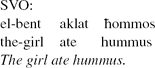
- (7)
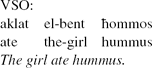
Following Benmamoun (Reference Benmamoun1997), Mohammad (Reference Mohammad2000), Ouhalla (Reference Ouhalla, Lightfoot and Hornstein1994), and Shlonsky (Reference Shlonsky1997), we assume that the base-generated order within the verb phrase in Palestinian Arabic is SVO. The derivation of VSO sentences in Palestinian Arabic involves verb movement (to I, the head of the inflection phrase [IP]), and the derivation of SVO sentences involves both verb movement (to I) and movement of the subject to spec-IP (Fassi-Fehri, Reference Fassi-Fehri1993; Mohammad, Reference Mohammad2000).Footnote 2 Before the age of 3, children who acquire Palestinian Arabic prefer to produce sentences in VS order. By the age of 3 years, both orders are mastered by children acquiring Palestinian Arabic (Friedmann & Costa, Reference Friedmann and Costa2011a). In the current study, we explored whether there is a difference between the comprehension of structures in the two subject and verb orders in hearing impairment.
DIGLOSSIA IN ARABIC
Arabic is a typical case of diglossia (Ferguson, Reference Ferguson1959). The language spoken by the participants in this study is Palestinian Arabic, which is an exclusively spoken language, and is not written. Standard Arabic is the language used for writing, formal contexts, TV programs, news broadcasts, newspapers, and religious texts. It is the standard language used throughout the Arabic speaking world. Palestinian Arabic is linguistically related to Standard Arabic, but the two languages differ in various aspects of phonology, lexicon, and syntax.
Thus, children grow up speaking Palestinian Arabic and learn Standard Arabic only later, usually in school. Hence, Standard Arabic can be viewed almost as a second language (Saiegh-Haddad, Reference Saiegh-Haddad2003). Palestinian Arabic is the main language children are exposed to, although they occasionally hear Standard Arabic in some TV programs and in prayers, for example (Saiegh-Haddad, Levin, & Hende, Reference Saiegh-Haddad, Levin and Hende2011). This situation is especially interesting in the context of individuals with hearing impairment. If, as is the case for most of the participants in the current study, the hearing impairment was detected or treated only at kindergarten age or later, then the first language, which requires input during the first year of life, might be impaired. This situation raises several questions: does the hearing impairment also affect the comprehension of sentences in a language that is acquired only after the hearing intervention has already begun (namely, Standard Arabic)? Will the participants with hearing impairment perform worse than hearing children, who also acquired Standard Arabic as a second language in school? (For a discussion of this point, see Mayberry & Lock, Reference Mayberry and Lock2003.) Will a second language learned by children who had difficulty acquiring a first language be different from the same second language learned by children with a first language that was acquired in typical conditions? This study will explore these questions through the assessment of comprehension of sentences in both Palestinian Arabic and Standard Arabic.
GENERAL EXPERIMENTAL INVESTIGATION
The study assessed the comprehension of sentences with syntactic movement using four tasks. Experiment 1 assessed the comprehension of relative clauses using a sentence–picture matching task, Experiment 2 tested the comprehension of wh-questions using a picture selection task, Experiment 3 further tested the comprehension of relative clauses using a comprehension questions task, and Experiment 4 assessed the comprehension of written relative clauses and topicalization sentences using a reading and paraphrasing task. Experiments 1–3 tested Palestinian Arabic, and Experiment 4 tested Standard Arabic. Following the presentation of the four experiments, we present an analysis of the (lack of) effect of age on performance, an analysis of the performance of the monaurally hearing impaired participants in the four experiments, and an analysis of the occurrence of various types of movement-derived sentences in children's songs, storybooks, and workbooks in Arabic.
General participants
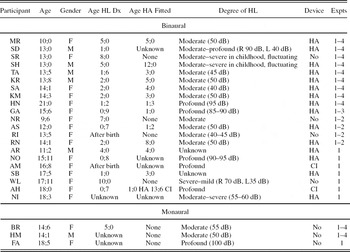
The participants were 24 Palestinian Arabic speakers ages 9;6–21;0 with hearing impairment. Detailed information about the 24 participants and the experiments in which each of them participated is presented in Appendix A. All of them had congenital hearing loss, with the exception of SR, who lost her hearing at the age of 3 months. The participants’ first diagnosis of hearing loss by an audiologist ranged from right after birth to as late as 10 years. All but one of the participants were trained only orally and did not know or use sign language. (Participant GA had also received some sign language training.) All but one studied in regular schools (8 of them in vocational schools), in hearing classes with inclusive schooling using oral education, with an individualized educational plan, and with additional classes by teachers for the deaf. GA was the only participant who studied in a special education class, which was the only possible educational setting in her city for children with hearing impairment. We included only hearing-impaired participants whose teachers reported that they had no other general problem (except language difficulties) and who performed well on simple sentences in our sentence comprehension test. (Their good performance on simple sentences indicated good comprehension of the words in the experiments, as well as good comprehension of the tasks and pictures.) None of the participants’ parents were deaf.
A fact that turned out to crucially affect the syntactic performance of the participants was that 21 of the 24 participants had binaural hearing loss and 3 had a monaural hearing loss. Because of the very different performance of these two subgroups, their performance is reported separately. Experiments 1 through 4 report the performance of the binaural group and the performance of the three monaurally impaired children in the four experiments is reported in a separate section.
The participants with binaural hearing loss were 21 individuals (16 girls, 5 boys), aged 9;6–21;0 (M = 14;6, SD = 2;1); 19 of them lived in the Galilee in north Israel and were minimally exposed to Hebrew, and 2 lived in a city in central Israel where they spoke Hebrew in addition to Arabic. Fifteen routinely used binaural hearing aids; 2 used a cochlear implant; and 4 preferred not to use any type of hearing device, although medically they needed one.
The three participants (two girls, one boy) with monaural hearing loss were 14;1, 14;6, and 18;5 of age. All lived in Galilee, and their hearing loss was detected at birth. None of them used a hearing aid.
The control group for each experiment included Palestinian Arabic speakers with normal hearing and normal language development who were younger than the participants with the hearing impairment. The control participants for the picture-matching comprehension experiments (Experiments 1 and 2) were first and second graders aged 6;0–8;0. The control participants in the experiments that required reading or comprehension of center-embedded relative clauses, which could not be tested in these young ages, were tested with children and adolescents older than 8;10. None of the participants in the control groups had any report of neurological developmental difficulties or socioemotional problems. The number, ages, and gender of the participants in the control group for each experiment is given in the Method sections of each experiment.
General method
Each participant was tested individually in a quiet room over one to three sessions. The participants were told they could stop the testing whenever they wanted. No time limit was imposed in any of the experiments, and the experimenter repeated every item as many times as the participant requested. The participants could see the experimenter's lips throughout the testing, except for the hearing screening test. The experimenter did not give the participants any response-contingent feedback as to their success or failure on the test items, only general encouragement.
Prior to the experiments, hearing was screened, to ensure that the sentence stimuli in the experiments were perceived correctly, and that the performance was not influenced by difficulty in hearing the test sentences. In this hearing screening test, the experimenter asked the participants to repeat single syllables, single words, and simple sentences, which she said with her lips concealed, as well as 42 simple sentences that included sibilants, which she said when the participants could see her lips. This hearing screening test was administered at the same pace and volume used in the following experiments. The participants were asked to repeat each item aloud. Only individuals who made fewer than three errors in repetition were included in the comprehension experiments.
General material
All the sentences in all of the tasks were semantically reversible so that the participants would not be able to determine the meaning of the sentences on the basis of the words alone (namely, we did not use irreversible sentences like The girl is eating hummus, only reversible ones like The girl is drawing the grandmother). We also ensured that in all the tests, each picture and sentence included figures of the same gender and number (a boy and an elephant, which is masculine in Palestinian Arabic; a girl and a grandmother, etc.), so that the verb inflection could not be used to identify the subject because verbs in Palestinian Arabic agree with the subject in gender, number, and person. All the verbs in the embedded relative clauses in Experiments 1, 3, and 4 and the verbs in the questions, topicalization sentences, and simple sentences in Experiments 2 and 4 were agentive and transitive. In Palestinian Arabic, object relatives, object questions, and topicalization sentences include a resumptive object clitic pronoun on the verb. Thus, all these sentences in our experiments included a resumptive clitic pronoun. Because 19 of the binaural participants lived in the Galilee and 2 lived in Jaffa, where a slightly different dialect of Palestinian Arabic is used, the required phonological adjustments were carried out according to the dialect of the participant.
Statistical analyses
The performance of the hearing impaired group was compared to the performance of the control group using independent samples t test. Within-group comparisons between the participants’ performance in two conditions were conducted using a correlated t test. The performance of each participant with hearing impairment was compared to the control group's performance using Crawford and Howell's (Reference Crawford and Howell1998) t test. In tests and conditions in which the control group performed 100% correct with no variation (with 0 SD), t tests could not be performed. In these cases, we used a cutoff of 80% correct, below which the performance of a participant was considered significantly poorer than that of the control group. The performance of each participant in each condition was compared to chance level using the binomial distribution. An alpha level of 0.05 was used in all comparisons.
EXPERIMENT 1: COMPREHENSION OF RELATIVE CLAUSES IN A PICTURE SELECTION TASK
The comprehension of relative clauses was first assessed using a binary sentence–picture matching task.
Participants
All hearing impaired individuals described in the General Participants Section participated in this task. The control group included 10 participants with normal hearing (5 boys, 5 girls). They were selected at an age in which they should have recently acquired the comprehension of object relatives and object questions. Their age range was 6;0–8;0, with an average of 7;3 years (SD = 0;7).
Procedure and materials
Each participant heard a sentence read by a native speaker of Palestinian Arabic and saw two pictures on the same page, one above the other. In one picture, the roles matched the sentence; in the other picture, the roles were reversed (Figure 1). The participant was asked to point to the picture that correctly described the sentence.
An example for a picture pair used in Experiment 1. [A color version of this figure can be viewed online at http://journals.cambridge.org/aps]

To make sure that the participants understood all the NPs included in the test and recognized the figures in the pictures, each participant was presented with the pictures prior to the test and asked to point to the figures by name (e.g., “Show me an elephant” and “Show me a lion” for the picture pair in Figure 1). All participants performed well on this pretest. Their good comprehension of the pictures and their acquaintance with the nouns in the sentences can also be seen in their good performance on the subject relative sentences reported below.
A total of 60 Palestinian Arabic sentences were presented to each participant. These sentences included 20 subject relatives,Footnote 3 20 object relatives in SV order, and 20 object relatives in VS order (see Examples (8)–(10)).
- (8)
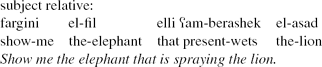
- (9)

- (10)
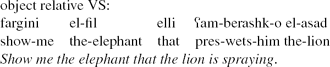
The three types of sentences were randomly ordered and presented in 3 blocks of 20 sentences each (7, 7, and 6 sentences of each type per block). Each participant saw the 20 picture pairs 3 times, and each picture pair appeared with all 3 sentence types. The correct picture in each pair was randomized both within each block (in each block, 10 sentences matched the upper picture, and 10 matched the lower picture), and between blocks (the matching picture in each picture pair was sometimes the top picture, and sometimes the bottom picture).
Results
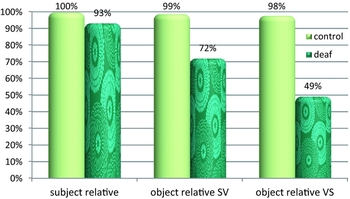
The results of Experiment 1, summarized in Figure 2, indicate that Palestinian Arabic speakers with hearing impairment have severe difficulty in the comprehension of object relatives. They performed relatively well on the subject relative sentences, in which the canonical order of agent and theme is preserved, though they performed poorer than the control group on this structure as well, t (29) = 2.00, p = .03. The comprehension of both types of object relatives was very poor, and significantly poorer than the control group's performance, both for the SV object relatives, t (29) = 2.92, p = .003, and for the VS object relatives, t (29) = 4.78, p < .0001.
The percentage correct for the comprehension of relative clauses in a sentence–picture matching task. [A color version of this figure can be viewed online at http://journals.cambridge.org/aps]

The performance of the participants with hearing impairment on object relatives was significantly poorer than on subject relatives, both for SV object relatives, t (20) = 3.48, p = .002; and for VS object relatives, t (20) = 6.13, p < .0001. Although both types of object relatives were comprehended poorly, the performance on SV object relatives was significantly better than on the VS object relatives, t (20) = 4.96, p < .0001.
The comparison of the performance of each of the participants with hearing impairment to chance level indicates that whereas all but one participant performed significantly above chance level on the subject relatives, 8 of the 21 participants performed at chance level in the comprehension of SV object relatives, and 11 performed at chance level on the VS object relatives, indicating a guessing pattern. All the participants in the control group performed above chance level on all sentence types.
The comparison of each participant with hearing impairment with the control group indicates that 11 of them performed significantly poorer than the control group on subject relatives, t (9) > 2.68, p < .01; 14 of the hearing impaired participants performed significantly poorer than the controls on the SV object relatives, t (9) > 3.38, p < .004; and 17 of the 21 hearing impaired participants performed significantly poorer than the controls on the VS object relatives, t (9) > 3.09, p < .006.
EXPERIMENT 2: COMPREHENSION OF SUBJECT AND OBJECT QUESTIONS
Experiment 2 tested the comprehension of another structure that involves wh-movement: wh-questions. We chose to test which questions rather than who questions because in many populations that have difficulty with wh-movement, which questions reflect the difficulty in comprehension, whereas the performance on who questions is better (de Vincenzi, Arduino, Ciccarelli, & Job, Reference de Vincenzi, Arduino, Ciccarelli, Job and Bagnara1999; and Avrutin, Reference Avrutin, Grodzinsky, Shapiro and Swinney2000, for Italian and English-speaking children; Friedmann, Belletti, & Rizzi, Reference Friedmann, Belletti and Rizzi2009, for normal acquisition in Hebrew; Friedmann & Novogrodsky, Reference Friedmann and Novogrodsky2011; and Levy & Friedmann, Reference Levy and Friedmann2009, for syntactic specific language impairment in Hebrew; Hickok & Avrutin, Reference Hickok and Avrutin1996, for agrammatic aphasia; and recently, Friedmann & Szterman, Reference Friedmann and Szterman2011, for Hebrew-speakers with hearing impairment).
Participants
Fourteen of the binaural hearing impaired participants (10 girls, 4 boys) participated in this study. Their age range was 9;6–21 (M = 13;7, SD = 2;8, see Appendix A for more information on the participants in this test). The control group was the same control group as in Experiment 1.
Materials and procedure
The comprehension of questions in Palestinian Arabic was tested using a picture selection task. The pictures presented in this task were different from those presented in Experiment 1: each picture included three figures, two of the same type that differ in at least one feature (two dancers with different dresses, two elephants of different colors, a small and a big bear, etc.), and one additional figure of a different type. As seen in Figure 3, the first figure in the picture was performing an action on the second, and the second figure was performing the same action on the third one, which was of the same type as the first figure. The experimenter asked a question while the participant was looking at a page with the picture. The participant was then requested to answer the question by pointing to the correct figure.
An example for a picture pair used in the question–picture matching task.

A total of 60 which questions were presented to each participant. These questions included 20 subject questions, 20 object questions in SV order, and 20 object questions in VS order. See Examples (11)–(13) for questions that were presented with Figure 3.
(11) subject question:
Aya fil ʕam-berasheq el-walad?
which elephant pres-wets the-boy
Which elephant is spraying the boy?
(12) object question SV:
Aya fil el-walad ʕam-berashq-o?
which elephant the-boy pres-wets-him
Which elephant is the boy spraying?
(13) object question VS:
Aya fil ʕam-berashq-o el-walad?
which elephant pres-wets-him the-boy
Which elephant is the boy spraying?
It is interesting that questions such as (11) in Palestinian Arabic are in principle ambiguous between subject and object questions. Namely, both the elephant spraying the other elephant and the elephant being sprayed in Figure 3 can be grammatical responses to the question in (11). However, in neutral sentences, normal speakers strongly prefer to interpret the question as a subject question. This might be partly because object questions in Palestinian Arabic, like object relatives and topicalization sentences, are produced with an object resumptive clitic pronoun. Thus, a question in SVO order has two cues for subject interpretation: the SVO order, and the absence of object resumptive pronoun. Even in languages in which there is no resumptive, SVO questions are interpreted as subject question even when a theoretical possibility for object interpretation exists. De Vincenzi (Reference de Vincenzi1991), for example, studied a very similar structure in Italian. She brought theoretical claims as well as results from Italian speakers showing that although these questions are in principle ambiguous, speakers interpret them consistently according to their subject reading (see also Belletti, Friedmann, Brunato, & Rizzi, Reference Belletti, Friedmann, Brunato and Rizzi2012). In addition, in producing questions, speakers strongly prefer to produce subject questions such as the one in (11), whereas an object question is produced with a resumptive pronoun, as in Examples (12) and (13), to disambiguate. Thus, SVO questions are theoretically ambiguous but practically show very clear preference for subject interpretation. (This will also be evident from the results of the control group below.) Still, we did not treat an object question interpretation as incorrect but rather compared the preferred responses on these questions of the hearing impairment group and the control group.
The questions were randomly ordered. Each participant saw 20 pictures 3 times; each picture appeared with all three question types. In each viewing of the 20 pictures, there were a similar number (7, 7, and 6) of questions of each type. The correct answer to all questions was always one of the two figures of the same type (one of the elephants in Figure 3, the splashing elephant in subject questions, and the splashed elephant in object questions), and never of the middle figure. For each picture, the questions were created so that some of them matched one figure, and some matched the other.
Results
The main result of the wh-question comprehension task was that the Palestinian Arabic speakers with hearing impairment had considerable difficulty understanding which object questions, both in SV and VS order. They also showed a pattern that was different from that of the controls in the interpretation of subject questions.
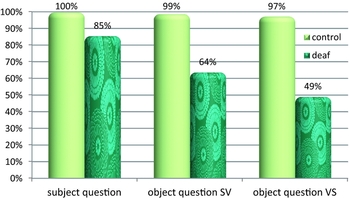
Their performance in the comprehension of which object questions was significantly poorer than that of the control group, both for SV object questions, t (22) = 3.07, p = .003, and for VS object questions, t (22) = 6.06, p < .0001, as seen in Figure 4.
The performance of the hearing impaired and the control groups on which questions. [A color version of this figure can be viewed online at http://journals.cambridge.org/aps]

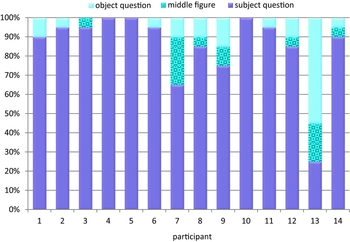
Responses to the subject questions differed between the groups in three respects. Whereas the hearing participants tended to interpret these questions as subject questions, and in 199 of their 200 responses pointed to the agent figure when they heard these questions,Footnote 4 11 of the 14 participants with hearing impairment responded to some of the subject questions as object questions (Figure 5). This yielded a significant difference in the rate of subject question interpretation, t (22) = 2.21, p = .02.
Distribution of the 20 responses to subject questions for each participant in the hearing impaired group. [A color version of this figure can be viewed online at http://journals.cambridge.org/aps]

It is interesting that, during the test, many of the control participants spontaneously remarked that this type of question is ambiguous and both answers are possible, but that they preferred to point to the agent. None of the participants with hearing impairment made such a remark.
A third difference between the participants with hearing impairment and the control group, which applied both for the subject questions and for the object questions, was that only the participants with hearing impairment sometimes pointed to the middle figure. That is, when they heard a question like “Which elephant did the boy spray?” they sometimes pointed to the boy. This occurred in 4.7% of the subject questions, 8.4% of the SV object questions, and 6.6% of the VS object questions. This might have resulted from the tendency, reported for Hebrew speaking children with hearing impairment in Friedmann and Szterman (Reference Friedmann and Szterman2006), to answer according to the last (embedded) part of the sentence. For example, when hearing the (Hebrew) sentence “Which elephant the boy sprayed?” the participant would answer according to the chunk “the boy sprayed,” which would cause him to point to the boy who is spraying. The same tendency probably led our Arabic speaking participants to sometimes point to the middle figure. When hearing Example (12) for example, focusing on “the boy is spraying him” would lead to pointing to the middle figure, the boy.
The participants with hearing impairment performed significantly poorer in the object questions compared to the subject questions (when subject interpretation was considered the correct answer, according to control participants’ performance): performance on subject questions was significantly better than on SV object questions, t (13) = 2.72, p = .009, and significantly better than on VS object questions, t (13) = 5.10, p = .0001. Although both VS and SV object questions yielded very poor comprehension, the VS object questions were significantly poorer than the SV object questions, t (13) = 2.58, p = .01.
The comparison of the performance of each of the participants to chance level indicates that only 2 of the 14 participants with hearing impairment performed at chance level on the subject questions, but 6 and 11 of the 14 performed at chance level on the SV and VS object questions, respectively, indicating a guessing pattern. All of the participants in the control group performed above chance level on all question types.
In the comparison of the performance of each individual participant with hearing impairment in each question type to the control group, 10 of the 14 participants performed significantly poorer than controls on the SV object questions, t (9) > 5.36, p < .0001, and 13 of the 14 performed significantly poorer than the control group on the VS object questions, t (9) > 4.99, p < .0001.
EXPERIMENT 3: COMPREHENSION OF RELATIVE CLAUSES IN A COMPREHENSION QUESTIONS TASK
Experiments 1 and 2 indicated that Palestinian Arabic speakers with hearing impairment encounter difficulties in the comprehension of object relative sentences and of object questions, and that both SV and VS orders are problematic, although the VS order is even more impaired. In order to further explore their ability to understand sentences derived by wh-movement, we used another experimental method: comprehension questions (adapted from the Battery for Assessment of Syntactic Abilities in Children [BAMBI] Zika Meguvana; Friedmann & Novogrodsky, Reference Friedmann and Novogrodsky2002).
This method allowed us to make several direct comparisons: between subject relatives and object relatives, between center embedding and right-branching embedding (which we will call here “final embedding,” to avoid confusion because Arabic is read from right to left), between questions on the subject and questions on the object, and between questions on the relative clause and questions on the main clause.
Participants
Ten of the individuals with binaural hearing impairment participated in this task (6 girls, 4 boys) ages 10;0–21;0 (M = 14;1, SD = 2;10). The control group included 8 participants with normal hearing (5 girls, 3 boys). Their age range was 8;10–17;9 (M = 12;6, SD = 3;0; see Appendix A for more information on the participants in this test).
Materials and method
The participants heard a Palestinian Arabic relative clause with two full NPs (singular and of the same gender) and then a question about the agent or the theme of the action in the sentence. They answered by saying one of the two NPs. Each participant heard 90 center-embedding or final-embedding subject and object relatives and answered questions that required the comprehension of the thematic roles in the relative clause or in the main clause, as seen in Examples (14)–(22). The examples given here all use the same NPs and verb to simplify the reading of the examples, but in the test, each combination of two NPs and a verb only appeared once. The variety of sentence types and questions in this test reduced the ability of the participants to use a response strategy (or, at least, the ability to use a strategy that would yield the correct answer consistently). In this task, the correct response in five of the conditions was the first NP and in four conditions it was the second NP. The sentences of the nine conditions were randomly ordered so that there were no two consecutive sentences of the same condition, and no similar NPs in consecutive sentences.
(14) final embedding, subject relative, subject question on the relative clause (FSRsq):
shoft el-walad elli rasam el-ab. min elli rasam?
saw-I the-boy that drew the-father. who that drew?
I saw the boy that drew the father. Who drew?
(15) final embedding, subject relative, object question on the relative clause (FSRoq):
shoft el-walad elli rasam el-ab. min elli rasamu-u?
saw-I the-boy that drew the-father. who that drew-pl-him?
I saw the boy that drew the father. Who was drawn?
(16) final embedding, object relative, subject question on the relative clause (FORsq):
shoft el-walad elli el-ab rasam-o. min elli rasam?
saw-I the-boy that the-father drew-him. who that drew?
I saw the boy that the father drew. Who drew?
(17) final embedding, object relative, object question on the relative clause (FORoq):
shoft el-walad elli el-ab rasam-o. min elli rasamu-u?
saw-I the-boy that the-father drew-him. Who that drew-pl-him?
I saw the boy that the father drew. Who was drawn?
(18) center embedding, subject relative, object question on the relative clauseFootnote 5 (CSRoq):
el-walad elli rasam el-ab shereb. min elli rasamu-u?
the-boy that drew the-father drank. Who that drew-pl-him?
The boy that drew the father drank. Who was drawn?
(19) center embedding, object relative, subject question on the relative clause (CORsq):
el-walad elli el-ab rasam-o shereb. min elli rasam?
the-boy that the-father drew-him drank. Who that drew?
‘The boy that the father drew drank. Who drew?
(20) center embedding, object relative, object question on the relative clause (CORoq):
el-walad elli el-ab rasam-o shereb. min elli rasamu-u?
the-boy that the-father drew-him drank. who that drew-pl-him?
The boy that the father drew drank. Who was drawn?
(21) center embedding, subject relative, subject question on the matrix clause (CSRsmainq):
el-walad elli rasam el-ab shereb. min elli shereb?
the-boy that drew the-father drank. who that drank?
The boy that drew the father drank. Who drank?
(22) center embedding, object relative, subject question on the matrix clause (CORsmainq):
el-walad elli el-ab rasam-o shereb. min elli shereb?
the-boy that the-father drew-him drank. who that drank?
The boy that the father drew drank. Who drank?
The comprehension questions we used included a wh-morpheme (min) and an embedding marker illi (most probably a doubly filled comp structure; Alex Grosu, personal communication). We used this type of questions because we could not use passive questions to ask about the object for three reasons: because it would add another movement structure to the test, because we could not use passive to ask a question about the subject, and because passive structures are very rarely used in Palestinian Arabic. We therefore chose to use the min illi questions, which are much more natural, unambiguous, and do not add another type of movement. For reasons of uniformity, we used the min illi questions for the subject questions as well.
Results
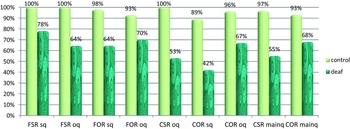
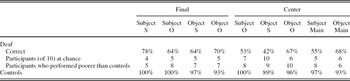
The results, summarized in Figure 6, clearly indicate that Palestinian Arabic speaking individuals with hearing impairment have a marked difficulty in the comprehension of all types of relative clauses. Their performance in each of the nine types of relative clauses tested was significantly poorer than that of the control group, t (16) > 2.63, p < .008. It is interesting that, unlike the results of Experiment 1, in which the participants performed relatively well on the subject relatives possibly because they could use the canonical order of the agent and the theme to perform the task, in the current task their difficulties emerged in the subject relatives as well. Their performance was significantly poorer than that of the controls in all four subject relative conditions; the highest performance on subject relatives, a final embedding structure with a subject question, was 78% correct.
Correct answers in the nine conditions of the comprehension questions task. F, final embedding; C, Center embedding; SR, subject relative; OR, object relative; sq, subject question on the relative clause; oq, object question on the relative clause; mainq, question on main clause. [A color version of this figure can be viewed online at http://journals.cambridge.org/aps]

This task allowed us to compare three aspects of relative clauses, and to examine which of them affected the comprehension of the participants with hearing impairment: the position of embedding (center versus final embedding), the type of relative clause (subject versus object relative), and the type of question asked about the sentence (subject question or object question). The most accurate comparison in this respect is to compare minimal pairs: conditions that differ on only one of these aspects.
This comparison indicated that the position of the embedding within the main clause affected the comprehension of the participants with hearing impairment, as seen in Figure 7. The three possible comparisons of minimal pairs between final and center embedding were in the object relative–subject question condition, in the subject relative-object question condition, and in the object relative–object question condition. All these comparisons yielded poorer performance in the center-embedding condition compared to the final-embedding condition, which was significant for the first comparison, t (9) = 3.46, p = .007, and marginally significant for the second, t (9) = 2.19, p = .056 (the third comparison yielded slightly but not significantly poorer center embedding). A summary of these three conditions yielded a significantly better performance on final embedding compared to center embedding, t (9) = 4.09, p = .003.
The effects of type of relative, position of embedding, and type of question. [A color version of this figure can be viewed online at http://journals.cambridge.org/aps]

The comparison of subject and object relatives did not yield any clear difference between the structures (Figure 7): The minimal pairs in which we compared subject and object relatives were final embedding-subject question; final embedding-object question; center embedding-object question; and center embedding-main question. None of these comparisons yielded a difference between subject and object relatives, t (9) < 1.73, p > .12, and the total comparison of the 4 conditions also showed no difference between subject and object relatives, t (9) = 0.67, p = .52.
The comparison of subject and object questions also yielded no clear difference (Figure 7). The minimal pairs in which subject and object questions were compared were final embedding-subject relatives, final embedding-object relatives, and center embedding-object relatives. The first two yielded opposite results, none of which was significant, and the third comparison showed significantly better performance on object questions, t (9) = 3.21, p = .01. The total comparison yielded no significant difference between subject and object questions, t (9) = 1.56, p = .15.
One possible factor that affected the participants’ performance was whether or not the correct response was the first or the second NP in the sentence. The percentage of correct responses in conditions in which the first NP was the correct answer was 68%, whereas in the conditions in which it was the second NP only 56% of the responses were correct. This difference was marginally significant, t (9) = 2.17, p = .058. It thus seems that in the presence of uncertainty about the interpretation of a relative clause, the participants tended to choose the first NP as the response.
Individual level analyses
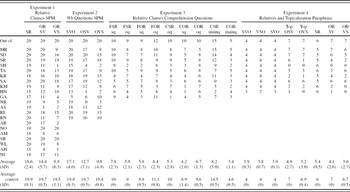
Because all the responses in this task were naming one of the two NPs in the given sentence, in this task, too, it was possible for the participants to guess, and for us to compare their performance to chance level, with a distribution around 50% correct. The results of this comparison are presented in Table 1. All the control participants performed above chance level on all conditions (except for one participant in a single condition). In marked contrast, each of the participants with hearing impairment performed at chance level on at least one condition, with an average of five conditions (out of nine) with a guessing pattern. The comparison of each participant to the control group yielded similar results: each participant performed significantly below the control group in at least two conditions, with an average of seven of the nine conditions significantly below the control group.
Percentage of correct responses, number of participants who performed at chance, and number of participants who performed significantly poorer than control group in each condition of the comprehension questions task

Note: Final and Center refer to the embedding position; Subject and Object refer to the relative types; and S, O, and Main refer to the respective subject, object, and main question types.
EXPERIMENT 4: COMPREHENSION OF RELATIVE CLAUSES AND TOPICALIZATION IN A PARAPHRASING TASK
Until now, the results have clearly shown that the comprehension of relative clauses and object wh-questions in Palestinian Arabic is severely impaired in Palestinian Arabic speaking individuals with hearing impairment. Experiment 4 tested two additional types of structures, topicalization structures, which, similarly to relative clauses and wh-questions, are derived by wh-movement, and an additional type of simple sentence, with VSO order. These structures were tested in Standard Arabic, using a reading and paraphrasing task. Such a method enables the assessment of comprehension in sentences presented visually rather than orally and allows the participant to have the sentence available to him/her until the paraphrase is complete, reducing working memory.
Participants
Nine of the binaural hearing impaired participants participated in this study (five girls, four boys; these were all the participants in Experiment 3, except for one girl who found this test too hard and decided not to participate). Their age range was 10;0–21;0 (M = 14;0, SD = 3;0; see Appendix A for more information on the participants in this test).
The control group included seven participants with normal hearing (three males, four females). Their average age was approximately 2 years younger than the experimental group (8;10–17;9, M = 12;0, SD = 3;0).
Procedure
The participants were asked to read each sentence aloud and then to explain it in their own words. A simple practice sentence was given prior to the test, and using this sentence as an example, the meaning of “explain the sentence in your own words” was discussed. Feedback was given for the participants’ paraphrasing of this sentence, and when it was necessary, further explanations and simple practice sentences were given until the participant understood the task. The experimental sentences were presented one by one. The participants read each sentence aloud and then paraphrased it as accurately as possible. To reduce demands on memory, each written sentence remained in front of the participants until they finished reading and paraphrasing it. If the paraphrase was unclear to the experimenter, a direct question was asked. For example, if the participants said in their paraphrase “He kissed,” we asked “Who kissed?” If the participants repeated the sentence word-by-word instead of paraphrasing it, we asked them to try to explain the sentence in their own words again. A paraphrase was considered incorrect if it included an incorrect thematic role assignment, namely, if the agent of the action described in the sentence was interpreted as the theme, or if the theme was interpreted as the agent. When a “don't know” or “I don't understand” response was given, the experimenter encouraged the participant to try and explain the sentence. If the participant still could not paraphrase (which happened very rarely), we counted this response as incorrect as well.
The sentences were presented in Standard Arabic because Palestinian Arabic does not have a written form. It allowed us to assess the participants’ comprehension of wh-movement-derived sentences in Standard Arabic. We chose Standard Arabic words that are used frequently and are as similar as possible to the Palestinian Arabic words. It is crucial that the syntactic structures that we tested were identical in Palestinian Arabic and Standard Arabic. We also provided lexical support during reading, giving the Palestinian Arabic word for the Standard written words, because we were not interested in testing the participants’ vocabulary, only their syntax. Because the experiment was also not targeted toward testing reading accuracy, we helped the participants in words that they found difficult to read aloud. The sentences were presented with diacritical voweling, but without the final voweling that signals the syntactic case of the NPs. Because of the two language systems, the task of explaining the sentence, written in Standard Arabic, “in their own words” was more natural for them, because they could explain it in Palestinian Arabic.
Materials
Eight sentence types were included in this experiment, with a total of 46 sentences: 4 simple sentences in SVO orderFootnote 6; 4 simple active sentences in VSO order; 4 simple active SVO sentences with this, which are parallel to the topicalization sentences; 14 topicalization sentences, half of them in SV order and half in VS order; 6 subject relatives; and 14 object relatives, half in SV order and half in VS order. The sentences were presented in random order.
Examples (23)–(30) show the types of sentences presented, all meaning the grandma (al-gadda) kissed (qabbalat) the girl (al-bent). Because topicalization sentences (26) and (27) are more natural with a demonstrative this (haðehe), we included an SVO sentence with this, Example (25), as their control. Thus, simple SVO sentences were given in two forms, four with and four without this. The SVO with this (25) was created as control of the topicalization sentences, which included this, whereas the SVO sentences without this (23) were used to control for the VSO sentences (24). Notice that the SVO sentences cannot be interpreted as object topicalization sentences because they do not include a resumptive pronoun.
(23) SVO: al-gadda qabbalat al-bent
the-grandma kissed the-girl
(24) VSO: qabbalat al-gadda al-bent
kissed the-grandma the-girl
(25) SVO this: haðehe al-gadda qabbalat al-bent
this the-grandma kissed the-girl
(26) OSV: haðehe al-bent, al-gadda qabbalat-ha
this the-girl the-grandma kissed-her
(27) OVS: haðehe al-bent, qabbalat-ha al-gadda
this the-girl kissed-her the-grandma
(28) subject relative: haðehe heya al-gadda allati qabbalat al-bent
this is the-grandma that kissed the-girl
(29) object relative SV: haðehe heya al-bent allati al-gadda qabbalat-ha
this is the-girl that the-grandma kissed-her
(30) object relative VS: haðehe heya al-bent allati qabbalat-ha al-gadda
this is the-girl that kissed-her the-grandma
Results
The main findings were that the participants with hearing impairment read and paraphrased the simple SVO and VSO sentences much like the controls but performed significantly poorer in paraphrasing the object relative clauses in both SV and VS orders and the object topicalization structures in both orders. The participants in the control group, whose average age was 2 years younger, performed very well (96%–100% correct) on all sentence types, making only three errors out of the 322 sentences they paraphrased.
On the SVO and VSO simple sentences, the accuracy of the paraphrasing of the participants with hearing impairment did not differ from that of the control group, t (14) = 0.88, p = .40 for both structures, and no difference was found between their performance on the SVO and VSO sentences (97% and 94% correct, respectively), t (8) = 1, p = .35. This indicates that not all types of movement are problematic for persons with a hearing impairment—at least movement of the verb to I (and of the subject to spec-IP) is spared.
Topicalization sentences
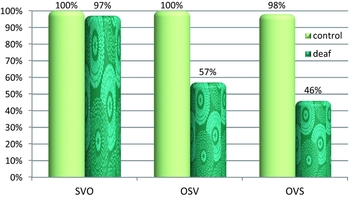
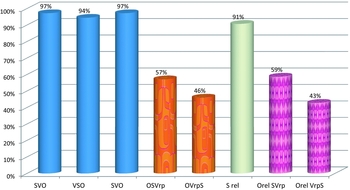
The comprehension of topicalization sentences in both OSV and OVS orders was significantly poorer than that of the control group, t (14) = 2.88, p = .006, and t (14) = 3.17, p = .003, as shown in Figure 8. The participants with hearing impairment performed significantly worse on the topicalization sentences than on the parallel SVO sentences, t (8) = 3.75, p = .002. No significant difference was found between the SV and VS topicalization sentences.
Correct paraphrases of topicalization sentences in the paraphrasing task. [A color version of this figure can be viewed online at http://journals.cambridge.org/aps]

The erroneous paraphrases included reversals of thematic roles, as can be seen in (31).
- (31)

Relative clauses
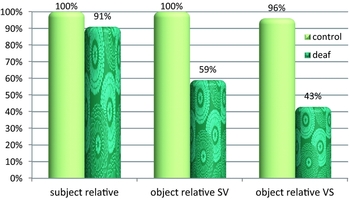
The participants with hearing impairment paraphrased both SV and VS object relatives significantly worse than the control group, t (14) = 2.90, p = .006, and t (14) = 3.52, p = .002, respectively. Even the comprehension of subject relatives in this test was significantly poorer for the participants with hearing impairment compared to the control group, t (14) = 2.77, p = .008 (see Figure 9).
Correct paraphrases of subject and object relative clauses in the paraphrasing task. [A color version of this figure can be viewed online at http://journals.cambridge.org/aps]

The paraphrasing of the subject relatives was significantly better than that of the object relatives, t (8) = 2.76, p = .01, and the comprehension of VS object relatives was poorer than that of SV object relatives, t (8) = 4.26, p = .001. The erroneous paraphrases of the object relative clauses, similarly to the paraphrases of the topicalization sentences, included reversals of thematic roles, as can be seen in Example (32).
- (32)

The percentage of correct paraphrases of the topicalization sentences and of the object relatives was very similar, with no significant difference between them. A summary of the paraphrasing performance of the participants with hearing impairment in each of the structures is presented in Figure 10.
Correct paraphrases of all sentence types in the paraphrasing task in the hearing impaired group. [A color version of this figure can be viewed online at http://journals.cambridge.org/aps]

Individual level analyses
The comparison of the performance of each of the participants to chance indicates that all but one of the participants with hearing impairment performed significantly above chance level on the simple SVO and VSO sentences and all performed above chance on the subject relatives, but only four of the nine participants performed above chance on the SV object relatives and SV topicalization sentences, and only three did so on the VS object relatives and VS topicalization sentences. All of the participants in the control group performed above chance on all sentence types.
In the comparison of the performance of each individual participant with hearing impairment to the control group on each sentence type, seven of the nine participants performed significantly poorer than controls on the VS topicalization sentences, and six of the nine had poorer performance on the VS object relatives, t (6) > 2.30, p < .03. Because there was no variance in the control group and all of the control participants performed at ceiling on all other types of sentences, it was impossible to compare the participants with hearing impairment to the control group using Crawford and Howell's (Reference Crawford and Howell1998) t test, but a count of the number of participants who correctly paraphrased two items fewer than the control group in each condition yielded no participants on the subject relatives, only one participant on the simple SVO and VSO sentences, 5 participants on the SV object relatives and topicalization sentences, and six of the nine participants on the VS object relatives and topicalization sentences. The individual performance of each of the participants with binaural hearing impairment in each of Experiments 1–4 is summarized in Table 2.
Number of correct responses in the participants with binaural hearing impairment compared to the hearing control participants

Note: SPM, sentence–picture matching task; SR, subject relative; ORSV, object relative subject–verb; ORVS, object relative verb–subject; SVO, subject–verb–object; OSV, object–subject–verb; OVS, object–verb–subject; FSR, final embedding, subject relative; sq, subject question on the relative clause; oq, object question on the relative clause; FOR, final embedding, object relative; CSR, center embedding, subject relative; COR, center embedding, object relative; mainq, subject question on the matrix clause; VSO, verb–subject–object.
NO EFFECT OF AGE
Because the age range was wide, as we tested participants aged 9;6−21;0, it was necessary to test whether age had any effect on their performance. In addition, this analysis can provide information as to whether the difficulty with wh-movement decreases with age.
The analysis of the correlation of age with each of the three relative clause types in the sentence–picture matching task (Experiment 1), the three wh-question types (Experiment 2), the nine relative clause conditions in the comprehension questions task (Experiment 3), and the three relative clauses and two topicalization structures in the paraphrasing task (Experiment 4) showed that none of the performances on any of these structures correlated positively with age (p > .32).
In addition, comparing for each structure the youngest third of hearing impaired participants and the oldest third of hearing impaired participants in the relevant tests again indicated no significant difference between the age groups (only the subject relative in the sentence–picture matching task showed a marginally significant better performance for the younger group, p = .05). An analysis that compared the younger half of participants with the older half on each of the experiments also showed no significant advantage for the older group on any of the structures. Three of the structures (subject relatives in the sentence–picture matching task, final-embedding subject relatives with subject questions in Experiment 3, and VS topicalization in the paraphrasing task) showed significantly better comprehension in the younger half of participants (p < .05.) No age effect was found in the control group either, because the youngest control participants in each task already performed at ceiling.
Thus, within the ages tested, there was no effect of age: structures that were already acquired were acquired before the age of 9;6, and structures that caused difficulty in comprehension showed persistent difficulty even up to the age of 21 years. These results are in line with a study that found that the functioning in school of Israeli Arab children with hearing impairment, as measured by their academic achievement levels in Arabic and mathematics and in other educational measures such as academic achievements, class behavior, participation, and more, does not improve with age but actually decreases (Most, Reference Most2006).
HOW DO INDIVIDUALS WITH MONAURAL HEARING LOSS UNDERSTAND SENTENCES DERIVED BY MOVEMENT?
The four experiments reported above showed very consistent results, indicating that individuals with binaural hearing loss who were not exposed to sufficient language input during the early stage of language acquisition had a very pronounced difficulty in comprehending sentences derived by syntactic movement, including subject and object relatives, wh-questions, and topicalization sentences. Does this generalization also apply to individuals whose hearing loss is only monaural? In our study, three adolescents participated who were defined by the educational system as “hearing impaired” and received the same support of a teacher for the deaf, but for whom, we discovered after administering the tests, the hearing loss was only monaural. We thus had the opportunity to compare their performance with that of the 21 participants with binaural hearing impairment.
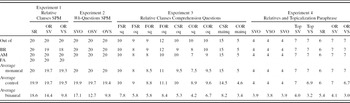
Their comprehension was critically different from that of the binaural group: As seen in Table 3, the performance of each of them was similar to that of the control group in all four experiments and above chance level in all conditions.
Number of correct responses in the monaurally hearing impaired compared to the binaurally hearing impaired and the hearing controls

Note: SPM, sentence–picture matching task; SR, subject relative; ORSV, object relative subject–verb; ORVS, object relative verb–subject; SVO, subject–verb–object; OSV, object–subject–verb; OVS, object–verb–subject; FSR, final embedding, subject relative; sq, subject question on the relative clause; oq, object question on the relative clause; FOR, final embedding, object relative; CSR, center embedding, subject relative; COR, center embedding, object relative; mainq, subject question on the matrix clause; VSO, verb–subject–object.
A further study of relative clause elicitation, using a preference task (from BAMBI-ADIF; Friedmann & Szterman, Reference Friedmann and Szterman2006; Novogrodsky & Friedmann, Reference Novogrodsky and Friedmann2006) with the same participants (Haddad-Hanna & Friedmann, in press) indicated that the picture is very similar with respect to their production ability: the monaurally impaired participants produced all the subject and object relatives correctly, whereas the binaurally impaired participants could produce only 78% of the subject relatives and 19% of the object relatives correctly.
Caution should be taken in drawing conclusions from a small group of three participants. However, the current results suggest that monaural hearing loss can yield a completely different language picture than does binaural hearing loss, probably because the hearing ear provides the necessary language input during the critical period for syntactic acquisition.
Empirical epilogue: Are sentences that are derived by movement important?
In the experiments described above we have shown that Palestinian Arabic speakers with binaural hearing impairment encounter great difficulties in comprehending various types of sentences derived by wh-movement. We turned to empirically examine whether this ability is necessary at all, that is, whether these types of sentences exist in their input, and how necessary such sentences are in understanding the language that surrounds Arabic speaking children. We analyzed three types of texts available to Arabic speaking children: 7 popular children's songs in Palestinian Arabic, 10 children's stories in Standard Arabic, and an Israeli school workbook for second grade in Standard Arabic. The songs and stories were selected because we thought these were among the most popular ones for Arabic speaking children in Israel when our participants were young children. The workbook is the one that is frequently used in the educational program for second graders in Israel.
We counted a total of 2,532 sentences, including 2,105 sentences in the workbook, 359 sentences in children's stories, and 68 sentences in the children's songs. The results were that between one-quarter and two-thirds of the sentences included wh-movement. The popular Palestinian Arabic songs included 59% sentences with wh-movement, and the children's stories and workbook in Standard Arabic included 66% and 25% sentences with wh-movement, respectively. A total of 13% wh-questions, 9% relative clauses, and 10% direct and indirect object topicalization sentences were included in the texts the children were exposed to, with an average of 32% sentences with wh-movement. Thus, school-aged Palestinian Arabic speaking individuals are definitely required to understand structures with wh-movement, and it is crucial to be aware of the specific deficit that individuals with hearing impairment have in this type of sentences.
DISCUSSION
This study explored the effect of hearing impairment in orally trained individuals on the comprehension of sentences derived by syntactic movement: relative clauses, wh-questions, and topicalization sentences. The main findings of this series of studies were that Palestinian Arabic speaking children, adolescents, and young adults with hearing impairment have a deficit in the comprehension of object relative clauses in SV and VS order, subject relatives in some tasks, object questions in SV and VS order, subject questions, and topicalization sentences in SV and VS order. This was found in three types of tasks, sentence–picture matching, comprehension questions, and reading and paraphrasing. The difficulty manifested itself both in Palestinian Arabic and in Standard Arabic. Not a single hearing impaired participant performed at the control participants’ level. This severe difficulty exists even though, in the analysis we made of more than 2,500 sentences in the input of Arabic speaking children, a third of the sentences included wh-movement. The existence of such a high rate of sentences derived by wh-movement underscores the importance of being aware of this difficulty in hearing impaired individuals.
Friedmann and Szterman (Reference Friedmann and Szterman2006) demonstrated that some children who had hearing aids fitted or cochlear implants implanted before the age of 8 months were able to understand movement-derived sentences similarly to hearing children. None of the participants in the current study had such early fittings of hearing aids, and none of them was enrolled in a language intervention program before they were 5 years old. This might account for the poor performance of all of the individual participants with binaural hearing impairment in the current study.
The findings bear on the persistent nature of the syntactic deficit in hearing impaired individuals. The hearing impaired group included participants from a wide age range: four of them were between 9;6 and 12;0, and five were above 17. Still, no correlation was found between age and performance, and no significant difference was found between the performance of the participants in these two extremes of the age range. Even for the older individuals, who had received written input for many years, syntactic ability remained impaired, indicating that once the critical age has passed without the required input, the syntax is impaired even if later input is available. Such persistent linguistic disorders in adolescence have also been reported by Delage and Tuller (Reference Delage and Tuller2007).
The results also indicated that lack of first language input at the critical period for first language acquisition critically affects the further ability to acquire a second language. Standard Arabic, a language learned in school, which can be viewed as a second language, was severely impaired for the participants with hearing impairment, and their comprehension of sentences in Standard Arabic was significantly poorer than the hearing controls, for whom this was a second language as well, but who presumably received language input during the critical period for a first language.
Whereas canonical structures in which the agent precedes the theme are often comprehended better than noncanonical structures (Friedmann & Szterman, Reference Friedmann and Szterman2006), some of the tasks in this study were able to expose significant difficulties also in canonical structures.
The picture selection task and the paraphrasing task revealed that the participants with hearing impairment performed significantly worse than the hearing control group on subject relatives. Still, the performance of most of the hearing impaired participants was relatively good (above 90% correct), and their comprehension of subject relatives was better than that of object relatives. Their comprehension of subject questions, as assessed in the picture selection task, was again poorer than that of the hearing control group and was poor in general, with more than one-third of the hearing impaired participants performing below 90% correct.
The comprehension question task was able to expose the difficulty in subject relatives more clearly, with only 64% correct performance on subject relatives, a performance that did not differ from that of object relatives, indicating difficulties in comprehension of both subject relatives and object relatives.
The difficulty in subject questions and subject relatives sheds light on a linguistic debate concerning whether or not subject wh-questions and subject relative clauses include syntactic movement (Agbayani, Reference Agbayani2000; Chomsky, Reference Chomsky1986; Clements, McCloskey, Maling, & Zaenen, Reference Clements, McCloskey, Maling and Zaenen1983). The difficulty in the comprehension of these structures, alongside the good performance on simple sentences without wh-movement, supports the idea of vacuous movement in subject questions and subject relatives: the difficulty in these structures can be accounted for if they include wh-movement from subject position (for a similar argument from Hebrew-speaking children with hearing impairment, see Friedmann, Novogrodsky, Szterman, & Preminger, Reference Friedmann, Novogrodsky, Szterman, Preminger, Armon-Lotem, Danon and Rothstein2008; and for an argument from agrammatic aphasia, see Friedmann, Reference Friedmann2002).
The results are also helpful in determining between two possible sources of the difficulty hearing impaired individuals have with relative clauses: the involvement of embedding or of wh-movement.Footnote 7 According to the results of this study, a deficit in embedding cannot be the sole source of this difficulty. Had embedding been the only source of the difficulty in understanding relative clauses, we would expect object questions and topicalization sentences, which do not include embedding, to be unimpaired. The consistent deficit across relative clauses, wh-questions, and topicalization sentences points in a different direction: because all three structures are derived by wh-movement, the results of the current study support a specific deficit in sentences derived by wh-movement.Footnote 8
Is this a general problem in syntactic movement? Our results indicate that it is not. Rather, it is a deficit that is specific to wh-movement. In Experiment 4 we tested the paraphrasing of sentences with verb movement. In Palestinian Arabic and Standard Arabic, both SV and VS orders are possible. The VS order is derived from the basic SV order by movement of the verb to I (the head of the inflection node). Experiment 4 compared the paraphrasing of simple SVO and simple VSO sentences, allowing for the assessment of verb movement in our participants.
Unlike the wh-movement sentences, verb movement did not pose any difficulty to the participants with hearing impairment, indicating that only phrase movement is problematic. Taking this question one step further, is this a general problem in phrase movement of all types, or does the problem pertain specifically to wh-movement?
One type of phrase movement that does not involve wh-movement is the movement of the argument of an unaccusative verb to a position before the verb (A-movement). Unaccusative verbs, like fell, dispersed, collapsed, and broke, include a single argument that is the theme of the action and is base-generated in postverbal position. The construction of an SV sentence with these verbs thus requires the movement of the argument to the subject position before the verb (The vase broke is derived from “__ broke the vase” by movement of the NP “the vase” to the subject position). A study of the repetition of such SV sentences with unaccusative verbs compared with the repetition of SV sentences with unergative and transitive verbs, which do not involve A-movement indicated that none of our participants had difficulties in the SV sentences with unaccusative verbs (Haddad-Hanna, Reference Haddad-Hanna2008). Because these sentences involve movement of the object to subject position, namely, A-movement, this indicates that not all phrasal movement types are impaired, and that the deficit in movement affects wh-movement selectively. Thus, not all types of dependencies and not all types of syntactic movement are impaired following lack of input in the critical period for syntax acquisition that results from hearing impairment, only wh-movement.
One interesting result related to the cross linguistic difference in the effect of resumptive pronouns: Arabic consistently uses resumptive pronouns (such as him in the sentence I know the dancer that the mayor adores him) in object relatives, object questions, and topicalization sentences, which are exactly the three structures tested in this study. In Hebrew, resumptive pronouns in object relatives are optional (in object questions and topicalization sentences they are ungrammatical). Previous studies in Hebrew have indicated that children with hearing impairment use resumptive pronouns heavily when they produce object relative clauses, and the inclusion of a resumptive pronoun in the object relative assists their comprehension (Friedmann et al., Reference Friedmann, Novogrodsky, Szterman, Preminger, Armon-Lotem, Danon and Rothstein2008; Friedmann & Szterman, Reference Friedmann and Szterman2006; Szterman & Friedmann, Reference Szterman and Friedmann2007). The current results from Palestinian and Standard Arabic indicate that in Arabic, in which resumptive pronouns are obligatory in object relatives, object questions, and topicalization sentences, sentences of these three structures were poorly comprehended, although a resumptive pronoun was included. Friedmann and Costa (Reference Friedmann, Costa and Rouveret2011b) suggested that the difference between Palestinian Arabic and Hebrew in this respect relates to the differences between resumptive pronouns in Palestinian Arabic and Hebrew: whereas resumptive pronouns are clitics in Palestinian Arabic, they are full pronouns in Hebrew.
A final, encouraging finding of this research was the very good performance of individuals whose hearing loss is only monaural. The performance of the three individuals with monaural hearing impairment on all the tasks and in all the syntactic structures did not differ from that of the hearing control group. Although it might not be surprising for people who work with this population, this study gives an empirical quantitative evidence for the possibility of having unimpaired syntax when the hearing loss is monaural. If syntactic problems in binaural hearing impaired individuals result from lack of exposure to natural language at a critical period for language acquisition, the current results suggest that language input from a single ear is enough to trigger normal acquisition of syntax. These results are encouraging also for the syntactic prognosis of children who were given a single hearing aid or cochlear implant early enough in life.
Characteristics of the participants with hearing impairment

ACKNOWLEDGMENTS
This research was supported by the Israel Science Foundation (Grant 1296/06 to N.F.); by the Lieselotte Adler Laboratory for Research on Child Development; and by the ARC Centre of Excellence in Cognition and its Disorders, Macquarie University. We thank Laurie Tuller and Ronit Szterman for discussions of the research and for their helpful comments on the article.