


Highlights
Caregiver burden in dementia is highly prevalent and persists over 6 months.
Neuropsychiatric symptoms, especially depression, anxiety, disinhibition and sleep disorders, strongly predict sustained burden.
Sex-specific patterns highlight the need for tailored caregiver support strategies.
Introduction
As populations worldwide age, the prevalence of neurodegenerative dementias, such as Alzheimer’s disease (AD), frontotemporal dementia and Lewy body dementia, continues to rise. Reference Livingston, Huntley and Liu1 Although extensive research has focused on the clinical progression of these diseases and on the development of disease-modifying therapies, it is the patient’s informal caregivers, typically spouses and family members, who bear a substantial and often underestimated burden. Providing daily care and emotional support to a person with dementia is associated with significant physical, psychological and financial strain, even with the positive aspects of caregiving to a loved one. This places caregivers at an increased risk of poor physical health, depression and social isolation compared to caregivers of individuals with other chronic illnesses. Reference Pinquart and Sörensen2–Reference Sörensen, Duberstein and Gill6 This high prevalence of caregiver distress highlights a critical public health issue that requires a deeper understanding of its risk factors, which may be amenable to biopsychosocial interventions.
Among the numerous factors contributing to caregiver burden, neuropsychiatric symptoms (NPS) – frequent non-cognitive manifestations of dementia – are consistently identified as one of the most significant and distressing challenges. Reference Lyketsos, Lopez and Jones7 Symptoms such as agitation, apathy, disinhibition, delusions and sleep disturbances are highly prevalent throughout the course of the disease and are strongly associated with numerous adverse outcomes for both patients and their families, including a lower quality of life, increased rates of hospitalization and earlier institutionalization. Reference Peters, Schwartz and Han8–Reference Breitve, Bronnick, Chwiszczuk, Hynninen, Aarsland and Rongve10 Despite the well-documented link between NPS and overall caregiver burden, the specific associations between individual symptoms and the intensity, nature and persistence of the burden they cause remain insufficiently understood. Systematic reviews have shown that certain symptoms – such as agitation, disinhibition, sleep disturbances and affective symptoms – are repeatedly associated with higher levels of caregiver distress and burden. Reference Terum, Andersen and Rongve11,Reference Cheng12 Recent cohort studies further highlighted that affective symptoms, psychosis and aberrant motor behaviors are among the strongest contributors to caregiver strain. Reference Iravani, Abdollahi, Eslamdoust-Siahestalkhi and Soleimani13–Reference van den Kieboom, Snaphaan, Mark, van Assen and Bongers15 However, much of this evidence is cross-sectional, and there remains a lack of longitudinal data exploring how individual symptoms predict sustained burden over time. Certain NPS may elicit acute distress, whereas others contribute to a more prolonged and cumulative burden that progressively erodes caregiver well-being over time. Clarifying which symptoms are most strongly associated with sustained burden is essential for developing tailored interventions that not only alleviate immediate distress but also prevent long-term exhaustion and burnout. Furthermore, emerging evidence suggests that the impact of specific symptoms may differ according to the caregiver’s sex, reflecting variations in coping strategies, emotional responses and the relational dynamics between caregiver and care recipient. However, few studies have systematically examined these associations according to the caregiver’s sex or gender. Understanding these nuanced interactions is critical for designing more equitable and effective support strategies.
The primary objectives of this study were to characterize the specific relationships between individual NPS and caregiver burden in a prospective longitudinal cohort of patient–caregiver dyads and to identify baseline factors associated with prolonged high caregiver burden over a 6-month period. The secondary objective was to assess the influence of caregivers’ sex on these associations, recognizing that sex-specific differences in caregiving roles and experiences may modulate the perception of burden.
Methods
Study design and population
We conducted a prospective longitudinal cohort study of older adult–caregiver dyads at the Centre Hospitalier de l’Université de Montréal (CHUM), a university-affiliated hospital. The study was approved by the Research Ethics Board of the Centre de Recherche du CHUM, and we adhered to the STROBE statement guidelines for observational studies. Reference von Elm, Altman and Egger16 Consecutive patient–caregiver dyads were recruited between October 2023 and June 2024 from specialized neurology and geriatric medicine clinics at the CHUM. To be eligible, patients had to be aged 60 years or older and have a formal clinical diagnosis of a dementia of neurodegenerative etiology, established according to international consensus criteria: AD, Reference Jack, Andrews and Beach17 a Lewy body spectrum disorder (LBD; dementia with Lewy bodies – DLB, Parkinson’s disease dementia – PDD), Reference Postuma, Berg and Stern18,Reference McKeith, Boeve and Dickson19 or a frontotemporal lobar degeneration spectrum disorder (FTLD; behavioral variant frontotemporal dementia – bvFTD, primary progressive aphasia – PPA, progressive supranuclear palsy – PSP, corticobasal syndrome – CBS). Reference Rascovsky, Hodges and Knopman20–Reference Armstrong, Litvan and Lang23 Older patients also had to have a primary caregiver as a study partner. Exclusion criteria for patients included a severe, unstable medical condition with a life expectancy of less than 12 months or the presence of NPS requiring immediate hospitalization. For caregivers, eligibility required regular contact with the patient (at least four interactions per week, self-reported). Written informed consent was obtained from all patients and caregivers before their participation, with patient consent for caregiver involvement being a prerequisite for dyad recruitment.
Patient–caregiver dyads were assessed at baseline (first visit) and at a 6-month follow-up visit (second visit). To minimize participation burden and loss to follow-up, research assessments were conducted in person and scheduled to coincide with regularly planned clinical appointments. All assessments were administered by trained and certified research assistants. Data collected included sociodemographic questionnaire (e.g., information on age, sex, education level, marital status and living situation for patients and age, sex, education level, relationship to the patient and co-caregiving status for caregivers), medical and psychiatric history and current drug regimen through a review of patient medical records and structured interviews with the patient and caregiver to document disease history and current treatments and cognitive assessment with the Mini-Mental State Examination Reference Folstein, Folstein and McHugh24 and the Montreal Cognitive Assessment, Reference Nasreddine, Phillips and Bédirian25 Neuropsychiatric assessments were achieved with the neuropsychiatric inventory (NPI), Reference Cummings26 which assesses the presence and severity of 12 common NPS (i.e., delusion, hallucination, agitation, depression, anxiety, euphoria, apathy, disinhibition, irritability, aberrant motor behavior, sleep disorders and appetite change). For each neuropsychiatric symptom, caregivers reported the frequency ([F]; from 0 to 4) and severity ([S]; from 1 to 3), as well as the associated distress level ([D]; from 0 to 5). The total NPI score is the sum of the [FxS] products for the 12 symptoms (maximum score of 144 points), and the total NPI distress score (NPI-D) is the sum of the [D] scores (maximum score of 60 points). Caregivers also completed the revised 22-item Zarit Burden Interview (ZBI) to assess caregiver burden. Reference Zarit, Reever and Bach-Peterson27 The ZBI is a widely used and validated self-report questionnaire designed to measure the subjective burden experienced by caregivers of individuals with chronic health conditions, such as dementia. It assesses a range of burden dimensions, including the caregiver’s health, social life, personal finances and emotional well-being. The total score provides a quantitative measure of the overall level of perceived burden (maximum score of 88 points).
Statistical analysis
Participant characteristics at baseline were reported using descriptive statistics, stratified by clinical dementia diagnosis (i.e., AD, FTLD and LBD). Continuous variables were presented as mean (standard deviation) or median (interquartile range) and categorical variables as frequencies and percentages.
Baseline factors associated with high caregiver burden
To assess the associations between NPS and caregiver burden at baseline, we performed correlation analyses. We examined associations between the total NPI score, the total NPI-D score, the individual 12 neuropsychiatric symptom scores ([F × S]) and the ZBI score. We also assessed associations between biopsychosocial variables (caregiver’s age, caregiver’s education level, patient’s age and disease duration) and caregiver burden at baseline. We calculated point-biserial correlation coefficients, where we dichotomized the caregiver’s burden into low and high burden scores on the ZBI. As there are different threshold values used in the literature to identify individuals with high caregiver burden, we used two different planned cutoffs: (1) 24 points, which has been previously been identified as a valid cutoff to identify family caregivers of older adults with probable depression Reference Schreiner, Morimoto, Arai and Zarit28 and (2) the categorical threshold of 41 points for moderate to severe burden. Reference Zarit, Reever and Bach-Peterson27 For continuous variables (e.g., patient’s and caregiver’s age), Pearson’s correlation coefficients (r) were used. Reference MacCallum, Zhang, Preacher and Rucker29 For the individual 12 neuropsychiatric symptom scores, which are ordinal and not normally distributed, Kendall’s Tau-b correlation coefficients (τ) were reported.
Baseline factors associated with prolonged high caregiver burden at 6 months
To assess the associations between NPS at baseline and prolonged high caregiver burden at 6 months, we repeated the point-biserial correlation analyses. Prolonged high burden was defined as a ZBI score at or above the prespecified thresholds (≥ 24 and ≥ 41 points) at both visits (i.e., baseline and 6 months). Dyads were dichotomized into those with prolonged high caregiver burden versus those without prolonged high caregiver burden.
Subgroup and sensitivity analyses
We performed our main analyses using a complete-case approach, which included only dyads that had no missing data at the first and second visits on any of the variables required for the analysis. To ensure the robustness of our results, a sensitivity analysis was conducted. This involved creating a complete dataset by imputing all missing values via multiple imputation (i.e., 22 ZBI scores at the 6-month visit). Reference Rubin30 We assumed that data were missing at random, and multiple imputation was performed using fully conditional specification. This approach iteratively imputes each variable with missing values using a regression model appropriate to its distribution. We generated 20 imputed datasets, a number sufficient to stabilize parameter estimates given the proportion of missingness. Convergence of the imputation models was assessed by inspecting iteration plots and verifying that parameter estimates stabilized across cycles. Subsequently, all original correlation analyses were repeated on the imputed dataset, allowing for a direct comparison of results to evaluate the effect of the missing data on our findings. For the secondary objective, we assessed the effect of caregiver’s sex on the associations between NPS and burden by conducting sex-stratified analyses, given known sex differences in caregiving burden experiences. The Benjamini–Hochberg correction was performed to control the false discovery rate (0.05) for all primary analyses. The statistical significance level was set at p < 0.05 for all analyses, and statistical analyses were performed using IBM SPSS Statistics, version 31.0. 31
Results
Patient and caregiver characteristics
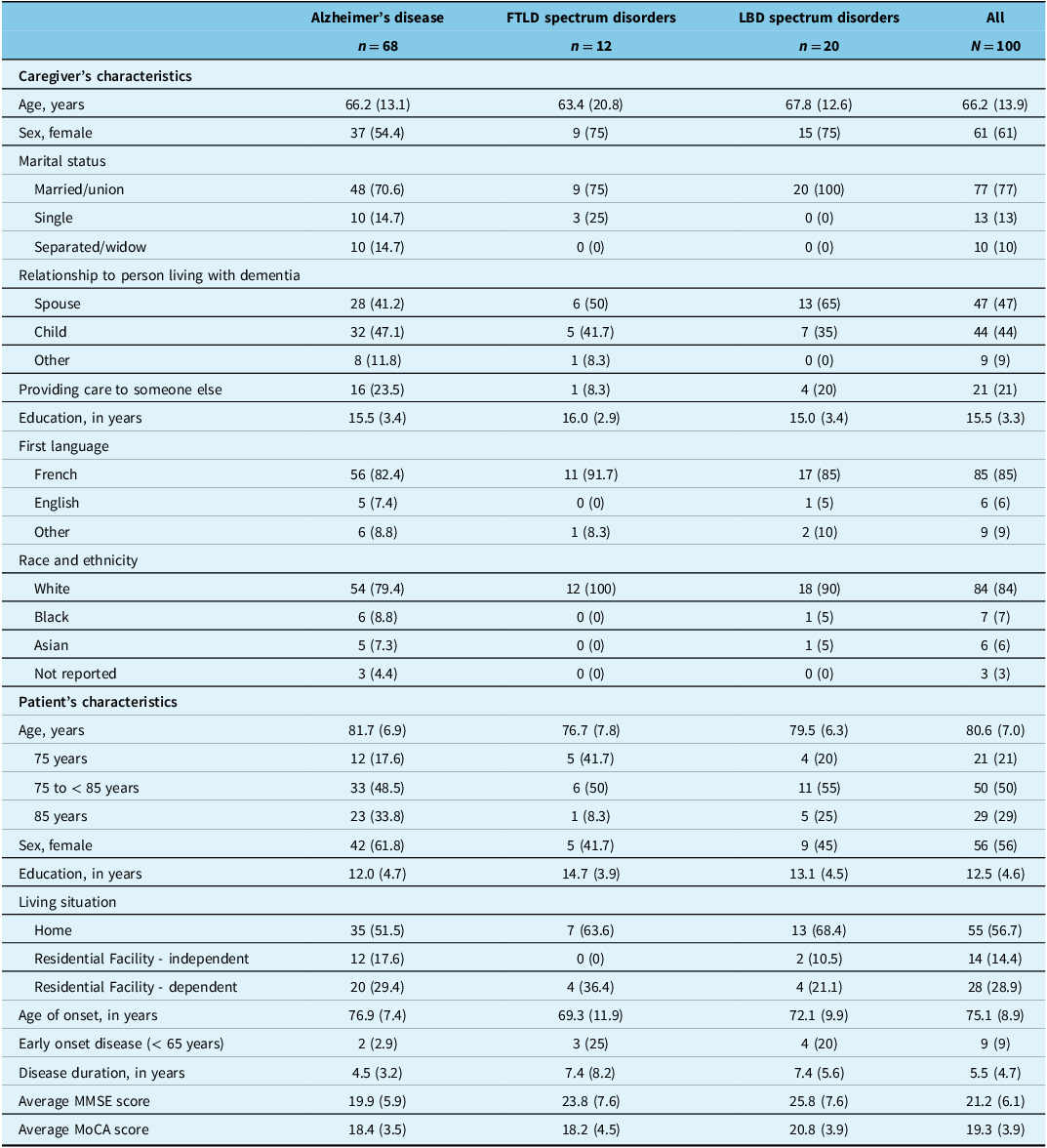
A total of 100 patient–caregiver dyads were recruited, and 78 dyads completed the second visit at 6 months. Caregivers average age was 66.2 ± 13.9 years and 61% were females, with an average of 15.5 ± 3.3 years of education (Table 1). Caregivers were most often the patient’s spouse (47%), followed by their child (44%), and 21% of caregivers reported they were also providing informal care to another person concomitantly. Female caregivers were most frequently the patient’s spouse (47.5%) and were providing informal care to a male individual (59%), while male caregivers were most frequently the patient’s child (51.3%) and were providing informal care to a female individual (79.5%) (see Supplementary Table 1). Patients’ average age was 80.6 ± 7.0 years, 56% were females, and most were living at home (55%). Regarding the etiologies of dementia, 68% had AD, 20% had a LBD spectrum disorder and 12% had an FTLD spectrum disorder, with an average disease duration of 5.5 ± 4.7 years.
Caregivers’ baseline characteristics according to their loved one main neurocognitive diagnosis

Note: Values represent averages (standard deviations) and counts (percentages).
FTLD = frontotemporal lobar degeneration; LBD = Lewy body disease; MoCA = Montreal cognitive assessment; MMSE = mini-mental status examination.
Baseline factors associated with high caregiver burden
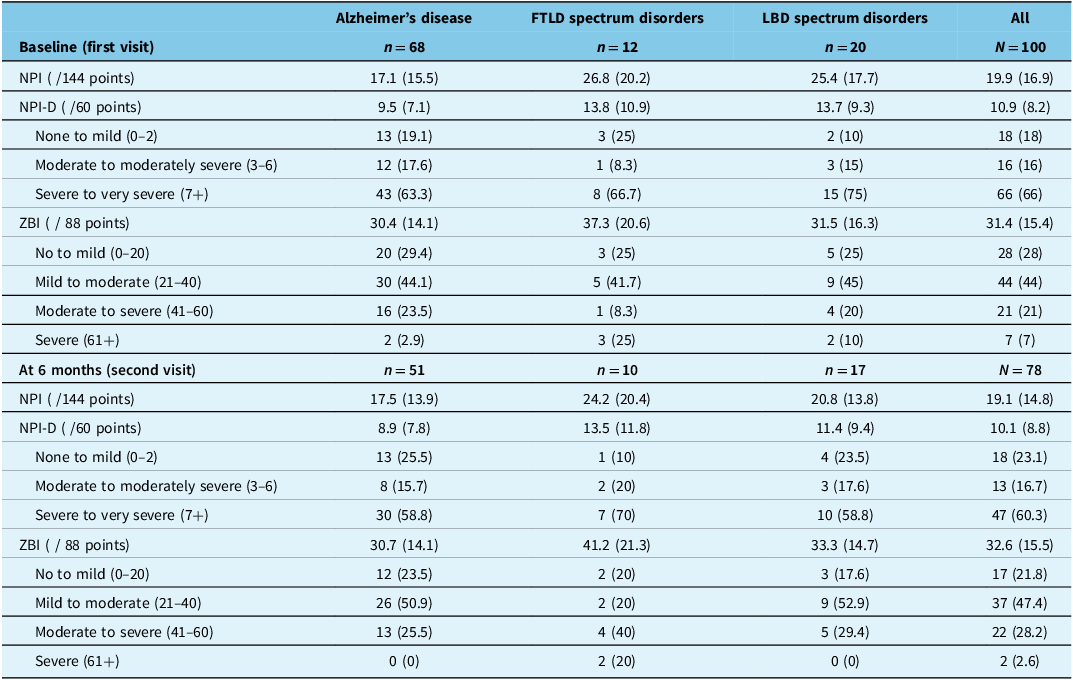
At baseline, caregivers burden according to the ZBI was in the mild to moderate range, with an average score of 31.4 ± 15.4 points, with 28% of caregivers with a score in the moderate to severe range (Table 2). Female caregivers had significantly higher burden on the ZBI compared to male caregivers, 33.9 ± 16.2 points vs. 27.4 ± 13.5 points, respectively (p = 0.039) (see Supplementary Table 2). Regarding NPS, the average total NPI score was 19.9 ± 16.9 points, while the average total NPI-D score was 10.9 ± 8.2 points, with 66% of caregivers having a distress score in the severe to very severe range. The total NPI scores varied significantly according to the patient’s diagnosis (p = 0.049), with FTLD and LBD having higher total scores than AD. Female caregivers reported significantly higher overall NPS in their loved ones than male caregivers, 23.6 ± 18.4 points vs. 14.2 ± 12.4 points, respectively (p = 0.006).
Patients’ neuropsychiatric symptoms and caregivers’ burden over time according to diagnosis

Note: Values represent averages (standard deviations) and counts (percentages).
FTLD = frontotemporal lobar degeneration; LBD = Lewy body disease; NPI = neuropsychiatric inventory; NPI-D = neuropsychiatric inventory – distress; ZBI = Zarit Burden interview.
At 6 months, the ZBI was 32.6 ± 15.5 points, with 30.7% of caregivers with a score in the moderate to severe range (Table 2). Prolonged high caregiver burden according to ZBI cutoff scores of 24 points and 41 points was found in 57.5% and 19.2% of caregivers, respectively. The total NPI and NPI-D scores remained stable, with an average of 19.1 ± 14.8 points and 10.1 ± 8.8 points, respectively, with 60.3% of caregivers having a distress score in the severe to very severe range.
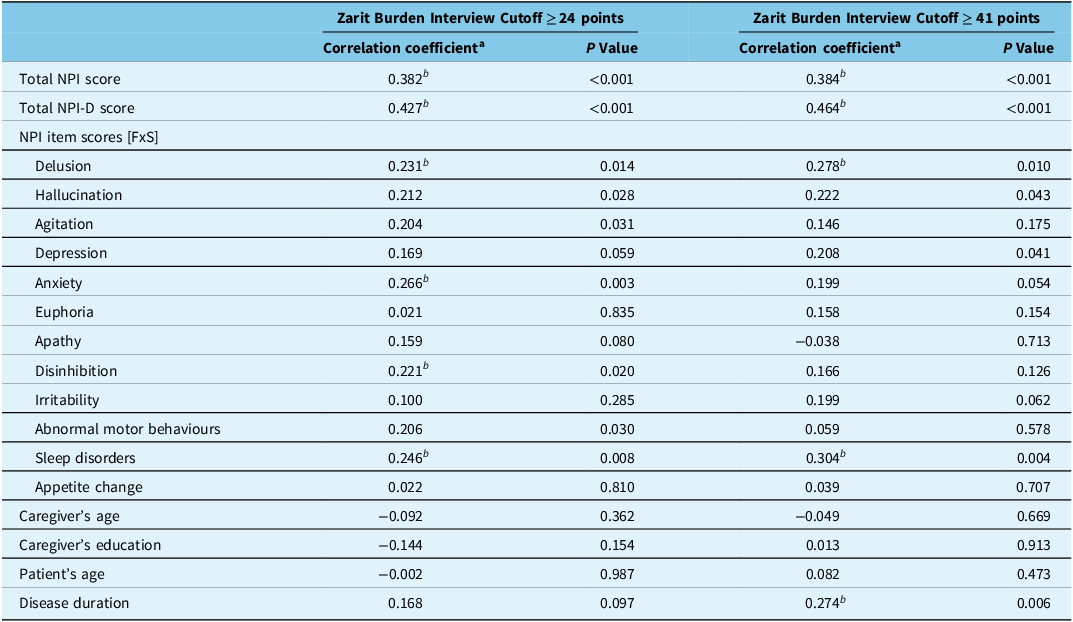
Correlation analyses between caregiver burden according to the ZBI scores with NPS and biopsychosocial factors at baseline are reported in Table 3. The total NPI and total NPI-D scores significantly correlated positively with high caregiver burden, regardless of the cutoff used (all p values < 0.001). Disease duration also significantly correlated positively with burden when using a cutoff of 41 points on the ZBI (r = 0.274, p = 0.006). Several NPS significantly correlated positively with high caregiver burden, regardless of the cutoff used, specifically delusion, hallucination and sleep disorders. Depression item score significantly correlated positively with the higher ZBI cutoff (τ = 0.208, p = 0.041), while agitation, anxiety, disinhibition and abnormal motor behavior item scores significantly correlated positively with the lower ZBI cutoff. No statistically significant correlations were found for the NPS of euphoria, apathy, irritability and appetite change, caregiver’s age and education and patient’s age. After correcting for multiples comparisons, the correlations between high caregiver burden with the total NPI, total NPI-D, delusion, anxiety, disinhibition, sleep disorders and disease duration remained statistically significant.
Correlations between neuropsychiatric symptoms and biopsychosocial factors at baseline with caregiver burden

Note: a Kendall-tau’s (τ) correlation coefficients for analyses with NPI item scores and Pearson’s (r) correlation coefficients for other variables.
b Correlation remained statistically significant after Benjamini–Hochberg correction for false discovery rate.
NPI = neuropsychiatric inventory; NPI-D = neuropsychiatric inventory – distress.
Correlation analyses were repeated according to caregiver’s sex (see Supplementary Table 3). For both sexes, total NPI and total NPI-D scores correlated significantly with high burden, with the notable exception of male caregivers with the higher ZBI cutoff. For female caregivers, significantly positive correlations with high burden were found for delusion, hallucinations, agitation, anxiety, disinhibition, abnormal motor behaviors and sleep disorders, as well as with disease duration. For male caregivers, significantly positive correlations between high burden and depression and irritability were found.
Baseline factors associated with prolonged high caregiver burden at 6 months
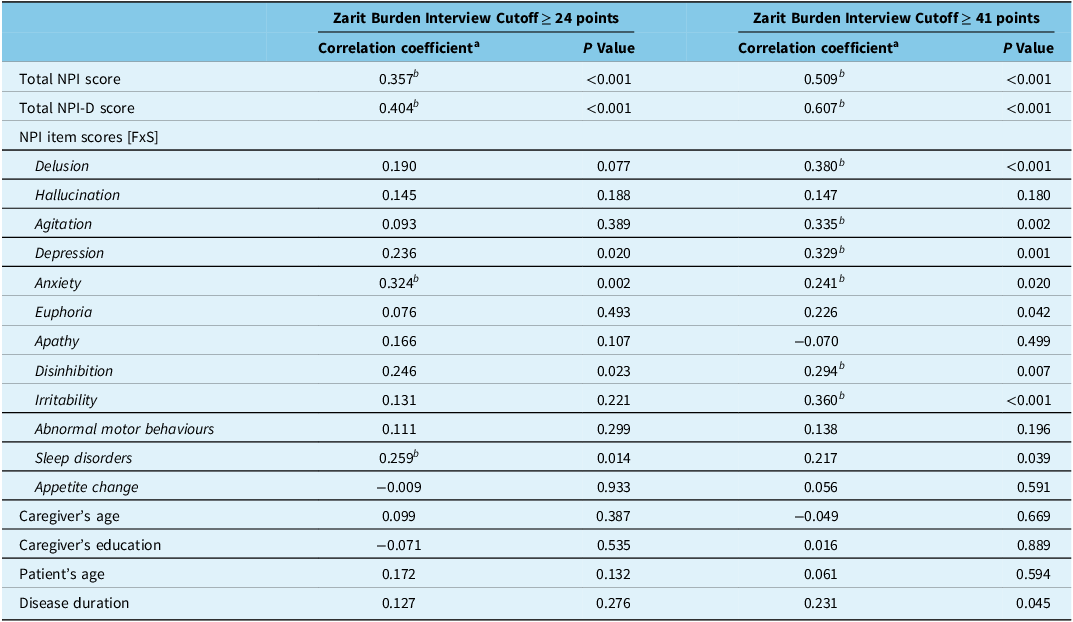
Correlation analyses between prolonged high caregiver burden at 6 months according to the ZBI scores with NPS and biopsychosocial factors at baseline are reported in Table 4. Again, the total NPI and total NPI-D scores significantly correlated positively with prolonged high caregiver burden, regardless of the cutoff used (all p values < 0.001). Several NPS significantly correlated positively with prolonged high caregiver burden, regardless of the cutoff used, specifically depression, anxiety, disinhibition and sleep disorders. Delusion, agitation, euphoria and irritability item scores significantly correlated positively with a higher ZBI cutoff. After correcting for multiples comparisons, the correlations between prolonged high caregiver burden with the total NPI, total NPI-D, delusion, agitation, depression, anxiety, disinhibition, irritability and sleep disorders remained statistically significant.
Correlations between neuropsychiatric symptoms and biopsychosocial factors with prolonged high caregiver burden at 6 months

Note: a Kendall-tau’s (τ) correlation coefficients for analyses with NPI item scores and Pearson’s (r) correlation coefficients for other variables.
b Correlation remained statistically significant after Benjamini–Hochberg correction for false discovery rate (FDR).
NPI = neuropsychiatric inventory; NPI-D = neuropsychiatric inventory – distress.
Correlation analyses were repeated according to caregiver’s sex (see Supplementary Table 4). Again, for both sexes, total NPI and total NPI distress scores correlated positively and significantly with prolonged high burden, regardless of the cutoff used, except for male caregivers with a ZBI cutoff of 41 points for the total NPI score. For male caregivers, the depression and irritability item scores had the strongest positive correlations with high prolonged burden (τ = 0.450, p = 0.009; and τ = 0.578, p = 0.001, respectively), while for female caregivers, delusion and agitation item scores had the strongest positive correlations (τ = 0.475, p < 0.001; and τ = 0.464, p < 0.001, respectively).
Sensitivity analyses
Results of the repeated correlation analyses with imputed missing data (i.e., ZBI scores from 22 dyads lost to follow-up at the second visit) are presented in Supplementary Table 5 and Supplementary Table 6. Characteristics of participants lost to follow-up are presented in Supplementary Table 7. Overall, most significant positive correlations remained robust after sensitivity analyses. Exceptions were observed for the correlation of anxiety with prolonged higher caregiver burden when applying a cutoff of 41 points on the ZBI, the correlations of depression and irritability with prolonged higher burden among female caregivers when using a cutoff of 41 points on the ZBI and the correlation between the total NPI-D score and prolonged higher burden among male caregivers at the 41 cutoff.
Discussion
Caregivers of individuals living with dementia experience substantial and enduring burden. In our longitudinal cohort of 100 older patient–caregiver dyads recruited in specialized neurology and geriatric clinics, nearly one-third of caregivers reported moderate to severe burden at baseline, and a similar proportion persisted at 6 months. These findings confirm the high prevalence of caregiver distress and highlight its persistence over time. Reference Brodaty, Woodward, Boundy, Ames and Balshaw32,Reference Hsieh, Leyton and Caga33 Our results demonstrate that NPS are strong correlates of caregiver burden, in line with prior studies, most specifically in AD. Reference Cheng, Lam and Kwok34–Reference Mank, van Maurick and Rijnhart37 Specifically, psychotic symptoms (delusions and hallucinations), agitation, anxiety, disinhibition, sleep disorders and depression emerged as particularly distressing to caregivers. Importantly, depression, anxiety, disinhibition and sleep disorders predicted prolonged high burden over 6 months, underscoring their long-term impact on caregivers’ well-being. Psychotic symptoms and sleep disturbances also disproportionately affected female caregivers, whereas mood symptoms were more strongly associated with male caregivers’ burden.
Several factors may explain these findings. First, sex-related differences in exposure to patient symptomatology may be influenced by the neuroepidemiology of dementia subtypes: LBD spectrum disorders, characterized by complex visual hallucinations, systematized delusions and rapid eye movement sleep behavior disorder, are more prevalent in males, meaning their symptoms are more frequently encountered by female caregivers. Reference Couture, Carmel and Rousseau38 Conversely, AD, which often presents with mood symptoms, is more prevalent in females, thereby exposing male caregivers to a higher burden from depression and irritability. Reference Eikelboom, Pan and Ossenkoppele39 Second, coping strategies may differ by gender. While women may be more experienced or socially supported to manage mood disturbances, men caregivers may perceive behavioral dysregulation (e.g., agitation and disinhibition) as less distressing but struggle more with mood-related symptoms in their care recipients. These patterns align with prior evidence showing that female caregivers tend to rely more on emotion-focused coping and report greater distress when confronted with persistent affective symptoms, whereas male caregivers more often use task-oriented or problem-focused strategies and experience heightened strain when emotional or interpersonal demands increase. Reference Bullard, Brown, Scheffer, Toledo and Levenson40–Reference Roden and Falzarano42 Studies have also shown that men are more likely to suppress emotional responses – a strategy associated with poorer psychological outcomes – while women more frequently engage in cognitive reappraisal or seek social support, which may buffer the impact of certain NPS. Reference Bullard, Brown, Scheffer, Toledo and Levenson40 Third, the fluctuating versus persistent nature of NPS, as well as their clinical response to pharmacological interventions, may modulate their impact. For instance, psychosis and disinhibition, although less prevalent overall, are acutely disruptive and often unpredictable, thereby placing unique strain on caregivers. Sleep disorders, in particular, interfere with caregivers’ own rest and contribute to cumulative fatigue, a well-documented risk factor for burnout. Reference Gehrman, Gooneratne, Brewster, Richards and Karlawish43,Reference Perez, Perrin, Lageman, Villaseñor and Dzierzewski44 Moreover, the nature of the caregiver–care recipient relationship may further account for these patterns. Spouse caregivers (typically women), who cohabit with the care recipient, experience greater exposure to psychotic manifestations and sleep disturbances, whereas adult child caregivers, who often live apart of care recipients, are more affected by mood disturbances observed during visits.
Our analyses allow us to identify caregivers at heightened risk of prolonged burden, regardless of the specific dementia subtype or stage. In particular, caregivers of patients with anxiety, depression, disinhibition or sleep disorders may benefit from earlier psychosocial support and symptom-targeted interventions. Recognition of sex- and gender-specific patterns is also clinically relevant, suggesting that tailored approaches – such as psychoeducation, counseling and support strategies adapted to caregiver sex/gender and coping styles – may mitigate burden more effectively. Reference Pöysti, Laakkonen and Strandberg45 For example, male caregivers, who more often adopt task-focused coping, may benefit from structured care plans, problem-solving training and brief, skills-based programs that provide clear strategies for managing disinhibition or nighttime behaviors. In contrast, female caregivers, who more frequently use emotion-focused coping, may benefit from emotional support groups, interventions addressing guilt and role overload and programs enhancing boundary-setting and self-care. Caregivers who rely on avoidant coping may benefit from motivational interviewing or stress appraisal interventions, while those using hyper-vigilant or protective coping – common in spousal caregivers – may benefit from sleep hygiene coaching, respite planning and behavioral coaching for managing anxiety or depressive symptoms in the patient. Gender roles also shape caregiving expectations; thus, interventions such as peer support networks tailored to gendered caregiving experiences or care-navigation assistance for individuals with limited social support may be particularly beneficial. While we primarily reported results according to caregiver sex, we also collected information on gender, with all participants identifying as cisgender. This distinction remains important, as gender roles and social expectations may influence caregiving experiences independently of biological sex. Future studies should therefore consider both sex- and gender-based analyses to capture the complexity of caregiving dynamics, in more gender-diverse individuals and across and within different dementia subtypes and stages.
Strengths and limitations
Our prospective study has several important strengths. First, by recruiting patient–caregiver dyads with commonly encountered neurodegenerative conditions (AD, LBD and FTLD) across a broad disease continuum, from mild to severe stages, our findings have high clinical representativeness. Second, we examined sex-related differences, which remains an underexplored but increasingly recognized dimension of caregiving research. Finally, because there is no universally accepted cutoff for defining “high caregiver burden,” our analysis’s robustness was enhanced by using two distinct thresholds on the ZBI: one previously associated with a risk of depression and a second categorical threshold for moderate to severe burden. This approach strengthens the clinical transferability of our findings and provides practical guidance for clinicians. Nonetheless, several limitations must be acknowledged. First, our subgroup sizes were insufficient for a detailed analysis of disease- or stage-specific associations between NPS and burden. While we presented our results according to patient-specific diagnosis, correlation analysis was only performed across diagnoses. For instance, while psychotic symptoms are more prevalent, persistent and severe in LBD spectrum disorders, we could not determine if they are more distressing for LBD caregivers compared to those caring for individuals with other dementia etiologies. Reference Couture, Carmel and Rousseau38,Reference Galvin, Duda, Kaufer, Lippa, Taylor and Zarit46 Similarly, we were unable to fully explore how the impact of certain symptoms may diminish or change in later disease stages as well as the effect of other symptoms and manifestations not captured by the NPI (e.g., wandering and sundowning). Second, our predominantly Caucasian cohort (84%) limits the generalizability of our findings and the exploration of ethnocultural differences in caregiving, which is a critical, under-investigated issue. Reference Liu, Chi and Wu47 In addition, participating caregivers had a high level of education (more than 15 years of education), which is considered a protective factor against caregiver burden through enhanced knowledge, skills and coping mechanisms as well as better access to resources. Third, recruitment from a specialized geriatric cognitive clinic and movement disorder clinic in a tertiary care setting may introduce a referral bias toward more complex cases, which could reduce the generalizability of our results to community-based or primary care populations, where symptoms might be less severe and caregiver burden may be related to other factors, such as issues with accessing specialized care. Reference Ramakrishnan and Malhotra48 At last, we excluded patients younger than 60 years. Hence, the burden of caregivers for individuals with young-onset dementia was not explored in our study.
Conclusion
This prospective study of 100 patient–caregiver dyads demonstrates that caregiver burden is both highly prevalent and persistent over time. NPS – particularly depression, anxiety, disinhibition and sleep disturbances – are key drivers of both acute and sustained burden, with sex-specific patterns observed. These findings underscore the need for systematic assessment of NPS in dementia care, as well as early identification and targeted support of caregivers most at risk. Personalized biopsychosocial interventions addressing both the patient’s symptoms and the caregiver’s coping resources may represent the most effective strategy to reduce long-term caregiver distress and improve outcomes for both members of the dyad.
Supplementary Material
The supplementary material for this article can be found at https://doi.org/10.1017/cjn.2026.10545.
Data Availability Statement
The data that support the findings of this study are available from the corresponding author upon reasonable request.
Acknowledgments
We thank Sylvain G. Bélisle for his help in creating the tables.
Author Contribution
OS and PD designed the study. OS, MC and PD collected and analyzed the data. OS and PD interpreted the data. OS and PD drafted the manuscript. All authors contributed significantly to the content, critically reviewed and approved the final manuscript for publication.
Funding Statement
None.
Competing Interests
The authors declared no potential conflicts of interest with respect to the research, authorship and publication of this article.




Target article
Neuropsychiatric Symptoms and Caregiver Burden in Dementia: A Longitudinal Dyadic Cohort Study
Related commentaries (2)
Reviewer Comment on Skoda et al. “Neuropsychiatric Symptoms and Caregiver Burden in Dementia: A Longitudinal Dyadic Cohort Study”
Reviewer Comment on Skoda et al. “Neuropsychiatric Symptoms and Caregiver Burden in Dementia: A Longitudinal Dyadic Cohort Study”