INTRODUCTION
Parkinson’s disease (PD) is a neurodegenerative disorder in which basal ganglia (BG) deterioration progressively compromises motor function and high-level cognition (McKinlay, Grace, Dalrymple-Alford, & Roger, Reference McKinlay, Grace, Dalrymple-Alford and Roger2010; Samii, Nutt, & Ransom, Reference Samii, Nutt and Ransom2004; Svenningsson, Westman, Ballard, & Aarsland, Reference Svenningsson, Westman, Ballard and Aarsland2012). Its growing prevalence, now estimated at 1% in the elderly population (Samii et al., Reference Samii, Nutt and Ransom2004), creates major socio-financial burdens. A need thus arises for measures enabling early (and, ideally, preclinical) detection to diminish its worldwide impact.
Linguistic tasks are promising tools in this regard (Bocanegra et al., Reference Bocanegra, García, Pineda, Buriticá, Villegas, Lopera and Ibáñez2015; García & Ibáñez, Reference García and Ibáñez2014). Indeed, executive deficits in PD (McKinlay et al., Reference McKinlay, Grace, Dalrymple-Alford and Roger2010) are typically accompanied by impairments of syntax, action semantics, and action-verb processing (Bocanegra et al., Reference Bocanegra, García, Pineda, Buriticá, Villegas, Lopera and Ibáñez2015; Cardona et al., Reference Cardona, Gershanik, Gelormini-Lezama, Houck, Cardona, Kargieman and Ibanez2013; García & Ibáñez, Reference García and Ibáñez2014; García et al., 2016). In line with embodied cognition models (Barsalou, Reference Barsalou1999; Cardona et al., Reference Cardona, Gershanik, Gelormini-Lezama, Houck, Cardona, Kargieman and Ibanez2013; Gallese & Lakoff, Reference Gallese and Lakoff2005; García & Ibáñez, Reference García and Ibáñez2016), such findings indicate that networks specialized for sequencing hierarchically organized motor patterns (such as the basal ganglia) are critical for homologous linguistic operations—sequencing hierarchically organized lexical patterns, namely, syntax (Ullman, Reference Ullman2004, Reference Ullman2008)—and for processing action-related information (Bak, Reference Bak2013)—as captured in recent action-language coupling models based on dynamic networks and predictive-coding principles (García & Ibáñez, Reference García and Ibáñez2016). In this unprecedented study, we explore whether such language disturbances are also present in asymptomatic individuals at risk for PD.
While most patients present sporadic forms of the disease, genome-wide association studies have identified 28 risk loci, including mutations in PARK2 or LRRK2 (Nalls et al., Reference Nalls, Pankratz, Lill, Do, Hernandez, Saad and Singleton2014). Since PD features prolonged prodromal stages (Braak et al., Reference Braak, Del Tredici, Bratzke, Hamm-Clement, Sandmann-Keil and Rub2002), research on distinctive deficits shared by symptomatic and asymptomatic mutation carriers may reveal preclinical impairments and open opportunities for new therapeutic approaches. Here, we pursue this possibility by comparing linguistic skills among sporadic PD patients (PD-Sp), genetic PD patients with PARK2 or LRRK2 mutation (PD-Gen), asymptomatic first-degree relatives of the latter with similar mutations (PD-Rel), and healthy controls.
Our focus is on PD-Rel. Though free of motor symptoms, these individuals carried PARK2 or LRRK2 gene mutations. The latter is the main genetic determinant of PD (Goldwurm et al., Reference Goldwurm, Di Fonzo, Simons, Rohe, Zini, Canesi and Bonifati2005), and it was present in most subjects. Mutations at the LRRK2 gene present an autosomal dominant pattern and lead to substantia nigra atrophy. Yet, the expression of this gene is influenced by modifier genes which co-determine symptom severity and presentation age. Although disease onset will typically occur in late life (Goldwurm et al., Reference Pineda-Trujillo, Carvajal-Carmona, Buritica, Moreno, Uribe, Pineda and Ruiz-Linares2005), individuals with this mutation will eventually manifest PD.
Accordingly, we hypothesized that PD patients would be impaired across language domains, and that at least some of those deficits would also be present in PD-Rel. Evidence of such shared deficits would highlight the relevance of verbal measures to tap motor-network integrity even in the absence of movement disorders.
METHODS
Participants
The study included 106 adult participants from Antioquia, Colombia. This region is a genetic isolate with high rates of familial dementia, in general (Acosta-Baena et al., Reference Acosta-Baena, Sepulveda-Falla, Lopera-Gomez, Jaramillo-Elorza, Moreno, Aguirre-Acevedo and Lopera2011; Arcos-Burgos & Muenke, Reference Arcos-Burgos and Muenke2002), and PD, in particular (Pineda-Trujillo et al., Reference Pineda-Trujillo, Carvajal-Carmona, Buritica, Moreno, Uribe, Pineda and Ruiz-Linares2001, Reference Pineda-Trujillo, Apergi, Moreno, Arias, Lesage, Franco and Ruiz-Linares2006). The clinical samples comprised 33 PD-Sp patients, with no expression of any risk mutation tested; and eight PD-Gen patients, showing at least one of these risk mutations: the autosomal recessive C212Y mutation on PARK2 (caused by G to A transition at 736 position), the 321-322 GT insertion on exon 3 (321±322insGT) also on PARK2 (Pineda-Trujillo et al., Reference Pineda-Trujillo, Carvajal-Carmona, Buritica, Moreno, Uribe, Pineda and Ruiz-Linares2001), or the autosomal dominant mutation on gene LRRK2 (G2019S) (Goldwurm et al., Reference Goldwurm, Di Fonzo, Simons, Rohe, Zini, Canesi and Bonifati2005). Clinical diagnosis of PD was made by expert neurologists (A.V. and O.B.) following current criteria (Hughes, Daniel, Kilford, & Lees, Reference Hughes, Daniel, Kilford and Lees1992). Motor impairments were assessed with the Unified Parkinson’s Disease Rating Scale (section III). Disease stage was rated with the Hoehn & Yahr scale (except for five subjects from the PD-Sp group with unilateral movement disorders, all patients showed bilateral motor compromise). Functional skills were evaluated with the Barthel Index and the Lawton & Brody Index. All patients were evaluated during the “on” phase of medication.
PD-Rel comprised nine individuals unaffected by PD. All of them carried mutations on the PARK2 (N=3) or LRRK2 (N=6) genes, whose associated neuropathology is characterized by nigral degeneration. Homozygous (and, less often, heterozygous) expression of PARK2 mutations (Pineda-Trujillo et al., Reference Pineda-Trujillo, Apergi, Moreno, Arias, Lesage, Franco and Ruiz-Linares2006) has a penetrance of 80–90% around age 40. Instead, penetrance of LRRK2 mutations varies from 17% at age 50 to 85% at age 70 (Goldwurm et al., Reference Pineda-Trujillo, Carvajal-Carmona, Buritica, Moreno, Uribe, Pineda and Ruiz-Linares2005), showing that late disease onset is most typical.
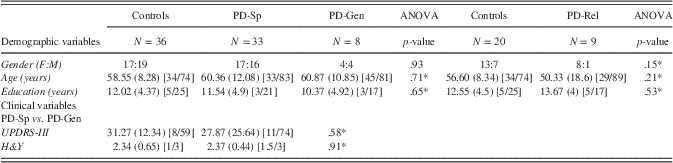
The clinical and subclinical samples were matched for gender, age, and education with two groups of healthy controls (N=36 and 20, respectively) featuring no familial history of PD. Additional participant data and statistical comparisons between groups can be found in Table 1.
Demographic data and clinical evaluation

Note. Values are expressed as mean (SD), except for gender. Ranges are provided between brackets [Min / Max].
PD-Sp = sporadic Parkinson’s disease patients; PD-Gen = genetic Parkinson’s disease patients with parkin or dardarin mutation; PD-Rel = asymptomatic first-degree relatives of PD-Gen with parkin or dardarin mutation; UPDRS-III = Unified Parkinson’s Disease Rating Scale, part III; H&Y = Hoehn & Yahr scale.
* p-values were calculated through ANOVA tests.
All participants were free of psychiatric conditions and gave written informed consent. The study was carried out in accordance with the Declaration of Helsinki and was approved by the Ethical Research Committee of Antioquia University’s Faculty of Medicine.
Materials
Participants completed a neuropsychological evaluation tapping executive, semantic, and linguistic domains typically compromised since early disease stages (Bocanegra et al., Reference Bocanegra, García, Pineda, Buriticá, Villegas, Lopera and Ibáñez2015; Cardona et al., Reference Cardona, Gershanik, Gelormini-Lezama, Houck, Cardona, Kargieman and Ibanez2013; García & Ibáñez, Reference García and Ibáñez2014; McKinlay et al., Reference McKinlay, Grace, Dalrymple-Alford and Roger2010). Executive functions were examined through the INECO Frontal Screening (IFS) battery (Torralva, Roca, Gleichgerrcht, Lopez, & Manes, Reference Torralva, Roca, Gleichgerrcht, Lopez and Manes2009), which taps domains such as motor programming, conflict resolution, inhibitory control, and working memory. This battery comprises 20 items, and its maximum score is 30.
Semantic representation of objects and actions was assessed through the Pyramids and Palm Trees (PPT) test and the Kissing and Dancing Test (KDT), respectively. In both tests, participants must choose which of two pictures is most closely related to a cue picture. Each test comprises 52 trials, and the maximum score is 52. These instruments have revealed specific deficits in PD (Bocanegra et al., Reference Bocanegra, García, Pineda, Buriticá, Villegas, Lopera and Ibáñez2015; Cardona et al., Reference Cardona, Kargieman, Sinay, Gershanik, Gelormini, Amoruso and Ibanez2014; Ibanez et al., Reference Ibanez, Cardona, Dos Santos, Blenkmann, Aravena, Roca and Bekinschtein2013) and other motor diseases, such as Huntington’s disease (Kargieman et al., Reference Kargieman, Herrera, Baez, Garcia, Dottori, Gelormini and Ibanez2014) and Cockayne syndrome (Baez et al., Reference Baez, Couto, Herrera, Bocanegra, Trujillo-Orrego, Madrigal-Zapata and Villegas2013). Also, action-verb processing was assessed through the Action Naming subtest of the Boston Diagnostic Aphasia Examination (BDAE), which requires naming 12 pictures depicting motor actions (the maximum score is 12). This skill is also differentially compromised in PD (Herrera & Cuetos, Reference Herrera and Cuetos2012).
Finally, syntactic comprehension was assessed with two BDAE subtests: Embedded Sentences and Touching A with B. In both measures, participants must choose which of four pictures best represents a given utterance. Global syntactic performance was calculated by integrating both subtests’ scores (22 items, with a maximum score of 22). However, we also calculated separate scores, as each measure taps different syntactic processes. Stimuli in Embedded Sentences (10 items, maximum score=10) include relative clauses in their subject (e.g., The woman who is fat is kissing her husband) or direct object (e.g., The girl is chasing the boy who is wearing boots). Instead, Touching A with B (12 items, maximum score=12) features phrases with the verb touching and two nouns: in some cases, both nouns are coordinated direct objects (e.g., touching the spoon and the scissors); in others, one is a direct object and the other an instrumental adjunct (touching the scissors with the comb). Thus, while the former task is more crucially associated with executive (viz., working memory) skills, the latter requires identifying functional roles within predicates and depends less critically on extralinguistic mechanisms (Bocanegra et al., Reference Bocanegra, García, Pineda, Buriticá, Villegas, Lopera and Ibáñez2015). These tasks have revealed subtle deficits in motor disorders, including Huntington’s disease (Azambuja et al., Reference Azambuja, Radanovic, Haddad, Adda, Barbosa and Mansur2012), Cockayne syndrome (Baez et al., Reference Baez, Couto, Herrera, Bocanegra, Trujillo-Orrego, Madrigal-Zapata and Villegas2013), and, crucially, PD (Bocanegra et al., Reference Bocanegra, García, Pineda, Buriticá, Villegas, Lopera and Ibáñez2015).
Statistical Analysis
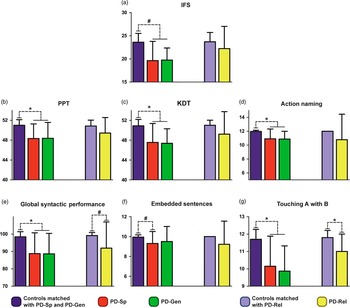
Demographic and experimental data were analyzed using analysis of variance (ANOVA) and Tukey’s honest significant difference (HSD) post hoc tests (except for gender, which was analyzed via Pearson chi-square tests). Effect sizes were calculated with Eta squared (n 2 ). Considering the current debate on whether language deficits in PD are influenced by executive dysfunction (Bocanegra et al., Reference Bocanegra, García, Pineda, Buriticá, Villegas, Lopera and Ibáñez2015; Hochstadt, Nakano, Lieberman, & Friedman, Reference Hochstadt, Nakano, Lieberman and Friedman2006), we addressed the possible influence of executive skills on language measures. To this end, the latter were also scrutinized with analysis of covariance (ANCOVA) using IFS scores as covariates. For brevity, the Results section offers only verbal descriptions of the observed differences. Full statistics are offered in Tables 2 and 3, and summarized in Figure 1.
Statistical analysis of executive, semantic, and linguistic tasks. # indicates statistical differences at p<.05. * indicates statistical differences at p<.05 after a covariance test adjusted for IFS scores (see statistical details in Tables 2 and 3). Black vertical bars indicate standard deviations. The y-axis in each panel shows the numerical scores of the corresponding test, except for “Global syntactic performance,” which is represented in percent values. IFS: INECO Frontal Screening battery; PPT: Pyramids and Palm Tress test; KDT: Kissing and Dancing Test; PD-Sp: sporadic PD patients; PD-Gen: genetic PD patients with parkin or dardarin mutation; PD-Rel: asymptomatic first-degree relatives of the latter with similar mutations.

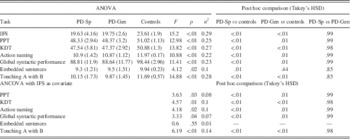
Statistical details of the performance of PD-Sp, PD-Gen, and matched healthy controls on the IFS and all semantic and language measures

Note. Values are expressed as mean (SD).
PD-Sp = sporadic Parkinson’s disease patients; PD-Gen = genetic Parkinson’s disease patients with parkin or dardarin mutation; IFS = INECO Frontal Screening battery; PPT = Pyramids and Palm Tress test; KDT = Kissing and Dancing Test.
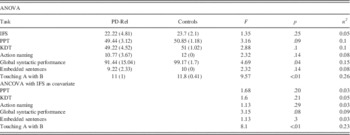
Statistical details of the performance of PD-Rel and matched healthy controls on the IFS and all semantic and language measures

Note. Values are expressed as mean (SD).
PD-Rel = asymptomatic first-degree relatives of PD-Gen with parkin or dardarin mutation; IFS = INECO Frontal Screening battery; PPT = Pyramids and Palm Tress test; KDT = Kissing and Dancing Test.
RESULTS
Sporadic and Genetic Patients
Executive performance was significantly better for controls than PD-Sp and PD-Gen (p<.01). The same was true of all language measures (all ps<.03). Of interest, deficits in PPT, KDT, Action Naming, global syntactic performance, or Touching A with B were not influenced by executive impairment (all ps<.05). The only difference that disappeared for both patient groups after adjusting for IFS scores corresponded to Embedded Sentences (p=.55). Finally, no analysis showed differences between PD-Sp and PD-Gen (Figure 1 and Table 2). In sum, except for complex-sentence processing impairments, other language deficits in both clinical groups were independent from executive dysfunction.
Asymptomatic Mutation Carriers
Executive performance was similar between PD-Rel and controls (p=.25). Likewise, no between-group differences were observed in PPT (p=.09), KDT (p=.10), or Action Naming (p=.14). These patterns remained unchanged after covariation with IFS scores. However, global syntactic performance was significantly poorer for PD-Rel (p=.04). This difference was driven by the results of one specific subtest. Whereas PD-Rel did not differ from controls in the Embedded Sentences task (p=.14), they showed significantly lower scores in Touching A with B (p<.01). The latter two results remained after covariation with IFS scores (Figure 1 and Table 3). In short, PD-Rel evinced selective, sui generis difficulties in a syntactic task which does not crucially rely on executive skills.
DISCUSSION
Both PD-Sp and PD-Gen showed pervasive language deficits. Their impairments in action semantics, object semantics, and action naming replicate previous findings in PD (Cotelli et al., Reference Cotelli, Borroni, Manenti, Zanetti, Arevalo, Cappa and Padovani2007) and other motor disorders, such as motor neuron disease and amyotrophic lateral sclerosis (Bak & Hodges, Reference Bak and Hodges2004). These deficits were not influenced by executive abilities. However, executive skills were differentially related to syntactic subdomains: whereas executive dysfunction did not influence the patients’ deficits to identify functional roles within predicates, it did account for their difficulties in complex-sentence processing. These findings mirror those from a study on early sporadic PD patients (Bocanegra et al., Reference Bocanegra, García, Pineda, Buriticá, Villegas, Lopera and Ibáñez2015), corroborating the multidimensional role of the BG in language (Cardona et al., Reference Cardona, Gershanik, Gelormini-Lezama, Houck, Cardona, Kargieman and Ibanez2013).
The involvement of executive functions in only one of the syntactic subtests arguably reflects the latter’s differential demands. Parsing of embedded sentences calls on working memory mechanisms to maintain information active during processing of long-distance dependencies (Hochstadt et al., Reference Hochstadt, Nakano, Lieberman and Friedman2006). In a sentence like The woman who is fat is kissing her husband, subject-verb agreement cannot be established until the relative clause (who is fat) has been processed. Similarly, the pronoun her must be linked to its co-referential noun. To both ends, subject-relevant information must be kept active in working memory as new constituents are being parsed. Processing requirements are very different in Touching A with B. For example, the grammatical function of the phrase the scissors in touching the spoon and the scissors and touching the spoon with the scissors is determined by its immediately previous word: when preceded by and, it manifests the same function as its preceding noun phrase (direct object); when preceded by with, it is necessarily an instrumental adjunct. Thus, this task suggests negligible demands on working memory and other executive functions, as recently shown (Bocanegra et al., Reference Bocanegra, García, Pineda, Buriticá, Villegas, Lopera and Ibáñez2015).
Yet, our most interesting finding concerned PD-Rel. These subjects gave no signs of executive, semantic, or action-verb production difficulties. More crucially, while they were not impaired in Embedded Sentences, they showed a significant disturbance in Touching A with B. This dissociation within the syntactic domain fits well with our previous interpretation. Performance on Embedded Sentences was arguably spared because the key executive mechanisms needed to parse long-distance dependencies were still operative. Thus, even if networks more specifically devoted to grammar were compromised, executive resources sufficed for task completion (Hochstadt et al., Reference Hochstadt, Nakano, Lieberman and Friedman2006).
Conversely, Touching A with B relies less crucially on domain-general skills. Indeed, as was the case with PD-Sp and PD-Gen, deficits in this task for PD-Rel were independent of executive abilities. This pattern aligns with our claim that the identification of functional roles within predicates depends on specifically grammatical mechanisms and involves minimal reliance on working memory. Despite the small size of the PD-Rel sample and the ceiling-level performance of its controls, this task yielded a large effect size (n 2 higher than 0.2; see Table 3). This result is noteworthy as effect sizes reveal the magnitude of between-group differences irrespective of sample size. Accordingly, we propose that this sui generis disturbance may constitute a preclinical sign of focal and incipient BG (specifically, nigral) deterioration, indexing possible development of PD. This finding also suggests that PARK2 and LRRK2 mutations compromising BG functioning have subtle disease-independent effects on syntactic mechanisms.
This explanation also accounts for why action semantics and action-verb deficits were absent in PD-Rel despite being a hallmark of PD (García & Ibáñez, Reference García and Ibáñez2014). While those domains share frontostriatal circuits with syntax, they depend on more widely distributed networks. Indeed, conceptual and lexical processing of action-related information is mainly associated with frontal (e.g., primary motor and premotor cortices, Broca’s area) and, less crucially, temporal (e.g., Wernicke’s area) hubs (Cardona et al., Reference Cardona, Gershanik, Gelormini-Lezama, Houck, Cardona, Kargieman and Ibanez2013; García & Ibáñez, Reference García and Ibáñez2016; Pulvermuller, Reference Pulvermuller2005). Thus, although advanced atrophy in clinical PD stages preeminently disturbs such functions, complete sparing of cortical networks would support their adequate processing in asymptomatic mutation carriers.
In sum, individuals at genetic risk for PD could be characterized by impairments in language skills which focally rely on BG integrity. Deficits in other language domains could be specific to clinical stages, after cerebral atrophy has surpassed a critical threshold (Braak et al., Reference Braak, Del Tredici, Bratzke, Hamm-Clement, Sandmann-Keil and Rub2002). In this sense, note that mean scores of the PD-Rel group in all other measures were below those obtained by controls. Tentatively, these results could reflect a (yet non-significant) pattern of difficulties which is likely to turn into full-blown deficits once subjects reach a clinical stage. While speculative in nature (mainly due to the sample’s size), this possibility would reinforce the specificity of syntactic subdomains (in particular, functional role assignment) as key targets for the pre-clinical detection of probable PD. Indeed, effect sizes for “Touching A with B” were notably higher than those for all tasks yielding non-significant differences (see Table 3).
Implications
The worldwide spread of PD calls for tools allowing timely diagnosis and intervention. Our data suggest that specifically syntactic deficits may constitute a preclinical sign of the disease, even before other linguistic and extralinguistic domains are affected. Promisingly, the task affording this finding (Touching A with B) is an ultra-brief, robust measure which could be massively applied to patients and their asymptomatic relatives.
So far, only one study on PD has applied it, mirroring our findings in early-stage patients (Bocanegra et al., Reference Bocanegra, García, Pineda, Buriticá, Villegas, Lopera and Ibáñez2015). Yet, the task has also shown deficits in other autosomal dominant neurodegenerative motor disorders, such as Huntington’s disease (Azambuja et al., Reference Azambuja, Radanovic, Haddad, Adda, Barbosa and Mansur2012). Above and beyond this instrument, additional syntactic tasks revealing deficits in early PD patients (Cardona et al., Reference Cardona, Gershanik, Gelormini-Lezama, Houck, Cardona, Kargieman and Ibanez2013) could be applied to asymptomatic mutation carriers with the aim to develop a preclinical screening protocol. Prodromal detection of motor-network dysfunction could offer clinicians an opportunity to delay functional decline, perhaps via cognitive training.
However, note that these possibilities should be entertained with great caution. In addition to featuring a modest size, both genetic samples included two gene mutations with different penetrance in different age ranges: for PARK2, 80–90% around age 40 (Pineda-Trujillo et al., 2001, 2006); for LRRK2, 17% at age 50 and 85% at age 70 (Goldwurm et al., Reference Pineda-Trujillo, Carvajal-Carmona, Buritica, Moreno, Uribe, Pineda and Ruiz-Linares2005). Thus, a long-term follow-up study would be indispensable to corroborate the hypothesis emerging from our results, and to clarify their specific relation to each mutation.
Our findings also have theoretical implications. First, a debate has emerged on whether syntactic deficits in PD depend on executive dysfunction (Bocanegra et al., Reference Bocanegra, García, Pineda, Buriticá, Villegas, Lopera and Ibáñez2015; Hochstadt et al., Reference Hochstadt, Nakano, Lieberman and Friedman2006). Rather than supporting overarching affirmative or negative answers, our data suggest that the question may have been posed at a wrong level of granularity. Indeed, syntactic sub-functions with discrepant executive demands may be differentially compromised following BG deterioration.
Second, while deficits in PD-Sp and PD-Gen confirm the cross-dimensional role of BG circuits in language functions, results from PD-Rel suggest that these subcortical structures (and, in particular, the substantia nigra) are more focally related to domain-specific syntactic skills. Such a finding fits well within the embodied cognition framework, which posits that high-order cognition is rooted in lower-level sensorimotor systems (Barsalou, Reference Barsalou1999; Gallese & Lakoff, Reference Gallese and Lakoff2005). Accordingly, we propose that the crucial role of the BG for handling syntax (i.e., sequencing hierarchically organized patterns of linguistic information) stems from its more basic specialization for handling movement (i.e., sequencing hierarchically organized patterns of sensorimotor information). This hypothesis is compatible with multiple reports of syntactic impairments in PD (Angwin, Chenery, Copland, Murdoch, & Silburn, Reference Angwin, Chenery, Copland, Murdoch and Silburn2006; Friederici, Kotz, Werheid, Hein, & von Cramon, Reference Friederici, Kotz, Werheid, Hein and von Cramon2003; Grossman et al., Reference Grossman, Cooke, DeVita, Lee, Alsop, Detre and Hurtig2003; Hochstadt et al., Reference Hochstadt, Nakano, Lieberman and Friedman2006; Lee, Grossman, Morris, Stern, & Hurtig, Reference Lee, Grossman, Morris, Stern and Hurtig2003; Lieberman et al., Reference Lieberman, Kako, Friedman, Tajchman, Feldman and Jiminez1992; Zanini et al., Reference Zanini, Tavano, Vorano, Schiavo, Gigli, Aglioti and Fabbro2004), and illuminates the nature of the relationship between syntax and the procedural memory system (Ullman, Reference Ullman2004, Reference Ullman2008).
Finally, these results indicate that language-related genes may not be restricted to those classically reported, such as FOXP2 and DCDC2. Indeed, LRRK2 and PARK2, whose neuropathology is associated with nigral degeneration, may be linked to the development of (language-specific) syntactic mechanisms. In this sense, the quest for genetic determinants of language should move beyond its usual targets in an attempt to specify the subtle contributions of several (possibly myriad) genes.
Limitations and Further Research
The PD-Gen and PD-Rel groups were of moderate size, though certainly not smaller than those reported in several groundbreaking studies showing links between genetic factors and both embodied (Bak et al., Reference Bak, Yancopoulou, Nestor, Xuereb, Spillantini, Pulvermuller and Hodges2006) and more general (Espay et al., Reference Espay, Spina, Houghton, Murrell, de Courten-Myers, Ghetti and Litvan2011; Fujioka et al., Reference Fujioka, Boeve, Parisi, Tacik, Aoki, Strongosky and Wszolek2014; Mercadillo et al., Reference Mercadillo, Galvez, Diaz, Hernandez-Castillo, Campos-Romo, Boll and Fernandez-Ruiz2014; Renda et al., Reference Renda, Voigt, Babovic-Vuksanovic, Highsmith, Vinson, Sadowski and Hagerman2014) language domains. In this sense, we have aimed to minimize potential misreadings of results from these samples by adopting key methodological measures (Button et al., Reference Button, Ioannidis, Mokrysz, Nosek, Flint, Robinson and Munafo2013), such as offering abundant details of the participants’ profiles (including sociodemographic, clinical, and genetic data) and explicit rationales for the statistical tests we conducted.
The results from PD-Gen and PD-Rel afford novel experimental insights into the genetic basis of embodied syntactic deficits in PD. While both samples are valuable because of their uniqueness, it would be crucial to replicate our study with more participants. Such replications should also include tasks tapping other aspects of syntax (e.g., active-passive transformations, markedness) to determine the extent of syntactic impairment related to PD-relevant mutations. Also, PD-Gen and PD-Rel participants included two key genetic mutations featuring different penetrance across age groups. Further research (ideally, with these very samples) could aim to disentangle the impact of each mutation to the observed patterns and their role in syntactic skills, while offering additional insights into their relation with cortico-subcortical networks via electrophysiological or neuroimaging recordings—see Melloni et al. (Reference Melloni, Sedeño, Hesse, García-Cordero, Mikulan, Plastino and Ibáñez2015).
CONCLUSION
Breakthroughs in the preclinical detection of PD are urgently needed to alleviate the socio-financial impact of the disease. Here, we offered an unprecedented report of linguistic deficits in asymptomatic carriers of mutations known to confer risk of PD. Replications and elaborations of our study could inspire valuable clinical and theoretical innovations in the quest to understand and counter this highly prevalent condition.
Acknowledgments
This work was partially supported by grants from CONICET, CONICYT/FONDECYT Regular (1130920), COLCIENCIAS (1115-545-31374 and 1115-569-33858), FONCyT-PICT 2012-0412, FONCyT-PICT 2012-1309, FONDAP 15150012, and INECO Foundation. Conflict of Interest: None to declare.