In soccer games, a goalkeeper stops shots successfully because he is able to estimate the ball's trajectory and a future point at which to intercept it. Similarly, in language comprehension, we can often guess what comes next in a sentence prior to the actual language input (Kimball, Reference Kimball and Kimball1975), and this ability to generate a prediction on how a sentence will continue makes our comprehension extremely rapid and robust (Marslen-Wilson, Reference Marslen-Wilson1973). Recent psycholinguistic research on adults provides substantial evidence for the prevalence of predictive processing (DeLong, Urbach, & Kutas, Reference DeLong, Urbach and Kutas2005; Federmeier, Reference Federmeier2007; Lau, Stroud, Plesch, & Phillips, Reference Lau, Stroud, Plesch and Phillips2006).
To the degree that second-language (L2) learners also engage in real-time comprehension, the same mechanism may be operative. Accordingly, generating predictions should also result in efficient and reliable processing of the L2. However, there are mixed findings for or against how well L2 learners are able to generate predictions (Dowens, Vergara, Barber, & Carreiras, Reference Dowens, Vergara, Barber and Carreiras2010; Dussias, Valdés Kroff, Guzzardo Tamargo, & Gerfen, Reference Dussias, Valdés Kroff, Guzzardo Tamargo and Gerfen2013; Foote, Reference Foote2010; Grüter, Lew-Williams, & Fernald, Reference Grüter, Lew-Williams and Fernald2012; Hopp, Reference Hopp2013; Keating, Reference Keating2009; Martin et al., Reference Martin, Thierry, Kuipers, Boutonnet, Foucart and Costa2013). As Kaan (Reference Kaan2014) pointed out, the conditions under which L2 learners are or are not successful in achieving predictive processing remain to be determined. In addressing this issue, the present study considered incremental processing in L2 Japanese. The Japanese language provides a strong test case for incremental and expectation-driven sentence comprehension, but the number of experimental studies exploring how L2 learners engage in processing is small, albeit growing (Mitsugi & MacWhinney, Reference Mitsugi, MacWhinney, VanPatten and Jegerski2010, Reference Mitsugi and MacWhinney2016).
In Japanese, all arguments appear before the verb. Nevertheless, Japanese comprehenders process linguistic input incrementally without a delay before encountering the verb. Postpositional case markers, in principle, serve as cues for thematic role assignments and, as such, guide incremental processing for native speakers (Aoshima, Phillips, & Weinberg, Reference Aoshima, Phillips and Weinberg2004; Kamide, Altmann, & Haywood, Reference Kamide, Altmann and Haywood2003; Miyamoto, Reference Miyamoto2002; Yamashita, Reference Yamashita1997). However, Japanese case markers are known to be difficult for L2 learners to master. Studies have shown that L2 learners, particularly those whose first language (L1) is English, overlook critical information that case markers present (Iwasaki, Reference Iwasaki and Karimi2008; Koda, Reference Koda1993; Sasaki, Reference Sasaki1991, Reference Sasaki1994). This deficit could impede the L2 learners’ use of case markers during real-time comprehension (Mitsugi & MacWhinney, Reference Mitsugi, MacWhinney, VanPatten and Jegerski2010).
The present study pursued this line of research by examining the use of case-marker cues to incrementally assign thematic roles and predictively activate the representation for which verb voice, active or passive, would be mentioned. The role of the disambiguating verb is another issue addressed in this study. Japanese case markers do not always provide definite information for role assignments until the sentence-final verb arrives. Passive structure, which is the structure under investigation in this study, is a case in point. The canonical order of Japanese passives is a sequence of a noun in the nominative case followed by a noun in the dative case, such as that shown in Example (1). At the time when Mary-ga is heard, it is initially assigned an agent role, but when the predicate tatak-are-ta is processed, the thematic role must be reanalyzed from the agent role to a patient role, so that the sentence is interpreted as having passive voice. In an active sentence, such as Example (2), an initially assigned agent role on John-ga is confirmed and does not require reanalysis.
-
(1)

-
(2)


Because sentence processing is probabilistic (Gibson & Pearlmutter, Reference Gibson and Pearlmutter1998; Hale, Reference Hale2001; Jurafsky, Reference Jurafsky1996; Levy, Reference Levy2008), the processor can use accruing linguistic and nonlinguistic information to generate predictions about the outcome of thematic role assignments, even before encountering the predicate tatak-are-ta in (1). Such predictions will be more refined when the comprehenders are also provided with visuocontextual evidence. Even though the interpretation of the sentential subject provides limited information regarding the upcoming noun and predicate, as soon as the second noun is heard, the likely thematic relationships among the referents are more constrained. With a visual scene depicting an act of hitting, a sequence of two nouns, marked –ga (nominative) and –ni (dative), signals that an upcoming verb, tataku, will involve the passive morpheme.
In order to assess the time course of these processes, the study used the visual-world eye-tracking paradigm (Tanenhaus, Spivey-Knowlton, Eberhard, & Sedivy, Reference Tanenhaus, Spivey-Knowlton, Eberhard and Sedivy1995). Because eye-tracking measures allow us to time lock each eye movement to a corresponding segment in the auditory input, they provide time-sensitive information about how different pieces of linguistic information are integrated over time (Tanenhaus, Reference Tanenhaus and Gaskell2007). The results presented here indicate that L2 speakers were less efficient in using the case-marking cues that native speakers use and that the learners used verb morphology information in a nativelike manner to compensate for the inefficiency in preverbal processing.
PREDICTIVE PROCESSING AND L2 LEARNERS
Adult psycholinguistic research has shown that native speakers not only integrate each word into a syntactic structure incrementally but also activate structural representations before they appear in the linguistic input (e.g., Altmann & Kamide, Reference Altmann and Kamide1999). This predictive behavior has been shown to be an integral component of language processing that makes comprehension fast and efficient (Federmeier, Reference Federmeier2007; Lau et al., Reference Lau, Stroud, Plesch and Phillips2006; Staub & Clifton, Reference Staub and Clifton2006). A critical issue in L2 processing research is whether the same processing strategies that have been identified in native speakers of a target language are also found in L2 learners’ processing (Grüter, Rohde, & Schafer, Reference Grüter, Rohde, Schafer, Orman and Valleau2014, Reference Grüter, Rohde and Schafer2016; Kaan, Reference Kaan2014).
One of the areas that have been extensively studied in L2 processing research is gender agreement during lexical and syntactic processing. In languages such as French and Spanish, grammatical gender is marked on the determiner, which precedes the noun, and the determiner serves as a predictive cue for the upcoming noun. For instance, Dahan, Swingley, Tanenhaus, and Magnuson (Reference Dahan, Swingley, Tanenhaus and Magnuson2000) showed that, in the absence of grammatical gender, French native speakers looked at pictures with names that shared an initial sound with the target (e.g., vase “vase” and vache “cow”) more than at pictures with phonologically unrelated names, demonstrating cohort effects. However, such effects disappeared when the nouns were preceded by gender-informative determiners. Several L2 studies suggest that L2 learners are less efficient in using gender-marked determiners for generating predictions (Guillelmon & Grosjean, Reference Guillelmon and Grosjean2001; Grüter et al., Reference Grüter, Lew-Williams and Fernald2012; Martin et al., Reference Martin, Thierry, Kuipers, Boutonnet, Foucart and Costa2013).
In response to L2 learners’ nonnativelike behavior in generating predictions, Grüter et al. (Reference Grüter, Rohde, Schafer, Orman and Valleau2014) proposed that learners have a reduced ability to generate expectations, which they call the RAGE hypothesis (see also Grüter, Rohde, & Schafer, Reference Grüter, Rohde and Schafer2016). The authors claim that the reduced ability of anticipatory processing is attributed to a limited capacity of the L2 processor, which does not have enough resources for updating predictions after dealing with the immediately required processes. Exceptions to this pattern have been observed, such that L2 learners demonstrated nativelike predictive processing (Dowens et al., Reference Dowens, Vergara, Barber and Carreiras2010; Dussias et al., Reference Dussias, Valdés Kroff, Guzzardo Tamargo and Gerfen2013; Foote, Reference Foote2010; Hopp, Reference Hopp2013; Keating, Reference Keating2009). To resolve the discrepancy, Kaan (Reference Kaan2014) proposed an individual difference account, in which the potential differences between native and nonnative predictive processing lie in the same factors that drive individual differences in native speakers; in particular, Kaan considered factors such as stored differences in frequency information and the accuracy and consistency of lexical representation. Frequency information bias moderates the outcomes of predictions, because predictions are generated on the basis of the likelihood of a certain word and syntactic frame occurring in the context (MacDonald, Pearlmutter, & Seidenberg, Reference MacDonald, Pearlmutter and Seidenberg1994).
The effect of frequency information can help us account for positive evidence offered by some studies that demonstrate nativelike predictive processing in only advanced L2 learners. Nevertheless, typical L2 learners receive language input that differs from that of native speakers in its nature and quantity. The logic is that some L2 learners accumulate the relevant frequency information, and therefore, their manner of predictive processing approximates that of native speakers. One convincing case comes from studies on verb subcategorization bias (Dussias & Cramer Scaltz, Reference Dussias and Cramer Scaltz2008; Dussias, Marful, Gerfen, & Molina, Reference Dussias, Marful, Gerfen and Molina2010; Frenck-Mestre & Pynte, Reference Frenck-Mestre and Pynte1997). Lee, Lu, and Garnsey (Reference Lee, Lu and Garnsey2013) examined how learners of English with an L1 of Korean used verb information when they read sentences such as (3) and (4). These sentences were presented with or without the complementizer that.
-
(3) The ticket agent admitted (that) the mistake might be hard to correct.
-
(4) The club members understood (that) the bylaws would be applied to everyone.
It was hypothesized that L2 learners experience garden-path effects at the auxiliary would in (4) with understood, but there should not be garden-path effects at might in (3) with admit. This is because the verb admit has a strong bias for a sentential complement, whereas the verb understand takes a direct object more frequently than a sentential complement, which leads speakers to anticipate the direct-object frame (Gahl, Jurafsky, & Roland, Reference Gahl, Jurafsky and Roland2004; Garnsey, Pearlmutter, Myers, & Lotocky, Reference Garnsey, Pearlmutter, Myers and Lotocky1997). Lee et al. (Reference Lee, Lu and Garnsey2013) found that when reading (4), both native speakers and L2 learners with advanced proficiency demonstrated a slowdown in reading time at the auxiliary, regardless of the presence of that. However, lower proficiency learners processed the auxiliary faster for verbs with sentential complement bias than for optimally transitive verbs but only with the presence of that. This pattern of results confirms that the L2 participants used the likelihood of a verb occurring with a direct object or with a sentence complement for processing complements. However, the lower proficiency learners needed an additional cue (i.e., the presence of that) to use verb frequency information for real-time processing. Limited exposure due to the learning experience leads to an underrepresentation of words and weaker associative connections (Chen, Reference Chen1990; Dufour & Kroll, Reference Dufour and Kroll1995), and therefore, these results support incremental processing being a developmental phenomenon.
In verb-final languages, verb subcategorization information is not as helpful as it is in English. Instead, case markers are known to guide incremental processing, allowing native speakers of verb-final languages to predict upcoming arguments in a sentence in Dutch and German (Bader & Meng, Reference Bader and Meng1999; Fanselow, Kliegl, & Schlesewsky, Reference Fanselow, Kliegl, Schlesewsky, Kemper and Kliegl1999). This difference in the types of cues used in predictive processing naturally leads us to question whether L2 learners are able to use case-marker cues for processing. Evidence from L2 processing studies in German and Dutch demonstrated that learners may have difficulty integrating case and gender assignment information (Havik, Roberts, Van Hout, Schreuder, & Haverkort, Reference Havik, Roberts, Van Hout, Schreuder and Haverkort2009; Hopp, Reference Hopp2006; Jackson, Reference Jackson2008). When processing temporarily ambiguous wh-questions, such as in Examples (5)–(7), L2 learners do not demonstrate a preference for a subject-first order to the same extent as native speakers do; the subject preference was only observed for simple past-tense sentences, such as (5), in which the verb is present early in the sentence, and not in those such as (7). However, German native speakers exhibited a processing preference for subject-first sentences, regardless of the location of the lexical verb (Jackson, Reference Jackson2008).
-
(5)
-
(6)
-
(7)


Subsequent studies have shown that highly advanced L2 learners can demonstrate nativelike strategies when they process sentences in a larger discourse context (Hopp, Reference Hopp2009) or sentences in which the initial wh-word is unambiguously marked with wer “who” or wen “whom” (Jackson & Dissias, Reference Jackson and Dussias2009). These results collectively suggest that highly proficient L2 learners may be able to acquire nativelike predictive processing in head-final languages too, but such processing strategies may be susceptible to a degree of ambiguity in the predictive cues and to the availability of lexical cues.
The Japanese case system does not have dichotomous rules, as in the assignment of either nominative or accusative case to Welche in (5). The Japanese nominative case, –ga, may correspond, before the verbal disambiguation, to the agent, the logical object (a theme or patient), or the logical object of a predicate adjective. Japanese therefore presents even greater ambiguity of case-marker cues than Germanic languages do. Despite this ambiguity, previous psycholinguistic research has shown that Japanese native speakers begin projecting the structure of an upcoming sentence prior to the verb and that case markers are one of the major determinants of that process (Aoshima et al., Reference Aoshima, Phillips and Weinberg2004; Kamide et al., Reference Kamide, Altmann and Haywood2003; Miyamoto, Reference Miyamoto2002; Nakano, Felser, & Clahsen, Reference Nakano, Felser and Clahsen2002; Yamashita, Reference Yamashita1997). Adapting case-marker-driven processing may be a challenging task for L2 learners. The Japanese case system is known to be one structure that is difficult to master by L2 learners (Iwasaki, Reference Iwasaki and Karimi2008). Studies in the competition model have shown that L2 learners of Japanese demonstrate a reliance on word-order cues, failing to employ information from case markers for comprehension (Kilborn & Ito, Reference Kilborn, Ito, MacWhinney and Bates1989; Rounds & Kanagy, Reference Rounds and Kanagy1998; Sasaki, Reference Sasaki1991, Reference Sasaki1994; for a review, see Sasaki & MacWhinney, Reference Sasaki, MacWhinney, Nakayama, Mazuka and Shirai2006).
To directly examine predictive processing by L2 learners of Japanese, Mitsugi and MacWhinney (Reference Mitsugi and MacWhinney2016) replicated Experiment 3 of Kamide et al. (Reference Kamide, Altmann and Haywood2003) with L2 learners with L1 of English. In line with the results obtained in the original study (Kamide et al., Reference Kamide, Altmann and Haywood2003), Mitsugi and MacWhinney (Reference Mitsugi and MacWhinney2016) demonstrated that Japanese native speakers showed anticipatory eye movements, looking at the theme object in the visual scene after hearing the sequence of a nominative-marked noun and a dative-marked noun in the ditransitive condition, as in (8), more than in the monotransitive condition, in which the sequence of a nominative-marked noun and an accusative-marked noun signals no theme object to follow, as in (9), before the point at which the theme was mentioned in the input.
-
(8)
-
(9)


In contrast, the L2 learners did not generate predictions. L2 learners regulated their attention to the theme object more in the ditransive condition than in the monotransitive condition only after the target words were mentioned. Mitsugi and MacWhinney (Reference Mitsugi and MacWhinney2016) accounted for the absence of predictions with the complexity of cues. That is, the process involved anticipation of the thematic role and lexical semantics based on the combined information of two preverbal nouns, which is more complicated than assigning a thematic role to either a nominative or an accusative noun by a single unambiguous cue, as in Germanic languages. Clearly, this interpretation remains speculative, and further testing of different linguistic structures for predictive processing is necessary. Building on Mitsugi and MacWhinney (Reference Mitsugi and MacWhinney2016), this study examined whether case markers are efficiently used by L2 learners of Japanese by looking at a different type of linguistic outcome prediction: active and passive voice. In the next section, we lay out the key features of the structure in question.
THE STRUCTURE AND PROCESSING OF JAPANESE
Japanese actives and passives have been considered a binary opposition in grammatical voice (Shibatani, Reference Shibatani and Shibatani1988). The shift to the passive voice from the active is expressed as a part of the inflection on the verb, which appears in sentence-final position. Examples (10) and (11) illustrate an active sentence and its passive counterpart, respectively. Generative approaches see the passive formation as a process of syntactic derivation from the active counterpart (Chomsky Reference Chomsky1995), and the process of the derivation of a passive sentence from an active sentence is as follows: the direct objet noun, which is originally marked with the accusative case –o, is promoted to the sentence-initial subject position. It is now marked with the nominative case affix –ga in the passive sentence shown in (11). The initial subject, in turn, is demoted, and it is marked with the dative case marker –ni. Finally, the passive morpheme –(r)are attaches to the verb root (Tsujimura, Reference Tsujimura1996).Footnote 2
-
(10)
-
(11)


In terms of the acquisition, it has been reported that Japanese-speaking children have difficulty comprehending passive sentences. Children exhibit non-adult-like interpretations until around age 5 or 6 (Sano, Endo, & Yamakoshi, Reference Sano, Endo, Yamakoshi, Do, Domínguez and Johansen2001). Possible sources of this difficulty have been explored; some researchers have argued that the structural complexities of passives (i.e., the A-chain maturation hypothesis; Borer & Wexler, Reference Borer and Wexler1987) contribute to this comprehension difficulty (Minai, Reference Minai, Nakayama and Quinn2000; Sugisaki, Reference Sugisaki1999). Others posit that the difficulty resides in the assignment of thematic roles in an atypical order (i.e., patient before agent). Hakuta (Reference Hakuta1982) showed that Japanese children misinterpret a first noun phrase of the sentence as the thematic agent when it is marked in the nominative case, drawing a parallel with English-speaking children, who use the canonical-order strategy (Slobin & Bever, 1982). Similarly, Clancy (Reference Clancy and Slobin1985) demonstrated that Japanese children acquired scrambled object–subject–verb passives earlier than they did subject–object–verb passives. In recent eye-tracking studies, Choi and Trueswell (Reference Choi and Trueswell2010) attributed the children's disproportionate reliance on cues to the order in which those cues become available (see Huang, Zheng, Meng, & Snedeker, Reference Huang, Zheng, Meng and Snedeker2013, for a study on children processing Chinese passives). Children were able to, like adults, incrementally build structural representations as soon as they had access to the relevant evidence, such as case markers in Korean (which has a case system similar to that of Japanese). However, when this initial structural commitment turned out to be incorrect, the children did not appear to revise their initial interpretation and made errors that were inconsistent with late-arriving grammatical cues.
Although L1 acquisition studies have focused on children's comprehension difficulty with passives experimentally using, for instance, act-out comprehension tasks, prior L2 studies on Japanese passives have been rather descriptive in nature, focused on error analysis and narrative analysis (Mizutani, Reference Mizutani1985; Otsuka, 1995; Reference SatoSato, 1997). These studies showed that the passive construction poses a great challenge for L2 learners of Japanese too, which is indexed by the delayed and scarce use of the structure by those speakers. For instance, Mizutani (Reference Mizutani1985) pointed out that learners of Japanese with L1 English had a tendency to use the active voice in contexts in which the passive voice would be more appropriate. Similarly, examining oral narrative samples, Watanabe (Reference Watanabe1996) found evidence that learners did not effectively handle perspectives, frequently and inconsistently changing the point of view in successive clauses, whereas native speakers told a story consistently from the main character's viewpoint. On the basis of such production patterns, Tanaka (Reference Tanaka and Tanaka1998) argued that difficulties with the use of Japanese passives stem from the relationship between structures and perspectives, in which Japanese speakers are required to use different syntactic structures, such as actives, direct passives, indirect passives, and benefactives, depending on the point of view in compound sentences.
Although these L2 studies can inform us about the pattern of learners’ errors and their relationship with surrounding structures, it eschews the significance of how, exactly, L2 learners process Japanese passives in real time. With this study, we take steps toward closing this gap. Taking a psycholinguistic approach, we systematically compared the time course of processing of Japanese passives by L2 learners with that of native Japanese speakers.
THE PRESENT STUDY
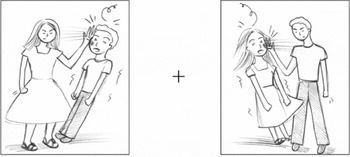
The present study examined the extent to which L2 learners incrementally assign thematic roles to preverbal nouns and predictively activate a structural representation of the upcoming verb voice before encountering the verb. This study further considered the process in which verb morphology information feeds into L2 learners’ comprehension. The processing patterns of active and passive sentences, as in Examples (12) and (13), were compared. We used the visual-world paradigm, with the two-choice picture-identification method, in which one picture matched the active reading, as in (12), and the other matched the passive reading, as in (13). Figure 1 demonstrates the setup for a visual scene.
An example of a visual scene used in the experiment.

-
(12)
-
(13)


The first research question posed in the current study is whether L2 learners of Japanese incrementally assign thematic roles when hearing preverbal nouns. Active sentences involve a preverbal sequence of a noun in the nominative case and a noun in the accusative case, as in (12), and passive sentences have a sequence of a noun in the nominative case and a noun in the dative case, as in (13). We hypothesized that if the participants effectively use the information provided by these case-marked nouns, they should predict a verb with active voice after hearing a sequence of a noun in the nominative case and a noun in the accusative case, and the participants should regulate their anticipatory eye movements toward the image depicting the active reading (see left image in Figure 1). After hearing a sequence of a noun in the nominative case and a noun in the dative case, they should anticipate that the upcoming verb would involve passive morphology and should regulate their anticipatory eye movements toward the image depicting the passive reading (see right image in Figure 1). Notice that the visual scene provides the meaning of the verb, and therefore, the participants should not anticipate the verb turning out to be one of the rare monotransitive verbs that take a noun marked in the dative case as its theme (e.g., au “meet”) or to be a construction in which the dative noun is interpreted as a goal after a ditransitive verb (e.g., watasu “pass”).Footnote 3 If, however, L2 learners do not incrementally assign thematic roles, they will initially extract identical information from the preverbal nouns. Consequently, there should be no difference in their attention to the pictures in the active and passive conditions.
The second question is how the information from the disambiguating verb feeds into comprehension. Evidence from previous psycholinguistic studies with native Japanese speakers suggests that when the initial assignment of thematic roles turns out to be wrong at a later point, native speakers revise the interpretation (Hirotani, Makuuchi, Rüschemeyer, & Friederici, Reference Hirotani, Makuuchi, Rüschemeyer and Friederici2011; Mazuka & Itoh, Reference Mazuka, Itoh, Mazuka and Nagai1995). In the passive condition, L2 learners’ eye movements to the picture describing the passive action are to increase over the course of processing the disambiguating verb when they correctly predict verb voice. However, if the participants analyze the preverbal fragment as a part of an active sentence in the passive condition, upon arriving at the passive morphology, –rare, their initial assignment will need revision for the sentence to be correctly interpreted as having passive voice.
Participants
Twenty native speakers of Japanese and 29 L2 learners of Japanese with an L1-English background took part in this study. They all received US$10 for their participation. The L2-learner participants were undergraduate students at a North American university, and the native-speaker participants were also recruited from this university's community. The learners were enrolled in forth- to eighth-semester Japanese courses at the time of data collection. The L2 learners’ exposure to the Japanese language was primarily through formal classroom instruction, but several L2 participants had studied abroad. Participants’ biographical information was assessed by a language learning history questionnaire, which was administered after the eye-tracking task.
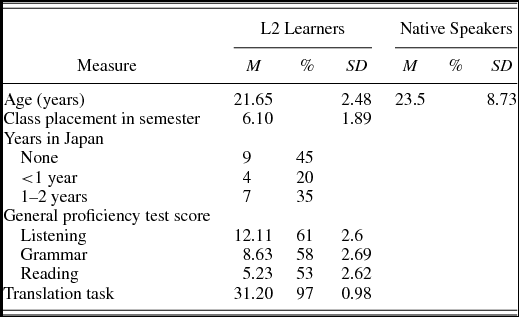
Because the L2 learners were recruited from various course levels, it was necessary to assess their proficiency levels and to take them into account when examining the learners’ processing. We used Part I of the Japanese Skill Test (Itomitsu, Reference Itomitsu1996). This test is a criterion-reference test and is reported to be effective and reliable in determining Japanese learners’ proficiency (Eda, Itomitsu, & Noda, Reference Eda, Itomitsu and Noda2008). The test consists of 45 multiple-choice items assessing a variety of grammatical structures in Japanese, including case-marking, conjugation, and sentence structure rules. The L2 participants took this proficiency test on a different day, after completing the eye-tracking session. Table 1 provides the biographic information and the proficiency test results obtained from the 20 L2 participants whose data points were included in the eye-tracking analysis.
Participant biographical information and results of offline measures

The L2 learners also completed a translation task in which they translated Japanese sentences to English. The translation task was administered after the eye-tracking task so as not to influence the results of the main part of the study. This task was used to make sure that the L2 learners had the relevant grammatical knowledge. The task covered but was not limited to active and passive structures; it also included sentences with causatives, causative-passives, and relative clauses, all of which required the participants to pay attention to thematic role assignments. There were 16 items that directly tested the translation of active and passive structures. A dichotomous scoring method was used, giving 1 point for each correct thematic role pair (i.e., agent–patient) and verb voice. The results of the translation task showed that the L2 learners did have the relevant grammatical knowledge (M = 31.2 points, 97%, SD = 0.98). For the translation task, the cutoff point was set at 91%, determined by selecting the point that was 2 SD away from the mean. All of the participants were carried forward for analysis.Footnote 4
Materials
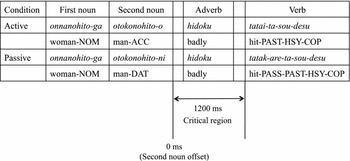
Twelve experimental sentence pairs were constructed on the basis of the two patterns illustrated in (12) and (13). The active sentences involved a preverbal sequence of a nominative-marked noun and an accusative-marked noun, followed by a transitive verb with active voice, and the passive sentences had a sequence of a nominative-marked noun and a dative-marked noun, followed by a transitive verb with the passive morphology –rare. A modal adverbial phrase (e.g., “badly,” “immediately,” and “seriously”) was added between the second noun and the sentence-final verb. The hearsay morpheme (i.e., the reported evidential) was added in order to manipulate the experimental stimuli so that the sentences would not end with a verb root. The vocabulary items were drawn from the textbooks used in the first- to third-semester Japanese courses at the institution where the study was conducted in order to ensure lexical familiarity. Figure 2 provides a visual demonstration of the regions of interest.
The periods of interest tagged in the audio stimuli.

Two female native speakers recorded experimental sentences at a natural speaking rate. The sentences were produced using standard intonation. The recording was done with a sampling rate of 44,100 Hz. To analyze eye movements with reference to the corresponding spoken sentences, we placed markers on the recorded stimuli. We marked the onset of the first noun and the offset of the second noun (in the active condition, onnnanohito-ga otokonohito-o “woman-NOM man-ACC”; in the passive condition, onnnanohito-ga otokonohito-ni “woman-NOM man-DAT”) and the onset and offset of the adverbial phrase (hidoku “badly”) and the sentence-final verb phrase (in the active condition, tataitasoudesu “hit-PAST-HSY-COP”; in the passive condition, tatakaretasoudesu “hit-PASS-PAST-HSY-COP” in each target sentence. A 200-ms slice of silence was added between the offset of the second noun and the onset of the adverbial phrase, and a 500-ms slice was added between the offset of the adverbial phrase and the onset of the verb phrase to control the duration of the critical region.
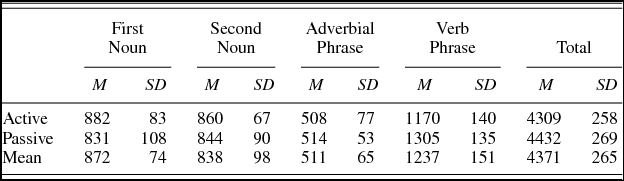
To examine the effect of predictive processing, analyses were conducted on the participants’ looks to the active picture scenes during the audio presentation of the adverbial phrase. Hereafter, this period will be called the critical region. The duration of the critical region was 1200 ms, which approximately corresponds to the preadverbial slice of silence (200 ms), the mean duration of the adverbial phrase period (500 ms), and the postadverbial silence (500 ms). In order to take into account the time spent on planning and regulating eye movements, the period of interest was offset by 200 ms (Matin, Shao, & Boff, Reference Matin, Shao and Boff1993). The statistical analysis was performed on the critical region, which was from 200 ms after the offset of the second noun and lasted 1200 ms. Table 2 reports the mean durations of these sentence regions.
Mean duration of sentence regions by condition

Note: A 200-ms slice of silence was added between the offset of second noun and the onset of adverbial phrase, and a 500-ms slice was added between the offset of the adverbial phrase and the onset of the verb phrase.
For each verb, two line drawings were created (see Figure 1). These images were drawn by hand, then scanned and edited for stimulus presentation. One drawing depicted the active reading (i.e., “the woman hit the man”), and the other drawing reversed the agent and patient roles (i.e., “the woman was hit by the man”). For each condition, 12 visual scenes were created. In order to ensure the reliability of these drawings, two native speakers of Japanese and one native speaker of English with advanced Japanese proficiency who did not participate in the main experiments, were asked to match the experimental sentences with the corresponding drawings. There was no disagreement or confusion in the matching procedure. These images were presented on the eye-tracking monitor at a resolution of 1680 × 1050 pixels.
The prerecorded spoken sentences were randomly assigned to the two experimental lists, such that the active and passive readings of the sentences each appeared on one of the lists, and each list contained an equal number of active and passive sentences. Each experimental list comprised 12 items, with 6 items per experimental condition, and these experimental sentences were combined with 36 filler sentences. The filler sentences had lengths and complexity similar to those of the experimental sentences.Footnote 5 The picture scenes and recorded spoken sentences were presented in a random order determined by the stimulus presentation system associated with the eye-tracking system. The positions of the active and passive picture scenes were counterbalanced.
The participants’ eye movements were recorded with an EyeLink 1000 desktop-mounted tracking device manufactured by SR Research, with a monocular sampling rate of 1000 Hz. The tracking device was connected to a PC that controlled the stimulus display and data storage. The visual stimuli were presented on a color 22-in. ViewSonic monitor. The participants were seated approximately 65 cm from the monitor and rested their chins comfortably on a chin rest. The participants’ eye positions were calibrated at the beginning of the experimental session and whenever it was necessary thereafter, using a 9-point calibration procedure for visual acuity below 0.5 degrees.
Procedure
The participants performed the eye-tracking task individually. They were instructed to determine which picture scene would match the sentence that they heard and to click the picture with the mouse. No feedback was given to their response. At the beginning of each trial, the participants viewed a fixation cross at the center of the screen. After 1500 ms, the fixation cross automatically disappeared, and then a trial started. A visual scene with two picture objects appeared on the screen, and a lead sentence (i.e., doshitandesuka? “What happened?”) was played. The onset of the visual scene display was matched to the onset of the lead sentence. After hearing the lead sentence, the participants heard a target sentence, in either active or passive voice. This orally presented sentence matched one of the picture objects in the visual scene. The visual scene disappeared 2000 ms after the offset of the sentence-final verb. Five practice sentences preceded the experimental items. The eye-tracking session took approximately 25 min to complete.
Analysis
Data treatments
We calculated response accuracy on the eye-tracking task (i.e., mouse clicks on the correct picture scenes). We excluded data from any participants whose responses were incorrect on more than one-third of the items in the eye-tracking study in order to ensure the reliability of their eye movement patterns. The data from all of the native Japanese participants were carried forward for analysis (response accuracy for actives, M = 1.00, SD = 0; for passives, M = 0.96, SD = 0.07). The data from 9 L2-learner participants were removed because of their low response accuracy; 7 of them were enrolled in fourth-semester, 1 in sixth-semester, and 1 in eighth-semester Japanese courses. The remaining data, from 20 native speakers of Japanese (8 males, 12 females) and 20 L2 learners of Japanese (10 males, 10 females), were submitted to analysis (response accuracy for actives, M = 0.91, SD = 0.10; for passives, M = 0.76, SD = 0.21).
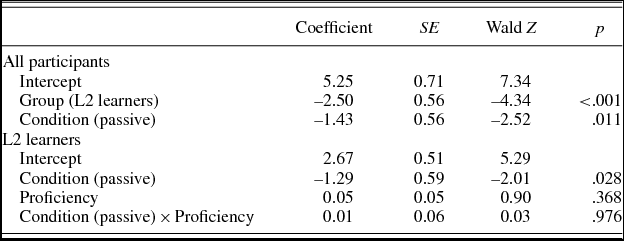
The accuracy data from the native-speaker and the L2-learner groups were analyzed using logit mixed models (Jaeger, Reference Jaeger2008). We first compared the native-speaker and the L2-learner groups in a single model. The model included the fixed effects condition and group.Footnote 6 The random-effect structure included random slopes for participant and for item, together with a by-participant random slope for condition. We used treatment coding for both fixed effects: for condition, with the active condition as the baseline, and for group, with the native-speaker group as the baseline. There was a significant effect of condition (estimate = –1.43, Wald Z = –2.52, p = .011), indicating that the native-speaker group performed less accurately on passive sentences than on active sentences. There was also a significant effect of group (estimate = –2.50, Wald Z = –4.43, p < .001), suggesting that the L2 learners were less accurate than the native speakers in the active condition. In addition, we separately analyzed the L2-learner group using a model that includes fixed effects of condition and proficiency and the interaction of these two effects. The random-effect structure of the model was the same as that of the joint model described earlier. The L2 learners performed less accurately on passive sentences than on active sentences (estimate = –1.29, Wald Z = –2.10, p = .026). There was no effect of proficiency. Table 3 shows the results of the logit mixed models.
Fixed effects in the logit mixed model of response accuracy in native speakers and in L2 learners

Note: L2, Second language.
For each participant, the eye-tracking data was analyzed only for the sentences for which they had clicked the picture object correctly, following the most often employed procedure for selecting the measure of performance in behavioral tasks. This process led to the exclusion of 2% of the native-speaker data and 16% of the L2-learner data. The average track loss was 14% for the native-speaker group and 13% for the L2-learner group. There was no trial with more than 40% track loss, and therefore, all data points were submitted to analysis. For the analysis of the verb disambiguation region, we included a total of 107 data points from the native speakers (59 target-initial trials and 47 distractor-initial trials) and 88 data points from the L2 learners (38 target-initial trials and 36 distractor-initial trials).
Analysis of the critical region
To assess the time course of processing, we used growth curve analysis, adapted for visual-world data (Mirman, Dixon, & Magnuson, Reference Mirman, Dixon and Magnuson2008). Growth curve analysis is a multilevel regression technique that allows for the estimation of inter- and intraindividual patterns that change over time (Raudenbush & Bryk, 2002). Although there is no consensus on the manner in which time course data from the visual-world method should be analyzed (for topics on eye-tracking data analysis, see the vol. 59 special issue of Journal of Memory and Language in 2008), our data characteristics are in line with the assumptions of growth curve modeling. With growth curve modeling, it is possible to analyze processing trajectories that change nonlinearly over time, observed in visual-world paradigm data when the proportion of fixations at the beginning is low and the curve levels off at the tails. The time effect was represented using orthogonal polynomials. This representation allows us to independently assess the various characteristics of the data (Mirman et al., Reference Mirman, Dixon and Magnuson2008). For example, the constant term captures the overall effect of condition for the entire analysis window; this is important because the critical region in the present experiment was in the middle of the sentence, and there may have been some preexisting effects at the onset of the analysis window. Similarly, the linear term captures the overall rate of increase or decrease of the effect over time. Including a higher order term does not change the value or the interpretation of the estimated lower order terms (Bollen, Reference Bollen, Cudeck and MacCallum2007), which makes the results more interpretable.
The analysis was conducted on fixations to the active picture scenes in 100-ms bins for the critical-region duration of 1200 ms. First, we analyzed all participants in a single model, directly comparing the effect between the native speakers and the L2 learners. We used treatment coding for both fixed effects: for condition, with the active condition as the baseline, and for group, with the native-speaker group as the baseline. This choice of coding is suitable because we are interested in examining the effect of condition, controlling for group, and the effect of group, controlling for condition. Having the active condition and the native-speaker group as baselines helps us determine how native speakers of Japanese process active and passive sentences and whether L2 learners’ processing pattern is different from that of native speakers when comprehending active and passive sentences. Our model included fixed effects of group and condition and the interaction of these two effects, a second-order orthogonal polynomial (the linear and quadratic terms), crossed with the fixed effects and their interaction. The model also included a random slope for participant, together with by-participant random slopes for condition, crossed with the linear and quadratic terms. By plotting the fixation trajectories, we judged that the second-order orthogonal polynomial sufficiently characterizes the data, and therefore, the cubic term was excluded (for a discussion of interpreting cubic terms in cognitive psychology data, see Mirman et al., Reference Mirman, Dixon and Magnuson2008). We analyzed the L2-learner data separately, using a model with the fixed effects of condition and proficiency and their interaction, crossed with the linear and quadratic terms. The random-effect structure was the same as in the joint model. In modeling the effect structure, we followed the “keep it maximal” approach (Barr, Levy, Scheepers, & Tily, Reference Barr, Levy, Scheepers and Tily2013). All growth curve analyses in the current study were performed using the lme4 package in the statistical software environment R (Bates, Maechler, Bolker, & Walker, Reference Bates, Maechler, Bolker and Walker2014).
Analysis of the verb disambiguation region
To assess whether the native Japanese speakers and the L2 learners were sensitive to morphological information from the passive verb, we conducted an onset-contingent analysis to track the participants’ eye movements separately for target-initial trials (i.e., those in which the participants started by looking at the passive picture scene) and distractor-initial trials (i.e., those in which the participants began by looking at the active picture scene; Fernald, Pinto, Swingley, Weinberg, & McRoberts, Reference Fernald, Pinto, Swingley, Weinberg and McRoberts1998; Fernald, Zangl, Portillo, & Marchman, Reference Fernald, Zangl, Portillo, Sekerina, Fernández and Clahsen2008). These trials were divided based on the fixation location at the onset of the verb. In successful comprehension, the participants who start with looks at the target picture scene should keep looking at the target, whereas the participants who initially look at the distractor should shift quickly to the target picture (Fernald et al., Reference Fernald, Pinto, Swingley, Weinberg and McRoberts1998, Reference Fernald, Zangl, Portillo, Sekerina, Fernández and Clahsen2008).
We used treatment coding for the location of initial gaze (i.e., initial gaze), with the target-initial trials as the baseline, and also used treatment coding for group, with the native-speaker group as the baseline. We used growth curve analysis of the verb disambiguation region with the fixed effects of group and trial type and interaction of group by trial type, crossed with a second-order orthogonal polynomial. The random-effect structure included a random slope for participant, by-participant random slopes for trial type, crossed with the linear and quadratic terms.
RESULTS
The critical region
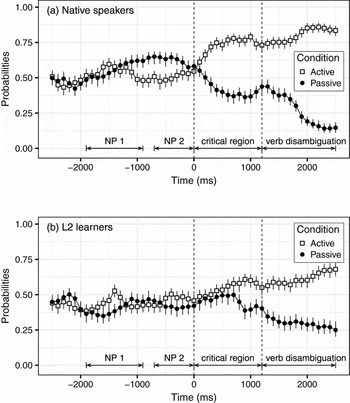
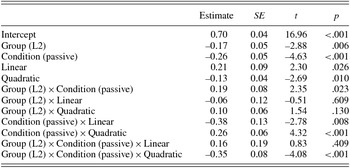
Figure 3a illustrates the native speakers’ looks to the active picture scenes aggregated by condition in each 100-ms bin. There was a significant effect of condition, estimate = –0.26, t (40) = –4.63, p < .001, which captures the difference in the looks to the active picture scenes between the active and the passive conditions in the native speaker group; the negative estimate indicates that the looks to the active picture scenes in the passive condition were made less frequently than those in the active condition. There were significant effects on the linear term, estimate = 0.21, t (40) = 2.30, p = .026, and the quadratic term, estimate = –0.13, t (40) = –2.69, p = .010. These significant effects suggest that, in the active condition, the native speakers’ looks to the active picture progressively increased. Similarly, the effects of condition on the linear term was significant, estimate = –0.38, t (40) = –2.78, p = .008; in particular, the negative estimate for the linear term indicates that the rate at which the native speakers looked at the active picture scenes was lower in the passive condition than in the active condition. The effect of condition on the quadratic term was also significant, estimate = 0.26, t (40) = 4.32, p < .001, indicating a reliable difference in the rise-and-fall rates of these two conditions.
The Japanese native speakers’ and the second language learners’ proportions of fixation to the active picture, aggregated by condition in each 100-ms time bin for the critical region, which includes the presentation of an adverbial phrase, following two preverbal nouns.

The model also demonstrated a significant effect of group, estimate = –0.17, t (40) = –2.88, p = .006, which suggests that, in the active condition, the L2 learners looked at the active picture scenes less than the native speakers did. The interaction of group and condition was also significant, estimate = 0.19, t (40) = 2.35, p = .023, indicating that the differences between the looks to the active picture scenes in the active condition and those in the passive condition vary substantially between the two groups. However, in the active condition, there was no effect of group on the two time terms. In the passive condition, there was no effect of group on the linear term, but the group effect on the quadratic term was significant, estimate = –0.35, t (40) = –4.08, p < .001, capturing the curve difference between the native speakers and the L2 learners in the passive condition. Figure 3b illustrates the L2 learners’ looks to the active picture scenes aggregated by condition. A summary of the results is shown in Table 4.
Overall growth curve analysis on fixations to the active picture scenes for the critical region

Note: L2, Second language.
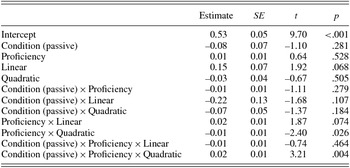
A separate analysis was conducted on the L2 learners’ fixations to the active picture scenes. We did not find a significant difference in the looks to the active picture scenes between the active and the passive conditions; there was no effect of condition on the intercept, the linear, or the quadratic term. Neither the effect of proficiency nor the interaction effect of proficiency and condition was significant on the intercept or on the linear term. However, proficiency showed a strong effect on the quadratic term, estimate = –0.01, t (20) = –2.40, p = .026. The negative coefficient of proficiency on the quadratic term indicates that, in the active condition, the more proficient the learners were, the higher the rise-and-fall rate of looks to the active scenes they exhibited (i.e., the curvature is downward). Furthermore, the interaction effect of proficiency and condition on the quadratic term was also significant, estimate = 0.02, t (20) = 3.21, p = .004. The positive estimate suggests that the effect of proficiency on the rise and fall rate in the passive condition was smaller than in the active condition (i.e., the curvature is upward). A summary of the results is shown in Table 5.
Analysis of L2 learners’ fixation to the active pictures for the critical region

The verb disambiguation region
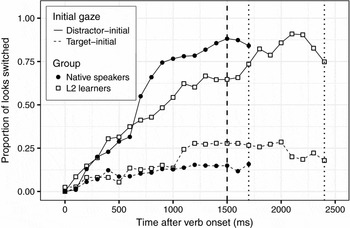
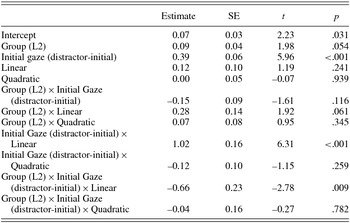
Figure 4 shows the onset-contingent plot for the verb disambiguation region. We performed a growth curve analysis on the native speakers’ and the L2 learners’ proportions of looks switched in the passive condition, and our model compared the differences in the time course of processing in the target-initial and distractor-initial trials of those two groups. The effect of initial gaze was significant on the intercept term, estimate = 0.39, t (27.31) = 5.96, p < .001, indicating that the native speakers made more shifts to the correct picture scenes in the distractor-initial trials than in the target-initial trials. The native speakers’ looks to the correct picture scenes stayed flat in the target-initial trials; however, the looks in the distractor-initial trials increased progressively over time, which is captured by the significant effect of initial gaze on the linear term, estimate = 1.02, t (23.55) = 6.31, p < .001. The effect of initial gaze on the quadratic term was not significant. The native speakers’ processing trajectory shows that as soon as they received the information from the passive morpheme, they discriminated the two picture scenes sharply, regardless of their initial gaze.
Onset-contingent plot of distractor-initial and target-initial trials for the passive condition by the native Japanese speakers and the second language learners, measured from the disambiguating verb's onset. At each 100-ms interval, the data points show the mean proportion of trials on which the participants shifted from the picture object they started on to look at the other picture object. The left dashed line shows the average offset of the verb phrase, and the dotted lines shows the average exit time of an experimental trial for the native speakers and the second language learners.

The model also showed that, on the intercept term, neither the effect of group nor the interaction effect of group and initial gaze was significant. These results suggest that the overall proportions of shift were not reliably different between the two groups. The rate at which the L2 learners erroneously shifted away from the target picture scenes was slightly higher than that of the native speakers, but this difference was not statistically significant; this is indexed by the interaction effect of group and initial gaze being not significant on the linear term or on the quadratic term. Similarly, there was no significant interaction effect of group and initial gaze on the intercept term, but the same interaction effect of group and initial gaze on the linear term was significant, estimate = –0.66, t (26.04) = –2.78, p = .009. This indicates that the rate at which the L2 learners correctly shifted to the target picture scenes in the distractor-initial trials was lower than that of the native speakers. This interaction effect on the quadratic term was not significant. From a visual inspection of Figure 4, the L2 learners seemed to exhibit more false alarms in the target-initial trials than the native speakers were, but such a difference did not reach the statistical significance. The current analysis, however, demonstrated that the L2 learners integrated the passive morpheme information and looked at the target picture scenes in a manner indistinguishable from that of the native speakers. A summary of the results is shown in Table 6.
Analysis of the rate of fixation changed to the target by the native speakers and the L2 learners for the verb disambiguation region

Note: L2, Second language.
DISCUSSION
In the present study, we investigated whether Japanese comprehenders use knowledge of its case system for incrementally assigning thematic roles and activating the representations of upcoming verb voice and examined how they disambiguate their initial interpretation when arriving at sentence-final verbs.
We examined the predictive effects of case-marked nouns on the identification of upcoming verb voice. In line with the previous results of Kamide et al. (Reference Kamide, Altmann and Haywood2003), the present study demonstrated that the native speakers used the information from case markers to assign thematic roles prior to hearing the verb. Once a sequence of two nouns was perceived, the native speakers’ fixations to the active picture scenes increased in the active condition and decreased in the passive condition progressively over time and quickly leveled off to the asymptote. These processing patterns suggest that the native speakers committed to real-time structure building in the preverbal position and predicted verb voice. However, the L2 learners did not seem to use case-marked nouns to assign thematic roles in the preverbal position in a manner comparable to that of the native speakers. The learners’ processing patterns during the critical region show that, compared to the native speakers, the L2 learners were less likely to look at the active picture scenes in the active condition, and were more likely to look at the active picture scenes in the passive condition. This pattern of results suggests a lack of preverbal structural commitment by the L2 learners.
We also examined how the information from passive verb morphology feeds into real-time comprehension. The analysis of the verb disambiguation region suggests that both the native-speaker and the L2-learner groups clearly distinguished passive sentences from active sentences; the target-initial trials were associated with a lower rate of shifts than were the distractor-initial trials. This pattern, in turn, indicates that the L2 learners were able to use the passive morpheme to drive their visual inspection patterns in a manner qualitatively equivalent to that of the native speakers. Our results provide clear behavioral evidence that certain grammatical cues present challenges for L2 learners to deploy during real-time processing, whereas other cues can be used in a manner highly comparable to that of native speakers.
It is important to place the current findings squarely in the burgeoning field of L2 predictive processing. The issues in regard to limited resources, pointed out by the RAGE hypothesis (Grüter et al. Reference Grüter, Rohde, Schafer, Orman and Valleau2014, Reference Grüter, Rohde and Schafer2016), and to stored differences of frequency information (Kaan, Reference Kaan2014) guide us to further consider what would make a certain linguistic cue drain processing resources and introduce L1–L2 differences in incremental processing. There are certainly many possibilities, because Japanese passives present a number of structural differences compared with passives in English, the learners’ L1. Such cross-linguistic differences will contribute to the difficulty for the L2 learners; comprehenders naturally have biases that reflect the structure of the particular language being used.
First, the L2 learners’ lack of predictive processing can be attributed to the difficulty of the Japanese case system for L2 learners, which is congruent with the findings of the competition model studies (for a review, see Sasaki & MacWhinney, Reference Sasaki, MacWhinney, Nakayama, Mazuka and Shirai2006). Because of the inherent difficulty, it is possible that L2 learners have partial knowledge of case markers in general. Perhaps, then, such partial knowledge of case markers is an artifact of the difficulty associated with linking form and meaning. DeKeyser (Reference DeKeyser2005) argued that when distinct forms express the same meaning and the same form expresses distinct meanings, it makes establishing the link between form and meaning difficult for L2 learners (i.e., an opacity of form and meaning) and thus makes retrieval difficult. The Japanese case system seems a relevant instance of such opacity. For instance, the nominative case marker –ga must appear in each clause; therefore, –ga is considered the default case (Fukui, Reference Fukui1986). However, this default status can also induce mappings of one form to multiple interpretations. In regard to the present investigation, the case alternation in the active and passive voices presents opacity: in passive sentences, the nominative-marked noun is a logical object (i.e., a theme or patient) that instead functions as the grammatical subject. Furthermore, some grammatically simple and frequent structures also jeopardize the link between case markers and thematic roles. Nominative object constructions (e.g., a transitive adjective, such as suki “fond of” and a complex predicate consisting of an action verb and an auxiliary adjective tai “want”) are cases in point. All of these instances of logical objects marked in the nominative case make the link between case markers and thematic roles hard to establish; the weak form–meaning mapping gives rise to low cue reliability (MacWhinney, Reference MacWhinney1987, Reference MacWhinney and Robinson2001).
By extension, the account of opacity in form–meaning mapping and its retrieval difficulty may help us reconcile why the L2 learners in the present study did not use the information from the case markers, whereas some of the previous studies in German had demonstrated L2 learners’ nativelike use of case information (Hopp, Reference Hopp2009; Jackson & Dussias, Reference Jackson and Dussias2009). For example, when processing German subject- and object-extracted wh-questions (e.g., “Who do you think admired the athlete after the game?” or “Who do you think the athlete admired after the game?”), the initial wh-words were immediately and unambiguously coded as the subject or direct object (i.e., wer “who” or wen “whom”) of the complement clause (Jackson & Dussias, Reference Jackson and Dussias2009). In contrast, when processing temporarily ambiguous sentences (“Which engineer met the chemist?” or “Which engineer did the chemist meet?”), in which the wh-word presents the opacity (i.e., Welche-NOM or Welche-ACC), the effect of case markers was not observed in L2 (Hopp, Reference Hopp2006; Jackson, Reference Jackson2008). In the present study, the participants were first required to deal with the opacity of each case marker and then were required to attend to the joint cues of information posed by two nouns to anticipate verb voice. The nature of prediction required here is susceptible to processing difficulty because of the multiple levels of ambiguity. We believe that, in future studies, measuring the opacity of form–meaning relationships and the associated difficulty of retrieval may provide a more general account of L2 predictive processing, because it potentially provides an idea of how the reduced ability in anticipation interacts with the design features of a language.
Second, a cause of nonnativelike processing in L2 learners may have resided in the combination of case-marked preverbal noun phrases and passive verbs. Even though the analysis of the verb disambiguation region showed that the L2 learners successfully integrated the passive morpheme, quite clearly, holding two preverbal nouns without assigning thematic roles imposes a heavy load on working memory by the time the disambiguating verb is encountered (Harrington & Sawyer, Reference Harrington and Sawyer1992; Just & Carpenter, Reference Just and Carpenter1992). The low response accuracy scores of L2 learners may well be due to a remnant of difficulty experienced in retaining case-marker information and integrating it with predicted verb forms. Integration difficulty of Japanese passive voice can be considered at least from two perspectives. One is to assume that success in preverbal processing is a prerequisite for success in processing the sentence-final verb. Mazuka and Itoh (Reference Mazuka, Itoh, Mazuka and Nagai1995) argued that native Japanese speakers assign thematic roles tentatively during preverbal processing. After the verb arrives, the assignment of thematic roles is reevaluated with the added information from the verb. The findings from the present study can be interpreted as supporting that the converse of Mazuka and Itoh's (Reference Mazuka, Itoh, Mazuka and Nagai1995) argument may also hold. In particular, successful comprehension requires that the components of sentences be integrated in real time and the earlier structural hypothesis be evaluated as compatible or not later on. The need for this later compatibility check presents an obvious difficulty when the comprehender does not have a set of initially constructed representations that he or she checks the compatibility against. Another perspective is to view that the integration difficulty resides in the structure of passive construction itself. Passives require thematic roles to be assigned in an atypical order (i.e., protopatient before protoagent), and it is known to be a challenge to processing even for adult native speakers (Ferreira, Reference Ferreira2003). Furthermore, a series of recent studies demonstrated that the order of linguistic cues also contributes to acquisition and processing difficulty (Choi & Trueswell, Reference Choi and Trueswell2010; Pozzan & Trueswell, Reference Pozzan and Trueswell2015; Trueswell, Kaufman, Hafri, & Lidz, Reference Trueswell, Kaufman, Hafri, Lidz, Biller, Chung and Kimball2012). Children learning Kannada, a verb-final language, were shown to experience more difficulty in comprehending causative verbs than children learning Tagalog, a verb-initial language that also has causative verb morphology (Trueswell et al., Reference Trueswell, Kaufman, Hafri, Lidz, Biller, Chung and Kimball2012). Similarly, Pozzan and Trueswell (Reference Pozzan and Trueswell2015) maintained that linguistic cues that become available late in the sentence are more difficult to acquire than early-arriving cues by adults learning a miniature artificial language. The current study, however, has shown that case markers, a cue early in the stimulus, were not efficiently used by the L2 learners, but passive morphology, a later cue, was. This suggests that the order of linguistic cues alone may not be a predictor of processing difficulty by L2 learners, at least in the context of Japanese passives.
Our results also give rise to a number of issues that warrant further investigation. One of these involves the effect of L2 proficiency. From the visual inspection of the critical region (Figure 3), one observes that the learners’ fixation patterns started to diverge at around 500 ms after the onset of the critical region, and these trends continued to the verb disambiguation region. These fixation patterns can be taken as a sign of emerging anticipatory processing by L2 learners; it is delayed but qualitatively comparable to that of native speakers. In addition, the significant effects of proficiency on the quadratic term (i.e., the effect of proficiency on the quadratic term and the effect of the interaction of proficiency and condition on the quadratic term) provide partial evidence that L2 proficiency plays a role in the efficacy of predictive processing.
However, the picture is not complete; proficiency alone did not surface as a significant predictor, but it influenced the rise-and-fall rate of the fixation trajectory. If proficiency is a critical factor in predicting whether L2 learners can exhibit nativelike processing in Japanese, we should have expected the effect of proficiency and the interaction of proficiency and condition on the intercept and the linear terms too. One speculative explanation of what may be causing this incompleteness is the small divergence in L2 proficiency; our L2 participants were recruited from college-level Japanese courses, and thus differences in learning experience are as small as a couple of semesters. It would be ideal to further investigate the role of L2 proficiency in predictive processing, and including participants with varying proficiency may well help us examine whether predictive processing is a developmental phenomenon. Such investigations have important theoretical implications for supporting experience-based theories of sentence comprehension (MacDonald et al., Reference MacDonald, Pearlmutter and Seidenberg1994) in L2 processing.
Second, in this study, we demonstrated that L2 learners were able to integrate passive morphological information. The experimental design adopted here is limited in recognizing whether such a comprehension difficulty evolved because of thematic reanalysis or its interplay with syntactic reanalysis. A passive sentence involves thematic reanalysis and syntactic reanalysis (for theoretical assumptions, see Hoshi, Reference Hoshi1991, Reference Hoshi and Tsujimura1999; Miyagawa, Reference Miyagawa and Tsujimura1999). Hirotani et al. (Reference Hirotani, Makuuchi, Rüschemeyer and Friederici2011) compared neurocognitive processes when native Japanese speakers process active, passive, and causative sentences. The participants’ neural network showed sensitivity to thematic reanalysis different from that to syntactic reanalysis. In future research, the inclusion of sentences that involve the same sequence of preverbal nouns with varying verb types, such as transfer datives (i.e., no reanalysis is required), causatives (i.e., thematic reanalysis is required), and passives (i.e., thematic and syntactic reanalysis is required), is much needed to tease apart the potential effects of these linguistically distinct processes.
Controlling the sentence condition more systematically, we may be able to reason more clearly about what, precisely, is happening in the preverbal processing. With the choice between only active and passive voice, although filler sentences were included, the native Japanese speakers may have used case-marker cues strategically by locking in on the idea that encountering a dative-marked noun means an upcoming passive-voice verb. Making a sequence of preverbal nouns consistent allows us to distinguish this type of keyword-driven response from predictive activation of linguistic representations.Footnote 7 Similarly, Figure 3 shows that there is a diversion between the active and passive conditions roughly around the offset of the first noun and slightly before the offset of the second noun.Footnote 8 This fixation pattern is not fully explicable by the default thematic assignment and combinatory frequency information of two case-marked nouns; one would hypothesize that the proportion of the fixation to the active picture scenes would have increased in both the active and the passive conditions. This study focused on the adverbial region, because we anticipated that the processor needed some buffer to generate predictions based on aggregated information from two case-marked nouns. Nevertheless, Japanese has a diverse set of structural choices given by case markers at different points in sentences (Chang, Reference Chang2009), and therefore, in future studies, linguistic conditions leading to the processes in question should be consistent, so that patterns of processing as a whole can be systematically interpreted.
In summary, this study examined the extent to which L2 learners of Japanese incrementally assign thematic roles before encountering a sentential-final verb and generate predictions of that verb's voice. The results demonstrated that, although the native Japanese speakers processed sentences incrementally and integrated preverbal thematic-role assignments with a predicted verb voice aided by case markers, the L2 learners were less committed in their assignment of thematic roles to the preverbal nouns. Nevertheless, the L2 learners were able to integrate information from the passive morpheme, successfully discriminating active and passive sentences. These results highlight the usefulness of case markers in predictive processing in Japanese; L2 learners are less efficient in using this cue, but they use information indicated by verbs to compensate their reduced ability in preverbal processing.
APPENDIX A
Target items
Two versions of each experimental sentence were created, corresponding to each of the experimental conditions, as seen in Sentence (1) below. For the remaining sentences, only Condition (a) (the active sentence) is shown.
-
(1)
-
a. 子供がお父さんを 急いで起こしたそうですよ。
I heard that the child hastily woke up the father.
-
b. 子供がお父さんに急いで起こされたそうですよ。
I heard that the child was hastily woken up by the father.
-
-
(2) 女の人が男の人を強くたたいたそうですよ。
I heard that the woman badly hit the man.
-
(3) おじいさんが男の子をしっかり洗ったそうですよ。
I heard that the elderly man thoroughly washed the boy.
-
(4) おばあさんがおじいさんをゆっくりマッサージしたそうですよ。
I heard that the elderly woman slowly massaged the elderly man.
-
(5) 男の子が女の子を急に ハグしたそうですよ。
I heard that the boy suddenly hugged the girl.
-
(6) お母さんが子供をすぐに呼んだそうですよ。
I heard that the mother immediately called the child.
-
(7) 女の人が男の人を急いで殺したそうですよ。
I heard that woman quickly killed the man.
-
(8) 女の人が男の人をしっかり褒めたそうですよ。
I heard that woman extensively praised the man.
-
(9) 男の人が女の人を急に叱ったそうですよ。
I heard that the man suddenly scolded the woman.
-
(10) 女の子が男の子をひどくいじめたそうですよ。
I heard that the girl badly bullied the boy.
-
(11) 女の子が男の子を強く蹴ったそうですよ。
I heard that the girl strongly kicked the boy.
-
(12) おじいさんがおばあさんをゆっくり押したそうですよ。
I heard that the elderly man slowly pushed the elderly woman.
ACKNOWLEDGMENTS
This work was supported by the University of Kansas General Research Fund allocation 2302332-099 (to S.M.). I thank Philip Kroh and Leslie Montes for experimental preparation and data collection and Alison Gabriele, Brian MacWhinney, Utako Minai, Theres Grüter, and three anonymous reviewers for their valuable comments on earlier versions of this paper. Any errors are my own.