Introduction
Prisoners have high rates of mental health problems (Birmingham et al. Reference Birmingham, Mason and Grubin1996; Singleton et al. Reference Singleton, Meltzer and Gatward1998). The transition from prison to community is fraught with difficulties. Almost half (42%) of prisoners have no fixed abode at the time of release and 50% have no GP when they leave prison (Williamson, Reference Williamson2006). For prisoners with severe mental illness, the shift between prison and community treatment is associated with a range of negative outcomes including having no permanent residence (Revolving Doors, 2002) and having a suicide rate eight times higher than the general population (Pratt et al. Reference Pratt, Piper, Appleby, Webb and Shaw2006). In addition, a decreased drug tolerance following detoxification regimes in prison means that the risk of overdose is high in prisoners with substance abuse problems (Farrell & Marsden, Reference Farrell and Marsden2008). To address these issues, mental health teams, known as in-reach teams were introduced across prisons in England and Wales in 2002, with a view to ensuring continuity of care for prisoners with severe mental illness (Steel et al. Reference Steel, Thornicroft, Birmingham, Brooker, Mills, Harty and Shaw2007).
The premise for Critical Time Intervention (CTI) was developed in New York with individuals who had been homeless prior to being admitted to hospital (Susser et al. Reference Susser, Valencia, Conover, Felix, Tsai and Wyatt1997; Herman et al. Reference Herman, Opler, Felix, Valencia, Wyatt and Susser2000; Lennon et al. Reference Lennon, McAllister, Kuang and Herman2005). There are similarities between this group and discharged mentally ill prisoners with respect to levels of disengagement with health and social care (Susser et al. Reference Susser, Valencia, Conover, Felix, Tsai and Wyatt1997; Durcan & Knowles, Reference Durcan and Knowles2006). It has been already noted by some authors that it is not unusual for prisoners to be released from custody without a detailed plan of re-integrations into the community and that the CTI model could be a useful adaption to this population (Draine & Herman, Reference Draine and Herman2007). It is the first few weeks post-release which are the most stressful and with the right help can make the difference as to whether the prisoner incorporates successfully back into society or re-offends. These authors argue CTI at this point provides important emotional and practical support, as well as advocacy. CTI is a holistic model of case management which focuses on linking patients up with community services to ensure care is delivered. The aim is to build on their links in the community, both personal and in terms of services (Draine & Herman, Reference Draine and Herman2007). It is not meant as a permanent support system. It is strictly time limited, maintaining continuity of care only during a critical period of transition, in this pilot study, between 4–6 weeks, during which responsibility is gradually passed to existing community mental health services.
This pilot randomised controlled trial sought to adapt CTI to the English prison system and to assess whether it would confer benefit by promoting engagement of prisoners with severe mental illness with community-based services on their release. For prisoners who are sentenced, a specific release date is available allowing discharge plans to be worked towards for that date. However, for those who are unsentenced or unconvicted, discharge planning is more difficult due to the unpredictability of what may happen at court. The person may be found not guilty, or the case may be dismissed or they may receive a community sentence resulting in their release on that day, or they may return to prison under a custodial sentence. The main aim of the study was to assess the feasibility of using CTI with prisoners. We hypothesised that those who received the intervention would be more likely to be in contact with mental health services at the point of follow-up. We also wanted to identify barriers to making contact with community-based services for discharged prisoners. The study took place between July 2007 and April 2008.
The study was approved by Essex 2 Research Ethics Committee (REC: 05/Q0302/11).
Method
Design
A randomised controlled trial (RCT): Each prisoner was randomised to either CTI or Treatment as Usual (TAU). Those randomised to CTI received input from a CTI manager. Randomisation entailed generating numbered envelopes containing either TAU or CTI. The sealed envelopes were then sent to the sites. Following consent the researcher opened an envelope in the specified order in the presence of the participant, who was informed which group he was assigned.
Baseline data
Data were collected for socio-demographics, legal status, offence and length of time in prison, diagnosis and medication, first contact with mental health services, whether they were receiving input from mental health services at the time of reception, and what if any medication they were taking at the time of entry into custody.
TAU
Participants randomised to TAU received care from the prison in-reach team, including discharge planning arrangements.
CTI
Participants randomised to the CTI received input from the CTI manager. Five key areas were identified as being crucial to successful engagement: psychiatric treatment and medication management, housing, finances, substance misuse, and social support (via family or friends). The CTI manager worked with the prisoner prior to release to identify three priority problem areas with which they required help and which had the potential to be a barrier to engagement to mental health services (e.g. housing, benefits, substance abuse issues). The CTI manager then provided practical help to address these issues before release and on continuation after release (e.g. filling out forms, searching for housing). On release, the CTI manager continued to support the person to ensure transfer of care was smooth, accompanying them to the Community Mental Health Team (CMHT) for their appointment, ensuring they received their medication from the GP, etc. The aim was to facilitate engagement with services by addressing the self-reported problems of the participant and providing the resources to help meet those difficulties.
Sites
Three local prisons, two in the North West and one in London. Operational capacity varied between approximately 800 in the London prison to 1000 and 1200 in the North West prisons. One of the North West prisons also had a high security function, and the other held young offenders as well as adults.
Sample
Prisoners under the care of the in-reach team at each prison were recruited. Inclusion criteria were that they were to have a severe mental illness, be due for imminent release, and would be released to catchment areas of local mental health trusts. These criteria were established via the in-reach team. Exclusion criteria were patients who did not have severe mental illness (e.g. personality disorder or issues of substance abuse but no severe mental illness), who were yet to remain serving long sentences, or were being released to boroughs or areas outside the designated catchment areas.
Procedure
All prisoners meeting the inclusion criteria were approached for consent for inclusion in the study by the CTI manager. Following consent, they were randomised to TAU or CTI. Those randomised to TAU had no further contact with the CTI manager. Prisoners randomised to CTI continued to work with the CTI manager.
A separate research worker (blind to participant status) collected baseline data after consent and before release, and then followed up the participant to assess outcome measures until 6 weeks post-release.
Contact details of the participant were requested as well as permission to contact at least one other named person via whom we could maintain contact and seek outcome data at the point of obtaining outcome measures.
Sample size calculation
No formal power calculations were carried out prior to the study. Post hoc considerations (especially in the light of the high proportions not receiving the interventions as planned – i.e. prisoners were not actually released – see below) would lead us to conclude that this small pilot was unlikely to lead to any robust statistically significant treatment effects. At this stage, however, a less stringent significance level than 0.05 might be used (as high as 0.2, for example) because the pilot is more concerned with detecting promising effects rather than necessarily avoiding type 1 errors. Stone et al. (Reference Stone, Wheeler and Barge2007) have argued that this is entirely appropriate allowing for the fact that the objective of pilot trials is to identify promising interventions and that they should therefore not be constrained by conventional levels of significance. They state that by using a lower threshold of significance, a positive result is unlikely to be missed, while a negative result would also indicate issues that may not be clinically relevant.
Outcome measures
Outcome measures were taken at between 4–6 weeks post-release. Primary outcomes were contact and engagement with community mental health services or community substance abuse services at that time. In addition, participants were questioned on the five key areas, identified as being crucial to successful engagement: psychiatric treatment and medication management, housing, finances, substance misuse, and social support (via family or friends). These areas have been identified as being core problem areas for individuals being released from institutions, without which successful re-entry to community life is compromised (Draine & Herman, Reference Draine and Herman2007; Centre for Mental Health, 2008; UK Drug Policy Commission, 2008). We developed a seven-item questionnaire with yes/no questions to contact with mental health services, receiving medication, being registered with a GP, contact with substance abuse services if applicable, with family, having housing, and receiving an income. These answers were then followed up with a view to gaining more detail on barriers to these areas. The questionnaire was deliberately kept short and simple since with a view to maximising the opportunity to obtaining the key information when the contact was phoned.
Data analyses
SPSS Version 15 was used to carry out the analyses. Chi-squares with exact tests were used to compare the CTI and TAU groups against each other for demographic and clinical characteristics and on outcomes. Due to numbers, this involved merging options within variables to obtain categorical outcomes. T-tests were used to compare ages of the groups.
Feasibility
Feasibility was explored via two models of CTI. At the north west sites, the CTI managers were based within the prison, working with the in-reach team, with the specific role of CTI management. At the London site, the model was CMHT based with the CTI manager regularly attending the prison to work with prisoners about to be released.
Results
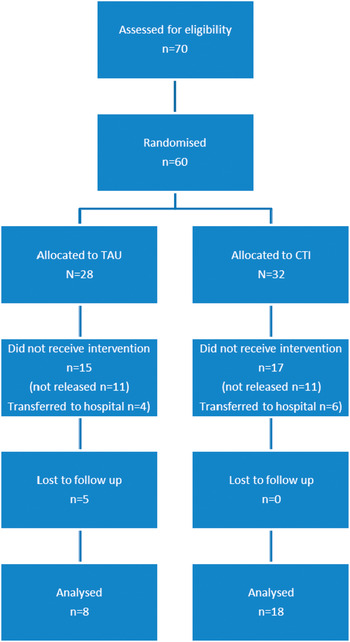
Seventy prisoners were approached to take part in the study. Nine refused and one person was referred for transfer to NHS facilities. Sixty prisoners were recruited to the trial, of whom 23 were followed up. Figure 1 shows the CONSORT chart of recruitment to follow-up.
Consort chart of recruitment and follow-up. (A colour version of this figure is available online at http://journals.cambridge.org/eps)

Outcome measures were sought 4–6 weeks post-release. The participant or other nominated contact person was contacted by the same research worker who had carried out the baseline assessments. This researcher then completed the seven-item questionnaire. Other nominated contact people included family members, CMHT care coordinator, probation staff, or hostel staff.
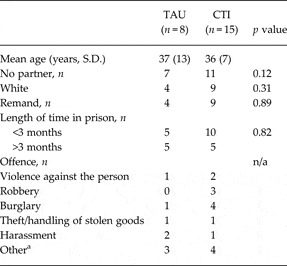
Table 1 shows the demographic characteristics of participants at baseline. There were no significant differences between the groups on any variables.
Participant characteristics at baseline assessments

aOther offences were criminal damage, driving offences, drunk and disorderly, possession of weapon and breach of anti-social behavioural orders.
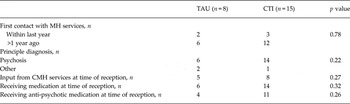
Table 2 shows the clinical characteristics of each group at baseline. There were no significant differences between groups.
Clinical history

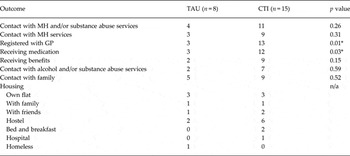
Table 3 shows the outcome measures for each trial group. We hypothesised that participants in the intervention group would be more likely to be in contact with mental health services at the point of follow-up, 6 weeks post-release. Almost three quarters (73%) of the CTI group were in contact with either mental health and/or alcohol or substance abuse services at follow-up compared to the TAU group of which 50% were in contact. This difference was not significant (p = 0.26). However, the CTI group were significantly more likely to be receiving their medication at the time of follow-up compared to the TAU group (38 v. 80%, p = 0.03), and they were also more likely to be registered with a GP (38 v. 87%, p = 0.01).
Outcomes at follow-up

*Significant at .05 level.
A higher proportion of CTI participants were receiving benefits at the time of follow-up compared to the TAU group (25 v. 60%), but these differences were not significant. There were no differences in terms of social support, and in terms of housing, there were no differences between groups except that one CTI participant had been admitted to hospital and one TAU participant was homeless at the time of follow-up.
The feasibility of the intervention was tested via two models, one prison based and one community based with the CTI manager visiting the prison. However, it quickly emerged that for the intervention to be successful, the majority of the work had to be performed from inside prison. This allowed the CTI manager to regularly meet with the prisoner, identify the potentially most problematic issues, and begin to make plans to resolve these prior to release. The CTI manager at the London site who was initially required to be community based found that it was simply not feasible to deliver the intervention effectively from outside the prison and therefore spent more time than anticipated inside the prison.
Discussion
Summary of main findings
The main aims of this study were: (i) to examine whether an adapted form of CTI would be feasible in the English prison system to assisted people with severe mental illness; and (ii) to assess whether CTI would make it more likely that prisoners with mental health problems would engage with mental health services upon release.
The main aim of the study was to establish whether the intervention was feasible. The role of the CTI manager was simply to be the key link between the in-reach team in the prison and the agencies outside the prison. In our study this role was fulfilled by a psychiatric nurse, but in fact, due to the social problems facing the prisoners, we found it could also be fulfilled by a social worker. Laying the groundwork for the prisoners' release was most often done from inside the prison, by spending time with the prisoner establishing their needs and then contacting the required agencies to address these needs. This meant that the more feasible CTI model was the one in which the CTI manager was based in the prison working alongside the in-reach team. Their role was different to that of the in-reach team in that they specifically focused on working with those individuals who were due for imminent release. The role required the CTI manager to be knowledgeable about local services and agencies and involved a considerable amount of detailed case work once the individual was in the community, taking them to the GP, to the CMHT base, to substance abuse services, and discussing any financial or social support needs. We found that prisoners who received the CTI were highly appreciative of this help and responded by staying in contact and engaging with the CTI manager. This reiterates that it is not the effectiveness of psychiatric interventions which keep the individual engaged but rather listening, accepting, and supporting them in their need for integration into community life (Davidson et al. Reference Davidson, Miller and Flanagan2008). The model is a simple one, yet extremely relevant and highly valued and accepted by prisoners as a way of managing the vulnerable transition period between prison and community following release. CTI managers commented that it felt instinctively right that the model helped to facilitate creative as well as logical interventions, and that as a model, CTI provided the basis of offering a better-integrated service in which the client comes first.
We also wanted to assess whether CTI would improve engagement with care. We found a higher proportion of participants in the CTI group were in contact with services 6 weeks after release compared to the TAU group. This difference was not statistically significant. However, we found that the CTI group was significantly more likely to be receiving medication and be registered with a GP at the time of follow-up. Half of the TAU group and two-thirds of the CTI group were held in prison on remand which meant that their release was often unpredictable. Many of the prisoners had been discharged by their CMHTs on entry into prison or before and on release it took an average of 4 weeks for their contact to be reinstated. In the interim, the intervention group were seen and supported by the CTI manager who could also ensure that they attended their GP to receive medication. However, for those in the TAU group this proved to be a break in service contact which would often lead to their disengagement with care. Even for those participants who were well known to their CMHT, the required process of referral, re-assessment, and discussion at team meeting was undergone before they were re-accepted on to the caseload, causing substantial and avoidable delay. Substance abuse teams on the other hand had a faster process for re-integration into services, sometimes taking on people within 24 h of their release.
Study limitations and implications
The study was a pilot RCT therefore the number of participants was relatively low. However, even so, CTI was found to be acceptable to prisoners, in terms of their satisfaction with increased levels of support and may confer clinical benefit. In addition, we confirmed that it is viable to practice a transitional role between prison and community mental health services. It was also possible to see the slow process of being taken back on to caseloads by CMHTs and how problematic this proved for engagement. There was no long-term follow-up within this study and so we could not assess medium- to long-term effects, including re-offending. In order to achieve continuity of care, there needs to be recognition that on release prisoners face a number of social problems for which many need detailed assistance. Previous research has shown that establishing support systems prior to an individual leaving an institution is crucial for continuity of care (Suárez et al. Reference Suárez, Bravo-Ortiz, Fernández-Liria and González-Juárez2011). The problems for individuals with mental health problems leaving prison are even more acute.
Great care is needed in drawing valid inferences concerning the effects of the intervention – the data are based on fewer than 50% of those randomised (i.e. we are no longer looking at a randomised comparison) and we have to assume at present that release from prison was not influenced in any way by being recruited into the trial. In the next stage, a larger-scale RCT, we shall investigate whether CTI confers longer term social and clinical benefits and whether it is cost-effective. In planning this trial, however, very careful consideration will have to be given to the timing of the randomisation so that it does not lead to the recruitment of prisoners who will never actually be released.
Acknowledgements
GT is supported in relation to a National Institute for Health Research (NIHR) Applied Programme grant awarded to the South London and Maudsley NHS Foundation Trust, and in relation to the NIHR Specialist Mental Health Biomedical Research Centre at the Institute of Psychiatry, King's College London and the South London and Maudsley NHS Foundation Trust. The views expressed in this publication are those of the author(s) and not necessarily those of the NHS, the NIHR or the Department of Health.
Declaration of Interest
The study was funded by the Medical Research Council (Trials Grant G0401268), with some additional funding from the Psychiatric Research Trust and Oxleas NHS Trust. Dr Parrott and Dr Forrester of Oxleas NHS Trust were collaborators on the study, and contributed to the study design, interpretation of data, and writing of this paper.