Introduction
Ceramics based on rare earth hafnates are known to be characterized with low volatility of components and thermal conductivity as well as high chemical stability and melting temperatures [Reference Stolyarova1, Reference Glushkova, Kravchinskaya, Kuznetsov and Tikhonov2]. It has been repeatedly shown that rare earth hafnates are promising for development of a wide range of new high temperature materials, such as thermal barrier coatings [Reference Cao, Vassen and Stoever3, Reference Nicholls, Lawson, Johnstone and Rickerby4] and casting molds for gas turbine engine blades [Reference Chubarov and Matveev5, Reference Kablov and Toloraiya6]. Nowadays high temperature materials are mostly based on zirconia stabilized with rare earth oxides [Reference Clarke and Phillpot7]. However, its main drawback is limited range of working temperatures less than 1473 K. Consequently, as working temperatures of gas turbine engines increase, a need arises for new refractory materials, which possess lower thermal conductivity and larger temperature range of phase stability than stabilized zirconia. A promising approach to improve the characteristics of high temperature ceramics is substitution of zirconia to hafnia [Reference Clarke and Phillpot7, Reference Miller8]. Hafnia based ceramics outperform materials based on zirconia in several aspects including high temperature phase stability due to the higher temperature of the HfO2 transition from monoclinic to tetragonal structure at 1923 K as compared to the ZrO2 corresponding phase transition temperature as 1475 K [Reference Navrotsky9]. Moreover, the higher temperature of the HfO2 phase transition leads to easier relaxation of stresses in the material caused by volume effect of this phase transition [Reference Curtis, Doney and Johnson10, Reference Ibégazène, Alpérine and Diot11].
Ceramics containing hafnia and rare earth oxides may also be used in various areas of the nuclear industry [Reference Glushkova, Kravchinskaya, Kuznetsov and Tikhonov2, Reference Wang, Li and Stevens12]. Materials based on lanthanoid hafnates (Ln2Hf2O7) are promising for dealing with radioactive waste since they demonstrate stability against ionizing radiation and are capable of forming solid solutions with actinoids. It should be underlined that hafnia-based materials are characterized with high coefficients of neutron absorption, which explains the possibility of their application for production of control rods in water-cooled reactors [Reference Wang, Li and Stevens12, Reference Larsen13].
As is well known, compounds with the pyrochlore structure having general formula A2B2O7 are attractive as systems with unique electrochemical properties. Due to presence of oxygen vacancies, lanthanoid hafnates possess intrinsic oxygen conductivity at elevated temperatures, which may be used for production of high temperature solid oxide fuel cells, gas sensors, and membranes for oxygen separation [Reference Shlyakhtina and Shcherbakova14, Reference López-Cota, Cepeda-Sánchez, Díaz-Guillén, Dura, López de la Torre, Maczka, Ptak and Fuentes15]. Thin films of hafnia doped with rare earth oxides were also shown to have ferroelectric properties as well as to be candidates for development of random-access memory [Reference Müller, Schröder, Böscke, Müller, Böttger, Wilde, Sundqvist, Lemberger, Kücher, Mikolajick and Frey16, Reference Mueller, Adelmann, Singh, Van Elshocht, Schroeder and Mikolajick17, Reference Chen, Xu, Sun, Zhou, Wang, Ding and Zhang18].
Processing of ultra-high temperature ceramics should take into account possibility of changing physicochemical properties because of alteration of their chemical or phase composition due to selective vaporization of components and high temperature phase transformation. Therefore, for successful synthesis and application of ultra-high temperature HfO2-ceramics, it is necessary to have information concerning vaporization processes of rare earth hafnates as well as their thermodynamic properties to predict physicochemical characteristics of refractory materials using various modeling approaches.
In the present study, lanthanum, neodymium, and gadolinium hafnates (Ln2Hf2O7) were chosen as subjects of consideration. Vaporization processes and thermodynamic properties of the hafnates mentioned were investigated in the series of experimental studies [Reference Vorozhtcov, Stolyarova, Lopatin, Simonenko, Simonenko, Sakharov, Sevastyanov and Kuznetsov19, Reference Sevastyanov, Simonenko, Simonenko, Stolyarova, Lopatin and Kuznetsov20, Reference Sevastyanov, Simonenko, V Sevastyanov, Simonenko, Stolyarova, Lopatin and Kuznetsov21]. Physicochemical properties of systems containing hafnia and rare earth oxides available in the literature, such as thermal expansion coefficients, thermal diffusivity coefficients, thermal conductivity coefficients, crystallization temperatures and enthalpies, enthalpy increments, heat capacities, as well as vaporization processes, were considered and generalized earlier in review [Reference Stolyarova, Vorozhtcov and Lopatin22].
Thermodynamic properties of lanthanum hafnate were studied at high temperatures in Refs. Reference Vorozhtcov, Stolyarova, Lopatin, Simonenko, Simonenko, Sakharov, Sevastyanov and Kuznetsov19, Reference Babu and Nagarajan23, Reference Ushakov, Navrotsky, Tangeman and Helean24, Reference Kopan’, Gorbachuk, Lakiza and Tishchenko25, and Reference Stolyarova, Vorozhtcov, Lopatin and Shilov26 by the various experimental approaches. In Ref. Reference Babu and Nagarajan23, enthalpy increments of lanthanum hafnate were measured by the inverse drop calorimetric method in the temperature range 988–1733 K. Based on these data, the La2Hf2O7 heat capacities and absolute entropies were derived at the temperatures 300–1800 K using heat capacity and entropy values at 298 K obtained by the Neumann–Kopp rule as constraints for fitting the data. Formation enthalpy of pyrochlore lanthanum hafnate from the oxides was determined by drop solution calorimetry at 298 K [Reference Ushakov, Navrotsky, Tangeman and Helean24]. In this study, lanthanum hafnate with the fluorite structure was not obtained; thus, the enthalpy of the pyrochlore–fluorite transition was not derived for La2Hf2O7. The La2Hf2O7 heat capacities were obtained [Reference Kopan’, Gorbachuk, Lakiza and Tishchenko25] by adiabatic calorimetry in the temperature range 57–302 K. It was also shown [Reference Kopan’, Gorbachuk, Lakiza and Tishchenko25] that the temperature dependence of the La2Hf2O7 heat capacities obtained experimentally is in satisfactory agreement with that evaluated by the Neumann–Kopp rule with relative deviation being lower than 3.8%.
Studies of thermodynamic properties of neodymium hafnate with the pyrochlore structure are limited to the results [Reference Sevastyanov, Simonenko, Simonenko, Stolyarova, Lopatin and Kuznetsov20, Reference Sevastyanov, Simonenko, V Sevastyanov, Simonenko, Stolyarova, Lopatin and Kuznetsov21, Reference Paputsky, Krzhizhanovskaya and Glushkova27]. Some physicochemical properties of pyrochlore neodymium hafnate such as thermal conductivity, density, thermal expansion coefficient, and specific conductance were presented in book [Reference Arseniev, Glushkova, Evdokimov, Keller, Kravchenko, Kravchinskaya, Krzhizhanovskaya, Kuznetsov, Kurbanov, Potemkin, Tikhonov and Tseytlin28]. Formation enthalpy of pyrochlore neodymium hafnate from oxides at temperature 298 K was determined by the method of combustion in adiabatic calorimeter [Reference Paputsky, Krzhizhanovskaya and Glushkova27].
Thermodynamic properties of gadolinium hafnate with the pyrochlore and fluorite structures were investigated using following experimental approaches [Reference López-Cota, Cepeda-Sánchez, Díaz-Guillén, Dura, López de la Torre, Maczka, Ptak and Fuentes15, Reference Sevastyanov, Simonenko, Simonenko, Stolyarova, Lopatin and Kuznetsov20, Reference Babu and Nagarajan23, Reference Ushakov, Navrotsky, Tangeman and Helean24, Reference Paputsky, Krzhizhanovskaya and Glushkova27]. Some physicochemical properties of pyrochlore gadolinium hafnate such as density and specific conductance were presented in book [Reference Arseniev, Glushkova, Evdokimov, Keller, Kravchenko, Kravchinskaya, Krzhizhanovskaya, Kuznetsov, Kurbanov, Potemkin, Tikhonov and Tseytlin28]. Heat capacities of pyrochlore Gd2Hf2O7 synthesized by mechanical milling were measured by differential scanning calorimetry in the temperature range 373–1073 K [Reference López-Cota, Cepeda-Sánchez, Díaz-Guillén, Dura, López de la Torre, Maczka, Ptak and Fuentes15]. The authors [Reference López-Cota, Cepeda-Sánchez, Díaz-Guillén, Dura, López de la Torre, Maczka, Ptak and Fuentes15] noted that at temperatures higher than 673 K, the Gd2Hf2O7 heat capacity increased monotonically with temperature increase instead of approaching a constant value predicted by the Dulong–Petit law. The procedure of determination of the Gd2Hf2O7 heat capacities in Ref. Reference Babu and Nagarajan23 was identical to that described above for lanthanum hafnate. The study [Reference Ushakov, Navrotsky, Tangeman and Helean24] was devoted to determination of formation enthalpies from the oxides for Gd2Hf2O7 with pyrochlore and fluorite structures at 298 K by drop solution calorimetry as well as the enthalpy of the Gd2Hf2O7 pyrochlore–fluorite phase transition. The fluorite Gd2Hf2O7 formation enthalpy from the oxides was found to be (−25.3 ± 4.7) kJ/mol [Reference Ushakov, Navrotsky, Tangeman and Helean24]. Formation enthalpy of fluorite Gd2Hf2O7 from the oxides was also obtained by the method of combustion in adiabatic calorimeter [Reference Paputsky, Krzhizhanovskaya and Glushkova27]. This value of the formation enthalpy at the temperature 298 K equaled −41 kJ/mol according to [Reference Paputsky, Krzhizhanovskaya and Glushkova27], which is 1.6 times less than that in Ref. Reference Ushakov, Navrotsky, Tangeman and Helean24.
However, nowadays a variety of information about hafnium-containing systems was obtained also by the Knudsen effusion mass spectrometric method (KEMS). That is the main reason why the careful analysis of the thermodynamic data found by KEMS recently for various hafnates, such as lanthanum, neodymium, and gadolinium hafnates [Reference Vorozhtcov, Stolyarova, Lopatin, Simonenko, Simonenko, Sakharov, Sevastyanov and Kuznetsov19, Reference Sevastyanov, Simonenko, Simonenko, Stolyarova, Lopatin and Kuznetsov20, Reference Sevastyanov, Simonenko, V Sevastyanov, Simonenko, Stolyarova, Lopatin and Kuznetsov21], has to be done, on the one hand, and has to be expanded with simultaneous consideration of the data for these compounds obtained by various independent approaches, on the other hand. To achieve that, first, in the present study, the summary of the recent results found by KEMS about thermodynamic properties of hafnia-containing systems is presented. Second, to obtain a wider set of thermodynamic properties of the hafnates under study, the additional data on the heat capacities of these compounds were determined experimentally in this study by differential scanning calorimetry. Combining the results found earlier by KEMS with the experimental calorimetric data presented for the first time in this manuscript for heat capacities of La2Hf2O7 and Gd2Hf2O7 allowed further calculation and evaluation of such thermodynamic properties of these compounds as standard formation Gibbs energies from the elements at the temperature 2445 K, standard formation enthalpies from the elements at the temperature 2445 K, as well as absolute entropies at the temperatures 298 and 2445 K.
Therefore, it will be reasonable in the current manuscript to summarize KEMS results obtained earlier, to present experimental data on heat capacities of the compounds under consideration, to calculate their thermodynamic properties in the wide temperature range using the results by the KEMS and DSC methods, and then to evaluate the general tendency of their changes according to the ionic radii of the corresponding lanthanoids.
Summary of thermodynamic properties of hafnia-containing systems at high temperatures obtained by KEMS
Vaporization processes and thermodynamic properties of lanthanum hafnate with pyrochlore structure were studied by KEMS in Refs. Reference Vorozhtcov, Stolyarova, Lopatin, Simonenko, Simonenko, Sakharov, Sevastyanov and Kuznetsov19 and Reference Stolyarova, Vorozhtcov, Lopatin and Shilov26. Formation Gibbs energy of La2Hf2O7 from the oxides was determined at the temperatures 2445 K [Reference Vorozhtcov, Stolyarova, Lopatin, Simonenko, Simonenko, Sakharov, Sevastyanov and Kuznetsov19] and 2337 K [Reference Stolyarova, Vorozhtcov, Lopatin and Shilov26]. Temperature dependence of the LaO partial vapor pressures over La2Hf2O7 (p(LaO)) was obtained in the temperature range 2190–2447 K [Reference Vorozhtcov, Stolyarova, Lopatin, Simonenko, Simonenko, Sakharov, Sevastyanov and Kuznetsov19],
 $$\ln \;p\left( {{\rm{LaO,Pa}}} \right) = - {{78000\; \pm \;5000} \over T} + \left( {32\; \pm \;2} \right)\quad .$$
Concentration dependences of the NdO partial vapor pressures, the Nd2O3 and HfO2 activities, and formation Gibbs energies from the oxides were obtained at the temperature 2300 K in the composition range from Nd2Hf2O7 to HfO2 by KEMS [Reference Sevastyanov, Simonenko, Simonenko, Stolyarova, Lopatin and Kuznetsov20, Reference Sevastyanov, Simonenko, V Sevastyanov, Simonenko, Stolyarova, Lopatin and Kuznetsov21]. In the temperature range 2096–2331 K, the NdO partial vapor pressures over Nd2Hf2O7 were presented as a function of temperature [Reference Sevastyanov, Simonenko, Simonenko, Stolyarova, Lopatin and Kuznetsov20],
 $$\log \;p\left( {{\rm{NdO,Pa}}} \right) = - {{36750\; \pm \;2200} \over T} + \left( {16.2\; \pm \;1.0} \right)\quad .$$
Vaporization processes and thermodynamic properties of pyrochlore Gd2Hf2O7 were investigated also by KEMS [Reference Sevastyanov, Simonenko, Simonenko, Stolyarova, Lopatin and Kuznetsov20]. The Gd2O3 and HfO2 activities, and formation Gibbs energies from the oxides for Gd2Hf2O7 were determined at the temperature 2630 K in this study [Reference Sevastyanov, Simonenko, Simonenko, Stolyarova, Lopatin and Kuznetsov20]. The GdO partial vapor pressures as a function of temperature were obtained over gadolinium hafnate in the range 2154–2392 K [Reference Sevastyanov, Simonenko, Simonenko, Stolyarova, Lopatin and Kuznetsov20],
 $$\log \;p\left( {{\rm{GdO,Pa}}} \right) = - {{26400\; \pm \;1900} \over T} + \left( {10.4\; \pm \;0.8} \right)\quad .$$
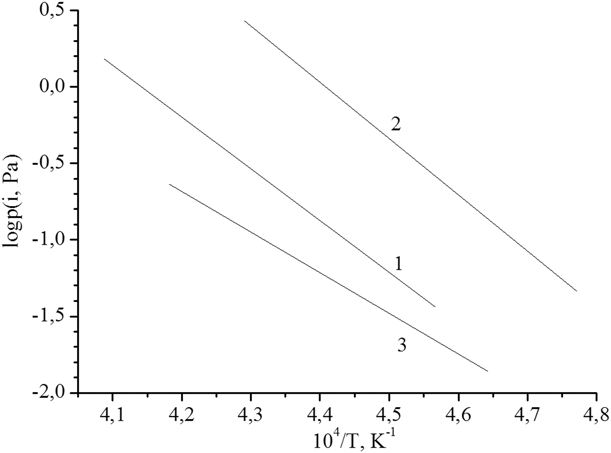
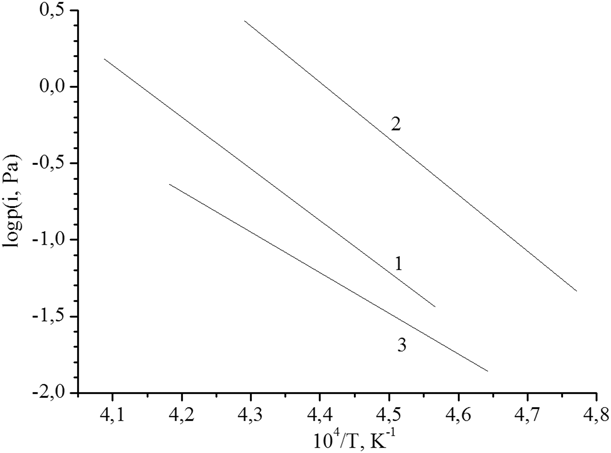
Summarizing high temperature behavior of La2Hf2O7, Nd2Hf2O7, and Gd2Hf2O7 studied by KEMS [Reference Vorozhtcov, Stolyarova, Lopatin, Simonenko, Simonenko, Sakharov, Sevastyanov and Kuznetsov19, Reference Sevastyanov, Simonenko, Simonenko, Stolyarova, Lopatin and Kuznetsov20, Reference Sevastyanov, Simonenko, V Sevastyanov, Simonenko, Stolyarova, Lopatin and Kuznetsov21], the temperature dependences of the LaO, NdO, and GdO partial vapor pressures over them are compared in Fig. 1.
The temperature dependences of the LaO, NdO, and GdO partial vapor pressures over La2Hf2O7, Nd2Hf2O7, and Gd2Hf2O7, respectively: 1 is the LaO partial vapor pressure in the temperature range 2190–2447 K [Reference Vorozhtcov, Stolyarova, Lopatin, Simonenko, Simonenko, Sakharov, Sevastyanov and Kuznetsov19]; 2 is the NdO partial vapor pressure in the temperature range 2096–2331 K [Reference Sevastyanov, Simonenko, Simonenko, Stolyarova, Lopatin and Kuznetsov20]; 3 is the GdO partial vapor pressure in the temperature range 2154–2392 K [Reference Sevastyanov, Simonenko, Simonenko, Stolyarova, Lopatin and Kuznetsov20].
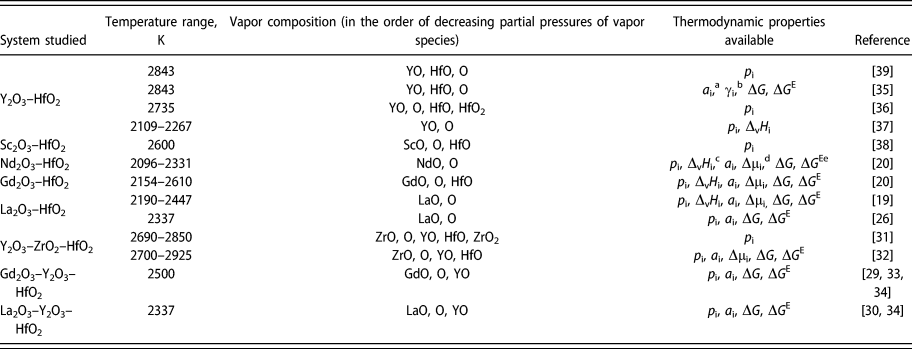
Results on vaporization processes and thermodynamic properties of the systems containing hafnia and rare earth oxides by KEMS are summarized in Table I including information for three ternary systems Gd2O3–Y2O3–HfO2, La2O3–Y2O3–HfO2, and Y2O3–ZrO2–HfO2, which were investigated in Refs. Reference Kablov, Stolyarova, Lopatin, Vorozhtcov, Karachevtsev and Folomeikin29, Reference Kablov, Stolyarova, Vorozhtcov, Lopatin, Fabrichnaya, Ilatovskaya and Karachevtsev30, Reference Belov and Semenov31, and Reference Sevastyanov, Simonenko, Simonenko, Stolyarova, Lopatin and Kuznetsov32. It follows from Table I that binary systems based on hafnia have been studied to some extent by KEMS. However, ternary systems containing hafnia and rare earth oxides are still waiting for large-scale research. It should be noted that KEMS, despite the fact that this method was suggested by Ionov for study of inorganic compounds in 1948 [Reference Ionov40], even now has a lot of advantages for investigation of thermodynamic properties compared with other experimental methods such as the possibility to obtain simultaneously the complete set of thermodynamic parameters (activities of components, enthalpy of mixing, Gibbs energies of formation from oxides, and excess Gibbs energies) in the wide temperature range up to 3000 K [Reference Stolyarova and Semenov41, Reference Stolyarova42]. Variety of thermodynamic experimental data found by KEMS at high temperatures for the binary and ternary hafnate systems and presented in Table I is one of the additional confirmations of the KEMS abilities. Advantages of this approach to study binary and ternary systems based on hafnia may be analyzed when the comparison of the data on vaporization processes and thermodynamic properties of the hafnia-containing systems is made based on the results summarized in Table I. As it follows from this analysis, it may be concluded that vaporization processes of the binary and ternary systems of hafnia presented in Table I were similar to the transition to the gaseous phase of the pure oxides as a part of the corresponding systems. The main peculiarity of thermodynamic properties describing high temperature behavior of the hafnia-containing systems studied is the negative deviations from the ideal behavior at high temperatures. It should also be mentioned that in the series of binary systems such as La2O3–HfO2, Nd2O3–HfO2, and Gd2O3–HfO2, level of deviations from the ideality in these systems is closely connected with the electron structure of the corresponding rare earth oxide as shown in Ref. Reference Stolyarova, Vorozhtcov, Lopatin and Shilov26. It should be underlined also that the Redlich–Kister representation was successfully applied to treat the thermodynamic properties in such systems as Gd2O3–Y2O3 and Gd2O3–Y2O3–HfO2 [Reference Vorozhtcov, Shilov and Stolyarova33, Reference Kablov, Stolyarova, Lopatin, Vorozhtcov, Karachevtsev and Folomeikin43] studied by KEMS at high temperatures. Applicability of the Kohler method [Reference Kohler44] for calculation of the high temperature thermodynamic properties of the Gd2O3–Y2O3–HfO2 and La2O3–Y2O3–HfO2 systems based on the data for the corresponding binary systems was discussed in Refs. Reference Kablov, Stolyarova, Vorozhtcov, Lopatin, Fabrichnaya, Ilatovskaya and Karachevtsev30 and Reference Kablov, Stolyarova, Lopatin, Vorozhtcov, Karachevtsev and Folomeikin43. It should be underlined that thermodynamic properties of solid solutions in the Gd2O3–Y2O3–HfO2 and La2O3–Y2O3–HfO2 systems found in Refs. Reference Kablov, Stolyarova, Vorozhtcov, Lopatin, Fabrichnaya, Ilatovskaya and Karachevtsev30 and Reference Kablov, Stolyarova, Lopatin, Vorozhtcov, Karachevtsev and Folomeikin43 at high temperatures may be optimized using the generalized lattice theory of associated solutions or the Barker theory [Reference Barker45] as it was shown in Refs. Reference Vorozhtcov, Shilov and Stolyarova33 and Reference Shilov, Stolyarova, Vorozhtcov and Lopatin34.
Results of high temperature studies of hafnia-containing systems obtained using KEMS approach [Reference Vorozhtcov, Stolyarova, Lopatin, Simonenko, Simonenko, Sakharov, Sevastyanov and Kuznetsov19, Reference Sevastyanov, Simonenko, Simonenko, Stolyarova, Lopatin and Kuznetsov20, Reference Stolyarova, Vorozhtcov, Lopatin and Shilov26, Reference Kablov, Stolyarova, Lopatin, Vorozhtcov, Karachevtsev and Folomeikin29, Reference Kablov, Stolyarova, Vorozhtcov, Lopatin, Fabrichnaya, Ilatovskaya and Karachevtsev30, Reference Belov and Semenov31, Reference Sevastyanov, Simonenko, Simonenko, Stolyarova, Lopatin and Kuznetsov32, Reference Vorozhtcov, Shilov and Stolyarova33, Reference Shilov, Stolyarova, Vorozhtcov and Lopatin34, Reference Belov and Semenov35, Reference Marushkin and Alikhanyan36, Reference Kablov, Folomeikin, Stolyarova and Lopatin37, Reference Semenov, Kuligina, Teterin, Menchuk and Shkol’nikov38, Reference Semenov, Belov, Baydin, Ivanauskas, Vyšniauskas, Majauskas, Karaulov and Taranuha39]: composition of vapor and thermodynamic properties available in the literature.
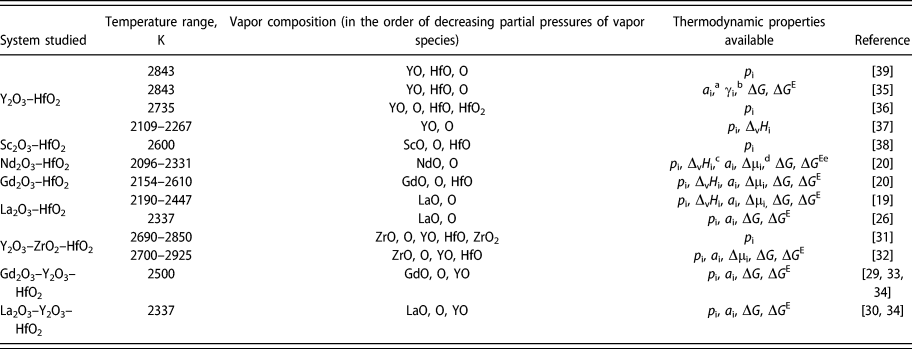
a Where a i is the component activity.
b Where γi is the activity coefficient of component.
c Where ΔvH i is the partial molar enthalpy of vaporization of component.
d Where Δμi is the component chemical potential.
e Where ΔG E is the excess Gibbs energy.
It is extremely reasonable to generalize thermodynamic information obtained not only by KEMS but also by the other thermodynamic experimental approaches such as differential scanning calorimetry for some rare earth hafnates, which is the main purpose of the present study.
Therefore, based on the brief review of the available experimental results on thermodynamic properties of lanthanum, neodymium, and gadolinium hafnates presented above, it may be concluded the following.
(i) There are no systematic thermodynamic studies of lanthanoid hafnates at high temperatures.
(ii) To consider and compare thermodynamic properties of lanthanum, neodymium, and gadolinium hafnates (Ln2Hf2O7) at high temperatures, some additional determination of the La2Hf2O7 and Gd2Hf2O7 heat capacities is required. It is this issue that will be the topic of the current study including the additional differential scanning calorimetric investigation required to recalculate the formation Gibbs energies from the oxides determined earlier at high temperatures down to the temperature 298 K.
Thus, the general consistency of the data obtained earlier by KEMS with the experimental data on heat capacities determined in the present investigation will be further considered in accordance with the main purposes indicated above. One of the advantages of this consideration is usage of the results found by the independent experimental approaches (KEMS and DSC) for obtaining the reliable thermodynamic data of La2Hf2O7, Nd2Hf2O7, and Gd2Hf2O7 in the wide temperature range.
Results and discussion
Experimental determination of the La2Hf2O7 and Gd2Hf2O7 heat capacities
To confirm the previously obtained data [Reference Babu and Nagarajan23, Reference Kopan’, Gorbachuk, Lakiza and Tishchenko25], the La2Hf2O7 heat capacities were determined in the present study by differential scanning calorimetry in the temperature range 350–840 K and are shown in Table SI (Supplementary material). The smoothed temperature dependence of the La2Hf2O7 heat capacities in the range 350–840 K was obtained by approximation of the experimental data presented in Table SI with a polynomial equation,
 $$\eqalign{{C_{\rm{p}}}\left( {{\rm{L}}{{\rm{a}}_{\rm{2}}}{\rm{H}}{{\rm{f}}_{\rm{2}}}{{\rm{O}}_{\rm{7}}}} \right) = 111.94 + 0.57T - 7.60 \cr\times {10^{ - 4}}{T^2} + 3.38 \times {10^{ - 7}}{T^3}\quad .$$
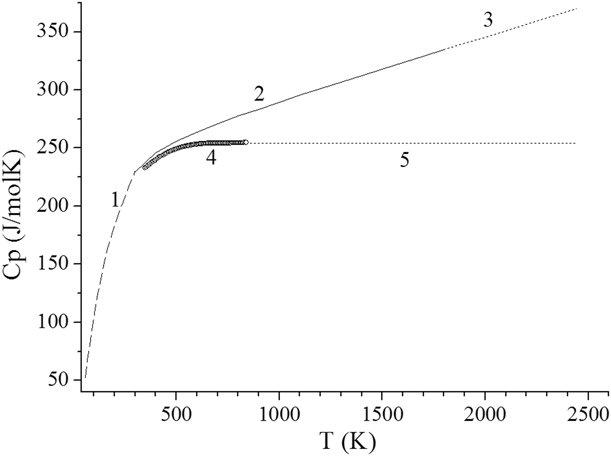
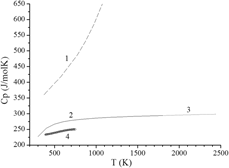
The relative deviation of the La2Hf2O7 experimental heat capacities from the values approximated by Eq. (4) in the temperature range 350–840 K is given in Fig. S1 (Supplementary material). The smoothed curve of the La2Hf2O7 heat capacities is shown in Fig. 2 in comparison with the data found earlier [Reference Babu and Nagarajan23, Reference Kopan’, Gorbachuk, Lakiza and Tishchenko25]. It follows from Fig. 2 that at low temperatures up to 500 K, the La2Hf2O7 heat capacities obtained in Ref. Reference Babu and Nagarajan23 and in the present study demonstrate the same character of temperature changes. However, in the temperature range 600–840 K, the La2Hf2O7 heat capacities obtained in the present study stabilized at the value of (254 ± 13) J/(mol K), while the La2Hf2O7 heat capacities from Ref. Reference Babu and Nagarajan23 increased in the whole temperature range of measurement up to 1800 K. The fact that the La2Hf2O7 heat capacities do not stabilize at a constant value was realized by the authors [Reference Babu and Nagarajan23] who mentioned that such type of behavior was not consistent with the temperature dependences of heat capacities of gadolinium and europium hafnates obtained in the same study. According to [Reference Babu and Nagarajan23], explanation of this fact may be related to the crystal chemistry of the pyrohafnates.
The temperature dependences of heat capacities of lanthanum hafnate: 1 is the experimental data [Reference Kopan’, Gorbachuk, Lakiza and Tishchenko25]; 2 is the experimental data [Reference Babu and Nagarajan23]; 3 is the extrapolation of the results [Reference Babu and Nagarajan23] up to the temperature 2445 K; 4 is the smoothed curve of the experimental data obtained in the present study; 5 is the extrapolation of the results obtained in the present study to the temperature 2445 K.
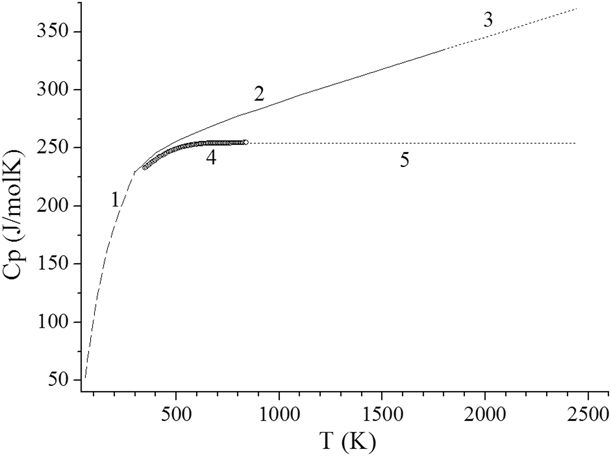
It should be mentioned that despite the fact that the results of the La2Hf2O7 heat capacity determination were obtained in Refs. Reference Babu and Nagarajan23 and Reference Kopan’, Gorbachuk, Lakiza and Tishchenko25 in different temperature ranges as shown in Fig. 2, they are in excellent agreement at the overlapping temperature 298 K. This is an explainable consistency since in Ref. Reference Kopan’, Gorbachuk, Lakiza and Tishchenko25, the La2Hf2O7 heat capacities obtained experimentally were shown to agree with those evaluated according to the Neumann–Kopp rule with a deviation less than 3.8%. The Neumann–Kopp rule was also used in Ref. Reference Babu and Nagarajan23 for evaluation of the heat capacity of La2Hf2O7 at the temperature 298 K as a constraint to fit the experimental data.
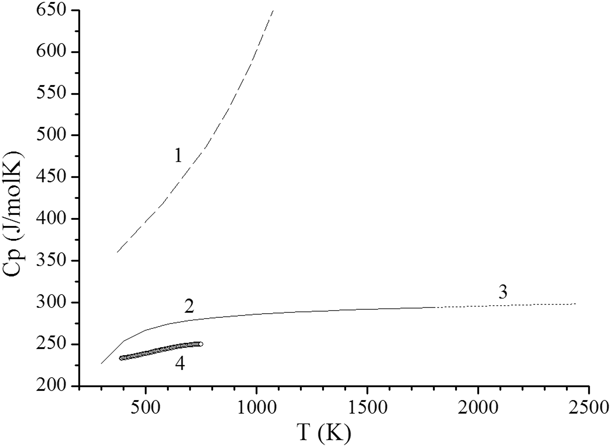
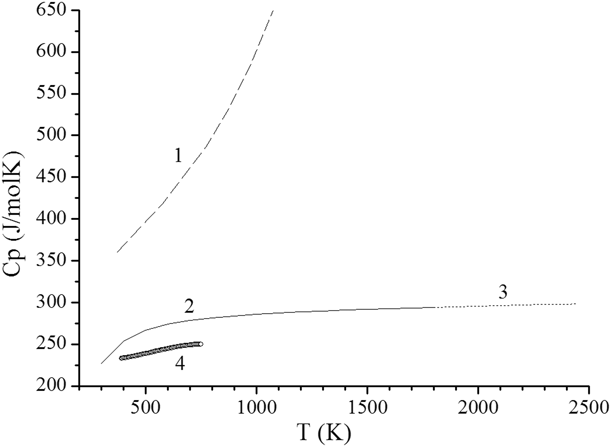
As it was shown above, the Gd2Hf2O7 heat capacities were repeatedly studied [Reference López-Cota, Cepeda-Sánchez, Díaz-Guillén, Dura, López de la Torre, Maczka, Ptak and Fuentes15, Reference Babu and Nagarajan23] and are shown in Fig. 3. Analysis of the Gd2Hf2O7 heat capacity values presented in Fig. 3 led to a conclusion about disagreement of the results [Reference López-Cota, Cepeda-Sánchez, Díaz-Guillén, Dura, López de la Torre, Maczka, Ptak and Fuentes15] and [Reference Babu and Nagarajan23]. It may be assumed that the Gd2Hf2O7 heat capacities [Reference López-Cota, Cepeda-Sánchez, Díaz-Guillén, Dura, López de la Torre, Maczka, Ptak and Fuentes15] are overestimated since even at the lowest temperature of measurement as 373 K, the Gd2Hf2O7 heat capacity value, which equals 360.0 J/(mol K), was close to the Dulong–Petit limit. In addition, it should be noted that the Gd2Hf2O7 heat capacity data [Reference López-Cota, Cepeda-Sánchez, Díaz-Guillén, Dura, López de la Torre, Maczka, Ptak and Fuentes15] were significantly higher than the corresponding heat capacities of related compounds with structural similarity such as La2Hf2O7 [242.1 J/(mol K) at 373 K [Reference Babu and Nagarajan23]], Sm2Hf2O7 [252.7 J/(mol K) at 373 K [Reference Kandan, Prabhakara Reddy, Panneerselvam and Mudali46]], and Gd2Zr2O7 [242.2 J/(mol K) at 370 K [Reference Lutique, Javorskỳ, Konings, Krupa, van Genderen, van Miltenburg and Wastin47]]. In order to clarify the validity of the data [Reference Babu and Nagarajan23] and [Reference López-Cota, Cepeda-Sánchez, Díaz-Guillén, Dura, López de la Torre, Maczka, Ptak and Fuentes15], the Gd2Hf2O7 heat capacities were determined in the present study by differential scanning calorimetry. The Gd2Hf2O7 heat capacity value at the temperature 500 K obtained in the present study was shown to be (236 ± 5) J/(mol K), which is almost half as much as the value in Ref. Reference López-Cota, Cepeda-Sánchez, Díaz-Guillén, Dura, López de la Torre, Maczka, Ptak and Fuentes15 [approximately 400 J/(mol K)]. Thus, data on the Gd2Hf2O7 heat capacities obtained in Ref. Reference Babu and Nagarajan23 may be considered preferable to those from Ref. Reference López-Cota, Cepeda-Sánchez, Díaz-Guillén, Dura, López de la Torre, Maczka, Ptak and Fuentes15.
The temperature dependences of heat capacities of gadolinium hafnate: 1 is the experimental data [Reference López-Cota, Cepeda-Sánchez, Díaz-Guillén, Dura, López de la Torre, Maczka, Ptak and Fuentes15]. 2 is the experimental data [Reference Babu and Nagarajan23]. 3 is the extrapolation of the results [Reference Babu and Nagarajan23] up to the temperature 2445 K. 4 is the smoothed curve of the experimental data obtained in the present study.
The complete set of the Gd2Hf2O7 heat capacities obtained in the present study by differential scanning calorimetry in the temperature range 390–750 K is given in Table SII (Supplementary material). The temperature dependence of the Gd2Hf2O7 heat capacities in the range 390–750 K presented in Table SII was approximated with a polynomial equation,
 $$\eqalign{{C_{\rm{p}}}\left( {{\rm{G}}{{\rm{d}}_{\rm{2}}}{\rm{H}}{{\rm{f}}_{\rm{2}}}{{\rm{O}}_{\rm{7}}}} \right) = 269.7 - 0.29T + 6.6 \times {10^{ - 4}}{T^2} \cr- 4.1 \times {10^{ - 7}}{T^3}\quad .$$
The relative deviation of the Gd2Hf2O7 experimental heat capacities from the values obtained using Eq. (5) in the temperature range 370–750 K is presented in Fig. S2 (Supplementary material). The smoothed curve of the Gd2Hf2O7 heat capacities is also shown in Fig. 3.
The peculiar shape of the temperature dependence of the Gd2Hf2O7 heat capacities may be related to a phase transition process taking place in the sample. Although, according to the phase diagram of the Gd2O3–HfO2 system [Reference Andrievskaya48], the pyrochlore Gd2Hf2O7 phase is the only stable modification in the temperature range of the present study, synthesis of this compound by the glycol–citrate method yields metastable fluorite phase as is shown in Experimental details, which upon further thermal treatment transforms into pyrochlore modification. This transition is kinetically controlled and does not have one certain temperature of transformation. Moreover, Gd2Hf2O7 with pyrochlore and fluorite structures are characterized with very similar X-ray diffraction patterns. Therefore, there is some uncertainty in unambiguous identification if the fluorite–pyrochlore transition of Gd2Hf2O7 was complete. In the present study, the Gd2Hf2O7 sample was annealed at a moderate temperature of 1473 K to retain nanosized dimensions of grains in its powder. Consequently, it may be expected that the fluorite–pyrochlore transition process could fail to finalize and the metastable fluorite phase of Gd2Hf2O7 might still exist in the sample. Thus, it was presence of this fluorite phase in the sample that may be one of the explanations of the peculiar shape of the temperature dependence of the Gd2Hf2O7 heat capacities, which corresponded to a phase transition of the fluorite phase residue into pyrochlore modification (Fig. 3, curve 4). Apparently, to a certain extent, the described phenomenon could also influence curve 4 in Fig. 2 presented above for the temperature dependence of the La2Hf2O7 heat capacities.
Thermodynamic properties of the La2Hf2O7, Nd2Hf2O7, and Gd2Hf2O7 formation
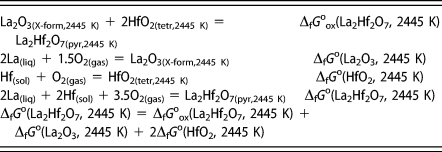
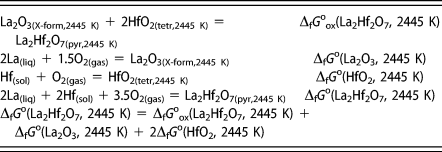
The formation Gibbs energy of La2Hf2O7 from the oxides was determined earlier [Reference Vorozhtcov, Stolyarova, Lopatin, Simonenko, Simonenko, Sakharov, Sevastyanov and Kuznetsov19, Reference Stolyarova, Vorozhtcov, Lopatin and Shilov26] by KEMS and equaled (−53 ± 4) kJ/mol at the temperature 2445 K [Reference Vorozhtcov, Stolyarova, Lopatin, Simonenko, Simonenko, Sakharov, Sevastyanov and Kuznetsov19] and (−51 ± 4) kJ/mol at 2337 K [Reference Stolyarova, Vorozhtcov, Lopatin and Shilov26]. The formation Gibbs energies of Nd2Hf2O7 and Gd2Hf2O7 from the oxides were obtained by KEMS [Reference Sevastyanov, Simonenko, Simonenko, Stolyarova, Lopatin and Kuznetsov20] and equaled (−38 ± 3) kJ/mol at 2300 K and (−46 ± 3) kJ/mol at 2610 K, respectively. As is well known, to obtain the standard formation Gibbs energies of the hafnates under consideration at the temperature 298 K, first, the formation Gibbs energies from oxides at temperatures of the measurements should be converted to the formation Gibbs energies from elements at the same temperatures using the thermochemical cycle, and, secondly, the formation Gibbs energies from elements should be recalculated from the temperatures of the measurements to 298 K using heat capacities of these hafnates. An example of the thermochemical cycle for calculation of the La2Hf2O7 standard formation Gibbs energies from the elements at 2445 K ΔfG o(La2Hf2O7, 2445 K) based on the La2Hf2O7 standard formation Gibbs energies from the oxides ΔfG oox(La2Hf2O7, 2445 K) determined in Ref. Reference Vorozhtcov, Stolyarova, Lopatin, Simonenko, Simonenko, Sakharov, Sevastyanov and Kuznetsov19 was presented in Table II. Equations in Table II included values of standard formation thermodynamic functions for pure oxides constituting the corresponding lanthanum, neodymium, and gadolinium hafnates (Ln2Hf2O7). Data on standard formation thermodynamic functions for pure oxides such as La2O3, Nd2O3, Gd2O3, and HfO2 were recalculated from the temperature 298 K up to 2445 K using the values available in Refs. Reference Gurvich, Veitz, Medvedev, Bergman, Jungman, Khachkuruzov and Iorish49 and Reference Konings, Beneš, Kovács, Manara, Sedmidubský, Gorokhov, Iorish, Yungman, Shenyavskaya and Osina50. The formation Gibbs energies of these hafnates from the oxides were also recalculated to the temperature 2445 K assuming linear dependence on temperature. The literature values of formation thermodynamic functions for pure oxides were presented in Table III. Based on these values and equations similar to those given in Table II, the determination of the formation Gibbs energies of La2Hf2O7, Nd2Hf2O7, and Gd2Hf2O7 at the temperature 2445 K was carried out and is presented in Table IV.
Thermochemical cycle for calculation of the La2Hf2O7 standard formation Gibbs energies from the elements at the temperature 2445 K ΔfG o(La2Hf2O7, 2445 K) based on the La2Hf2O7 standard formation Gibbs energies from the oxides ΔfG oox(La2Hf2O7, 2445 K) according to [Reference Vorozhtcov, Stolyarova, Lopatin, Simonenko, Simonenko, Sakharov, Sevastyanov and Kuznetsov19].
Thermodynamic properties of pure oxides HfO2, La2O3, Nd2O3, and Gd2O3 at the temperatures 298 and 2445 K according to [Reference Gurvich, Veitz, Medvedev, Bergman, Jungman, Khachkuruzov and Iorish49, Reference Konings, Beneš, Kovács, Manara, Sedmidubský, Gorokhov, Iorish, Yungman, Shenyavskaya and Osina50]: standard formation enthalpies [ΔfH o(i), kJ/mol], Gibbs energies [ΔfG o(i)], and absolute entropies [S o(i)].

The La2Hf2O7, Nd2Hf2O7, and Gd2Hf2O7 standard formation Gibbs energies from the elements ΔfG o(M2Hf2O7, 2445 K) calculated at the temperature 2445 K using the standard formation Gibbs energies from the oxides ΔfG oox(i, 2445 K) for these hafnates and equations from Table II. The La3+, Nd3+, and Gd3+ ionic radii (r i) are given in Å according to [Reference Shannon51].

The formation Gibbs energies of La2Hf2O7, Nd2Hf2O7, and Gd2Hf2O7 given in Table IV agreed with the well-known empirical rule mentioned earlier [Reference Andrievskaya48] that stability of pyrochlore hafnate phase decreases as radius of lanthanoid ion decreases. As was shown earlier [Reference Andrievskaya48, Reference Simoncic and Navrotsky52, Reference Mandal and Tyagi53], the reliability of this empirical rule was repeatedly confirmed, considering various physicochemical properties of rare earth pyrochlores. Influence of change in the rare earth ionic radii on stability of pyrochlore phase may be observed, for instance, in the phase diagrams of the Ln2O3–HfO2 systems [Reference Andrievskaya48, Reference Simoncic and Navrotsky52]. In this case, the decrease in the Ln3+ ionic radii leads to stabilization of the fluorite phase, which was illustrated in the fact that it becomes stable at lower temperatures as one moves along the lanthanoid series, and destabilization of the pyrochlore phase. While lanthanum, praseodymium, neodymium, and samarium pyrohafnates melt congruently, europium, gadolinium, and terbium pyrohafnates do not melt and transform upon heating into fluorite solid solutions, with the phase transition temperature decreasing from Eu2Hf2O7 to Tb2Hf2O7. Lanthanoids with the ionic radii less than that of Tb3+ do not form a compound with the pyrochlore structure at all, with their hafnates having the fluorite structure [Reference Andrievskaya48, Reference Simoncic and Navrotsky52]. One more example of this empirical rule [Reference Andrievskaya48, Reference Simoncic and Navrotsky52] was observed in the phenomenon of lowering intensity of the characteristic pyrochlore super-structure peaks in X-ray diffraction patterns of Ln2Hf2O7 in Ref. Reference Mandal and Tyagi53 while moving along the lanthanoid series. This observation was explained by the fact that with decrease in the Ln3+ ionic radii the pyrochlore structure tended to transform into defect-fluorite one characterized with absence of the pyrochlore super-structure peaks in X-ray diffraction patterns [Reference Mandal and Tyagi53]. The similar tendency of the lanthanoid hafnates thermodynamic behavior at high temperatures was observed in the present study. An increase of the formation Gibbs energies in the range of the lanthanoid hafnates from La to Gd was demonstrated as is shown in Table IV where the values of the La3+, Nd3+, and Gd3+ ionic radii are given for comparison.
The second important step for obtaining and further recalculation of the formation Gibbs energies of these hafnates from the temperature 2445 K to the temperature 298 K was done according to the following equation:
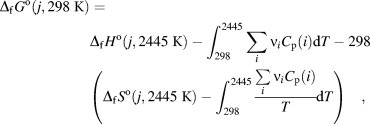 $$\eqalign{{\Delta _{\rm{f}}}{G^{\rm{o}}}\left( {j,298\;{\rm{K}}} \right) = {\Delta _{\rm{f}}}{H^{\rm{o}}}\left( {j,2445\;{\rm{K}}} \right) - \int_{298}^{2445} {\sum\limits_i {{\nu _i}{C_{\rm{p}}}\left( i \right){\rm{d}}T} } - 298\left( {{\Delta _{\rm{f}}}{S^{\rm{o}}}\left( {j,2445\;{\rm{K}}} \right) - \int_{298}^{2445} {{{\sum\limits_i {{\nu _i}{C_{\rm{p}}}\left( i \right)} } \over T}} {\rm{d}}T} \right)\quad ,$$
where ΔfG o(j, T), ΔfH o(j, T), and ΔfS o(j, T) are the standard formation Gibbs energy, enthalpy, and entropy of the j compound, and C p(i) are the heat capacities of i substances taking part in the reaction of formation of the j compound.
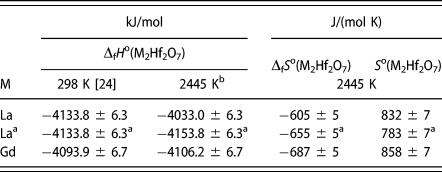
As followed from Eq. (6), the values of the standard formation enthalpy ΔfH o(j, 2445 K) and entropy ΔfS o(j, 2445 K) of the hafnates under consideration at the temperature 2445 K were required. The ΔfG o(j, 2445 K) values for the lanthanum and gadolinium hafnates from Table IV and ΔfH o(j, 298 K) for La2Hf2O7 and Gd2Hf2O7 obtained in Ref. Reference Ushakov, Navrotsky, Tangeman and Helean24 allowed evaluation of ΔfH o(j, 2445 K) and ΔfS o(j, 2445 K) using equations,
 $${\Delta _{\rm{f}}}{H^{\rm{o}}}\left( {j,2445\;{\rm{K}}} \right) = {\Delta _{\rm{f}}}{H^{\rm{o}}}\left( {j,298\;{\rm{K}}} \right) + \int_{298}^{2445} {\sum\limits_i {{\nu _i}{C_{\rm{p}}}\left( i \right){\rm{d}}T} } \quad ,$$
 $$\eqalign{{\Delta _{\rm{f}}}{S^{\rm{o}}}\left( {j,2445\;{\rm{K}}} \right) = {{\left( {{\Delta _{\rm{f}}}{H^{\rm{o}}}\left( {j,2445\;{\rm{K}}} \right) - {\Delta _{\rm{f}}}{G^{\rm{o}}}\left( {j,2445\;{\rm{K}}} \right)} \right)} / {2445}}\quad ,$$
where heat capacities of rare earth metals La and Gd were taken from Ref. Reference Konings and Beneš54 and extrapolated to the temperature 2445 K, those of oxygen and hafnium from Ref. Reference Gurvich, Veitz, Medvedev, Bergman, Jungman, Khachkuruzov and Iorish49 as well as of lanthanum and gadolinium hafnates from Ref. Reference Babu and Nagarajan23. The standard formation enthalpies and entropies of lanthanum and gadolinium hafnates evaluated using Eqs. (7) and (8) at the temperature 2445 K were presented in Table V. In addition, the similar evaluations based on Eqs. (7) and (8) were performed for lanthanum hafnate using also the heat capacities values obtained in the present study.
Thermodynamic properties of La2Hf2O7 and Gd2Hf2O7 at the temperatures 298 K [Reference Ushakov, Navrotsky, Tangeman and Helean24] and 2445 K estimated in the present study: the standard formation enthalpies ΔfH o(M2Hf2O7) and entropies ΔfS o(M2Hf2O7) from the elements; absolute entropies S o(M2Hf2O7) evaluated using the data on the formation Gibbs energies from the elements given in Table IV.b
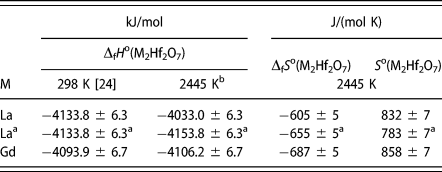
a ΔfH o(La2Hf2O7, 2445 K) was estimated using the La2Hf2O7 extrapolated heat capacities obtained in the present study.
b ΔfH o(La2Hf2O7, 2445 K) was estimated using the extrapolated heat capacities obtained in the present study and the experimental results [Reference Babu and Nagarajan23]. ΔfH o(Gd2Hf2O7, 2445 K) was estimated using the Gd2Hf2O7 heat capacities [Reference Babu and Nagarajan23] extrapolated up to the temperature 2445 K.
An additional attempt was made to evaluate the absolute entropies of lanthanum and gadolinium hafnates at the temperature 298 K using their available extrapolated heat capacities in order to compare the values obtained by this way with the absolute entropies of these hafnates presented in Ref. Reference Babu and Nagarajan23. The absolute entropy of Gd2Hf2O7 at the temperature 298 K according to [Reference Babu and Nagarajan23] was equal to 270.9 J/(mol K). Evaluation of the absolute entropy of Gd2Hf2O7 taken from Table V at the temperature 298 K using the extrapolated heat capacities from Ref. Reference Babu and Nagarajan23 led to the value (275 ± 10) J/(mol K).
The absolute entropy of La2Hf2O7 at the temperature 298 K according to [Reference Babu and Nagarajan23] equaled 247.6 J/(mol K). Evaluation of the absolute entropy of La2Hf2O7 taken from Table V at the temperature 298 K gave rise to the value (228 ± 10) J/(mol K) when the extrapolated heat capacities from Ref. Reference Babu and Nagarajan23 were used and to the value (257 ± 10) J/(mol K) when the extrapolated La2Hf2O7 heat capacities obtained in the present study were applied. Thus, usage of the La2Hf2O7 heat capacities determined in the present study ensured significantly better agreement of the La2Hf2O7 thermodynamic properties at high temperatures with the La2Hf2O7 absolute entropy obtained in Ref. Reference Babu and Nagarajan23 than usage of the La2Hf2O7 heat capacities from Ref. Reference Babu and Nagarajan23.
Finally, the values from Table V may be used further to evaluate ΔfG o(j, 298 K) of La2Hf2O7 and Gd2Hf2O7 using Eq. (6). Then, the values of ΔfG o(j, 298 K) estimated in the present study equaled (−3937 ± 10) kJ/mol for La2Hf2O7 using extrapolated heat capacities data of La2Hf2O7 obtained in the present study and (−3895 ± 10) kJ/mol for Gd2Hf2O7 using the Gd2Hf2O7 heat capacities from Ref. Reference Babu and Nagarajan23.
Conclusions
Based on the data obtained by the high temperature Knudsen effusion mass spectrometric method, such as formation Gibbs energies of La2Hf2O7, Nd2Hf2O7, and Gd2Hf2O7 from the oxides, the standard formation Gibbs energies of La2Hf2O7, Nd2Hf2O7, and Gd2Hf2O7 from the elements at the temperature 2445 K were calculated in the present study. These values of the standard formation Gibbs energies of La2Hf2O7, Nd2Hf2O7, and Gd2Hf2O7 from the elements were shown to be consistent with the empirical rule about decrease of stability of pyrochlore hafnate phase with decrease in lanthanoid ionic radius. Using the extrapolated La2Hf2O7 and Gd2Hf2O7 heat capacities obtained earlier and in the present study, evaluations of the standard formation enthalpies of La2Hf2O7 and Gd2Hf2O7 from the elements at the temperature 2445 K as well as absolute entropies of La2Hf2O7 and Gd2Hf2O7 at the temperatures 298 and 2445 K were carried out. The thermodynamic properties of La2Hf2O7, Nd2Hf2O7, and Gd2Hf2O7 determined and estimated in a wide temperature range in the present study allowed one to consider the reliability of the data available in the literature.
Experimental details
One of the advantages of the present study was in usage for determination of the La2Hf2O7 and Gd2Hf2O7 heat capacities of the same samples that were synthesized, identified, and studied earlier by KEMS in Refs. Reference Vorozhtcov, Stolyarova, Lopatin, Simonenko, Simonenko, Sakharov, Sevastyanov and Kuznetsov19 and Reference Sevastyanov, Simonenko, Simonenko, Stolyarova, Lopatin and Kuznetsov20 for obtaining the component activities and Gibbs energies of formation from the oxides at high temperatures. The main details of these syntheses that were done earlier [Reference Vorozhtcov, Stolyarova, Lopatin, Simonenko, Simonenko, Sakharov, Sevastyanov and Kuznetsov19, Reference Sevastyanov, Simonenko, Simonenko, Stolyarova, Lopatin and Kuznetsov20] are as follows: Lanthanum and gadolinium hafnates were synthesized by the glycol–citrate method, also known as the Pechini modification of self-propagating high-temperature synthesis as described earlier in Refs. Reference Vorozhtcov, Stolyarova, Lopatin, Simonenko, Simonenko, Sakharov, Sevastyanov and Kuznetsov19 and Reference Sevastyanov, Simonenko, Simonenko, Stolyarova, Lopatin and Kuznetsov20. The starting reagents were hafnium oxide-dichloride octahydrate and lanthanum (or gadolinium) nitrate octahydrate dissolved in the stoichiometric relationship in aqueous solution. Then citric acid and ethane-1,2-diol were used to bind metals with each other owing to polycondensation reactions. After that the mixture was evaporated and heated at the temperatures 523–623 K. The obtained gray powder was annealed at the temperature 973 K for 2 h to remove residual carbon. Further details of the preparation technique can be found in Refs. Reference Vorozhtcov, Stolyarova, Lopatin, Simonenko, Simonenko, Sakharov, Sevastyanov and Kuznetsov19 and Reference Sevastyanov, Simonenko, Simonenko, Stolyarova, Lopatin and Kuznetsov20.
The products of the synthesis were characterized by thermal analysis in air flow, X-ray phase analysis, and infrared spectroscopy. Formation of the lanthanum and gadolinium hafnates with the pyrochlore structure was confirmed for the samples annealed at the temperature 1473 K for at least 2 h. Since it is known [Reference Vorozhtcov, Stolyarova, Lopatin, Simonenko, Simonenko, Sakharov, Sevastyanov and Kuznetsov19, Reference Sevastyanov, Simonenko, Simonenko, Stolyarova, Lopatin and Kuznetsov20, Reference Sakharov, Simonenko, Simonenko, Vaganova, Lebedeva, Chaynikova, Osin, Sorokin, Grashchenkov, Sevastyanov, Kuznetsov and Kablov55, Reference Simonenko, Sakharov, Simonenko, Sevastyanov and Kuznetsov56, Reference Popov, Menushenkov, Yaroslavtsev, Zubavichus, Gaynanov, Yastrebtsev, Leshchev and Chernikov57] that synthesis of lanthanum, neodymium, and gadolinium hafnates by the Pechini or coprecipitation methods at temperatures less than 1273 K leads to crystallization of the product in the metastable fluorite structure, the samples were subjected to additional thermal treatment at the temperature 1473 K for 2 h in order to facilitate kinetic fluorite–pyrochlore transition. The chemical compositions of lanthanum and gadolinium hafnates were confirmed by EDX analysis (Oxford Instruments, Abingdon, the United Kingdom) [Reference Vorozhtcov, Stolyarova, Lopatin, Simonenko, Simonenko, Sakharov, Sevastyanov and Kuznetsov19, Reference Sevastyanov, Simonenko, Simonenko, Stolyarova, Lopatin and Kuznetsov20].
Vaporization processes and thermodynamic properties of lanthanum and gadolinium hafnates were investigated by KEMS, which combined the conventional Knudsen effusion approach and mass spectrometric analysis of vapor composition [Reference Stolyarova1, Reference Stolyarova and Semenov41]. Experiments were performed with the MS-1301 mass spectrometer (Institute of Analytical Instrumentation, Russian Academy of Sciences, Saint Petersburg, Russia) using a tungsten twin effusion cell. The hafnate under the study was placed in one compartment of the twin cell, while another compartment was used for vaporization of the reference substance to determine thermodynamic activities of components. Inner diameter of the effusion chamber used was 5.0 mm, and that of the effusion cell orifice was 0.5 mm. The cell was heated by electron bombardment. Temperature of the corresponding hafnate vaporization was measured by an EOP-66 optical pyrometer (Pribor, Kharkiv, Ukraine). Products of vaporization of hafnates under consideration, i.e., vapor species, effused from the Knudsen cell to the ion source where they were ionized by the electron ionization method at an energy of 25 eV. Ions were separated on the basis of their mass to charge ratio in homogenous sector magnetic field with the radius of central trajectory of 0.3 m. Ion currents of the ions in mass spectra of vapor were measured with a secondary electron multiplier. Ion current intensities in mass spectra of vapor are known to be proportional to partial pressures of vapor species in an effusion cell [Reference Stolyarova1, Reference Stolyarova and Semenov41].
The measurements of the heat capacity of lanthanum and gadolinium hafnates were carried out by differential scanning calorimetry using an STA 449 F3 Jupiter thermal analyzer (NETZSCH, Gerätebau, Germany). The measurements were made in the 350–840 K range in Pt–Rh crucibles covered by pierced lid with a constant heating rate of 20 K/min. Argon was used as a purge gas with a flow rate of 50 mL/min. Several experiments were carried out with different masses of samples from 20.3 to 111.7 mg, which allowed checking reproducibility of the data obtained. Temperature scale graduation was performed by melting and crystal-to-crystal transition measurements of standard samples (C10H16, In, Sn, Bi, and Zn of fraction purity not less than 0.9999). The standard uncertainty for temperature was 0.2 K. The heat capacity was determined by the DIN 51007 standard. Synthetic sapphire (α-Al2O3) was used as a standard reference sample. Systematic bias was estimated on the basis of results for several sapphire samples of different masses. The relative standard uncertainty of the heat capacity determination was 2% in the temperature range 350–600 K and 5% above 600 K.
Supplementary material
To view supplementary material for this article, please visit https://doi.org/10.1557/jmr.2019.206.
Acknowledgments
This study was financially supported by the Russian Foundation for Basic Research through Grant Nos. 16-03-00940 and 19-03-00721. Determination of the La2Hf2O7 and Gd2Hf2O7 heat capacities was performed at the Thermogravimetric and Calorimetric Research Center of the Research Park of Saint Petersburg State University. Authors are very grateful to K.A. Sakharov, V.G. Sevastyanov, and N.T. Kuznetsov for supplying the La2Hf2O7 and Gd2Hf2O7 synthesized and identified samples used in the present study.